 5-minute briefs
Samsung SK Hynix Foreign Ownership Analysis: 17-Year Low and 45% Market Concentration
Ownership at multi-year lows
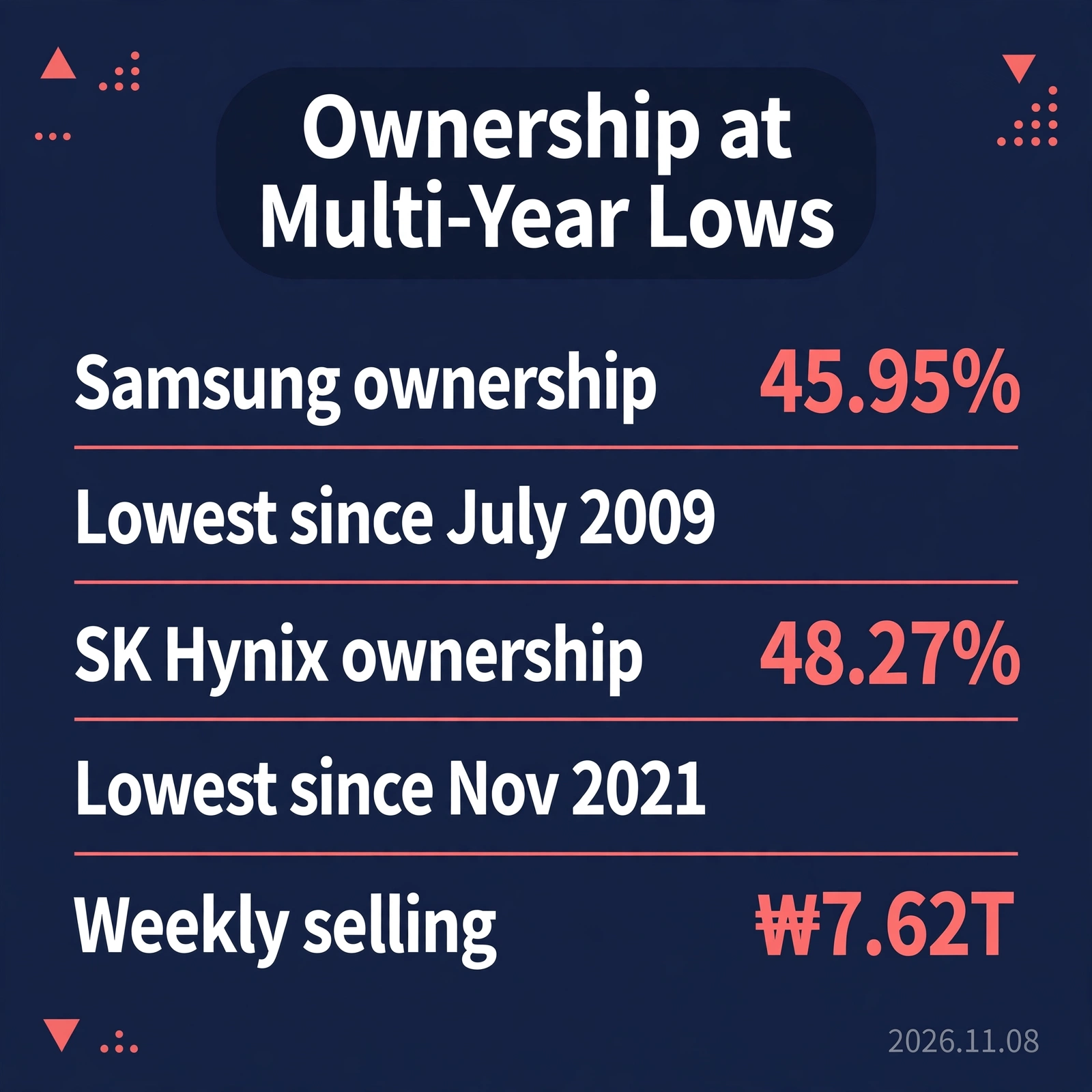
Foreign selling left a mark on the register, not just on prices. Foreign ownership of Samsung Electronics stood at 45.95% on November 6, the lowest in about 17 years and 4 months since July 7, 2009 (45.83%), when sentiment froze in the aftermath of the global financial crisis. SK Hynix’s foreign ownership fell to 48.27%, the lowest since November 22, 2021 (47.97%) — about five years. Both names are now below 50% foreign-owned. Samsung’s ownership had already dipped to 46.69% in July this year. For the semiconductor sector as a whole, foreign ownership stood at 46.6% on November 6, the lowest since 2013.
Over the five sessions from November 2 to 6, foreigners net sold 5.42 trillion won of SK Hynix and 2.19 trillion won of Samsung — 7.62 trillion won combined. That is 73% of their 10.41 trillion won of net selling across the whole KOSPI. Two days alone (November 5–6) came to more than 6 trillion won.
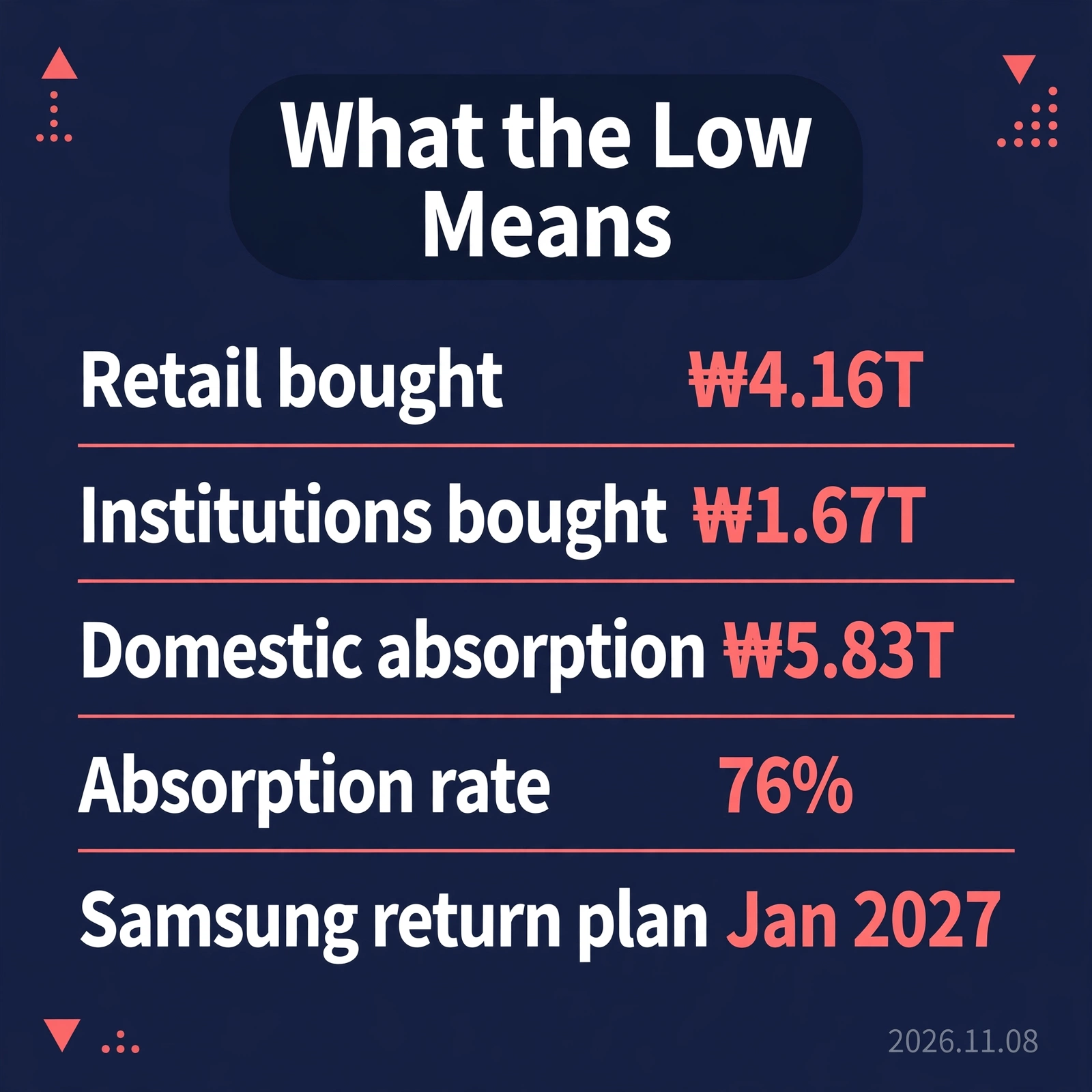
Domestic investors took the other side. Retail investors bought 4.16 trillion won of the two names (SK Hynix 2.21 trillion, Samsung 1.95 trillion) and institutions 1.67 trillion won (SK Hynix 1.41 trillion, Samsung 261 billion won) — 5.83 trillion won combined, about 76% of what foreigners sold. On November 5 alone, retail bought a combined 2.12 trillion won of the two stocks.
45% of the index — the market is the two chip makers
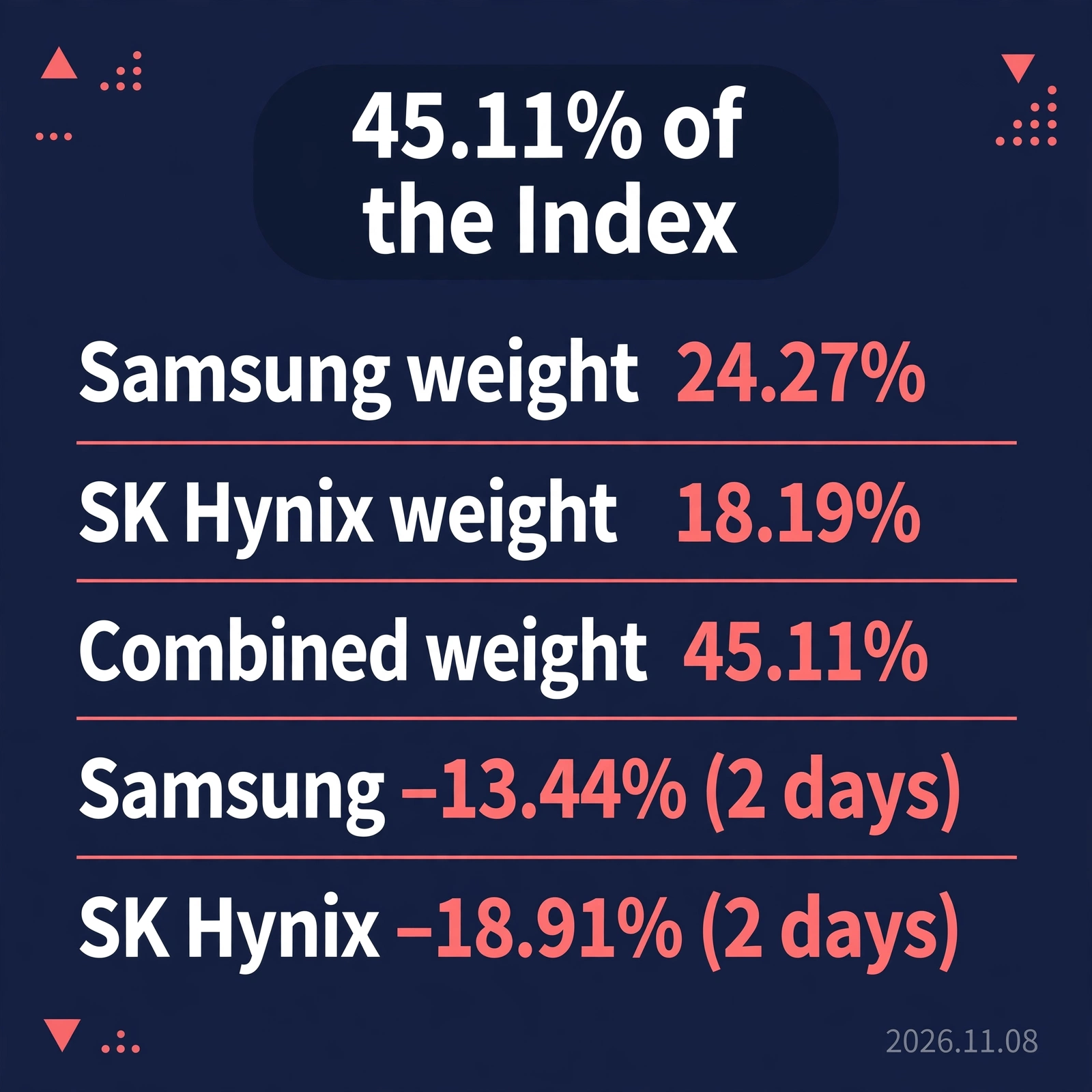
Low ownership matters because of the two names’ weight. As of November 6, Samsung is 24.27% of KOSPI market value and SK Hynix 18.19% — 45.11% together with Samsung preferred shares, up from 31.52% at the end of last year. Nearly half the index is two memory-chip makers, which is why the KOSPI now trades almost one-for-one with AI-investment sentiment.
The scale of the value destruction matches the weight. Their combined market value stood at 1,930.11 trillion won, below 2,000 trillion won for the first time in about seven months and down 53.77% from the June 25 peak of about 4,174.84 trillion won. Their share of total KOSPI market value has fallen to the 46% range, down more than 10 percentage points from 57.11% at the peak. The KOSPI’s total market value is about 4,175 trillion won, down some 3,275 trillion won (43.96%) from the June 22 peak of 7,450 trillion won; on November 6 alone, 267 trillion won evaporated, and 669 stocks closed at yearly lows, with 260 ending at all-time lows.
The declines themselves were steep. On Friday, Samsung fell 6.35% to 188,700 won and SK Hynix 10.44% to 1,132,000 won. Over two sessions, Samsung is down 13.44% and SK Hynix 18.91%. Intraday, Samsung touched 179,200 won and SK Hynix 1,089,000 won, seven-month lows. The market now treats the KOSPI as a proxy for AI investment: the concentration powered the rally in the first half of the year, and it is the weak link now that doubts about AI spending are growing.
What a multi-year ownership low means
A multi-year ownership low reads two ways. One is capitulation: if most sellers have already sold, the ammunition for further selling is spent, and a low ownership base means more room to buy back. The other is structural de-rating: if foreigners do not return, the low level is the new normal. Which one it is depends on who buys next.
Brokerages lean toward the first reading, with caveats. The decline stems from supply-demand factors rather than deteriorating earnings, so waiting beats selling, in their view — though Daishin’s Yang Ji-hwan warned the index is oversold but hard to call bottomed while hedge-fund stop-loss selling and liquidations remain unresolved, and advised buying carefully in tranches with cash. Kiwoom suggested broadening into banks, construction, transportation and biotech, which are less exposed to data-center regulation. KB Securities said sentiment could change once the policy direction becomes concrete, and that demand for 2027 is largely locked in — even if 2028 data-center plans change, other customers are likely to absorb the volume.
Shareholder returns are the other variable. JPMorgan noted that SK Hynix’s shareholder-return announcement improved supply and demand at the end of October, and that Samsung’s shareholder-return plan announcement in January next year will be a future supply-and-demand variable. A credible return plan is the most direct way to pull foreign holders back.
- Foreign ownership ratio: the share of a company's stock held by foreign investors. When it falls to a multi-year low, the marginal seller is largely gone — but so is the marginal buyer, until something brings them back.
- Market-cap weight: at 45% of the index, the two chip makers are the index. A foreign buyer who wants Korea exposure without the AI-beta cannot avoid them; a seller who wants out of AI cannot avoid selling them.
- The governance lens: Korea's discount partly reflects this concentration. When two companies are half the market, index-level diversification — the usual defense for foreign holders — does not exist.
Four numbers to watch. First, whether foreign ownership turns up — a bottom in the ownership ratio is the first sign the selling has ended. Second, whether November brings a return to net foreign buying — the six-session selling streak has to break first. Third, Samsung’s shareholder-return plan, expected in January, which could be the trigger for foreign re-entry. Fourth, whether foreign selling of the two names continues — if it does not stop, any index rebound stays capped.
Not investment advice. Figures are as confirmed on November 8, 2026, from the Korea Exchange, BigGo Finance, Yonhap Infomax, NoCut News and Chosun Biz.
Watch the video

Sources & references
- BigGo Finance — Foreign Investors Net Sell approximately $5.6 Billion in Samsung Electronics, SK Hynix in One Week — Ownership 45.95%/48.27% with previous lows; semiconductor sector ownership 46.6%, lowest since 2013; weekly selling about 10.4T won
- BigGo Finance — South Korea's Samsung Electronics, SK Hynix Plunge 11% in Two Days — Combined market value below 2,000T won, down 53.77% from June peak; KOSPI cap down 43.96%; 669 stocks at yearly lows on Nov 6; Kiwoom and KB broker views
- Yonhap Infomax — Won Shaken by 'Blue Tsunami' — Foreign IBs Say 'Current Account Surplus Provides Support' — JPM: SK Hynix shareholder return improved late-Oct flows; Samsung shareholder return plan announcement in January as future variable
- NoCut News — Foreigners Exit KOSPI... 10.4 Tln Won Net Sold Last Week — Foreigners net sold 10.41T won Nov 2–6; 7.6T won in the two chip names; ownership at multi-year lows
- Chosun Biz — Foreign investors dump Korea chip giants as Samsung holdings hit 17-year low — Samsung ownership also fell to 46.69% in July this year; both names' ownership below 50%
Related articles
- Foreign Buying Korea Analysis First Net Buying in Eight Sessions After 12.7 Trillion Won Selloff
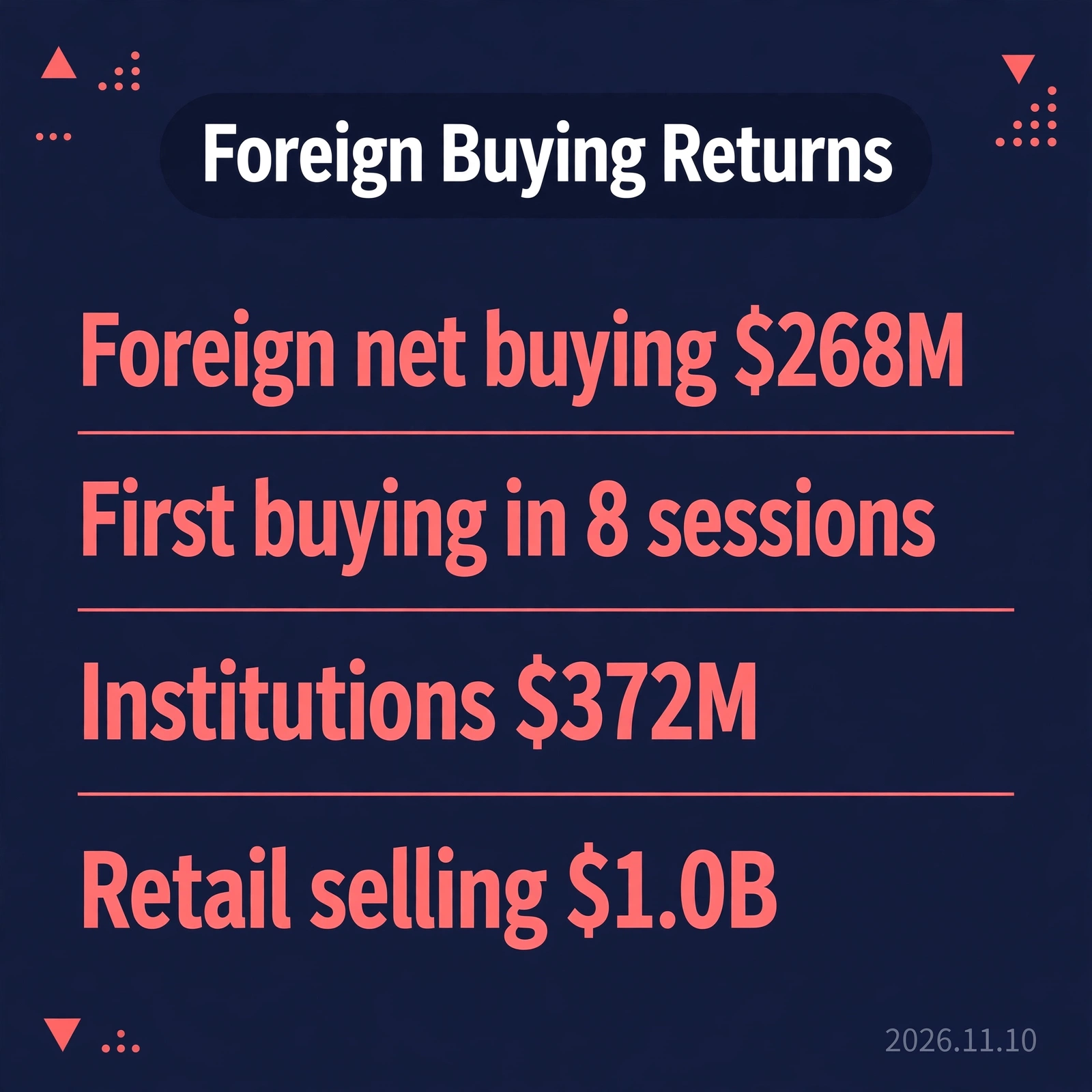
Foreign investors bought Korean shares for the first time in eight sessions, after selling 12.75 trillion won ($9.5 billion) over the previous seven. The buying is real but small — 2.8% of the outflow — and foreigners are still selling on the KOSDAQ. Four tests decide whether this is a turn or a one-day bounce.
- KOSPI Failed Rebound Analysis 5,018 Close Foreign Selling Streak and Nvidia Probe
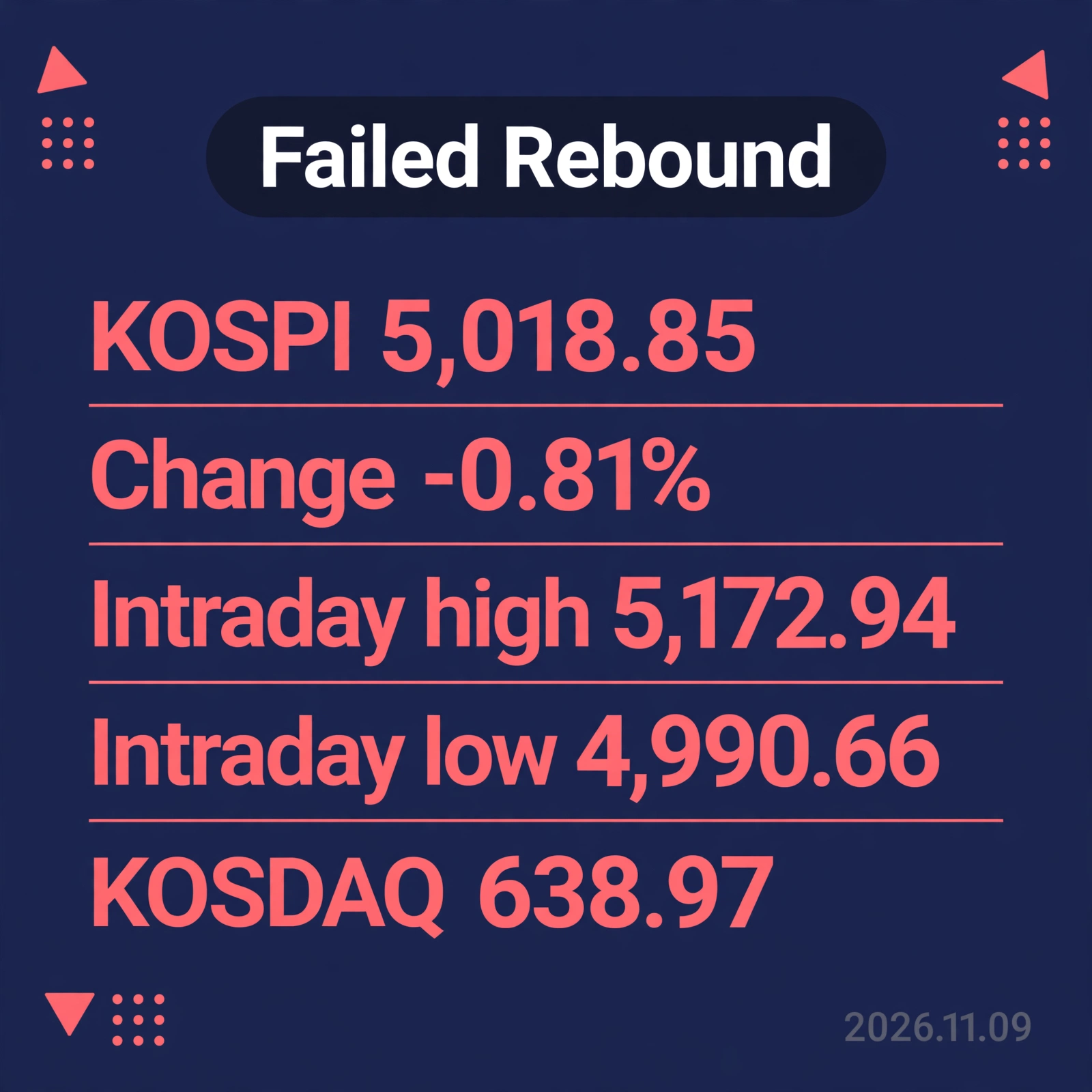
November 9 in Seoul: the KOSPI rallied 2.24% intraday to 5,172.94 but closed at 5,018.85 (−0.81%). Foreigners sold a seventh straight session, an Nvidia board probe capped the rally, and battery stocks gave back the blue-wave rally.
- KOSPI Monday Preview: 10.4 Trillion Won Foreign Selling, Won at 1,356.6, Margin Relief Starts
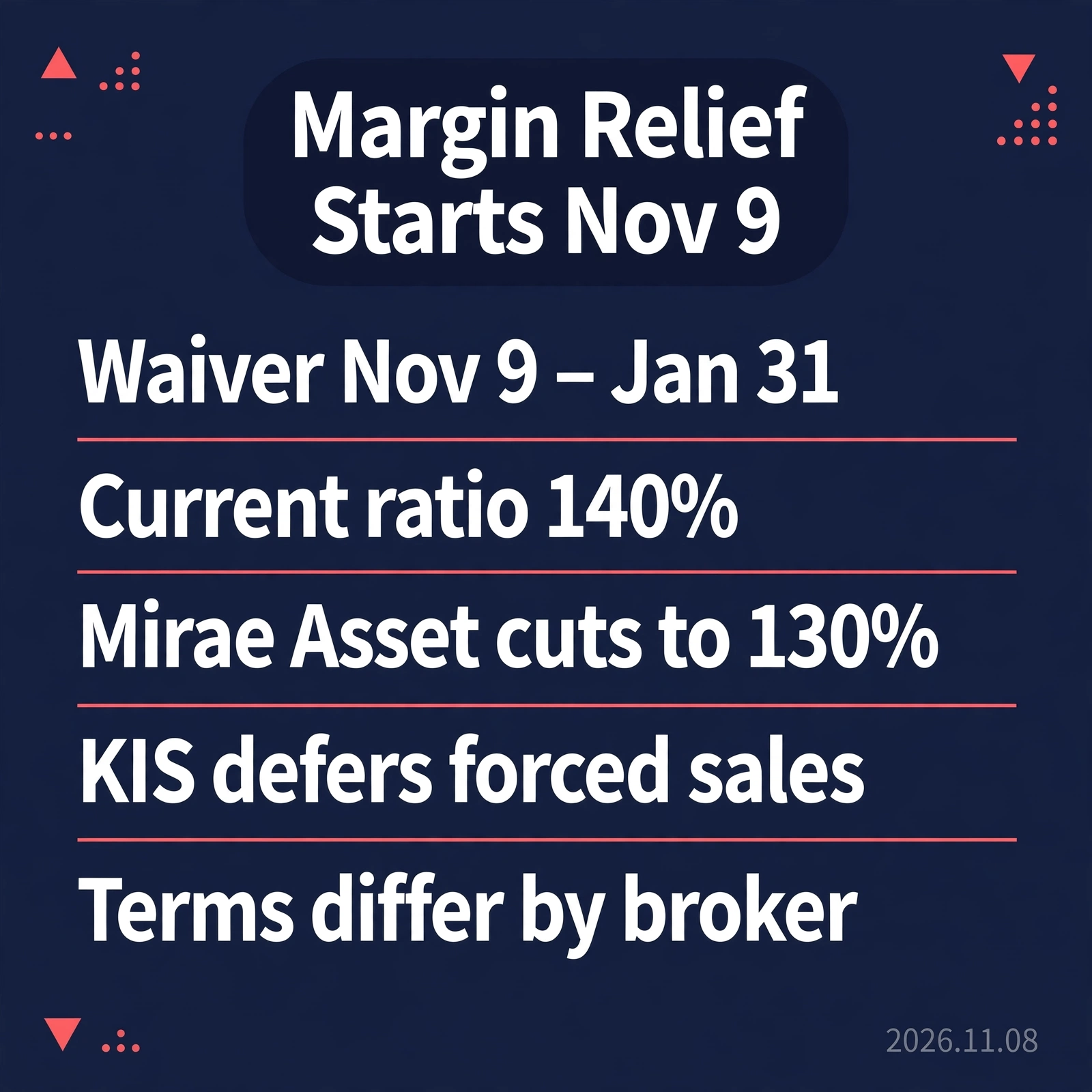
Korea market Sunday edition: Seoul is closed today, but the weekend formalized three months of margin-loan relief starting Monday. Foreigners sold about 10.4 trillion won of KOSPI shares last week, yet the won held at 1,356.6 — semiconductor export dollars and a record current-account surplus did the holding.
5minbrief on YouTube
The briefs also come as videos. Get the daily market wrap on YouTube.
Subscribe on YouTube