 5-minute briefs
KOSPI Failed Rebound Analysis 5,018 Close Foreign Selling Streak and Nvidia Probe
#foreign selling Korea#Samsung stock#SK Hynix stock#Korean battery stocks#won dollar#US CPI#CoreWeave earnings
A 2.24% rally that gave it all back
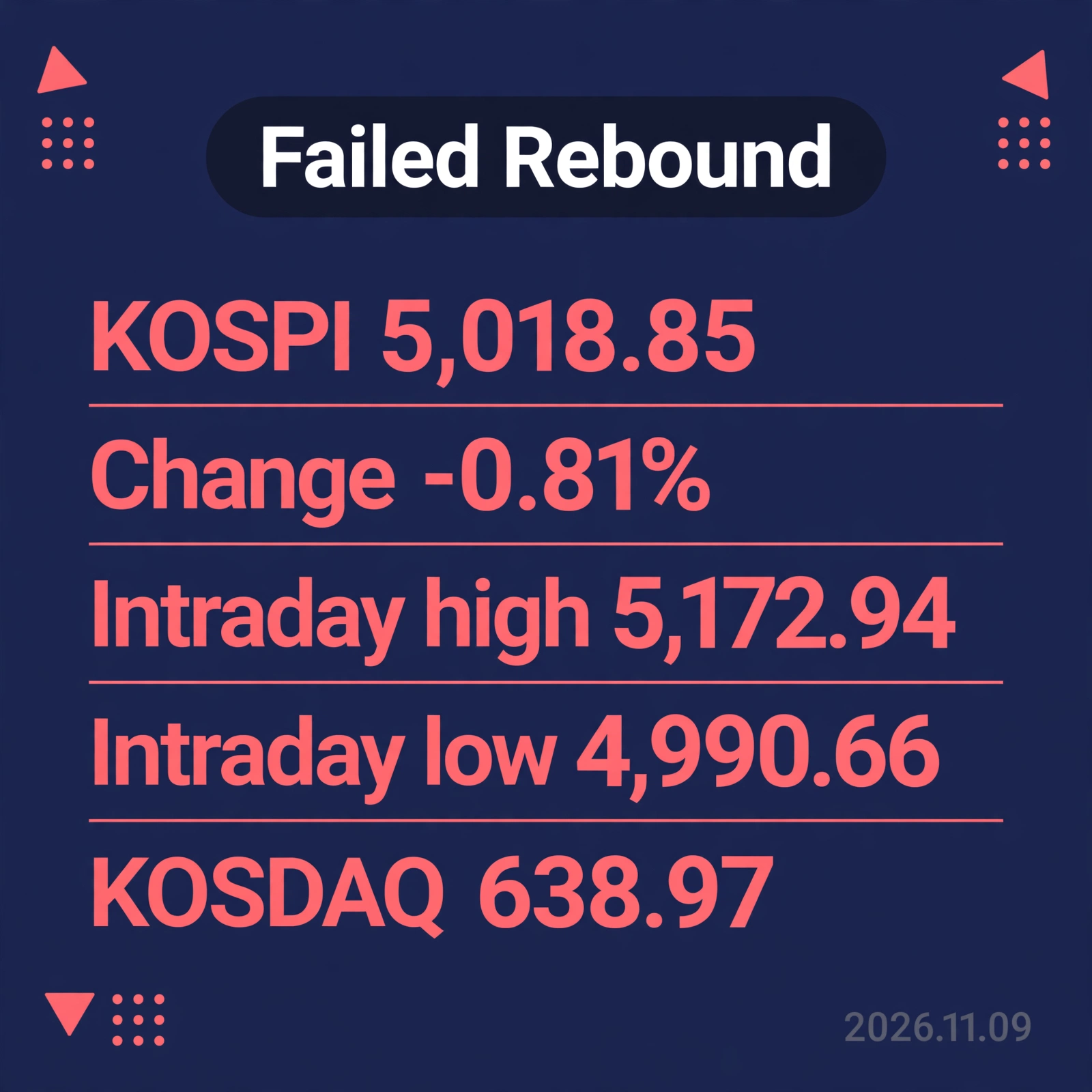
Seoul opened weak and then looked like a recovery day. The KOSPI started at 5,034.20 (−0.50%), dipped below 5,000 to an intraday low of 4,990.66, then climbed to 5,172.94 (+2.24%) before surrendering the entire gain to close at 5,018.85, down 40.84 points (−0.81%). The KOSDAQ followed the same arc: up to 658.66 intraday, closing at 638.97 (−0.82%). Trading value was 17.26 trillion won on the KOSPI and 4.26 trillion won on the KOSDAQ. Losers outnumbered winners 527 to 340.
The early lift came from Friday’s US session. The Nasdaq rose 1.09% to 24,579.42 and the Philadelphia Semiconductor Index jumped 4.21% to 9,390.25, pulling bargain hunters into Korean chips. Institutional buying from financial-investment accounts pushed the index up. But the rebound only retraced part of last week’s damage, and selling reasserted itself in the afternoon.
Almost every sector fell. On the KOSPI, securities −3.99%, transport and warehousing −3.56%, transport equipment and parts −3.27%, food, beverage and tobacco −3.18% led the declines. On the KOSDAQ, financials −4.81% and general services −4.66% fell hardest.
Foreigners sold a seventh straight session — institutions absorbed it alone
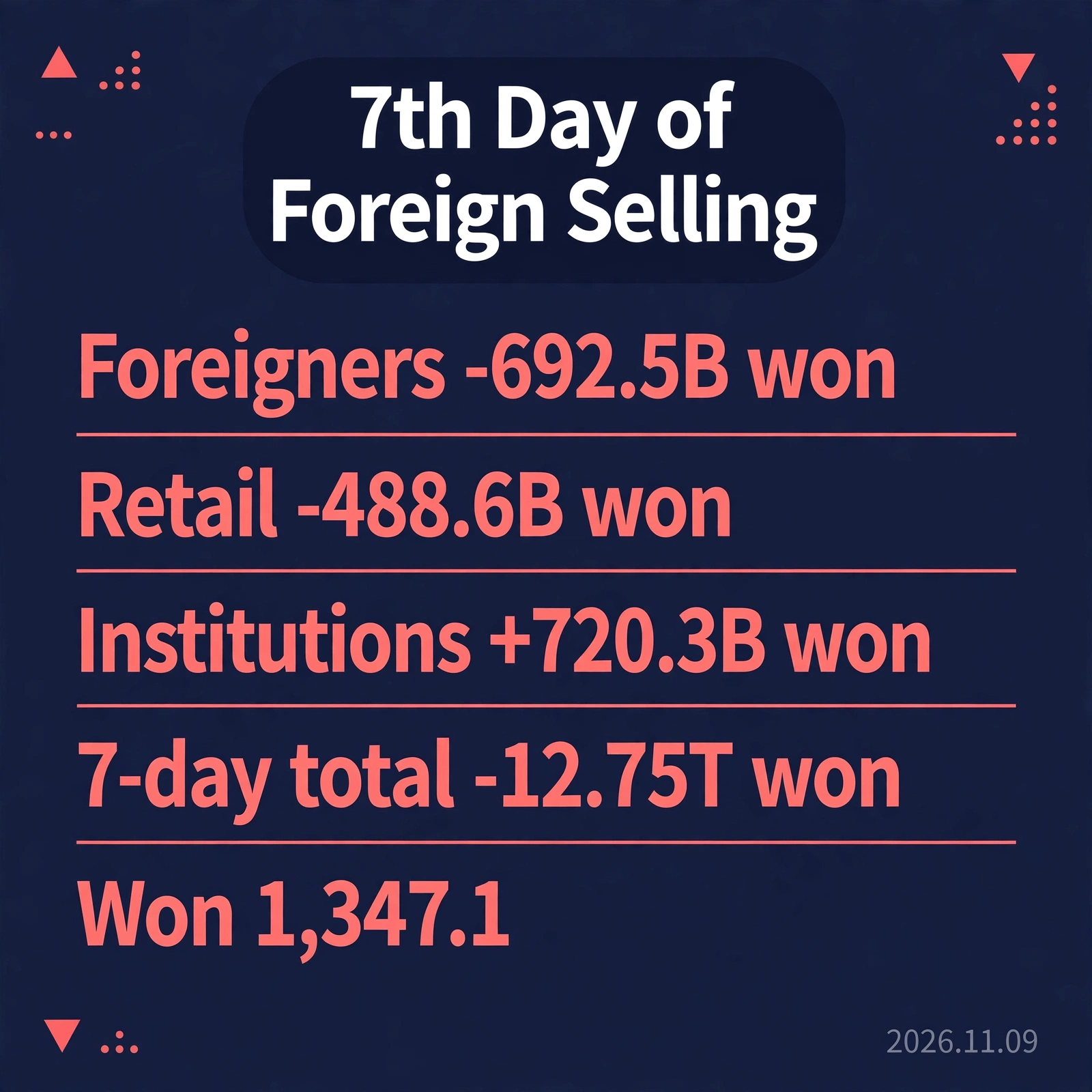
Flows split cleanly. Foreigners net sold 692.5 billion won of KOSPI shares, the seventh straight session of selling, and retail investors sold 488.6 billion won. Institutions alone bought a net 720.3 billion won, their fourth straight buying session. Foreign selling over the seven sessions totals about 12.75 trillion won, including 10.44 trillion won in the five sessions of last week alone.
Inside the institutional buying, financial-investment accounts bought 1.11 trillion won and other corporations bought 461.3 billion won — of which 413.4 billion won was SK Hynix, reflecting its 20-trillion-won buyback program. On the KOSDAQ, foreigners sold 75.9 billion won and retail 39.6 billion won, while institutions bought 107.5 billion won.
The won, unusually, strengthened. The dollar-won rate closed at 1,347.1, down 9.5 won — its first fall in four sessions. That is the semiconductor-export buffer at work: exporters converting chip dollars into won partly offsets the dollar demand from foreign stock selling. Daishin Securities analyst Lee Kyung-min put it plainly: bargain hunting drove the semiconductor-led rebound attempt, but continued foreign selling limited the upside.
- Two stocks are nearly half the index: Samsung Electronics and SK Hynix are about 45% of KOSPI market value. When foreigners sell those two names, the whole index moves — there is no broad base to absorb it.
- Ownership is at multi-year lows: Samsung's foreign ownership fell to 45.95% on November 6, the lowest since July 2009; SK Hynix's fell to 48.27%, the lowest since November 2021. Foreigners are not just trimming — they are leaving at a pace not seen in years.
- The won usually falls with them: heavy foreign selling normally pushes the won down. That it strengthened today is a reminder that Korea's record current-account surplus is doing real work in the FX market.
The Nvidia headline that capped the rally
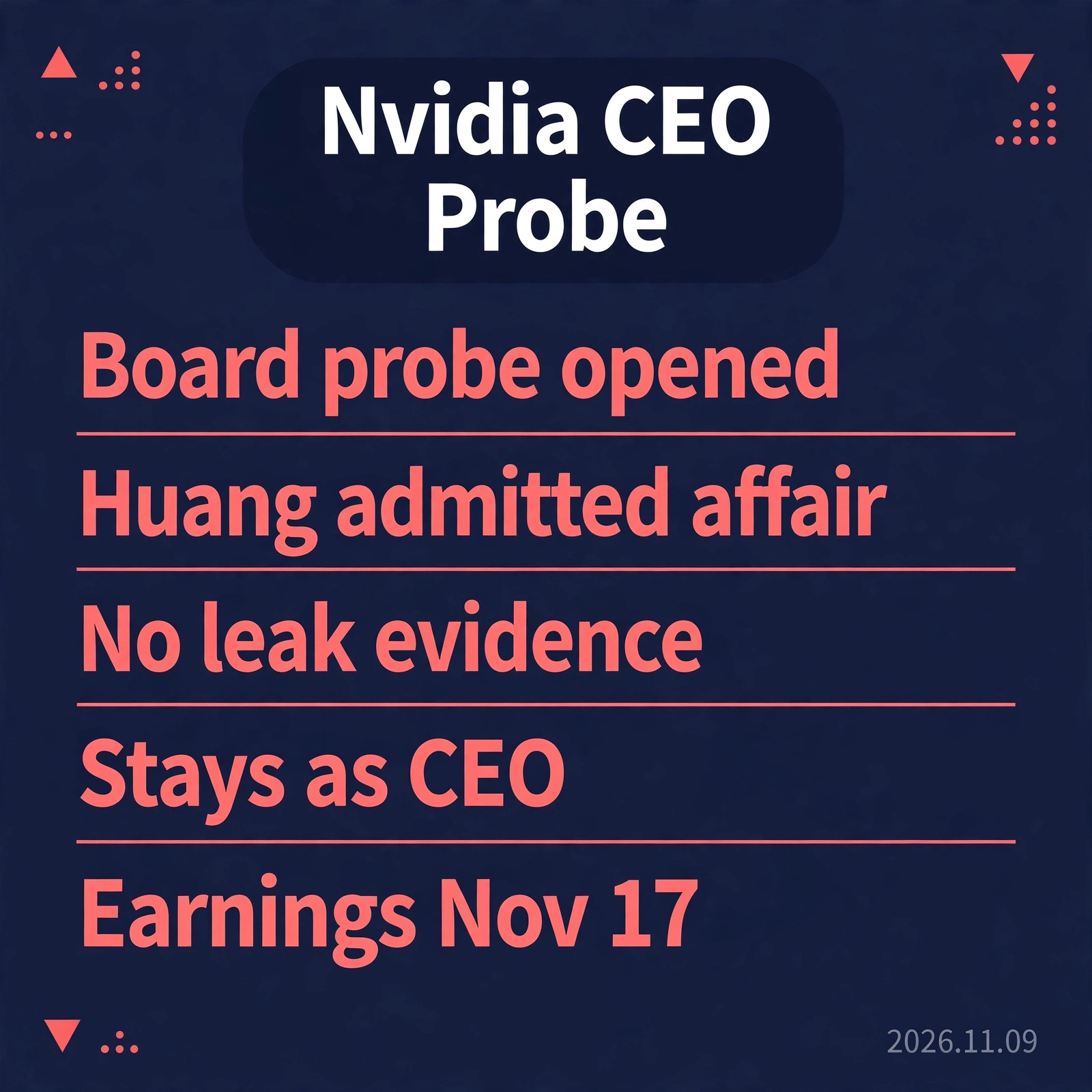
The afternoon fade has a name. On Sunday (US time), Nvidia’s board said it will open an independent probe into reports that CEO Jensen Huang was targeted by a foreign intelligence service. An independent-director committee, advised by outside counsel, will run the investigation. Huang admitted to an affair, apologized to employees and said he will cooperate fully.
The board also said it sees “no reason to believe” US national security or Nvidia trade secrets were compromised, reaffirmed its confidence in Huang and management, and confirmed Huang stays as CEO while the probe runs. The woman at the center is Alice Wong, a former executive of Megaspeed, a Singapore data-center company; US intelligence officials suspect she was recruited by China’s Ministry of State Security. What has not been established is whether she acted for Chinese intelligence or whether any Nvidia or US national-security information was passed on.
Politics is moving fast. The Republican chairs of three House committees — Foreign Affairs, the Select Committee on China, and Intelligence — have demanded Huang appear at a closed joint briefing on November 18, and Democratic lawmakers have signalled their own inquiries. The affair admission and the espionage allegation are separate questions, but the market read them together: uncertainty at the top of the world’s most important AI chipmaker. Nvidia reports third-quarter earnings on November 17, nine days after the probe was announced.
For Korea, this is not a distant governance story. The KOSPI’s two largest names sell memory into the same AI data-center buildout Nvidia’s chips anchor, so a leadership overhang at Nvidia lands directly on Seoul’s index. The securities industry is already advising caution on the volatility of semiconductor stocks exposed to Nvidia risks.
Batteries gave back the blue-wave rally in three sessions
The other drag was batteries. Samsung SDI fell 11.32% to 415,000 won, LG Energy Solution gave back 5.78% to 318,000 won, POSCO Future M fell 5.01% and LG Chem 5.17%. Samsung SDI has dropped 23.9% in three sessions, from 545,000 won on November 4 to 415,000 won today.
The reversal is the mirror image of November 4. After the Democrats’ midterm sweep, hopes for stronger green-energy support — plus expectations that AI data-center power demand would expand the energy-storage (ESS) market — lifted Samsung SDI 11.57%, POSCO Future M 10.81% and LG Energy Solution 5.03% in a single session. Three sessions later, most of that gain is gone: profit-taking after a sharp rally, plus doubt over whether US green-policy shifts will actually turn into battery earnings.
The market read the same election two ways. Batteries priced it as green-policy support and ESS demand; chips and power equipment priced it as data-center regulation risk. The two readings could not coexist for long — and the battery reading folded first.
What to watch — US CPI and CoreWeave earnings
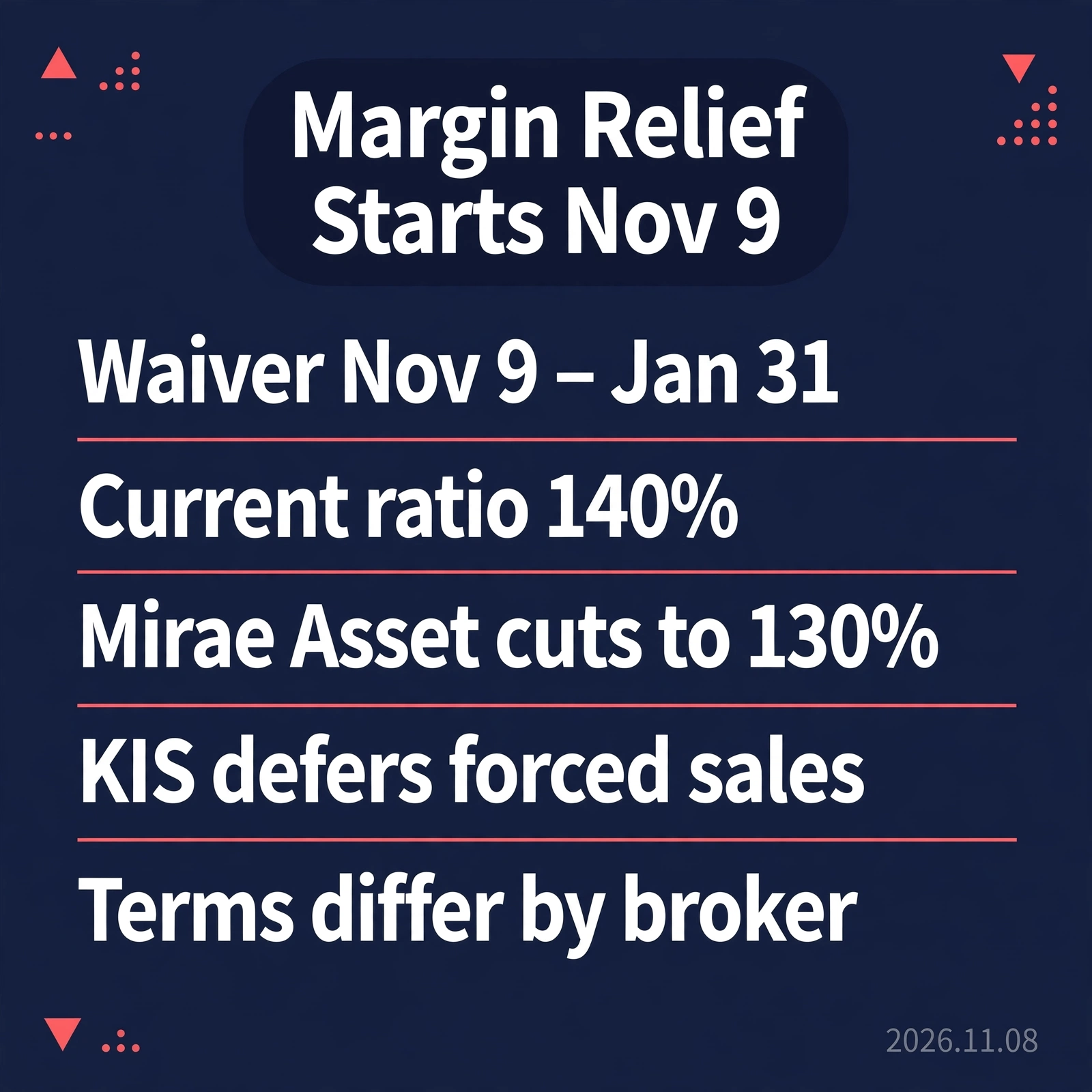
Also starting today: the three-month waiver of margin-loan collateral rules (November 9–January 31). Mirae Asset Securities cut its maintenance ratio to 130% from 140%; Korea Investment & Securities will defer forced sales by one business day for clients who apply. Terms differ by broker, so checking your own broker’s start date and application process matters as much as the relief itself.
| Date (Korea time) | Event |
|---|---|
| Tue, Nov 10, 22:30 | US October CPI |
| Wed, Nov 11, early morning | CoreWeave Q3 earnings (after US close Nov 10) |
| Wed, Nov 11 | MSCI November index review results |
| Thu, Nov 12 | Intel AI Summit Seoul (COEX) |
| Fri, Nov 13, early morning | Cisco earnings (after US close Nov 12) |
| Fri, Nov 13, 22:30 | US October PPI |
| Tue, Nov 17 | Nvidia Q3 earnings |
| Dec 8–9 | US Federal Reserve rate decision |
Three numbers to watch. First, whether foreign selling continues and whether the KOSPI holds 5,000 — holding it confirms a floor; losing it confirms the downtrend. Second, CoreWeave’s earnings — not just revenue growth but cash flow, interest costs and funding plans, which decide whether doubts about AI-investment sustainability fade. Third, US October CPI and the December hike probability — after a stronger-than-expected jobs report, the inflation print decides whether hike odds climb further.
Not investment advice. Figures are as confirmed on November 9, 2026, from the Korea Exchange, Yonhap, Maeil Business, MoneyToday, Aju Press and Mitrade.
Sources & references
- Yonhap — Stocks close lower as investors search for directions amid AI sector uncertainties — KOSPI 5,018.85 (−0.81%), losers 527 vs winners 340, institutions +717.1B won, Samsung +0.64%, SK Hynix +0.35%, LG Energy Solution −5.78%, won 1,347.1
- Maeil Business — KOSPI closes down despite intraday turnaround — KOSPI open 5,034.20, intraday high 5,172.94 (+2.24%), institutions +720.3B won, individuals −488.6B, foreigners −692.5B won; KOSDAQ 638.97 (−0.82%)
- MoneyToday — KOSPI gives up gains as individual, foreign selling mounts — Samsung Electronics +3.55% and SK Hynix +5.39% intraday, Samsung SDI down in the 11% range, LG Energy Solution down in the 5% range
- Yonhap — KOSPI 200 Closing Price List — Samsung SDI 415,000 won, down 53,000 won (−11.32%)
- Aju Press — Battery Stocks Decline After Recent Surge, Samsung SDI Drops Over 6% — Nov 4 rally: Samsung SDI +11.57%, POSCO Future M +10.81%, LG Energy Solution +5.03% on green-policy hopes after US midterms
- Mitrade — The Week Ahead: October CPI and PPI Due as CoreWeave, Cisco and Applied Materials Report — US October CPI Tue Nov 10 8:30 a.m. ET, CoreWeave Q3 after the close Nov 10, PPI Fri Nov 13, Nvidia earnings Nov 17
Related articles
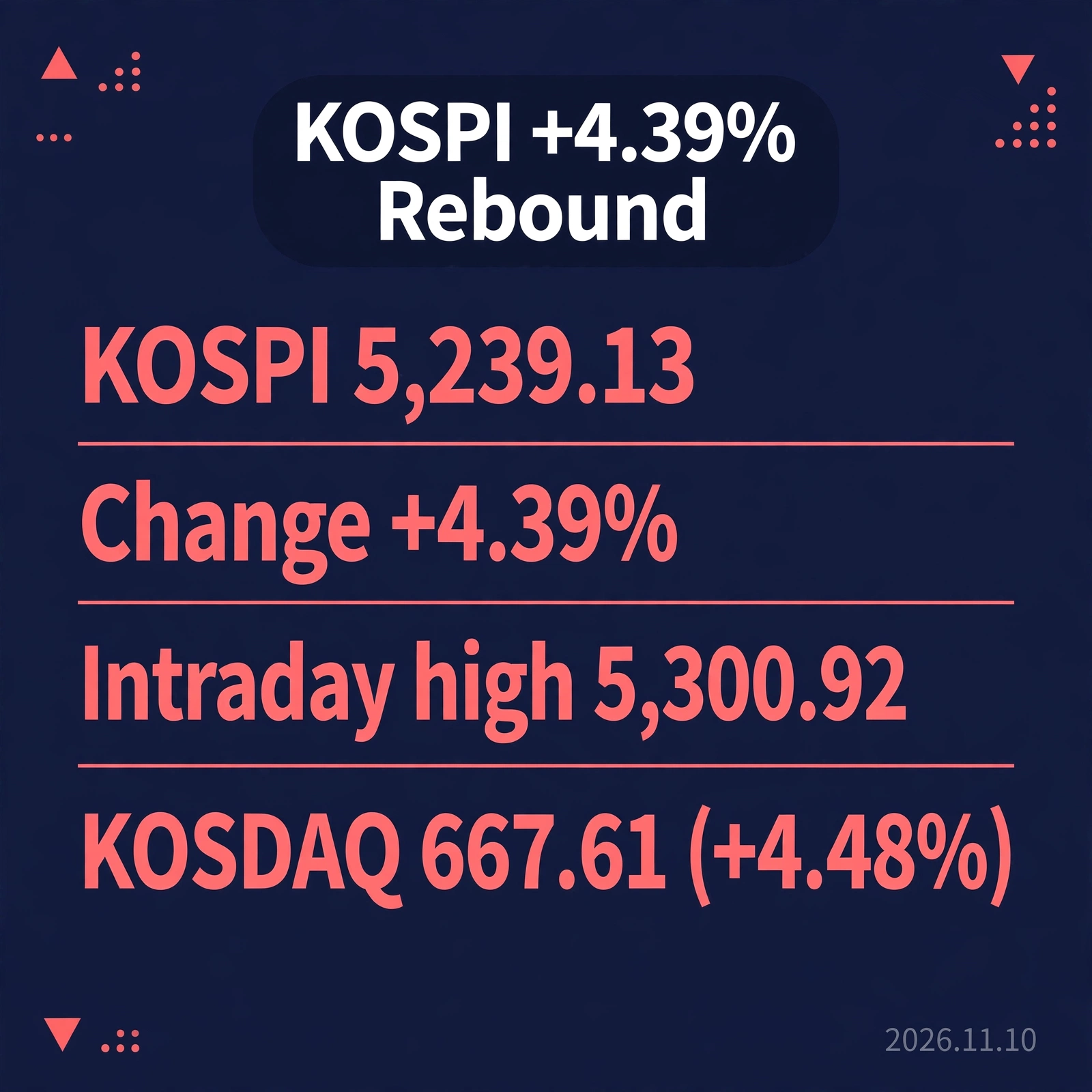
- KOSPI 5239 Rebound Analysis 4.39% Surge Foreign Buying Returns and Won Strength
November 10 in Seoul: the KOSPI jumped 4.39% to 5,239.13, its biggest gain since October 28, as foreigners bought Korean shares for the first time in eight sessions. The won strengthened to 1,337.5 per dollar. Tonight's US CPI and CoreWeave earnings decide whether the rebound holds.
- KOSPI Monday Preview: 10.4 Trillion Won Foreign Selling, Won at 1,356.6, Margin Relief Starts
Korea market Sunday edition: Seoul is closed today, but the weekend formalized three months of margin-loan relief starting Monday. Foreigners sold about 10.4 trillion won of KOSPI shares last week, yet the won held at 1,356.6 — semiconductor export dollars and a record current-account surplus did the holding.
- KOSPI 5,000 Defense Analysis Weekly 11.71% Drop and Next Week Rebound Conditions
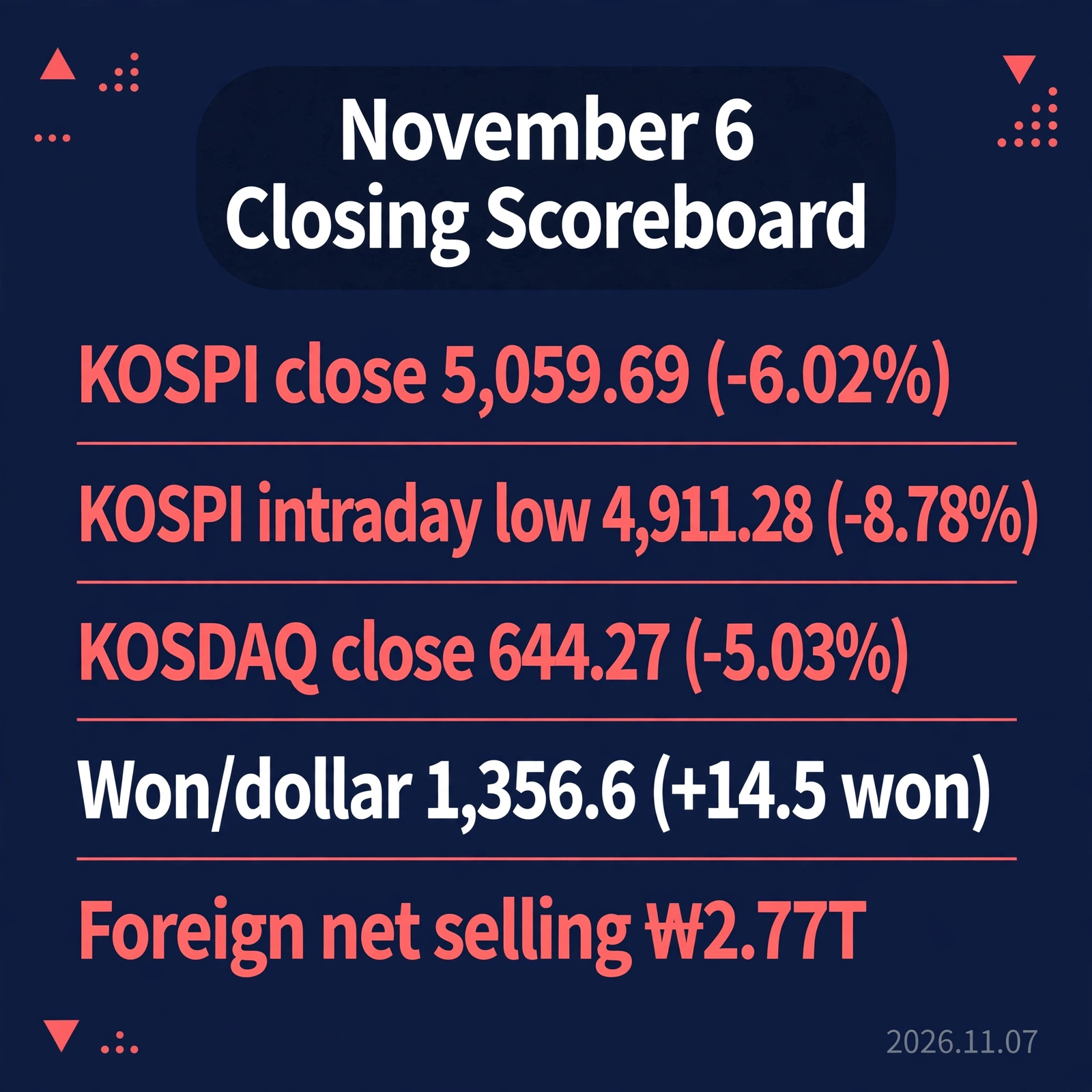
Korea market Saturday edition: the KOSPI closed Friday at 5,059.69, down 6.02% on the day and 11.71% on the week, after a circuit breaker halted trading minutes after the open. US chips bounced Friday, and next week's CoreWeave earnings and US CPI decide whether Seoul rebounds.
5minbrief on YouTube
The briefs also come as videos. Get the daily market wrap on YouTube.
Subscribe on YouTube