 5-minute briefs
Semiconductor Rebound Analysis SOX 4.21% Recovery and Three Bottom Confirmation Conditions
#semiconductor rebound#SOX#AMD#Nvidia
The rebound in numbers: SOX up 4.21%, a third of the loss recovered
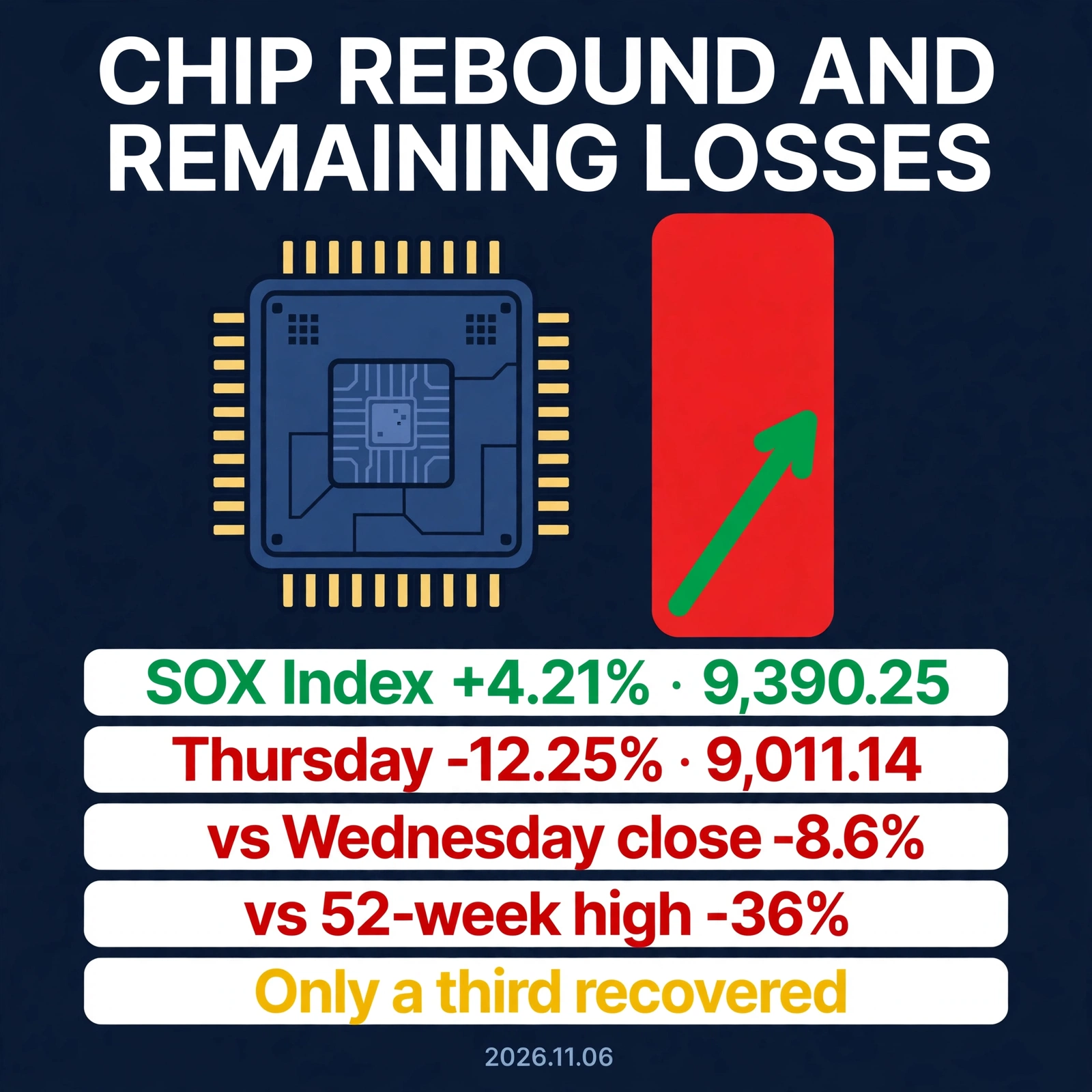
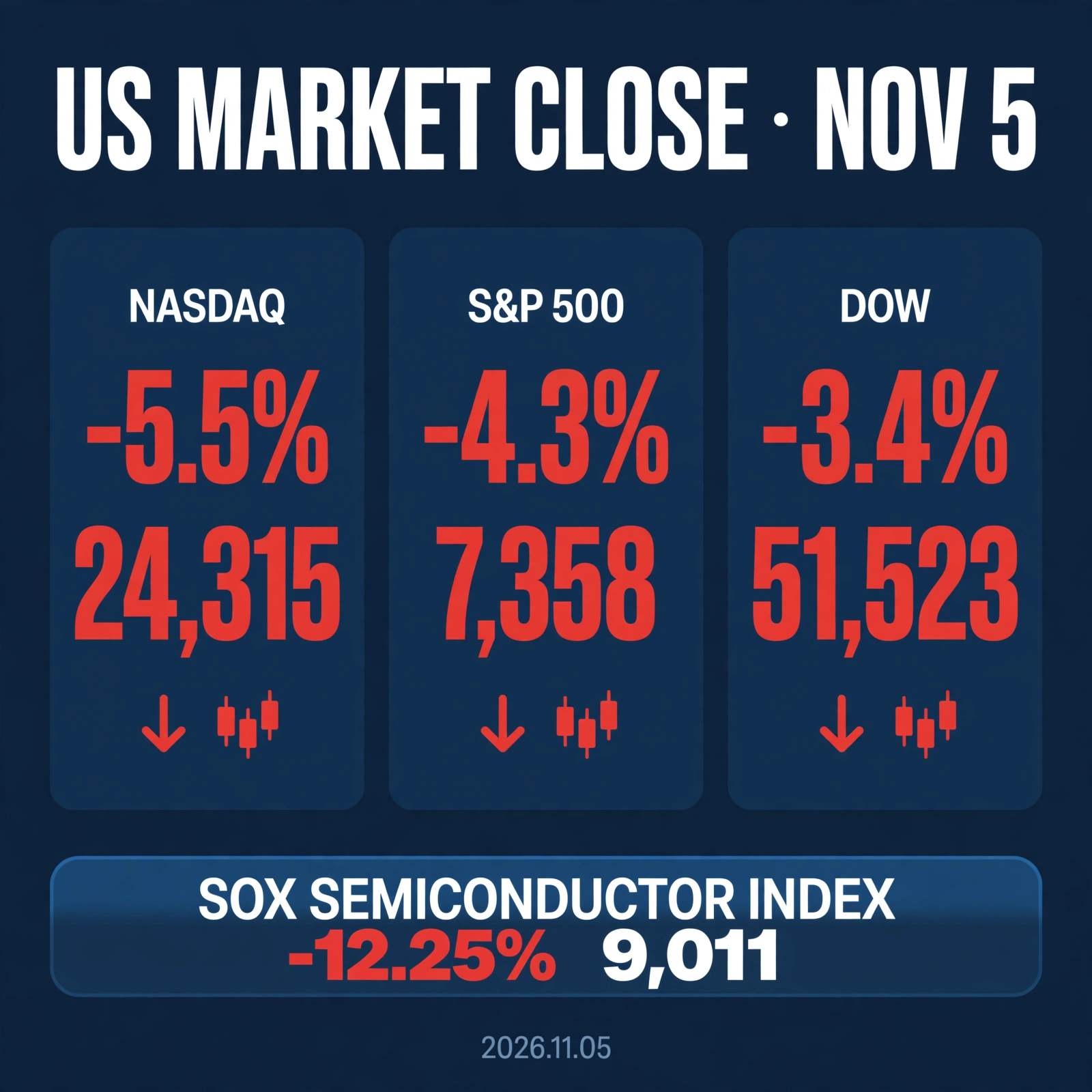
The numbers first. The Philadelphia Semiconductor Index (SOX) rebounded 4.21% to 9,390.25, a day after plunging 12.25% to 9,011.14. Chip ETFs moved with it. SOXX rose 3.51% to $136.53 and SOXQ gained 3.91% to $73.82.
But the size of the recovery changes the story. The index is still about 8.6% below Wednesday’s close of 10,268.65 and more than 11% below Tuesday’s intraday level of 10,600. Against its 52-week high, it sits 36% lower. Of Thursday’s 12.25-point percentage drop, Friday recovered 4.21 points — about a third.
Among individual names, AMD jumped 11.04% to $449.04 and Nvidia gained 2.78% to $186.64. Micron rose 5.1%, Intel 7.7%, Qualcomm 5.5%, and Lam Research 8.2%. The stocks that fell hardest on Thursday rose most on Friday. That is a textbook dip-buying session. The damage, though, predates Thursday: over the past month, Lam Research is down 36%, Applied Materials 30%, AMD 22%, and Nvidia 15%.
Why gains faded: half the morning rally disappeared
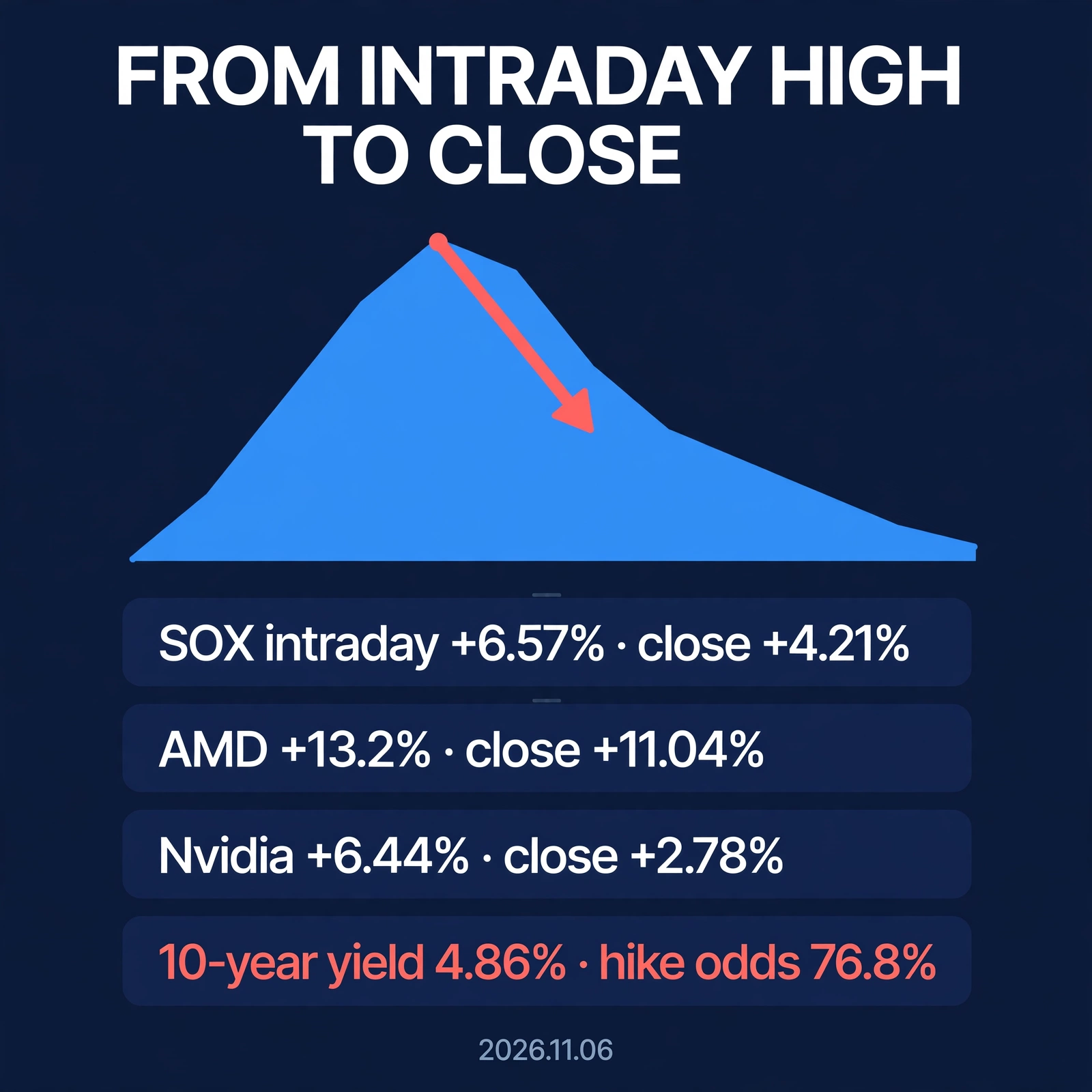
The most telling feature of the day is that gains shrank. The semiconductor index reached 6.57% in early trading but closed up 4.21% — nearly half the rally gone. The same pattern showed in individual names. AMD peaked at 13.2% before closing at 11.04%, and Nvidia peaked at 6.44% before closing at 2.78%. Morning heat cooled by the afternoon.
The jobs report capped the rally. October payrolls came in three times above forecasts, the 10-year Treasury yield rose to around 4.86%, and December Fed hike odds climbed to 76.8%. That weighs on rate-sensitive growth stocks, and chip stocks carry the highest valuations of all. The technology ETF (XLK) fell nearly 8% for the week, its worst week since April 2025. What held the rebound back was not chip news, but rates.
Bank of America analyst Vivek Arya said “indiscriminate selling of chip stocks on AI capex fears could start to run its course” by early 2027. That is a call for selling to ease, not for an immediate rally. Dip buyers returned, but it is too early to say the sellers have left.
Three bottom-confirmation conditions: policy signals, AI demand, technical support
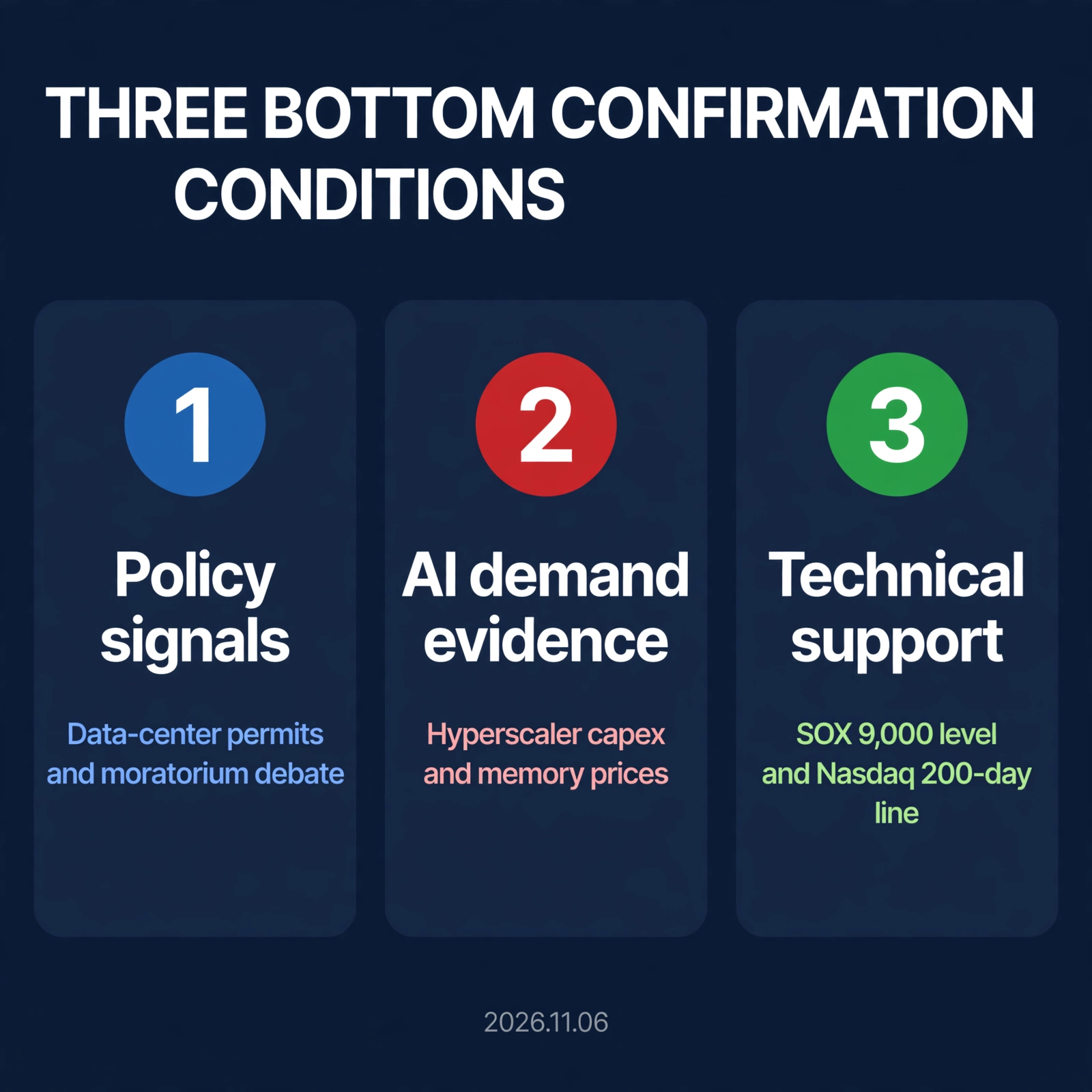
Whether the bounce is a bottom or a retracement turns on three conditions. First, policy signals. Thursday’s rout was driven by fears that a Democratic Congress could tighten permits and regulation for data centers. Which state permit and moratorium bills reach the table first, and what governors and legislatures in data-center states say, will decide the matter. Second, AI demand evidence. AMD chief executive Lisa Su said she sees no slowdown in AI chip demand, and Qualcomm kept its $5 billion fiscal 2027 data-center revenue target. Whether hyperscaler capex continues and memory prices hold will be the evidence. Third, technical support: whether the semiconductor index holds above 9,000, whether the Nasdaq reclaims its 200-day moving average, and whether dip buying continues into next week.
None of the three was confirmed on Friday. Policy signals have not arrived, AI demand is still at the stage of management statements, and one day of gains does not confirm technical support. So the accurate reading of Friday’s bounce is “a retracement of an oversized drop,” not “a confirmed bottom.” Still, the fact that fear turned into buying within a day matters. The sellers who vanished on Thursday came back as buyers on Friday.
- Philadelphia Semiconductor Index (SOX): an index of 30 leading semiconductor stocks. It rebounded 4.21% on November 6 to 9,390.25.
- Dip buying: buying after a sharp fall on the view that prices have become cheap. Friday's chip buying after Thursday's rout is a textbook case.
- Retracement: a bounce that recovers part of a large drop. Friday recovered about a third of Thursday's 12.25% fall.
- Indiscriminate selling: selling across a whole sector without distinguishing between names. BofA sees this selling easing by early 2027.
- 200-day moving average: the average closing price over the past 200 trading days. Falling below it is read as a sign the medium-term trend has turned. The Nasdaq sits below it.
Three things to watch
First, October CPI on Tuesday, November 10. A hot print would lift Treasury yields again and stall the chip rebound. Second, the first AI and data-center policy signals from the Democratic Congress. Whether permit and moratorium debates take concrete shape or fade as post-election overreaction sets the terms for recovery. Third, whether buying continues into next week. Holding above 9,000 on the semiconductor index and reclaiming the 200-day moving average on the Nasdaq would be the first test of a bottom. What matters more than one day’s rebound is whether the rate pressure and policy uncertainty that cut it short start to clear.
Watch the video

Sources & references
- WSJ — Chip Stocks Recover Some Losses After Rout — PHLX Semiconductor Index rebound, individual chip moves, BofA analyst Vivek Arya outlook (official close: SOX +4.21% at 9,390.25, AMD +11.04%, Nvidia +2.78%)
- Reuters — US STOCKS-Nasdaq rebounds as chip stocks recover from steep losses — Chip rebound, jobs report raising December hike concerns, Nasdaq in correction, semiconductor index down 12% Thursday
- The Private Banker — Chipmakers Rebound Sharply a Day After $2.3 Trillion Rout — Semiconductor index up 5.3% in early trading, about 8% below Wednesday's close and 10.5% under Tuesday's level of 10,600, 10-year yield near 4.88%
- KuCoin — U.S. AI hardware stocks rebound, Philadelphia Semiconductor Index rises 6.5% — Intraday semiconductor index up as much as 6.57%, AMD 13.2%, Nvidia 6.44%, TSMC 7.55%, Micron 9.07%
Related articles
- Nasdaq Rebound Semiconductor Index 4.21% Recovery Jobs Surprise Rate Hike Fears Analysis
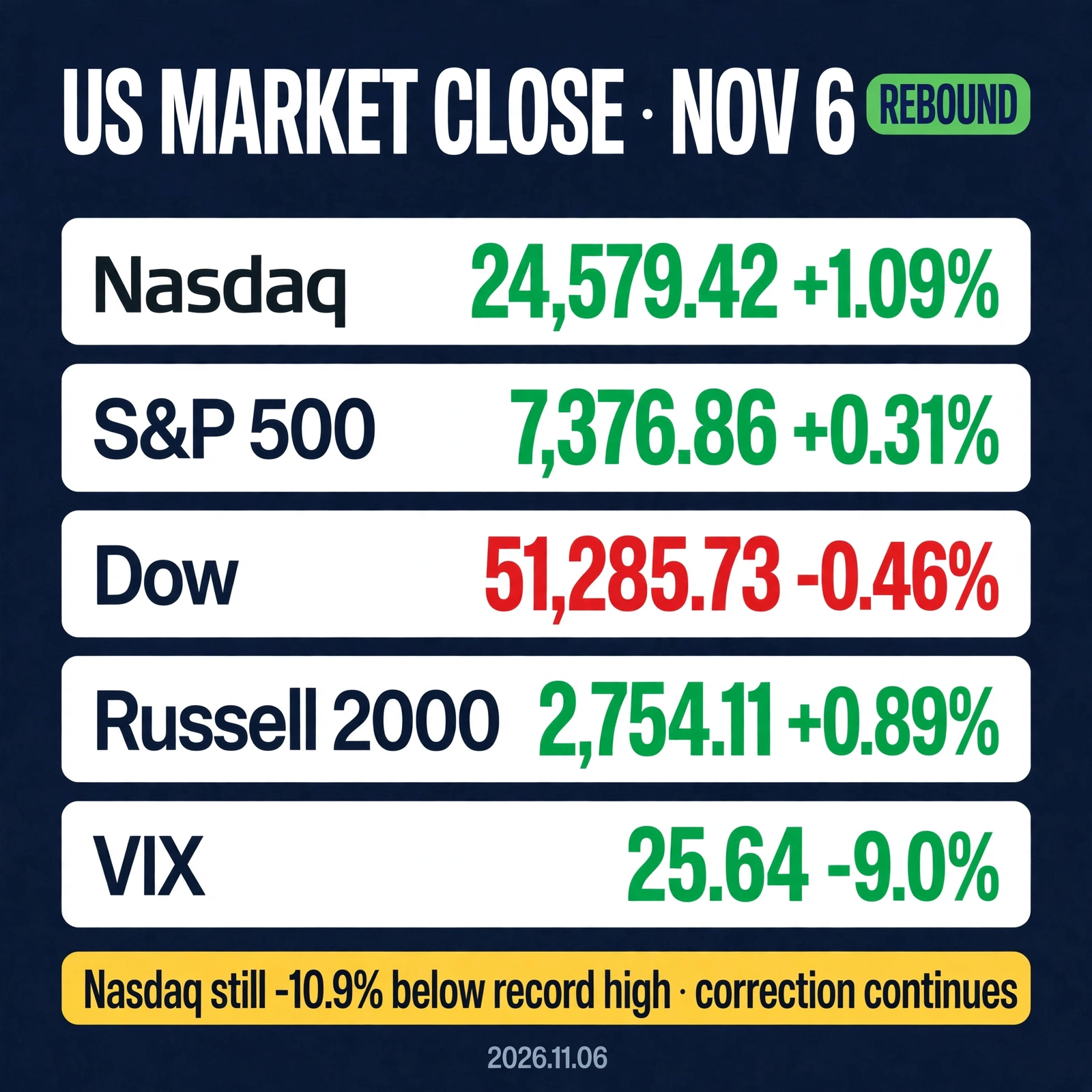
On November 6, US stocks bounced as chip stocks recovered: the Nasdaq rose 1.09%, the S&P 500 gained 0.31%, and the Dow slipped 0.46%. October payrolls jumped 165,000, far above forecasts, lifting December Fed hike odds to 76.8%.
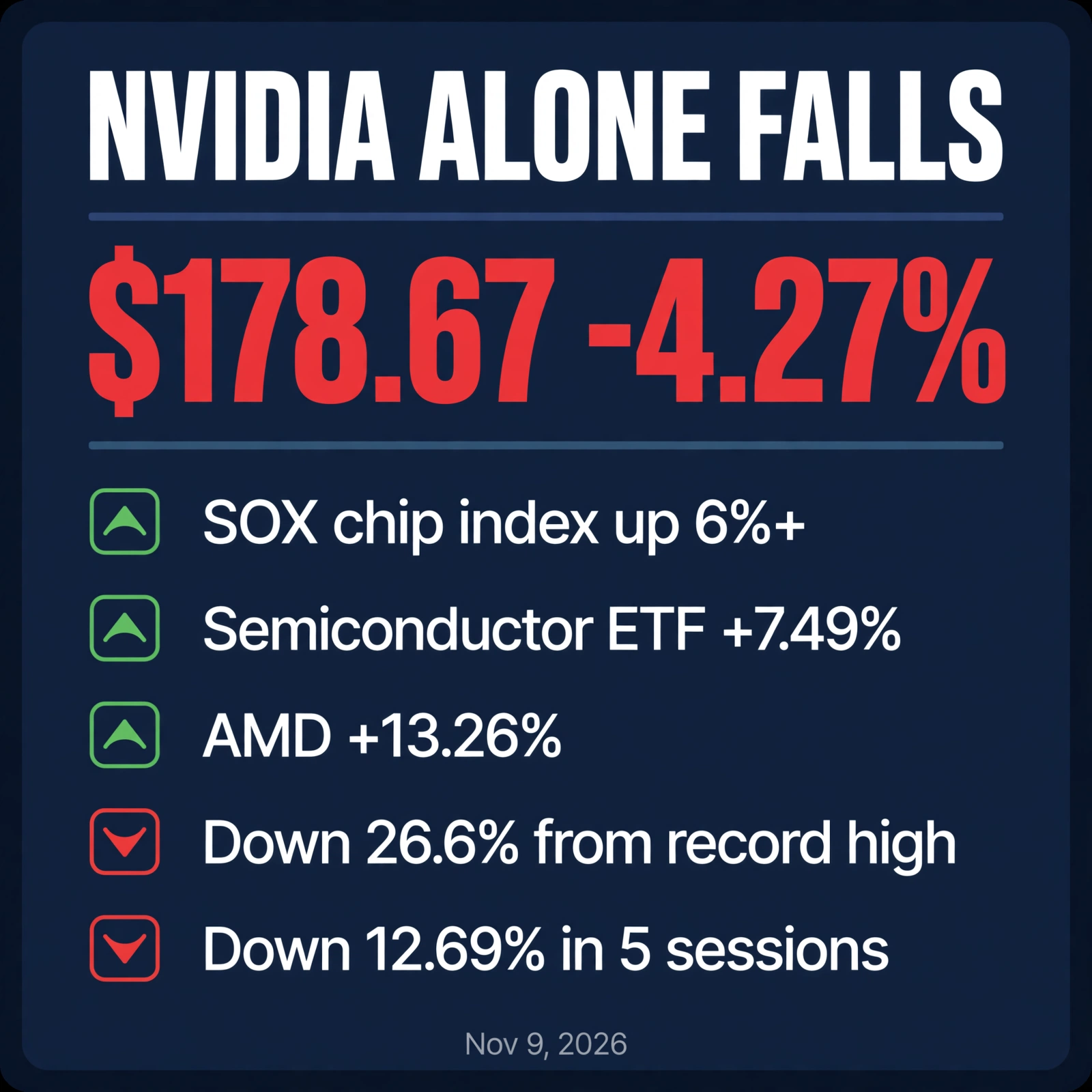
- Nvidia Stock Analysis: Solo Decline as Chips Surge and SOX Reclaims 10,000
The semiconductor index jumped more than 6% on Monday — but Nvidia fell 4.27%, the only decliner in the SOX. A board investigation into CEO Jensen Huang turned leadership risk into a valuation discount on the AI leader.
- Nasdaq Correction Semiconductor Index 12% Plunge S&P 500 4.4% Drop Analysis
On November 5, US stocks fell hard as a chip rout pushed the Nasdaq down 5.5% into correction territory. The S&P 500 dropped 4.4%, the Dow fell 3.4%, and the Philadelphia Semiconductor Index plunged 12.25%.
5minbrief on YouTube
The briefs also come as videos. Get the daily market wrap on YouTube.
Subscribe on YouTube