 5-minute briefs
KOSPI Monday Preview: 10.4 Trillion Won Foreign Selling, Won at 1,356.6, Margin Relief Starts
#foreign selling Korea#won dollar exchange rate#margin loan Korea#semiconductor exports#US CPI#CoreWeave earnings#KOSPI 5000
Margin relief, formalized — three months from Monday
South Korea’s stock market is closed today, Sunday, November 8. Friday’s close was covered in yesterday’s brief, so today is about what the weekend added: the formal margin-relief announcement, the weekly foreign-selling tally, the won’s surprising resilience — and Monday’s checkpoints.
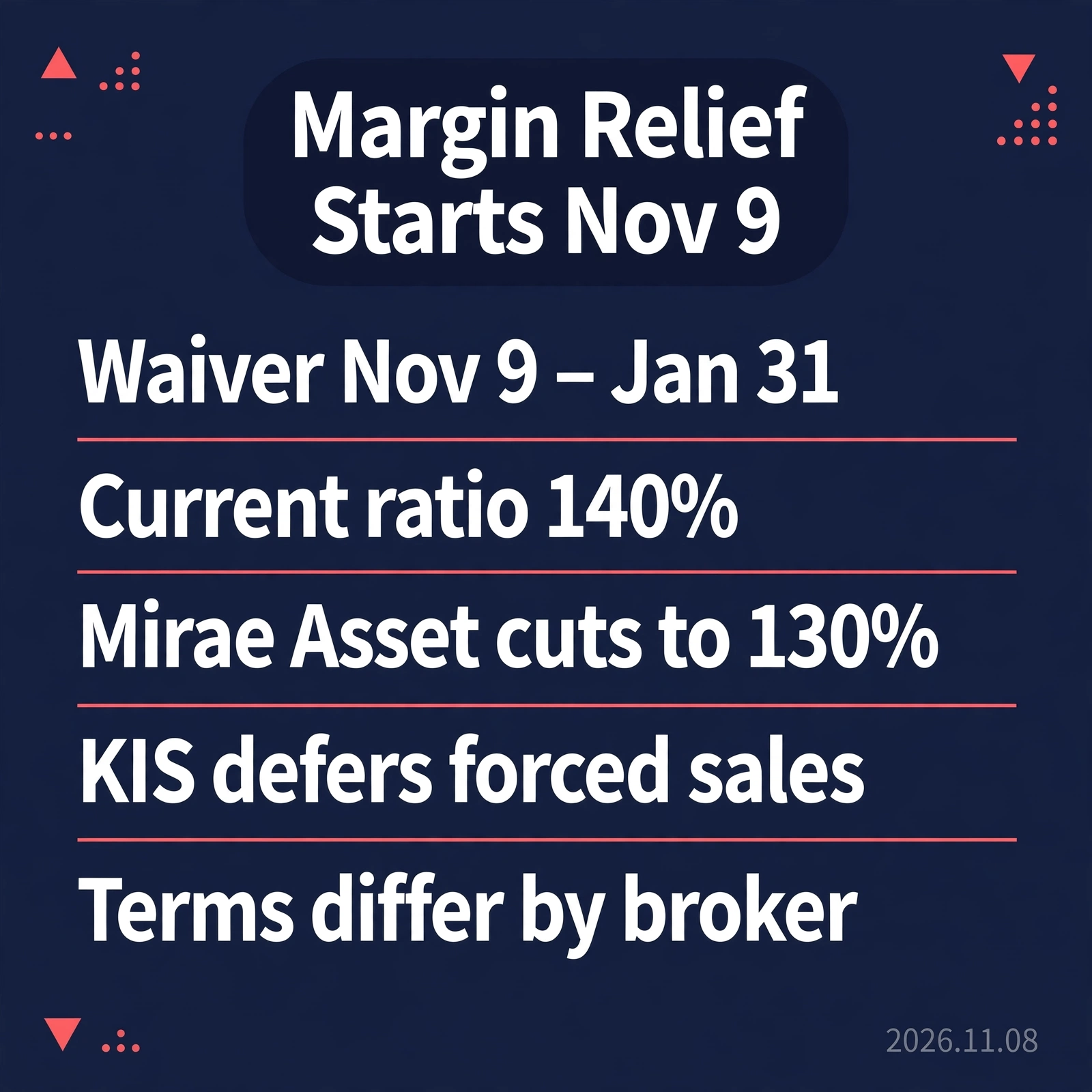
The Financial Supervisory Service and the Korea Financial Investment Association said today that brokerages will be exempt from the 140% margin-loan collateral maintenance rule from November 9 through January 31. The FSS issued a no-action letter putting the November 6 emergency-meeting decision into formal effect. Under the rule, a brokerage lending on margin must hold collateral worth at least 140% of the loan; for the next three months it can set the ratio flexibly, based on the borrower and market conditions. The aim is to break the loop in which falling prices trigger forced sales, and forced sales push prices down further. The same relief was used for three months in July 2022.
Terms differ by broker, and that is the part investors need to check. Mirae Asset Securities will cut its maintenance ratio for domestic stocks to 130% from 140% for the November 9–January 31 window. Korea Investment & Securities will defer forced sales for clients who apply — accounts at 130% collateral or above can reapply daily, those between 120% and 130% only once, and accounts below 120% are not eligible. Kiwoom Securities will grant a one-day deferral to applicants between 130% and 140%. Samsung Securities will cut its ratio by 10 percentage points for one day on November 9, then set up a separate application system. The waiver does not ban forced selling; it lets each brokerage decide. Some NH Investment & Securities branches told customers the relief would start November 10, a day late — so checking your own broker’s start date and application process before Monday’s open matters as much as the relief itself.
- F4 meeting: the emergency market-monitoring meeting of the finance ministry, Financial Services Commission, Financial Supervisory Service and the Bank of Korea. It is convened when markets move violently, and its decisions signal how far the government will go.
- Margin loans ("debt-fueled" investing): retail investors borrow from brokerages to buy stocks, pledging the shares as collateral. When prices fall, brokerages can forcibly sell the shares — a forced sale that adds selling pressure in a falling market.
- Why foreigners care: forced selling is mechanical, not fundamental. A wave of it can push quality names below any valuation anchor, which is when foreign buyers usually step in — or stay away until the selling clears.
Foreigners sold 10.44 trillion won in a week — Samsung and SK Hynix took 7.62 trillion
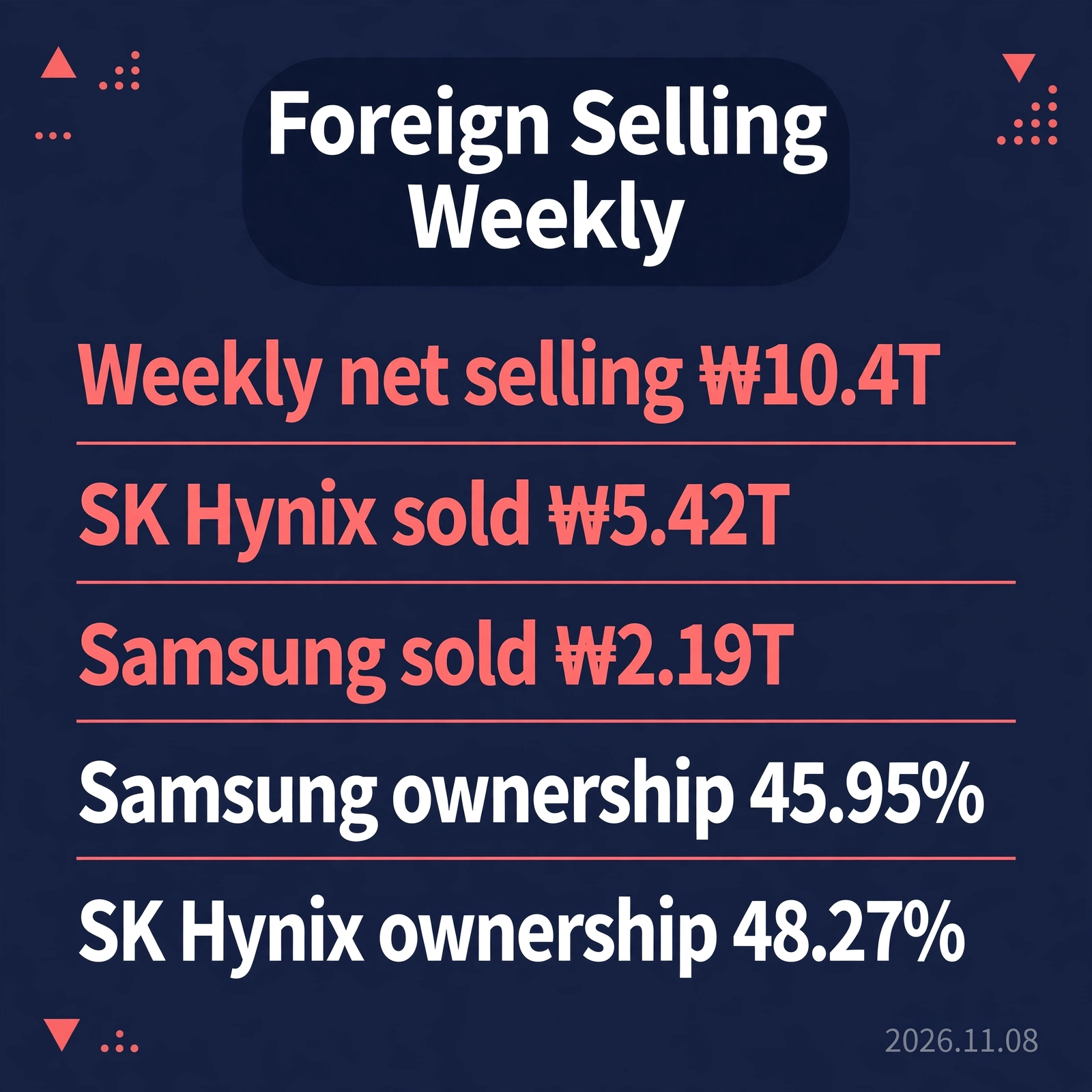
Foreign investors net sold about 10.4 trillion won (about $7.7 billion) of KOSPI shares over the five sessions from November 2 to 6, according to the Korea Exchange. SK Hynix accounted for 5.42 trillion won and Samsung Electronics 2.19 trillion won — 7.62 trillion won combined. Two days alone (November 5–6) came to more than 6 trillion won. The six-session selling streak totals about 12 trillion won, and foreigners have now sold a net 29.08 trillion won over the past month and 219.70 trillion won this year.
Domestic investors absorbed much of it. In the two chip names, retail bought 4.16 trillion won (SK Hynix 2.21 trillion, Samsung 1.95 trillion) and institutions 1.67 trillion won (SK Hynix 1.41 trillion, Samsung 261 billion won) — 5.83 trillion won combined. Their combined market value has fallen below 2,000 trillion won for the first time in about seven months, down 53.77% from the June 25 peak.
The selling shows up in ownership, not just flows. Samsung’s foreign ownership fell to 45.95% on November 6, the lowest since July 7, 2009 — about 17 years and 4 months. SK Hynix’s foreign ownership fell to 48.27%, the lowest since November 22, 2021 — about 5 years. Together with Samsung preferred shares, the two names are 45.11% of KOSPI market value, up from 31.52% at the end of last year. Nearly half the index is two memory-chip makers, which is why the KOSPI now trades almost one-for-one with AI-investment sentiment.
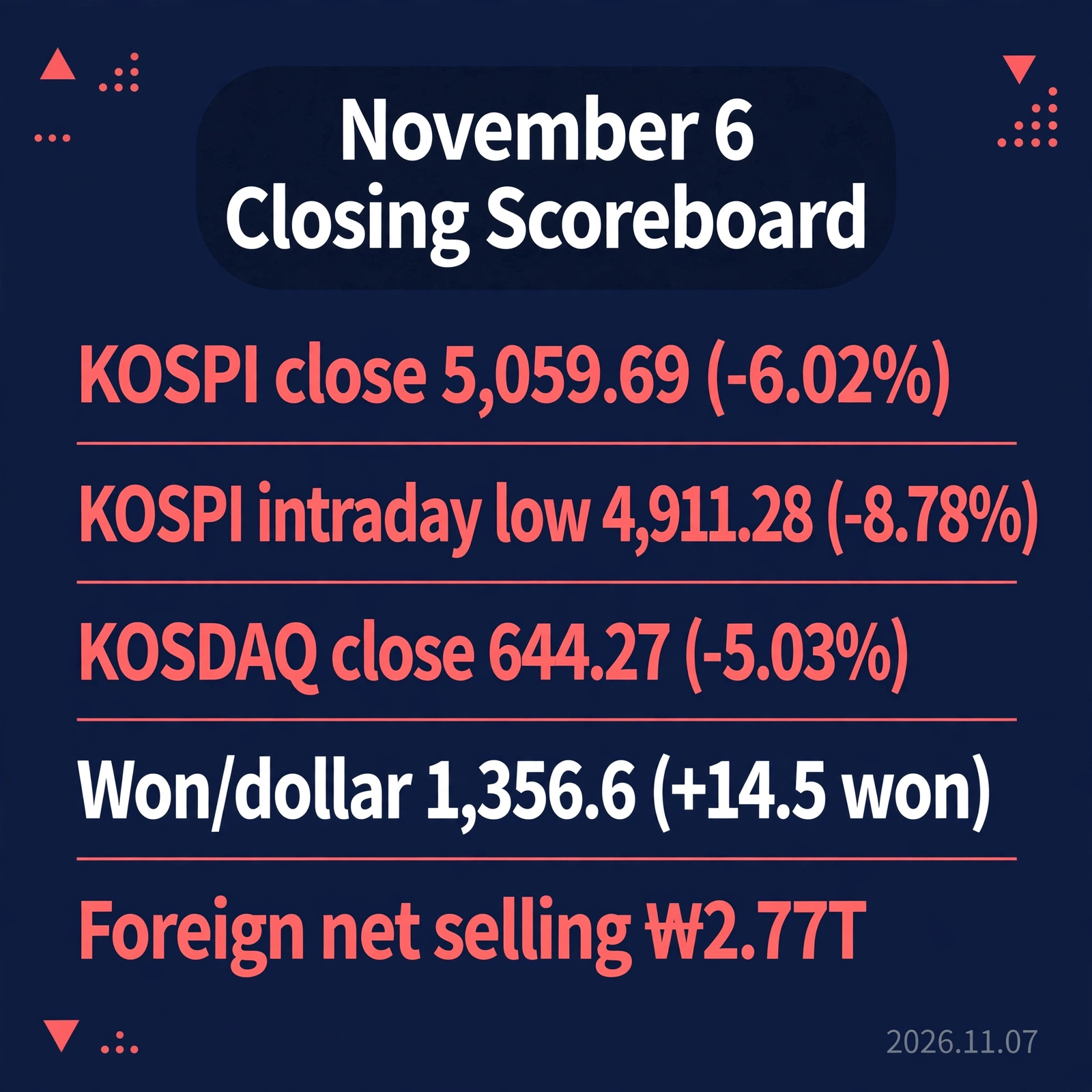
The damage was broad, not confined to chips. Of 2,659 listed companies, 844 (31.7%) touched their lowest price of the year during the week — 272 on the KOSPI (29.6%) and 572 on the KOSDAQ (32.7%). On Friday alone, 720 hit intraday yearly lows and 669 closed at yearly lows. Hyundai Motor (277,500 won on November 3), Hanwha Aerospace (660,000 won on November 6), Alteogen (200,500 won) and EcoPro (66,200 won) all closed at yearly lows. The KOSPI fell 11.71% on the week and the KOSDAQ 11.06%.
Why the won held — semiconductor dollars and a record surplus
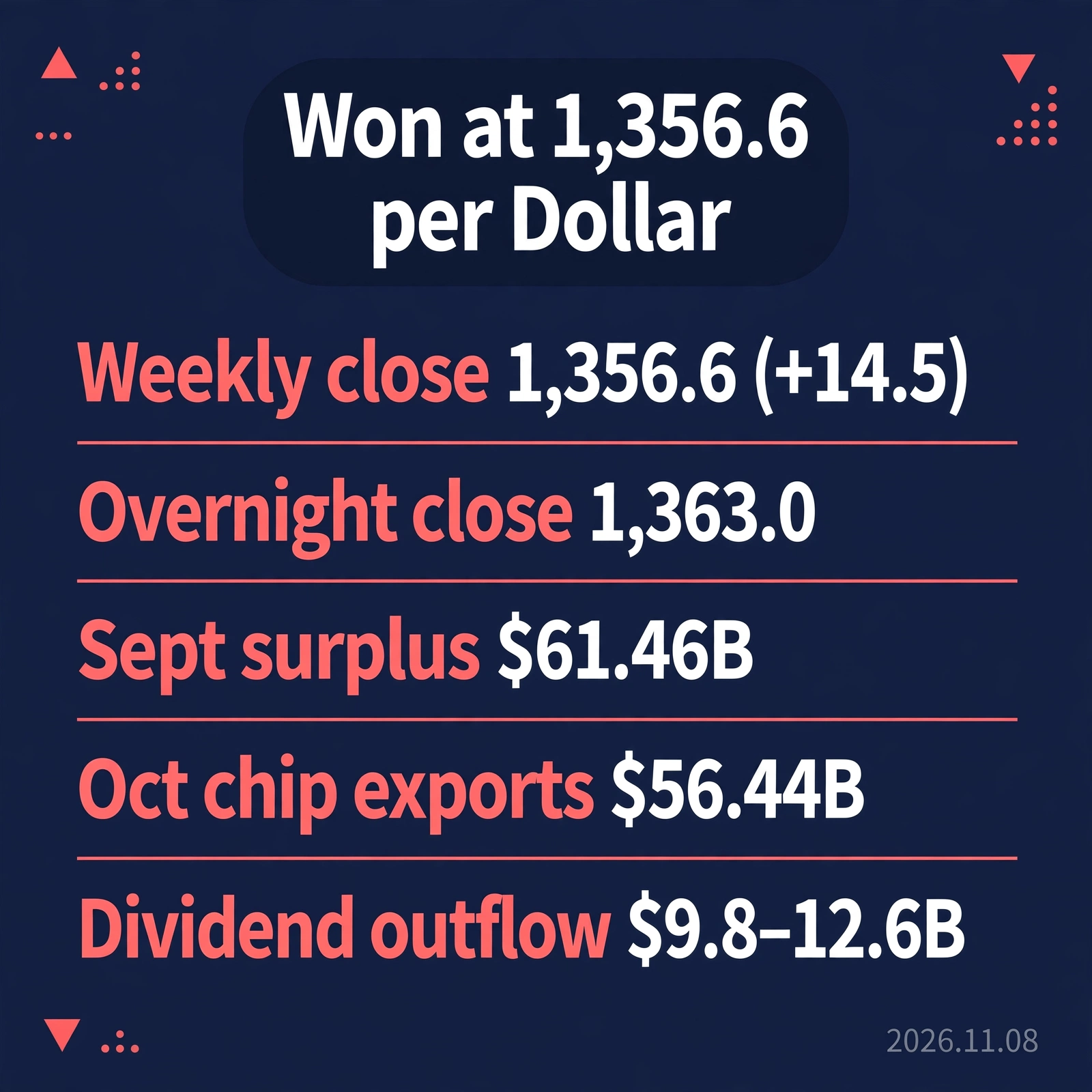
Despite more than 10 trillion won of foreign selling, the won barely moved. The dollar-won rate closed at 1,356.6 on Friday, up 14.5 won on the day, and the overnight close was 1,363.0. The intraday high was 1,362.2.
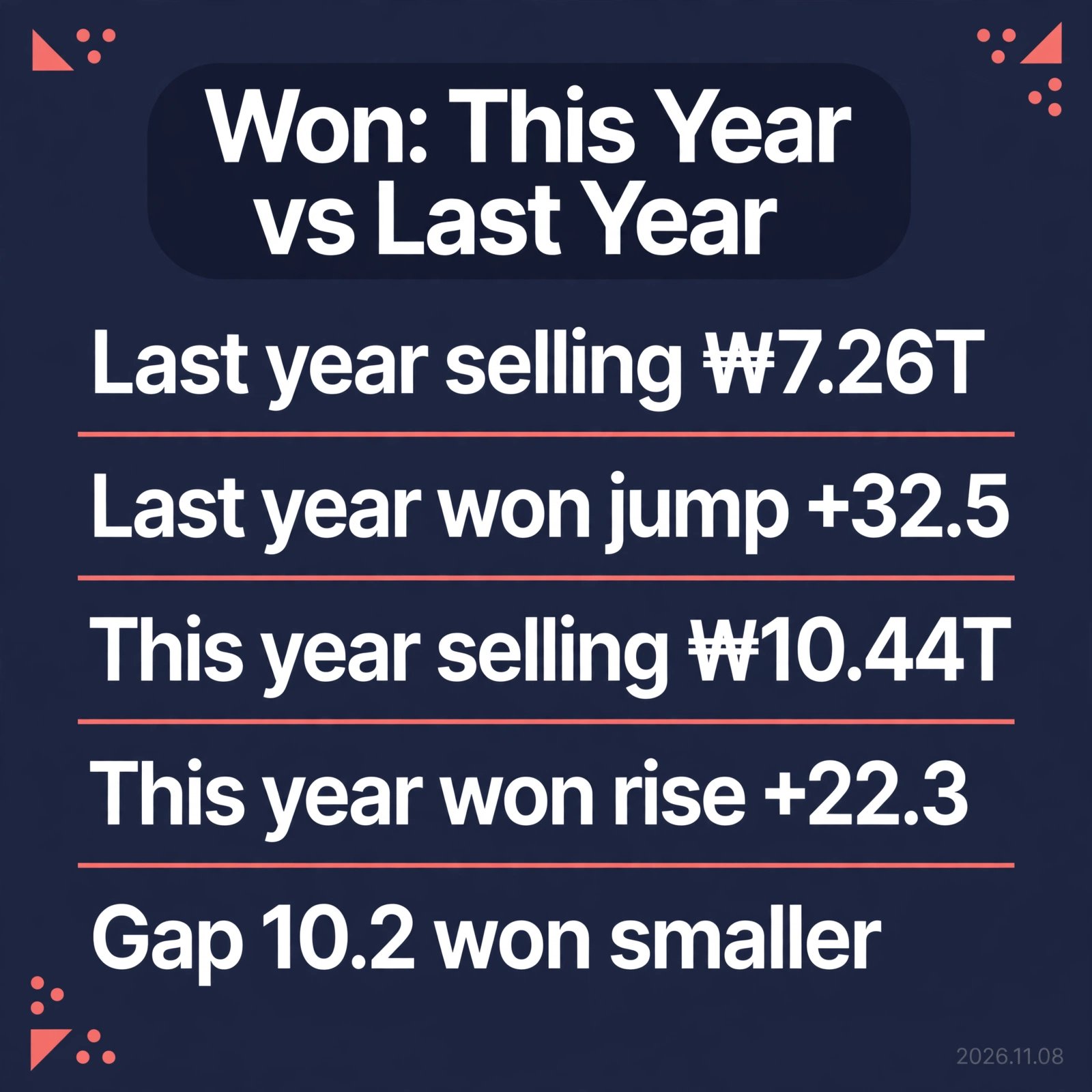
Compare that with the same week a year ago. Then, foreigners sold 7.26 trillion won over five sessions and the won jumped 32.5 won in a week, from 1,424.4 to 1,456.9. This year the won rose only 22.3 won over the week, from 1,334.3 on October 30 to 1,356.6 — 10.2 won less, on larger selling.
The buffer is semiconductor export dollars. South Korea’s current-account surplus hit a record $61.46 billion in September, the first month above $60 billion, and the January–September cumulative surplus reached $340.66 billion. October semiconductor exports were $56.44 billion, up 259.4% from a year earlier, and chips now make up 49.0% of total exports, up from 26.4%. Exporters converting those dollars into won — known as “nego” flows — partly offset the dollar demand from foreign stock selling. The same chips foreigners were selling in the stock market were supporting the currency in the FX market. Foreign banks agree: eight major foreign investment banks expect the surplus to average 19.4% of GDP this year, and Citi sees it averaging 22% of GDP from 2026 to 2028.
The risk is year-end. Large dividend remittances are coming. Citi estimates Samsung and SK Hynix will pay 44.1 trillion won in third-quarter dividends, of which foreigners own 22.4 trillion won; if 70–90% is sent abroad, that is $9.8–12.6 billion of dollar buying in November–December, against $6.9 billion in April–May. Goldman Sachs puts the figure at about $12 billion after November. If outflows exceed exporter dollar sales, the won’s buffer thins again.
Monday checkpoints — 5,000, CPI, CoreWeave, NVIDIA AI Day
US chips bounced on Friday, which should feed into Monday’s open. The Nasdaq rose 1.09% to 24,579.42 and the Philadelphia Semiconductor Index jumped 4.21% to 9,390.25. But that recovered only about a quarter of Thursday’s Nasdaq drop, so it was a day the decline stopped, not a day the trend turned.
Monday also brings NVIDIA AI Day Seoul 2026 to COEX (November 9–10), where Samsung and SK Hynix present how they use NVIDIA’s PhysicsNeMo platform for chip design and process simulation. The event itself produces no earnings or orders, but it is a read on AI-investment sentiment — the same sentiment that drove the selloff.
| Date (Korea time) | Event |
|---|---|
| Mon, Nov 9 | Korea market opens; margin-loan waiver takes effect; NVIDIA AI Day Seoul opens |
| Tue, Nov 10, 22:30 | US October CPI |
| Wed, Nov 11, early morning | CoreWeave Q3 earnings (after US close Nov 10) |
| Wed, Nov 11 | MSCI November index review results |
| Thu, Nov 12 | Intel AI Summit Seoul (COEX) |
| Fri, Nov 13, early morning | Cisco earnings (after US close Nov 12) |
| Fri, Nov 13, 22:30 | US October PPI |
| Dec 8–9 | US Federal Reserve rate decision |
Three numbers to watch. First, whether foreign selling continues and whether the KOSPI holds 5,000 — holding it confirms a floor; losing it confirms the downtrend. Second, CoreWeave’s earnings — not just revenue growth but cash flow, interest costs and funding plans, which decide whether doubts about AI-investment sustainability fade. Third, US October CPI and the December hike probability — after a stronger-than-expected jobs report, the inflation print decides whether hike odds climb further.
Not investment advice. Figures are as confirmed on November 8, 2026, from the Korea Exchange, Yonhap Infomax, Seoul Economic Daily, BigGo Finance and NoCut News.
Sources & references
- Seoul Economic Daily — Korea Eases Margin Collateral Rules to Curb Forced Stock Sales — Nov 9–Jan 31 waiver via no-action letter; Mirae Asset cuts ratio to 130%; Korea Investment, Kiwoom and Samsung Securities deferrals
- Yonhap Infomax — Won Shaken by 'Blue Tsunami' — Foreign IBs Say 'Current Account Surplus Provides Support' — Sept current-account surplus $61.46B, Jan–Sept $340.66B; Citi sees dividend repatriation of $9.8–12.6B in Nov–Dec; Goldman about $12B
- BigGo Finance — Foreign Investors Net Sell approximately $5.6 Billion in Samsung Electronics, SK Hynix in One Week — Weekly foreign selling about 10.4T won; Samsung ownership 45.95%, SK Hynix 48.27%; semiconductor sector ownership 46.6%, lowest since 2013
- BigGo Finance — South Korea's Samsung Electronics, SK Hynix Plunge 11% in Two Days — Two chip names' combined market value below 2,000T won, down 53.77% from June peak; YTD foreign selling 219.7T won; 669 stocks closed at yearly lows on Nov 6
- NoCut News — One-Third of Listed Firms Hit Yearly Low in Plunge — 844 listed firms (31.7%) hit yearly intraday lows last week; 720 on Nov 6 alone; 806 closed at yearly lows
- eDaily — Samsung, SK, LG Corp., Naver, and Coupang All in Attendance… NVIDIA Hosts 'AI Day' in Seoul — NVIDIA AI Day Seoul 2026 at COEX on Nov 9–10, about 2,000 attendees; Samsung and SK Hynix present chip-design AI cases
- BTIN — Nasdaq Rebounds but Ends Week Down 3.4% After AI Selloff — Official Friday closes: Nasdaq 24,579.42 (+1.09%), S&P 7,376.86 (+0.31%), Dow 51,285.73 (-0.46%), SOX +4.2%, payrolls 165,000
Related articles
- KOSPI 5,000 Defense Analysis Weekly 11.71% Drop and Next Week Rebound Conditions
Korea market Saturday edition: the KOSPI closed Friday at 5,059.69, down 6.02% on the day and 11.71% on the week, after a circuit breaker halted trading minutes after the open. US chips bounced Friday, and next week's CoreWeave earnings and US CPI decide whether Seoul rebounds.
- KOSPI Failed Rebound Analysis 5,018 Close Foreign Selling Streak and Nvidia Probe
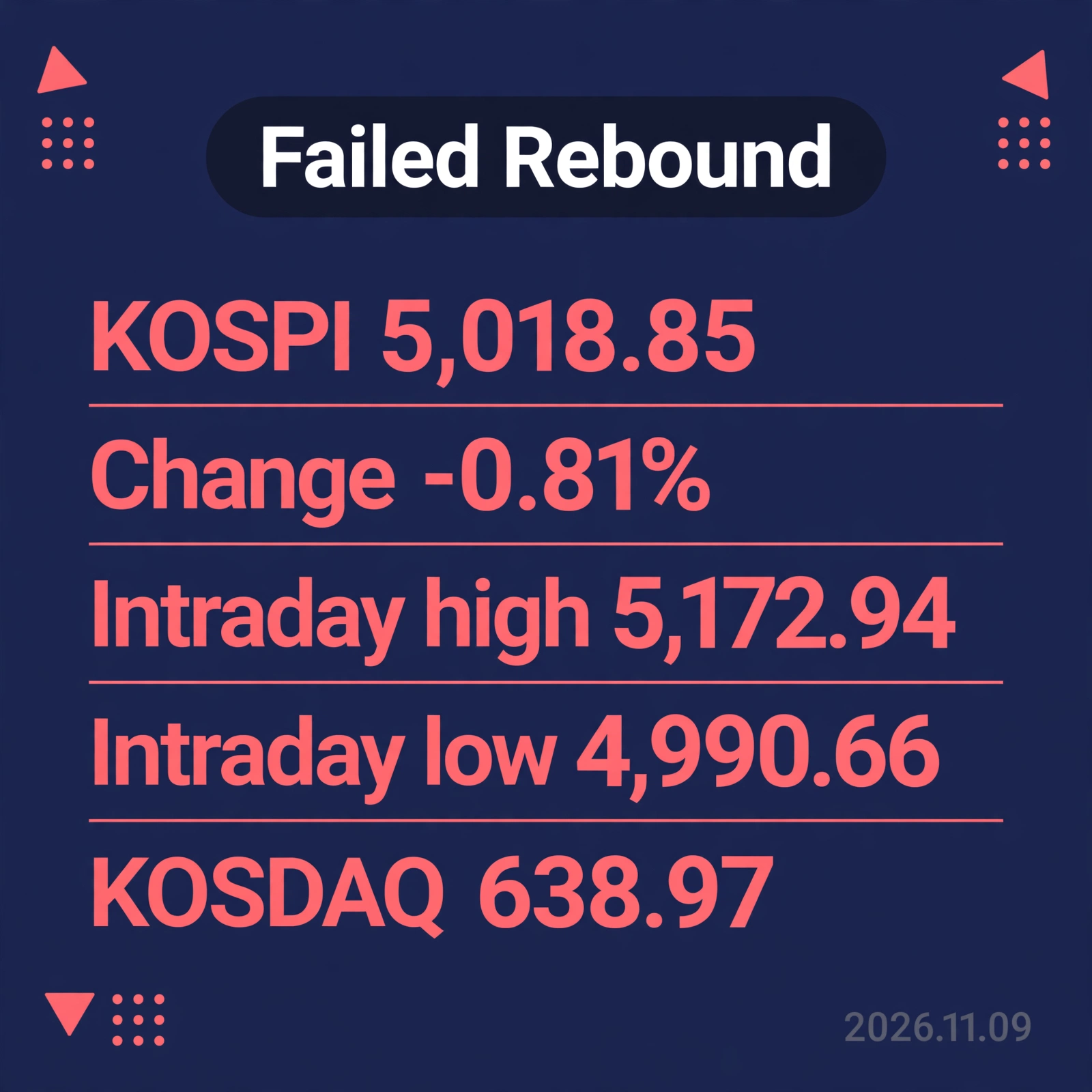
November 9 in Seoul: the KOSPI rallied 2.24% intraday to 5,172.94 but closed at 5,018.85 (−0.81%). Foreigners sold a seventh straight session, an Nvidia board probe capped the rally, and battery stocks gave back the blue-wave rally.
- Won-Dollar Defense Analysis: Semiconductor Export Dollars, Record Surplus, Dividend Repatriation Risk
Foreigners sold about $7.7 billion of Korean shares in a week, yet the won held at 1,356.6. A record $61.46 billion current-account surplus and $56.44 billion of October chip exports did the holding. The next test is $9.8–12.6 billion of dividend repatriation.
5minbrief on YouTube
The briefs also come as videos. Get the daily market wrap on YouTube.
Subscribe on YouTube