 5-minute briefs
Foreign Buying Korea Analysis First Net Buying in Eight Sessions After 12.7 Trillion Won Selloff
#foreign buying Korea#won dollar#US CPI
The first ‘buy’ in eight sessions — and its size
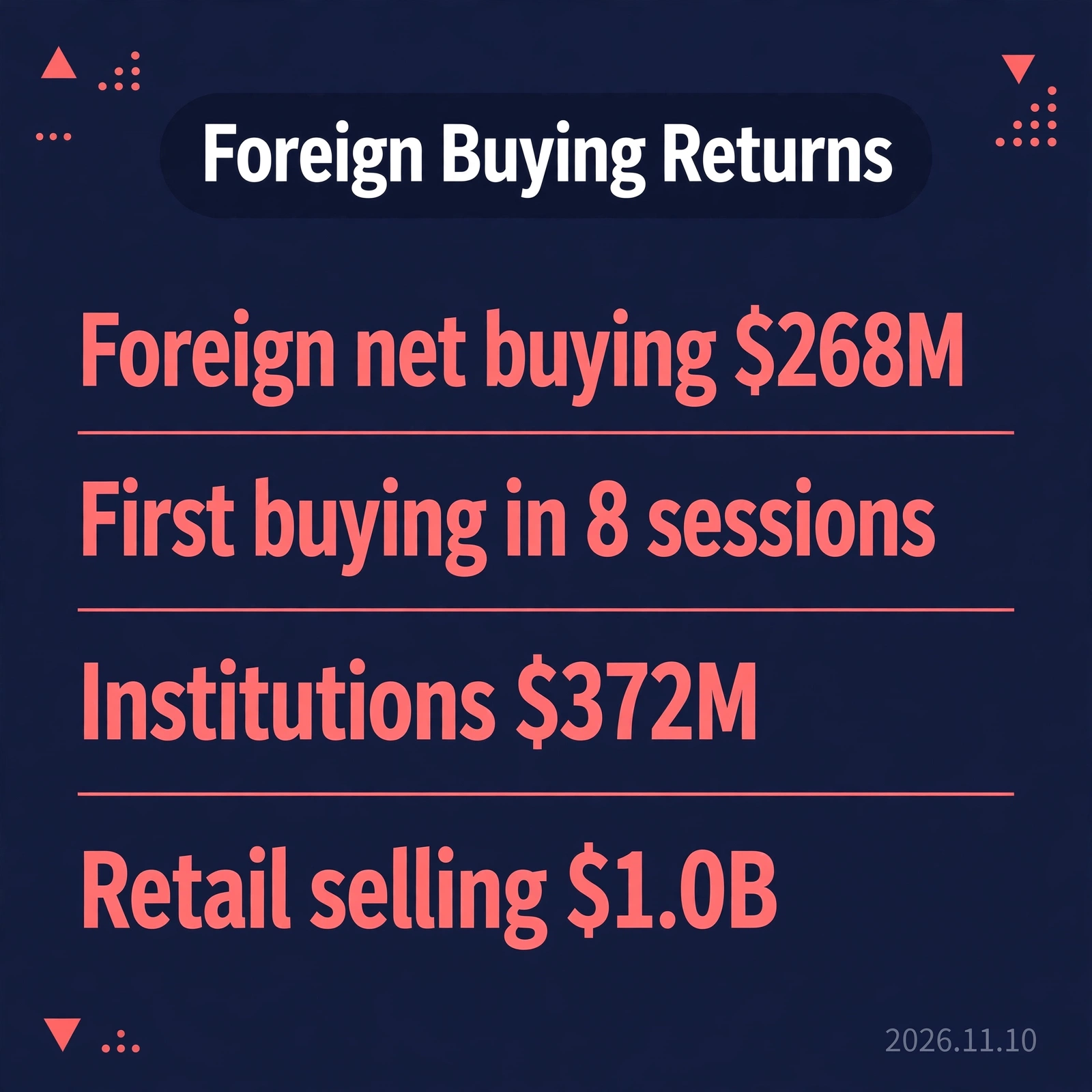
Foreigners net bought 358.7 billion won (about $268 million) of KOSPI shares on November 10 — their first net buying in eight sessions. Institutions bought a net 498.0 billion won (about $372 million) alongside them, while retail investors net sold 1.34 trillion won (about $1.0 billion) for a second straight session. Combined, foreign and institutional buying totalled 856.7 billion won (about $640 million).
The direction changed; the scale has not — yet. The 358.7 billion won of buying equals 2.8% of the 12.75 trillion won foreigners sold over the previous seven sessions. One day of inflows does not undo seven sessions of selling. A reversal needs several more days of buying to count as one.
Seven sessions, 12.75 trillion won — where the selling came from
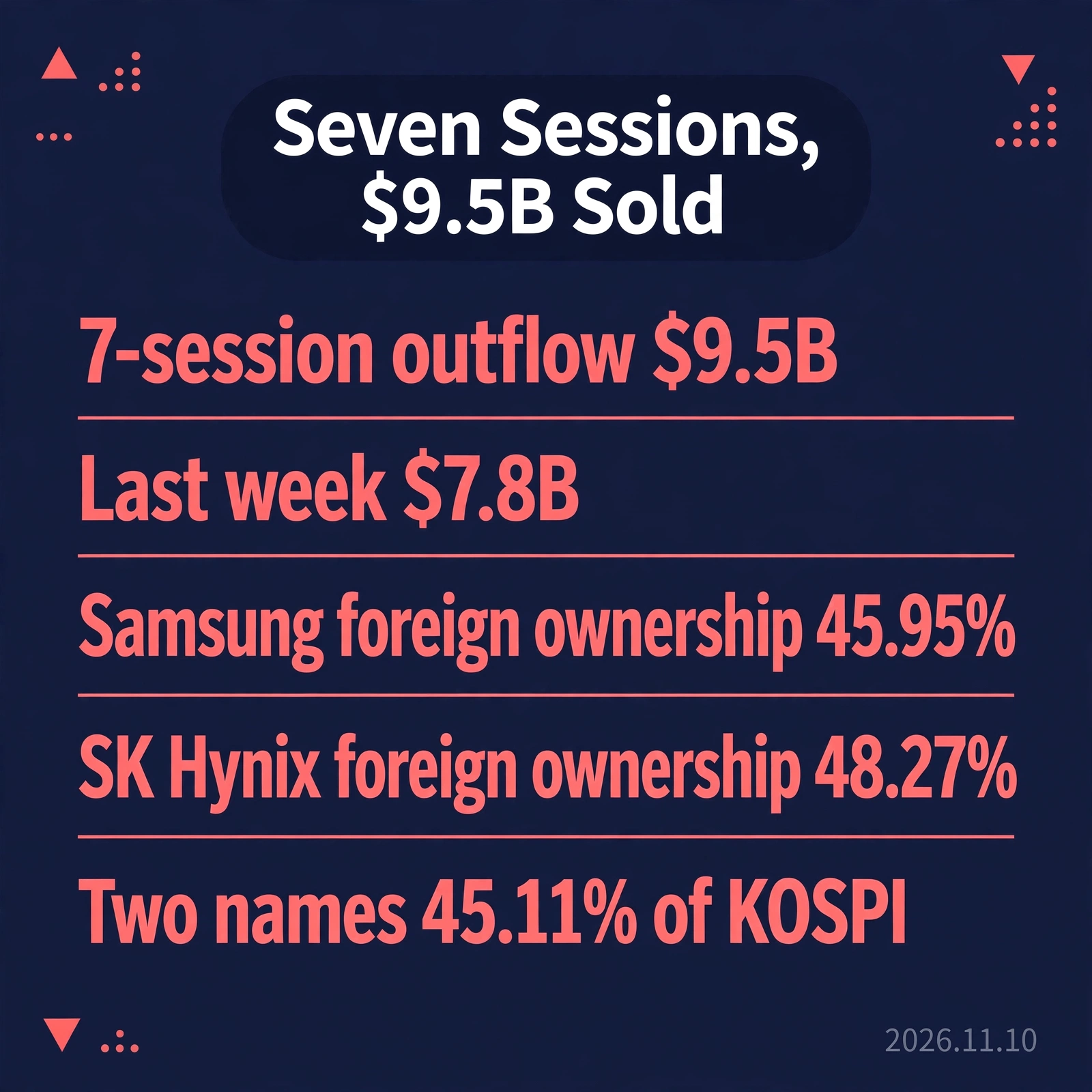
The selling was concentrated in one week. Foreigners net sold 10.44 trillion won (about $7.8 billion) in the five sessions of last week alone, including 5.42 trillion won in SK Hynix and 2.19 trillion won in Samsung Electronics — 7.62 trillion won from the two names combined. On November 9 they sold another 692.5 billion won, extending the streak to seven sessions.
The selling left a mark on the shareholder register, not just on prices. Foreign ownership of Samsung Electronics fell to 45.95% on November 6, the lowest since July 2009 — about 17 years and 4 months. SK Hynix’s foreign ownership fell to 48.27%, the lowest since November 2021 — about five years. Both names are now below 50% foreign-owned, and foreign ownership of the semiconductor sector as a whole stood at 46.6%, the lowest since 2013.
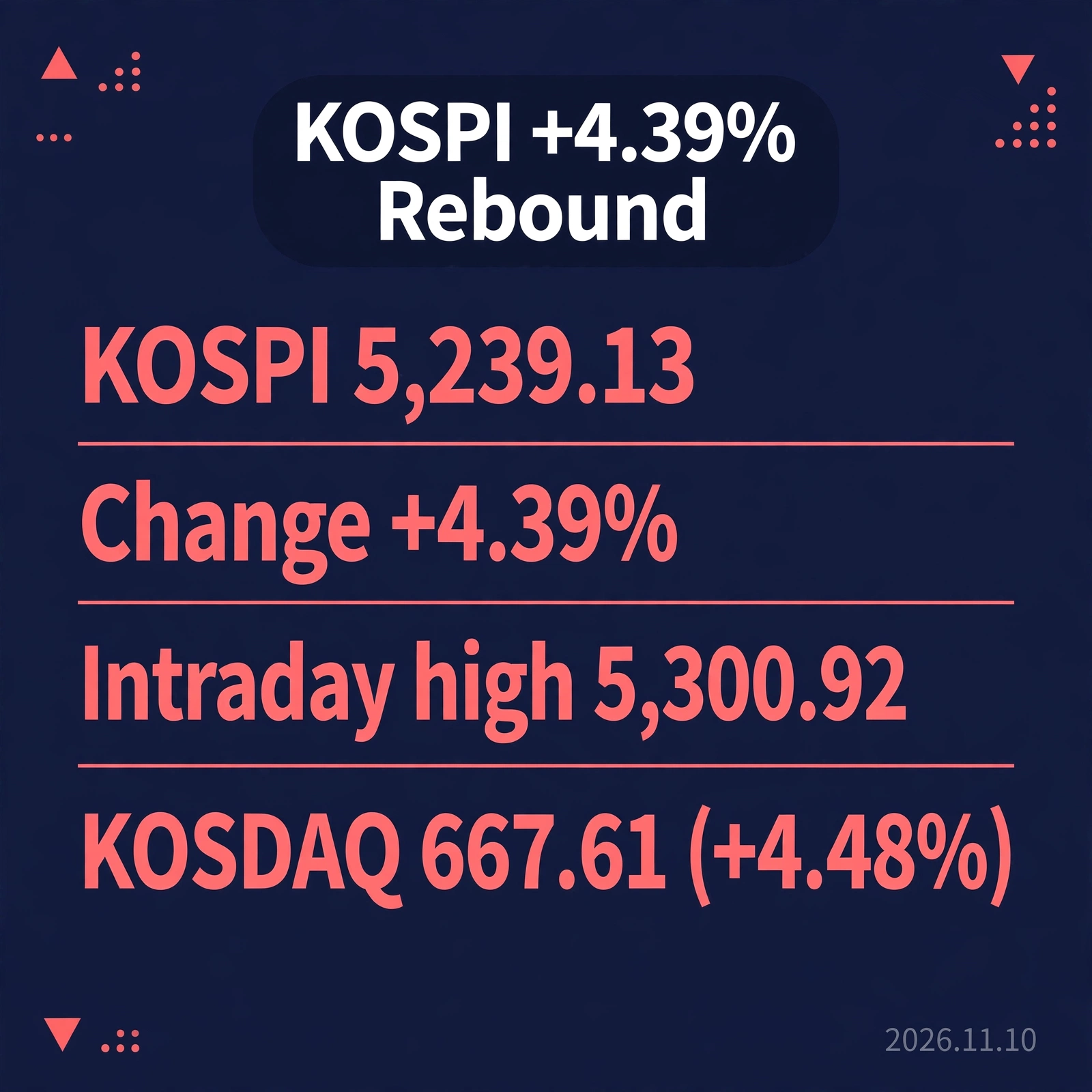
That is why the structure matters. The two names are 45.11% of KOSPI market value: when foreigners sell those two, the whole index moves, and when they buy them back, the rebound is largest there too. Today’s 4.39% KOSPI gain is, in large part, this structure working in reverse. The corollary: if foreign buying stays confined to the two names, the breadth of the rebound stays limited.
What changed — three shifts behind the turn
The buying was not random. Three changes lined up.
First, US semiconductors bounced. The PHLX Semiconductor Index jumped 6.85% overnight, with AMD up 13.26%, Broadcom 8.78% and Micron 6.25%. The two names foreigners sold hardest — Samsung and SK Hynix — are the same names that track the US chip rally, so the bounce gave flow a reason to reverse.
Second, oil plunged and the war premium came out. Brent crude fell 5.85% to $92.57 a barrel after President Trump said further strikes on Iran “will not be necessary for the time being.” Brent has now fallen 18.4% in six sessions. Risk appetite recovered, and the motive to de-risk faded with it.
Third, the data-center regulation scare is fading. The Democrats’ midterm sweep raised fears that regulation would slow the AI buildout — the direct cause of last week’s slide. Kiwoom Securities now notes that investors are converging on the view that the regulation risk is smaller than feared. The narrative that pushed foreigners out has weakened.
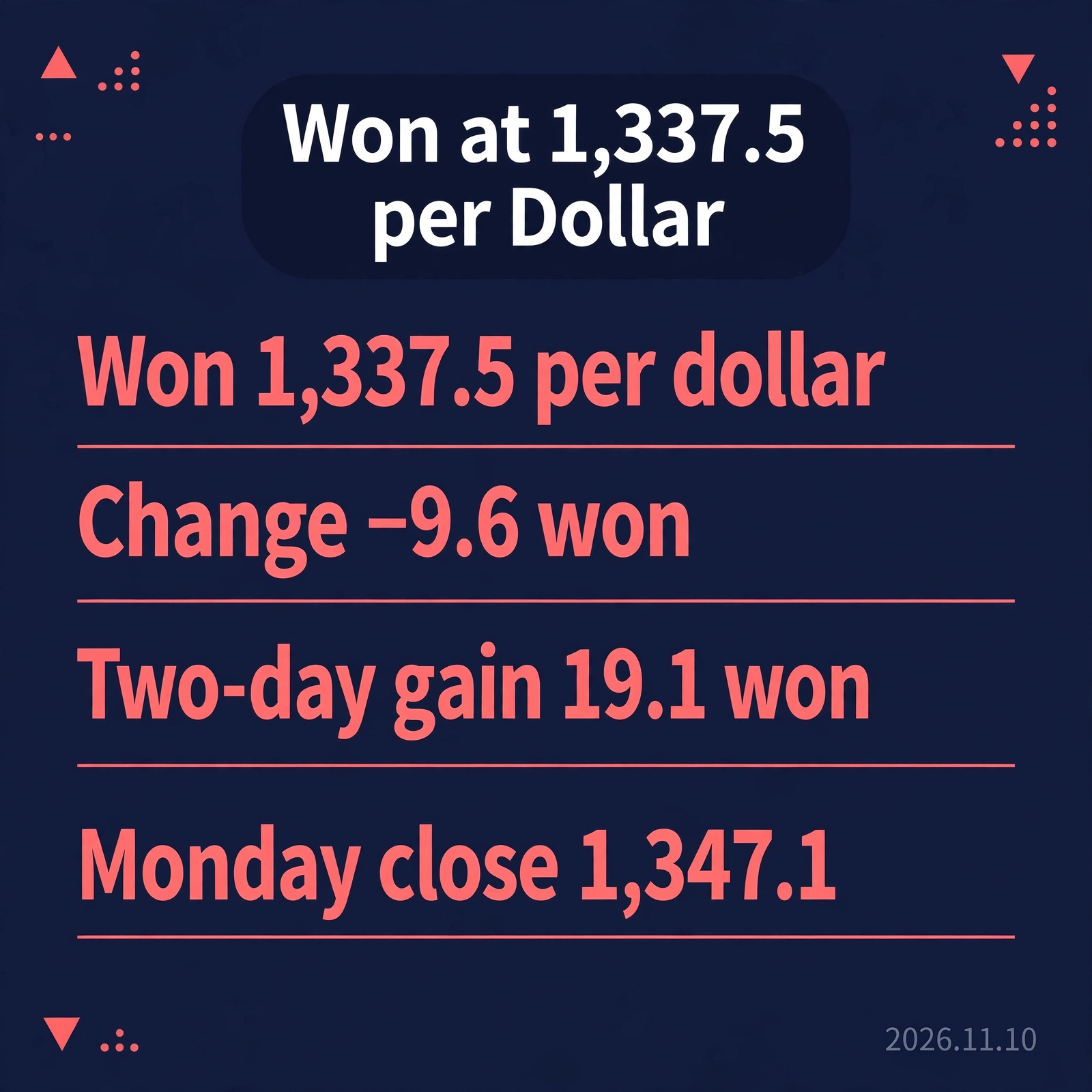
Add the won: it strengthened for a second straight day, to 1,337.5 per dollar. A stronger won improves foreign investors’ returns on won-denominated assets, so the currency and the flows are now reinforcing each other in the same direction.
Turn or blip — four tests
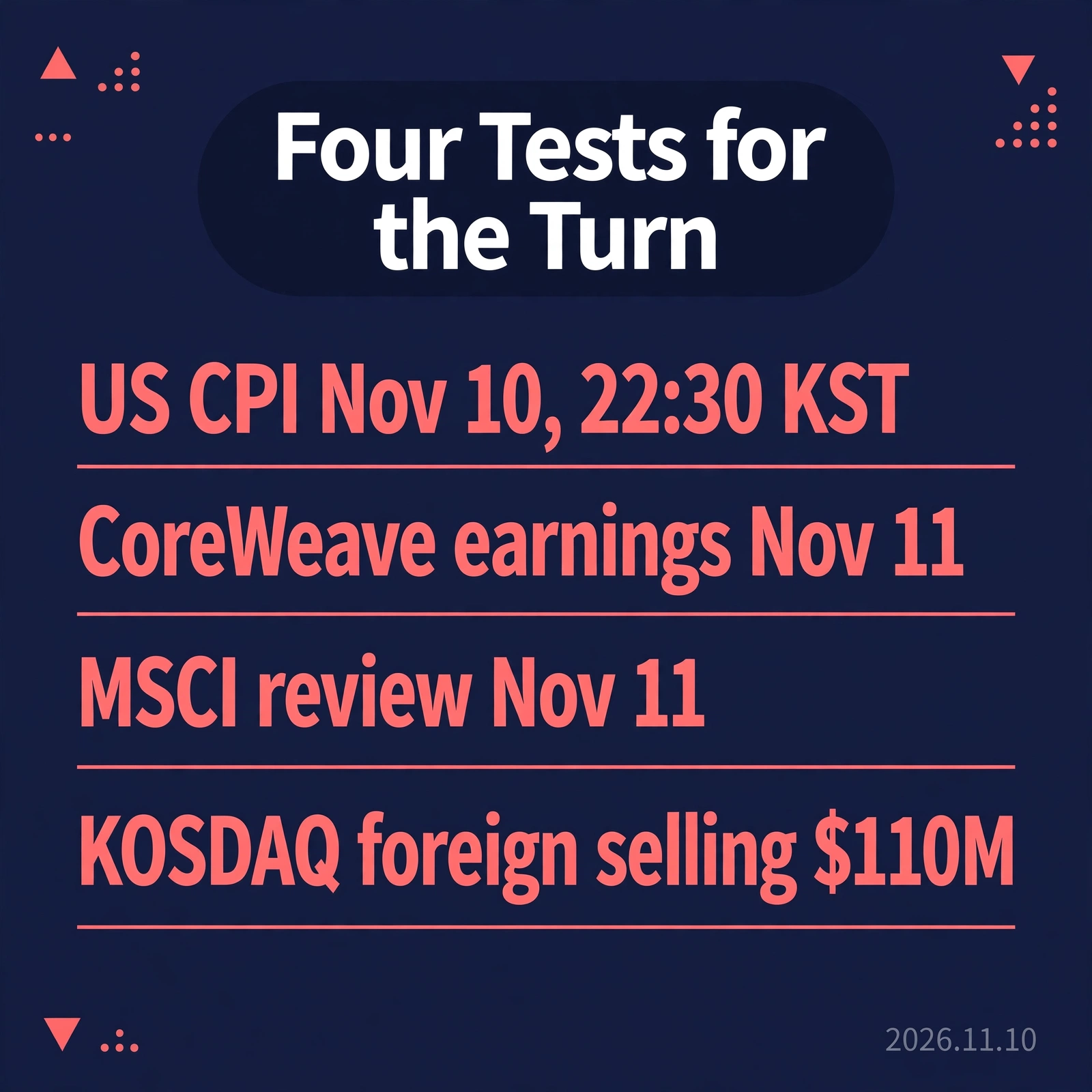
One day cannot settle a trend change. Four tests, in order:
First, do foreigners buy again tomorrow? A second consecutive day of inflows is the first evidence that this is an inflection rather than a one-day bargain hunt. A return to net selling tomorrow would mark today as a blip.
Second, do they buy on the KOSDAQ too? Foreigners still sold 147.0 billion won (about $110 million) on the KOSDAQ today. If buying spreads beyond large-cap KOSPI names, foreign risk appetite has genuinely returned; if it stays confined, the rebound’s breadth stays limited.
Third, tonight’s US October CPI and CoreWeave earnings. CPI is expected at +0.3% month-on-month and +0.2% core. A hotter print would lift December Fed hike odds and cool foreign buying sentiment. CoreWeave’s results answer whether doubts about AI-investment sustainability are fading.
Fourth, MSCI’s November review results on November 11. As a semiannual review it can bring larger constituent changes, and passive rebalancing can shake stock-level flows. With the foreign turn and the MSCI announcement landing in the same week, flow direction needs re-checking after the results.
Not investment advice. Figures are as confirmed on November 10, 2026, from the Korea Exchange, Yonhap, NoCut News and BigGo Finance. Foreign and institutional flows are regular-session figures.
Sources & references
- NoCut News — KOSPI and KOSDAQ Rebound About 4% After Blue Tsunami, Rally To Continue? — Foreigners net bought 358.7B won for the first time in eight sessions, institutions 498.0B won, individuals sold 1.3396T won
- Yonhap — Seoul shares soar over 4 pct to snap 3-day slide on tech rally, oil prices fall — KOSPI 5,239.13 (+4.39%), trading value 16.2T won ($12.1B), SOX +6.85%, won 1,337.5
- NoCut News — Foreigners Exit KOSPI... 10.4 Tln Won Net Sold Last Week — Foreigners net sold 10.41T won Nov 2–6; 7.6T won in the two chip names; ownership at multi-year lows
- BigGo Finance — Foreign Investors Net Sell approximately $5.6 Billion in Samsung Electronics, SK Hynix in One Week — Ownership 45.95%/48.27% with previous lows; semiconductor sector ownership 46.6%, lowest since 2013; weekly selling about 10.4T won
Related articles
- KOSPI 5239 Rebound Analysis 4.39% Surge Foreign Buying Returns and Won Strength
November 10 in Seoul: the KOSPI jumped 4.39% to 5,239.13, its biggest gain since October 28, as foreigners bought Korean shares for the first time in eight sessions. The won strengthened to 1,337.5 per dollar. Tonight's US CPI and CoreWeave earnings decide whether the rebound holds.
- Won Dollar Exchange Rate Analysis 1337.5 Won Two-Day Drop and 1330s Return
The won strengthened to 1,337.5 per dollar, down 9.6 won on the day and 19.1 won over two sessions. The move is not dollar weakness — it is Korean risk appetite and exporter dollar selling reversing last week's chip-driven spike. Tonight's US CPI decides the next direction.
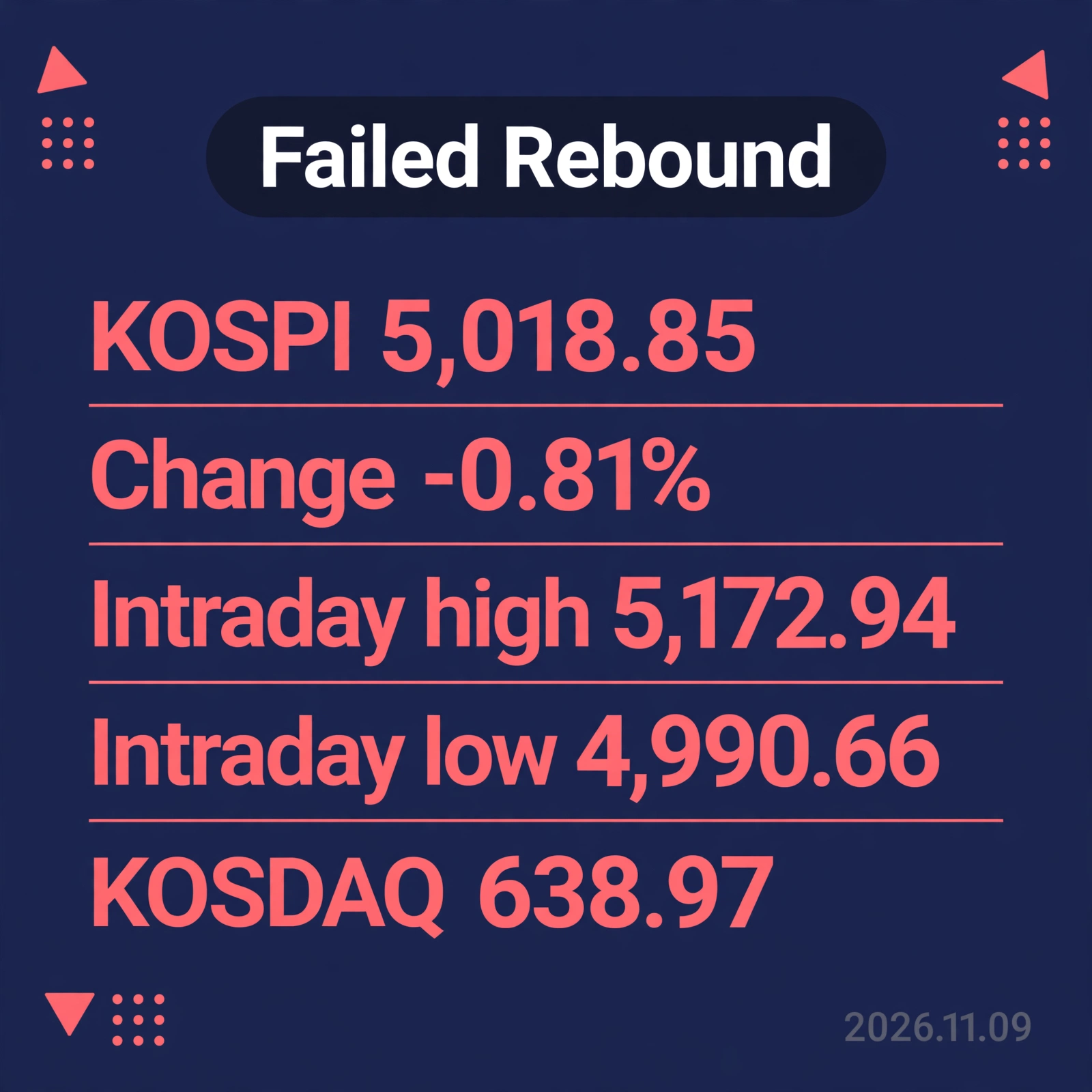
- KOSPI Failed Rebound Analysis 5,018 Close Foreign Selling Streak and Nvidia Probe
November 9 in Seoul: the KOSPI rallied 2.24% intraday to 5,172.94 but closed at 5,018.85 (−0.81%). Foreigners sold a seventh straight session, an Nvidia board probe capped the rally, and battery stocks gave back the blue-wave rally.
5minbrief on YouTube
The briefs also come as videos. Get the daily market wrap on YouTube.
Subscribe on YouTube