 5-minute briefs
Won-Dollar Defense Analysis: Semiconductor Export Dollars, Record Surplus, Dividend Repatriation Risk
#won dollar exchange rate#semiconductor exports#foreign selling Korea
Same selling, different won — this year vs last year
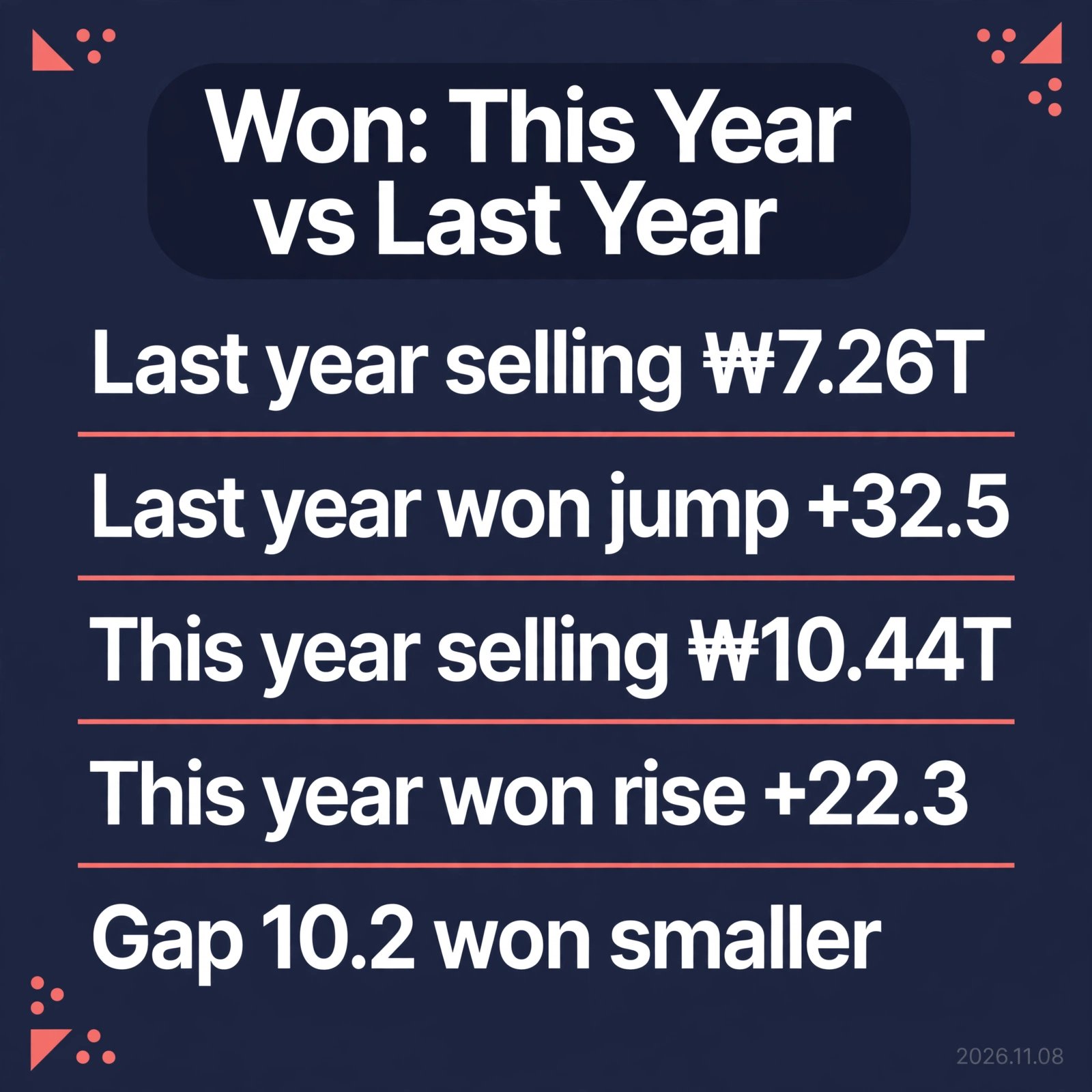
The stock market collapsed, but the currency held. The cleanest comparison is the same week a year ago.
| Same week last year | This week | |
|---|---|---|
| Foreign selling over 5 sessions | 7.26 trillion won | 10.44 trillion won |
| Won move | 1,424.4 → 1,456.9 | 1,334.3 → 1,356.6 |
| Weekly rise | +32.5 won | +22.3 won |
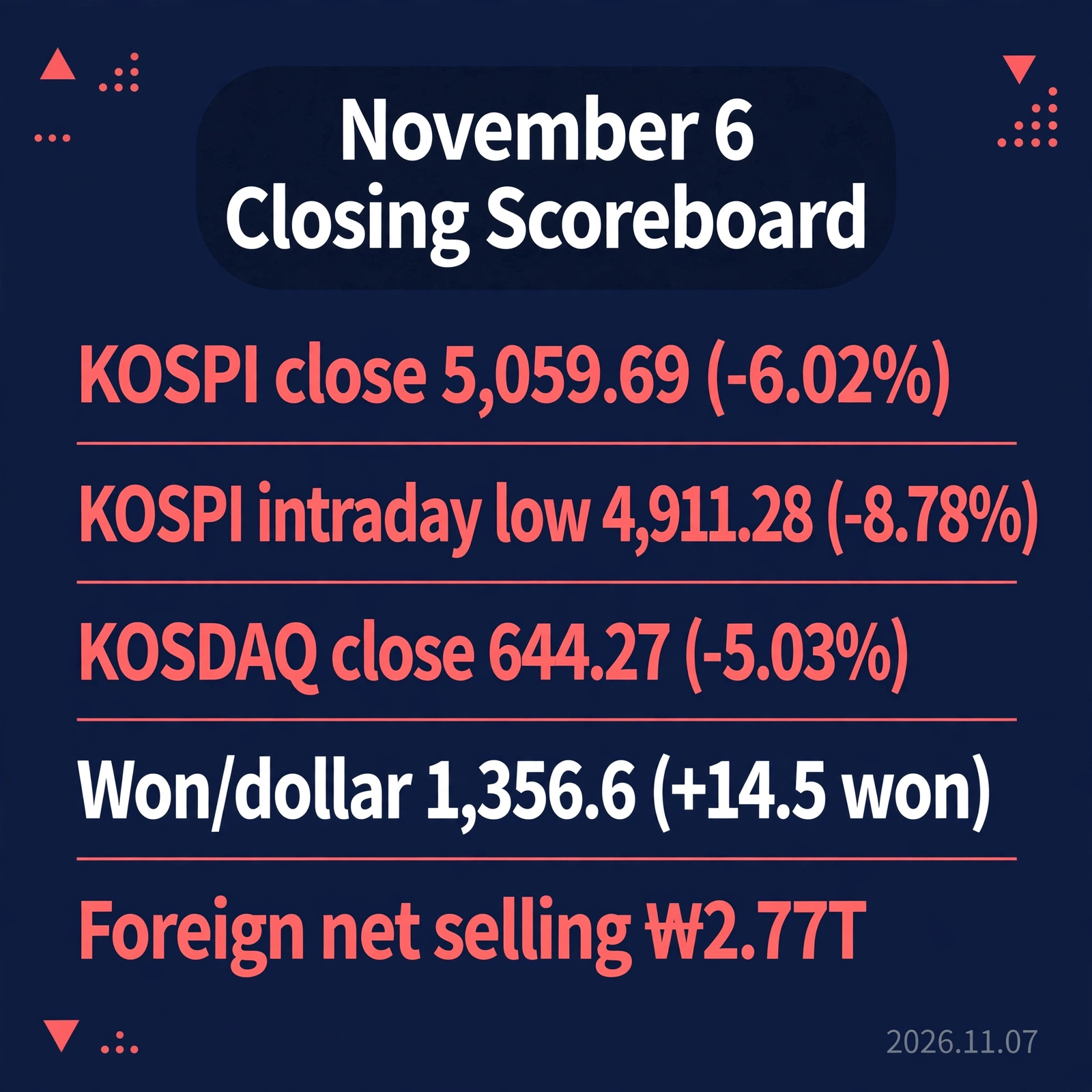
A year ago, AI-bubble fears drove foreigners to sell 7.26 trillion won over five sessions, and the won jumped 32.5 won in a week. This year selling was larger, yet the won’s rise was 10.2 won smaller. Friday’s own move was not violent either: the won closed the Seoul session at 1,356.6, up 14.5 won, after an intraday high of 1,362.2 and an overnight close of 1,363.0.
Two weeks earlier the won had been strengthening. On October 26 it touched 1,320.6 intraday and closed the week at 1,323.1, the lowest since October 2, 2024. Friday’s close is 33.5 won above that — the strong-won trend has paused, not reversed. The market’s own verdict, in the words of one local economist, is that the won held up relatively well given the scale of the stock shock.
What did the holding — semiconductor export dollars
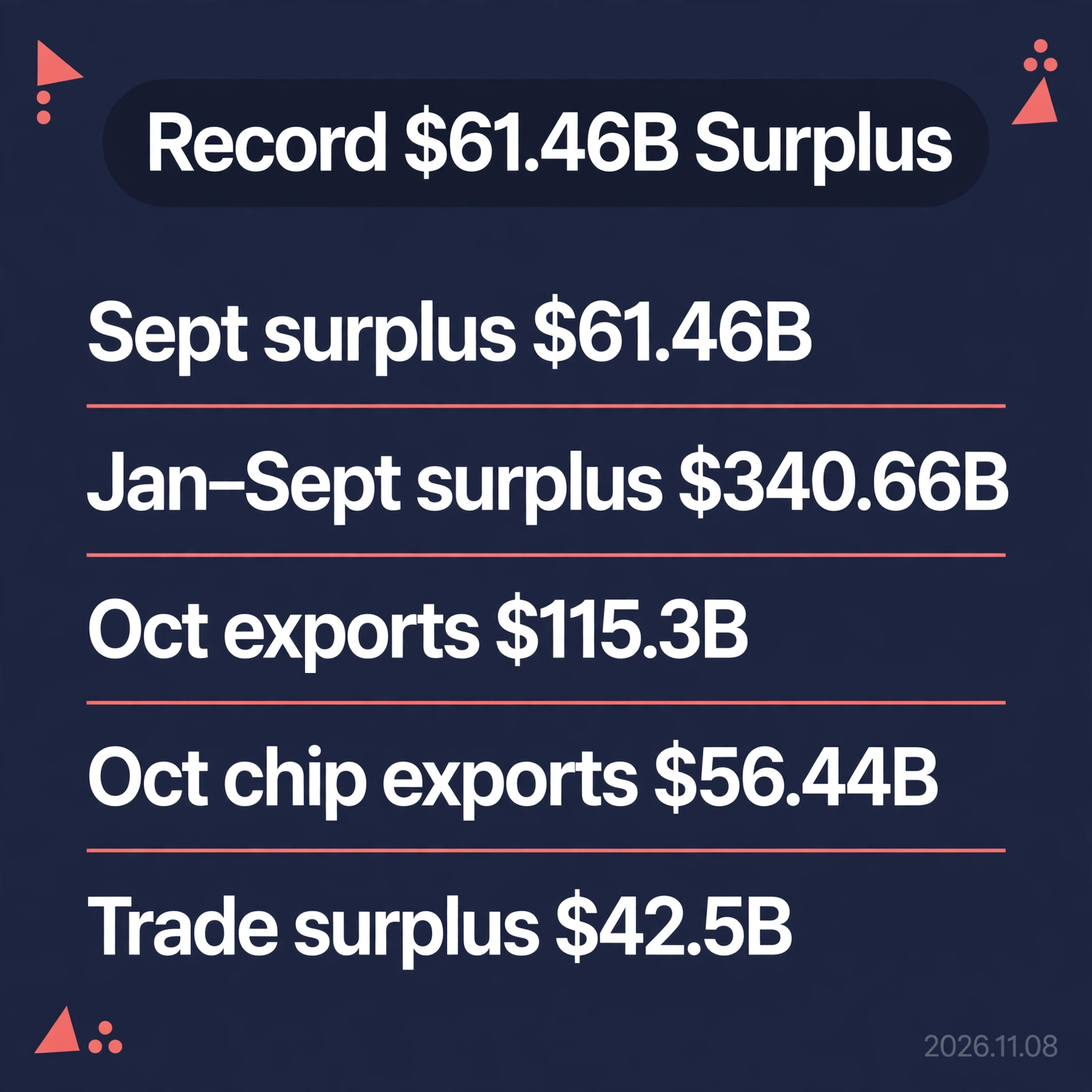
The buffer is the dollars that semiconductor exports earn. South Korea’s current-account surplus hit a record $61.46 billion in September, the first month above $60 billion, up from $46.11 billion in August and above the previous record of $49.73 billion set in June. The January–September cumulative surplus reached $340.66 billion, and the third-quarter surplus alone, $149.65 billion, already exceeds last year’s full-year record of $123.05 billion. The surplus has now run for 41 consecutive months since May 2023, and the Bank of Korea expects this year’s annual surplus to exceed its $450 billion forecast, with October likely the second-highest month on record.
October’s trade data kept the story going. Exports rose 93.7% from a year earlier to $115.3 billion, with semiconductor shipments up 259% to $56.4 billion, and the trade surplus came to $42.5 billion. Chips now make up 49.0% of total exports, up from 26.4% a year ago.
The mechanism is simple. Exporters convert their dollars into won — “nego” flows — adding dollar supply that partly offsets the dollar demand from foreign stock selling. The same chips foreigners were selling in the stock market were supporting the currency in the FX market. MUFG noted that the tech boom supports the currency, though foreign equity outflows weaken the effect. Foreign investment banks agree the surplus will last: eight major foreign banks expect it to average 19.4% of GDP this year, and Citi sees it averaging 22% of GDP from 2026 to 2028, with long-term supply agreements between Korean memory makers and global cloud operators stabilizing future demand and prices.
But selling alone does not explain the won’s move. As one strategist put it, foreigners sold in July and August too, yet the won strengthened sharply then — so this rebound is not only about selling. If AI data-center investment is delayed, markets are pricing in doubt about whether Korea can earn as many dollars next year, and that doubt shows up in the currency as well as in stocks. Hedge funds cutting positions and raising cash also need to buy dollars to go home, adding safe-haven dollar demand.
The next test — dividend repatriation and next year’s AI spending
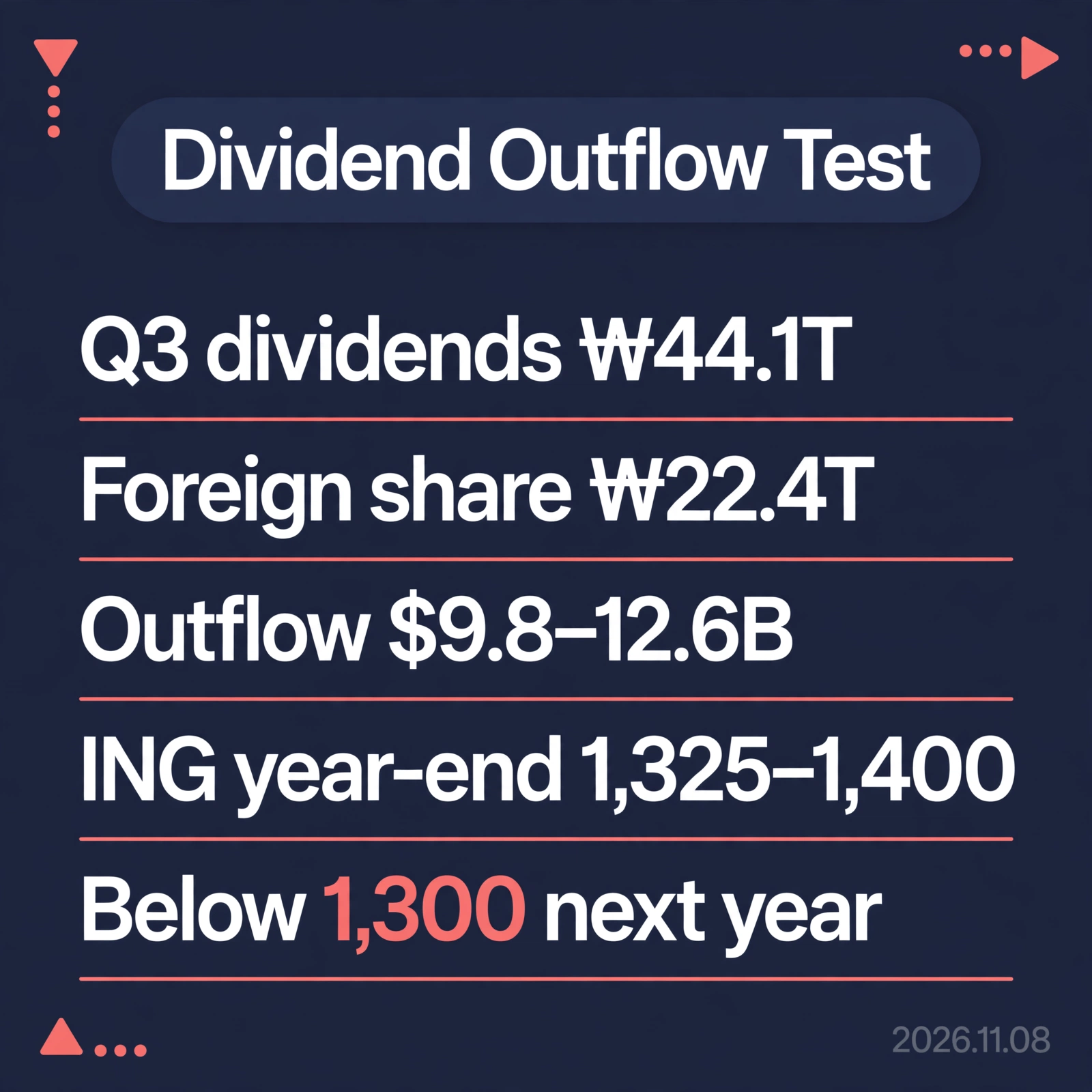
The buffer is not permanent. Large dividend remittances are coming at year-end. Citi estimates Samsung and SK Hynix will pay 44.1 trillion won in third-quarter dividends, of which foreigners own 22.4 trillion won; if 70–90% is sent abroad, that is $9.8–12.6 billion of dollar buying in November–December, against $6.9 billion in April–May. Goldman Sachs puts the figure at about $12 billion after November. If outflows exceed exporter dollar sales, the won’s buffer thins again. September’s financial account already showed the pressure: foreign investment in domestic securities fell $13.81 billion while domestic investment in overseas securities rose $16.63 billion. Residents’ foreign-currency deposits hit a record $154.7 billion in September, up $14 billion in a month.
Forecasts point the same way, with different conviction. ING expects 1,325–1,400 won into year-end and below 1,300 won next year as exporter conversions expand. One local brokerage sees the won entering the 1,200s next year, arguing the trade and current-account numbers point to a stronger won, with foreign selling only partly offsetting the surplus — and expanding shareholder returns at Samsung and SK Hynix would keep conversion flows coming. Others are warier: year-end 1,300–1,400 won, with volatility, not direction, as the watchword, as US foreign policy and major central-bank decisions crowd into November and December.
- Current account: exports minus imports, plus income and transfers. A large surplus means dollars are flowing into the country, which supports the won.
- "Nego" flows: exporters selling the dollars they earn to buy won. When they are large, they cap how far the won can fall — even during a stock selloff.
- Repatriation: foreign investors sending dividends home must buy dollars and sell won. A $10–13 billion wave in two months is enough to move the rate on its own.
Four numbers to watch. First, the October current-account surplus — another near-record would harden the buffer story. Second, the scale of November–December dividend repatriation — the $9.8–12.6 billion estimate is the year-end swing factor. Third, whether foreign stock selling eases — continued selling keeps offsetting the surplus. Fourth, whether the won stabilizes around 1,350 — stability there would suggest last week’s rout was a short-term washout, not a trend.
Not investment advice. Figures are as confirmed on November 8, 2026, from the Bank of Korea, Yonhap Infomax, the Korea Herald, Trading Economics and the JoongAng Ilbo.
Watch the video

Sources & references
- Yonhap Infomax — Won Shaken by 'Blue Tsunami' — Foreign IBs Say 'Current Account Surplus Provides Support' — Sept current-account surplus $61.46B, Jan–Sept $340.66B; foreign IBs see surplus averaging 19.4% of GDP; Citi $9.8–12.6B dividend repatriation; Goldman about $12B
- Korea Herald — S. Korea's current account surplus tops $60b for 1st time on chip boom — Sept $61.46B vs $46.11B in Aug; prev record $49.73B in June; Q3 $149.65B; 41 straight months of surplus; annual surplus expected above $450B forecast
- Trading Economics — South Korean Won Weakens on Foreign Outflows — Oct exports $115.3B (+93.7%), semiconductor shipments $56.4B (+259%); resident FX deposits record $154.7B in Sept
- JoongAng Ilbo — Foreigners Sold 6 Trillion Won, but the Won Held Thanks to Semiconductor Dollars (Korean) — Same-week comparison a year ago: won jumped 32.5 won on 7.26T won of selling; this year 22.3 won on larger selling (Korean-language source; no English version of this comparison found)
Related articles
- KOSPI Monday Preview: 10.4 Trillion Won Foreign Selling, Won at 1,356.6, Margin Relief Starts
Korea market Sunday edition: Seoul is closed today, but the weekend formalized three months of margin-loan relief starting Monday. Foreigners sold about 10.4 trillion won of KOSPI shares last week, yet the won held at 1,356.6 — semiconductor export dollars and a record current-account surplus did the holding.
- KOSPI 5,000 Defense Analysis Weekly 11.71% Drop and Next Week Rebound Conditions
Korea market Saturday edition: the KOSPI closed Friday at 5,059.69, down 6.02% on the day and 11.71% on the week, after a circuit breaker halted trading minutes after the open. US chips bounced Friday, and next week's CoreWeave earnings and US CPI decide whether Seoul rebounds.
- KOSPI 3.59% Plunge Foreign Institutional 2.9 Trillion Won Selling AI Funding Fear
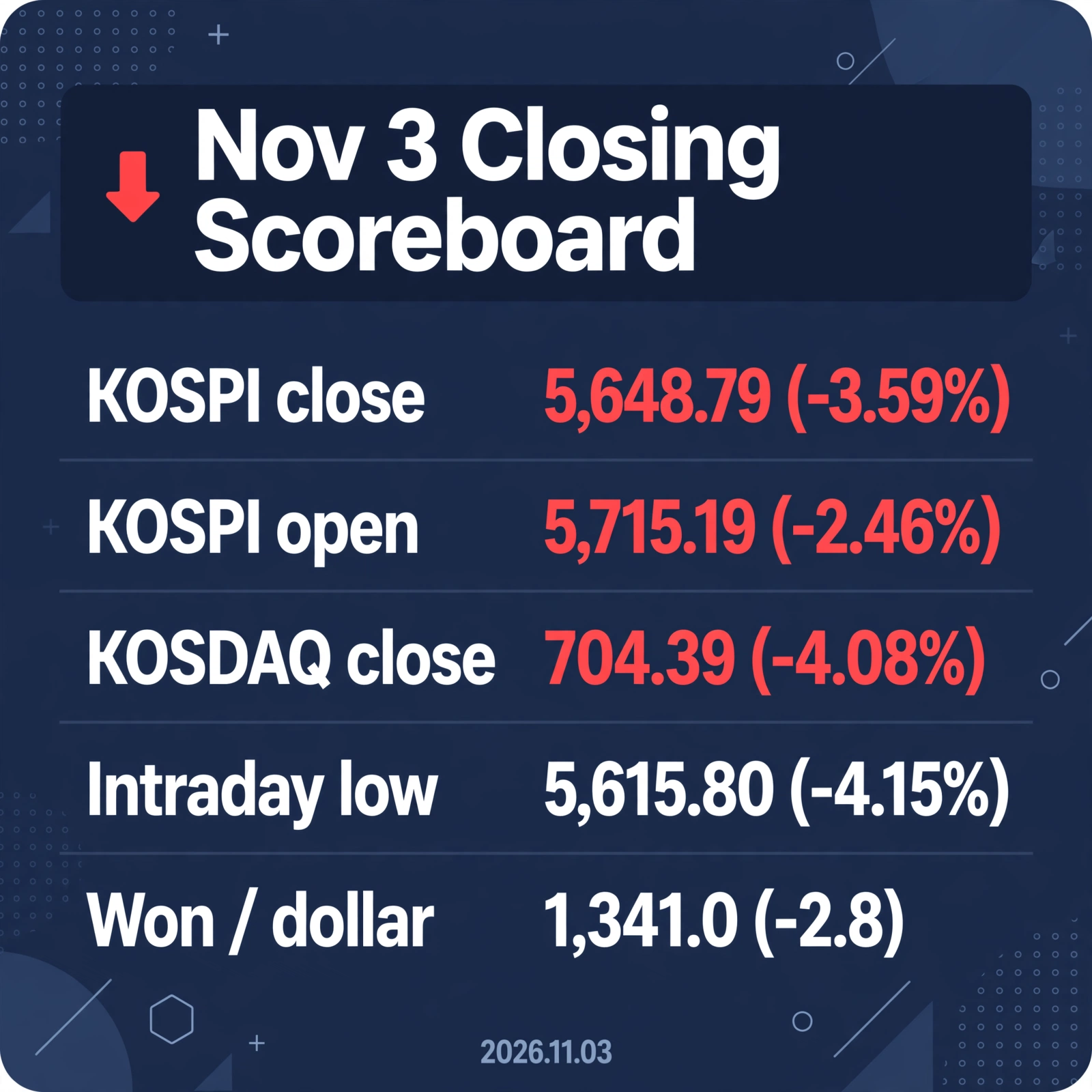
November 3 Korea market close: the KOSPI fell 3.59% to 5,648.79 and the KOSDAQ fell 4.08% to 704.39 as AI funding worries and US midterm caution triggered heavy foreign and institutional selling. Retail investors bought a net 2.60 trillion won alone. What it means for EWY holders.
5minbrief on YouTube
The briefs also come as videos. Get the daily market wrap on YouTube.
Subscribe on YouTube