 5-minute briefs
Strait of Hormuz Oil Price Analysis US Iran Strikes and 13% Weekly Drop
#Strait of Hormuz#Brent crude#oil price
Oil weekly scoreboard: Brent $98.32, down 13.3% in a week
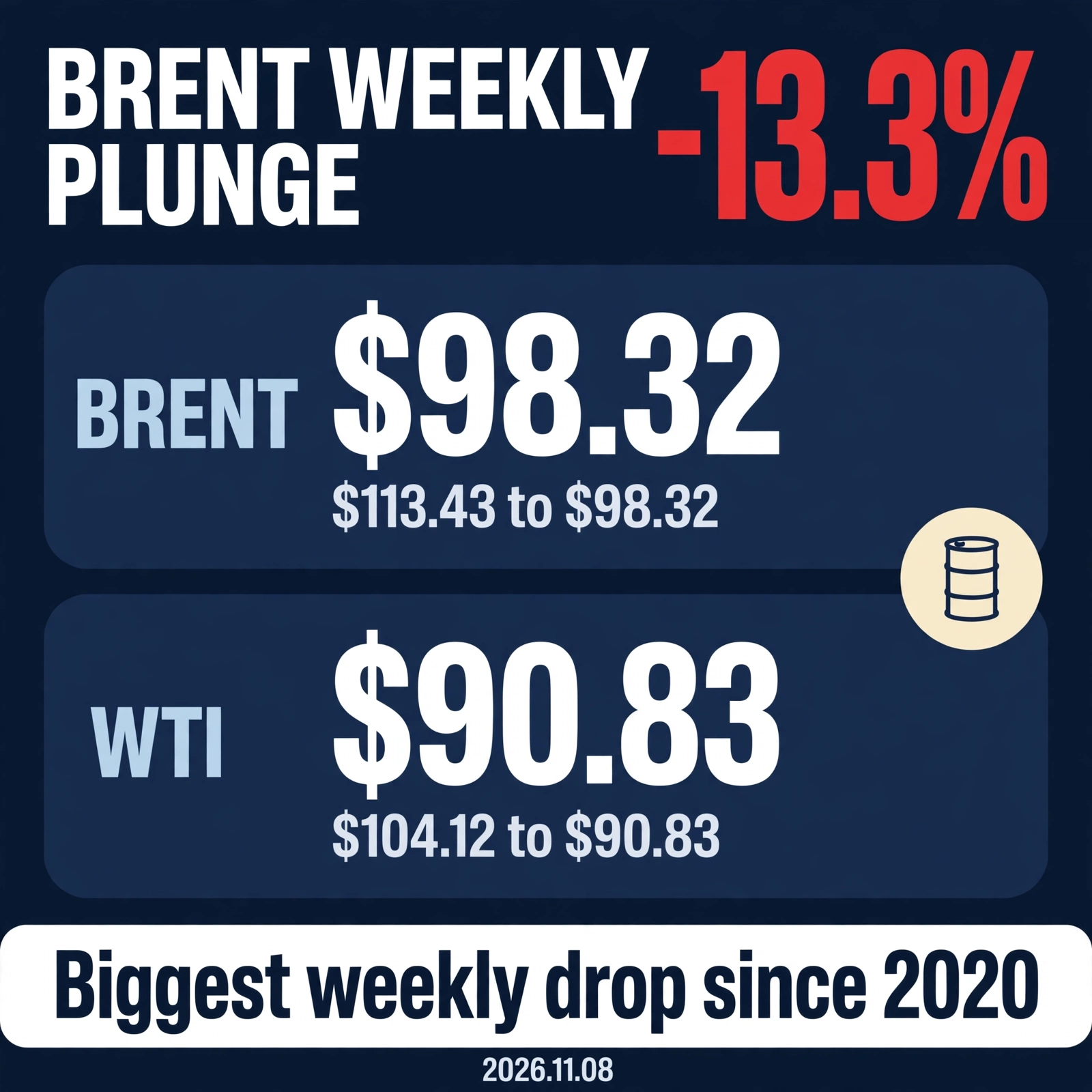
Oil ended the week almost flat on the day. January Brent settled 3 cents higher at $98.32 a barrel, and December WTI rose 31 cents to $90.83 on Friday, November 6. The week tells a different story. Brent fell from $113.43 on October 30 to $98.32 — down $15.11, or 13.3% — while WTI dropped from $104.12 to $90.83, down $13.29, or 12.8%. It is the biggest weekly drop since 2020, a pace not seen since the pandemic sell-off.
The midterm election set the direction. After Democrats won both chambers of Congress, the market bet the result would push Washington toward a diplomatic end to the war with Iran. Reports that Tehran sent a nuclear proposal to Washington through Qatari mediation drained more than $15 of war premium from Brent in a week. Hedge funds cut their combined net long positions in WTI and Brent by 78,492 contracts to 272,075 in the week to November 3 — the largest reduction since June.
But the slide was concentrated early in the week, and the decline stalled as attacks continued. On Thursday, Brent jumped 3.9% to $98.29 after reports of tanker attacks. On Friday, attack headlines supported prices through the session. Deal hopes pushed oil down; attack headlines kept it from falling further.
The weekend on the water: Qeshm strikes and tankers hitting mines
While oil fell, the strait moved the other way. On Friday, November 6, the US carried out limited strikes on an Iranian air-defence installation on Qeshm Island, the strategic chokepoint in the Strait of Hormuz. President Donald Trump called them “minor strikes”, saying the small air-defence devices Iran had installed were neutralised in “15 minutes, maybe 5 minutes”. Iranian state media reported two projectiles hitting the Suza area of Qeshm. US forces had also struck Qeshm and other targets on November 2, the day before the midterms, in what was described as a defensive action.
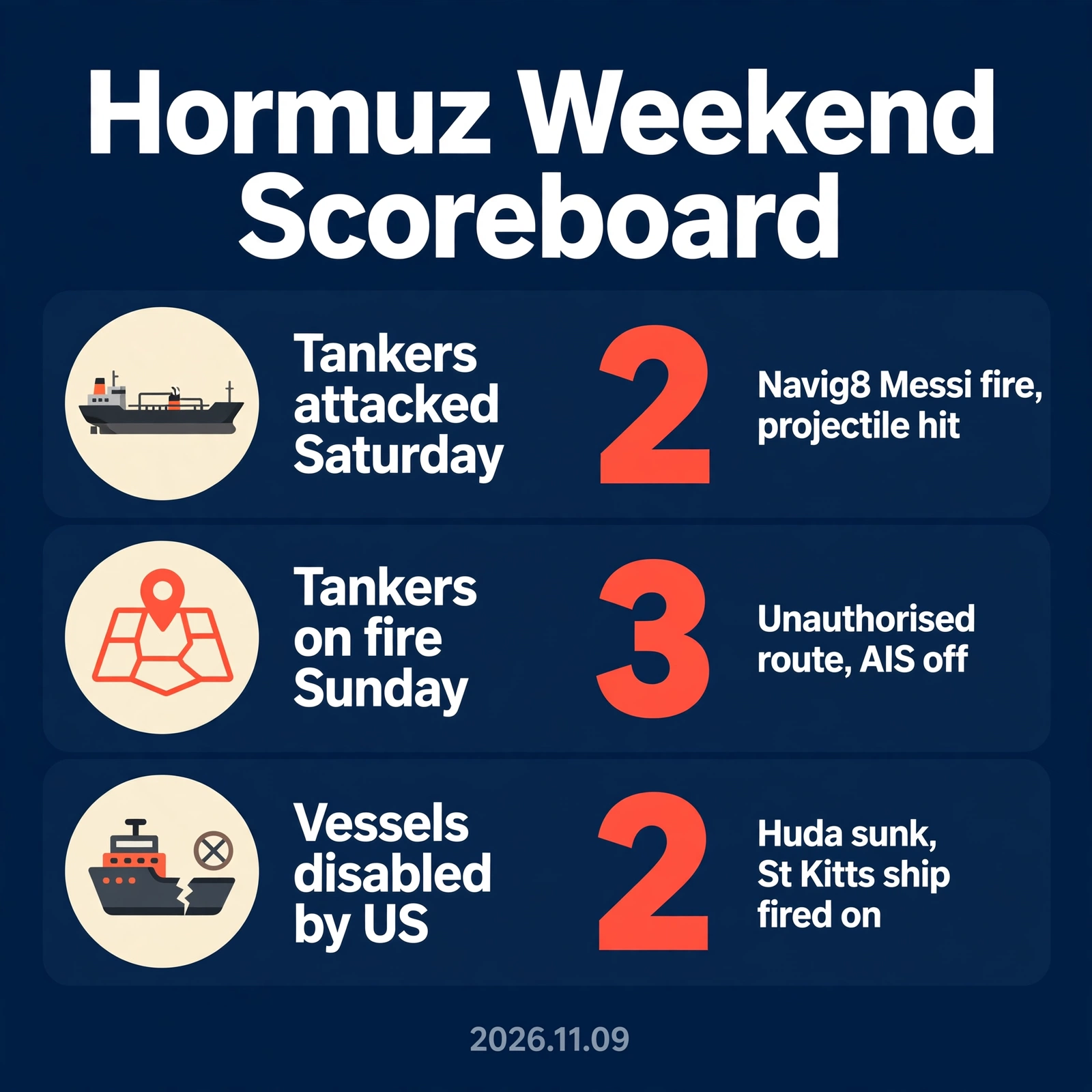
On Saturday, a tanker caught fire on a mine inside the strait. Iran’s Revolutionary Guards said two tankers hit naval mines on November 6 local time, one east of the strait and one inside it. Both had their transponders switched off and were trying to leave the strait with US support when they struck the mines and caught fire, according to the Guards. Iranian media reported that five tankers and a tugboat suffered similar incidents the previous day. Iran also claimed it shot down a US drone over Qeshm — its 16th such claim — but the US has not confirmed the drone was downed.
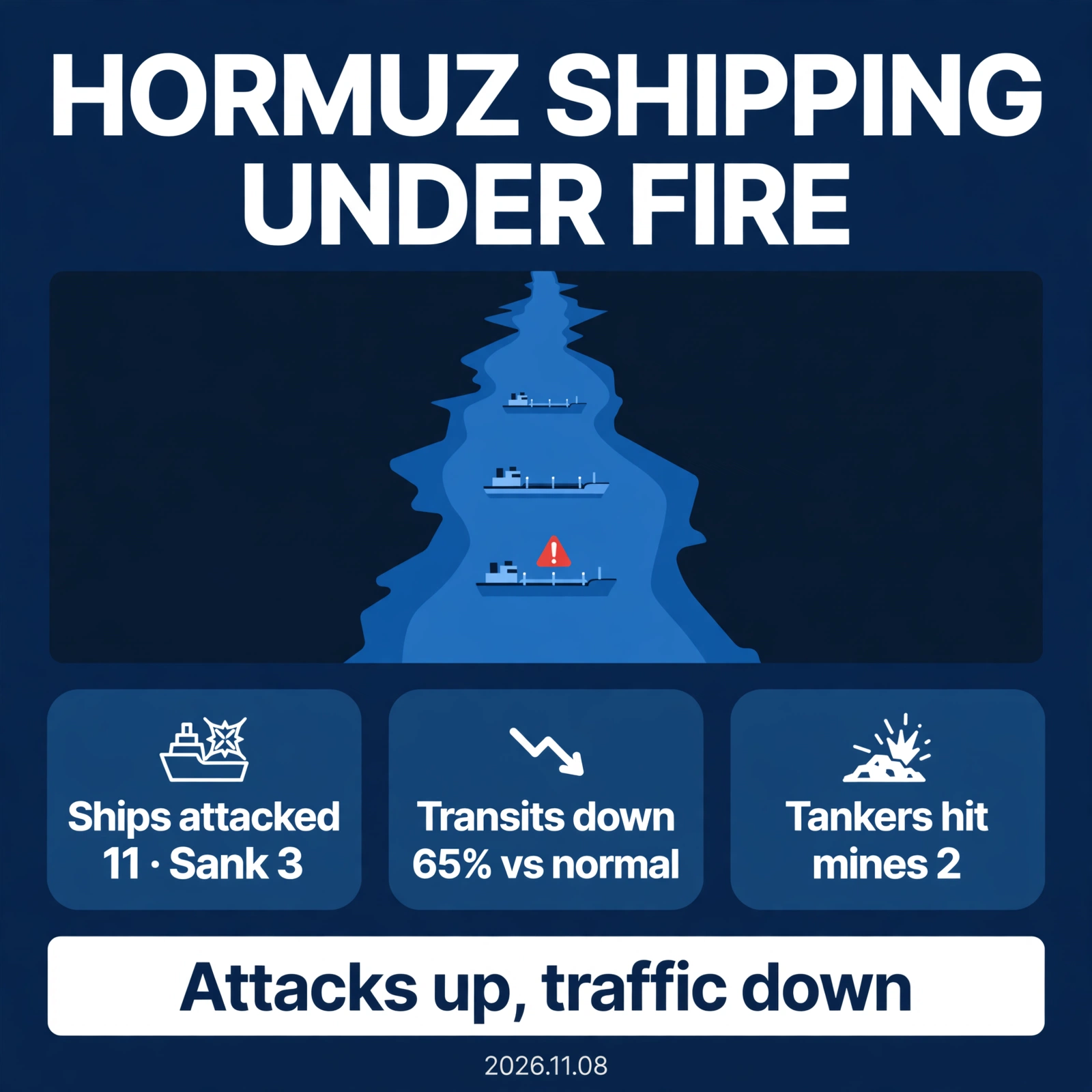
The UK Maritime Trade Operations agency (UKMTO) puts the wider picture in numbers. At least 11 ships were attacked in and around the Strait of Hormuz in the week ending November 6, and three of them sank. Western military intelligence has counted 88 projectile strikes since hostilities resumed in early July. Strait transits ran at 170 outbound and 155 inbound — about 65% below pre-conflict levels — and actual oil flows are under 60% of capacity. Oil fell on deal hopes while the ships crossing the strait thinned out and the attacks sped up.
The market’s bet: deal hopes against escalation odds
The diplomatic channel is still open. Qatar is mediating, and its emir spoke with President Trump by phone on Friday about the mediation effort. Reuters reported, citing a senior Iranian official, that Iran sent a nuclear proposal to Washington through Qatar. But Tehran wants the US naval blockade lifted, sanctions eased and frozen assets released before it fully reopens Hormuz. No agreement has been announced.
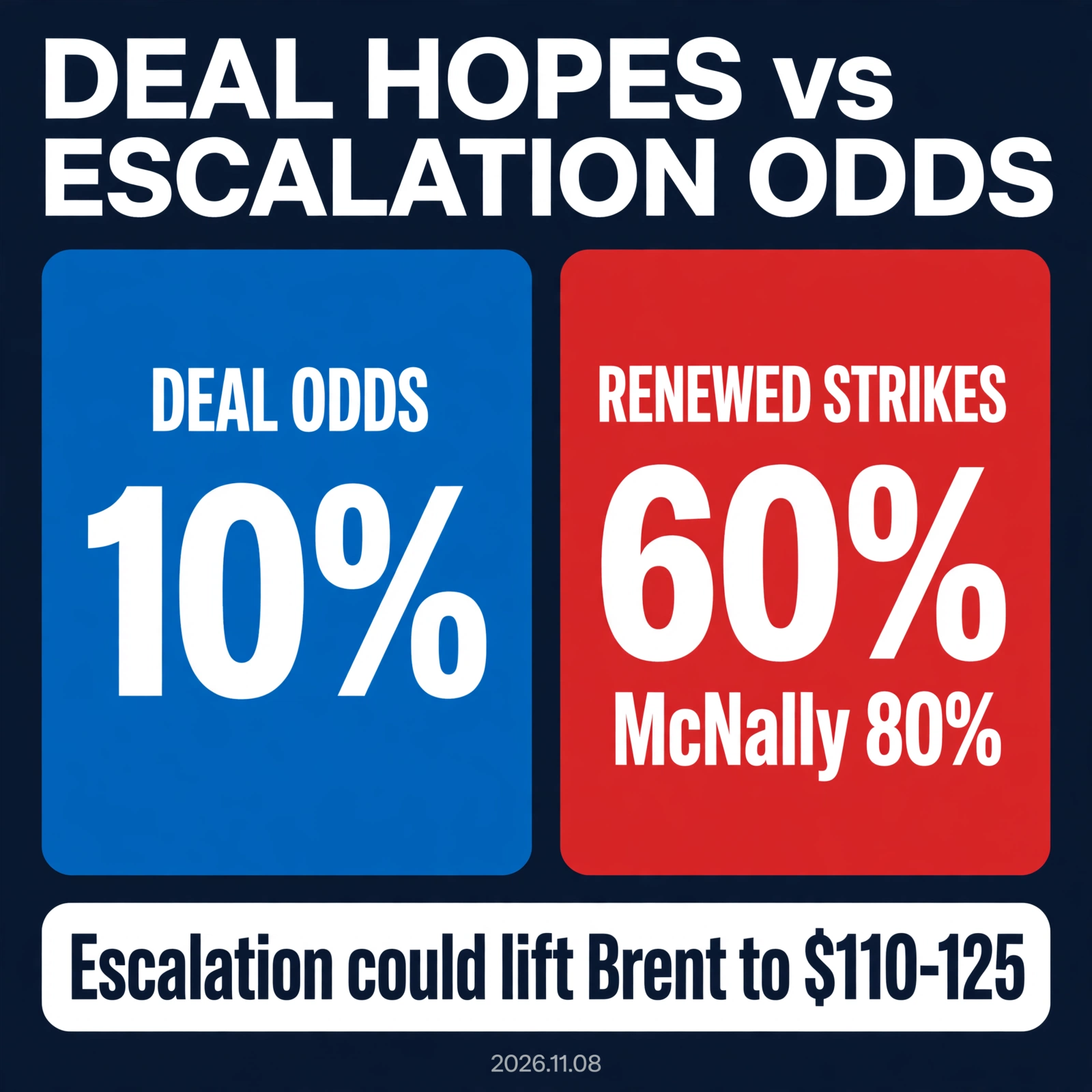
Analysts’ odds sit far from the market’s optimism. Eurasia Group put the probability of renewed US strikes at 60% and of a deal at 10%, and said escalation could push Brent to $110–125. Bob McNally of Rapidan Energy put the chance of resumed military action at 80% and expects Brent and WTI back above $100. The market bet on the 10% deal; analysts see 60–80% odds of renewed strikes.
US stocks reflected some of the tension on Friday. On official closes, the Nasdaq rose 1.09% to 24,579.42, the S&P 500 gained 0.31% to 7,376.86, and the Dow fell 0.46% to 51,285.73. Spot gold closed at $4,070.59, up about 4.5% on the week. Safe havens rose while oil fell. Before Tuesday’s October CPI and Wednesday’s OPEC monthly report, Monday’s open will first price the weekend’s Hormuz headlines.
- War premium: the extra price oil carries because of war and supply-disruption risk. It drains out when deal hopes rise and comes back when attacks continue.
- Strait of Hormuz: the narrow channel linking the Persian Gulf to the Gulf of Oman, the key sea route for the world's oil. Flows running under 60% of capacity means the supply chain is heavily constricted.
- Qeshm Island: a large Iranian island inside the Strait of Hormuz, overlooking the shipping lanes — a strategic chokepoint and the target of the latest US strikes.
- UKMTO: the United Kingdom Maritime Trade Operations agency, which tracks and publishes attacks and safety information for shipping in Middle East waters.
- Naval mine: an explosive placed in the sea that detonates when a ship touches it. Iran says tankers using "unauthorised" routes hit mines.
- Net long position: hedge funds' bets on higher oil prices minus their bets on lower prices. A falling net long means funds are closing out bullish bets.
To sum up: oil fell 13% in a week on deal hopes, while attacks in the Strait of Hormuz ran at a near-record pace in the same week. The US strikes on Qeshm, the tankers hitting mines, and the UKMTO count of 11 ships attacked and 3 sunk show the water moving the opposite way from the market. Oil did not fall because the war ended — it fell because the market bet first that the war would end. Whether that bet holds, or the war premium comes back, turns on the Hormuz headlines after the weekend.
Sources & references
- Al Jazeera — Qeshm island and Hormuz hit, as mediators try to prevent US-Iran escalation — UKMTO count of 11 ships attacked and 3 sunk in the week to November 6, transits 65% below pre-conflict levels, Saturday mine strike on a tanker
- Swiss Financial Time — Brent Settles at $98.32 as Oil Posts Its Biggest Weekly Drop in Years on Iran Peace Bets — Brent down about 13% on the week from $113.43 to $98.32, Eurasia Group 60% renewed strikes vs 10% deal, $110–125 escalation case
- FinanceFeeds — Brent Crude Oil Price: $98.32 After 16% Weekly Drop — Saturday snapshot: Brent $98.32 and WTI $90.83 settles, $93 support and $105 resistance, US CPI on Tuesday and OPEC report on Wednesday
- Gulf News — Middle East war: 5 things UAE residents need to know today — Trump's limited strikes on Qeshm Island air defence, Qatar mediation proposals, Brent $98.32 and WTI $90.83 settles
Related articles
- Hormuz Oil Negotiation Analysis: Trump Restraint and Mining War
Three more tankers caught fire in the Strait of Hormuz over the weekend. Trump said fresh strikes are 'highly unlikely' if talks progress, while the IRGC keeps mining the strait. The fork Monday's open has to price.
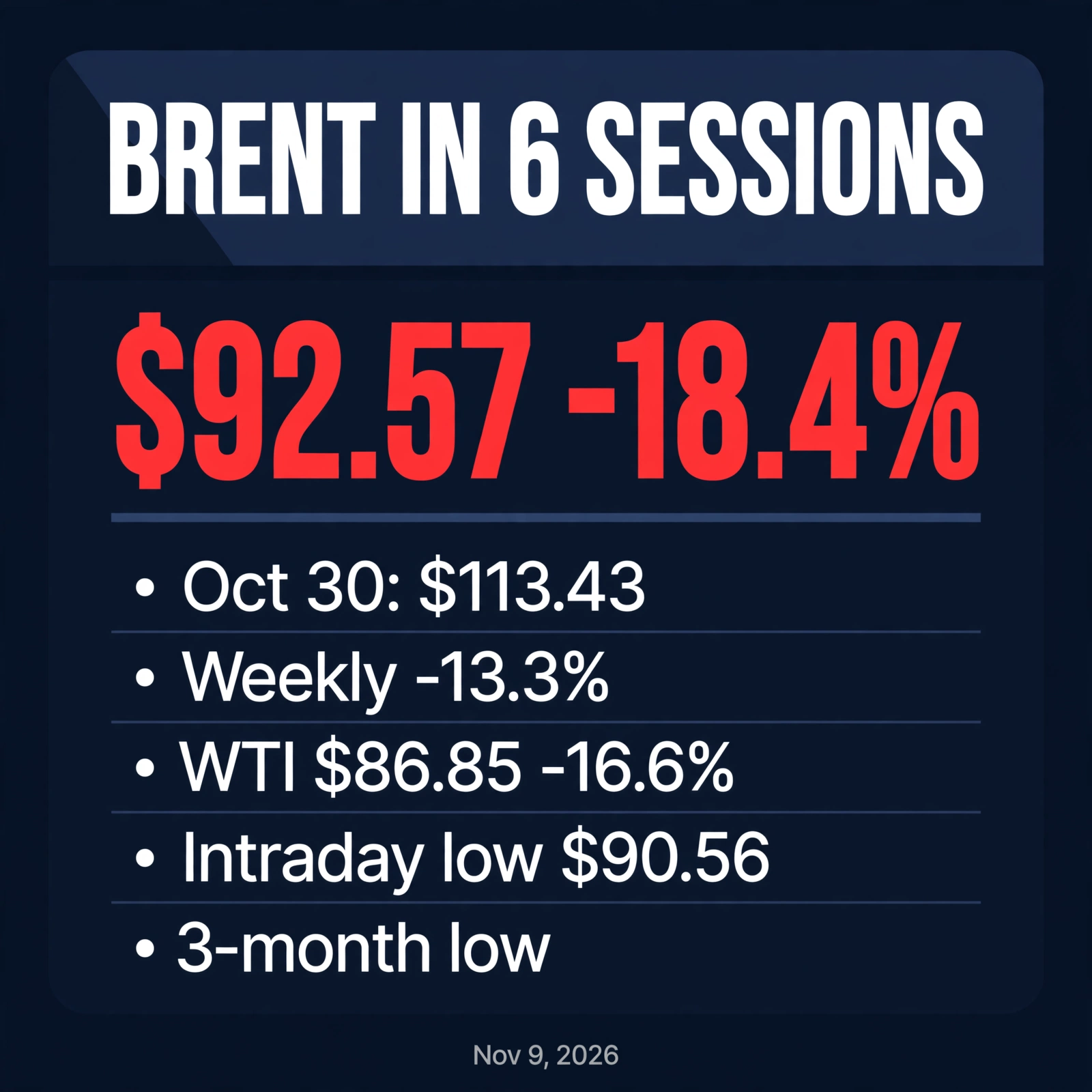
- Brent Crude Analysis: 18.4% Drop in Six Sessions on Negotiation Hopes
Brent crude has fallen 18.4% in six sessions, from $113.43 on October 30 to $92.57 on November 9. The war premium is unwinding fast — but analysts put renewed strikes at 60%, and that gap sets the terms for a reversal.
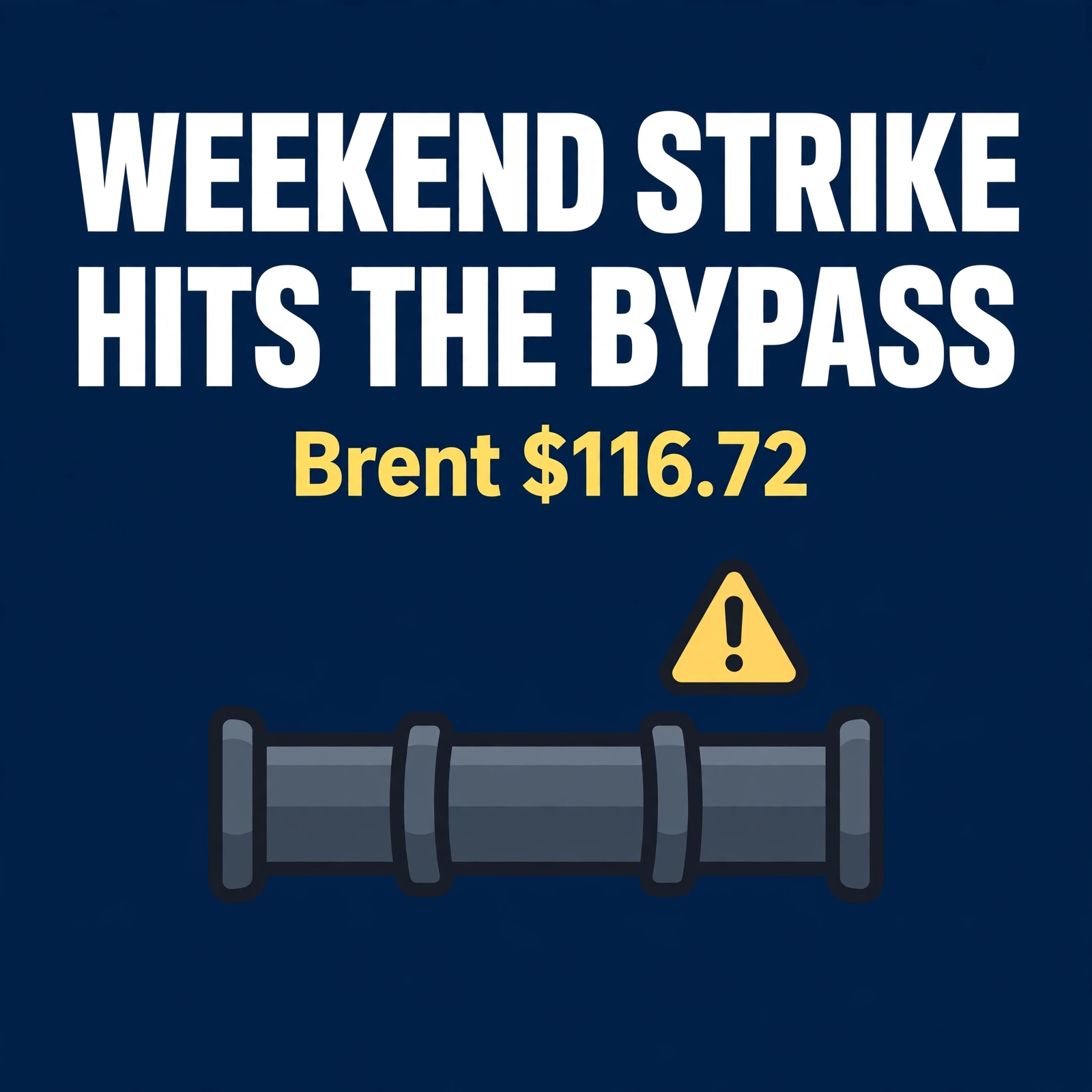
- Oil Price Outlook Brent 116 Dollars Saudi East-West Pipeline Attack Hormuz Bypass Risk Analysis (October 26)
Monday, October 26 US market holiday edition: with no newly closed trading session, this edition covers one issue in depth — Saturday's claimed attack on Saudi Arabia's East-West pipeline. Brent closed Friday at $116.72; the bypass moves up to 7 million barrels a day.
5minbrief on YouTube
The briefs also come as videos. Get the daily market wrap on YouTube.
Subscribe on YouTube