 5-minute briefs
KOSPI 5,000 Defense Analysis Weekly 11.71% Drop and Next Week Rebound Conditions
#KOSPI 5000#foreign selling Korea#won dollar exchange rate#margin loan Korea#US CPI#CoreWeave earnings#Nasdaq rebound
Friday recap — circuit breaker, then a bare hold above 5,000
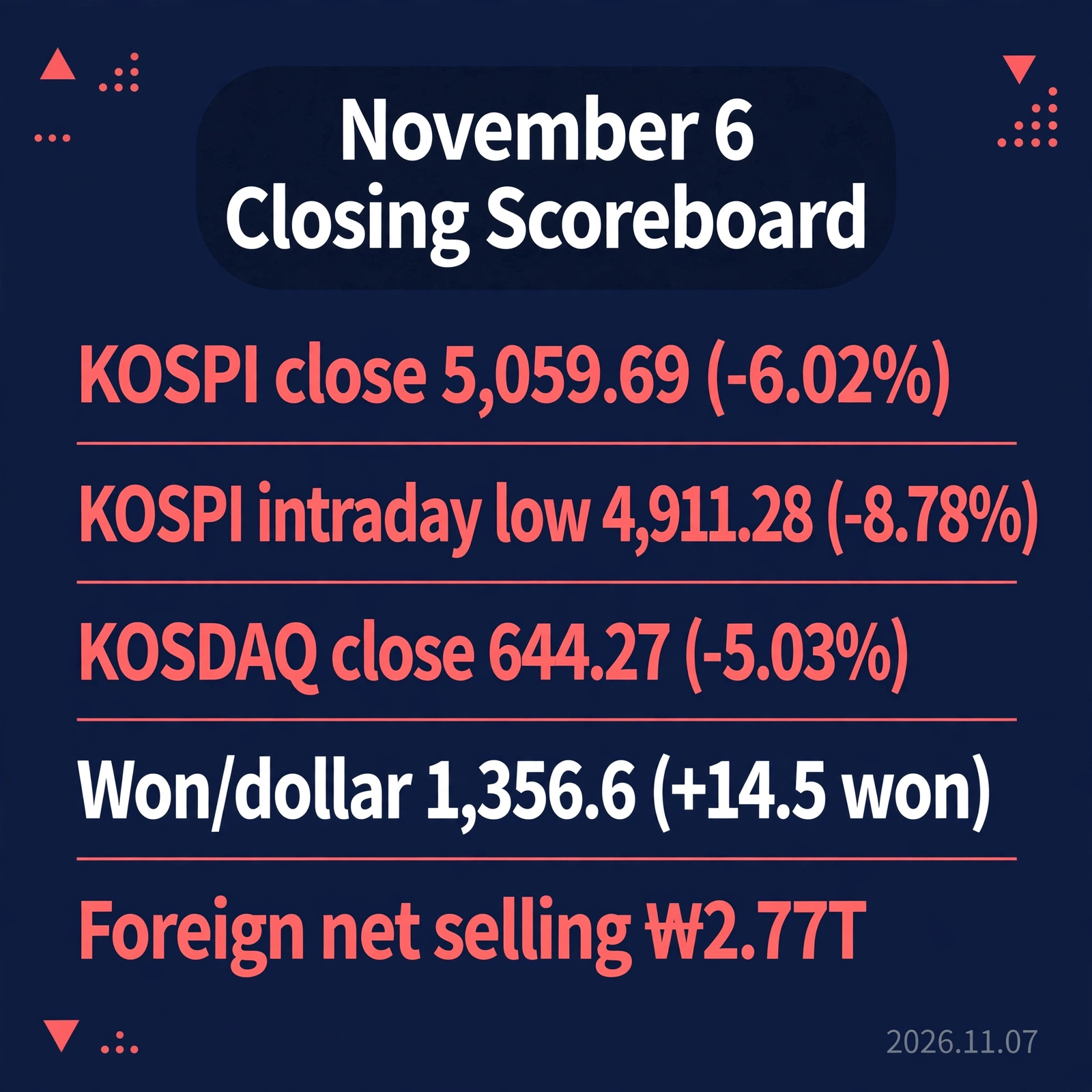
South Korea’s stock market is closed today, Saturday, November 7. This brief recaps Friday’s close, the weekend’s domestic developments, and next week’s checkpoints.
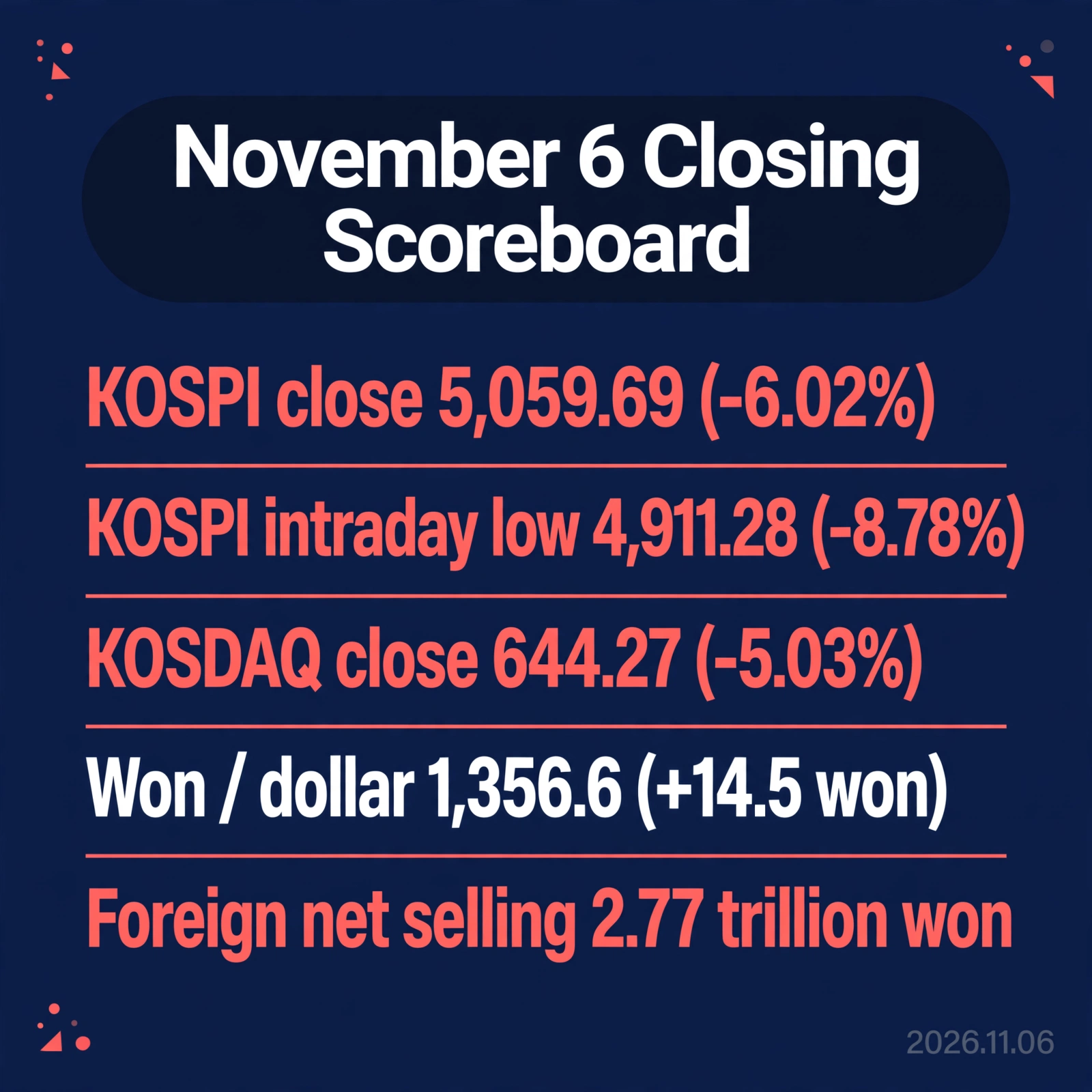
The KOSPI closed at 5,059.69, down 324.11 points (6.02%) on Friday, according to the Korea Exchange. It opened 2.24% lower at 5,263.26, then slid to an intraday low of 4,911.28, down 8.78%. A stage-1 circuit breaker halted all trading for 20 minutes at 9:03:33 a.m., the 11th halt this year and the 17th on record. It was the first time the index had traded below 5,000 intraday since February 6, and the close was the lowest since March 31. The KOSDAQ fell 5.03% to 644.27, after touching 629.17 intraday. Over two sessions the KOSPI has fallen 10.98%; over the week it fell 11.71%, from 5,730.74 to 5,059.69. It now sits 44.5% below its June 22 peak of 9,114.55.
| Index | Open | Intraday low | Close | Change |
|---|---|---|---|---|
| KOSPI | 5,263.26 | 4,911.28 | 5,059.69 | –6.02% |
| KOSDAQ | 654.43 | 629.17 | 644.27 | –5.03% |
| Won / dollar | — | — | 1,356.6 | +14.5 won |
Foreign investors drove the selling. They net sold 2.77 trillion won of KOSPI shares, a sixth consecutive session of selling that brings the six-session total to 12.16 trillion won. Domestic institutions bought 1.70 trillion won and retail investors bought 601 billion won. Foreigners were, however, net buyers of 687 billion won in KOSPI 200 futures, so cash selling and futures buying pointed in opposite directions. On the KOSDAQ, retail and foreign investors sold 110.5 billion and 101.4 billion won respectively, while institutions bought 205.7 billion won.
The two memory names set the tone. Samsung Electronics fell 6.35% to 188,700 won and SK Hynix fell 10.44% to 1,132,000 won. Over two sessions, Samsung is down 13.44% and SK Hynix 18.91%, and foreigners sold a combined 4.77 trillion won of the two names. Together the two companies account for roughly half of the KOSPI’s market value, which is why the index moves almost one-for-one with them. Of the KOSPI’s constituents, 760 fell and only 131 rose.
- Circuit breaker: when the index falls 8% or more from the previous close and stays there for a minute, the exchange halts all trading for 20 minutes. Stage 2 triggers at 15%, stage 3 at 20%. Friday's halt came at 9:03:33 a.m.
- Price limit: unlike the US, Korean stocks have a daily ±30% price band, so single names can still move violently within a session.
- Sell-sidecar: when futures plunge, program sell orders are suspended for five minutes. One fired on the KOSPI at 9:34 a.m. and on the KOSDAQ at 9:06 a.m. on Friday.
Wall Street’s Friday bounce — Nasdaq up 1.09%, rate pressure intact
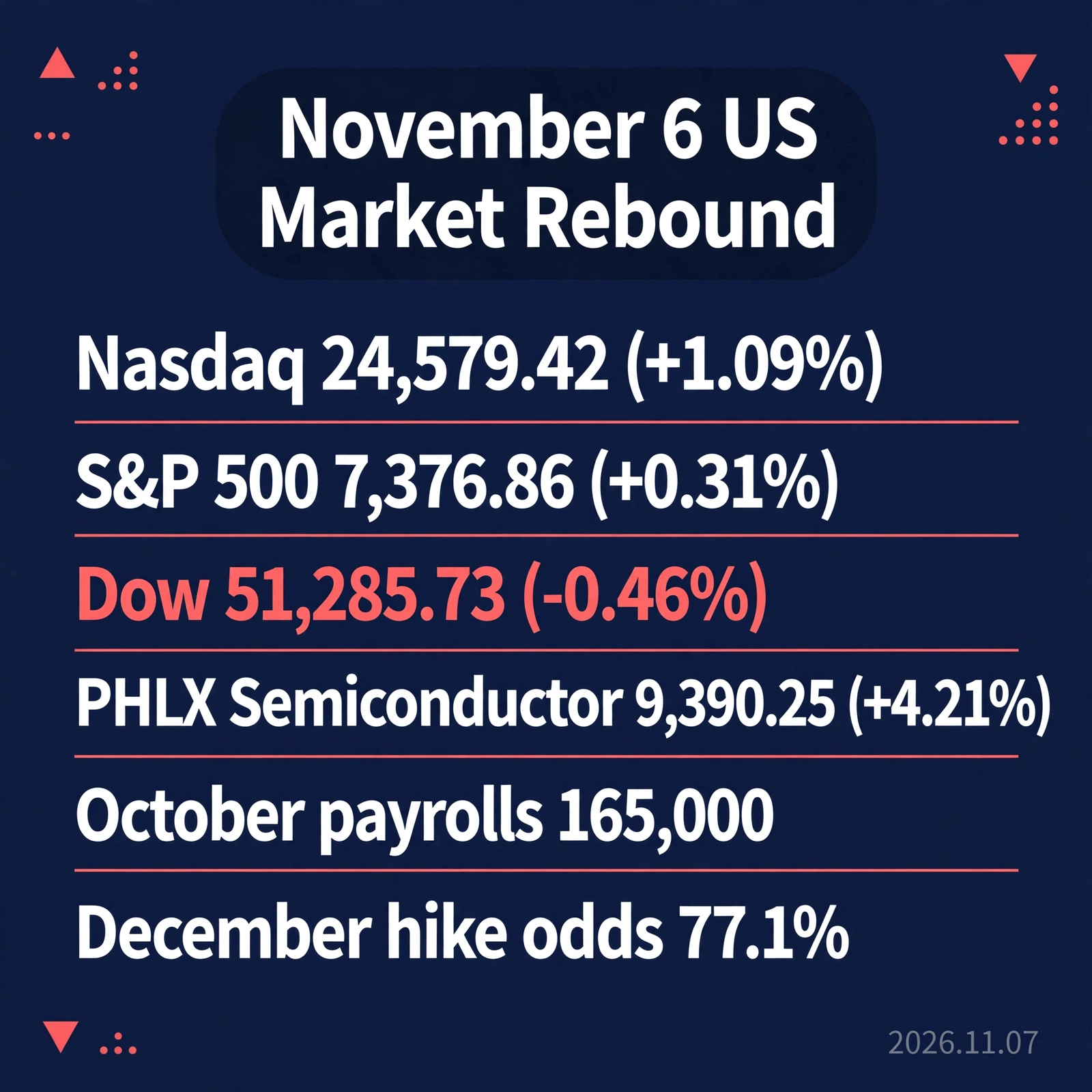
US stocks bounced on Friday, but the bounce was partial. On official closes, the Nasdaq Composite rose 264.43 points (1.09%) to 24,579.42 and the S&P 500 added 23.13 points (0.31%) to 7,376.86, while the Dow fell 237.33 points (0.46%) to 51,285.73. The Philadelphia Semiconductor Index rebounded 4.21% to 9,390.25 and the VIX fell 9.01% to 25.64. For the week, the Nasdaq lost 3.4%, the S&P 500 2.7% and the Dow 0.9% — the Nasdaq’s fourth straight weekly decline.
Keep the size in perspective. Thursday’s Nasdaq drop was 5.52%, so Friday recovered only about a quarter of it. The Nasdaq is still 10.9% below its record close of 27,599.89 on October 6 and remains in correction territory. Friday was a day the decline stopped, not a day the trend turned.
By name, AMD jumped 11% and Nvidia rose 2.8%; TSMC’s US-listed shares and Micron rose about 6% each, and Tesla gained 4.23%. But the financing doubt behind the selloff has not cleared. Reports that Microsoft is winding down a contract to lease AI computing capacity from Oracle pushed Oracle down as much as 5.17% intraday before it closed slightly higher. Texas governor-elect Gina Hinojosa said she would legislate protections for residents and halt data-center construction until those protections are in place — though she does not take office until January. Separately, Nvidia has reportedly asked TSMC to develop advanced 3D memory, which would put a new competitor into a memory market now split three ways between Samsung, SK Hynix and Micron. That is still at the reporting stage, not a confirmed development or production plan.
The jobs report capped the rally. October nonfarm payrolls rose 165,000, nearly triple the roughly 60,000 consensus, and unemployment fell to 4.1%. August and September payrolls were revised up by a combined 84,000. Strong hiring pushed the odds of a 25-basis-point December hike to 77.1% on CME FedWatch, up from 66.9% at Thursday’s close, and the 10-year Treasury yield to 4.86%. Jobs point toward tightening while falling oil points toward softer inflation — so October CPI, due the night of November 10, is the next number that sets December hike odds.
Weekend issues — margin-loan waiver starts Monday, but the rollout is uneven
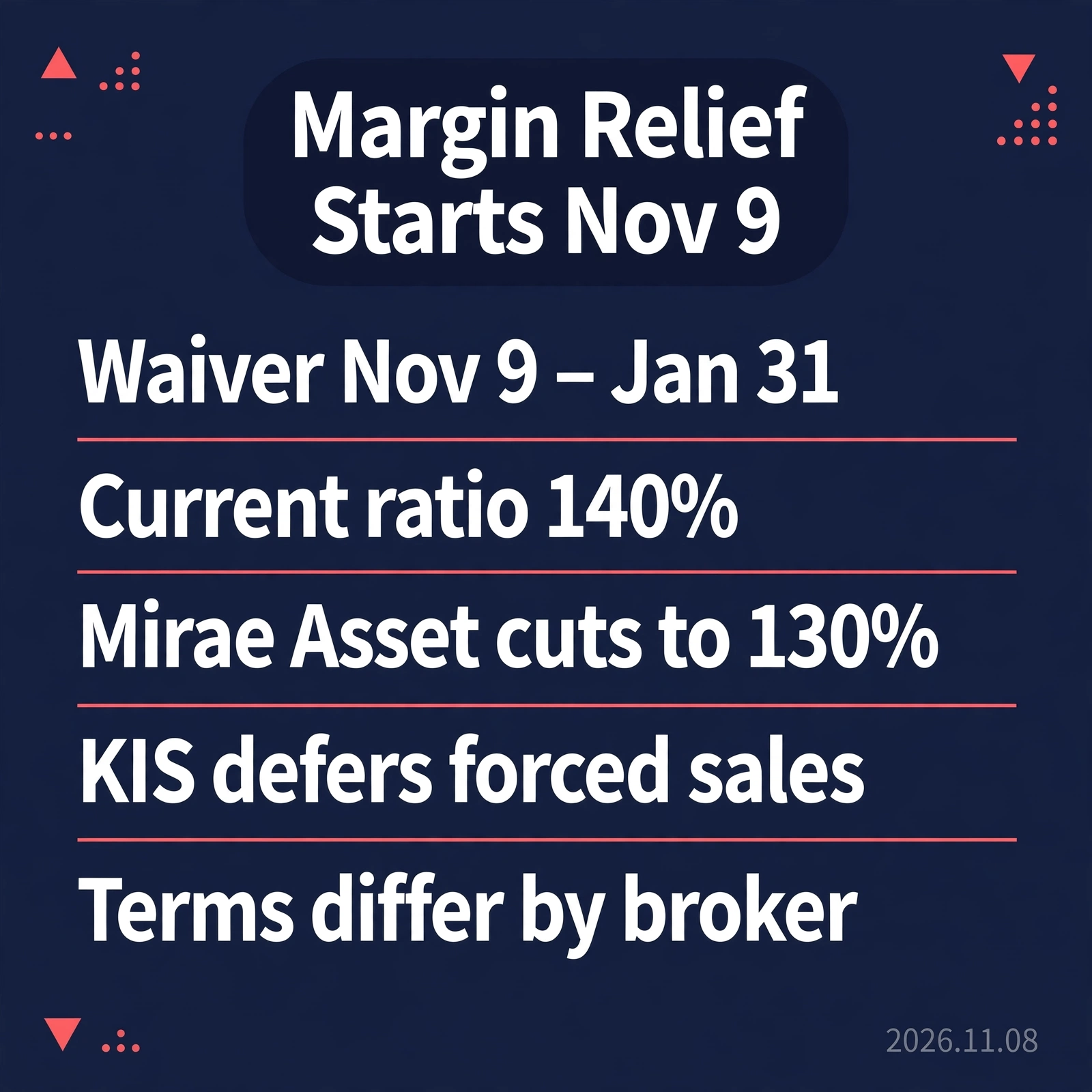
The government moved on Friday. At a joint market-review meeting chaired by Deputy Prime Minister and Finance Minister Lee Hyung-il, authorities decided to exempt brokerages from the 140% collateral maintenance requirement on margin loans for three months, starting Monday, November 9. The aim is to break a vicious circle: falling prices erode collateral, forced selling follows, and forced selling pushes prices down further. The same exemption was used for three months in July 2022. Outstanding margin loans stand at about 28.6 trillion won — the waiver stops forced selling from cascading, not leverage itself from shrinking.
But the rollout is already uneven. Some NH Investment & Securities branches in the Jeonnam-Gwangju region told customers the waiver would apply from November 10, a day later than the government date, according to an Asia Economy report on Saturday. A branch employee told an affected customer the notice had arrived from the company at 4:45 p.m. and that staff were calling clients. It is unclear whether this is a head-office decision or a branch-level mix-up, and most other brokerages are applying the waiver from November 9. The key point for investors: the exemption does not force brokerages to halt forced selling. Each firm may set its own timing under its own risk rules, so a customer whose broker still applies the old ratio on Monday could be sold out of a position the government’s measure was meant to protect.
- 140% collateral rule: an investor who buys on margin must keep collateral worth at least 140% of the loan. Below that, the broker can force-sell the shares. The waiver suspends that requirement for three months.
- Why it matters now: after two sessions of double-digit percentage declines, collateral values fell fast, and forced selling threatened to add supply into an already panicked market.
- Retail weight: Korean retail investors are unusually active in margin trading, so the rule reaches a large part of the market — and its uneven rollout reaches them unevenly.
Weekend issues — Team Korea’s Czech nuclear split, a 1 trillion won gap
Korea’s flagship nuclear export has hit a governance fault line. On October 29, Korea Hydro & Nuclear Power (KHNP) ended contract talks with the Daewoo Engineering & Construction–Doosan Enerbility consortium for construction of two APR1000 reactors at Dukovany in the Czech Republic. The dispute is over who bears the cost of design changes: KHNP wanted a lump-sum contract fixed on baseline quantities, while the consortium wanted payments adjusted as quantities rise with detailed design. The gap in recognised construction costs is about 1 trillion won. The APR1000 is being built commercially for the first time, which makes quantities and costs hard to pin down in advance.
The blame game is now public. KHNP says it gave the consortium enough time and ended talks to protect the schedule; Daewoo says KHNP changed the terms on October 7, demanded an answer within about three weeks, and declared talks over without properly reviewing a revised proposal submitted on October 29. Daewoo asked the trade ministry to mediate, but the ministry says it has no legal authority to mediate a commercial dispute between companies — a telling limit on state power in a project marketed as a national team effort. The ministry has, however, activated an emergency management system with weekly checks by the minister and vice minister.
The official schedule stands: a construction permit application in April 2027, groundbreaking in November 2029, and a new contractor selected by July 2027, with a tender notice in March–April 2027 and a bidder briefing in January. Doosan Enerbility says it will bid in the new tender, and Hyundai Engineering & Construction confirmed the same on its October 30 earnings call. A Samsung C&T–Hyundai E&C consortium is seen as a contender.
The market read the news as a single event, but Doosan’s exposure is split. On Friday, Doosan Enerbility fell 9.33% to 44,700 won and Daewoo E&C fell 4.59% to 10,400 won. Yet Doosan’s reactor equipment (about 4.9 trillion won) and turbine generator (about 0.7 trillion won) supply contracts, signed with KHNP on December 16, 2025 and worth about 5.64 trillion won combined, remain in effect without amendment or termination. Doosan also publicly distanced itself from a consortium statement issued by Daewoo, saying it was released without prior consultation and that Doosan, as a non-lead member with a 45% stake against Daewoo’s 55%, played only a limited role in the construction talks. What is on trial is the “On Time, On Budget” execution record Korea’s nuclear industry sells abroad. The full analysis is in today’s companion post.
Next week — UK selling may be exhausting, and CoreWeave plus CPI decide
The first question for next week is the nature of foreign selling. UK-based funds net sold 97 trillion won of Korean shares in January–September, 76 trillion won of it in just four months from June to September. That is about 45% of all foreign net selling of 214 trillion won in the period; US funds sold 65 trillion won. The scale is striking because UK holdings of Korean shares (172 trillion won) are only about a sixth of US holdings (1,006 trillion won). The suspected driver is a UK inheritance-tax change: from April 6, 2027, unwithdrawn pension assets and pension death benefits become subject to the 40% inheritance tax. The bill was finalised in March 2026 and the details published in May, giving pensioners an incentive to withdraw pensions as living funds rather than leave them for inheritance. The full analysis is in today’s companion post.
There are also signs the selling is exhausting itself. Korea Investment & Securities researcher Yeom Dong-chan notes that UK holdings have fallen back to early-year levels and monthly net selling has shrunk, and that US funds have been net buyers since July. It is too early to call the end of net selling, but the capacity to keep selling at the same pace is diminishing.
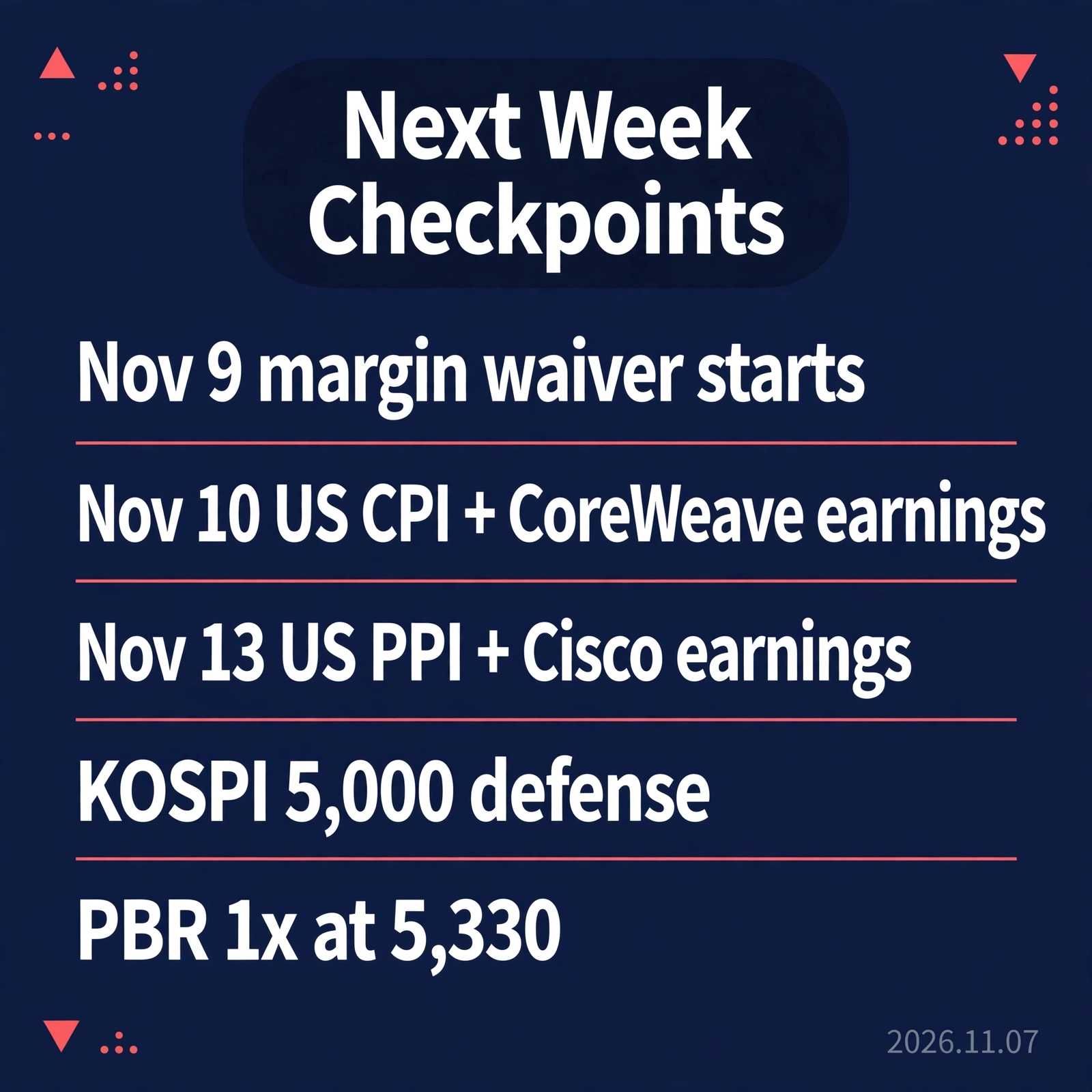
Analysts are split. Shinhan Investment & Securities’ Kang Jin-hyuk warns of aftershocks from fear-driven selling early next week, citing broken technical support and a surge in put-option trading. Daishin Securities’ Lee Kyung-min puts the chance of a full federal halt to data-center construction at under 5% and reads the drop as an undershoot in a mid-term bottoming process, with 12-month forward price-to-book of 1x at 5,330. Samsung Securities’ Heo Jin-wook argues the Democrats’ priorities are health-insurance subsidies, tariff repeal and ending the Iran war, so AI regulation is not their top priority and the concern should fade over time — while falling oil and stable long rates support real incomes and consumption.
The calendar (Korea time):
| Date | Event |
|---|---|
| Mon, Nov 9 | Korean market reopens; margin-loan waiver takes effect |
| Tue, Nov 10, 22:30 | US October CPI |
| Early Wed, Nov 11 | CoreWeave Q3 earnings (US Nov 10 after close) |
| Early Fri, Nov 13 | Cisco earnings (US Nov 12 after close) |
| Fri, Nov 13, 22:30 | US October PPI |
| Dec 8–9 | FOMC rate decision |
Three numbers to watch: whether foreign selling continues and whether the KOSPI holds 5,000; CoreWeave’s earnings — not just revenue growth but cash flow, interest costs and funding plans, which test whether AI investment is sustainable; and US October CPI and December hike odds, which decide whether the rate burden that capped Friday’s rebound gets heavier.
Not investment advice. Figures verified as of November 7, 2026, from the Korea Exchange, Yonhap, Aju Press, KBI Intelligence, World Nuclear News, BTIN, Maeil Business Newspaper and Asia Economy.
Sources & references
- Aju Press — KOSPI plunges over 6% as AI selloff triggers trading halt — KOSPI 5,059.69 (-6.02%), circuit breaker at 9:03 a.m., foreign selling 2.77 trillion won, margin-loan collateral waiver from Monday
- KBI Intelligence — This Week in Korean Industry, 6th November 2026 — KOSPI weekly drop, KHNP Czech nuclear tender after talks collapse, Samsung C&T–Hyundai E&C seen as contender
- World Nuclear News — KHNP ends negotiations with construction consortium for Czech units — KHNP ends Dukovany construction talks, new contractor by July 2027, Doosan equipment contracts remain in effect
- BTIN — Nasdaq Rebounds but Ends Week Down 3.4% After AI Selloff — Official Friday closes: Nasdaq 24,579.42 (+1.09%), S&P 7,376.86 (+0.31%), Dow 51,285.73 (-0.46%), SOX +4.2%, payrolls 165,000
- Maeil Business Newspaper — Analysts say UK inheritance tax reorganization raised net foreign selling — UK funds net sold 97 trillion won in January–September, 76 trillion won in June–September, holdings down to early-year levels
- Asia Economy — NH Investment & Securities branches give conflicting margin-waiver start dates — Some NH Investment & Securities branches in Jeonnam-Gwangju told customers the waiver starts November 10, a day later than the government date
Related articles
- KOSPI Monday Preview: 10.4 Trillion Won Foreign Selling, Won at 1,356.6, Margin Relief Starts
Korea market Sunday edition: Seoul is closed today, but the weekend formalized three months of margin-loan relief starting Monday. Foreigners sold about 10.4 trillion won of KOSPI shares last week, yet the won held at 1,356.6 — semiconductor export dollars and a record current-account surplus did the holding.
- KOSPI Failed Rebound Analysis 5,018 Close Foreign Selling Streak and Nvidia Probe
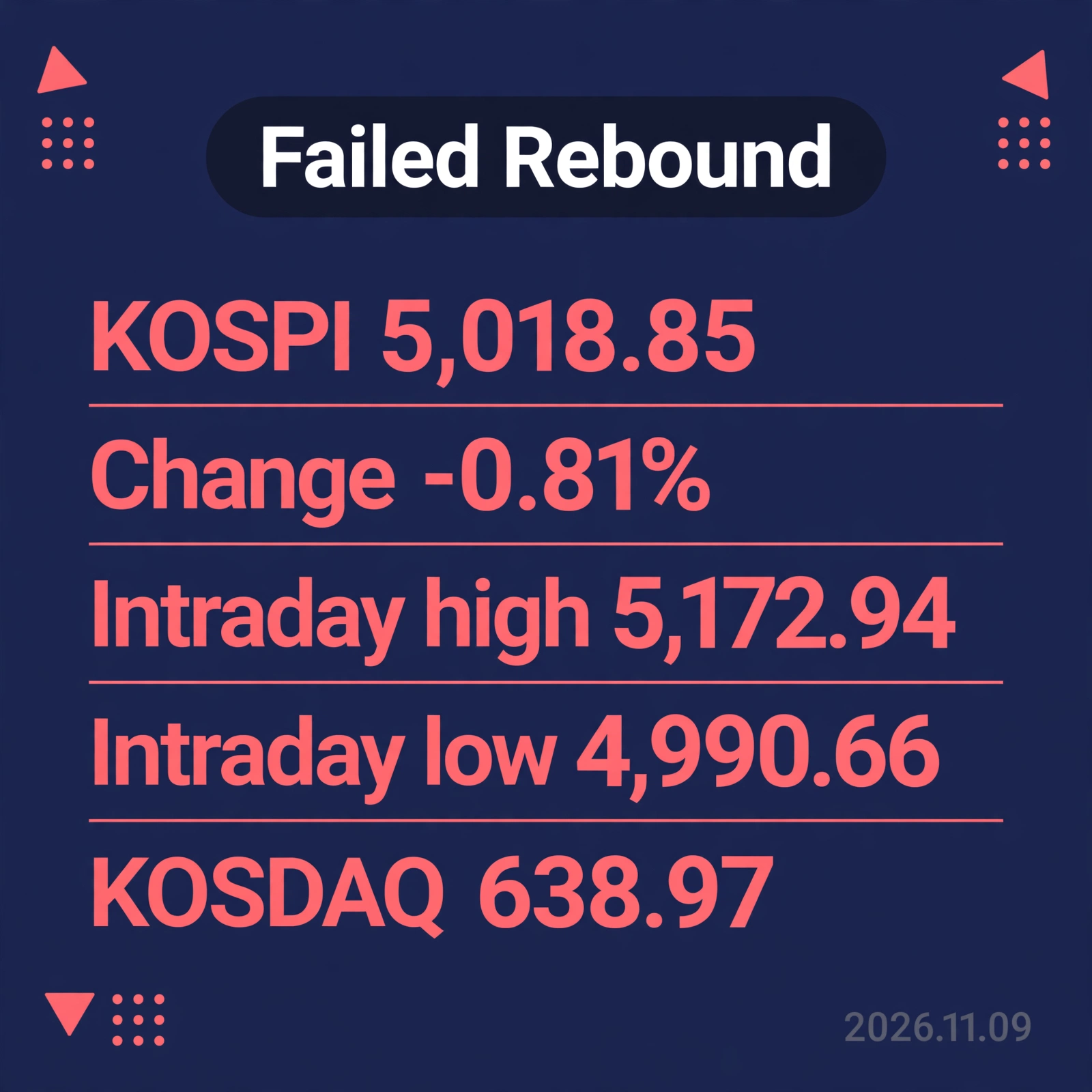
November 9 in Seoul: the KOSPI rallied 2.24% intraday to 5,172.94 but closed at 5,018.85 (−0.81%). Foreigners sold a seventh straight session, an Nvidia board probe capped the rally, and battery stocks gave back the blue-wave rally.
- KOSPI 6.02% Plunge Analysis Circuit Breaker 5000 Defense Foreign Selling
November 6 Korea market brief for foreign investors: the KOSPI plunged 6.02% to 5,059.69 as a stage-1 circuit breaker halted trading after an 8.78% intraday plunge. Foreigners sold a net 2.77 trillion won, their sixth straight day of selling, and the won fell to 1,356.6 per dollar.
5minbrief on YouTube
The briefs also come as videos. Get the daily market wrap on YouTube.
Subscribe on YouTube