 5-minute briefs
Czech Nuclear Team Korea Split Analysis 1 Trillion Won Cost Gap and Doosan Equipment Contract
How the talks collapsed — lump sum versus cost-plus
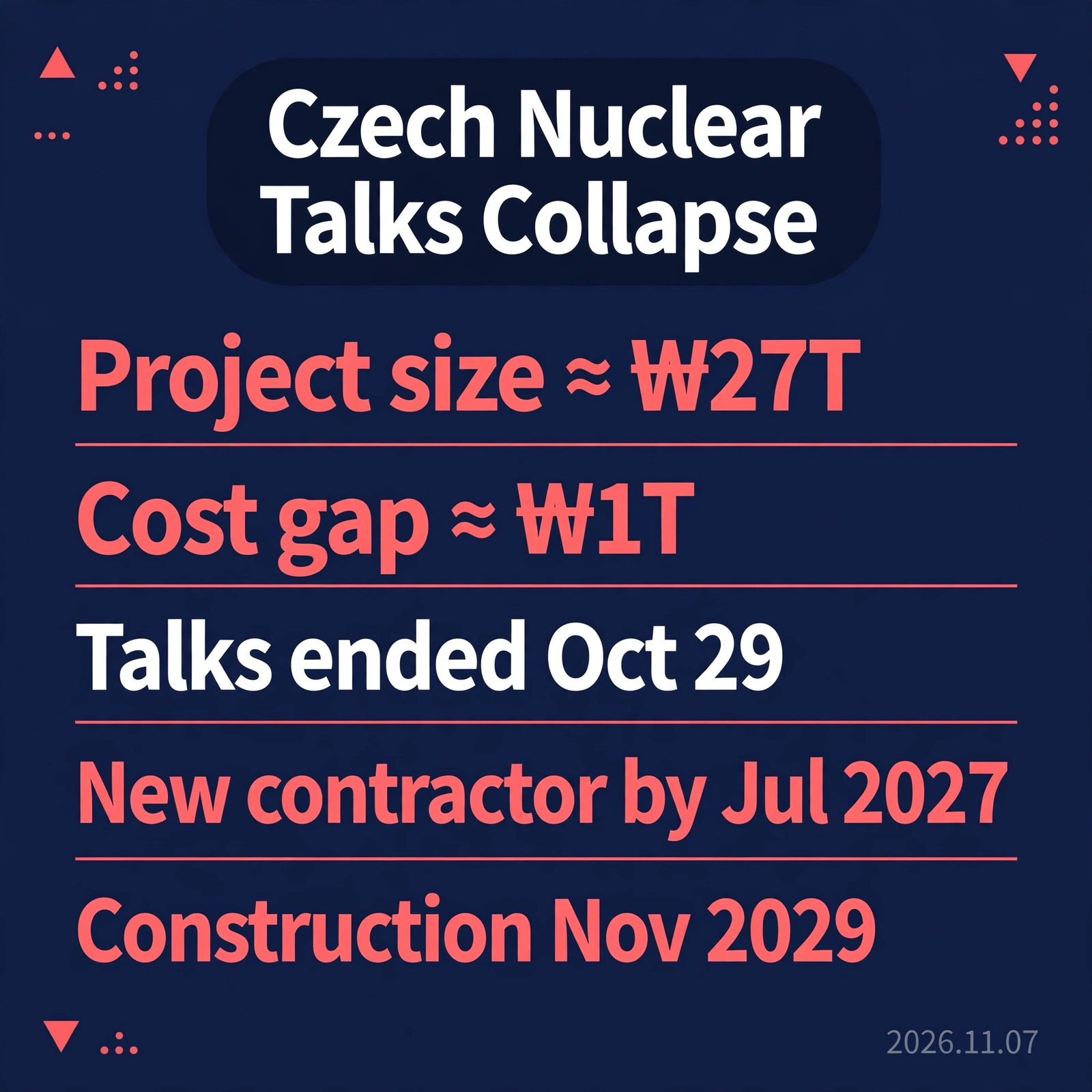
The numbers first. Dukovany is a roughly 27 trillion won project to build two Korean APR1000 reactors in the Czech Republic, with commercial operation targeted for 2039 and 2040. KHNP signed the main contract with the Czech client in June 2025, and the Daewoo–Doosan consortium had been construction partners since 2018. On October 29, KHNP ended the construction talks and switched to competitive bidding.
The fight is over how construction costs are set. KHNP wanted a lump-sum contract fixed on baseline quantities, while the consortium wanted payments adjusted as quantities rise with detailed design. Daewoo, which does not do the design work, argued it was unreasonable to bear the cost of extra work created by design changes without adjustment. The APR1000 is being built commercially for the first time, so the scope and cost are hard to predict in advance. The gap in recognised construction costs is about 1 trillion won.
Both sides now blame each other. KHNP says it gave the consortium enough time and ended talks to protect the schedule. Daewoo says KHNP changed the terms on October 7, demanded an answer within about three weeks, and declared talks over without properly reviewing a revised proposal submitted on the morning of October 29 — one that cut the total price, accepted some extra volume, and offered to absorb losses of several hundred billion won. Daewoo asked the trade ministry to mediate, but the ministry says it has no legal authority to mediate a commercial dispute between companies. That is a telling limit: a project sold as a national team effort has no state referee when the team splits. The ministry has, however, activated an emergency management system with weekly checks.
Doosan’s real exposure — 5.64 trillion won intact, 3 trillion won to re-bid
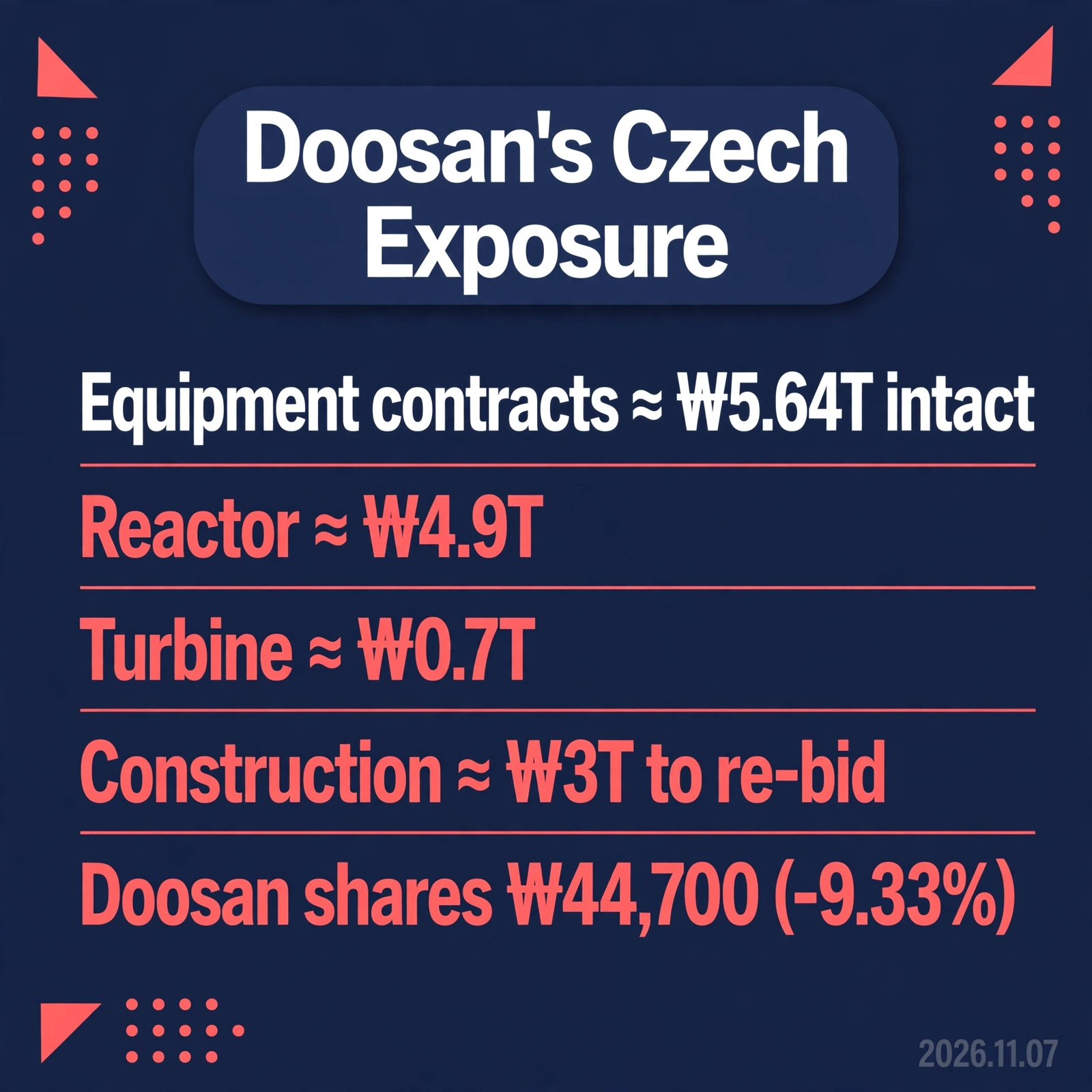
This is where the market is most likely to misread the story. On Friday, Doosan Enerbility fell 9.33% to 44,700 won and Daewoo E&C fell 4.59% to 10,400 won. But their positions differ. Daewoo was the lead contractor, with a 55% stake, and a party to the talks. Doosan held 45% and played only a limited, non-lead role — and it publicly distanced itself from a consortium statement issued by Daewoo, saying it was released without prior consultation.
Doosan’s Czech business has two parts. First, reactor equipment (about 4.9 trillion won) and turbine generator equipment (about 0.7 trillion won) supply contracts, worth about 5.64 trillion won combined, were signed on December 16, 2025 and remain in effect without amendment or termination. Doosan said in a disclosure on October 29 that design, procurement and manufacturing preparation continue as planned. Second, the construction work, which securities firms estimate at about 3 trillion won for Doosan, must now go through a new tender. Doosan says it will bid.
In other words, what Doosan lost is not a confirmed 5.64 trillion won, but the certainty of about 3 trillion won in construction work it had not yet won. Friday’s 9.33% drop may therefore reflect anxiety about the whole nuclear business, not just the construction piece. The Czech energy and construction associations added pressure on November 6, formally demanding that KHNP quickly publish the new contractor timetable and contract model, saying the absence of a construction contract is blocking local firms from mobilising staff and equipment. A long rebidding process could indirectly burden Doosan’s equipment manufacturing and delivery schedule.
Doosan’s Q3 earnings — operating profit up 90.6% to 261.2 billion won
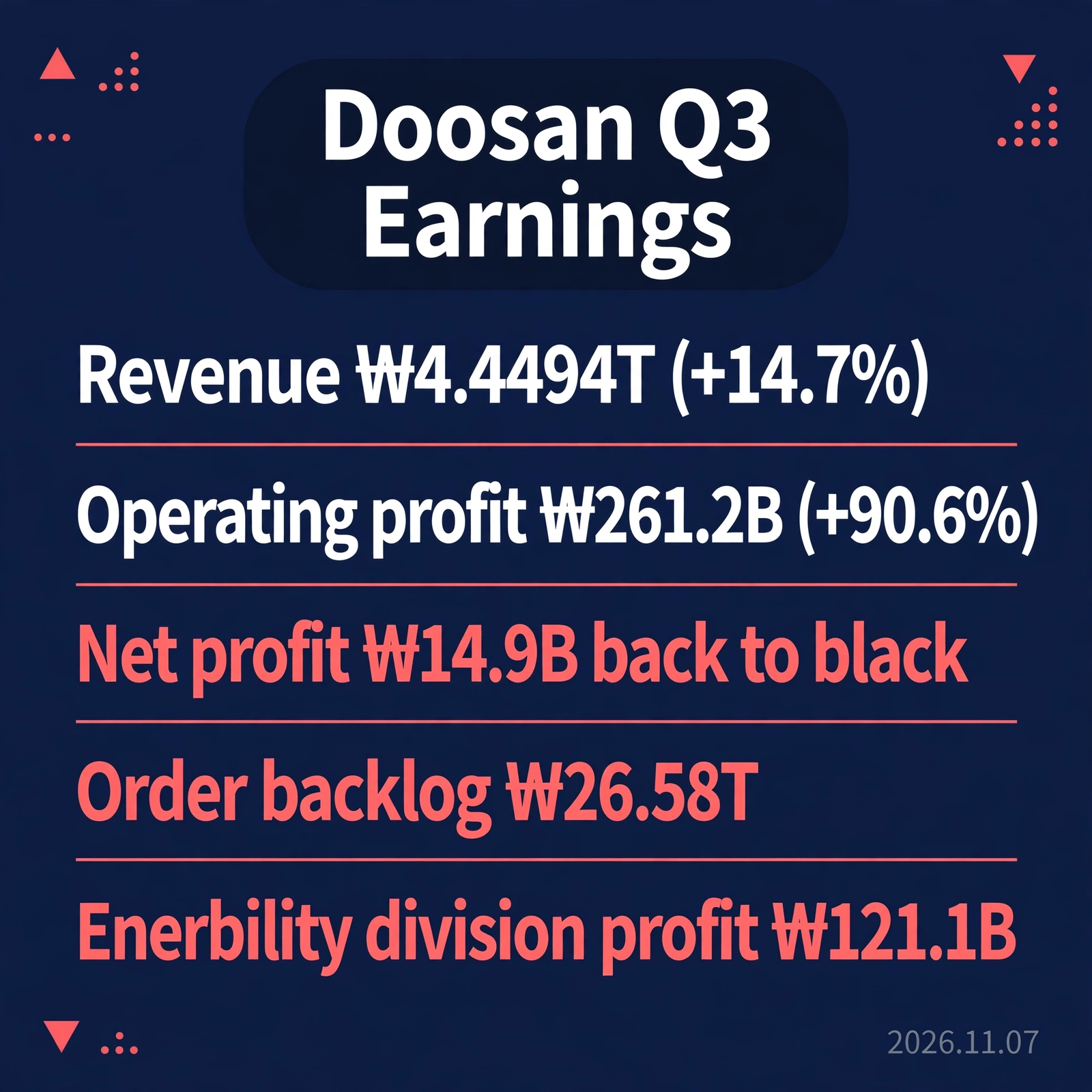
The earnings released the same day tell the opposite story. Doosan reported third-quarter consolidated revenue of 4.4494 trillion won (up 14.7% year on year) and operating profit of 261.2 billion won (up 90.6%). Net profit was 14.9 billion won, a turnaround from a 24.0 billion won loss a year earlier. Operating profit beat the 248.4 billion won consensus. For the first nine months, revenue was 13.4354 trillion won (up 10.1%), operating profit 809.0 billion won (up 46.9%) and net profit 301.5 billion won (up 97.5%). Quarter on quarter, however, revenue fell 5.8% and operating profit 16.9%.
Nuclear and gas turbines drove the improvement. The Enerbility division’s third-quarter operating profit was 121.1 billion won, about nine times the 13.4 billion won a year earlier, with the margin rising 2.3 percentage points to 6.6%. Orders also surged: nine-month orders reached 9.999 trillion won, up 85.5% year on year and about 75% of the 13.3 trillion won annual target, while the order backlog rose 70.9% to 26.5805 trillion won. The company plans to pursue about 1 trillion won of small modular reactor orders and 700 billion won of offshore wind orders in the fourth quarter.
One caution: third-quarter net profit of 14.9 billion won is small next to operating profit of 261.2 billion won, and the disclosure does not explain the items in between. The return to quarterly net profit is real, but judging earnings quality requires seeing whether net profit follows operating profit in the next quarter.
What comes next — the rebidding timetable and the “On Time, On Budget” test
The official schedule stands. A bidder briefing in January 2027, a tender notice in March–April 2027, selection of a new contractor by July 2027, a construction permit application in April 2027 and groundbreaking in November 2029. Hyundai Engineering & Construction confirmed on its October 30 earnings call that it will bid, and a Samsung C&T–Hyundai E&C consortium is seen as a contender. Whether the old consortium bids again is an open question; Daewoo wants renegotiation, but it is unclear whether KHNP will reverse its decision to end talks.
Three risks remain. First, replacing the contractor is not easy: the cost and risk-sharing terms must be settled from scratch, and if no agreement is reached on who bears the uncertainty of a first-of-a-kind APR1000 build, the same conflict could repeat with a new builder. Second, settling what the old consortium already spent: Daewoo has raised the possibility of a legal dispute over termination, and a drawn-out settlement would burden the handover to a new contractor. Third, credibility abroad: Korea’s nuclear export pitch rests not only on price and technology but on execution — finishing on schedule and on budget. The “On Time, On Budget” record is now on trial.
Three numbers to watch: the January 2027 bidder briefing and the March–April tender terms — whether KHNP insists on lump-sum or leaves room for quantity settlement will decide whether the rebidding succeeds; the form of Doosan’s rebid — alone or with a new partner — which sets the size of its construction order; and fourth-quarter earnings and orders, including the planned SMR and offshore-wind wins, and whether net profit starts tracking operating profit.
Not investment advice. Figures verified as of November 7, 2026, from World Nuclear News, KBI Intelligence, Asia Economy, MTN and Financial News.
Watch the video

Sources & references
- World Nuclear News — KHNP ends negotiations with construction consortium for Czech units — KHNP ends Dukovany construction talks, new contractor by July 2027, Doosan equipment contracts signed December 16, 2025 remain in effect, reactors due 2039 and 2040
- KBI Intelligence — This Week in Korean Industry, 6th November 2026 — KHNP fixed-price demand versus consortium quantity adjustments, Samsung C&T–Hyundai E&C seen as contender, Doosan Skoda Power turbine contract in force
- Asia Economy — Dispute Intensifies Over 27 Trillion Won Czech Nuclear Plant Contract — Daewoo offered to absorb hundreds of billions of won in losses in its October 29 revised proposal, KHNP ended talks the same day, ministry says it has no authority to mediate
- MTN — Doosan Enerbility distances itself from Daewoo over Czech nuclear talks collapse — Doosan equipment supply contract 5.6 trillion won intact, consortium stakes Daewoo 55% and Doosan 45%, Doosan to bid in new tender, order backlog 26.58 trillion won
- Financial News — Doosan Enerbility Q3 operating profit 261.2 billion won, up 90.6% — Q3 revenue 4.4494 trillion won (+14.7%), operating profit 261.2 billion won (+90.6%), net profit 14.9 billion won back to black, nine-month net profit 301.5 billion won (+97.5%)
Related articles
- KOSPI 5,000 Defense Analysis Weekly 11.71% Drop and Next Week Rebound Conditions
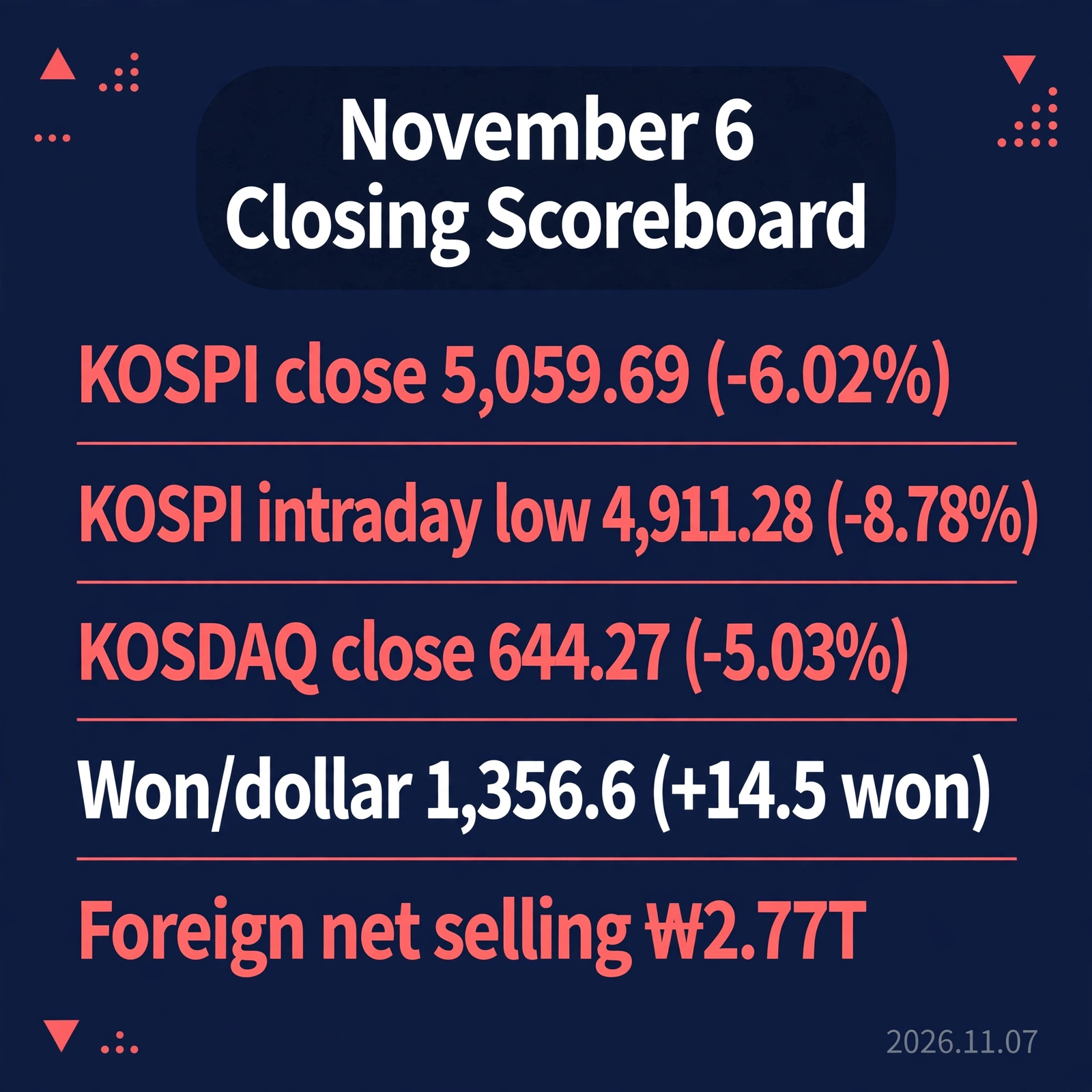
Korea market Saturday edition: the KOSPI closed Friday at 5,059.69, down 6.02% on the day and 11.71% on the week, after a circuit breaker halted trading minutes after the open. US chips bounced Friday, and next week's CoreWeave earnings and US CPI decide whether Seoul rebounds.
- CoreWeave Q3 Earnings Analysis Revenue $3.66B Beat and $846M Interest Cost Verdict
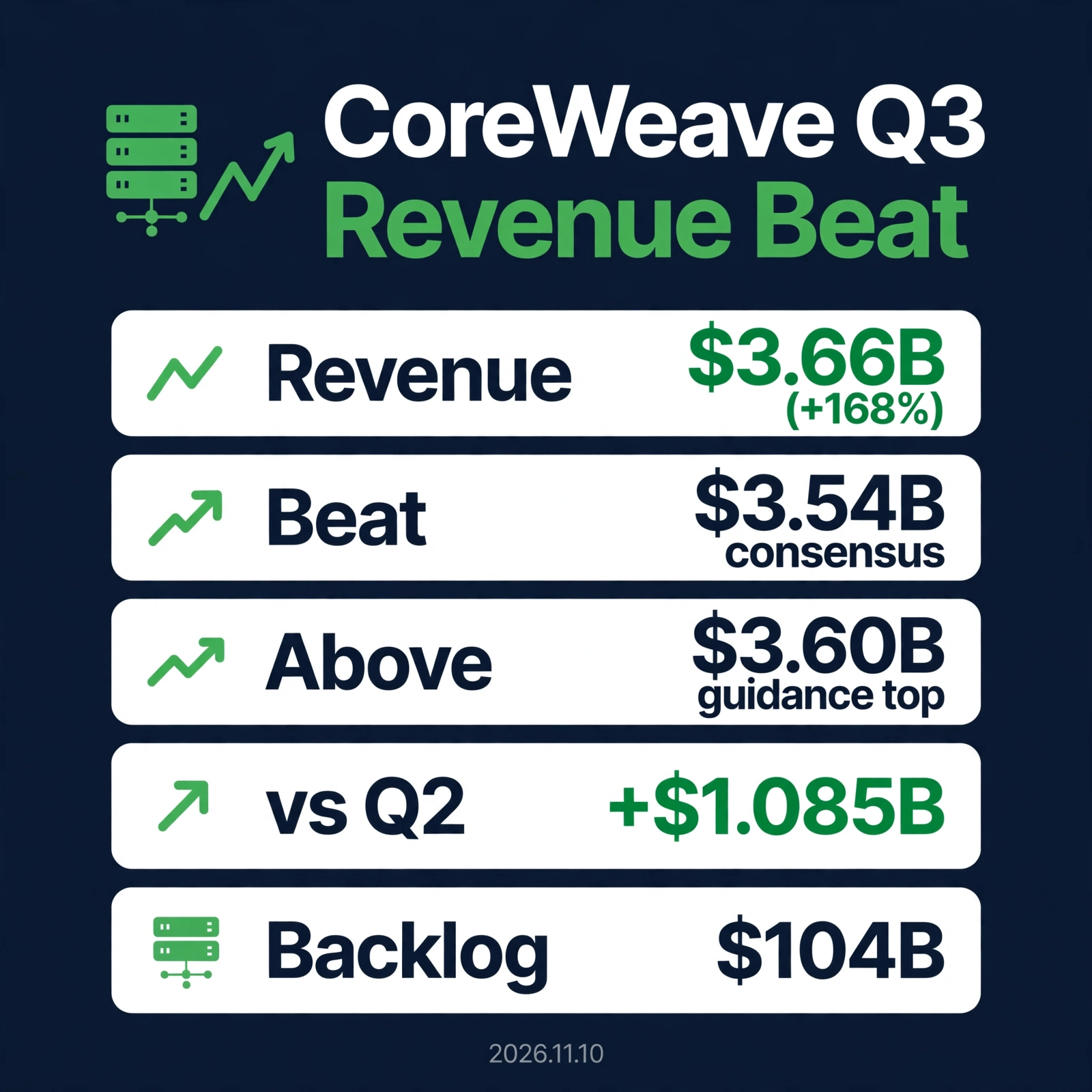
CoreWeave's Q3 revenue of $3.66 billion beat estimates and the company raised its full-year outlook. But interest expense of $846 million was more than double adjusted operating income of $379 million, and the operating margin fell from 16% to 10%. Demand is proven; the money-making structure is not.
- Constellation Energy Stock Analysis: AI Power Demand and Q3 Earnings Surprise
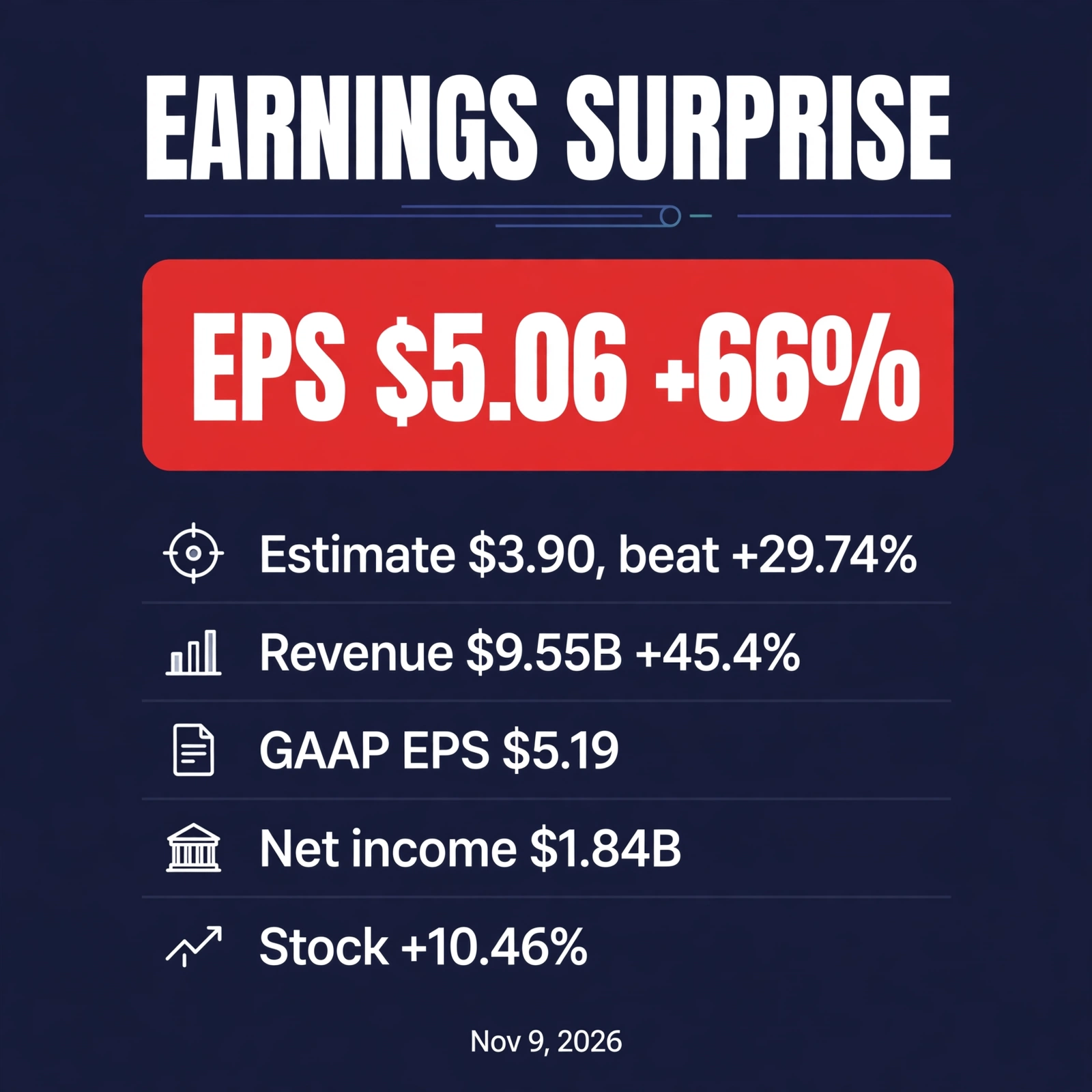
Constellation Energy jumped 10.46% after third-quarter adjusted EPS of $5.06 beat estimates by 30%. Twenty-year nuclear deals with Amazon and Google show what AI power demand really looks like — while long-term debt has swollen to $19 billion.
5minbrief on YouTube
The briefs also come as videos. Get the daily market wrap on YouTube.
Subscribe on YouTube