 5-minute briefs
Nasdaq Correction Semiconductor Index 12% Plunge S&P 500 4.4% Drop Analysis
#US stock market#midterm elections#Nvidia
Index close: Nasdaq confirms a correction, erasing Wednesday’s rally in a day
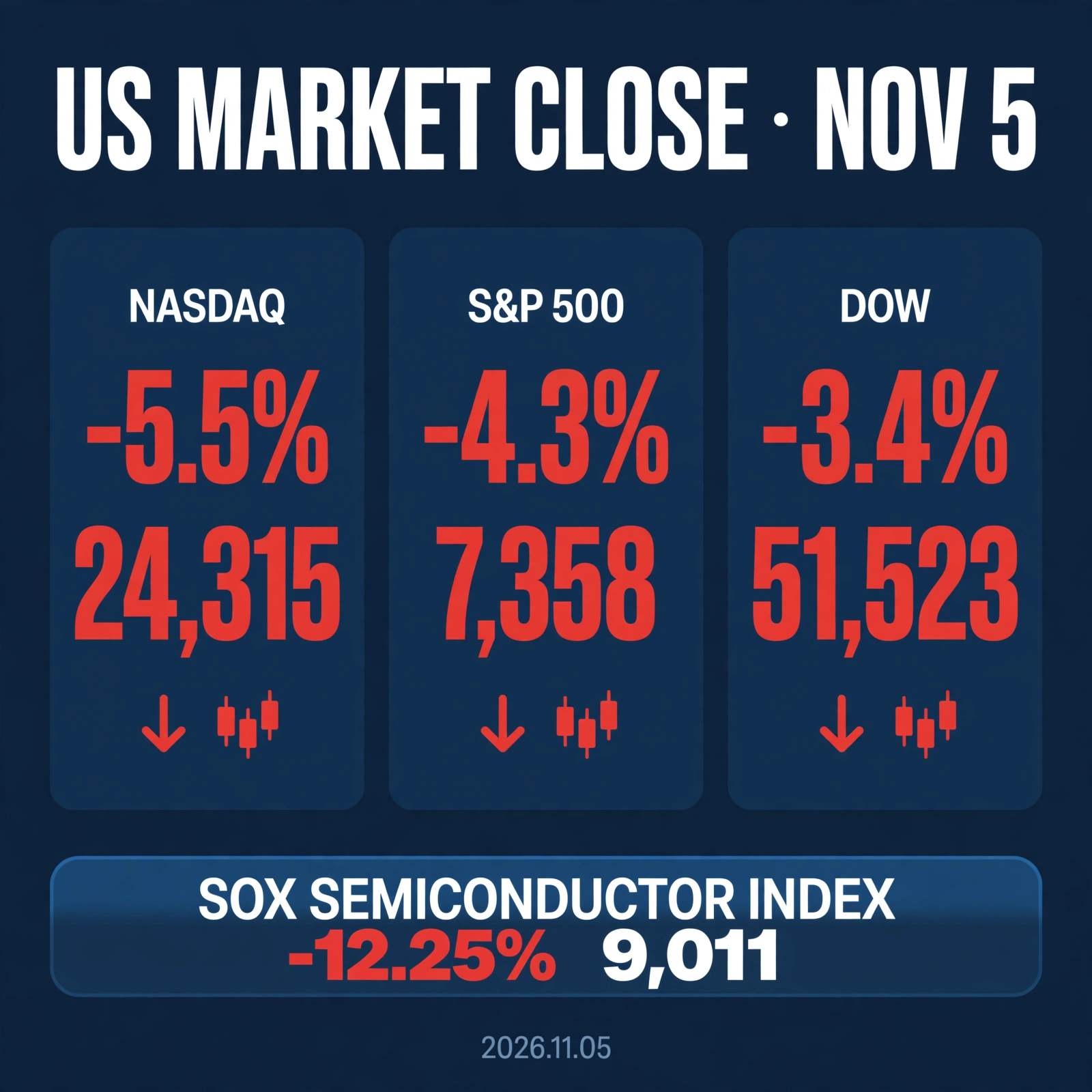
The closing numbers first. The Nasdaq Composite fell 1,422 points to 24,315 (–5.5%). That puts it 11.9% below its record closing high of 27,599.89 from October 6, confirming a correction — a decline of 10% or more from a recent high. It is the index’s second correction of 2026. The S&P 500 fell 4.36% to 7,353.73, its steepest one-day drop since April 2025. The Dow Jones Industrial Average lost 1,833.06 points to 51,523.06 (–3.4%), and the Nasdaq-100 fell 6.36%. The Nasdaq also slipped below its 200-day moving average.
It was the mirror image of the day before. On November 4, after Democrats swept both chambers of Congress in the midterms, the Dow jumped 1,569.40 points to 53,356.12 (+3.03%), the S&P 500 rose to 7,688.62 (+1.58%), and the Nasdaq closed at 25,736.51 (+1.44%). But chip stocks were already moving the other way on Wednesday. The Philadelphia Semiconductor Index (SOX) fell 3.13% that day, with Nvidia down 3.17%, Micron down 7.00%, and SanDisk down 7.91%. Thursday’s rout was that split widening, not something that appeared out of nowhere. What flipped in a day was not the election result but the market’s reading of it: on Wednesday investors bought the removal of uncertainty; on Thursday they sold the prospect of tighter permits and regulation for data centers under a Democratic Congress.
Chip rout: SOX plunges 12%, memory and neocloud hit hardest
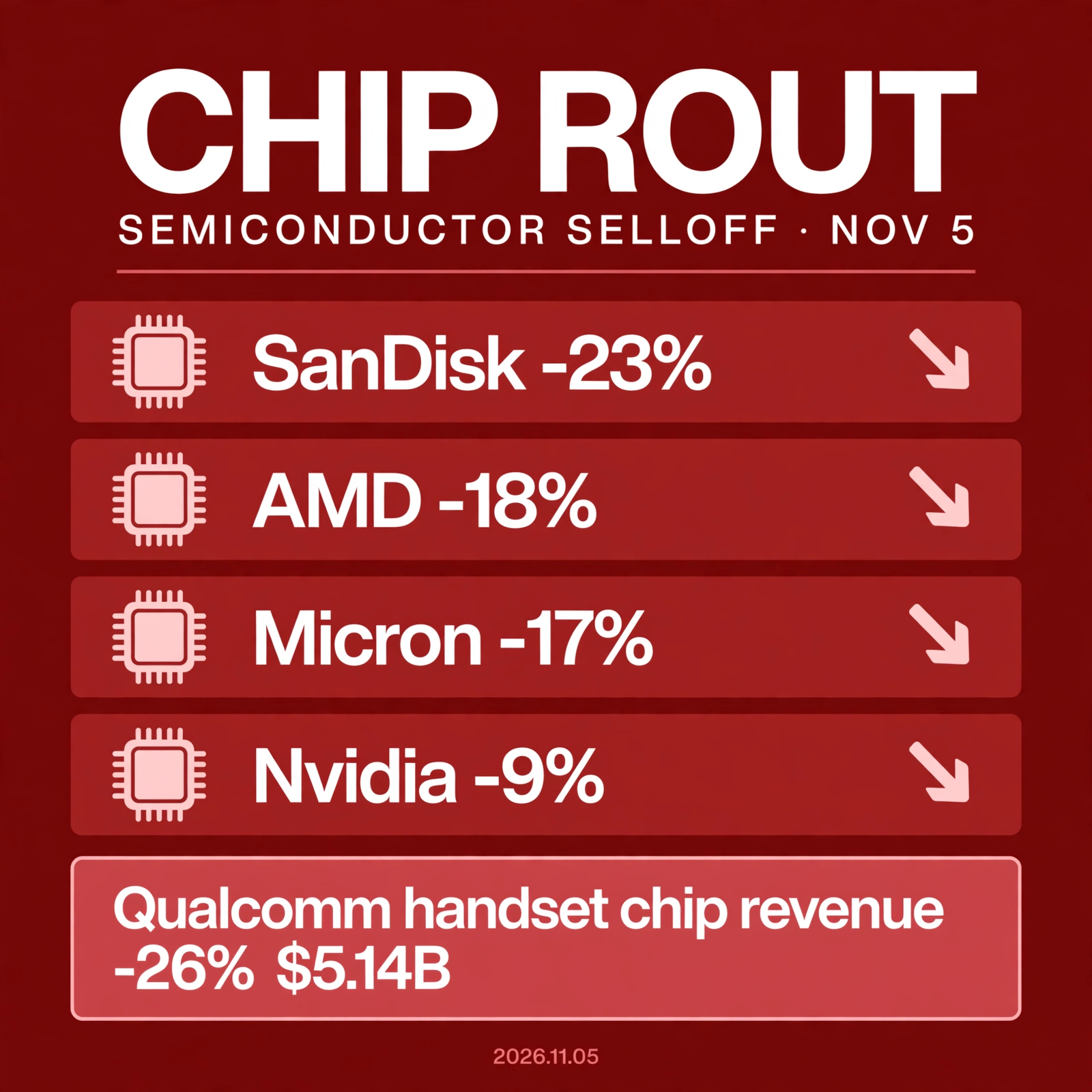
The semiconductor index was the center of the day. The PHLX Semiconductor Index plunged 1,257.52 points to 9,011.14 (–12.25%), close to its worst single-day fall since the COVID crash in March 2020, and about 31% below its 52-week high. Among individual names, SanDisk fell about 23%, AMD about 18%, Micron about 17%, Nvidia about 9%, and Tesla more than 10%. The damage predates Thursday: over the past month, Lam Research is down 36%, Applied Materials 30%, AMD 22%, and Nvidia 15%, so the leaders of the 2026 rally were already deep in a drawdown before the S&P 500’s worst session in more than a year.
Two triggers deepened the fall. First, Qualcomm’s fiscal fourth-quarter results. Revenue came in at $10.322 billion, down 8.4% from a year earlier, and handset chip revenue plunged 26% to $5.14 billion, missing Wall Street estimates. Adjusted earnings per share fell 28% to $2.17. Automotive chip revenue, by contrast, surged 89% to a record $1.99 billion, and IoT grew 4%. Soft smartphone demand pulled the trigger on chip selling, and Qualcomm shares fell more than 13% intraday before closing down about 9%. Second, Bloomberg reported that Micron suspended plans for a $4.5 billion memory-chip plant in Taiwan because of a prolonged labor dispute. The market read it as a demand warning rather than a supply story.
Policy interpretation piled on top. With Democrats winning in data-center-heavy states such as Texas and Georgia, the prospect of slower permits and tighter power and water rules for new data centers moved to the foreground. Data-center construction stocks and neocloud names fell by double digits. It was not bad earnings that set the price, but the prospect that the data centers yet to be built may be built more slowly — a view that rewrote both order books and valuations in one day. The fundamentals have not collapsed: AMD chief executive Lisa Su said she sees no slowdown in AI chip demand, and Qualcomm kept its $5 billion fiscal 2027 data-center revenue target.
Oil, rates, gold, and Bitcoin: money moved toward safety
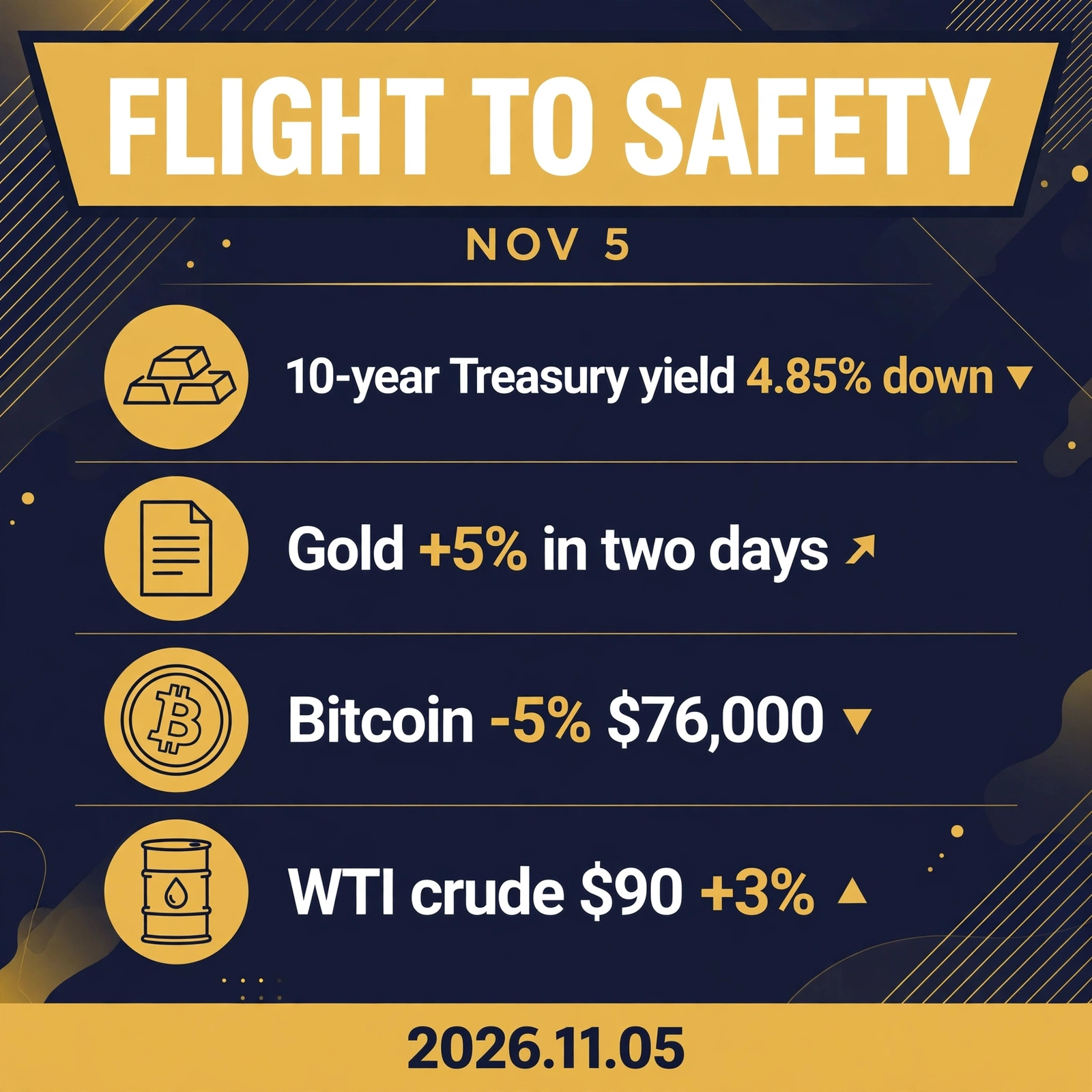
While stocks fell, money moved toward safety. The 10-year Treasury yield fell to around 4.85%, pushing bond prices higher, and gold rose about 5% over two days. Gold had already gained 3.4% on Wednesday to $4,074.50 an ounce and kept climbing on Thursday. Bitcoin fell about 5% to around $76,000. Even within risk assets, investors were drawing lines. The dollar weakened.
Oil moved the other way. Brent crude traded around $98 a barrel and WTI around $90, up about 3%. On Wednesday, WTI had fallen 8.3% to settle at $88.12 on hopes for an end to the Middle East conflict, but on Thursday doubts about whether a deal would actually materialize brought a rebound. The oil rebound supported energy stocks, but it was nowhere near enough to offset the tech selloff. Within the S&P 500, technology and consumer discretionary led the losses, energy held up best, and defensive sectors such as consumer staples and health care outperformed.
The sellers stood out, too. Retail investors net sold $358 million of individual US stocks as of 2:58 p.m. in New York, the largest single-day net selling since March 17, 2020, according to Vanda Research. The usual dip buyers did the opposite. Market watchers also pointed to hedge funds locking in profits before year-end and cutting leverage. Whether this is a one-day scare or a turn in trend is still unknown. But a down day without buyers runs deeper than usual.
- Correction: a decline of 10% or more from a recent high. The Nasdaq is 11.9% below its October 6 record close, confirming a correction — its second this year.
- Philadelphia Semiconductor Index (SOX): an index of 30 leading semiconductor stocks. It plunged 12.25% on November 5 to 9,011.14.
- Neocloud: a newer cloud provider renting out large fleets of AI GPUs. These names were hit hardest by data-center slowdown fears.
- Data-center regulation: permits, power, and water rules for new data centers. After the midterms, talk of state-level moratoriums on new permits is spreading.
- Deleveraging: cutting borrowed money. As hedge funds shrink positions, selling can feed on itself.
- 200-day moving average: the average closing price over the past 200 trading days. Falling below it is read as a sign the medium-term trend has turned. The Nasdaq broke below it.
Three things to watch
First, the October jobs report on Friday, November 6. Layoff announcements in October were the fewest since 2023, and ADP private payrolls rose 86,000, above expectations. The report will shape the labor-market picture and the Fed’s December rate path — markets currently price about a 69% chance of a 25-basis-point cut in December. Second, the first AI and data-center policy signals from the new Democratic Congress. Which state permit and moratorium bills reach the table first, and what governors and legislatures in data-center states say, will set the conditions for any semiconductor rebound. Third, technical support and whether stocks are oversold. Watch whether the Nasdaq settles below its 200-day moving average, whether buyers return with the SOX 31% below its 52-week high, and whether retail selling continues. What matters more than one day’s plunge is whether the policy uncertainty behind it starts to clear.
Sources & references
- Reuters — Tech-stock rout accelerates retreat from AI trade — Semiconductor index down as much as 11% intraday, Nasdaq more than 10% below its October 6 record and on course for a correction, data-center regulation worries, SOX about 31% below its 52-week high
- The Private Banker — S&P 500 Plunges 4.3% in Worst Day Since April 2025 — November 5 close: Dow 51,523.06 (–3.4%), S&P 500 –4.3%, Nasdaq –5.5%, SOX 9,011.14 (–12.25%); retail investors net sold $358 million of individual stocks as of 2:58 p.m.
- AI Stock Wire — Nasdaq correction: what happened after 31 others — Nasdaq closed at 24,315, down 5.5% and 11.9% below its October 6 record close of 27,599.89; second correction of 2026
- Bloomberg via SWI swissinfo — Nasdaq 100 Sinks 5% as Chipmaker Selloff Deepens — Nasdaq 100 down 5%, S&P 500 down 3.3% at noon, Bitcoin down 4.8% to $76,287, Apple plans about $7 billion investment-grade bond sale
Related articles
- US Stock Market Weekly Recap Nasdaq Falls 3.4 Percent Thursday AI Rout and Correction Analysis
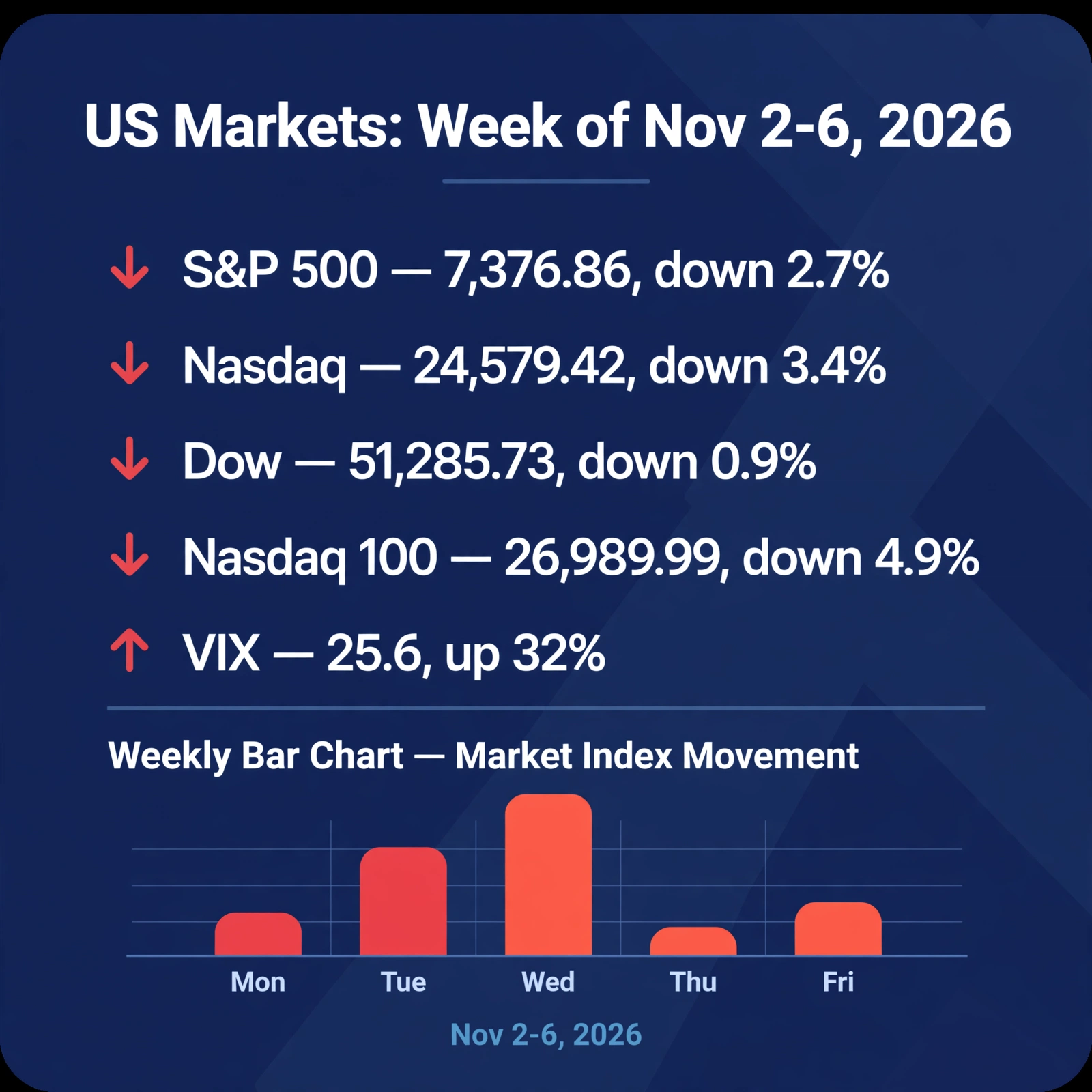
US stock market weekly recap for November 2–6. The S&P 500 fell 2.7%, the Nasdaq 3.4% and the Dow 0.9%, and Thursday's AI sell-off pushed the Nasdaq into correction territory. Midterms, the jobs report and the Hormuz oil plunge, plus next week's CPI and PPI checkpoints.
- Nasdaq Rebound Semiconductor Index 4.21% Recovery Jobs Surprise Rate Hike Fears Analysis
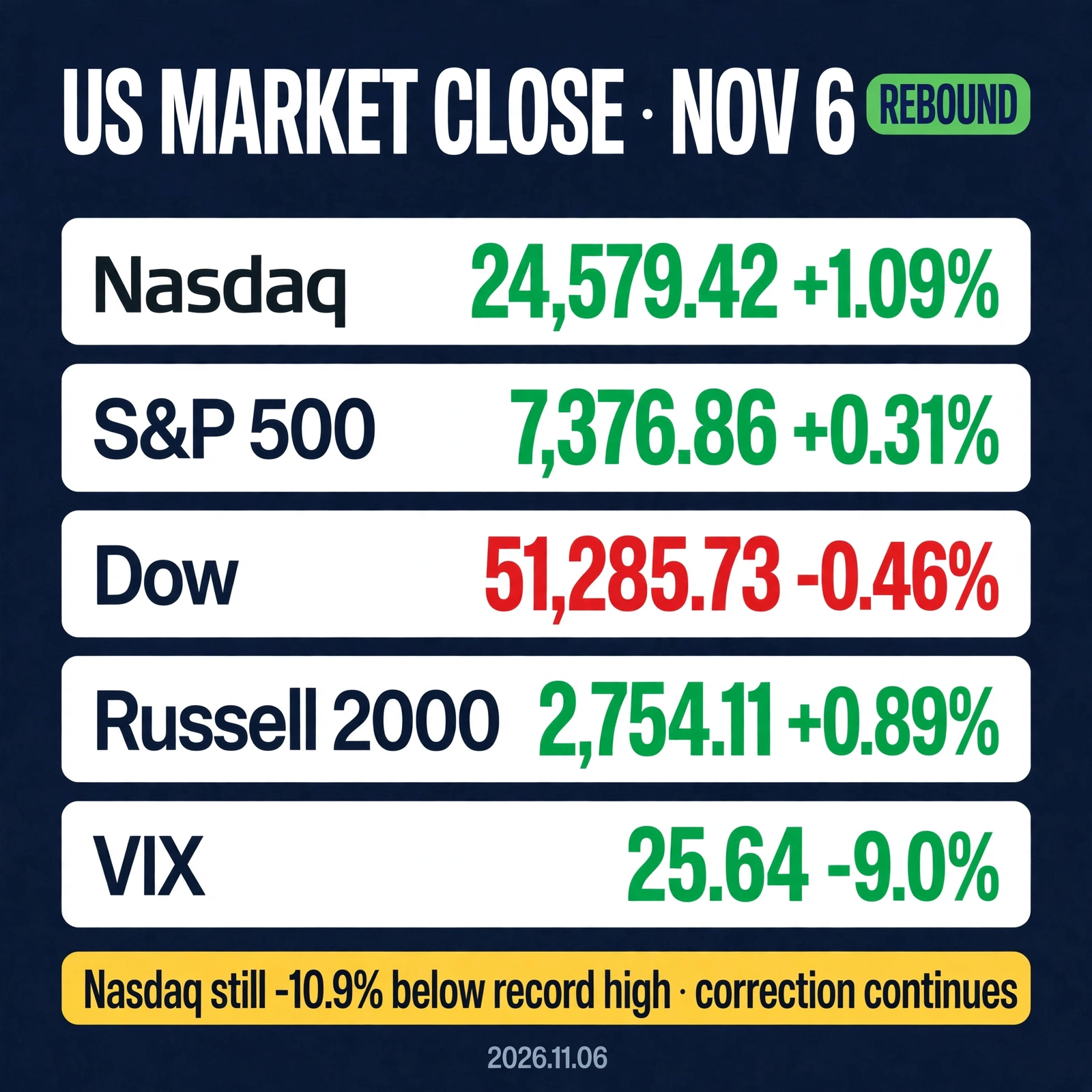
On November 6, US stocks bounced as chip stocks recovered: the Nasdaq rose 1.09%, the S&P 500 gained 0.31%, and the Dow slipped 0.46%. October payrolls jumped 165,000, far above forecasts, lifting December Fed hike odds to 76.8%.
- Semiconductor Rebound Analysis SOX 4.21% Recovery and Three Bottom Confirmation Conditions
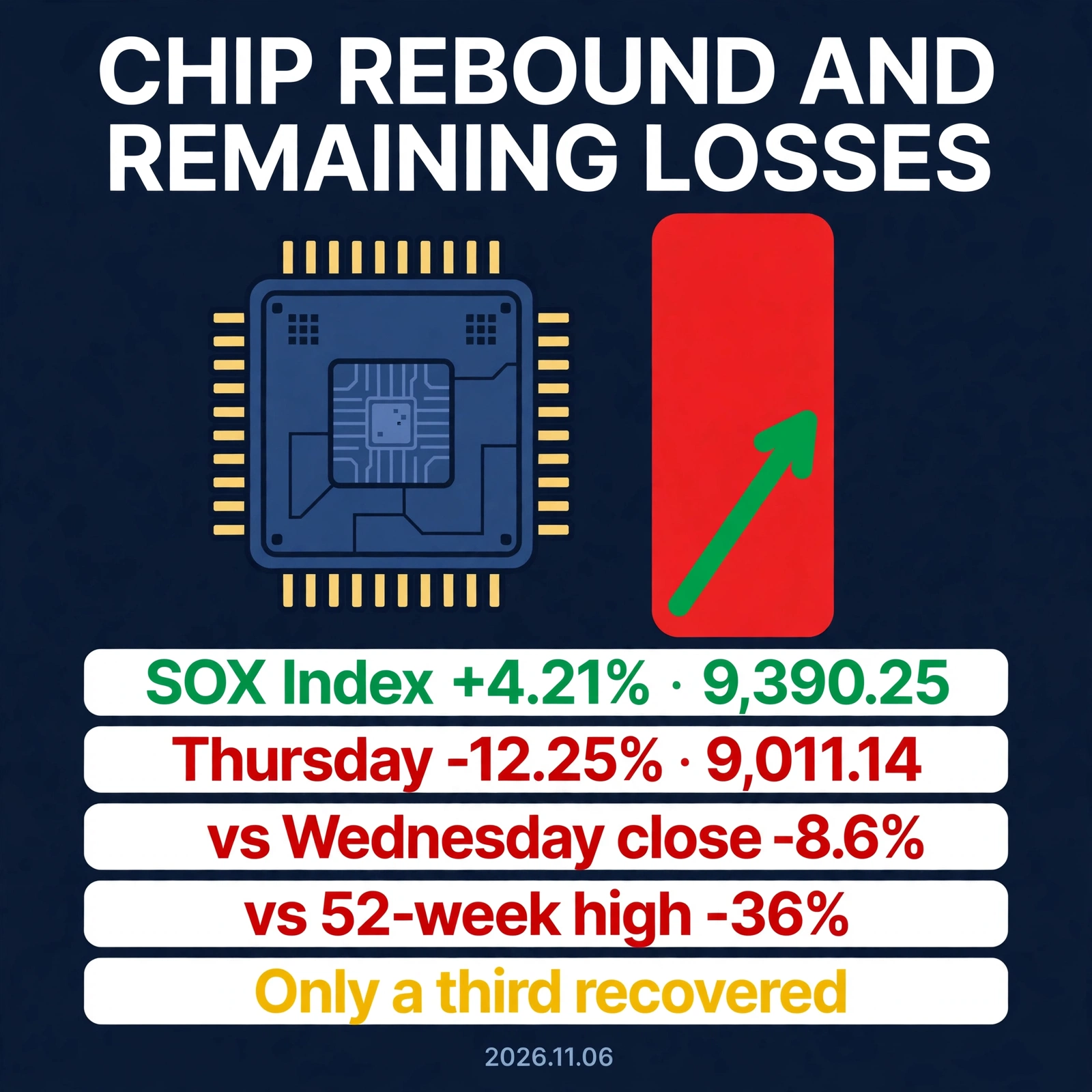
The Philadelphia Semiconductor Index rebounded 4.21% but recovered only a third of Thursday's losses, and gains faded from a 6.6% intraday high. Whether the bounce is a bottom or a retracement turns on three conditions: policy signals, AI demand evidence, and technical support.
5minbrief on YouTube
The briefs also come as videos. Get the daily market wrap on YouTube.
Subscribe on YouTube