 5-minute briefs
Nvidia Stock Analysis: Solo Decline as Chips Surge and SOX Reclaims 10,000
Monday’s semiconductor sector told two stories. The Philadelphia Semiconductor Index (SOX) rose more than 6% and reclaimed 10,000, and the semiconductor ETF (SOXX) closed up 7.49% at $146.76. But Nvidia fell 4.27% to $178.67 — the only stock in the SOX to fall. Same sector, same day, opposite directions. Here is what split them.
A split day: SOX up more than 6%, Nvidia down 4.27%
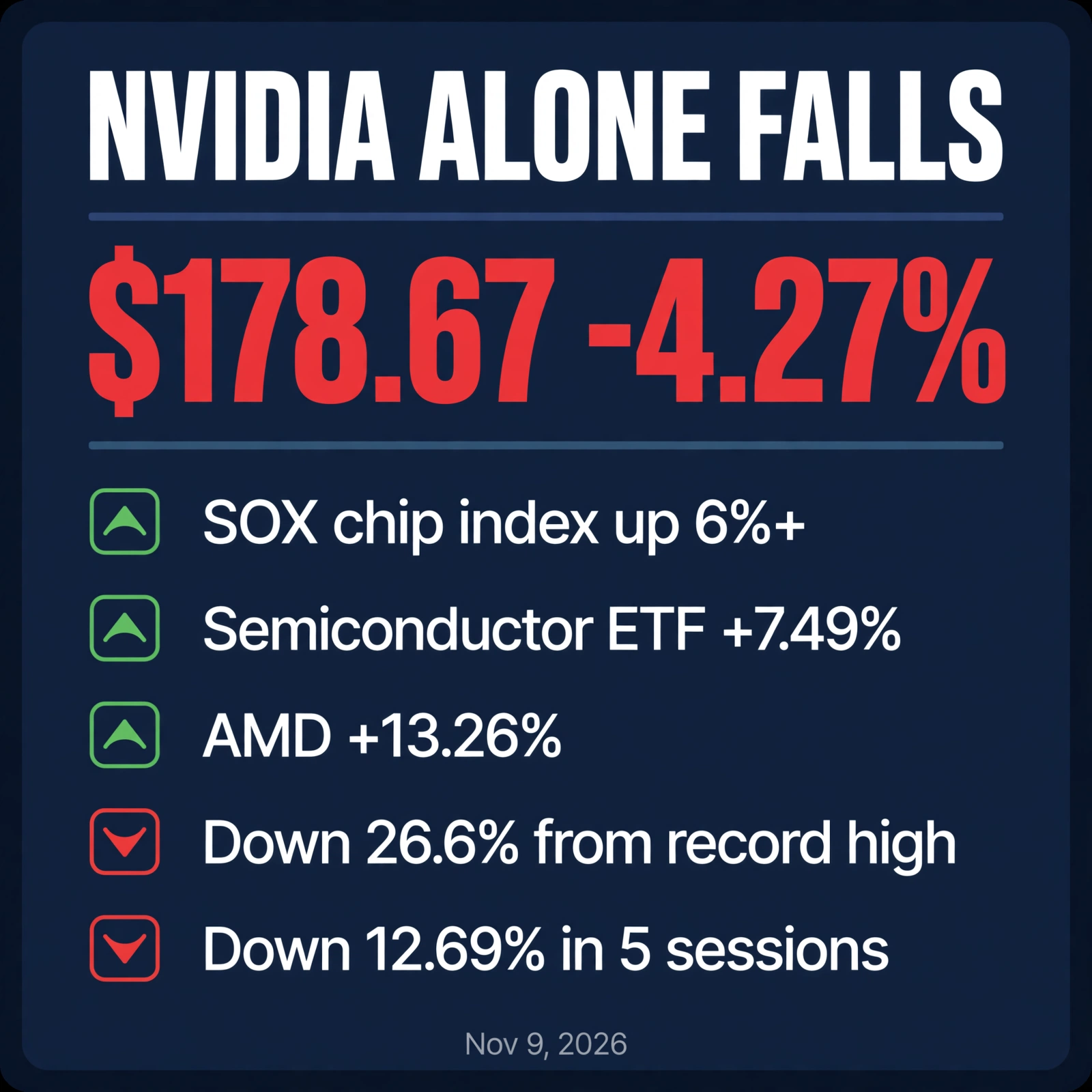
The winners’ numbers were loud. AMD jumped 13.26% to $508.58, Broadcom rose 8.78% to $319.48, and Micron gained 6.25% to $733.15. AMD got an Oppenheimer upgrade (target $600) and a forecast of 135% data-center revenue growth in 2027 — on top of an 11.04% gain on Friday. The SOX had plunged more than 12% last week for its biggest weekly drop since the week ended April 4, 2025; Monday reclaimed about half of it in one session.
Nvidia alone went the other way. It fell as low as $170.24 intraday, its lowest since March 31, and closed at $178.67 (−4.27%). The stock is down 12.69% over five sessions and 22.07% over a month. Against its October 6 record of $243.37, it sits 26.6% lower. Market value is around $4.50 trillion — still the world’s second-most valuable company — but more than a fifth of it has evaporated in a month.
The split was not an accident. Morgan Stanley and UBS called last week’s AI selloff overdone, and the market bought AI demand again. It just left Nvidia out of the purchase. Investors chose “buy AI, sell Nvidia” for the day.
Why Nvidia alone fell: the board investigation and key-man risk
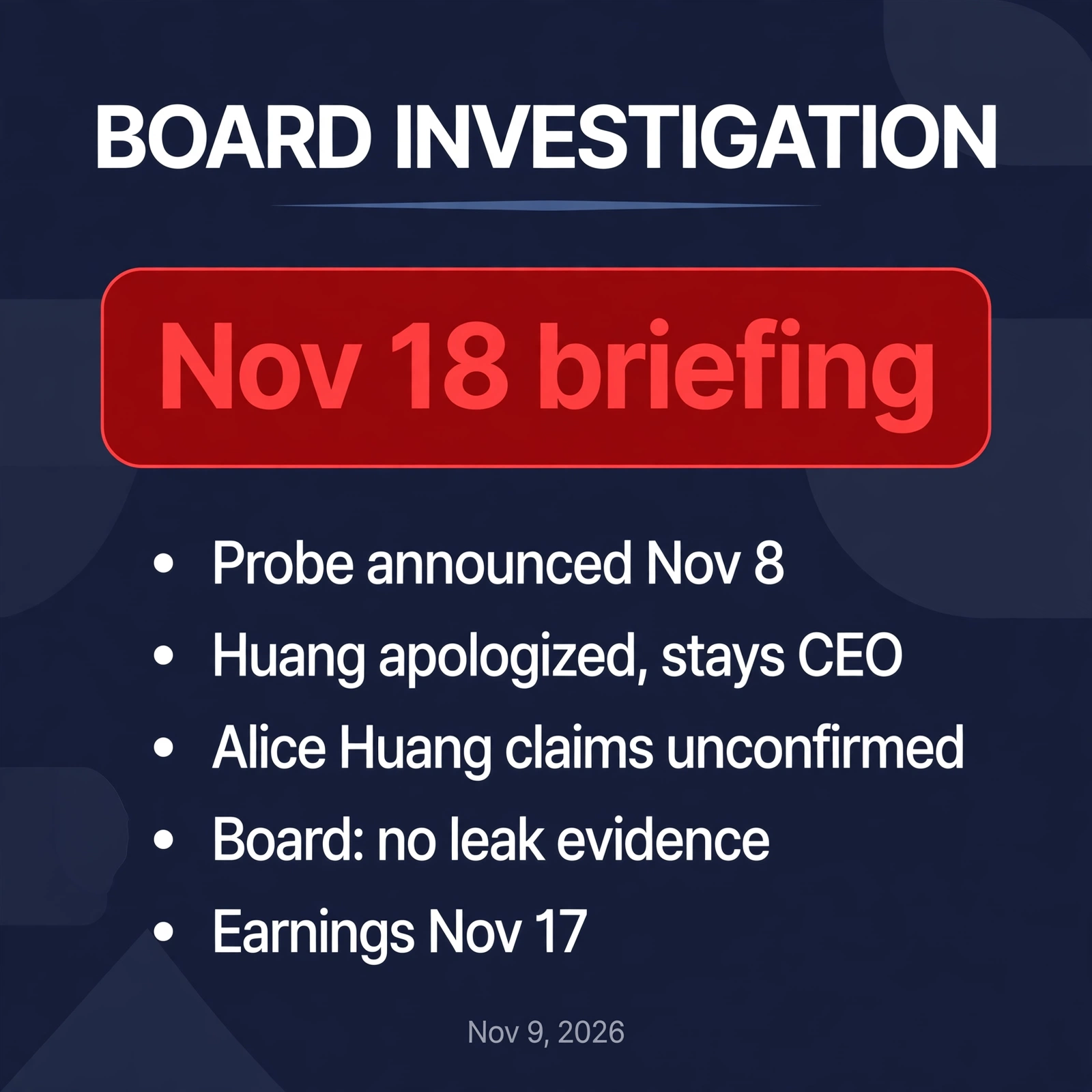
The direct trigger is the board’s independent investigation that broke over the weekend. On November 8, Nvidia’s board said it would investigate whether CEO Jensen Huang was targeted by a foreign intelligence operation. Huang admitted personal wrongdoing and apologized in a memo to staff, while making clear he remains CEO. The New York Times reported US intelligence officials believe Alice Huang, a former executive at Singapore-based Megaspeed, collected information for China. The board said it has no reason to believe US national security or company secrets were compromised, and China’s Foreign Ministry called the claims a smear. Whether espionage occurred and whether information changed hands remain unconfirmed.
What the market priced was uncertainty, not facts. Wedbush’s Dan Ives called the episode a “stain” on Huang that would bring at least several congressional investigations. Three House committee chairs have asked Huang to appear for a closed-door briefing on November 18. The tenure of the man who co-founded the company in 1993 and has led it ever since is suddenly unclear — that is key-man risk in its purest form. Bernstein kept its Outperform rating and $400 target, but the stock moved on its own.
The risk bites because of where Nvidia sits. Nvidia is the AI chip leader and one of the heaviest weights in the SOX and the Nasdaq-100. When the leader’s leadership wobbles, the valuation logic of the whole index wobbles with it. So the market bought chips and sold Nvidia. A sector bet and a single-stock bet, split apart.
What the split means: AI demand and Nvidia, priced separately
The split asks one question. Is AI demand alive while Nvidia’s premium is not? Monday’s answer was “demand yes, premium no.” AMD, Broadcom and Micron rising is a bet that AI infrastructure demand has not broken. Nvidia alone falling is a bet that the benefit of that demand is not automatically Nvidia’s. It reads as a signal that the competitive map is shifting.
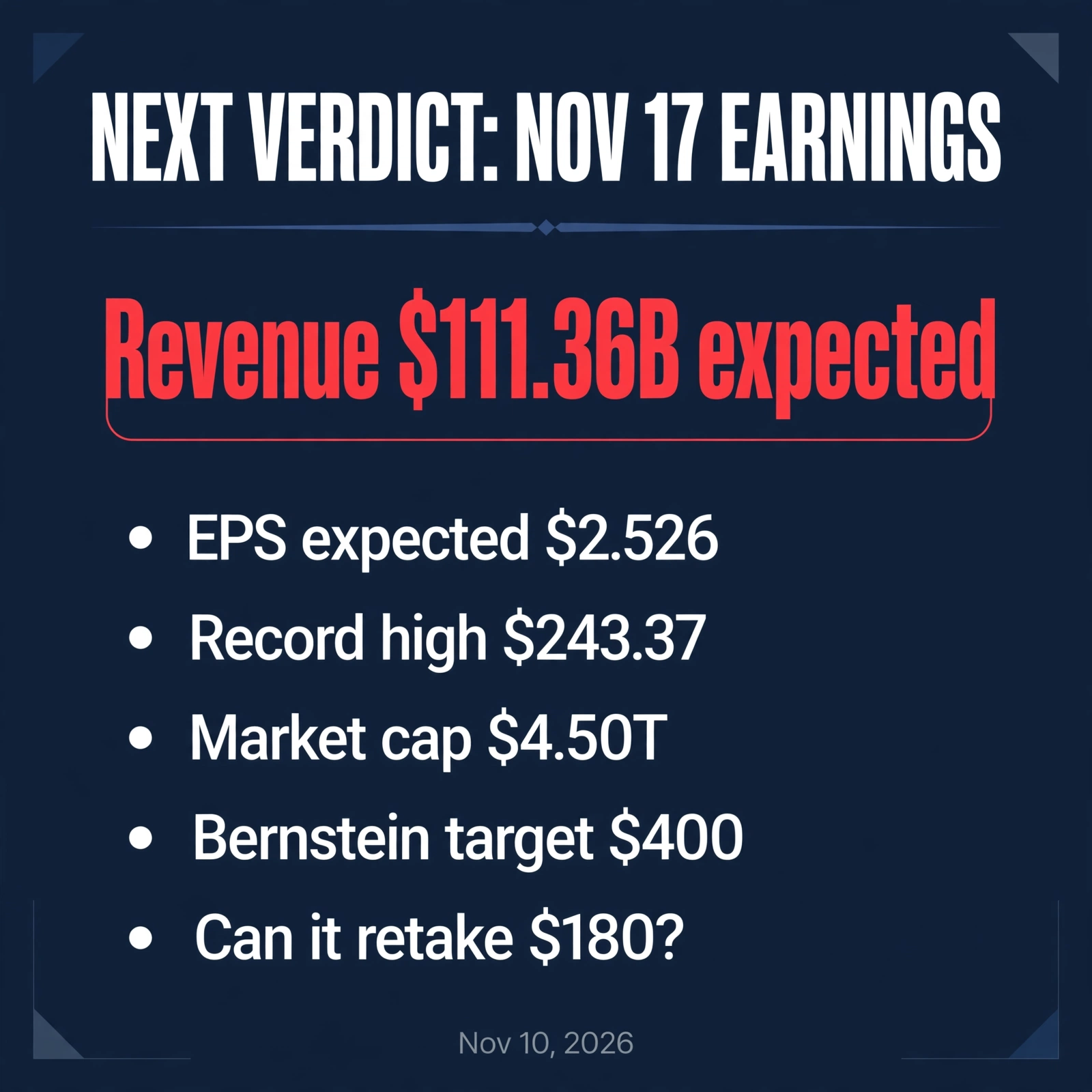
The next verdict comes in a week. Nvidia reports third-quarter results on November 17. Consensus is EPS of $2.526 and revenue of $111.36 billion. A beat lets earnings cover the leadership risk; a miss stacks two risks on top of each other. The House closed-door briefing follows the next day, November 18. Until earnings, the first checkpoint is whether the stock retakes $180.
Three things to watch. First, data-center revenue and guidance on November 17 — whether the numbers can cover the leadership controversy. Second, what follows the November 18 House briefing — whether the investigation widens. Third, whether AMD and Broadcom keep rising — the longer rivals stay strong, the more Nvidia’s premium gets cut. A day when chips rise and the leader falls is a signal that stock-picking has started inside the AI trade.
- SOX (Philadelphia Semiconductor Index): An index of 30 major US chip stocks — the sector's thermometer. It holds Nvidia, AMD, Broadcom and Micron.
- SOXX: The semiconductor ETF tracking the SOX. It closed up 7.49% at $146.76 on Monday.
- Sole decliner: The only stock in an index to fall. On Monday in the SOX, that stock was Nvidia.
- Key-man risk: The danger that a company's value depends heavily on one person. Huang, who co-founded Nvidia in 1993, is that person.
- Closed-door briefing: A non-public session with Congress. Three House committee chairs asked Huang to appear on November 18.
Not investment advice. Prices are November 9, 2026 US closes.
Watch the video

Sources & references
- Reuters via Kitco — Wall St jumps back as oil slide eases inflation worries; Nvidia slumps — Nvidia the SOX's sole decliner, lowest intraday since March 31; SOX up more than 6%; AMD up about 13%, Broadcom nearly 9%
- NDTV Profit — AMD, Broadcom, Micron Rally Up To 8% As Chip Stocks Defy Nvidia Rout — Morning moves (AMD +8.62%, Broadcom +6.87%, Micron +5.46%, SOX +4.78%, Nvidia −4.92%); Oppenheimer upgrade, 135% data-center growth in 2027
Related articles
- Semiconductor Rebound Analysis SOX 4.21% Recovery and Three Bottom Confirmation Conditions
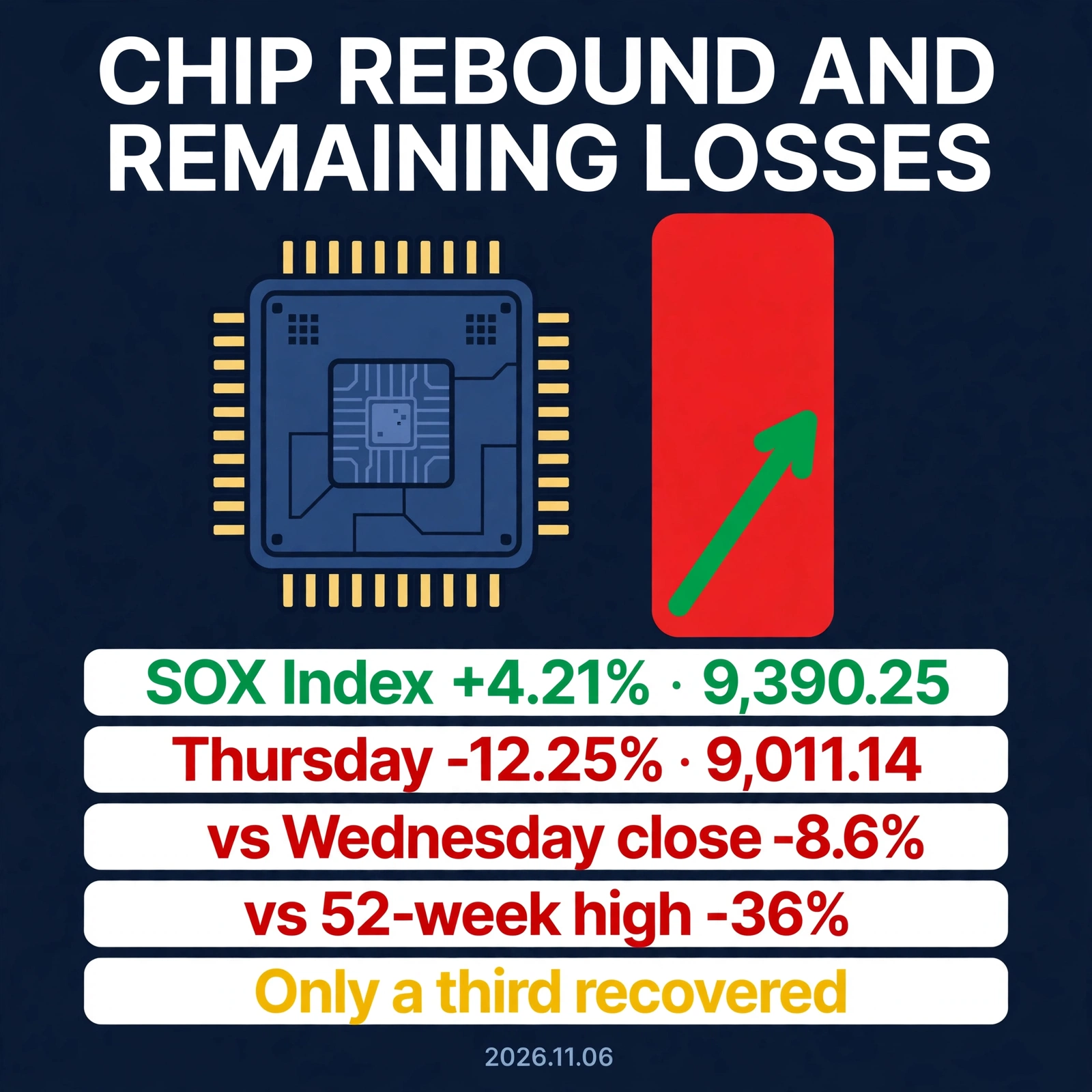
The Philadelphia Semiconductor Index rebounded 4.21% but recovered only a third of Thursday's losses, and gains faded from a 6.6% intraday high. Whether the bounce is a bottom or a retracement turns on three conditions: policy signals, AI demand evidence, and technical support.
- Intel Earnings Analysis Q3 Beat Overshadowed by Weak Q4 Guidance Stock Plunges 28.58%
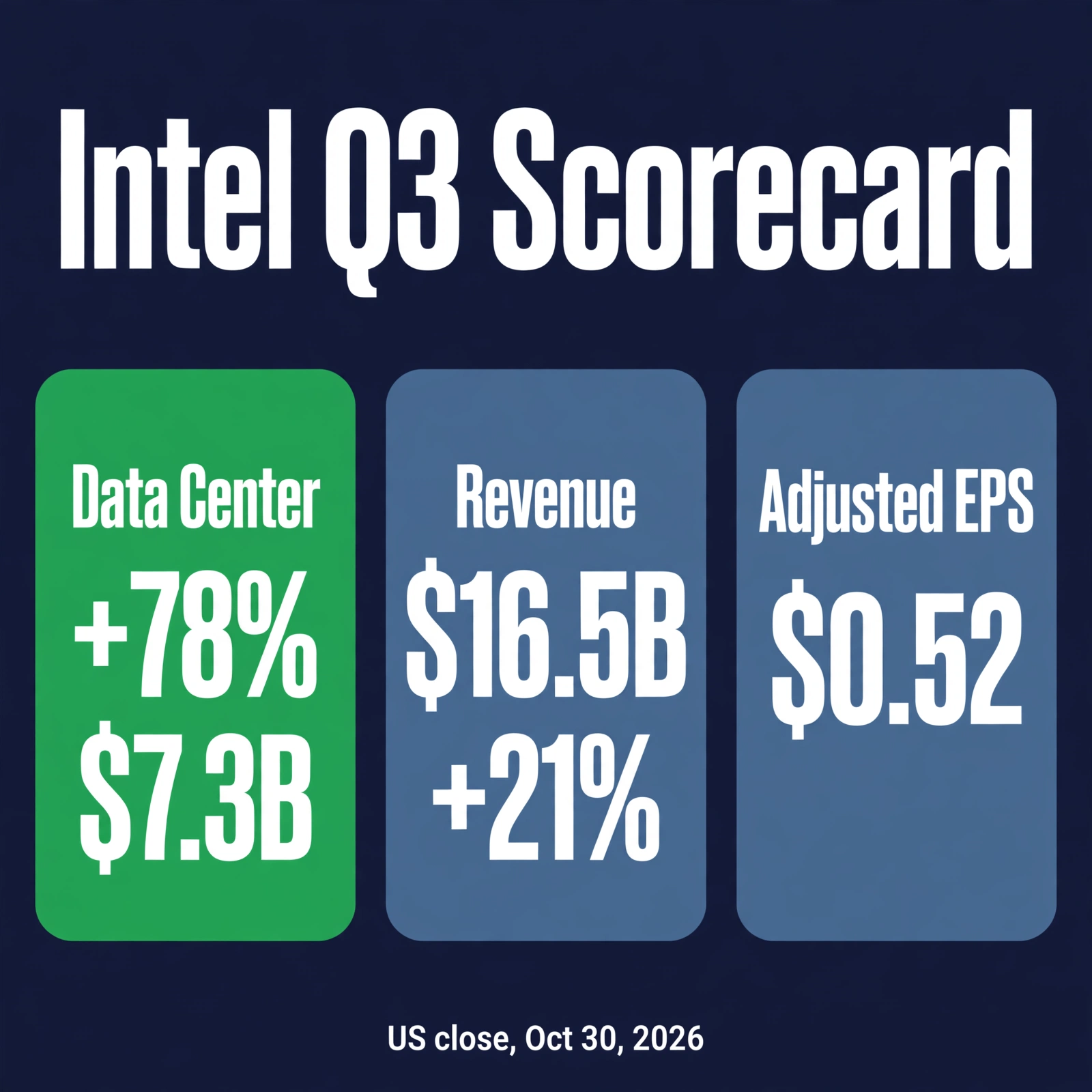
Intel's Q3 revenue of $16.5 billion (+21%) and adjusted EPS of $0.52 beat expectations, but Q4 revenue guidance of $15–$16 billion fell far short of the ≈$17.1 billion consensus, sending shares down 28.58%. Data center grew 78% while PC fell 5%, and an Israel fab shutdown added to the reset.
- September CPI Market Reaction S&P 500 -1.1% Nasdaq -1.9% SOX -4.3%
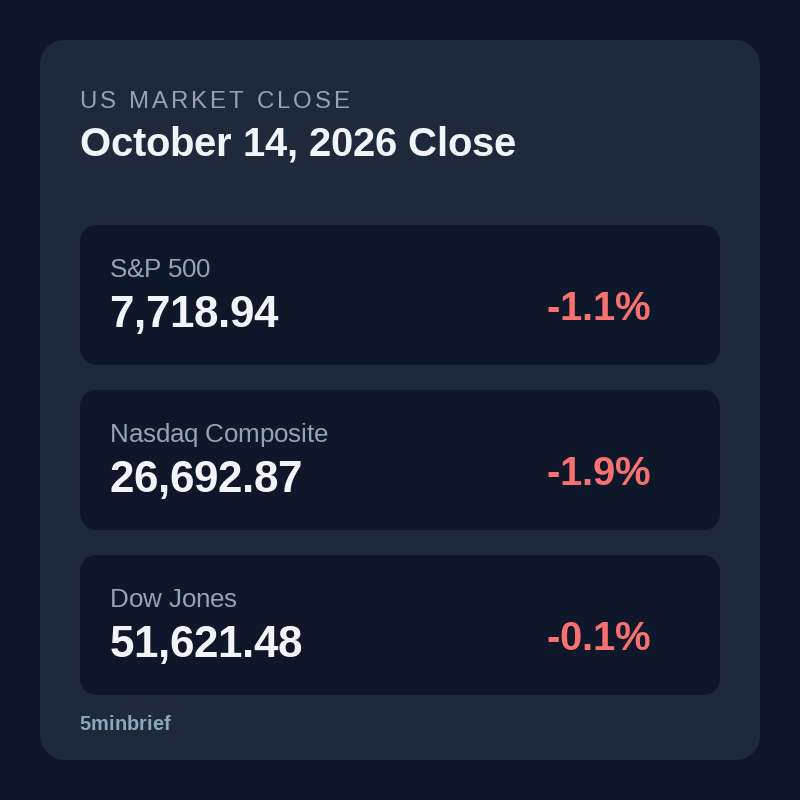
October 14, 2026 market close: hotter-than-expected September CPI revived Fed rate-hike fears, sending the Nasdaq down 1.9%. What happened, in plain English.
5minbrief on YouTube
The briefs also come as videos. Get the daily market wrap on YouTube.
Subscribe on YouTube