 5-minute briefs
KOSPI 3.59% Plunge Foreign Institutional 2.9 Trillion Won Selling AI Funding Fear
#KOSPI plunge#foreign selling Korea#Samsung Electronics#SK Hynix#won dollar exchange rate#US midterm elections
Closing scoreboard — a round trip in two days, intraday low of 5,615.80
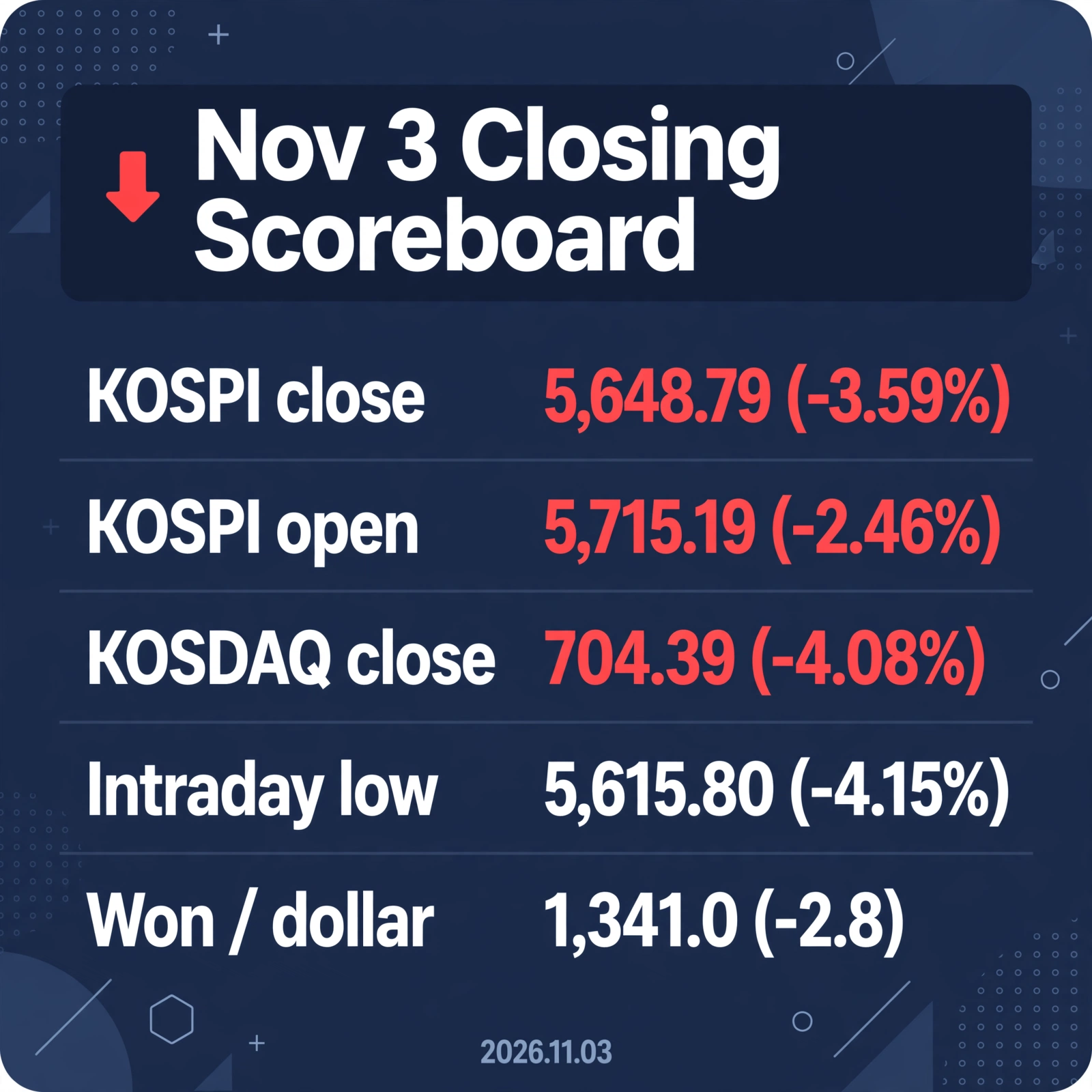
According to the Korea Exchange (KRX), the KOSPI closed at 5,648.79, down 210.29 points (3.59%). It opened 2.46% lower at 5,715.19 and kept sliding to an intraday low of 5,615.80, down 4.15%. The KOSDAQ closed at 704.39, down 29.97 points (4.08%), after opening 1.42% lower at 723.92 and dipping to 702.34 intraday. Trading volume on the KOSPI was light at 192.4 million shares worth 14.1 trillion won (about $10.5 billion), with decliners beating gainers 656 to 220. In both markets, rising stocks were fewer than 25% of all listed shares.
| Index | Open | Close | Change |
|---|---|---|---|
| KOSPI | 5,715.19 | 5,648.79 | –3.59% |
| KOSDAQ | 723.92 | 704.39 | –4.08% |
| Won / dollar | — | 1,341.0 | –2.8 won |
Why it fell — the question changed from “is AI real?” to “who pays for it?”
Overnight in New York, the Nasdaq fell 1.07% and the S&P 500 fell 0.51%, while the PHLX Semiconductor Index fell 3.37%, following a 7.2% plunge on Friday. Only the Dow rose, up 0.41%. The proximate trigger was funding news: Oracle fell 8.8% on plans to raise $20 billion through stock and bond sales for AI infrastructure, reports said Meta is considering a bond issue of more than $20 billion, and Anthropic’s amended filing showed large spending commitments alongside rising revenue. Investors are not doubting that AI investment is happening; they are doubting whether debt-funded AI spending earns its keep.
Two more ingredients piled on. First, caution ahead of the US midterm elections, where the Republican Party faces an uphill challenge to keep its congressional majority — policy uncertainty tends to cap appetite for risk assets. Second, profit-taking after the previous day’s rebound. A Mirae Asset Securities analyst summed it up: concerns about the profitability of AI investments persist, and the sharp US chip sell-off weighed heavily on Korea. Note the irony for Korea watchers: good news for AI demand (more data-center spending) became bad news for AI suppliers’ stocks the moment the funding method came into question.
Flows — foreigners and institutions sold together, retail bought alone
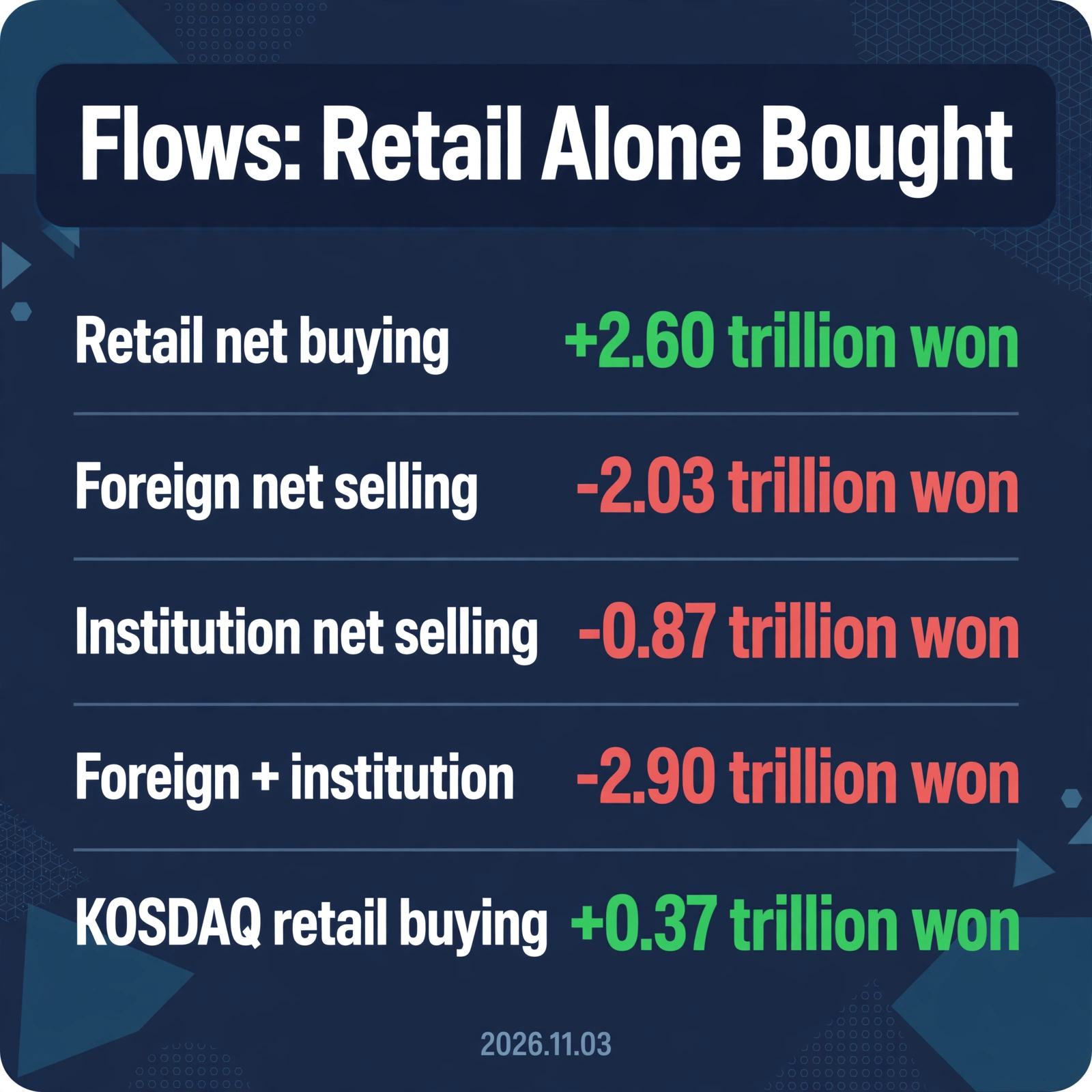
On the KOSPI, retail investors bought a net 2.60 trillion won, while foreign investors sold a net 2.03 trillion won and institutions sold a net 0.87 trillion won — combined net selling of about 2.90 trillion won. On the KOSDAQ, retail bought a net 0.37 trillion won while foreigners sold 0.13 trillion won and institutions sold 0.24 trillion won. The day before, institutions had bought a net 1.23 trillion won of KOSPI shares; the swing from institutional buying to institutional selling in 24 hours is the single biggest change in the market’s plumbing.
- Concentration. Korea's index is dominated by a handful of names. When foreigners de-risk, they sell the most liquid exposure first — Samsung Electronics and SK hynix — and the index follows those two stocks down.
- Retail dip-buying culture. Korean retail investors ("개미", ants) famously buy falling markets. Their 2.60 trillion won of buying cushioned the fall but could not offset selling concentrated in the top-weighted names.
- The won did not panic. The won actually strengthened slightly to 1,341.0 per dollar. That suggests today's foreign selling looked more like a global tech de-risking trade than a broad exit from Korean assets — a distinction worth watching in the next sessions.
For an EWY holder, the practical point is that a US credit-sentiment story can cost you 3.59% in Seoul while the Nasdaq itself falls only 1.07%. Korea is a leveraged play on the AI hardware cycle: it amplifies both directions. That amplification is the reason to size a Korea position deliberately rather than treating it as a generic emerging-market allocation.
Stocks and sectors — chip giants down 4–5%, only defensives stood up
Samsung Electronics fell 4.15% to 219,500 won and SK hynix fell 5.03% to 1,398,000 won. Samsung Electro-Mechanics (–7.38%), SK Square (–5.37%) and LG Energy Solution (–5.06%) fell hard, along with Hyundai Motor (–3.31%), Naver (–3.65%) and Kakao (–3.03%). The exceptions were narrow: Samsung Biologics rose 2.11% and Kia rose 0.42%. By sector, only pharmaceuticals (+0.58%) and paper and wood (+0.55%) rose, while medical and precision instruments (–7.60%), machinery and equipment (–5.00%) and electrical and electronics (–4.76%) led the fall.
Oil added a second, smaller story. Hopes for a US–Iran diplomatic solution sent crude down more than 7%, and SK Innovation plunged 9.36% and S-Oil dived 11.77% as refiners and chemical names underperformed. That oil fell yet stocks still fell tells you which driver mattered: AI funding fear, not energy prices, set the tone.
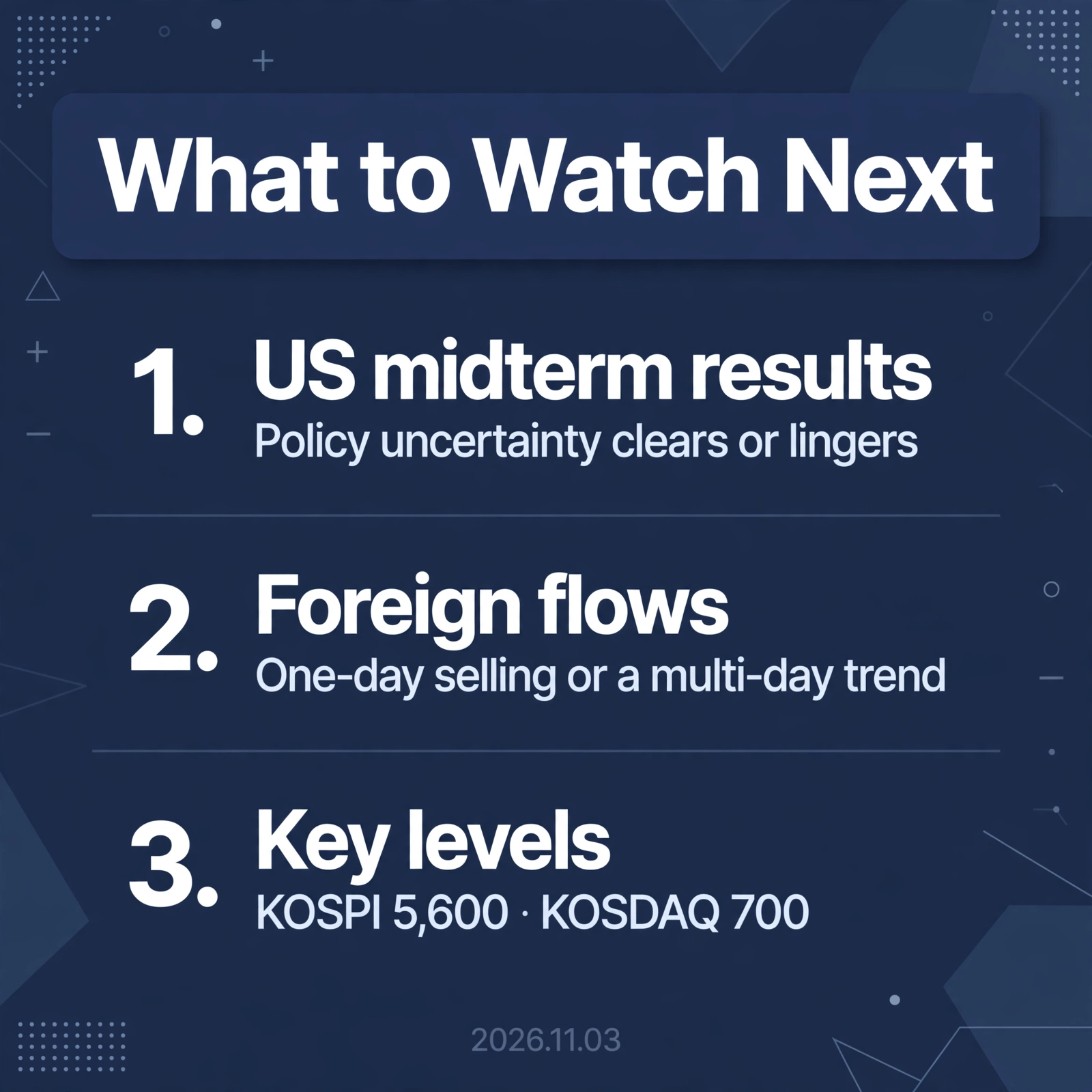
What to watch — midterms, foreign flows, and the 5,600 and 700 lines
Three numbers decide whether this is a one-day shock or the start of a semiconductor re-rating. First, the US midterm results: a clearer policy picture could calm markets, but a divided government could also constrain the industrial-policy support that Korean exporters count on. Second, whether foreign spot selling stops after one day or continues — one day of selling is noise, three days is a trend. Third, whether the KOSPI holds 5,600 and the KOSDAQ holds 700. The KOSDAQ closed at 704.39, so the 700 line is the week’s first real test. For foreign investors, the checklist is simple: do not chase the retail dip until foreign flows stabilize, and watch whether the next AI funding headline moves Seoul more or less than it moves the Nasdaq — that ratio is the market’s real-time verdict on Korea’s AI premium.
Not investment advice. Figures are from the Korea Exchange, Yonhap News and Financial News, as verified on November 3, 2026.
Sources & references
- Yonhap News — (LEAD) Seoul shares dip over 3 pct amid escalating AI woes — KOSPI 5,648.79 (–3.59%), Nasdaq –1.07%, SOX –3.4%, Samsung and SK hynix declines, Naver and Kakao, oil refiners, won at 1,341
- Financial News (English) — KOSPI tumbles 3.59% as AI jitters outweigh lower oil prices — KRX close, foreign and institutional net selling, sector moves, Samsung Biologics and Kia gains, KOSDAQ close at 704.39
- Financial News (English) — KOSPI falls more than 3% as foreign and institutional investors sell KRW 2.8 trillion — Meta and Oracle each seeking $20 billion, Anthropic filing, afternoon KOSPI at 5,640.10 (–3.74%)
Related articles
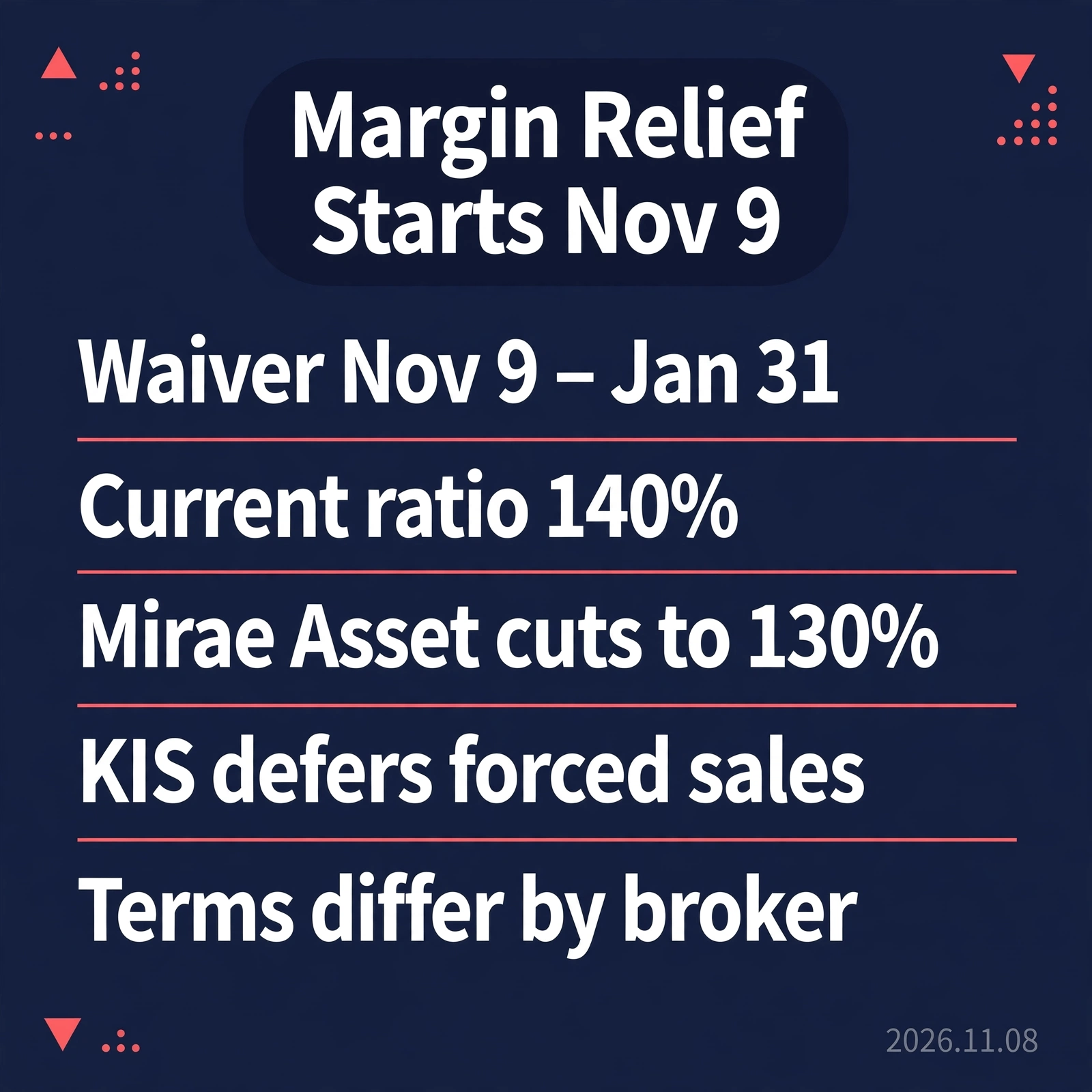
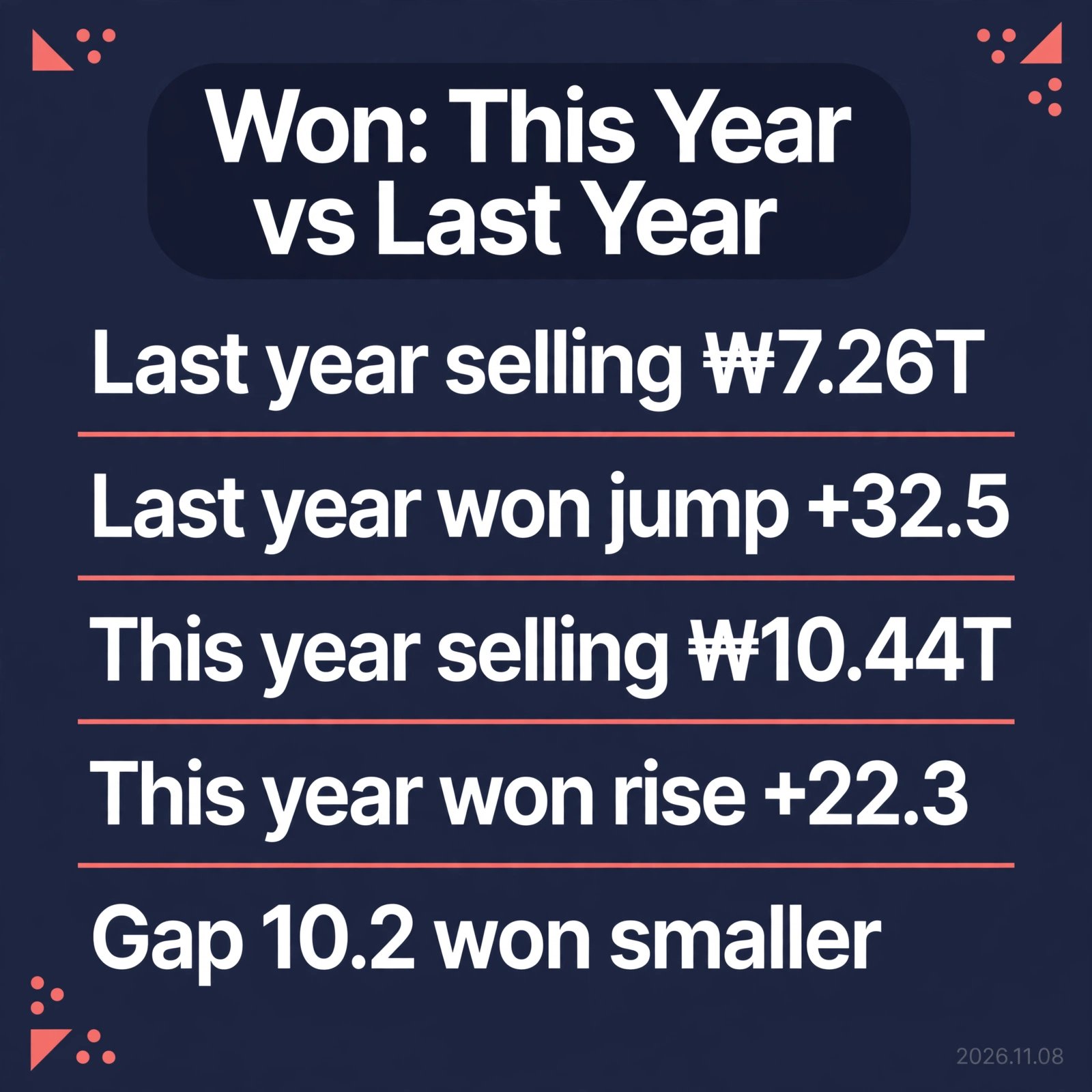
- KOSPI Monday Preview: 10.4 Trillion Won Foreign Selling, Won at 1,356.6, Margin Relief Starts
Korea market Sunday edition: Seoul is closed today, but the weekend formalized three months of margin-loan relief starting Monday. Foreigners sold about 10.4 trillion won of KOSPI shares last week, yet the won held at 1,356.6 — semiconductor export dollars and a record current-account surplus did the holding.
- Won-Dollar Defense Analysis: Semiconductor Export Dollars, Record Surplus, Dividend Repatriation Risk
Foreigners sold about $7.7 billion of Korean shares in a week, yet the won held at 1,356.6. A record $61.46 billion current-account surplus and $56.44 billion of October chip exports did the holding. The next test is $9.8–12.6 billion of dividend repatriation.
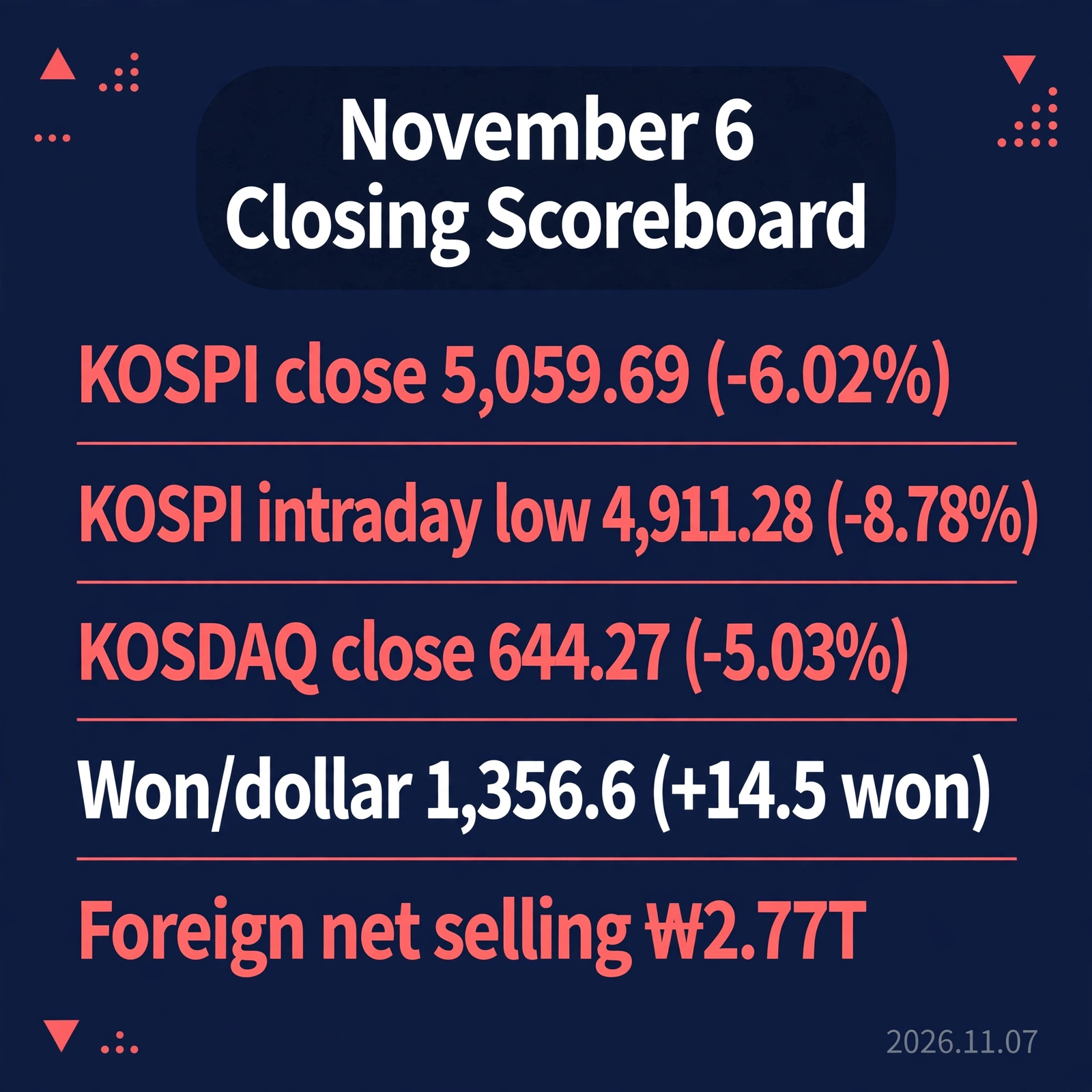
- KOSPI 5,000 Defense Analysis Weekly 11.71% Drop and Next Week Rebound Conditions
Korea market Saturday edition: the KOSPI closed Friday at 5,059.69, down 6.02% on the day and 11.71% on the week, after a circuit breaker halted trading minutes after the open. US chips bounced Friday, and next week's CoreWeave earnings and US CPI decide whether Seoul rebounds.
5minbrief on YouTube
The briefs also come as videos. Get the daily market wrap on YouTube.
Subscribe on YouTube