 5-minute briefs
KOSPI Rebound Analysis 2.24% Rally Institutional Buying Low PBR First Day
#Korea stocks#SK Hynix buyback#Samsung Electronics#won dollar#US midterm elections#EWY
The scoreboard — a weak open that flipped before 10 a.m.
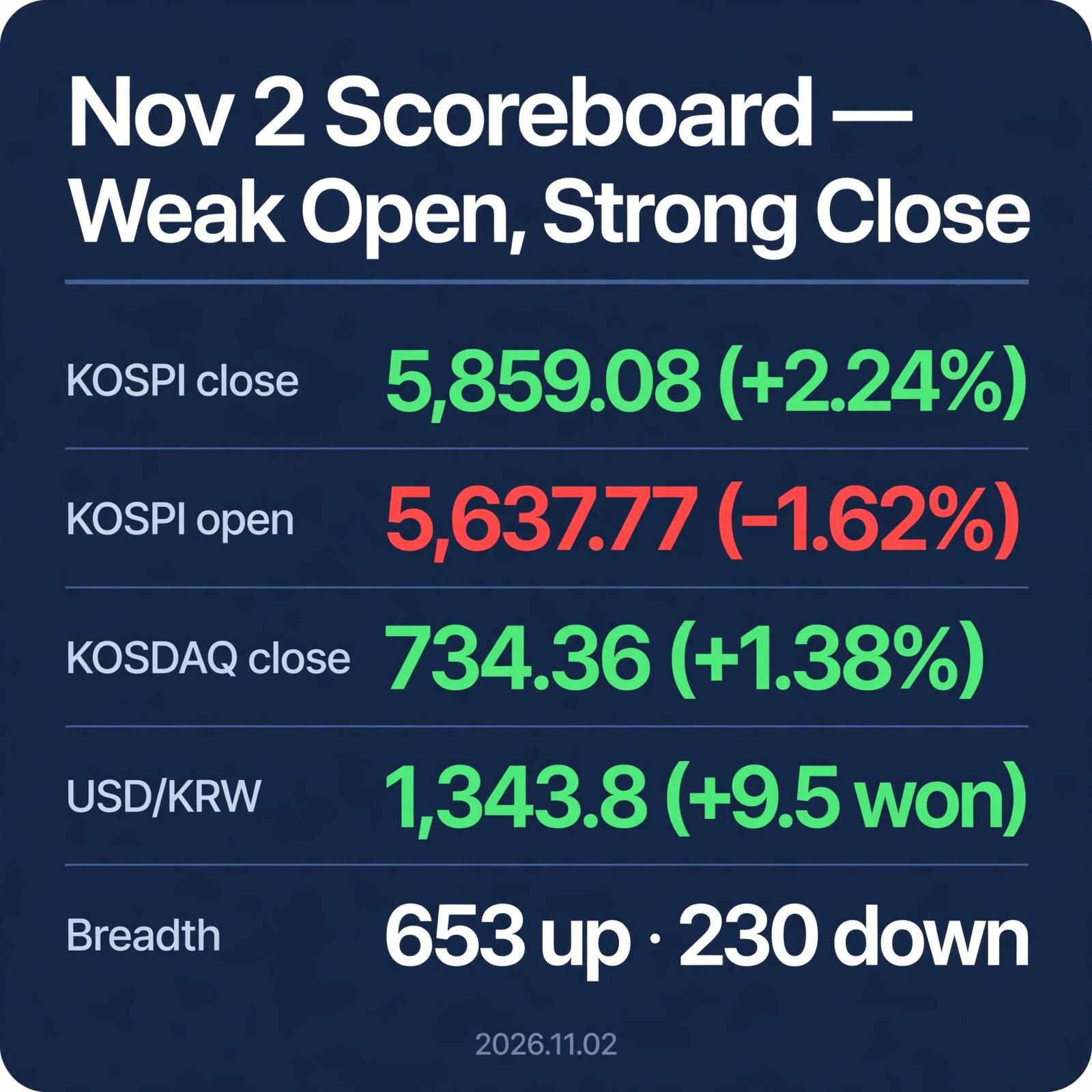
According to the Korea Exchange, the KOSPI closed at 5,859.08, up 128.34 points (2.24%). It opened at 5,637.77, down 92.97 points (1.62%), dipped to 5,616.50, turned higher around 9:36 a.m., pushed above 5,900 intraday, then gave back part of the gain. The KOSDAQ rose 9.98 points (1.38%) to 734.36, after opening down 1.10% at 716.44. Advancing stocks on the main board numbered 653 against 230 decliners. The won closed at 1,343.8 per dollar, up 9.5 won from the previous session’s daytime close — a reminder that a rising index and a firm currency do not always move together in Korea.
| Index | Open | Close | Change |
|---|---|---|---|
| KOSPI | 5,637.77 | 5,859.08 | +2.24% |
| KOSDAQ | 716.44 | 734.36 | +1.38% |
| USD/KRW | — | 1,343.8 | +9.5 won |
Who bought — pensions and buybacks formed the floor
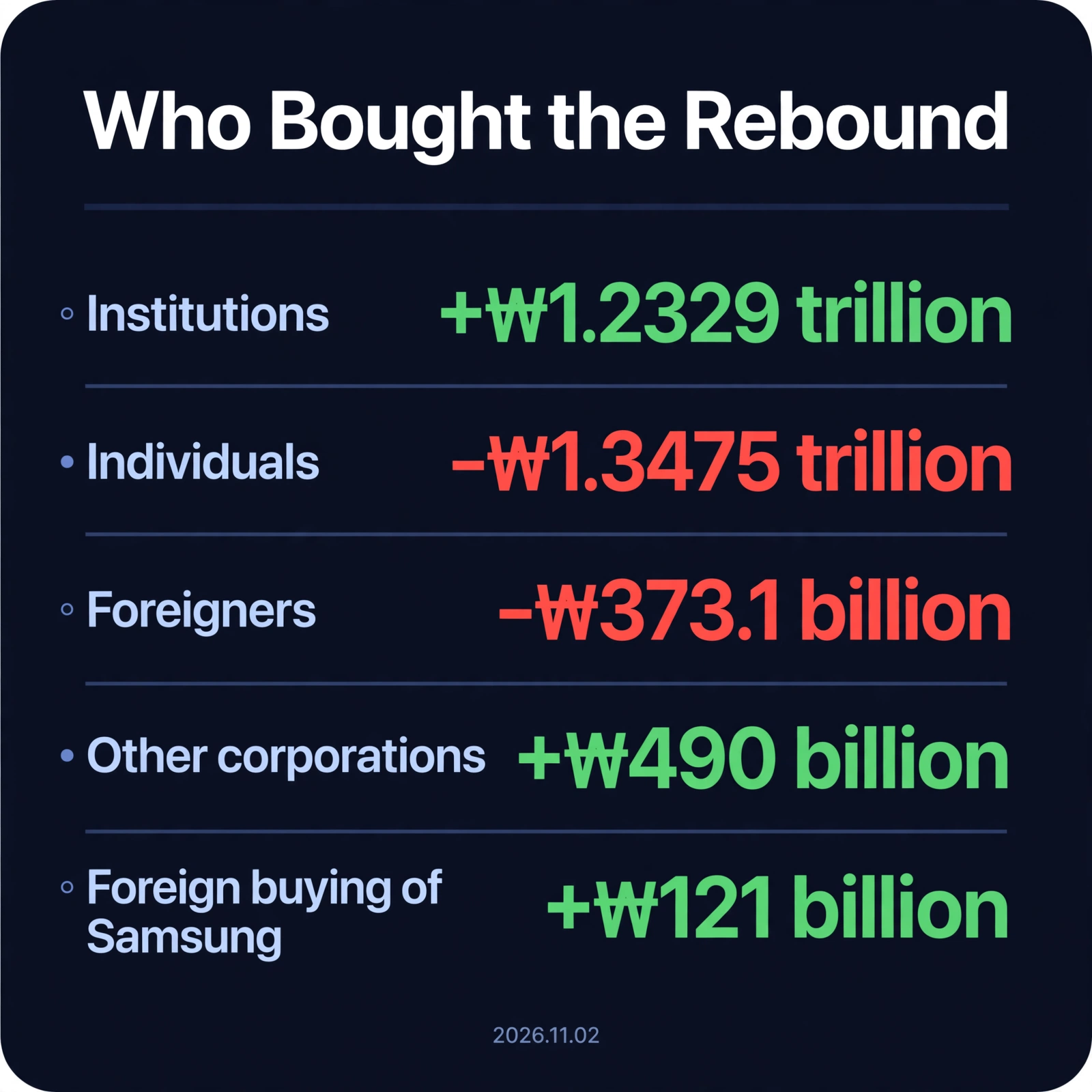
The flow table tells the story. Institutions bought a net 1.2329 trillion won on the main board, while individuals sold 1.3475 trillion won and foreigners sold 373.1 billion won. On top of that, other corporations bought about 490 billion won, a category widely read as including buyback orders. Analysts at Shinhan Investment point to two supports: the national pension fund, which bought heavily on October 30 and kept buying, and SK Hynix’s ongoing buyback.
The stock-level flows are more useful than the totals. Institutions bought SK Hynix worth 255.8 billion won and Samsung Electronics worth 162.8 billion won; the pension fund alone bought 60.2 billion won of SK Hynix. SK Hynix began a second buyback tranche on October 29, covering about 14.92 million shares through January 28, 2027, with about 500,000 shares (about 734.4 billion won, 3.35% of the planned amount) executed so far. Foreigners, meanwhile, bought Samsung Electronics worth 121 billion won even as they sold the broader market. That is selective buying, not a blanket exit — and it matters for EWY holders, because Samsung’s weight means foreign flows into that one name can diverge from the headline foreign total. On the KOSDAQ, institutions bought 62.3 billion won while foreigners and individuals sold 32.2 billion and 26 billion won respectively.
- Announcement is not execution. Korea's buyback headlines are usually reported as announced amounts. What supported prices on November 2 was buyback orders actually hitting the market, plus pension buying — execution, not the headline.
- The foreign total hides selection. A net foreign sale can coexist with foreign buying of Samsung. Reading only the aggregate flow misstates foreign sentiment toward the index's largest stock.
- A tag is not a thesis. The low-PBR label now shown on trading screens is a disclosure device, not a recommendation. Prices moved on day one, but the Value-Up test is what companies do next.
The governance lens — day one of the low-PBR name list
The second driver was policy, not earnings. The Korea Exchange published its first low-PBR (price-to-book ratio) list of 151 companies on November 1, and from November 2 the label appears on broker trading screens. By 10:51 a.m., 106 of the 151 names were rising, and Hyundai Steel closed up 11.61%. Lotte Shopping and E-Mart were also strong in the morning, up 6.96% and 5.93% respectively. Sector breadth helped: construction rose 5.76%, transportation and warehousing 5.31%, and metals 2.94%. That overlap is the caveat — steel and construction were strong across the board, so not all of the low-PBR gains can be credited to the list itself.
Why this matters beyond one session: the list is the Value-Up program moving from encouragement to naming. Companies that stayed in the bottom quartile of their industry’s PBR for years are now publicly tagged, with one-on-one improvement consulting promised from 2027 and a refreshed list due May 4, 2027. For foreign investors, the practical read is that governance pressure in Korea now has a visible, dated scoreboard. The stocks to watch are not the ones that jumped most on day one, but the ones that follow the tag with a concrete plan — a dividend increase, a buyback with a timetable, or a disposal of low-return assets. A separate companion post published today examines that day-one test in detail.
Stocks and sectors — chip leaders rebound, laggards diverge
Samsung Electronics rose 1.78% to 229,000 won and SK Hynix rose 3.81% to 1,472,000 won. SK Square gained 5.91%, Hanwha Aerospace 6.32%, and Hyundai Motor 1.77%. On the weak side, Samsung Biologics fell 4.37%, KB Financial 1.35%, and LG Energy Solution 0.97%. On the KOSDAQ, Simtec rose 6.08%, HLB 4.25%, Wonik IPS 2.82%, and EcoPro 2.22%. Weak sectors included real estate (–3.97%), pharmaceuticals (–1.92%), and securities (–0.71%). The breadth of the rebound — most sectors rising — fits a rotation into beaten-down cyclicals rather than a narrow chip-led bounce.
What to watch this week — US midterms and big-tech earnings set the tone
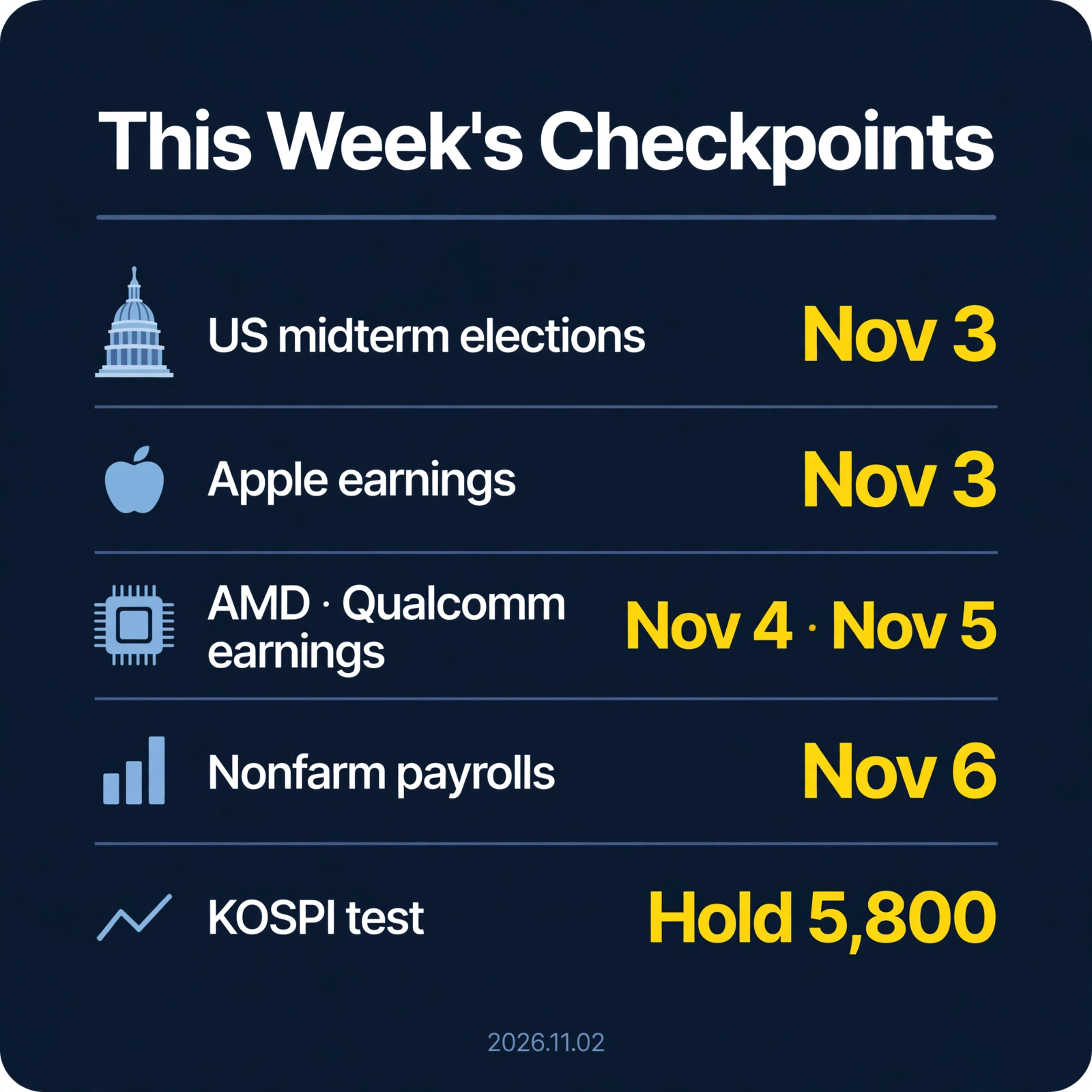
This week is crowded with US events that have repeatedly set Korea’s direction. First, the US midterm elections on November 3 (US time): past patterns show uncertainty fading after the vote, but a divided Congress could constrain policy and add short-term volatility. Second, big-tech earnings: Apple on November 3, AMD on November 4, and Qualcomm on November 5 will retest AI spending sentiment after Intel’s warning. Third, US data: the ISM manufacturing index on November 3, ADP employment and JOLTS on November 4, the ISM services index on November 5, and October nonfarm payrolls on November 6.
Three numbers to check on Tuesday: whether the KOSPI holds 5,800 and challenges 5,900 again, whether foreign spot flows turn from selling to buying, and whether low-PBR names hold their day-one gains for a second session. A 2.24% rebound built on pension buying and buyback execution is a floor, not yet a trend. For EWY holders, the position is unchanged in kind: Korea remains a market where domestic policy-driven flows can cushion a US-led selloff for a day, while foreign capital decides the direction over weeks.
Not investment advice. Figures are from the Korea Exchange, Yonhap News, Newsis, NewsPim and Global Economic, checked November 2, 2026.
Sources & references
- Yonhap News — KOSPI rebounds 2.2% after weak open, KOSDAQ up over 1% — KOSPI 5,859.08 (+2.24%), KOSDAQ 734.36 (+1.38%), opening levels and intraday move above 5,900
- Newsis — No Black Monday: KOSPI recovers 5,850 on Intel shock — Institutional buying of 1.23 trillion won, other-corporation buying of 490 billion won, sector moves, won at 1,343.8
- Newsis — 106 of 151 low-PBR stocks rise, Hyundai Steel up 11%, Lotte Shopping up 7% — Low-PBR list first-day morning breadth, Hyundai Steel, Lotte Shopping and E-Mart strength
- Global Economic — KOSPI withstands big-tech shock: foreigners buy Samsung, institutions buy SK Hynix — Institutional buying of SK Hynix and Samsung, foreign buying of Samsung worth 121 billion won
- NewsPim — Closing market: KOSPI rebounds 2.2% on 1 trillion won institutional buying, recovers 5,800 — KOSPI flows (institutions +1.2329 trillion won, individuals -1.3475 trillion won, foreigners -373.1 billion won), won at 1,343.8
Related articles
- KOSPI US Midterm Volatility Analysis 406-Point Swing Foreign Selling Rebound
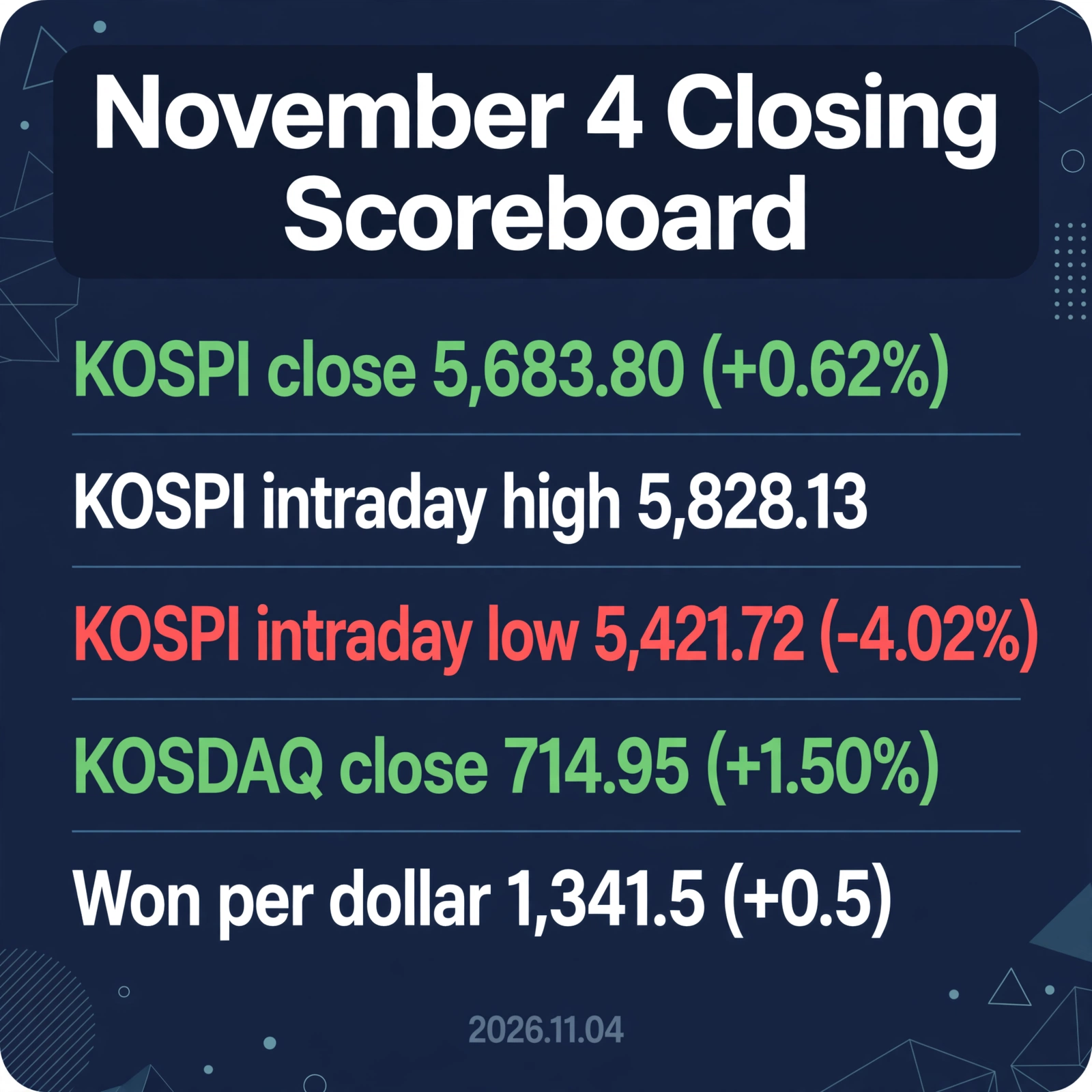
November 4 Korea market brief for foreign investors: the KOSPI swung 406.41 points intraday on US midterm vote counting, then closed up 0.62% at 5,683.80. Foreigners sold a net 2.5045 trillion won while retail and institutions bought 2.1602 trillion won, and battery and solar stocks surged on Democratic policy expectations.
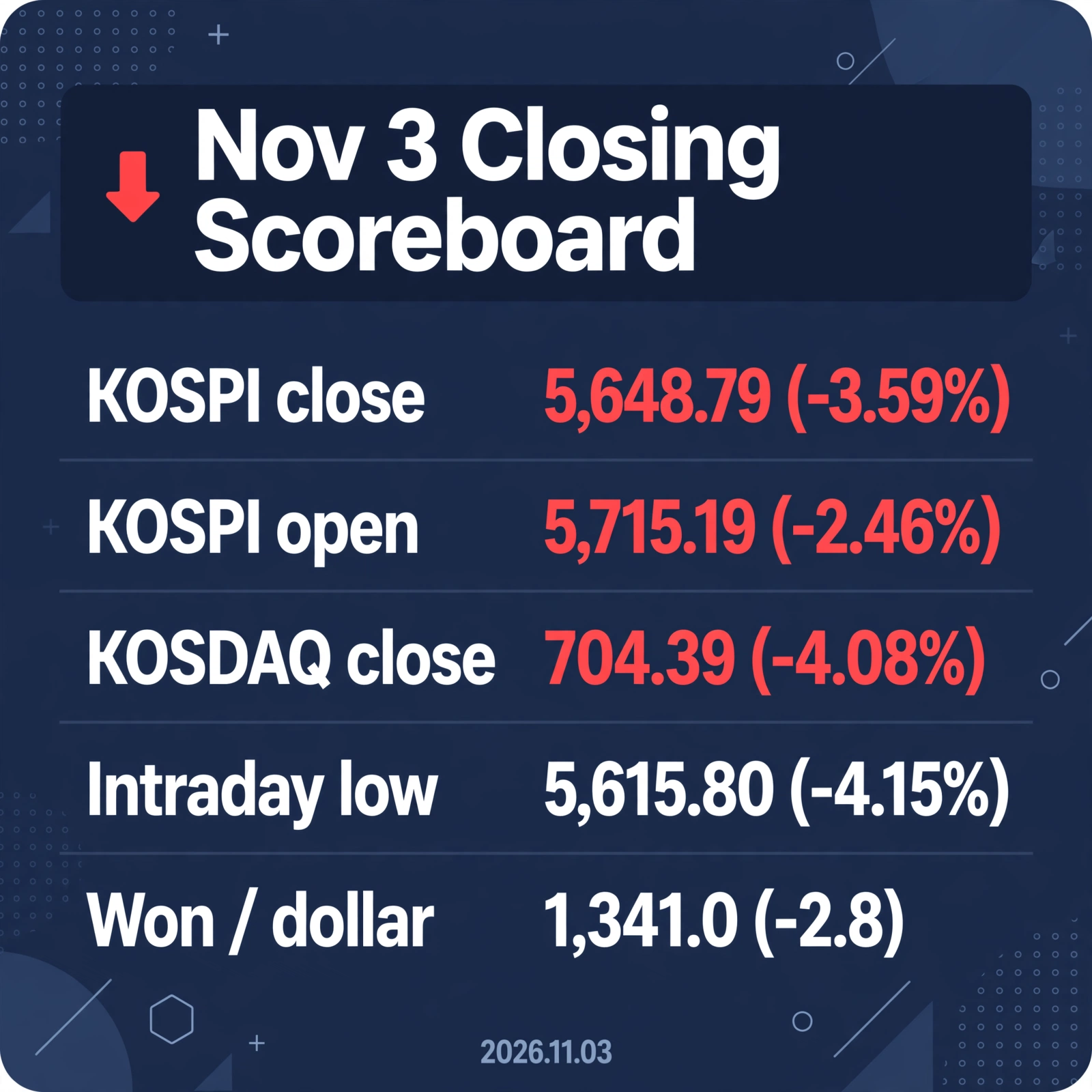
- KOSPI 3.59% Plunge Foreign Institutional 2.9 Trillion Won Selling AI Funding Fear
November 3 Korea market close: the KOSPI fell 3.59% to 5,648.79 and the KOSDAQ fell 4.08% to 704.39 as AI funding worries and US midterm caution triggered heavy foreign and institutional selling. Retail investors bought a net 2.60 trillion won alone. What it means for EWY holders.
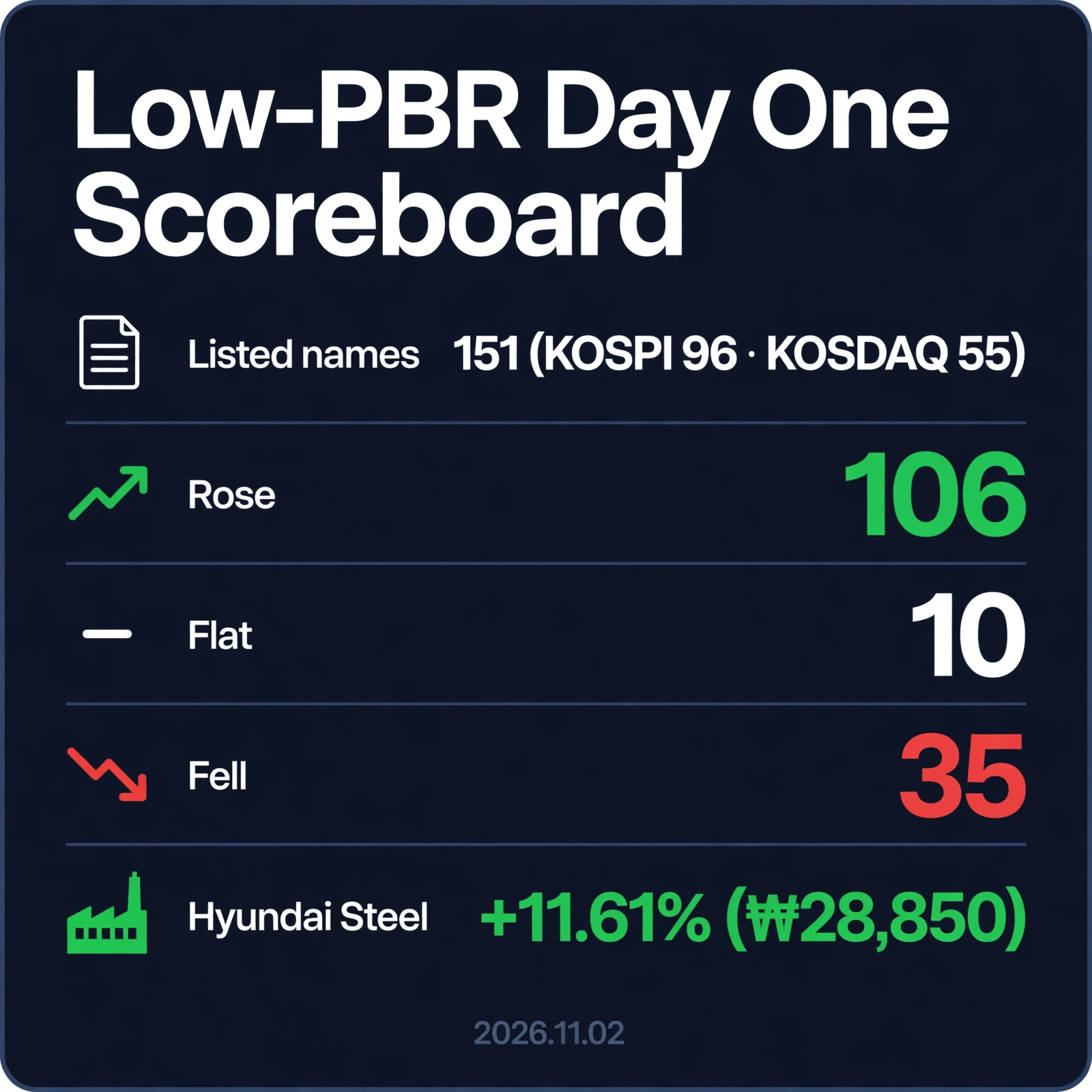
- Korea Low PBR First Day Analysis 106 of 151 Rise Hyundai Steel Surge
For foreign investors: on the first trading day of Korea's low-PBR name list, 106 of 151 stocks rose and Hyundai Steel surged 11.61%. But steel and construction rose across the board, so the list effect cannot be separated from sector strength. The real test is execution.
5minbrief on YouTube
The briefs also come as videos. Get the daily market wrap on YouTube.
Subscribe on YouTube