 5-minute briefs
KOSPI US Midterm Volatility Analysis 406-Point Swing Foreign Selling Rebound
#foreign selling Korea#won dollar#US midterm elections#data center regulation#Korean battery stocks
The closing scoreboard — a 406-point round trip in one session
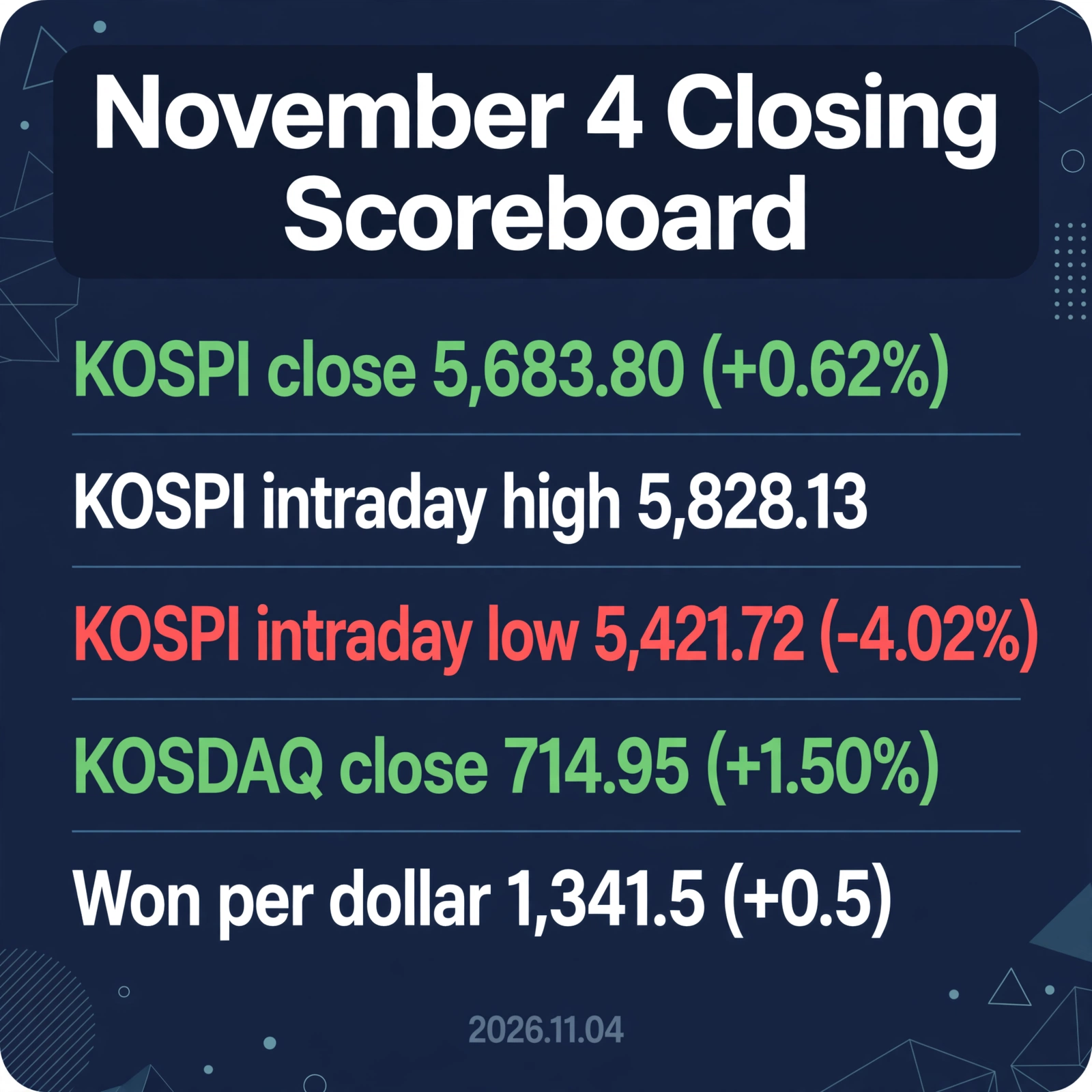
The Korea Exchange reports the KOSPI closed at 5,683.80, up 35.01 points (0.62%). The path mattered more than the close. The index opened at 5,786.13, up 2.43%, climbed to 5,828.13, up 3.17%, then fell to 5,421.72, down 4.02% around midday before recovering. The high-to-low range was 406.41 points, or about 7% from peak to trough. The KOSDAQ closed at 714.95, up 1.50%, after dipping below 700 intraday to 683.66. Gainers beat decliners 566 to 302 on the main board, and trading value reached 22.5 trillion won.
| Index | Open | Intraday high / low | Close | Change |
|---|---|---|---|---|
| KOSPI | 5,786.13 | 5,828.13 / 5,421.72 | 5,683.80 | +0.62% |
| KOSDAQ | 715.74 | — / 683.66 | 714.95 | +1.50% |
| Won / dollar | — | — | 1,341.5 won | +0.5 won |
Why it swung — midterm counting, data-center regulation fear, then a reversal
The strong open came from the US overnight session: the Nasdaq rose 0.83% and AMD reported strong data-center chip demand, pulling Korean chip stocks up at the open. The turn came as midterm vote counting pointed to Democrats taking both chambers of Congress. Investors worried that data-center construction rules could tighten — longer permits, and power-grid costs shifted onto developers rather than consumers. Local referendums in about ten states on data-center projects, many leaning against development, fed the same fear.
The rebound also came from politics. Reports that President Trump would accept the midterm result and work with Democrats helped stop the slide in the afternoon. Analysts called the intraday reaction excessive: Democratic control of Congress was already the leading scenario in polls, so the surprise was the margin of victory, not the outcome itself. The key distinction for foreign investors is timing: no regulation changed on November 4 — only the probability traders assigned to future regulation changed, then partly reversed. That is why the same stocks that fell 5–6% intraday closed almost flat.
Flows — foreigners sold 2.5045 trillion won, locals bought it back
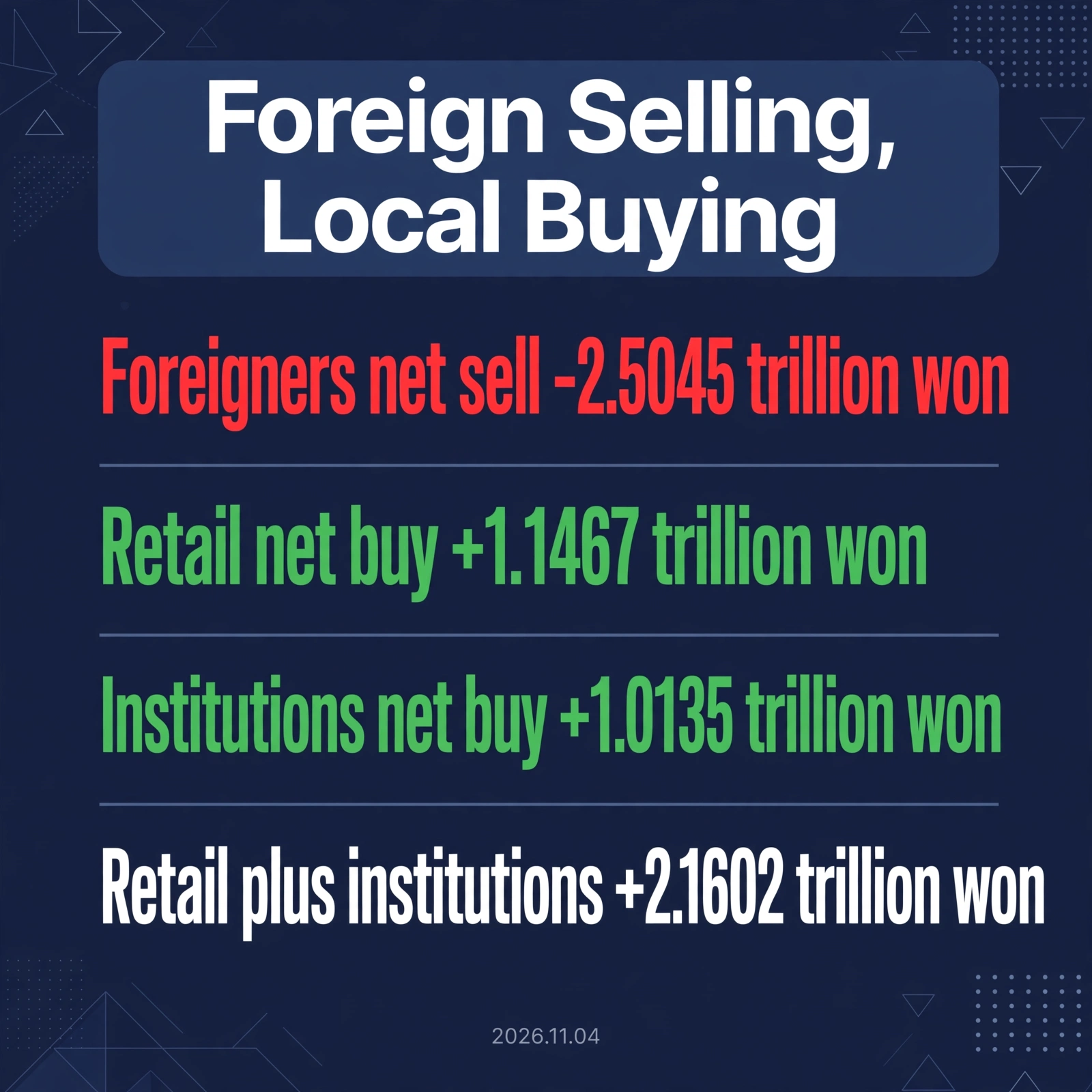
On the main board, foreign investors sold a net 2.5045 trillion won, the largest daily foreign outflow since October 15 by some tallies. Individuals bought a net 1.1467 trillion won and institutions bought a net 1.0135 trillion won, for a combined 2.1602 trillion won of buying. On the KOSDAQ, institutions bought a net 63.4 billion won while individuals sold 52.1 billion won and foreigners sold 0.7 billion won.
- Foreign flows are the swing factor in Korea. Overseas investors set the marginal price in large caps, so a 2.5 trillion won foreign sale day can drag the index even when local buyers step in.
- Retail buying is not a rescue signal by itself. Korean retail investors routinely buy dips; the question is whether institutions keep buying alongside them, as they did on November 4 after selling the day before.
- The won barely moved. At 1,341.5 per dollar, up just 0.5 won, the currency did not confirm a broad exit from Korean assets — the selling looked stock-specific, not a won panic.
Do not over-read one day of flows. Foreign selling in November extends a multi-month streak, according to Korea Times reporting, and analysts there caution that sweeping US policy change remains unlikely given presidential veto power. The practical read is narrower: watch whether foreign selling continues tomorrow and whether institutional buying holds — those two lines, not today’s close, decide whether this was a dip or the start of another leg down.
Stocks and sectors — chips flat, batteries and solar surging
Samsung Electronics closed down 0.68% at 218,000 won and SK Hynix down 0.14% at 1,396,000 won, after intraday lows of 208,000 won and 1,303,000 won respectively. Samsung Biologics (+2.96%), Hyundai Motor (+2.16%), and LG Energy Solution (+5.03%) rose. Krafton jumped 16.55% on a 300 billion won buyback and cancellation plan. By sector, telecom (+4.39%), electricity and gas (+4.03%), and pharmaceuticals (+3.44%) led, while entertainment and culture (–6.02%) and medical precision equipment (–2.87%) fell.
The dispersion trade was the story. Samsung SDI (+11.57%), POSCO Future M (+10.81%), and L&F (+12.84%) surged among battery names, and Hanwha Solutions (+18.64%) and OCI Holdings (+10.38%) surged among solar names, as traders priced in friendlier clean-energy policy under a Democratic Congress. For an EWY holder, this is the governance lens in action: US politics repriced Korean policy-exposed stocks in opposite directions on the same day, while the index itself barely moved. Owning the index means owning both sides of that bet.
What to watch next — the actual scope of regulation
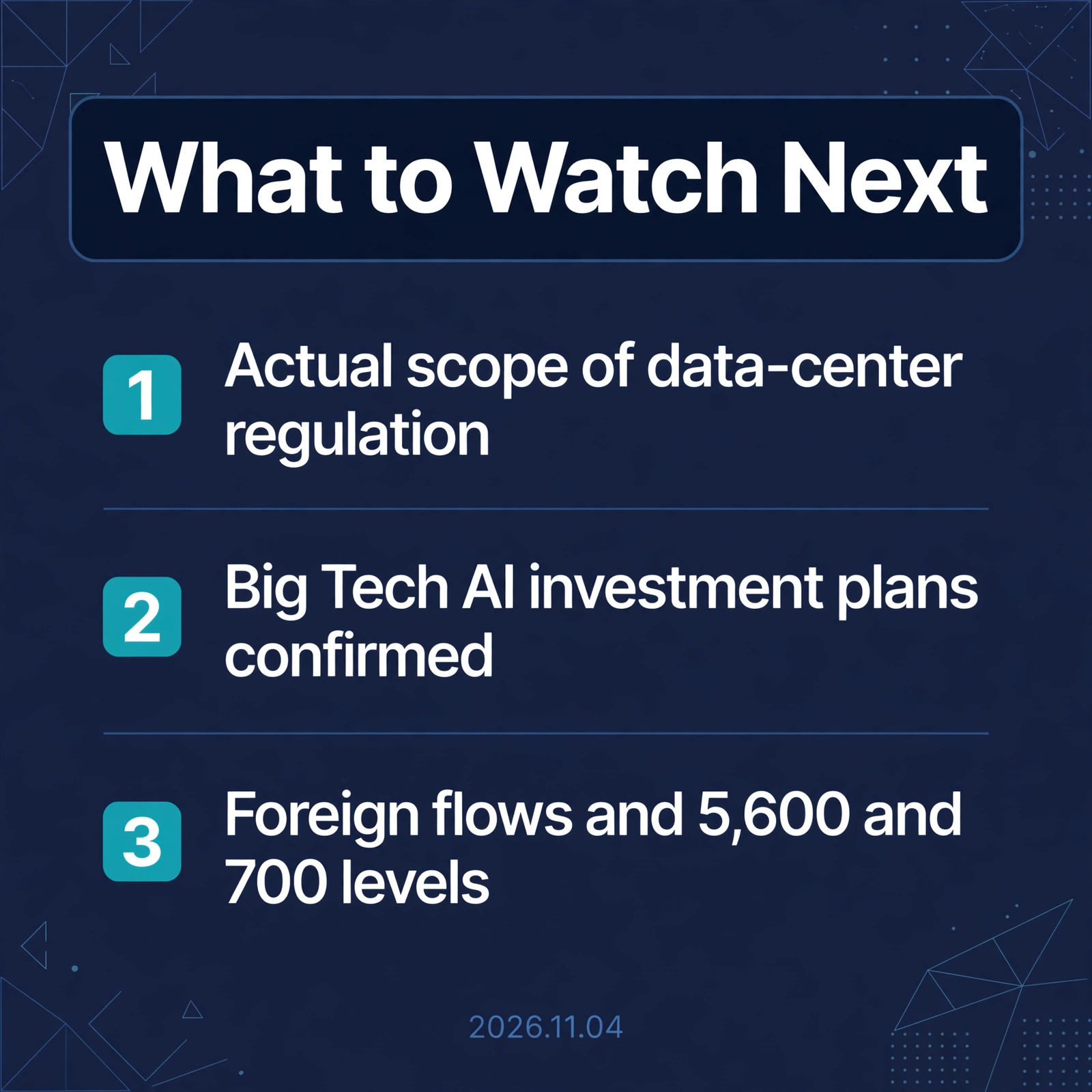
Three checks decide what November 4 meant. First, the actual scope of data-center regulation: whether permit and power-cost proposals become bills or stay at referendum level. Second, whether Big Tech confirms its AI investment plans unchanged — confirmation would validate the afternoon rebound; cuts would reopen the intraday lows. Third, foreign flows and the 5,600 KOSPI / 700 KOSDAQ levels. Holding both keeps the market in a volatile range; losing them would connect November 3’s plunge and November 4’s round trip into a single downtrend. Until those checks resolve, treat the 0.62% close as a pause, not a verdict.
Not investment advice. Figures are Korea Exchange, Yonhap, The Korea Times, Asia Business Daily, and Seoul Economic Daily reports confirmed November 4, 2026.
Sources & references
- Yonhap News Agency — (LEAD) Seoul shares close higher on early US midterm election outcome — KOSPI 5,683.80 (+0.62%), intraday high 5,828.13 and low 5,421.72, gainers 566 vs decliners 302, won at 1,341.5
- The Korea Times — Seoul stocks face fresh uncertainty as Democrats retake US Congress — Democratic control of both chambers, veto limits on sweeping change, foreign selling streak context
- Asia Business Daily (English) — Volatile KOSPI Closes Slightly Higher; KOSDAQ Gains More Than 1% — Investor flows: individuals 1.1467 trillion won and institutions 1.0135 trillion won net buying, foreigners 2.5045 trillion won net selling
- Seoul Economic Daily (English) — KOSPI Swings 7% Before Closing Higher as US Democrats Surge — 406.41-point high-to-low range, foreign selling as driver of the intraday plunge
Related articles
- KOSPI Failed Rebound Analysis 5,018 Close Foreign Selling Streak and Nvidia Probe
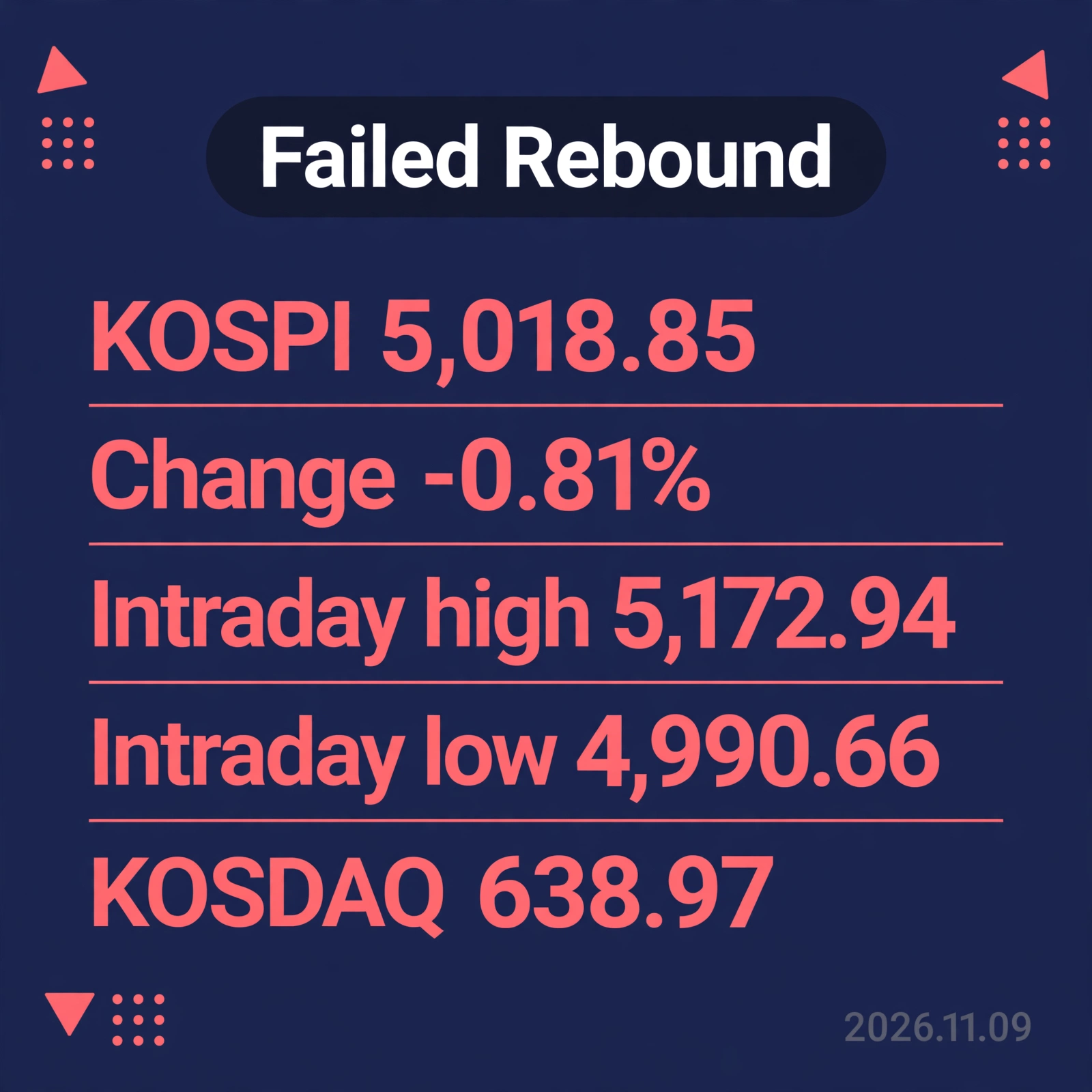
November 9 in Seoul: the KOSPI rallied 2.24% intraday to 5,172.94 but closed at 5,018.85 (−0.81%). Foreigners sold a seventh straight session, an Nvidia board probe capped the rally, and battery stocks gave back the blue-wave rally.
- KOSPI 5.28% Plunge Analysis Blue Wave Data Center Regulation Foreign Selling
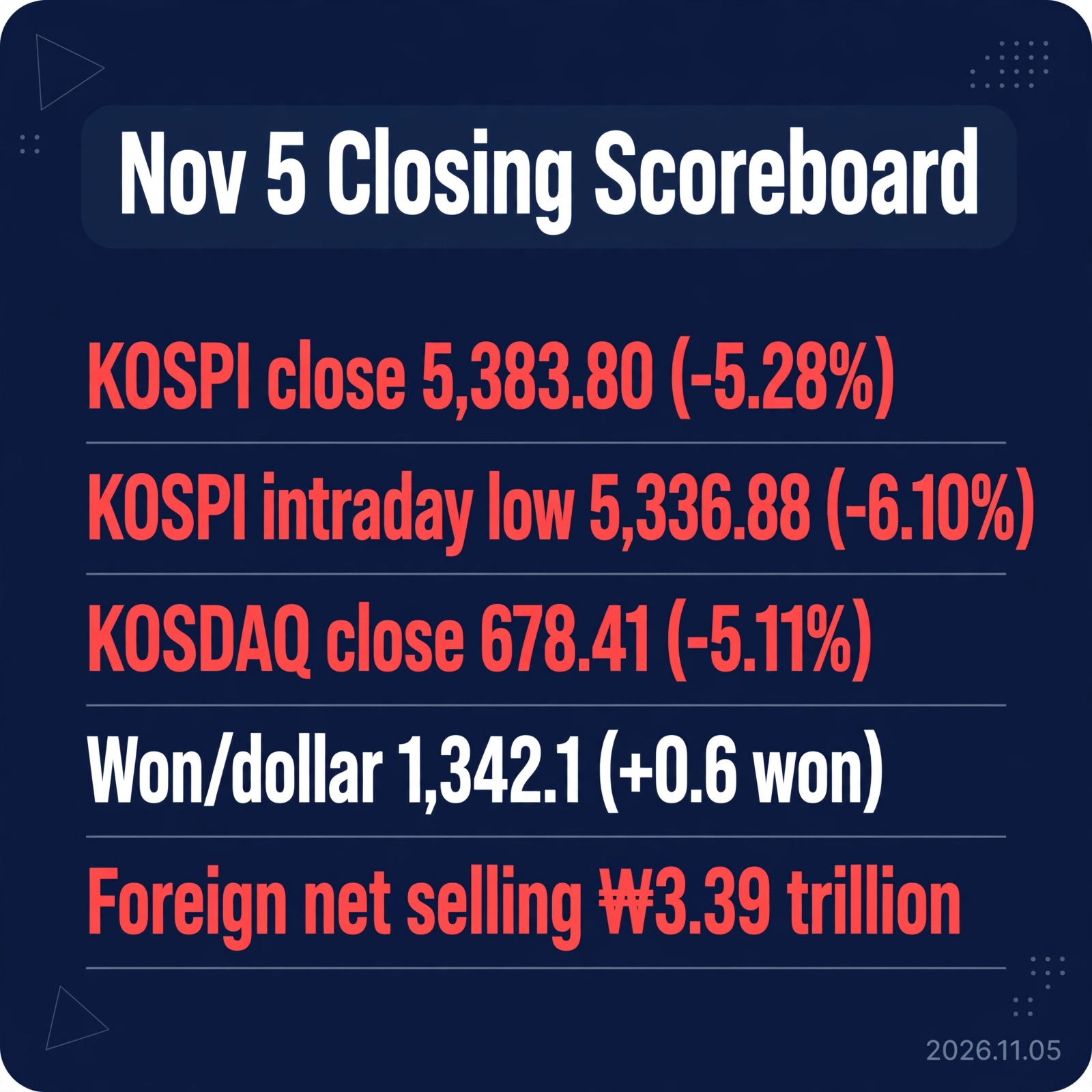
November 5 Korea market brief for foreign investors: the KOSPI plunged 5.28% to 5,383.80 and the KOSDAQ fell 5.11% to 678.41 as blue-wave AI data-center regulation fears drove 3.39 trillion won of foreign selling and triggered sell-side sidecars in both markets.
- KOSPI 6.02% Plunge Analysis Circuit Breaker 5000 Defense Foreign Selling
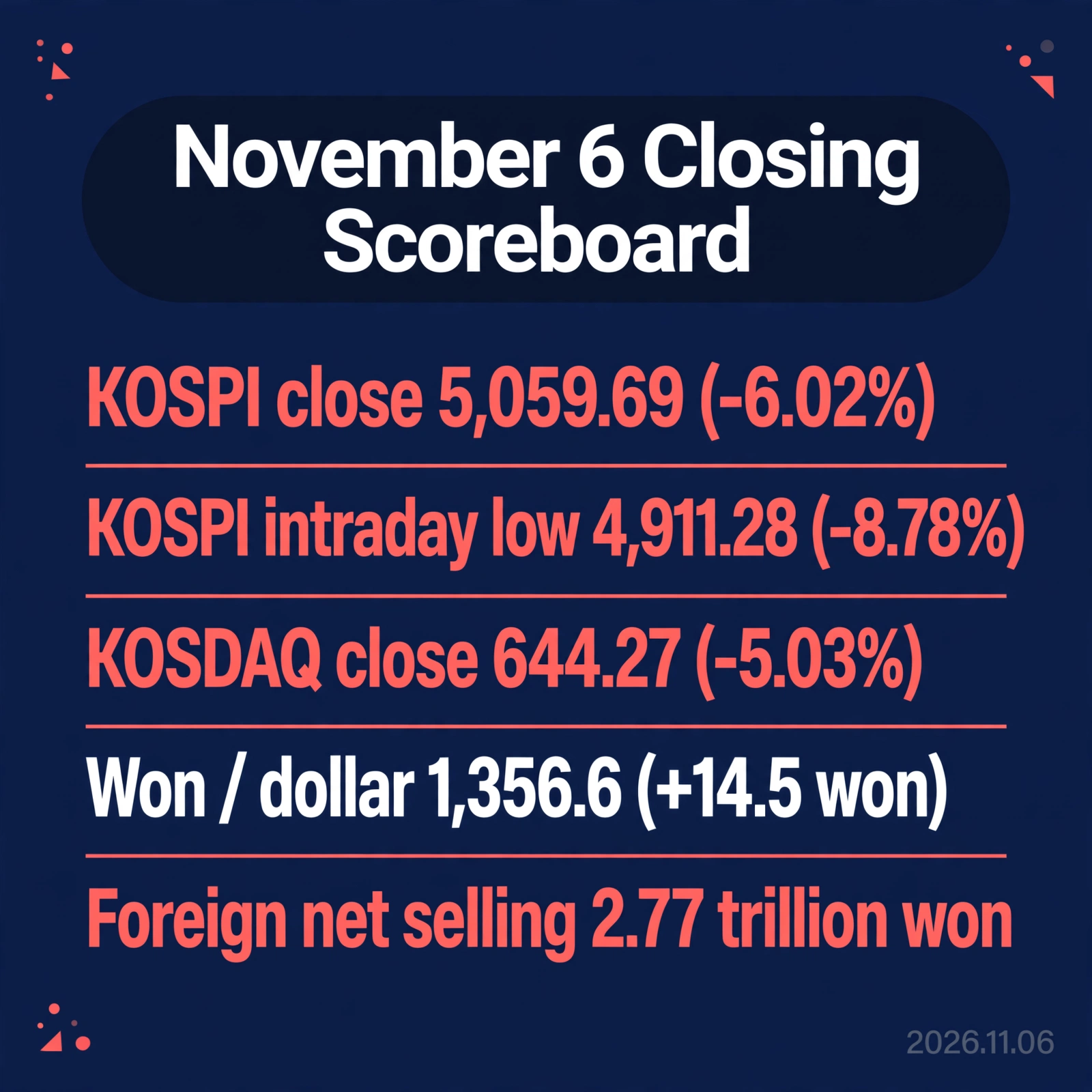
November 6 Korea market brief for foreign investors: the KOSPI plunged 6.02% to 5,059.69 as a stage-1 circuit breaker halted trading after an 8.78% intraday plunge. Foreigners sold a net 2.77 trillion won, their sixth straight day of selling, and the won fell to 1,356.6 per dollar.
5minbrief on YouTube
The briefs also come as videos. Get the daily market wrap on YouTube.
Subscribe on YouTube