 5-minute briefs
US Stock Market Weekly Recap Nasdaq Falls 2 Percent AI Spending Doubts Energy Strength Analysis
#US stock market#weekly recap#Nasdaq#S&P 500#Dow#Alphabet earnings#Intel#AI capex#Binance hack#oil prices#midterm elections
Last week’s flow: three days up, undone in two
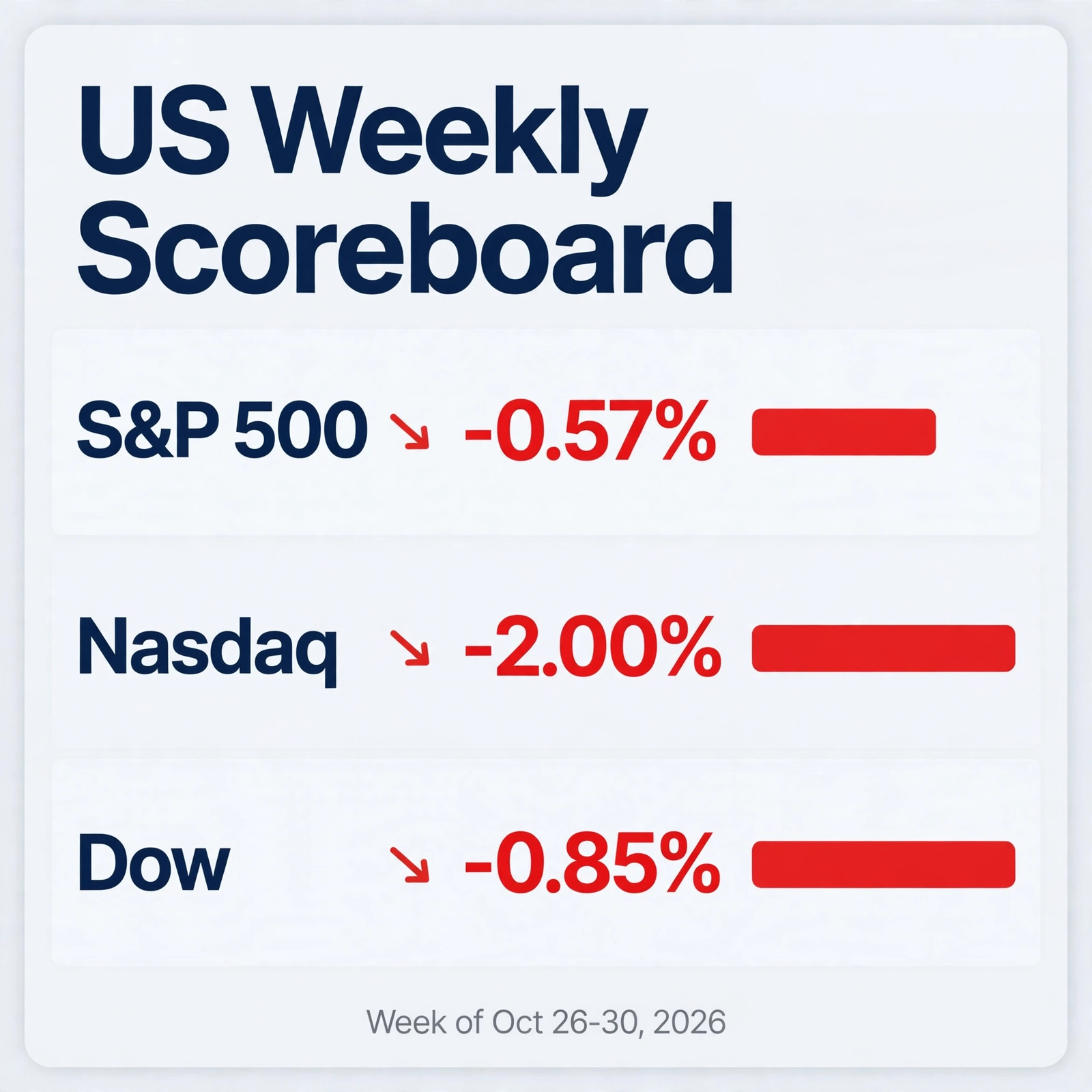
The weekly closes first. The S&P 500 finished at 7,580.07 (down 0.57%, or 43.61 points), the Dow at 51,770.31 (down 0.85%, or 444.85 points) and the Nasdaq at 25,437.00 (down 2.00%, or 518.34 points). Friday’s single-day losses (S&P 500 down 1.82%, Dow down 1.09%, Nasdaq down 2.86%) were larger than the weekly losses. In other words, one Friday wiped out the early week’s gains and then some.
The day-by-day split tells the story. On Monday, Anthropic’s IPO filing (S-1) set the tone, with first-half 2026 revenue of $16.286 billion and a first profitable quarter in Q2 (operating income of $974 million). On Tuesday, the Philadelphia Semiconductor Index jumped 3.60% as Broadcom, Bank of America, Blackstone, Citi and Morgan Stanley unveiled a $63 billion compute financing structure. On Wednesday, all three indexes edged higher, but the gains were less than half of Tuesday’s.
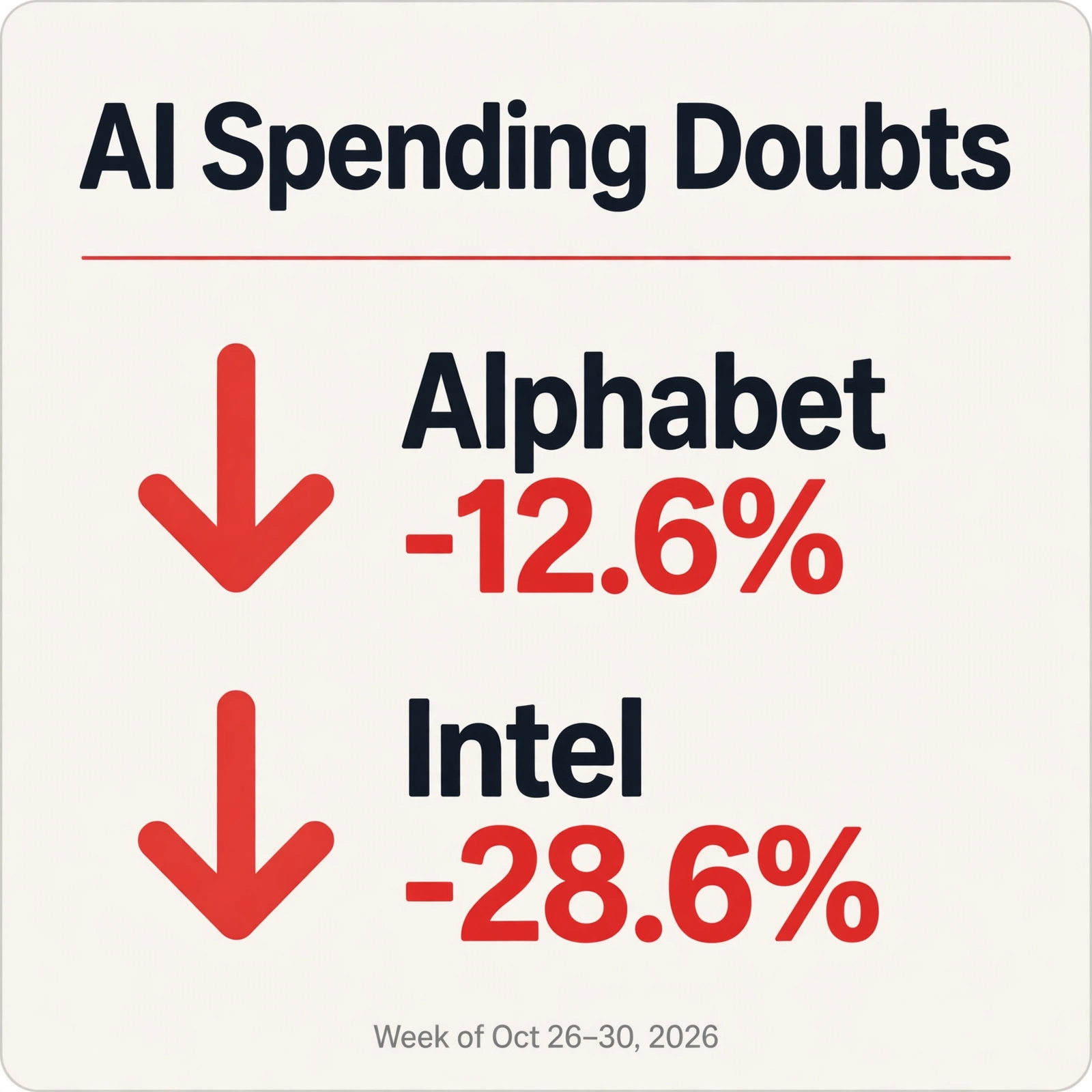
Thursday and Friday changed the week’s character. On Thursday, Alphabet plunged 12.6% and the Nasdaq fell 1.38%. On Friday, Intel crashed 28.58% and the Nasdaq fell another 2.86%, its worst single day since June. The 10-year Treasury yield eased from 5.00% to 4.93%, while the VIX fear gauge rose to 19.42. Gold futures fell 3.7% to $3,883 an ounce, the lowest since September 2025, and Bitcoin dropped below $77,000.
Zoom out to the full month and the divergence sharpens. The Nasdaq fell 5.3% in October, its worst monthly drop since March 2025, and the S&P 500 fell 0.9%. The Dow, by contrast, rose 1.7%. The earnings season itself was not bad: 82% of the 299 S&P 500 companies that had reported beat expectations, with quarterly earnings growth projected at 31.6%. “Good earnings, falling stocks” was the grammar of the season all week.
Key issue 1: Fed holds, but a 10–2 vote with hawkish dissents
On Wednesday, the Fed held its benchmark rate at 3.75–4.00%. The vote was 10–2. Governor Lisa Cook and Cleveland Fed President Beth Hammack dissented in favor of a 0.25-point hike. It was Chair Kevin Warsh’s first meeting, which drew extra attention. The statement said inflation “remains elevated,” and Warsh gave no hint about December.
What the decision leaves behind is twofold. First, a hold is not a signal for cuts. The dissents leaned hawkish, and the statement left the door to a hike ajar. Second, a structural change: starting next year, one of the eight annual meetings will be devoted to broad monetary policy strategy rather than a rate decision. Markets are likely to chew on those two points longer than on the hold itself. The December meeting (decision due December 9) is the next verdict.
Key issue 2: Big Tech earnings and the AI spending question — “spending a lot, leaking cash” lost
The earnings season’s message was brutally simple. Among AI spenders, the market separated the “spending less, earning more” names from the “spending a lot, leaking cash” names.
Alphabet plunged 12.6% on Thursday, wiping out about $500 billion in market value — the largest single-day value loss on record by Dow Jones’ count. The results were less “terrible” than “short of expectations”: Q3 revenue of $127.577 billion (+25%) came in just under the $128.22 billion consensus, and search ad revenue missed too. What the market really objected to was the direction of cash. Q3 capital spending surged 114% year over year to $51.355 billion, and free cash flow was negative $9.065 billion, the second straight negative quarter. The full-year capex outlook of $195–205 billion was left unchanged.
Amazon faced the same question. Q3 revenue of $201.9 billion (+12%) and EPS of $1.89 both missed expectations, and 12-month free cash flow swung to a negative $42.4 billion. The 2026 capex outlook of $220 billion was also left unchanged. But on Friday the stock recovered from an early drop of about 6% to close down just 1.4%. The market, for now, read it as “the worst was avoided.”
Friday’s main event was Intel’s 28.58% plunge. Results beat expectations, but fourth-quarter guidance fell far short, and the shock spread across chip stocks. The Philadelphia Semiconductor Index fell more than 7% on Friday, and the SOXX semiconductor ETF dropped more than 8%. ServiceNow crashed 27% on Thursday on disappointing fourth-quarter guidance, the worst S&P 500 performer, and Fortinet fell 20%. By contrast, Microsoft slipped just 0.11% on Thursday on strong Azure results. Weekly sector results point the same way: communication services fell 5.53% and technology fell 2%, while every other sector rose for the week.
Key issue 3: Strong growth, sticky inflation — the combination that forces the Fed to wait
Thursday’s macro data delivered a “strong growth, sticky inflation” combination. Q3 GDP grew at a 3.4% annualized rate, accelerating from 2.2% in Q2, while September PCE inflation ran at 3.6% year over year, far from the Fed’s 2% target. On Friday, the Q3 employment cost index rose 0.8% from the prior quarter, matching expectations and cooling from 0.9%. The October Chicago PMI came in at 55.3, below September’s 58.8 but still above the 50 expansion line.
This combination matters because it narrows the Fed’s options. Strong growth weakens the case for cuts, and sticky inflation keeps the Fed from closing the door on hikes. That is why the Fed held while leaving hawkish dissents on the record. Friday’s jobs report next week adds the third piece of the puzzle: the labor market.
Key issue 4: The Binance hack — a record $6.3 billion theft froze market sentiment
On top of the tech selloff came a crypto shock. About $6.3 billion was drained from Binance in roughly 20 minutes, the largest single theft in crypto history — more than four times the roughly $1.5 billion Bybit hack of February 2025. Binance says it has replenished 90% of the stolen amount from company funds and aims to resume withdrawals on November 1. But that 90% is not money recovered from the attackers; it is Binance buying back the same tokens with its own money to refill customer balances. About $3 billion has been frozen with the help of Tether, Circle and industry partners, though a freeze is not the same as a recovery.
The market reaction was immediate. Bitcoin fell at one point to $76,368, a six-week low, and on Friday Coinbase fell 10.62% and Robinhood 7.21%. US spot Bitcoin ETFs saw about $643.33 million in net outflows on October 30. Attribution is still unconfirmed: TRM Labs and Chainalysis pointed with high confidence to the North Korea-linked TraderTraitor group, but Binance has not named an attacker, and President Trump said “we don’t know yet. We’re investigating.” The November 1 withdrawal resumption and the November 3 proof-of-reserves verification are the first real tests of trust.
Key issue 5: Oil surge and energy’s counter-rally — where the money leaving tech went
All week, energy moved in the opposite direction from tech. On Saturday, October 24, Yemen’s Houthi rebels claimed missile and drone operations targeting Saudi Arabia’s East–West pipeline, oil pumping stations and Aramco facilities at Yanbu. The pipeline runs 1,200 km with capacity of 7 million barrels a day, Saudi Arabia’s key route bypassing the Strait of Hormuz. Saudi authorities did not confirm damage to oil facilities, but markets priced in the “possibility of disruption.”
On Friday, WTI crude rose 2.08% to $104.12 a barrel and Brent rose 2.40% to $117.64, the highest since April 29. ExxonMobil rose 2.16% and Chevron 1.75%, both hitting record highs. Exxon’s Q3 net income of $15.4 billion was its strongest quarter since the 2022 energy price spike, and Chevron’s $9.9 billion beat expectations. Six of the 11 sectors rose on Friday, led by energy (+1.91%) and consumer staples (+1.38%). The weekly sector map sums up the week: money rotated out of tech and into somewhere else.
- Free cash flow (FCF): cash a company generates after essential spending such as capital investment. A negative figure means it must rely on outside funding.
- Guidance: a company's own forecast for next quarter or full-year results. Stocks can fall on weak guidance even when results beat expectations.
- Philadelphia Semiconductor Index (SOX): an index of 30 major US semiconductor companies, a gauge of the whole chip sector's temperature.
- Proof of reserves (PoR): a cryptographic way for an exchange to show it actually holds customer assets. It shows asset holdings, not debts.
- Employment cost index (ECI): a gauge of wage and benefit costs that the Fed watches for wage-driven inflation pressure.
Next week’s checkpoints: midterms, Apple and AMD earnings, Friday’s jobs report
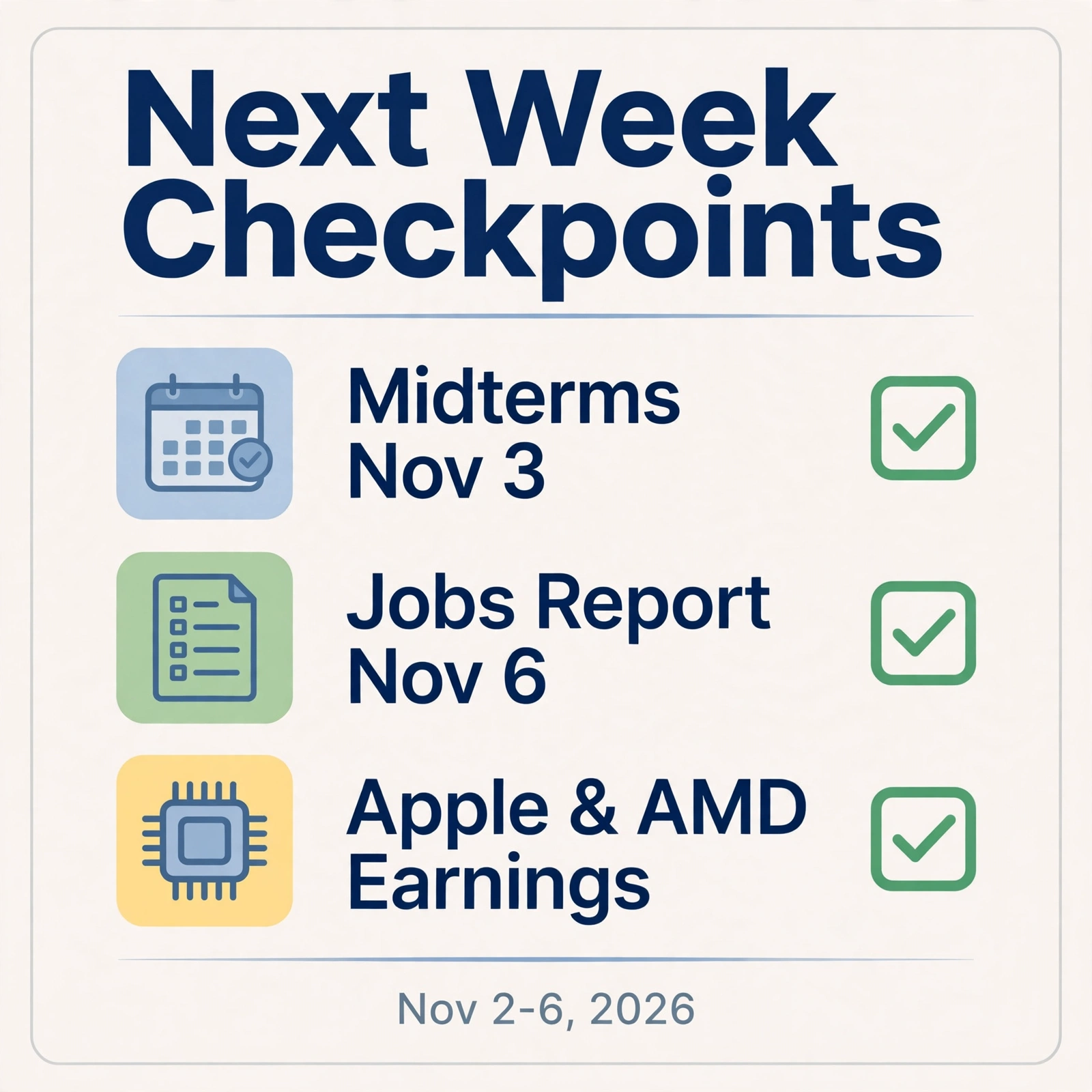
Next week (November 2–6) is packed from start to finish. Day by day:
- Monday, November 2: ISM manufacturing PMI (October) — consensus 54.7 versus 54.5 in September, a check on manufacturing expansion. After the close, Apple and Palantir report earnings. Apple’s fiscal Q4 results are the first answer to the market’s “prove it” demand. Monday also shows whether the Intel-driven chip selloff continues or Friday was an oversold low.
- Tuesday, November 3: US midterm elections — 35 Senate seats, all 435 House seats and 36 governorships are at stake, and markets will watch how the balance of power shifts policy and regulation expectations. The same day brings JOLTS job openings (September) and the Reserve Bank of Australia’s rate decision, plus AMD earnings (after the close) and the start of Binance proof-of-reserves verification.
- Wednesday, November 4: ISM services PMI (October), the ADP employment report and the US Treasury’s quarterly refunding announcement. After the close, Qualcomm and Arm report.
- Thursday, November 5: weekly initial jobless claims, the Challenger job cuts report and the Bank of England’s rate decision.
- Friday, November 6: the October jobs report (nonfarm payrolls and unemployment, 8:30 a.m. Eastern) and the preliminary University of Michigan consumer sentiment gauge settle the week’s direction. September payrolls rose 29,000 with unemployment at 4.2%.
One scheduling note: US daylight saving time ended on November 1, so US data releases arrive one hour later in Korean time from next week. The jobs report lands at 10:30 p.m. Korean time on Friday. In one sentence, the week ahead answers the question Friday posed: “good earnings, falling stocks” turned into a demand to “prove AI spending pays,” and the midterms, the jobs report and Apple and AMD earnings are where the answers come from.
Sources & references
- Federal Reserve — FOMC statement, October 28, 2026 — Rate hold decision, primary source
- Yonhap — New York stocks plunge on AI investment fears, Intel down 29%, Nasdaq down 2.9% — October 30 closes, Intel plunge, semiconductor index, oil and gold
- Yonhap — New York stocks fall across the board as AI fears reignite, Alphabet down 12.6% — October 29 closes and Alphabet plunge
- US Bureau of Economic Analysis — GDP advance estimate, Q3 2026 — Q3 GDP and PCE figures, primary source
- Yonhap — Binance completes 90% replenishment of stolen assets, withdrawals resume November 1 — 90% replenishment, 100% reserves for top 10 assets, November 1 withdrawal resumption
Related articles
- US Stock Market Weekly Recap Nasdaq Falls 3.4 Percent Thursday AI Rout and Correction Analysis
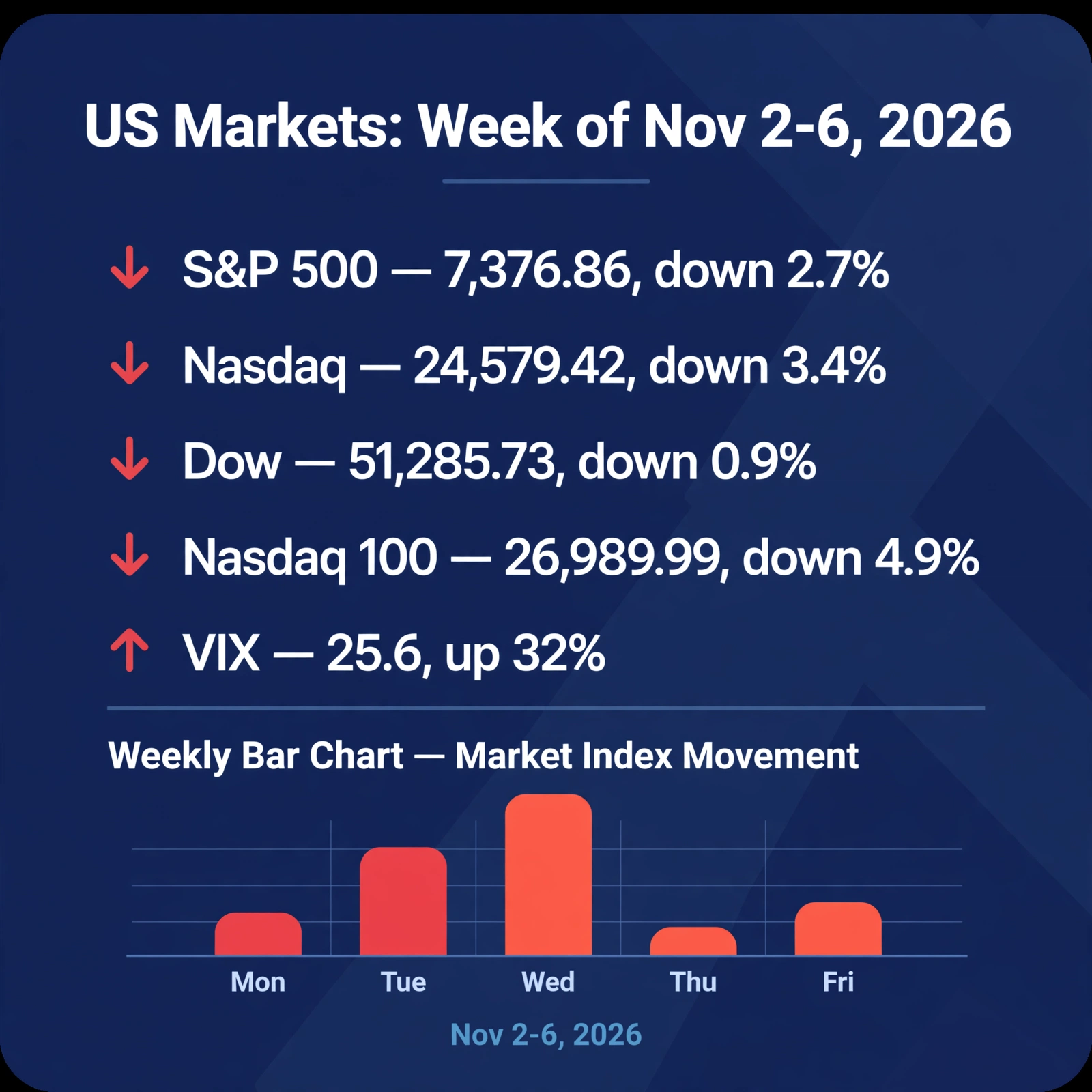
US stock market weekly recap for November 2–6. The S&P 500 fell 2.7%, the Nasdaq 3.4% and the Dow 0.9%, and Thursday's AI sell-off pushed the Nasdaq into correction territory. Midterms, the jobs report and the Hormuz oil plunge, plus next week's CPI and PPI checkpoints.
- US Stock Market Weekly Recap S&P 500 Down Dow Up AI Spending Selloff Oil Surge Analysis
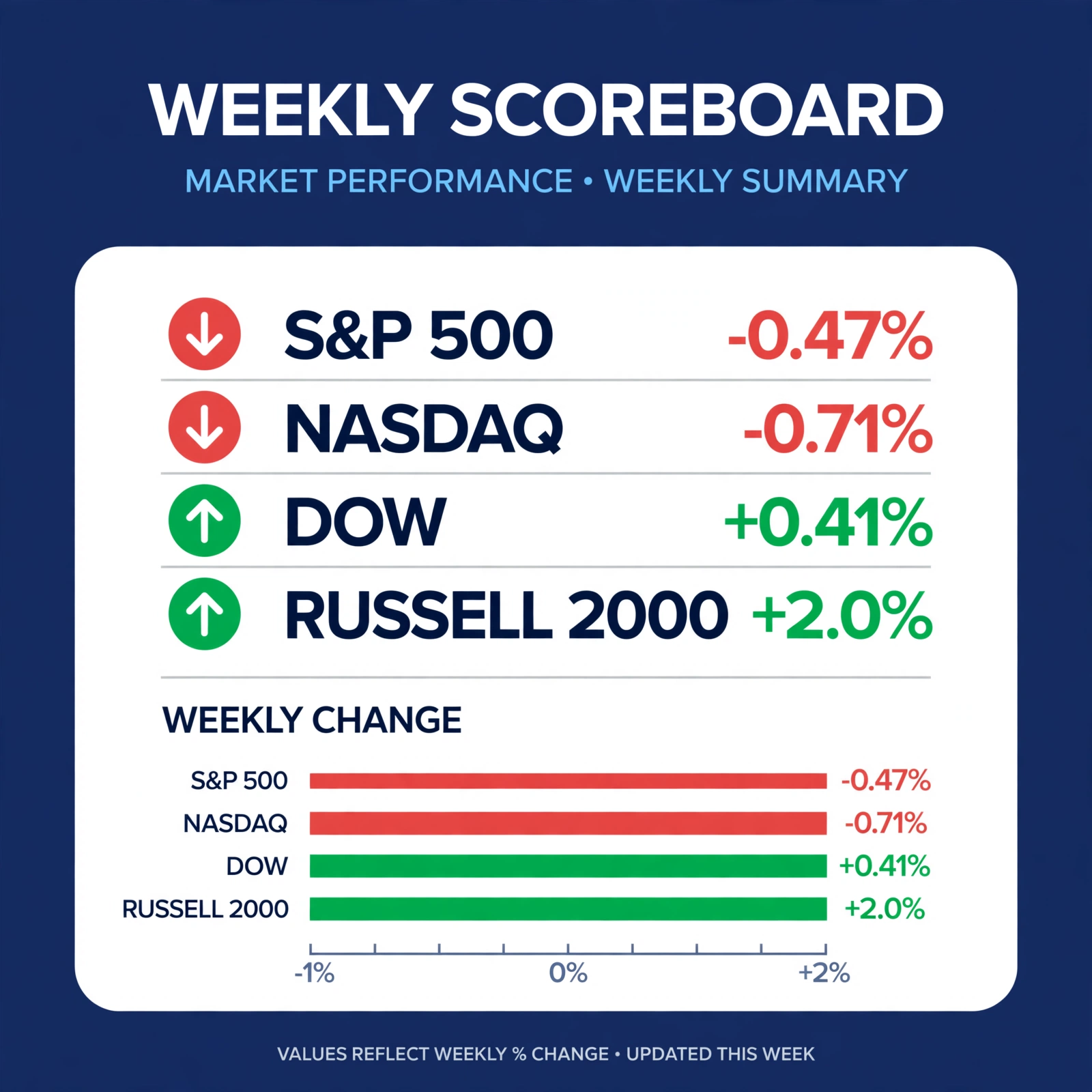
US stock market weekly recap for October 19–23: S&P 500 -0.47%, Nasdaq -0.71%, Dow +0.41%, Russell 2000 +2.0%. A Thursday AI spending selloff and an oil surge split the week. Next: FOMC, Microsoft, Alphabet, GDP, PCE.
- US Stocks November 3 Dow Falls 0.37% Nasdaq Rebounds 0.82% AMD Earnings Analysis
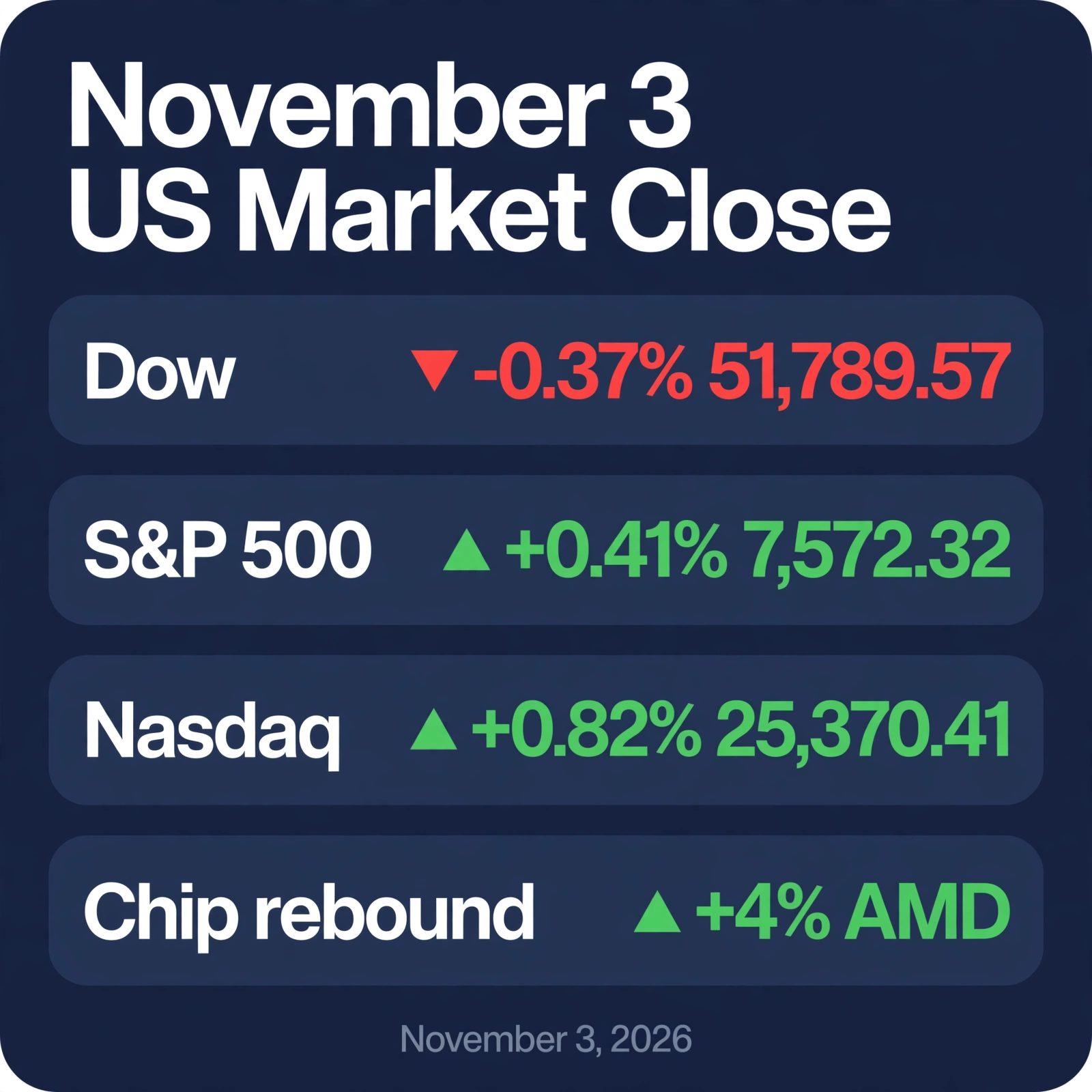
On November 3, US stocks reversed the previous day's pattern. The Dow fell 0.37% while the S&P 500 rose 0.41% and the Nasdaq gained 0.82%. After the close, AMD reported revenue of $13.38 billion and guided fourth-quarter revenue to about $17 billion, above expectations.
5minbrief on YouTube
The briefs also come as videos. Get the daily market wrap on YouTube.
Subscribe on YouTube