 5-minute briefs
Korea Sunday Closed Brief October KOSPI 16.19 Percent Fall 151 Low PBR Names US Midterms Analysis
Weekend scoreboard — October’s damage in one table
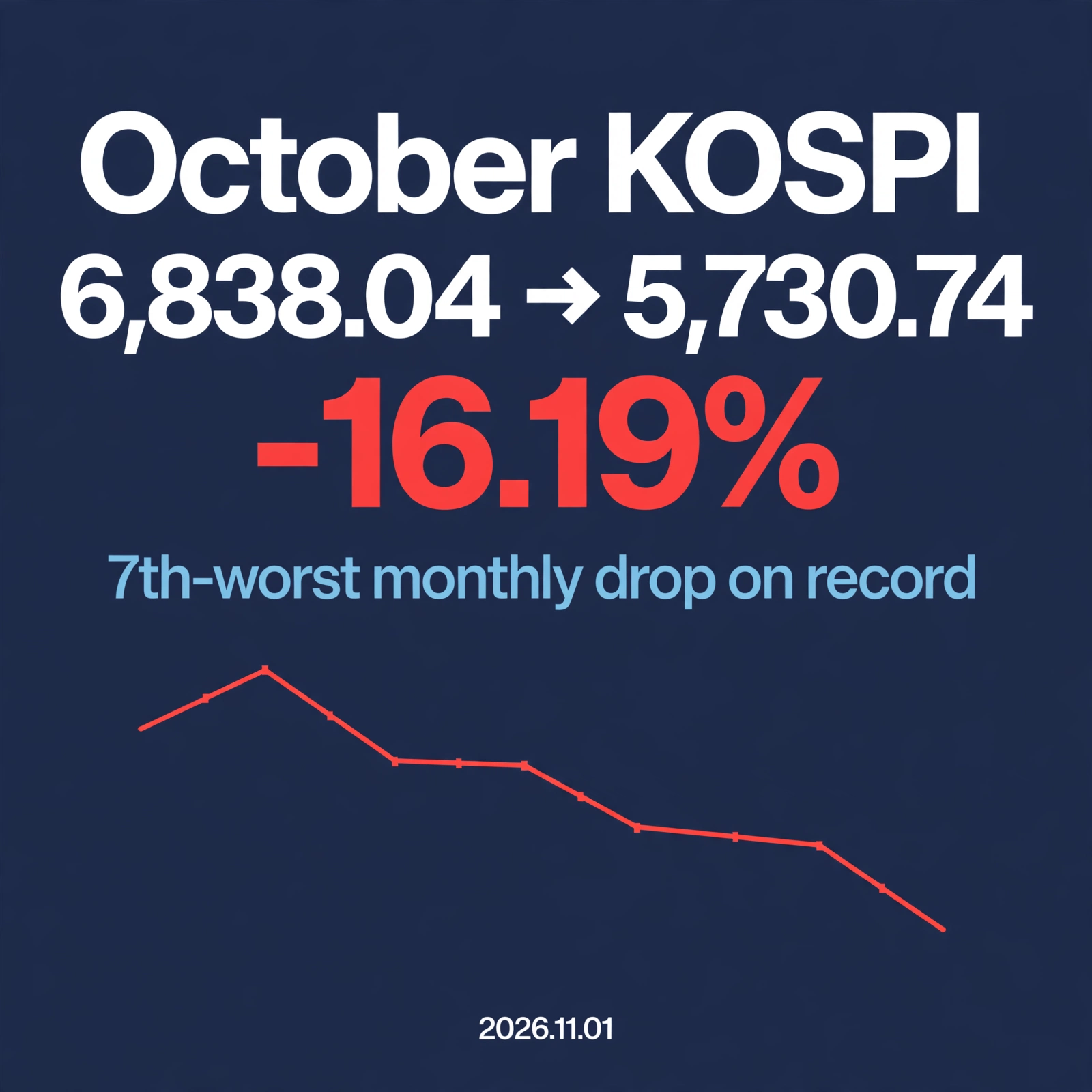
October was not a normal correction. The KOSPI rose on only 8 of the month’s 20 trading sessions, and the average loss on down days (3.00%) exceeded the average gain on up days (2.44%). Trading curbs tell the same story: sell-side sidecars fired 3 times in October (the 13th, 15th and 30th) and buy-side sidecars 3 times (the 21st, 27th and 28th). For the full year, sidecars on the main board have now fired 55 times, more than double the 26 recorded during the 2008 financial crisis and a record since the mechanism began in 2002. October joins March (–19.08%, fifth-worst) and July (–22.19%, third-worst) to give 2026 three of the seven worst monthly drops on record.
Friday’s close is Monday’s starting line: the KOSPI at 5,730.74 (–206.92 points, –3.48%) and the KOSDAQ at 724.38 (–28.85 points, –3.83%), with foreigners net sellers of KRW 1.6 trillion ($1.19 billion) on the day. The won closed at KRW 1,334.3 per dollar. The two index heavyweights fell with the market in October: Samsung Electronics down 16.20% and SK hynix down 20.16% for the month, closing Friday at KRW 225,000 ($169) (–3.02%) and KRW 1,418,000 ($1,063) (–7.08%) respectively.
| Index | October 1 | October 30 close | October change |
|---|---|---|---|
| KOSPI | 6,838.04 | 5,730.74 | –16.19% |
| KOSDAQ | — | 724.38 | Friday –3.83% |
| Won / dollar | — | 1,334.3 | Friday close |
Governance watch — 151 names, one tag, and a test of the Korea discount
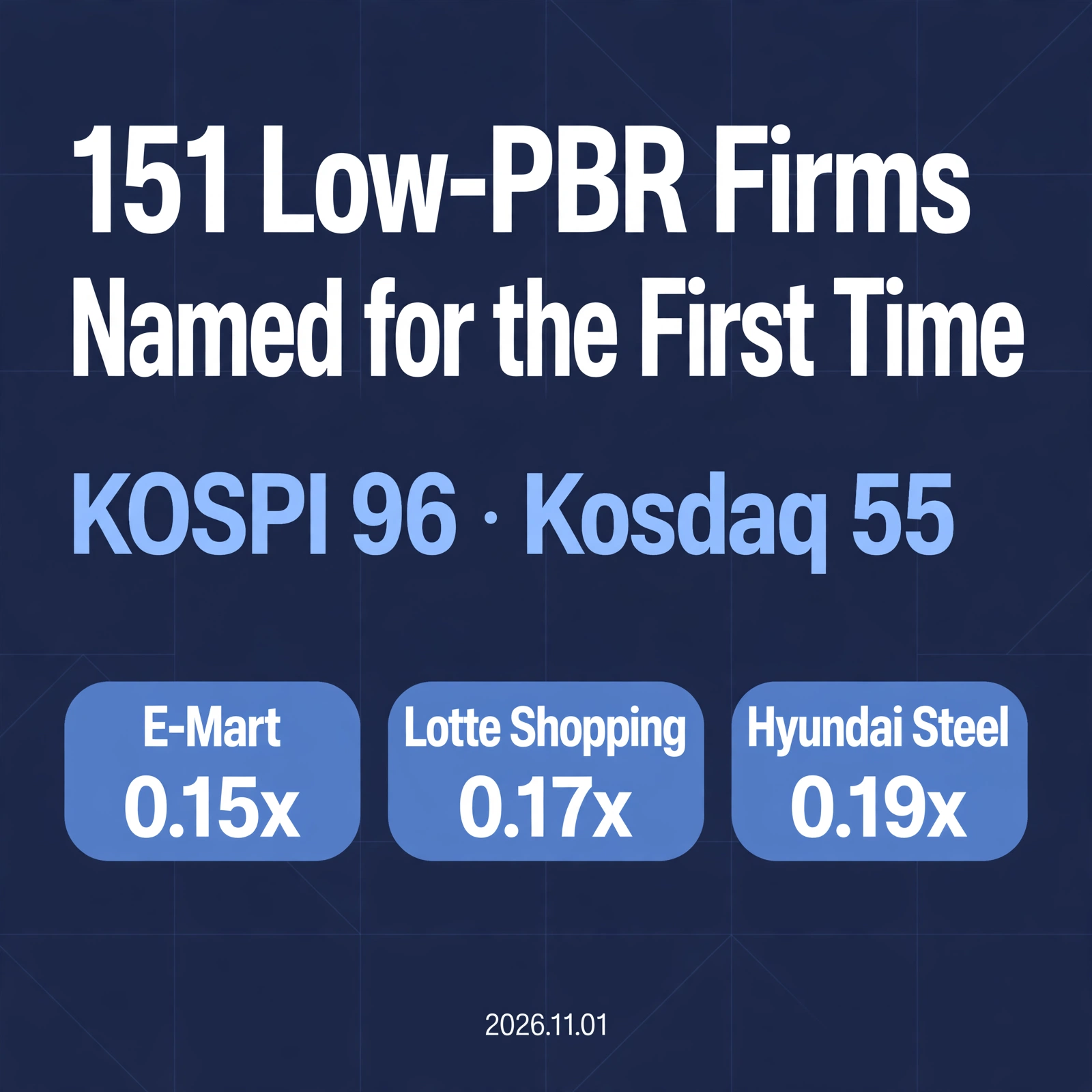
The Korea Exchange (KRX, South Korea’s stock exchange operator) on Sunday published its first-ever list of 151 low-PBR companies: 96 on the KOSPI and 55 on the Kosdaq. PBR, or price-to-book ratio, divides market capitalization by net assets; below 1.0 means the market values a firm at less than its book value. From Monday, November 2, the names appear on the exchange’s KIND disclosure system value-up page, and broker trading apps will show a “low PBR” tag next to the ticker. The list refreshes twice a year, next on May 4, 2027, and the exchange will offer one-on-one consulting to all 151 firms from 2027.
The selection rule is deliberately backward-looking. A firm qualifies if its sector-adjusted PBR ranked in the bottom 25% on the KOSPI or bottom 10% on the Kosdaq over three years, for six consecutive half-year periods or six of the last seven. Of 2,431 listed firms screened, 185 met the test; 34 were excluded because they had disclosed a PBR improvement plan by October 22, while 15 chronic cases stayed on the list despite disclosing plans. The named large caps show how deep the discount runs: E-Mart at 0.15 times book, Lotte Shopping at 0.17, Lotte Chemical at 0.18, Hyundai Steel at 0.19 and Hanwha Life at 0.27. A 0.15 multiple means the market prices the firm at 15% of its accounting net worth.
Why this matters to foreign investors: the “Korea discount” — the persistent gap between Korean and global valuations — is partly a governance story. Controlling shareholders, low payouts and opaque capital allocation have historically kept multiples low even when earnings were strong. Voluntary value-up disclosure since 2024 moved pledges; this list moves to publicity. The Korea Times quotes NH Investment & Securities strategist Na Jeong-hwan: even firms reluctant to return capital “may feel compelled to reconsider” once named. The honest caveat is that a tag is not a catalyst by itself. What foreign investors should watch from Monday is not the tag but the follow-up: which named firms announce concrete value-up plans, dividends or buybacks, and which stay silent. Silence after naming is itself information.
Buybacks — a KRW 102 trillion headline carried by two companies
The second governance number of the weekend cuts the other way. Korea Exchange data show listed firms filed KRW 101.92 trillion ($76.39 billion) of treasury-share purchases and disposals in January–October 2026, up 467.33% from KRW 17.97 trillion ($13.47 billion) a year earlier. The KOSPI accounted for KRW 100.40 trillion ($75.25 billion); the Kosdaq just KRW 1.52 trillion ($1.14 billion). But concentration is the story: Samsung and SK hynix filed KRW 82 trillion ($61.46 billion) between them, 80.45% of the total.
The execution gap between the two is the point foreign investors should price. SK hynix filed KRW 60 trillion ($44.97 billion) across August and October, completed its first KRW 40 trillion ($29.98 billion) tranche by October 21, and began a second KRW 20 trillion ($14.99 billion) tranche on October 29 running to January 28, 2027. Samsung filed about KRW 22 trillion ($16.49 billion), completed a KRW 15 trillion ($11.24 billion) tranche on October 6, but will not finalize its broader return plan until a January board meeting. As Yuanta Securities put it, the market’s question is not return capacity but “execution visibility.” A KRW 102 trillion market-wide headline that is really two companies’ filings should not be read as broad-based shareholder returns — and the low-PBR list above is, in part, the exchange’s answer to exactly that narrowness.
OpenAI in Seoul — a high-profile visit, no new deal announced

Sam Altman, chief executive of OpenAI, met about 50 Samsung Group executives in Yongin on October 31 and had lunch the same day with SK Group chairman Chey Tae-won alongside SK hynix and SK Telecom executives. Samsung said the session covered how AI reshapes industries and corporate decisions over the next decade, and that executives had completed hands-on generative AI training. No new contract or investment was announced.
The background cooperation is real but predates the visit: Samsung Group companies and OpenAI signed a letter of intent in October 2025 on global AI infrastructure, under which Samsung Electronics supplies high-performance, low-power memory for OpenAI’s Stargate data-center project, Samsung SDS handles data-center design, construction and operation, and Samsung C&T and Samsung Heavy Industries develop floating offshore data centers. SK hynix has a high-bandwidth memory (HBM) supply letter of intent with OpenAI, and SK Telecom is building an OpenAI-dedicated data center in Korea’s southwest. For EWY holders, the visit confirms that Korea’s memory makers sit inside the AI infrastructure build-out — but Monday’s chip prices will still be set by US tech sentiment, not by a seminar. Treat the visit as positioning, and wait for the next supply or order announcement before repricing anything.
What Monday actually tests — midterms, big tech earnings, and three numbers
The week ahead is crowded. US midterm elections are held November 3 (US time), with markets watching whether the vote clears political uncertainty or, if Democrats take the House, constrains the Trump administration’s agenda and adds short-term volatility. Earnings follow fast: Apple on November 3, AMD on November 4 and Qualcomm on November 5, each a read on whether AI spending converts into profit. US data — ISM manufacturing on November 3, ADP employment and JOLTS on November 4, ISM services on November 5 and the October jobs report on November 6 — set the Federal Reserve backdrop.
Three things to check on Monday. First, does the KOSPI hold 5,700, or retest Friday’s intraday low of 5,599.42? Second, do newly tagged low-PBR names draw value-up announcements or buying, or does the tag trade as stigma? Third, does the OpenAI visit cushion chip names against US tech weakness, or do Samsung and SK hynix follow the Nasdaq lower again? October proved Korean shares can fall on global AI doubts even with record domestic earnings. November’s question is whether governance pressure — a public list, concentrated buybacks, and a January Samsung board date — is enough to change that equation.
- PBR (price-to-book ratio): market capitalization divided by net assets. Below 1.0 means the market values a firm below its book value; 0.15 means 15% of book value.
- Sidecar: a five-minute suspension of program trades when KOSPI 200 futures move 5% or more from the previous close for at least one minute. It slows program trading; it does not halt stock trading.
- Value-up program: Korea's policy push for listed firms to disclose plans to lift corporate value, now extended from voluntary disclosure to the public low-PBR list.
- KIND: the Korea Exchange's listed-company disclosure system, where the low-PBR list is published.
- HBM (high-bandwidth memory): stacked memory chips built for AI accelerators, the product at the center of the Samsung–SK hynix–OpenAI relationship.
Not investment advice. Figures from the Korea Exchange, Reuters, The Korea Times, Aju Business Daily, BigGo Finance and Seoul Economic Daily, checked November 1, 2026. Won–dollar conversions use the October 30 close of KRW 1,334.3 per dollar.
Sources & references
- Reuters via The Standard — South Korean shares end month 16 percent lower on AI doubts — October 30 KOSPI close 5,730.74, monthly fall 16.2%, foreign selling, won at 1,334.3
- The Korea Times — Hanwha Life, Hyundai Steel, Lotte Shopping among 151 firms flagged for persistently low valuations — 151 low-PBR firms, 96 KOSPI and 55 Kosdaq, trading-platform tags, May 4 2027 next disclosure
- Aju Business Daily (English) — Samsung hosts OpenAI's Sam Altman for AI strategy talks with 50 executives — Altman meeting with Samsung executives and SK chairman, Stargate letter of intent background
- Aju Business Daily (English) — Korea Exchange Reveals 151 Low PBR Companies Including Lotte Shopping and E-Mart — 151 firms, 96 KOSPI and 55 Kosdaq, criteria, 2,431 screened, 185 candidates, 34 exclusions, individual PBR levels
- BigGo Finance (English) — South Korea's KOSPI Plunges 16% in October, Sidecar Halts Hit Record 55 — October KOSPI 6,838.04 to 5,730.74, minus 16.19%, seventh-worst monthly drop, sidecars 3 plus 3 in October, 55 for the year
- Seoul Economic Daily (English) — Korea Exchange Names 151 Low-PBR Companies in First Disclosure — 15 chronic firms kept on list despite plans, consulting from 2027, stewardship code revision
Related articles
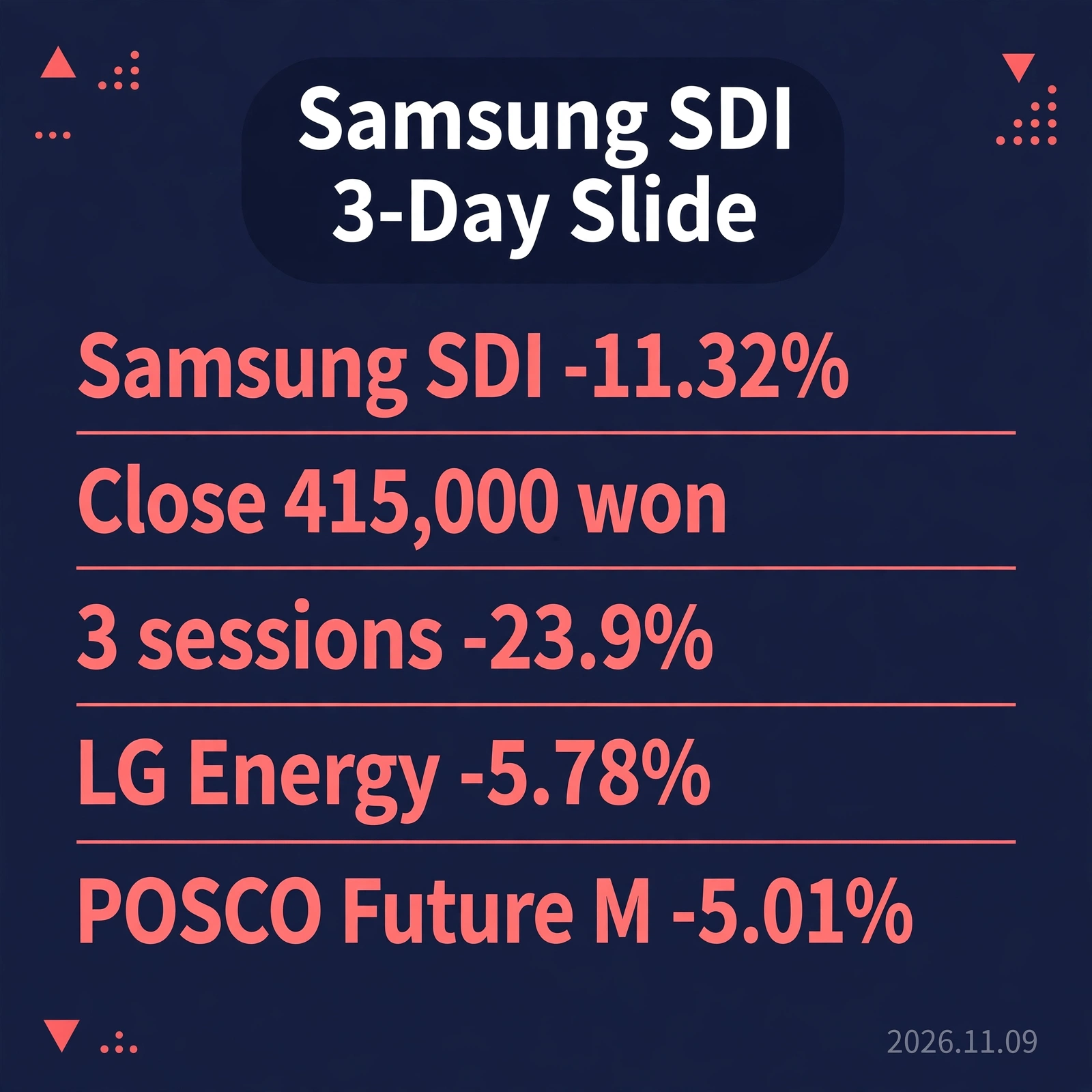
- Korean Battery Stocks Analysis Blue Wave Rally Reversal Samsung SDI 23.9% Drop
Korean battery stocks gave back their blue-wave rally in three sessions. Samsung SDI fell 23.9% from 545,000 won to 415,000 won, with LG Energy Solution, POSCO Future M and LG Chem down about 5% each. The market read the same election two ways.
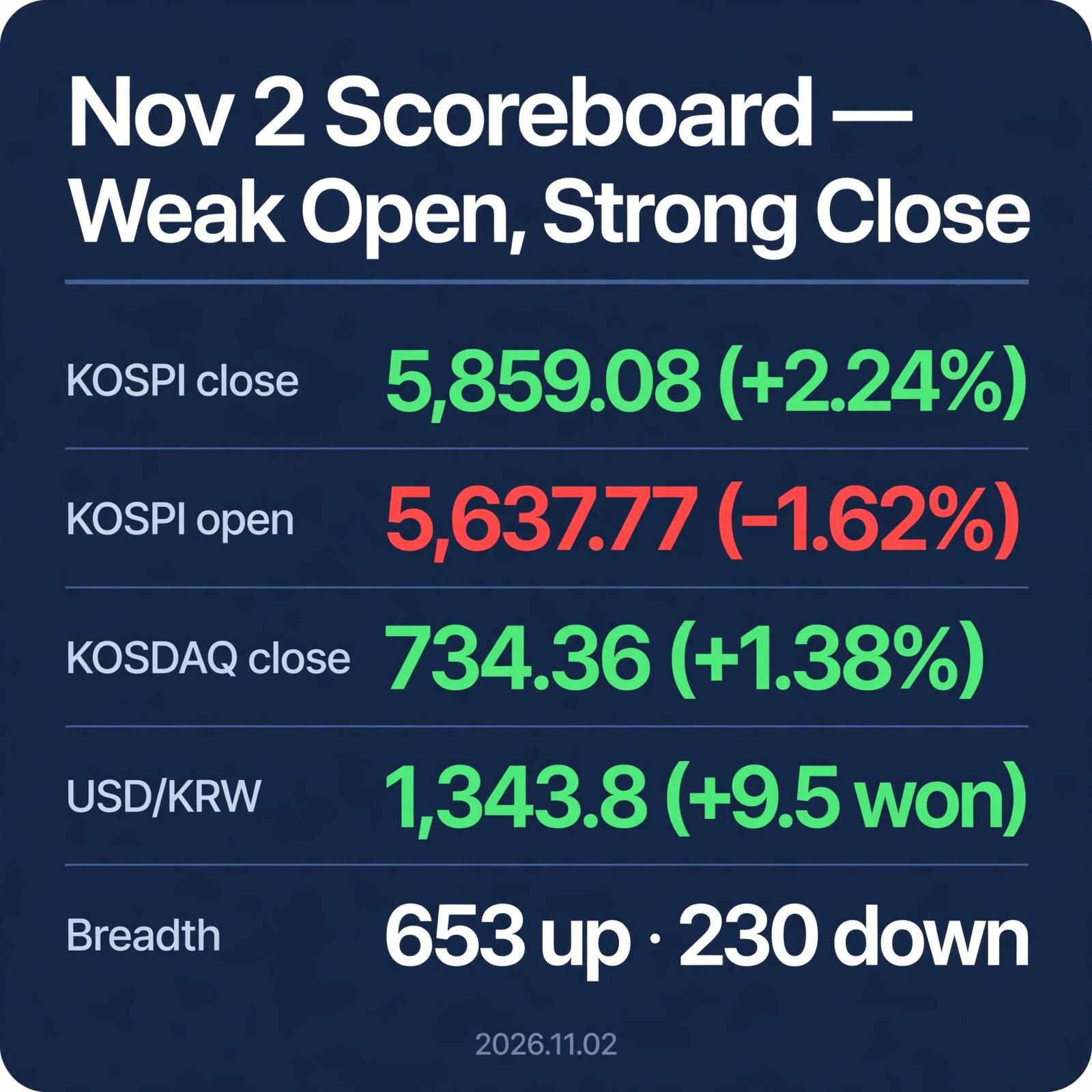
- KOSPI Rebound Analysis 2.24% Rally Institutional Buying Low PBR First Day
November 2 Korea market brief for foreign investors: the KOSPI opened down 1.62% on the US chip selloff, then rallied 2.24% to 5,859.08 on institutional buying and a strong first day for the low-PBR name list. Foreigners sold a net 373.1 billion won overall but bought Samsung Electronics.
- Korea Low PBR First Day Analysis 106 of 151 Rise Hyundai Steel Surge
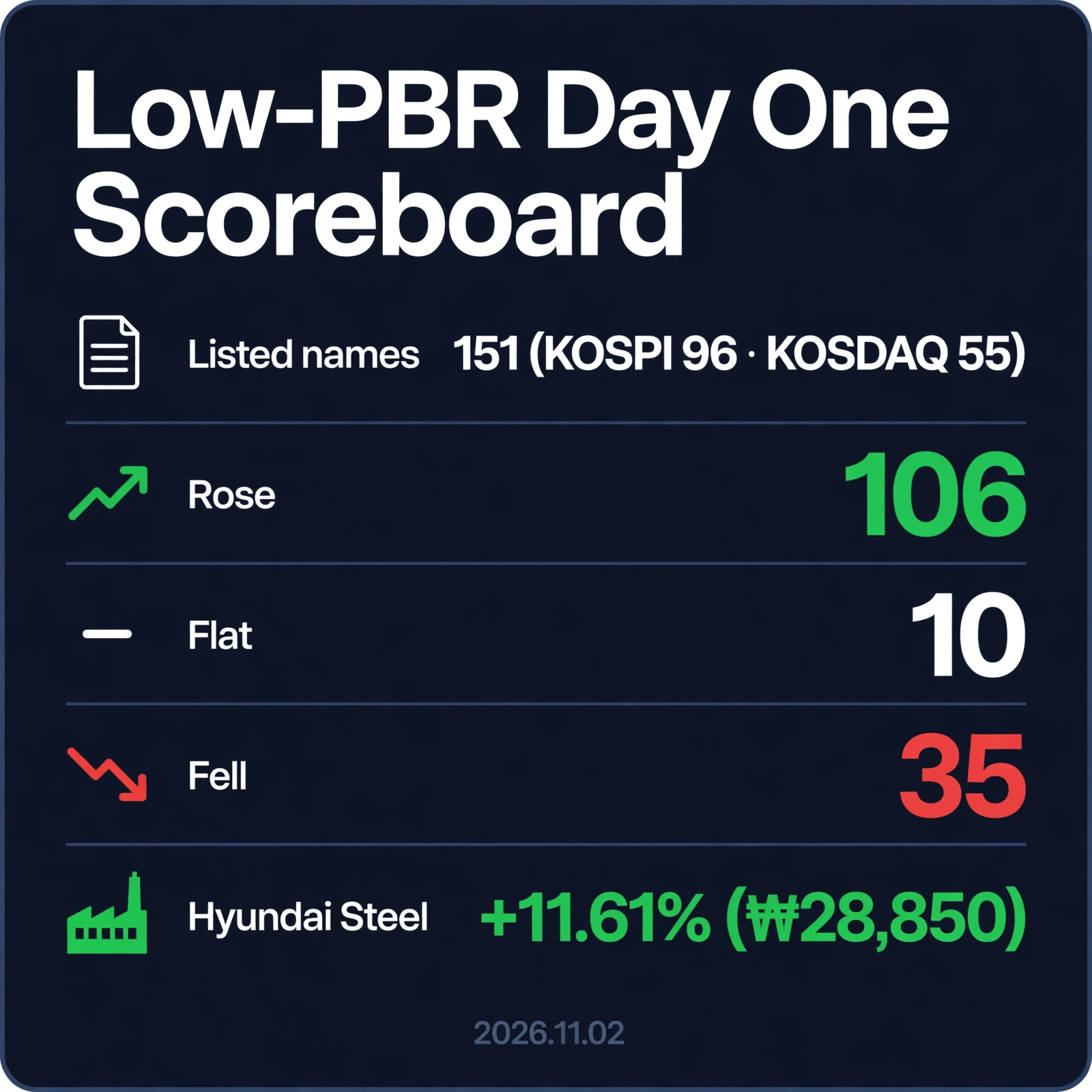
For foreign investors: on the first trading day of Korea's low-PBR name list, 106 of 151 stocks rose and Hyundai Steel surged 11.61%. But steel and construction rose across the board, so the list effect cannot be separated from sector strength. The real test is execution.
5minbrief on YouTube
The briefs also come as videos. Get the daily market wrap on YouTube.
Subscribe on YouTube