 5-minute briefs
US Stock Market Close Analysis Nasdaq Falls 2.86% Intel Plunges 28.58% Semiconductor Selloff (October 31)
#US stocks#Nasdaq#S&P 500#Dow#Intel#semiconductors#Amazon#AI spending
Closing scoreboard: the Nasdaq fell 2.6 times as much as the Dow
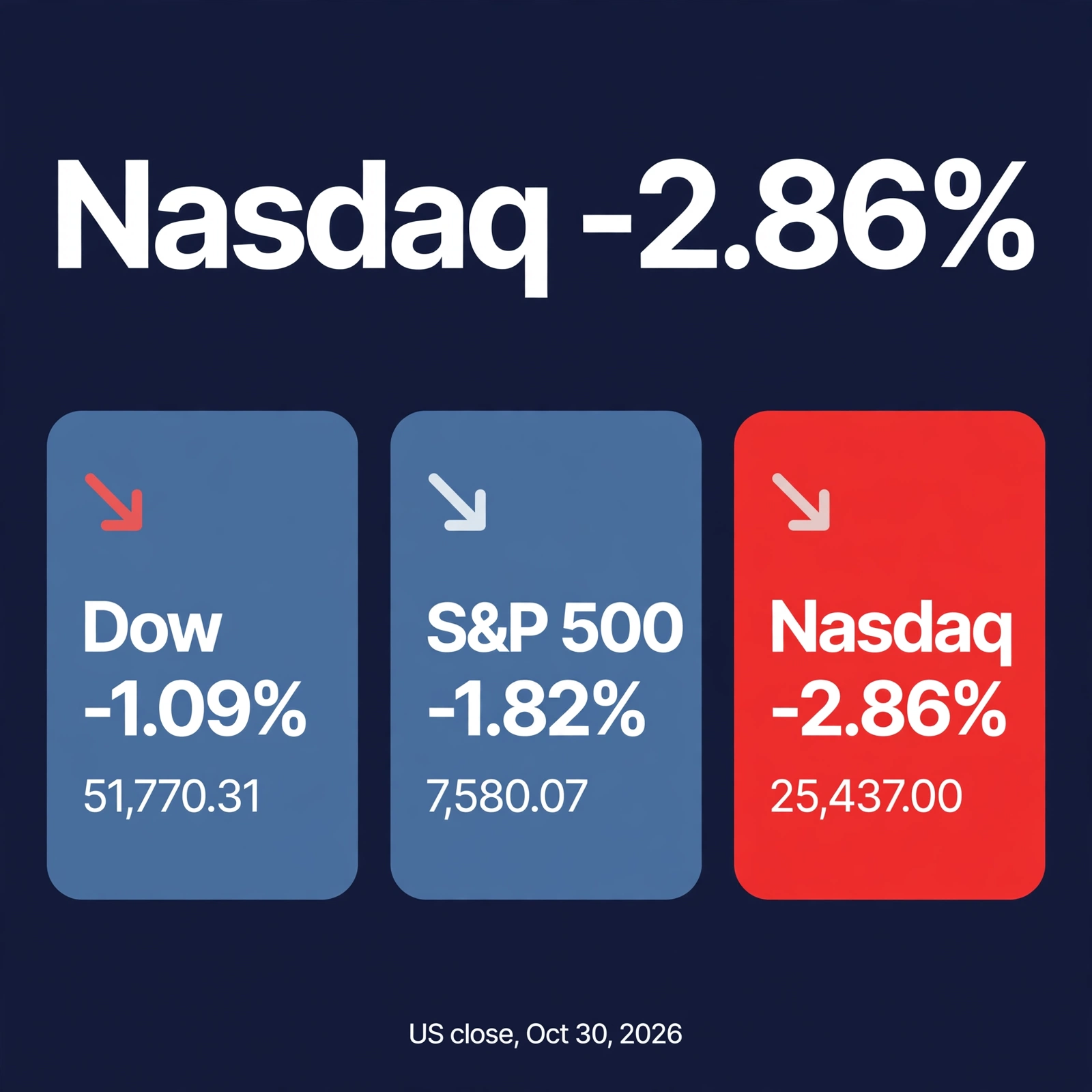
Thursday’s decline deepened on Friday. The Dow fell 572.25 points to 51,770.31, the S&P 500 fell 140.32 points to 7,580.07, and the Nasdaq fell 747.73 points to 25,437.00. At one point the Nasdaq was down ≈3.3% intraday. The Nasdaq 100 fell 3.46%, moving toward correction territory, and the Russell 2000 fell 1.66% to 2,811.84, ending a four-session winning run. Thursday could still be read as “only tech fell”; Friday lowered even that breakwater.
Inside the indexes, the temperature gap was clear. Technology fell 4.24%, the worst of the eleven sectors, but six sectors rose, including energy (+1.91%) and consumer staples (+1.38%). On the safety side, the 10-year Treasury yield slipped to 4.93%, and the VIX fear gauge jumped 12.84% to 19.42. Friday looked less like “sell everything” and more like “leave tech and move elsewhere.”
The Intel shock: how a good quarter produced a 28.58% plunge
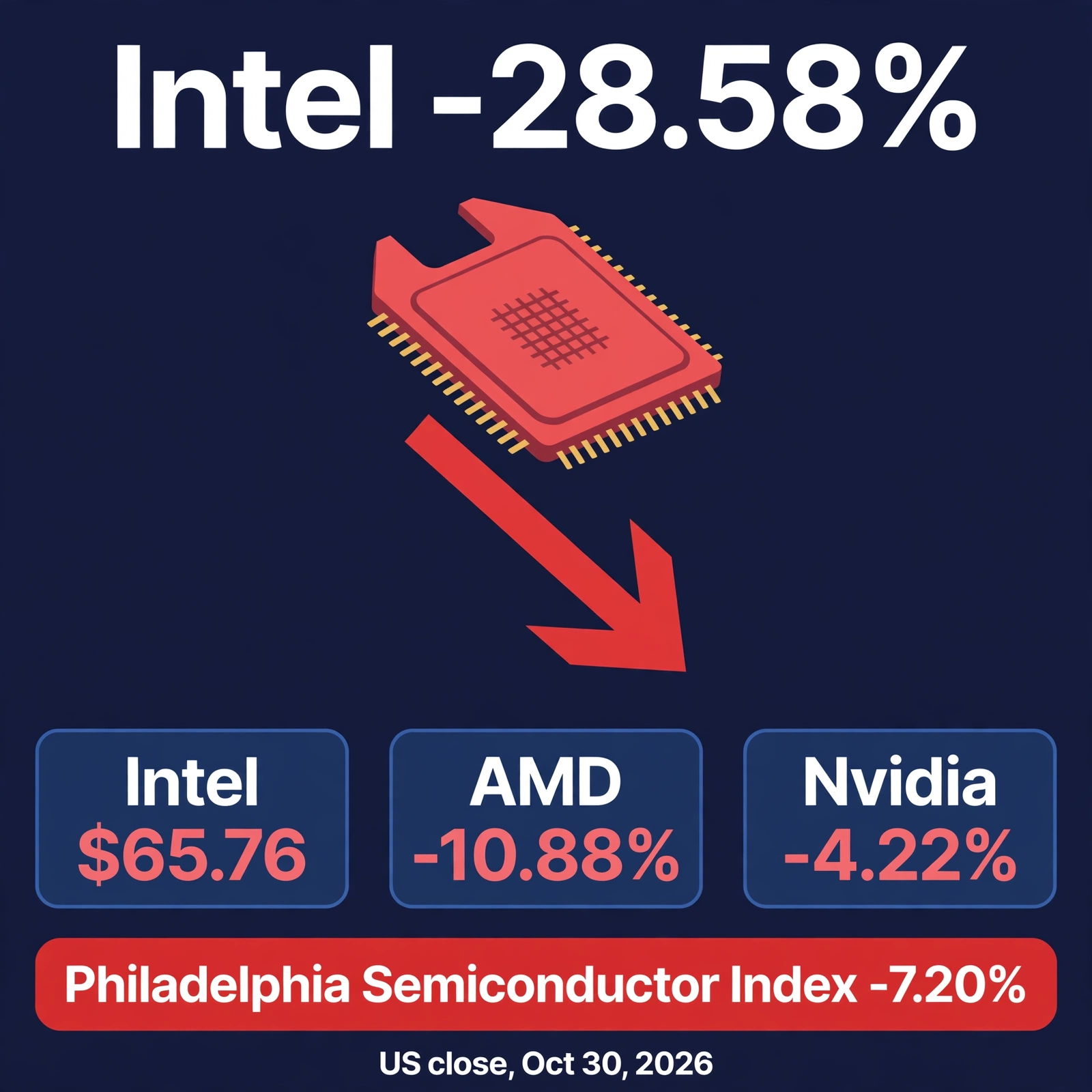
Intel’s day was a half-century record. Shares fell 28.58% to $65.76, the worst single day since the 1970s, erasing $26.31 from Thursday’s $92.07 close. Yet the quarter itself was not bad. Third-quarter revenue of $16.5 billion (+21%) matched expectations, and adjusted earnings of $0.52 per share beat the $0.40 consensus. Data Center and AI revenue surged 78% to $7.3 billion, its fastest growth in 15 years.
What the market priced was the outlook, not the quarter. Fourth-quarter revenue guidance of $15–$16 billion fell far short of the ≈$17.1 billion expected, and adjusted earnings guidance of $0.25 per share missed the $0.43 consensus. Client Computing revenue fell 5% to $8.1 billion, and the company said the PC slowdown could last at least into the first half of next year. Add a factory shutdown in Israel, and the verdict was “data center is strong, but the overall picture is cloudy.”
The shock spread across semiconductors. The Philadelphia Semiconductor Index plunged 7.20%, its biggest one-day drop since June 23. AMD fell 10.88% to $504.80 and Nvidia fell 4.22% to $204.64; Marvell fell by a double-digit percentage, and Broadcom and Micron each fell more than 5%. SK hynix’s US ADR fell 7.95%, and the SOXX semiconductor ETF dropped more than 8%. One company’s guidance repriced a whole sector in a single session.
Amazon’s recovery and energy’s opposite run: one selloff, different temperatures
Amazon was Friday’s other test. It slid ≈6% early in the session but closed down only 1.4%, recovering most of the drop. Third-quarter revenue of $201.9 billion (+12%) and earnings of $1.89 per share both missed expectations, and 12-month free cash flow turned to a negative $42.4 billion, yet the stock bounced off its lows. The 2026 capital expenditure forecast of $220 billion was maintained, which remains a burden, but the market’s first reaction was “the worst was avoided.” Alphabet, down 12.6% on Thursday, stayed weak but was no longer the day’s main story.
Energy ran in the opposite direction. Exxon Mobil rose 2.16% and Chevron rose 1.75%, both reaching record highs. Exxon’s third-quarter net income of $15.4 billion was its strongest quarter since the 2022 energy price surge, and Chevron’s $9.9 billion also beat expectations. WTI crude rose 2.08% to $104.12 per barrel, and Brent rose 2.40% to $117.64, its highest since April 29. War-driven refining margins pushed energy up while doubts about AI spending returns pushed tech down.
Macro and crypto: gold at a one-year low, bitcoin below $77,000
Friday’s macro data did not shake the market much. The third-quarter Employment Cost Index rose 0.8% from the prior quarter, matching expectations and slowing from 0.9%. The October Chicago PMI came in at 55.3, below both consensus (≈55.9–56.0) and September’s 58.8, but still above the 50 line that marks expansion. The Bank of Japan held its policy rate at 1.25%, while judging underlying inflation consistent with its 2% target for the first time since the target was introduced in 2013; one board member voted for a hike to 1.5%. A December hike remains on the table.
Elsewhere in risk assets, the news was colder. Gold futures fell 3.7% to $3,883 an ounce, their lowest since last September, and bitcoin dropped below $77,000 from a high near $82,000 the previous day. After news of the Binance hack broke the day before, Coinbase fell 10.62% and Robinhood fell 7.21%. A tech selloff and crypto weakness on the same day left risk appetite frozen across the board.
- Guidance: a company's advance forecast for next quarter or the year. Stocks often fall on weak guidance even after a good quarter.
- Philadelphia Semiconductor Index (SOX): an index of 30 major US chip companies. It reads the temperature of the whole chip sector.
- Employment Cost Index (ECI): a measure of wages and benefits. The Fed watches it for wage-driven inflation pressure.
- Correction territory: market shorthand for a drop of ≈10% from a high. It is not an official bear-market declaration.
October scorecard and Monday checkpoints: a month only the Nasdaq lost
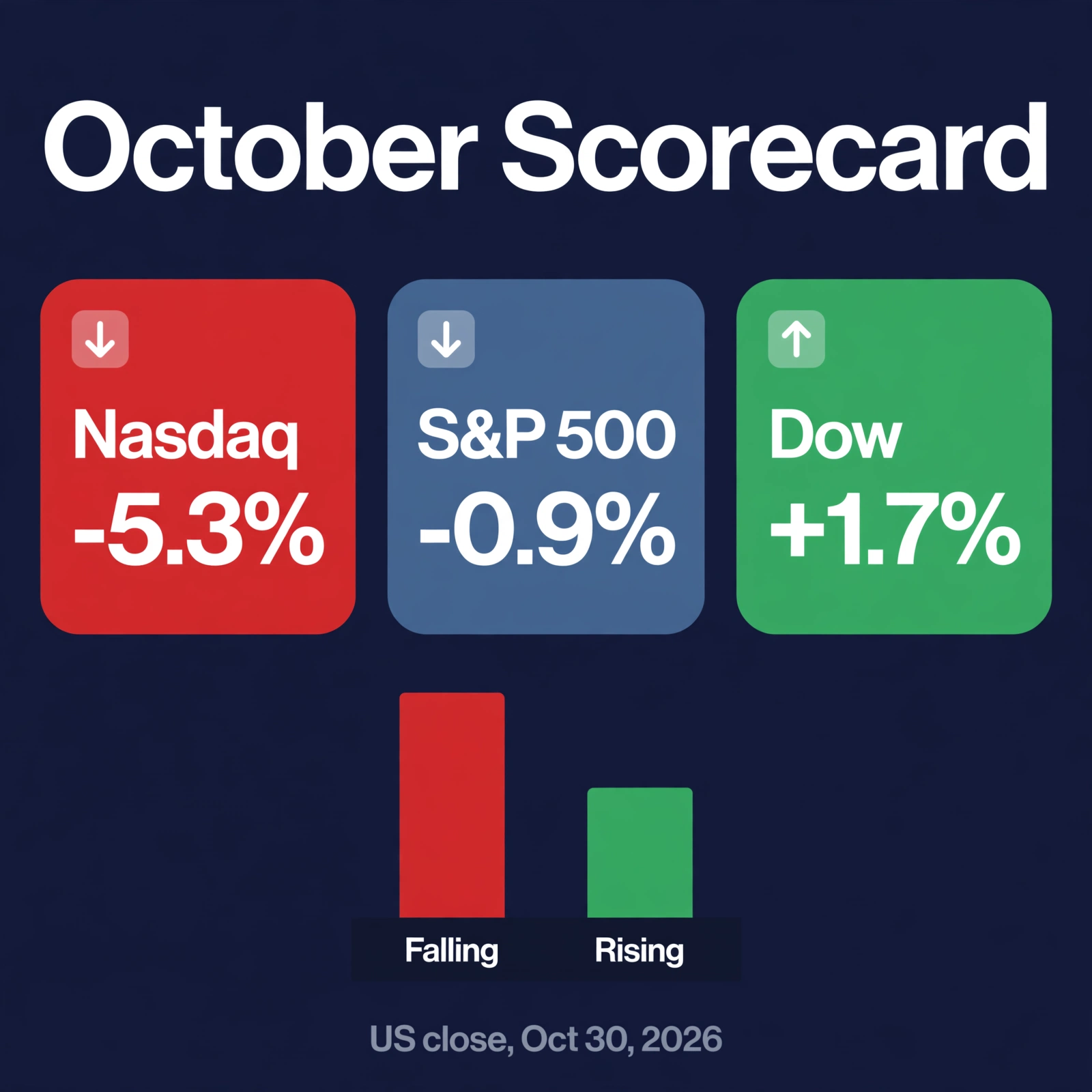
Zoom out to the full month and the split sharpens. The Nasdaq fell 5.3% in October, its biggest monthly drop since March 2025, and the S&P 500 fell 0.9%. By contrast, the Dow gained 1.7%, recovering from September’s 4.3% decline. All three indexes also ended the week lower. But the earnings season itself was not weak: 82% of the 299 S&P 500 companies that had reported beat expectations, and expected quarterly earnings growth stands at 31.6%. “Good earnings, falling stocks” was the grammar of the whole month.
Three questions to check on Monday (November 2). First, does the October ISM Manufacturing PMI (forecast 54.7, previous 54.5) confirm that manufacturing is still expanding? Second, does the Intel-led chip selloff continue on Monday, or was Friday an oversold low? Third, do next week’s earnings, including Apple and Palantir, answer the market’s demand to “show me” results? The answers will separate “the start of an AI bubble bursting” from “an excessive late-season correction.”
Sources & references
- Investopedia — Markets News, Oct. 30, 2026: Tech Sell-Off Sends Nasdaq, S&P 500 Reeling — October closes, monthly performance, gold, oil, Treasury yield
- Invezz — Nasdaq plunges 2.8% as Intel and Amazon results deepen AI stock sell-off — Intel guidance, chip selloff, S&P 500 earnings breadth
- Intel — Intel Reports Third-Quarter 2026 Financial Results — Q3 results and Q4 guidance, original release
Related articles
- US Market Close Analysis Nasdaq -1.38% Alphabet -12.6% Plunge GDP 3.4% PCE 3.6% (October 30)
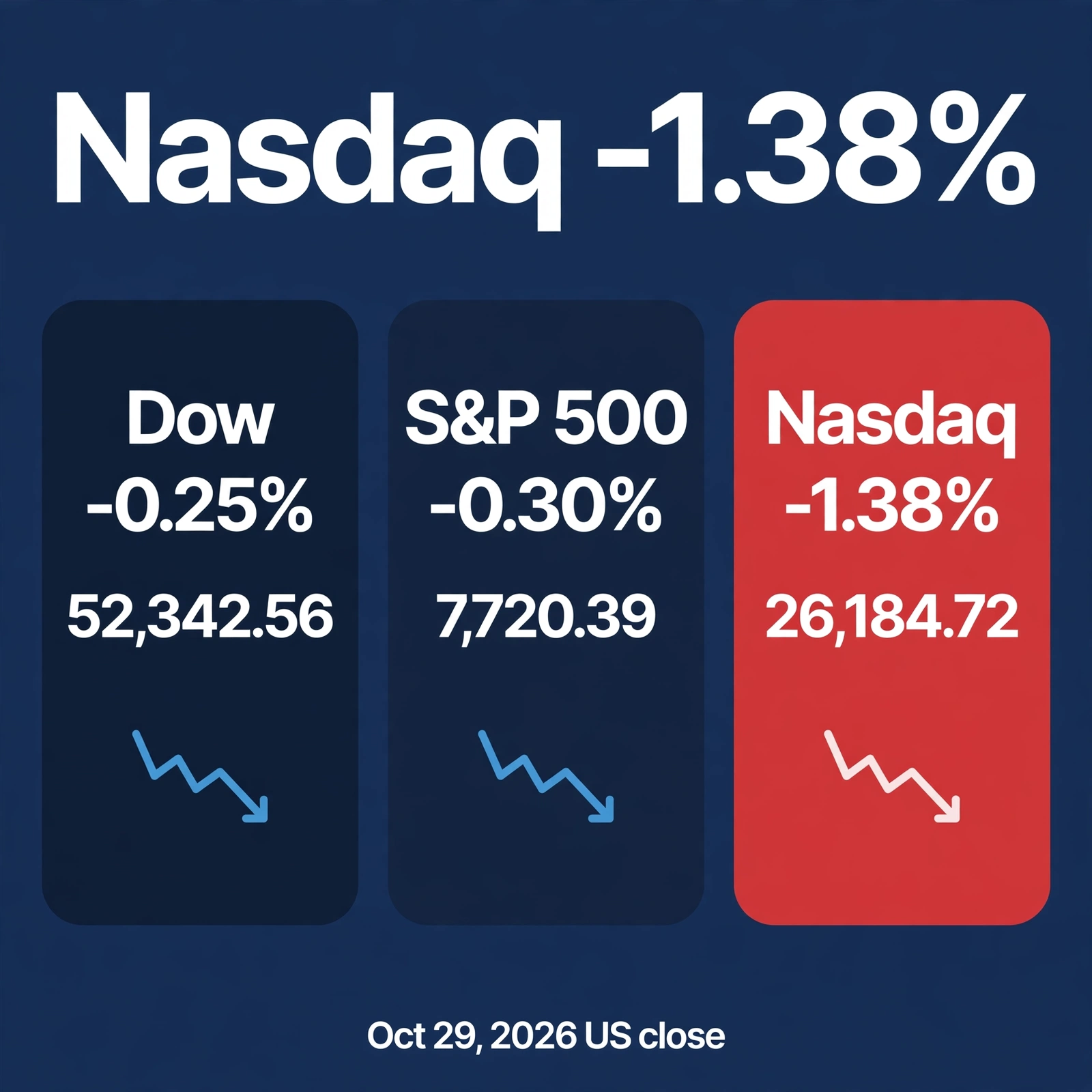
October 29 US close: Dow 52,342.56 (-0.25%), S&P 500 7,720.39 (-0.30%), Nasdaq 26,184.72 (-1.38%). Alphabet plunged 12.6%, ending a three-day winning streak, as Q3 GDP of 3.4% met September PCE of 3.6%. Amazon and Intel fell further after hours.
- US Stock Market Weekly Recap S&P 500 Down Dow Up AI Spending Selloff Oil Surge Analysis
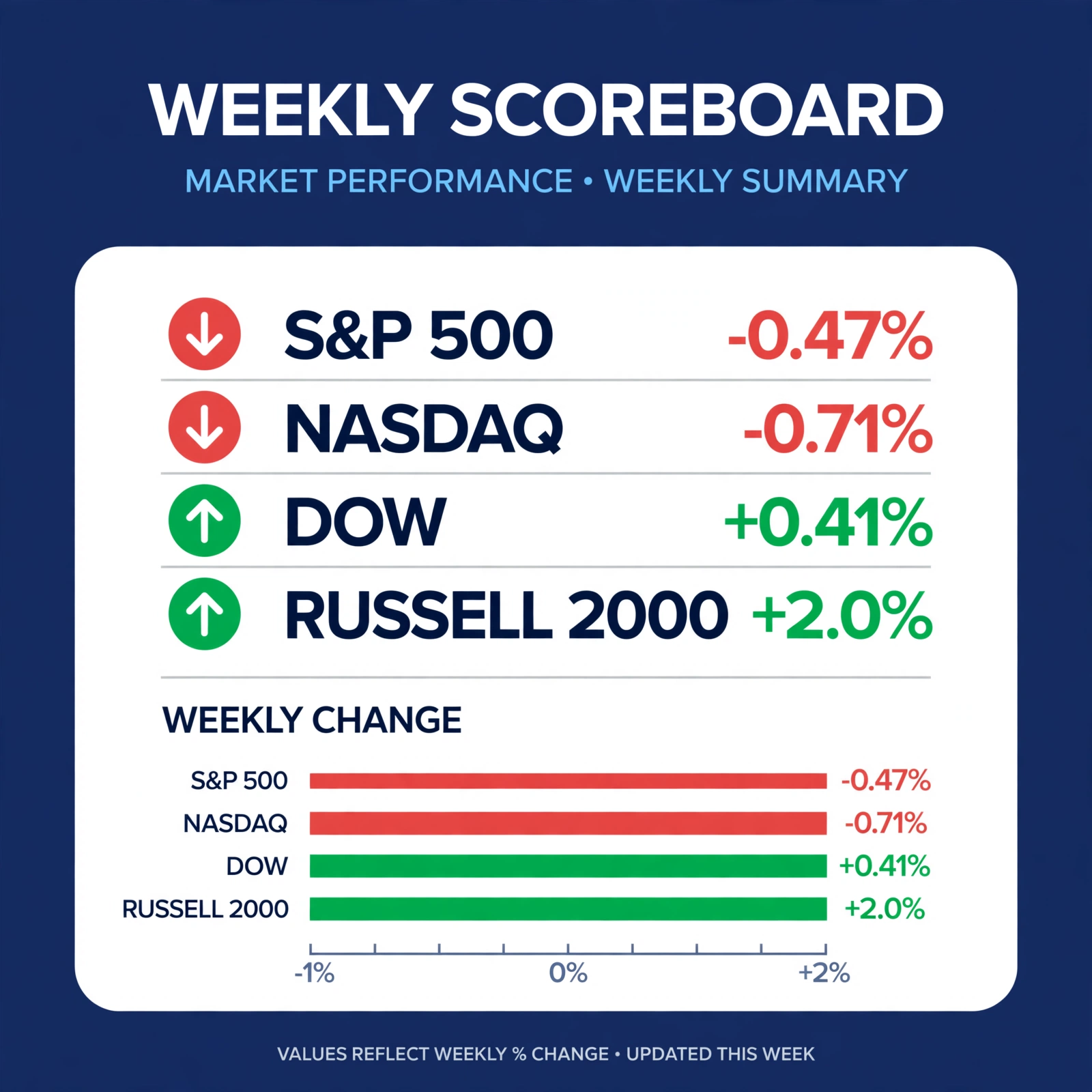
US stock market weekly recap for October 19–23: S&P 500 -0.47%, Nasdaq -0.71%, Dow +0.41%, Russell 2000 +2.0%. A Thursday AI spending selloff and an oil surge split the week. Next: FOMC, Microsoft, Alphabet, GDP, PCE.
- US Stocks November 3 Dow Falls 0.37% Nasdaq Rebounds 0.82% AMD Earnings Analysis
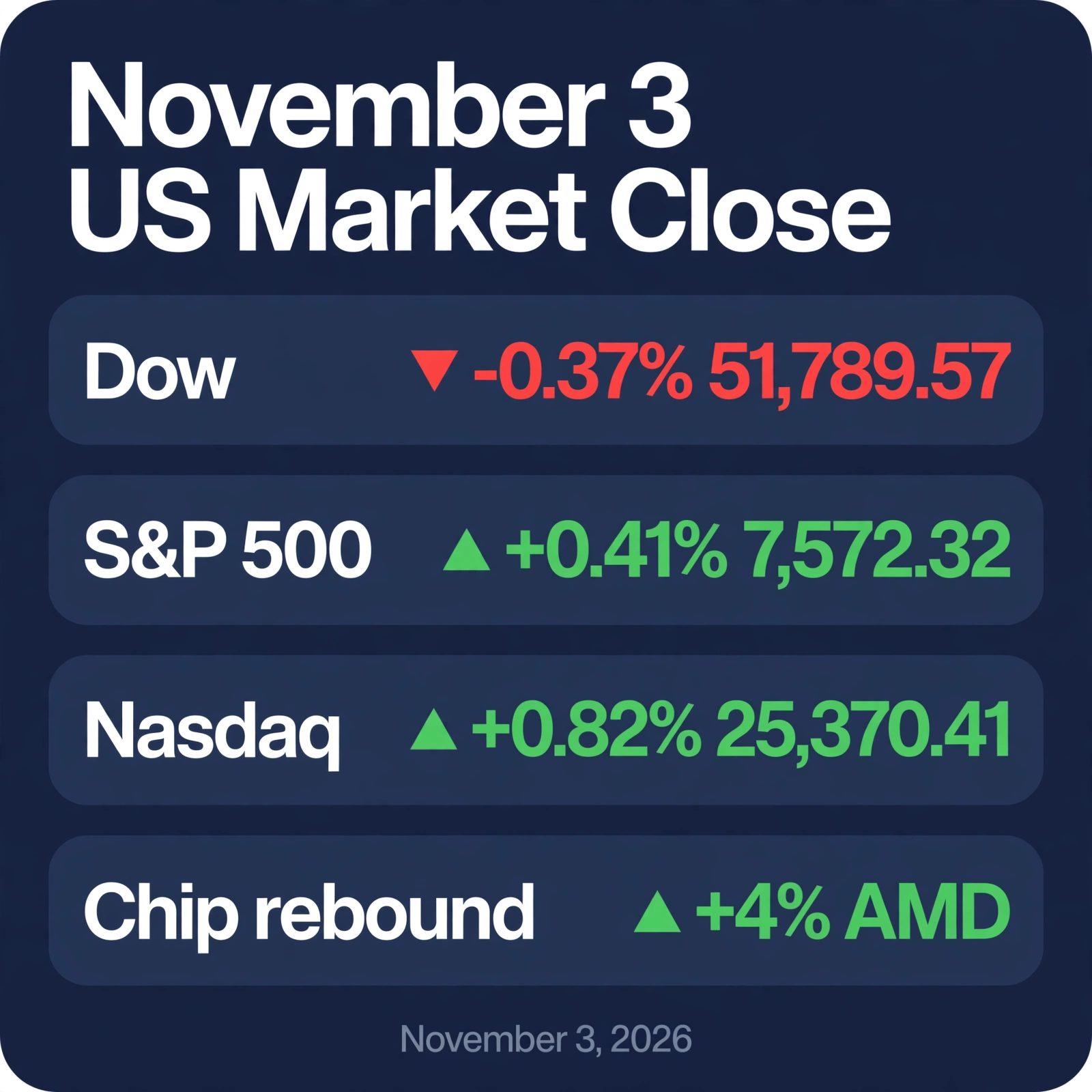
On November 3, US stocks reversed the previous day's pattern. The Dow fell 0.37% while the S&P 500 rose 0.41% and the Nasdaq gained 0.82%. After the close, AMD reported revenue of $13.38 billion and guided fourth-quarter revenue to about $17 billion, above expectations.
5minbrief on YouTube
The briefs also come as videos. Get the daily market wrap on YouTube.
Subscribe on YouTube