 5-minute briefs
KOSPI 1.24% fall Samsung shareholder return delay 5937 close analysis
#KOSPI#KOSDAQ#Samsung Electronics#SK hynix#Korea discount#won dollar exchange rate#EWY
Scoreboard — 6,000 given back in a day, intraday low 5,817
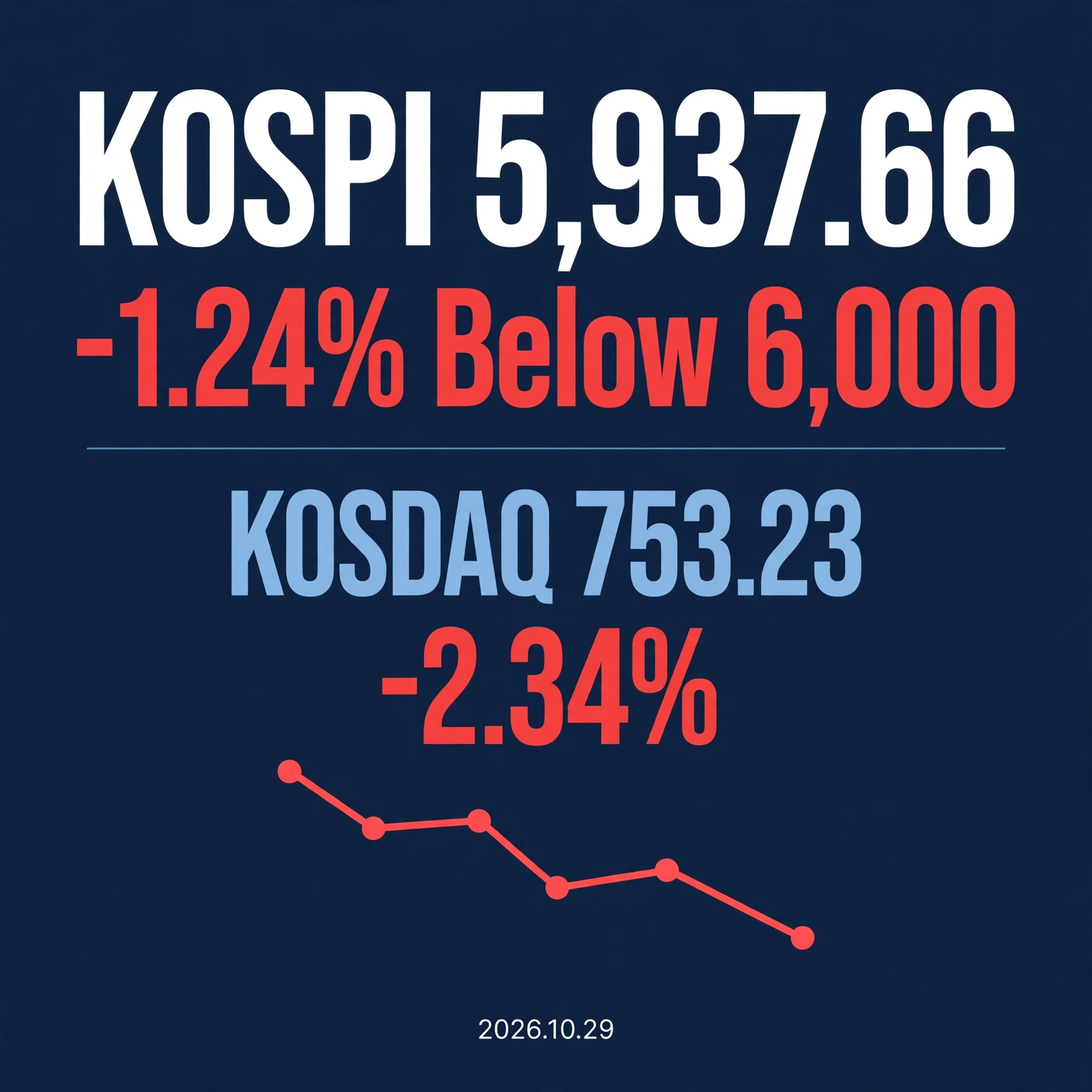
The KOSPI closed 74.78 points (1.24%) lower at 5,937.66, after opening 0.08% higher at 6,017.22 and touching an intraday high of 6,100.11. The index reversed around Samsung’s earnings announcement and fell as low as 5,817.92 before recovering part of the loss in the afternoon on strong results from names such as Hanwha Vision. Yesterday’s close of 6,012.44 had been the first above 6,000 in 10 sessions; today took it back in a single session.
The KOSDAQ closed 18.05 points (2.34%) lower at 753.23, after opening 0.45% lower at 767.78 and staying weak all session.
| Index | Close | Day change |
|---|---|---|
| KOSPI | 5,937.66 | –74.78 points (–1.24%) |
| KOSDAQ | 753.23 | –18.05 points (–2.34%) |
| Won / dollar | 1,336.8 | –0.9 won (previous session 1,337.7) |
Flows tell a subtler story than the headline. On the KOSPI, individuals bought a net KRW 33.3 billion and foreigners bought a net KRW 69.0 billion — their third straight day of net buying, though the morning’s roughly KRW 400 billion of foreign buying shrank sharply by the afternoon. Institutions sold a net KRW 447.2 billion. On the KOSDAQ, individuals bought a net KRW 217.3 billion while foreigners sold a net KRW 130.7 billion and institutions KRW 75.9 billion. For EWY holders, the read-across matters: today’s fall was led by domestic institutions and disappointed holders, not by a foreign exit.
Why it fell — record profit, vague returns, and two extra drags
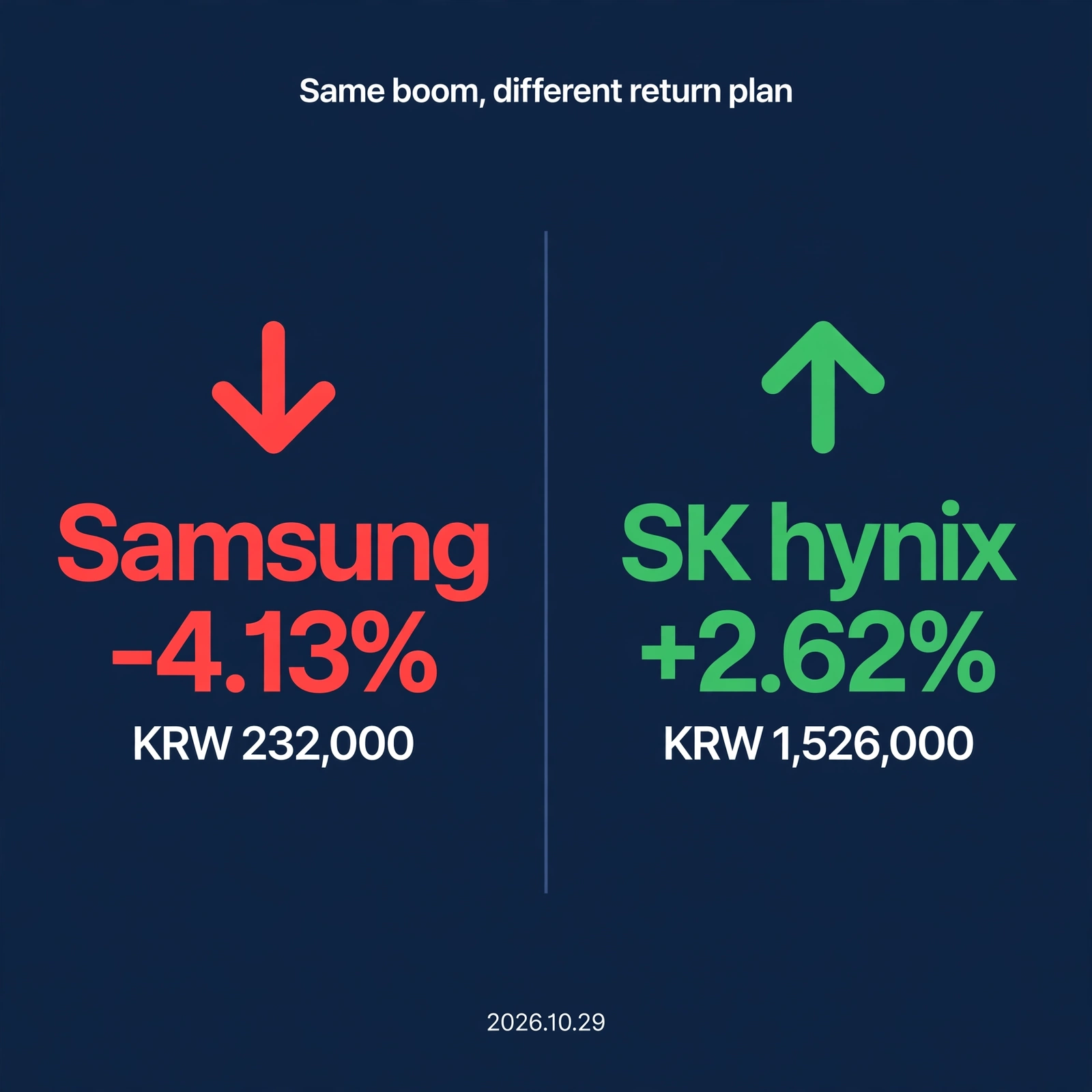
The first driver was Samsung’s deferred return plan. Samsung reported third-quarter operating profit of KRW 107.44 trillion, a fourth consecutive quarterly record, and the shares traded as high as KRW 249,000 before the announcement. The company put the year’s total shareholder return at KRW 90–110 trillion ($67.3–82.2 billion) but said specific execution measures and the next return policy will be finalized at a board meeting at the end of January 2027. What was confirmed was a KRW 30 trillion ($22.4 billion) dividend; the rest is direction — a substantial portion for buybacks and cancellations — rather than a schedule. The market wanted the schedule.
The second driver is the contrast with SK hynix, and this is the governance lesson. SK hynix paired its record quarter with numbers: about KRW 100 trillion ($74.8 billion) of returns this year — at least KRW 30 trillion in cash dividends and at least KRW 60 trillion in buybacks and cancellations — plus a third- and fourth-quarter dividend of KRW 20,000 per share, half of it a special dividend sharing gains from its Kioxia investment. SK hynix closed 2.62% higher at KRW 1,526,000, a second straight gain. Two memory giants, the same AI boom, the same record-profit territory — and the stock that quantified its returns rose while the one that deferred them fell. For foreign investors, this is the Korea discount in miniature: the discount is not really about earnings power, it is about whether cash visibly reaches shareholders, and markets reprice that credibility announcement by announcement. Toss Securities’ research head put it bluntly: with no immediate, concrete buyback plan to improve supply and demand, disappointed investors sold.
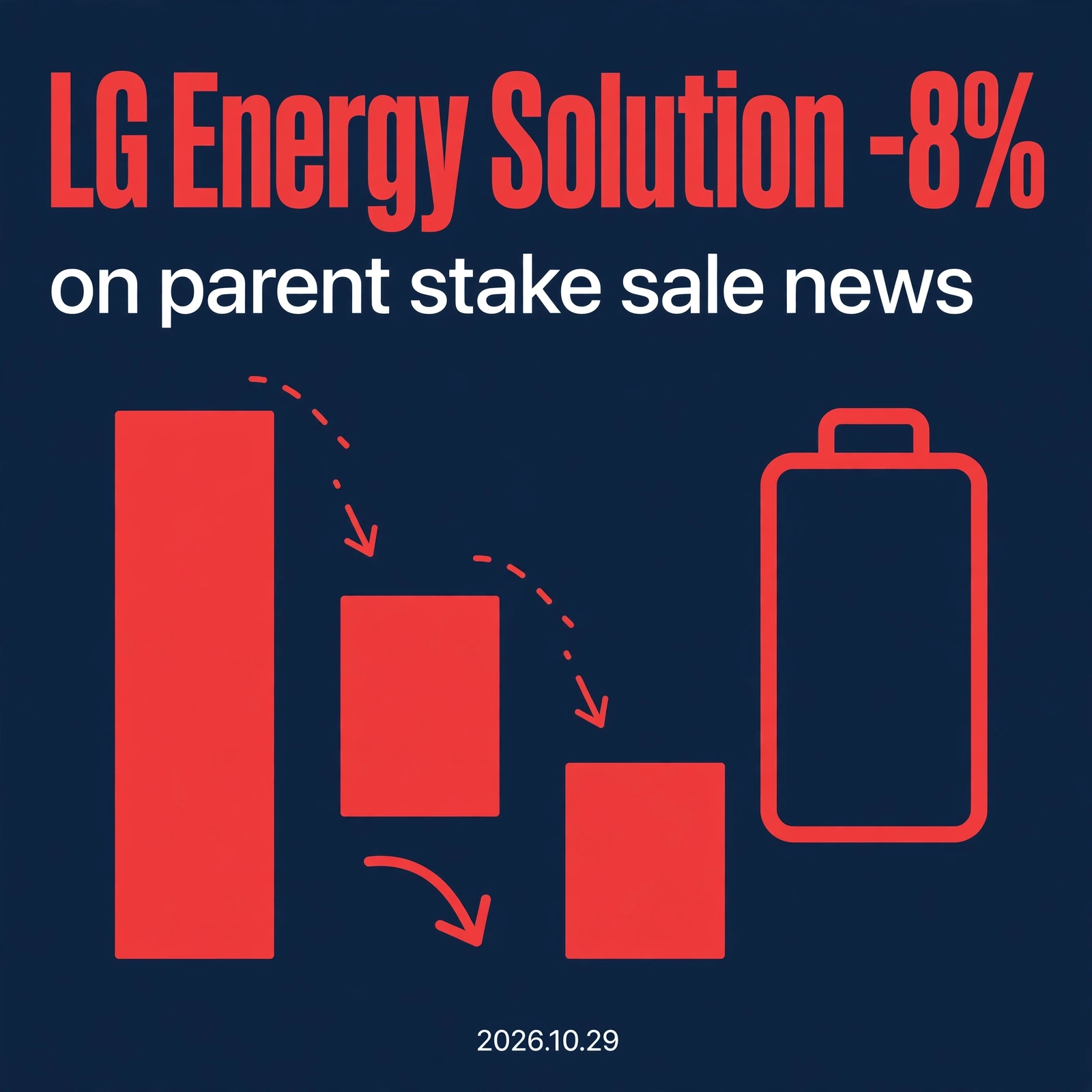
The third driver was LG Energy Solution and a collapsed Czech nuclear deal. LG Energy Solution plunged more than 8% after its largest shareholder, LG Chem, disclosed a price return swap (PRS) on 6,535,939 LG Energy shares — about KRW 2.5 trillion ($1.9 billion) at the October 27 reference price of KRW 382,500 per share. The two-year contract’s proceeds arrive November 27 and will repay borrowings and fund growth investment, while about 20% of after-tax proceeds — KRW 400 billion ($299 million) — goes to shareholder returns, of which KRW 300 billion ($224 million) funds treasury-share purchases and cancellations over six months and the rest the 2026 dividend. LG Chem’s stake falls from 79.38% to about 76.6%. Separately, the collapse of a Czech nuclear-plant construction contract involving Doosan Enerbility and Daewoo E&C dragged construction and machinery to the bottom of the sector table.
Winners and laggards — only financials and securities rose
By sector, financials and securities rose more than 1% — the only real bright spot. Machinery and equipment and construction fell more than 5%, chemicals and entertainment and culture more than 3%, and transportation equipment and parts, metals and IT services more than 2%. Utilities, electronics, manufacturing and general services also fell more than 1%. It was a near-across-the-board decline outside financials.
Among large caps, SK Square rose more than 3%, SK hynix more than 2% and KB Financial more than 1%, while Shinhan Financial, Samsung SDI, Kia and Samsung Life edged higher. On the downside, Samsung fell 4.13% to KRW 232,000, Samsung Electro-Mechanics and Hyundai Motor fell more than 1%, and Celltrion, Samsung C&T and Samsung Biologics slipped slightly. One earnings bright spot: Samsung SDI swung to a third-quarter operating profit of KRW 407.8 billion ($305 million) on revenue of KRW 4.69 trillion ($3.5 billion), up 52.6% from a year earlier — a turnaround from a KRW 591.3 billion loss a year ago, double the second quarter, and its best since the third quarter of 2023, led by energy storage systems (ESS) and battery backup units.
On the KOSDAQ, publishing and media reproduction surged more than 11%, the lone standout, while medical and precision instruments, machinery and transportation equipment fell more than 3% and electronics fell more than 2% as Samsung’s drop spread to chip materials, components and equipment suppliers. Among large caps only PSK Holdings edged higher; Alteogen fell more than 1%, HLB and Rino Industrial more than 2%, HPSP, Robotis and Simmtech more than 3%, Ecopro, Wonik IPS and Jusung Engineering more than 4%, Ecopro BM more than 5% and Rainbow Robotics more than 6%.
The won firmed — 1,336.8, as the Fed hold read dovish
The won recovered slightly even as stocks fell. The dollar-won rate closed at 1,336.8 at 3:30 p.m., down 0.9 won from 1,337.7, after opening at 1,342.0 and touching an intraday low of 1,331.3. The US Federal Reserve’s rate hold was read as more dovish than expected, and foreigners flipped to net selling in dollar futures — a reminder, covered in this morning’s US brief, that the won’s daily direction is driven at least as much by global dollar positioning as by equity flows. The rate remains in the high 1,330s, so dollar strength has eased, not vanished — unhedged EWY holders still carry that translation risk into tomorrow.
What to watch — the next test is execution dates, not earnings
The earnings-season baton has passed from results to execution calendars. Three dates matter. First, Samsung’s board meeting at the end of January 2027, when return details and the next return policy are due. Second, November 27, when LG Chem receives its PRS proceeds, followed by six months of KRW 300 billion in treasury-share purchases and cancellations. Third, SK hynix’s KRW 20 trillion buyback, which started October 29 and runs for three months — the live test of whether a concrete plan actually supports the price. Medium-term earnings expectations, meanwhile, still point up: FnGuide consensus puts Samsung’s 2027 operating profit at KRW 560.8 trillion, up 3.55% from three months ago, and 2028 at KRW 613.7 trillion, up 15.00%; SK hynix’s 2027 estimate was raised 1.68% to KRW 405.3 trillion and 2028 by 9.14% to KRW 435.7 trillion. Average analyst price targets imply more than 110% upside for both names from today’s closes. Short-term disappointment and medium-term optimism are pulling in opposite directions — the governance calendar decides which one wins.
- Price return swap (PRS): a derivative in which a company uses shares it holds as the underlying asset, pays fees to a securities firm over the contract term, and settles the difference from share-price moves — a way to raise cash now against a stake without an outright sale.
- Buyback and cancellation: the company buys its own shares and retires them. Fewer shares outstanding lifts per-share value, which is why it counts as a shareholder return.
- Sell the news: selling after an expected positive event, because the price already reflected the expectation and the announcement adds nothing new.
- Net buying / net selling: purchases minus sales for the day. Net buying means more was bought than sold.
- Consensus: the average of broker estimates. Beating consensus is a surprise; missing it is a shock.
Three questions for investors
First, does foreign buying on the KOSPI extend to a fourth day? Today’s foreign net buying shrank sharply in the afternoon, so tomorrow shows whether the three-day run is a trend or event-driven. Second, does Samsung hold around KRW 232,000, or does disappointment selling continue? With a three-month gap until the January board meeting, the stock must lean on earnings expectations and buyback hopes alone. Third, does the KOSPI hold the 5,900–6,000 zone? It recovered from an intraday low of 5,817.92; holding that zone would frame today as a pullback after a surge rather than a reversal.
Not investment advice. Figures are from the Korea Exchange, the Seoul foreign exchange market, Yonhap, MoneyToday, Financial News and Asia Business Daily, verified October 29, 2026.
Sources & references
- Yonhap — KOSPI closes at 5,937.66, down 74.78 points — Oct 29 KOSPI closing report
- MoneyToday — KOSPI gives back 6,000 after one day on Samsung return disappointment — Cross-check of closing levels, flows, sectors and stock moves
- Financial News — Samsung and SK hynix diverge on return-plan specificity — Comparison of return plans, consensus estimates and price targets
- Asia Business Daily — LG Chem sells KRW 2.5 trillion LG Energy stake, retires KRW 300 billion in treasury shares — PRS contract terms and return allocation
Related articles
- KOSPI 3.48% plunge Alphabet shock sell sidecar semiconductor fall analysis
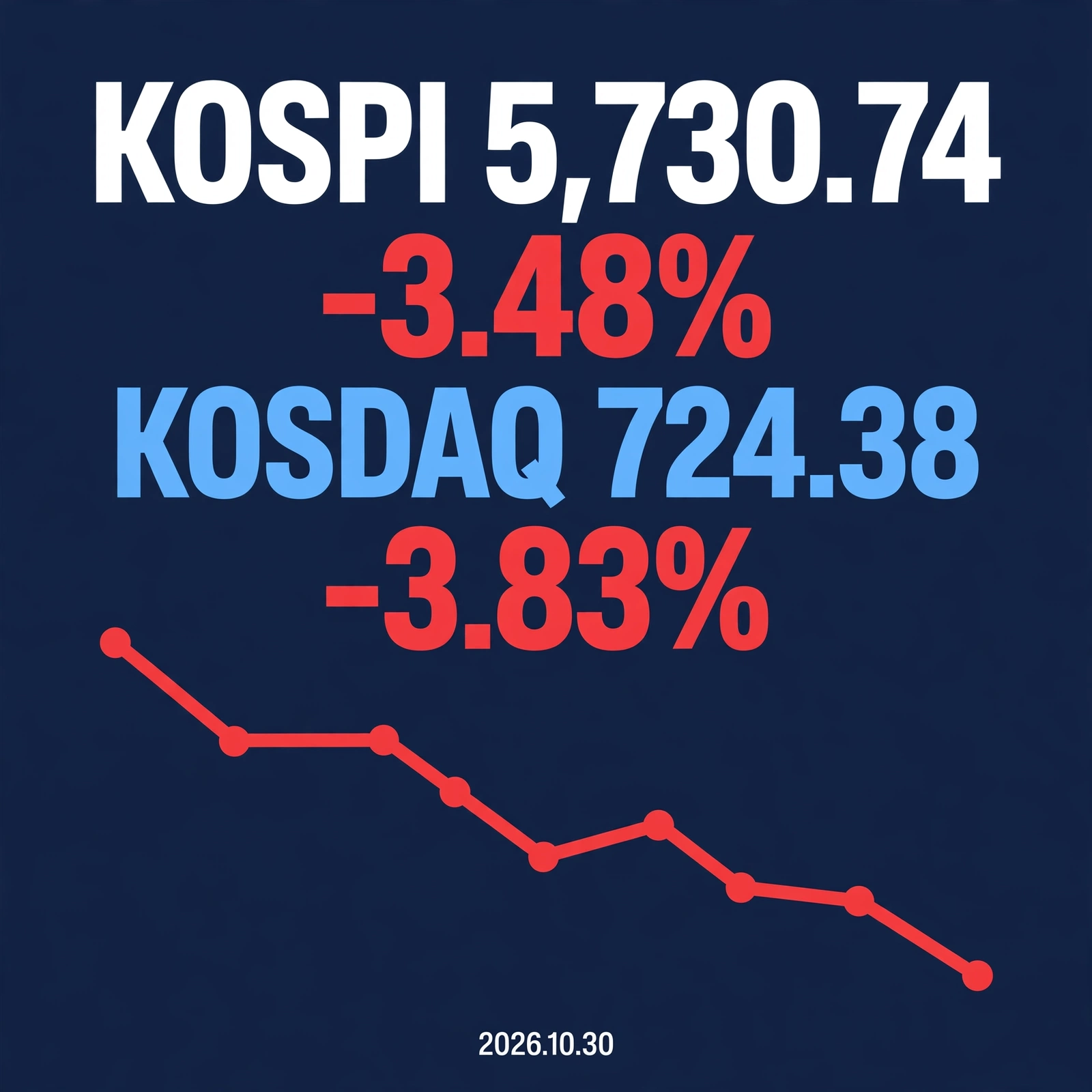
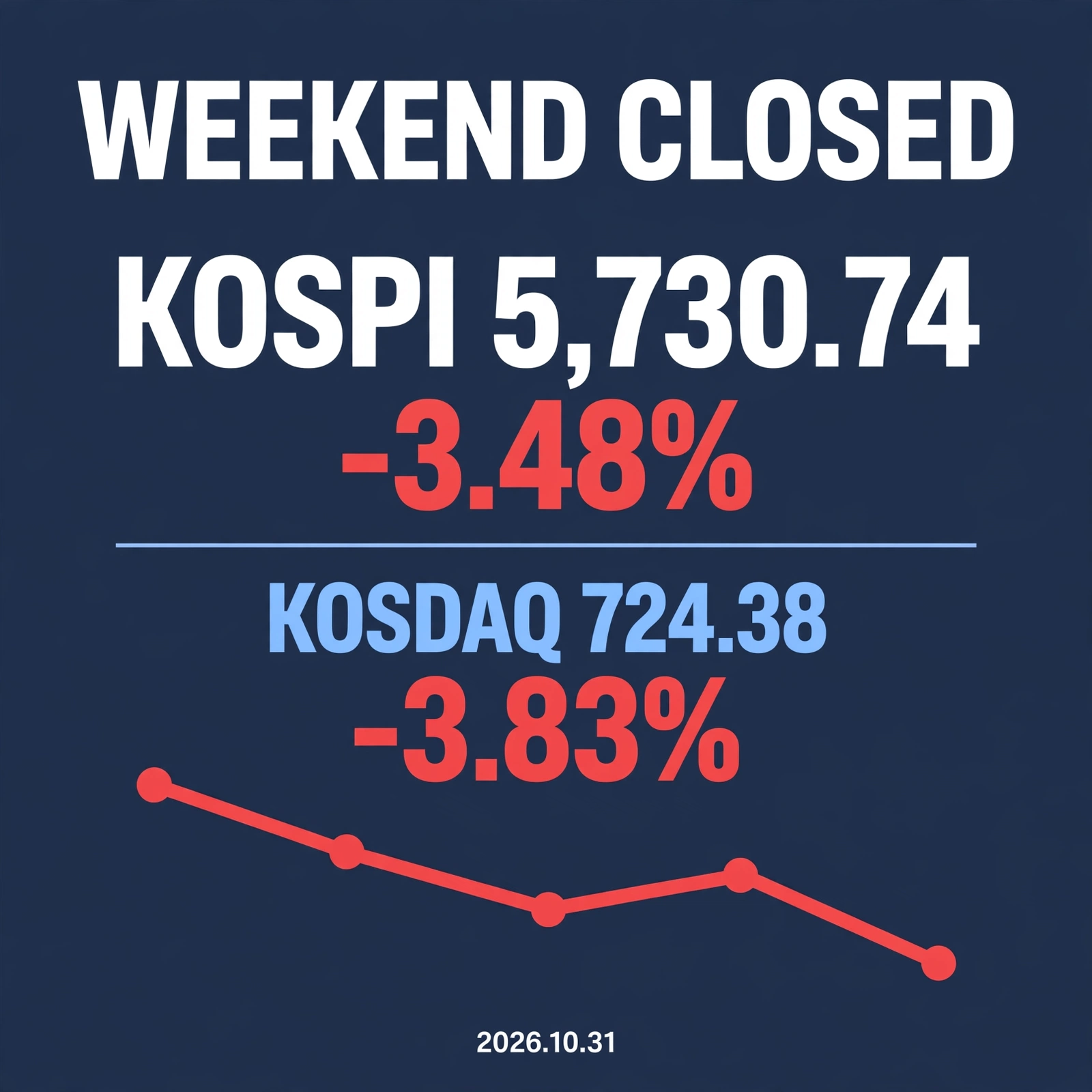
October 30 Korea market brief for foreign investors: the KOSPI fell 3.48% to 5,730.74 and the KOSDAQ fell 3.83% to 724.38 as Alphabet's earnings shock triggered a sell-side sidecar and foreigners sold a net KRW 1.62 trillion ($1.21 billion). Samsung fell 3.02% and SK hynix 7.08%. The won firmed to 1,334.3 per dollar.
- KOSPI 6.63% surge back above 6000 SK hynix record profit foreign buying
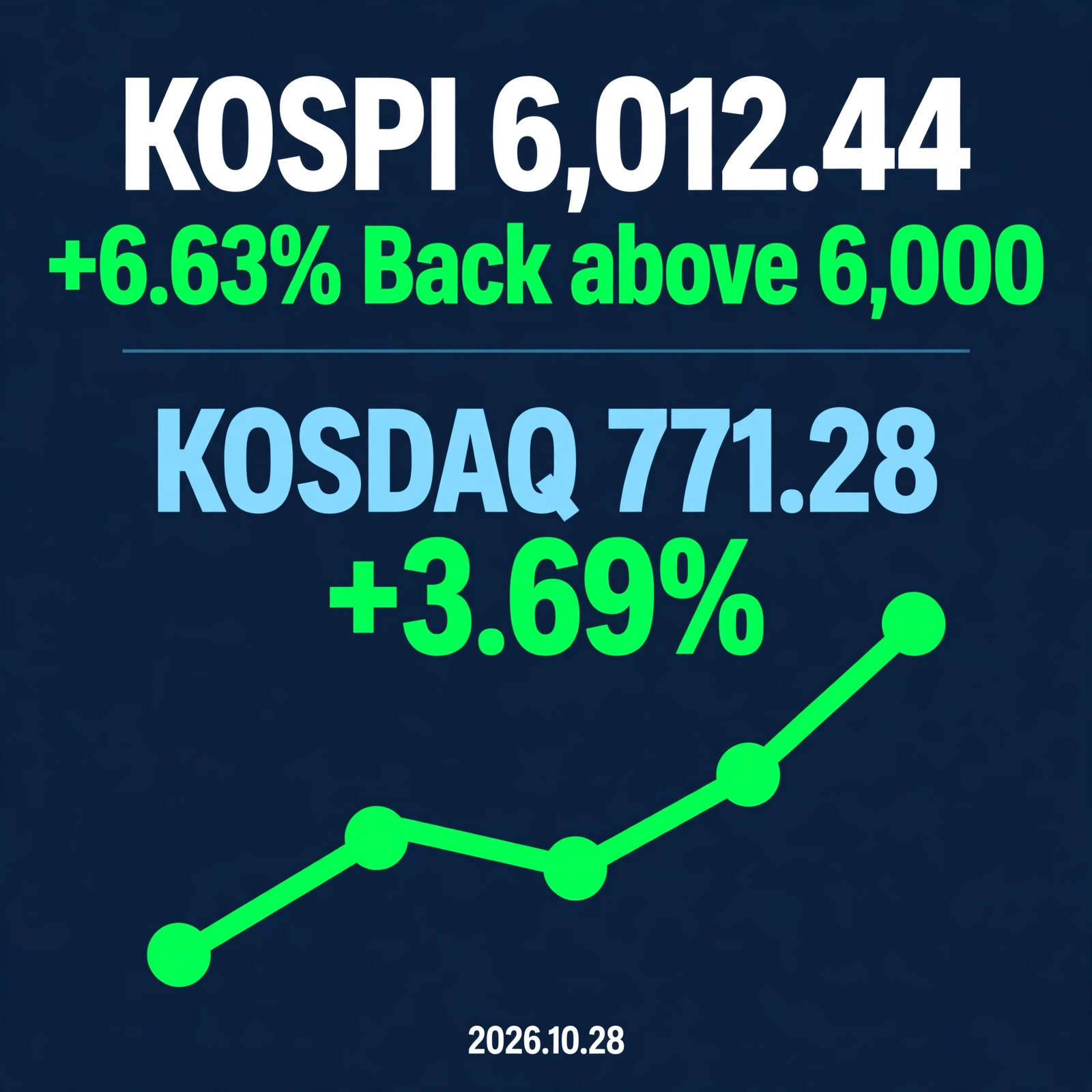
October 28 Korea market brief for foreign investors: the KOSPI jumped 6.63% to 6,012.44, its first close above 6,000 in 10 sessions, after SK hynix posted record third-quarter profit and a KRW 100 trillion shareholder-return plan. Foreigners and institutions bought together for a second day, Samsung rose 9.01% and SK hynix 10.89%. The won weakened to 1,337.7 per dollar.
- Korea Weekend Brief China PMI Contraction US Tech Selloff Samsung Shareholder Return Analysis
October 31 Korea weekend brief for foreign investors: Seoul is closed for the weekend, with the KOSPI last at 5,730.74 (-3.48%). Overnight the Nasdaq fell 2.86% on Intel's plunge, China's October manufacturing PMI slipped to 49.3, and WTI crude rose to $104.12 on a Strait of Hormuz incident. Samsung's remaining KRW 55–75 trillion ($41–56 billion) of returns awaits a January board decision.
5minbrief on YouTube
The briefs also come as videos. Get the daily market wrap on YouTube.
Subscribe on YouTube