 5-minute briefs
Korea Weekend Brief China PMI Contraction US Tech Selloff Samsung Shareholder Return Analysis
#KOSPI#SK hynix#won dollar#Strait of Hormuz#EWY
Weekend scoreboard — Friday’s close is the starting point for Monday
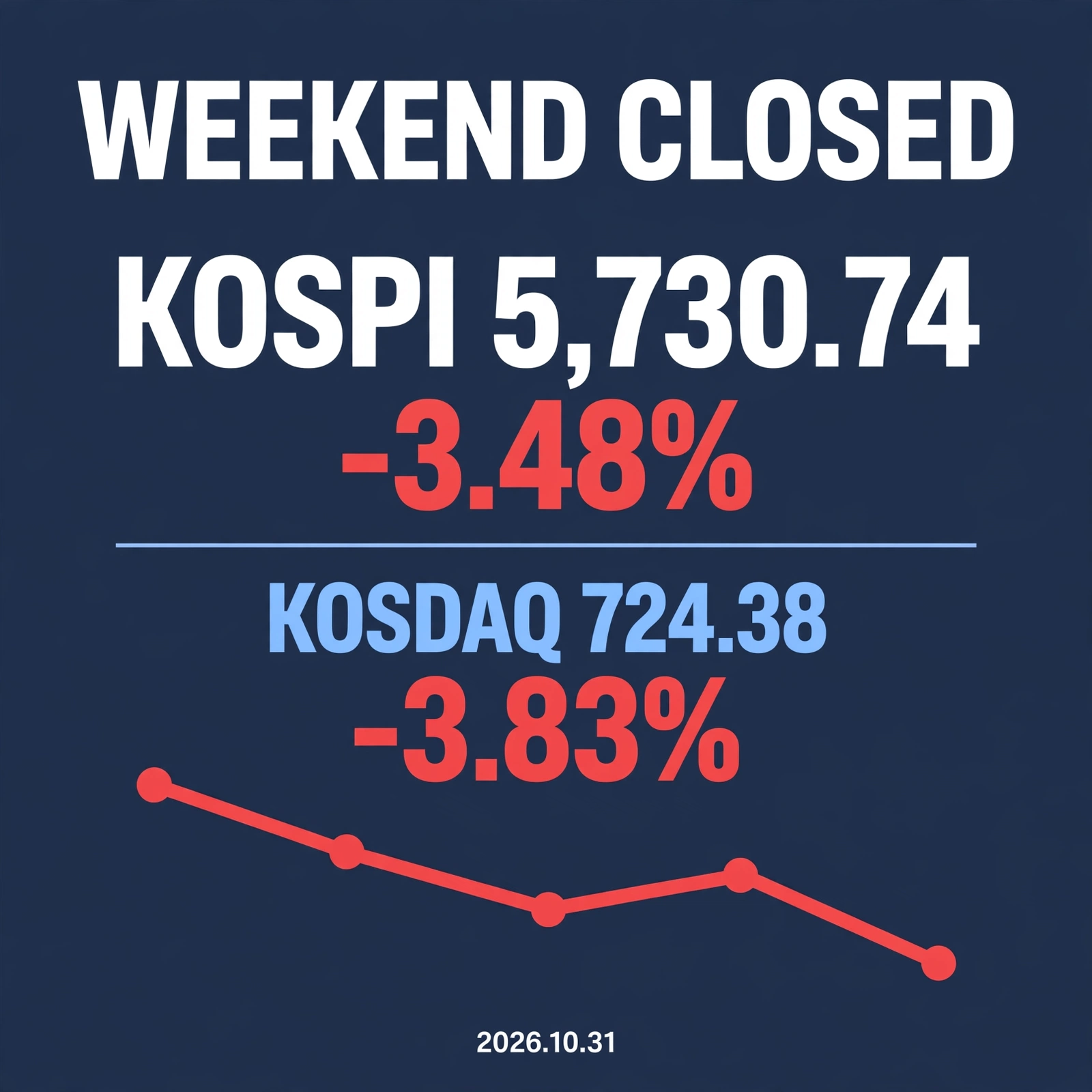
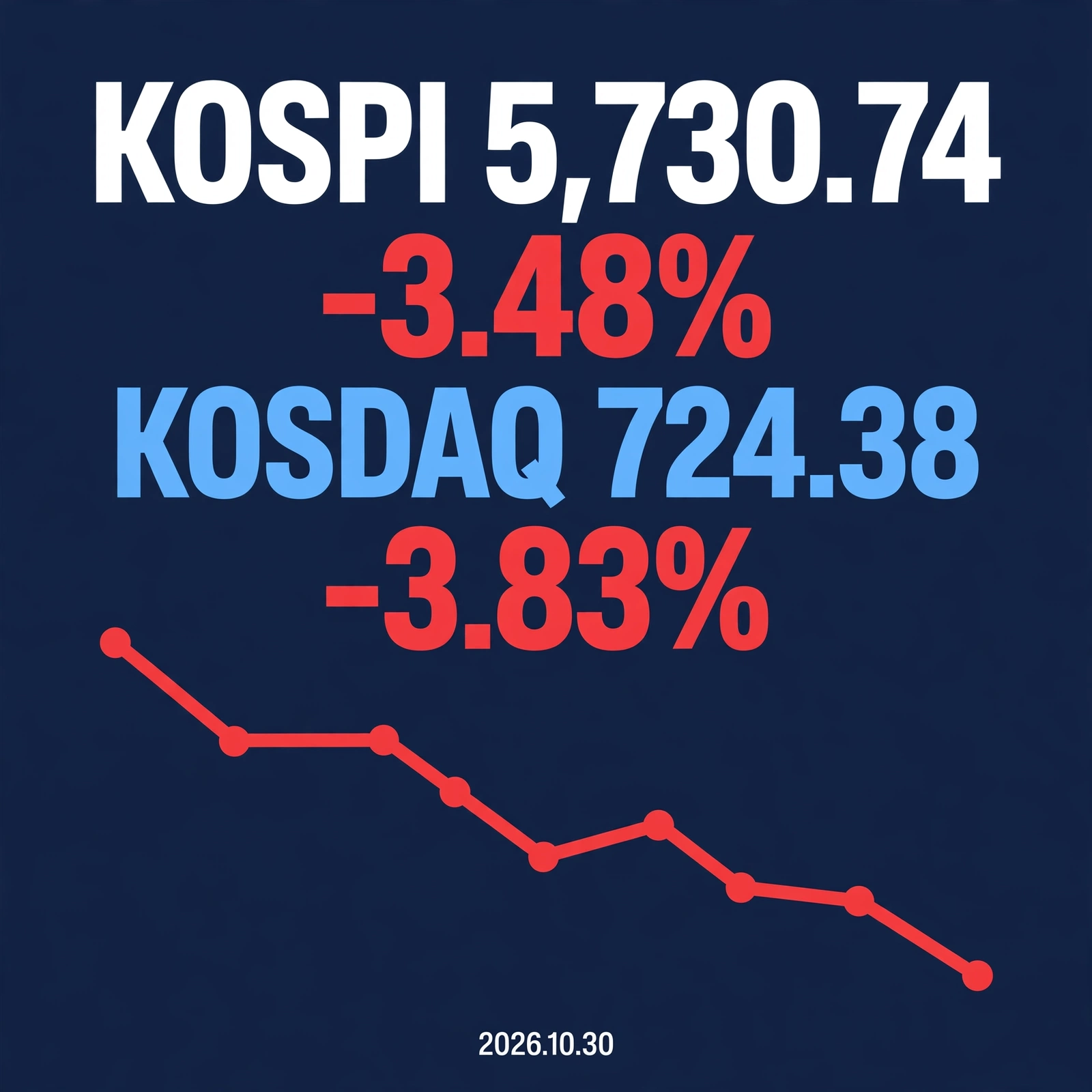
Friday (October 30) was a risk-off day in Seoul before the weekend even began. The KOSPI fell 206.92 points (3.48%) to 5,730.74 and the KOSDAQ fell 28.85 points (3.83%) to 724.38, with the KOSPI touching 5,599.42 intraday and triggering its first sell-side sidecar in 11 trading sessions. Foreigners sold a net KRW 1.62 trillion ($1.21 billion) on the KOSPI, ending three days of buying, while SK hynix fell 7.08% and Samsung 3.02%. The won closed at KRW 1,334.3 per dollar, 2.5 won stronger. Two sessions erased 281.70 points (4.69%) from the KOSPI. That is the level Monday has to defend.
| Index | Last close (Oct 30) | Day change |
|---|---|---|
| KOSPI | 5,730.74 | –206.92 points (–3.48%) |
| KOSDAQ | 724.38 | –28.85 points (–3.83%) |
| Won / dollar | 1,334.3 | –2.5 won (previous session 1,336.8) |
Overnight in the US — Nasdaq down 2.86%, Intel’s plunge repriced all chips
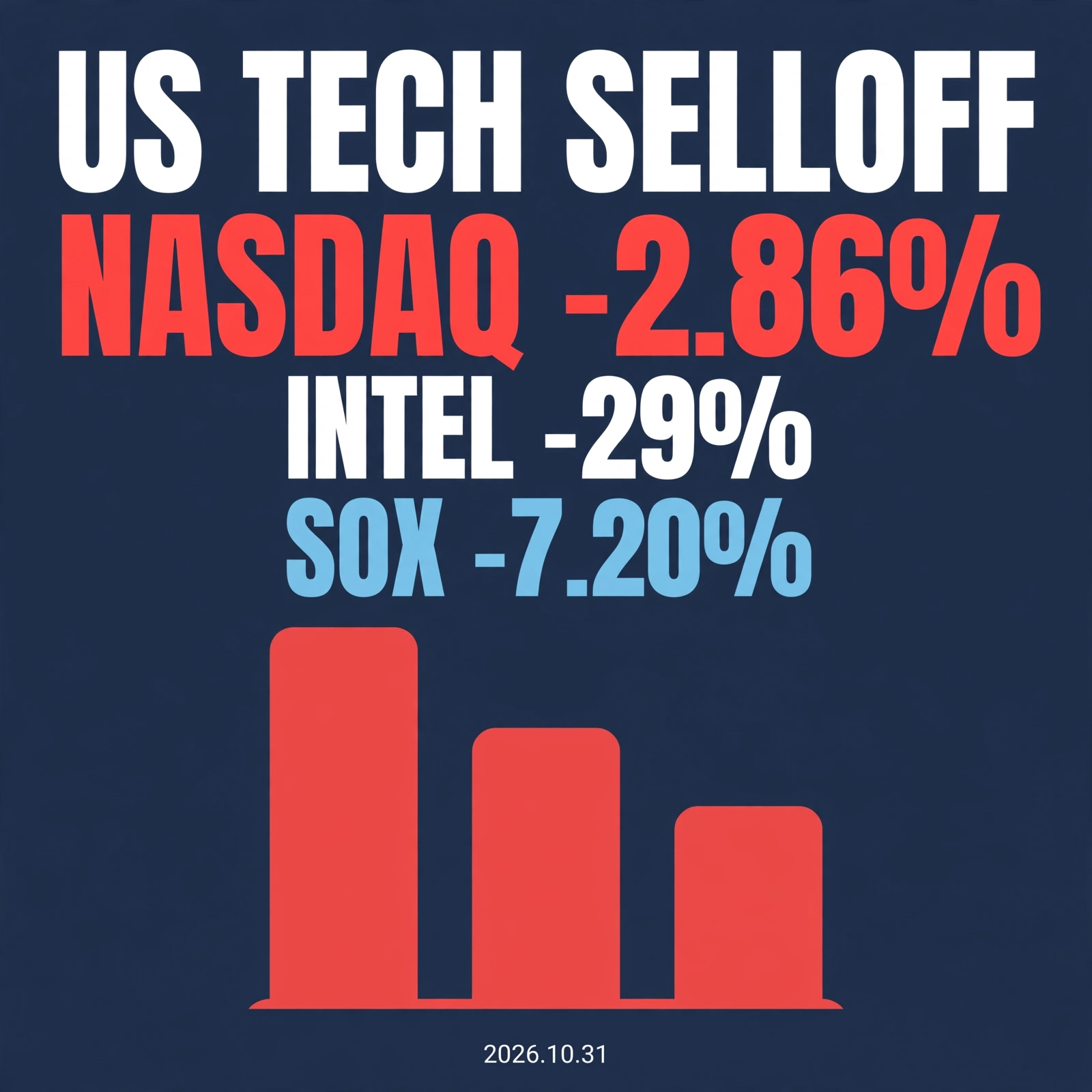
Friday night in New York extended Seoul’s pain. The Dow fell 572.25 points (1.09%) to 51,770.31, the S&P 500 fell 140.32 points (1.82%) to 7,580.07, and the Nasdaq fell 747.73 points (2.86%) to 25,437.00. The trigger was Intel, down roughly 29% after a fourth-quarter outlook that fell far short of expectations despite a better-than-expected third quarter. The shock spread across chips: the Philadelphia Semiconductor Index fell 7.20% to 10,688.80, its biggest one-day drop since June 23, with AMD down 10.88%, Nvidia down 4.22% and SK hynix’s US depositary receipt (ADR) down 7.95%. The VIX fear gauge rose to 19.42.
October as a whole tells a split story: the Nasdaq fell 5.3% and the S&P 500 fell 0.9%, while the Dow rose 1.7%. Tech fell; energy and defensives held. That split matters for EWY holders because Korea’s index is not a diversified market in miniature — it is a concentrated bet on memory chips. When US investors question whether AI spending pays, Korean suppliers are repriced first, not last. The offset to watch on Monday is energy: US energy stocks rose on Friday and Exxon Mobil and Chevron hit record highs, the same session oil jumped.
China PMI — 49.3 and back in contraction, with export orders at 48.7
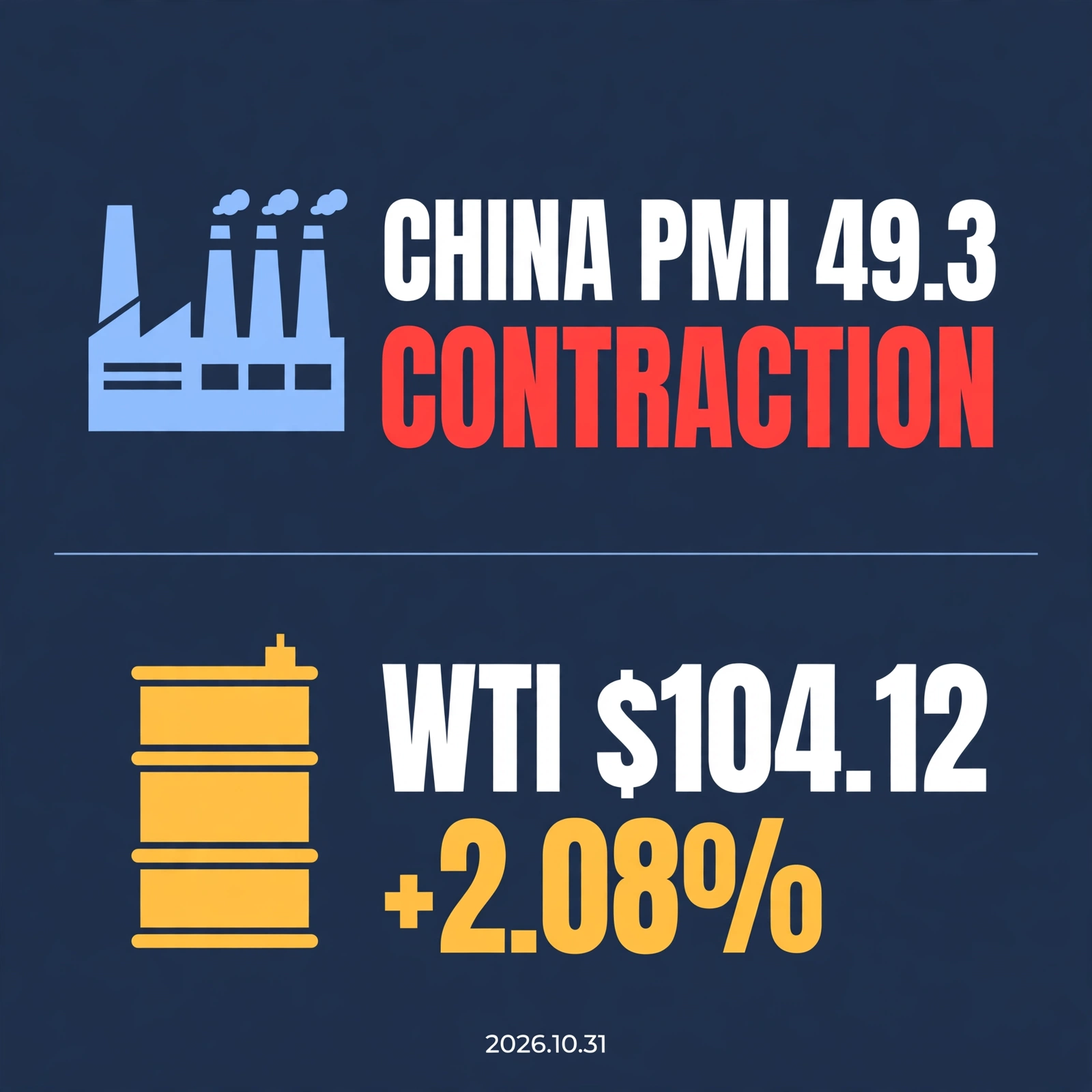
China’s National Bureau of Statistics reported on Saturday that October manufacturing PMI fell to 49.3 from 50.1 in September, down 0.8 points and below the Reuters consensus of 50.0. A reading above 50 signals expansion; below 50 signals contraction. September’s brief return to expansion lasted exactly one month. The details show supply and demand cooling together: production fell to 49.8 (–1.9 points) and new orders to 49.4 (–1.1 points), while new export orders fell from 50.0 to 48.7. Non-manufacturing activity also slipped into contraction at 49.7 (from 50.2), and the composite PMI fell to 49.7 (from 50.7).
The split inside the data is instructive. Large firms stayed in expansion at 50.2, and high-tech manufacturing (51.3) and equipment manufacturing (50.6) held above 50, while medium firms (48.4) and small firms (47.5) weakened further. The statistics bureau blamed demand pulled forward ahead of the National Day holiday (October 1–7) and a complicated international environment. For foreign investors in Korea, the transmission channel is straightforward: China is Korea’s largest export market, and weaker Chinese export orders mean softer demand for the intermediate goods Korea ships through Chinese supply chains. Monday’s question is not whether China-exposed Korean stocks fall — it is whether AI-linked chip names can rebound independently of the China signal.
Governance watch — Samsung’s record profit, and a payout decision deferred to January
Samsung Electronics reported third-quarter revenue of KRW 195.25 trillion ($146.4 billion) and operating profit of KRW 107.44 trillion ($80.5 billion), up 783.1% from a year earlier, with its chip division alone earning KRW 106.5 trillion ($79.8 billion). It is the first technology company anywhere to top KRW 100 trillion in quarterly operating profit. Yet the shares fell 4.13% to KRW 232,000 ($174) on the announcement day and slipped to KRW 225,000 ($169) on Friday. The reason, covered in depth in our October 29 post, is specificity, not size.
Samsung confirmed a full-year shareholder return of KRW 90–110 trillion ($67.5–82.4 billion) and a third-quarter cash dividend of KRW 30 trillion ($22.5 billion), or KRW 4,601 ($3.45) per share, payable November 27. With first-half dividends of KRW 4.9 trillion ($3.7 billion), confirmed and executed cash dividends total KRW 35 trillion ($26.2 billion). The remaining KRW 55–75 trillion ($41–56 billion) — the part the market actually wanted detailed — will be finalized at a board meeting in late January 2027. SK hynix, by contrast, nailed down a roughly KRW 100 trillion ($74.9 billion) package in numbers and rose. Benchmarking data shows the Samsung payout debate generated outlier videos on 10 channels this week, so foreign investors should expect the January board date to stay a live catalyst. The governance lesson travels: in Korea, where the “Korea discount” partly reflects doubt that profits reach shareholders, a return plan without dates and amounts is priced as uncertainty, not as generosity.
Oil and gold — WTI $104.12 on Hormuz, gold down for a third day
Oil rose on Middle East tension. WTI December futures rose $2.12 (2.08%) to $104.12 per barrel and Brent December futures rose $2.76 (2.40%) to $117.64. WTI gained 15.2% in October, its fourth straight monthly rise. The trigger was an October 29 incident in the Strait of Hormuz, where a tanker struck by a small boat carrying explosives was temporarily disabled, plus market concern that the US could strike Iran again after the November 3 midterm elections. The strait is the chokepoint for Middle Eastern crude shipments, so any disruption threat feeds straight into prices.
Gold moved the other way. December gold futures fell $132.50 (3.3%) to $3,898.90 per ounce, a third straight daily decline and a 6.9% fall for October, the second monthly decline in a row. Remarks raising the possibility of further Federal Reserve rate hikes were cited as a driver. The combination — oil up, gold down — is not a clean risk-off signal. Part of the gold selling looks like investors raising cash to cover equity losses rather than a vote against safety. For Korea, an oil importer, the read-across is two-sided: refiners and energy names may benefit on Monday, while airlines, shipping and chemicals face cost pressure, and higher oil feeds the inflation debate that shapes Bank of Korea (South Korea’s central bank) expectations.
The real economy at home — Seoul’s new-apartment supply hits a 13-year low
One domestic real-economy data point deserves foreign investors’ attention even though it is not a stock-market signal. Real Estate R114 data show Seoul apartment move-ins this year at 17,698 units, about 45% below last year’s 32,370 and the lowest since 2013 (16,321 units) — just 38% of the 2019 peak of 46,118. Next month brings only 488 units across three complexes; next year recovers slightly to 18,329, but 2028 falls to 13,212, the lowest since records began in 1990. Over the same period, Seoul’s average presale price rose from KRW 27.99 million ($21,000) per 3.3 square meters in 2021 to KRW 54.01 million ($40,500) this year — nearly double in five years.
This is a structural supply variable, not a trading call. It shapes the medium-term backdrop for construction and building-materials earnings, and it tightens the rental market in ways that feed household spending power. When reading Korean construction news, foreign investors should check move-in and groundbreaking volumes alongside presale headlines: the supply cliff runs to 2028, so it will outlast any single quarter’s sales result.
- PMI (Purchasing Managers' Index): a survey of purchasing managers on orders, output, employment and inventories. Above 50 means expansion; below 50 means contraction.
- Sell-side sidecar: a five-minute suspension of program sell orders when KOSPI 200 futures fall 5% or more from the previous close for at least one minute. It slows program trading; it does not halt stock trading.
- ADR (American Depositary Receipt): a dollar-denominated certificate trading in the US that represents shares of a foreign company. SK hynix's ADR shows how US investors are pricing Korean chips overnight.
- WTI and Brent: the US and North Sea crude benchmarks. Korea mostly imports Middle Eastern crude priced off Dubai, but global direction is set by WTI and Brent first.
- Shareholder return: cash handed back to shareholders through dividends and share buybacks and cancellations. In Korea, the schedule and amounts matter more than the headline total.
Three questions for Monday
First, does foreign selling on the KOSPI continue? Friday’s KRW 1.62 trillion ($1.21 billion) of selling ended three days of buying; a second heavy day would signal repositioning rather than a one-day rebalance. Second, does the KOSPI hold 5,700, or retest the 5,599.42 intraday low? Losing that low turns a sharp correction into a technical breakdown. Third, does higher oil show up as energy strength or as cost pressure? The same oil rise can lift refiners and hurt airlines, shipping and chemicals — Monday’s sector winners will reveal which interpretation the market chose. With the US midterm elections on November 3 adding caution, Monday is a day to manage volatility first and chase direction second.
Not investment advice. Figures from Yonhap, Newsis, Digital Daily, China’s National Bureau of Statistics and Real Estate R114, checked October 31, 2026.
Sources & references
- CNA — China's factory activity marks third contraction in four months — China October manufacturing PMI 49.3, non-manufacturing 49.7, sub-indexes
- Investopedia — Markets News, Oct. 30, 2026: Tech Sell-Off Sends Nasdaq, S&P 500 Reeling — October 30 US closes, monthly performance, oil and gold
- AJP — KOSPI slides as Samsung earnings fall short of expectations — Samsung Q3 profit, share fall, January board review of returns
- Financial News (English) — New apartment move-ins in Seoul hit a 13-year low — Seoul apartment move-in volume, outlook, presale prices
Related articles
- KOSPI 3.48% plunge Alphabet shock sell sidecar semiconductor fall analysis
October 30 Korea market brief for foreign investors: the KOSPI fell 3.48% to 5,730.74 and the KOSDAQ fell 3.83% to 724.38 as Alphabet's earnings shock triggered a sell-side sidecar and foreigners sold a net KRW 1.62 trillion ($1.21 billion). Samsung fell 3.02% and SK hynix 7.08%. The won firmed to 1,334.3 per dollar.
- KOSPI 1.24% fall Samsung shareholder return delay 5937 close analysis
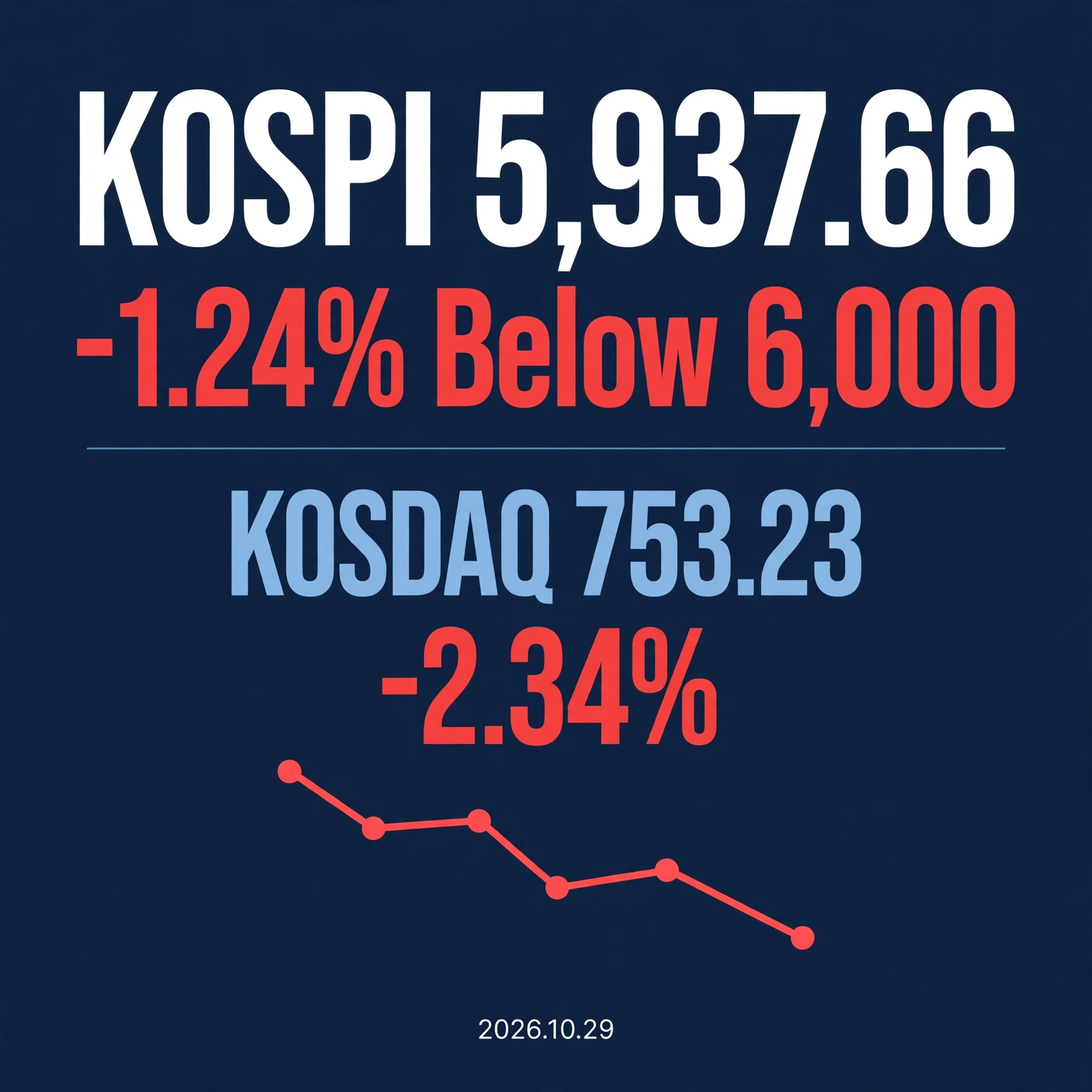
October 29 Korea market brief for foreign investors: the KOSPI fell 1.24% to 5,937.66, giving back the 6,000 line one day after retaking it, and the KOSDAQ fell 2.34% to 753.23. Samsung posted record third-quarter operating profit of KRW 107.44 trillion yet fell 4.13% after deferring shareholder-return details to January, while SK hynix, which spelled out a KRW 100 trillion ($74.8 billion) return plan, rose 2.62%. LG Energy Solution plunged more than 8%. The won firmed to 1,336.8 per dollar.
- KOSPI Rebound Analysis 2.24% Rally Institutional Buying Low PBR First Day
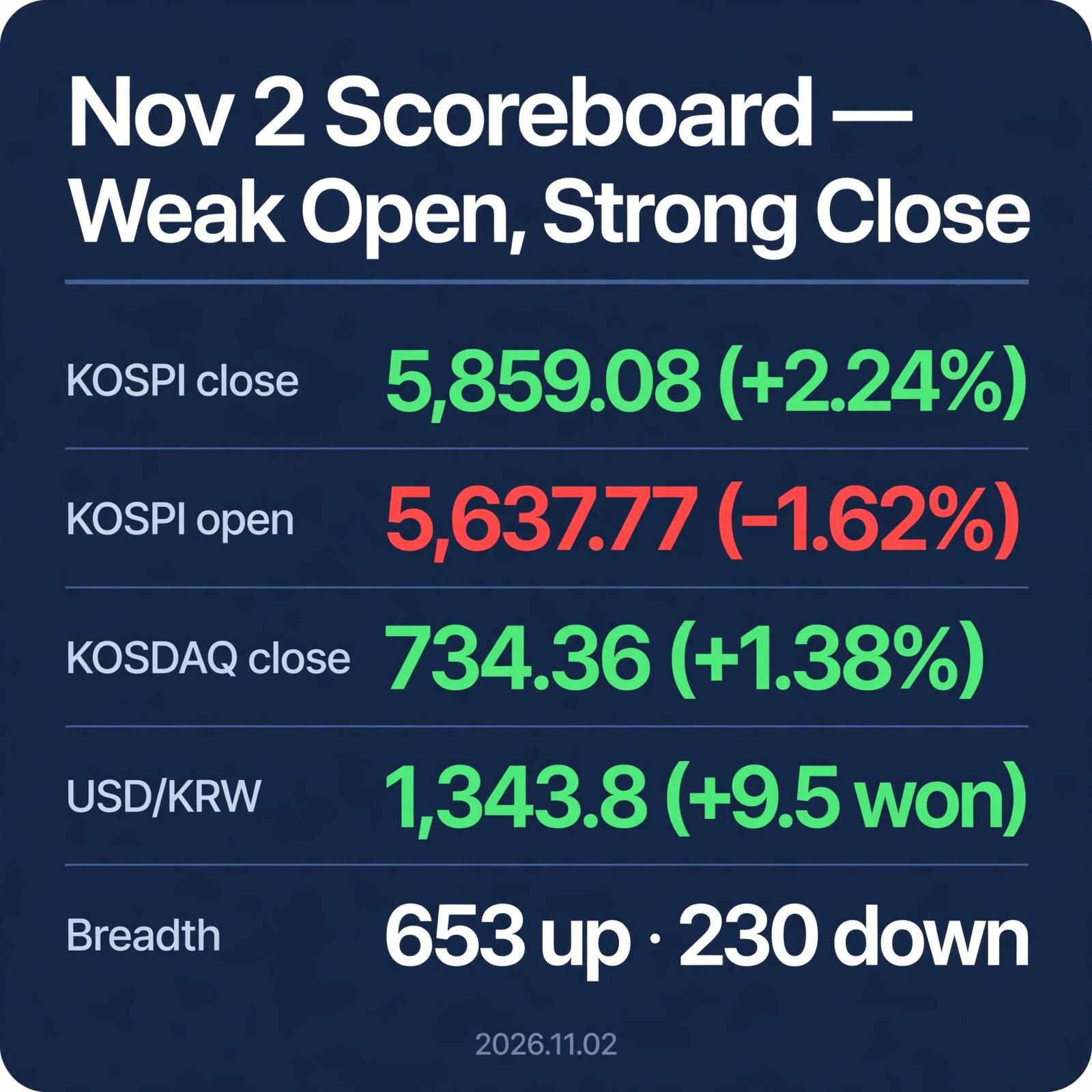
November 2 Korea market brief for foreign investors: the KOSPI opened down 1.62% on the US chip selloff, then rallied 2.24% to 5,859.08 on institutional buying and a strong first day for the low-PBR name list. Foreigners sold a net 373.1 billion won overall but bought Samsung Electronics.
5minbrief on YouTube
The briefs also come as videos. Get the daily market wrap on YouTube.
Subscribe on YouTube