 5-minute briefs
KOSPI 3.48% plunge Alphabet shock sell sidecar semiconductor fall analysis
#KOSPI#KOSDAQ#Alphabet#SK hynix#Samsung Electronics#foreign selling#won dollar exchange rate#EWY
Scoreboard — 5,600 broke intraday, part of the fall recovered by the close
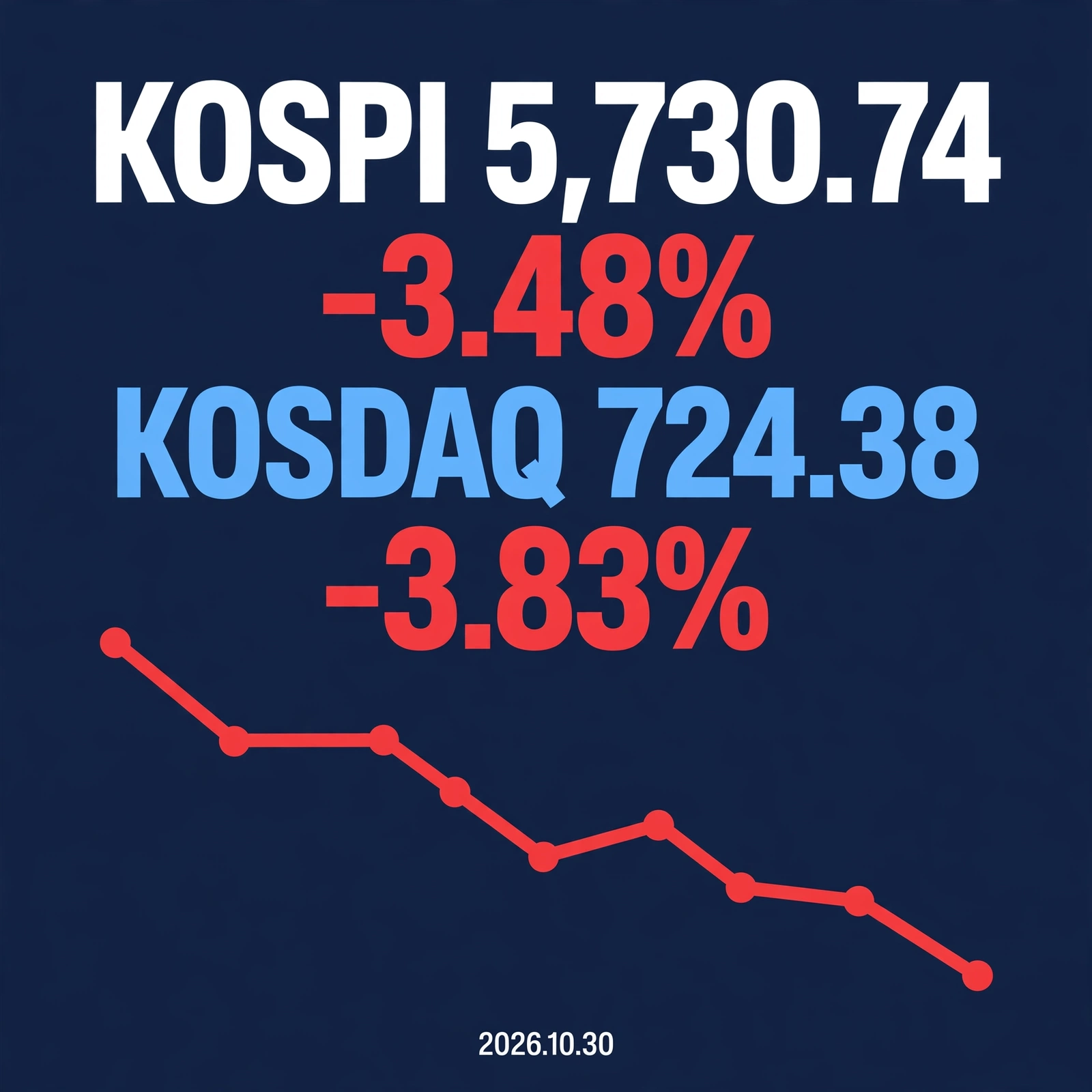
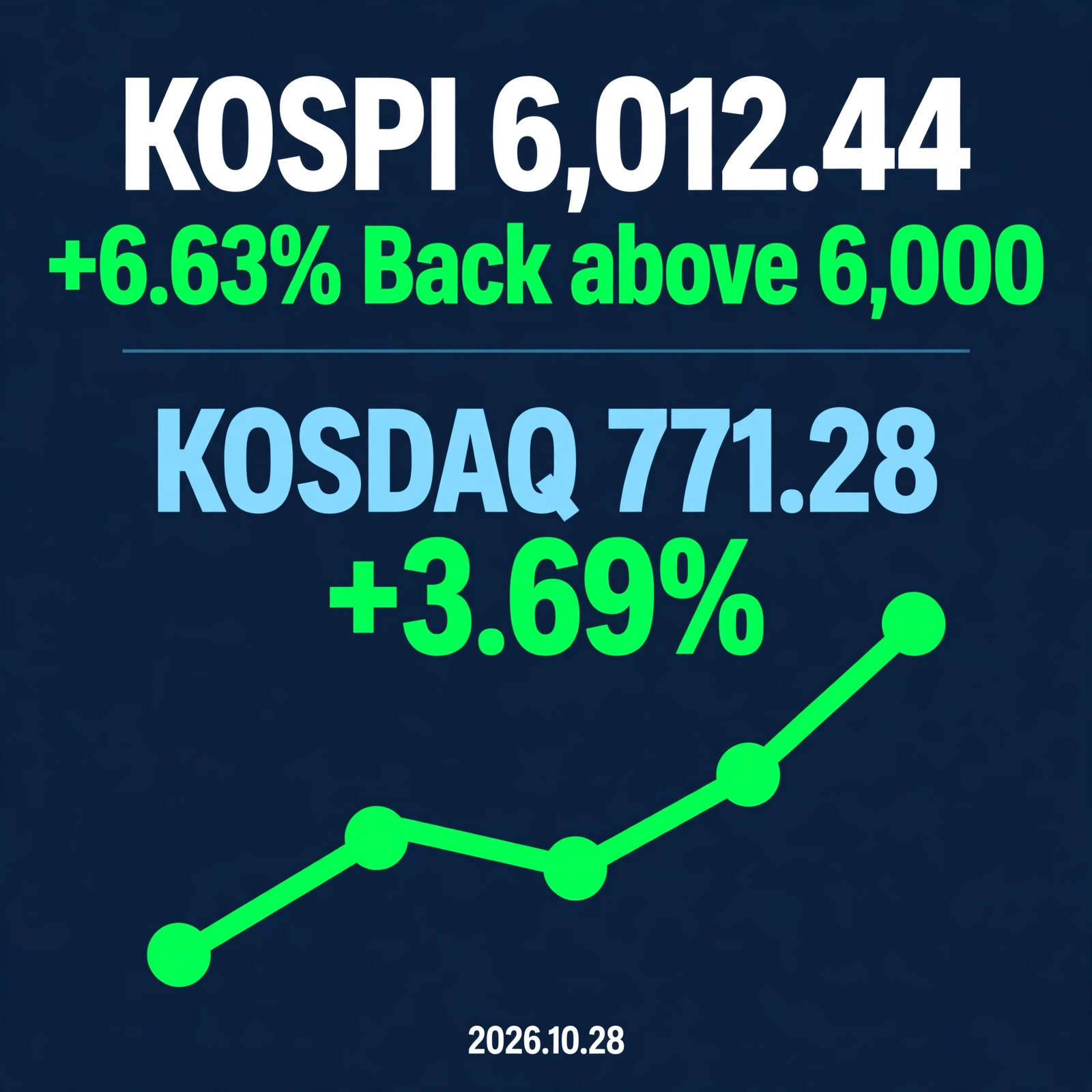
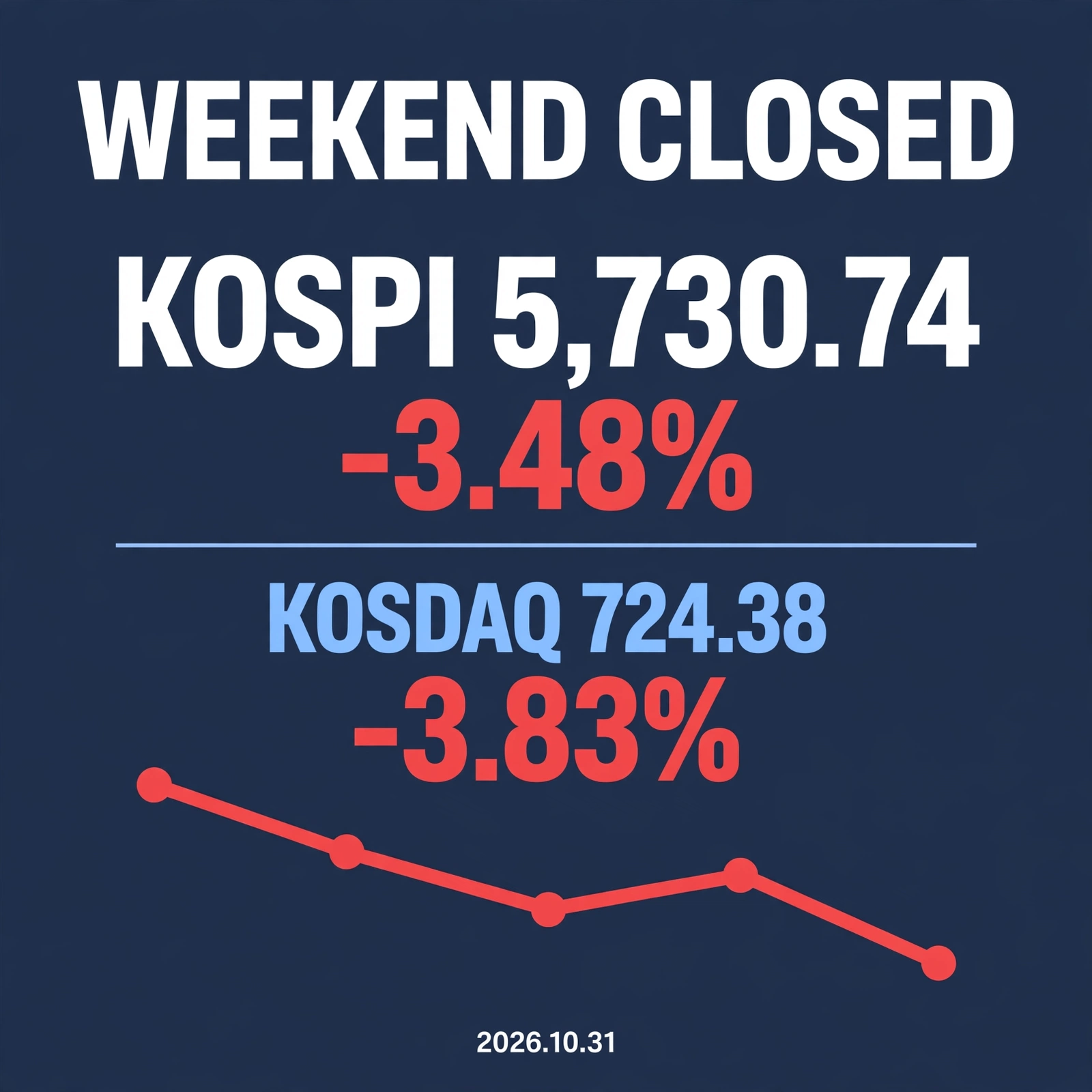
The KOSPI closed 206.92 points (3.48%) lower at 5,730.74, after opening 2.99% lower at 5,760.35 and extending losses to an intraday low of 5,599.42. Afternoon buying from individuals and institutions trimmed the loss, but the index failed to retake 5,800. In two sessions the KOSPI has fallen 281.70 points (4.69%) from 5,937.66 on October 29 — and it now sits more than 280 points below the 6,000 line it retook on October 28.
The KOSDAQ closed 28.85 points (3.83%) lower at 724.38, after opening 2.05% lower at 737.76 and touching an intraday low of 717.27 (–4.77%).
| Index | Close | Day change |
|---|---|---|
| KOSPI | 5,730.74 | –206.92 points (–3.48%) |
| KOSDAQ | 724.38 | –28.85 points (–3.83%) |
| Won / dollar | 1,334.3 | –2.5 won (previous session 1,336.8) |
Flows reversed from yesterday. On the KOSPI, foreigners sold a net KRW 1.62 trillion ($1.21 billion), while individuals bought a net KRW 619.8 billion ($464 million) and institutions KRW 743.2 billion ($557 million). Inside the institutional total, the National Pension Service bought a net KRW 892.9 billion ($669 million) — meaning other domestic institutions were net sellers even as the pension fund bought. On the KOSDAQ, individuals bought a net KRW 168.7 billion ($126 million) while foreigners sold KRW 27.7 billion ($21 million) and institutions KRW 137.6 billion ($103 million). KOSPI trading value was KRW 19.27 trillion ($14.44 billion). Decliners outnumbered advancers 655 to 232 on the KOSPI, and 1,406 to 266 on the KOSDAQ.
Why it fell — Alphabet’s cash-flow deficit repriced Korea’s chip suppliers
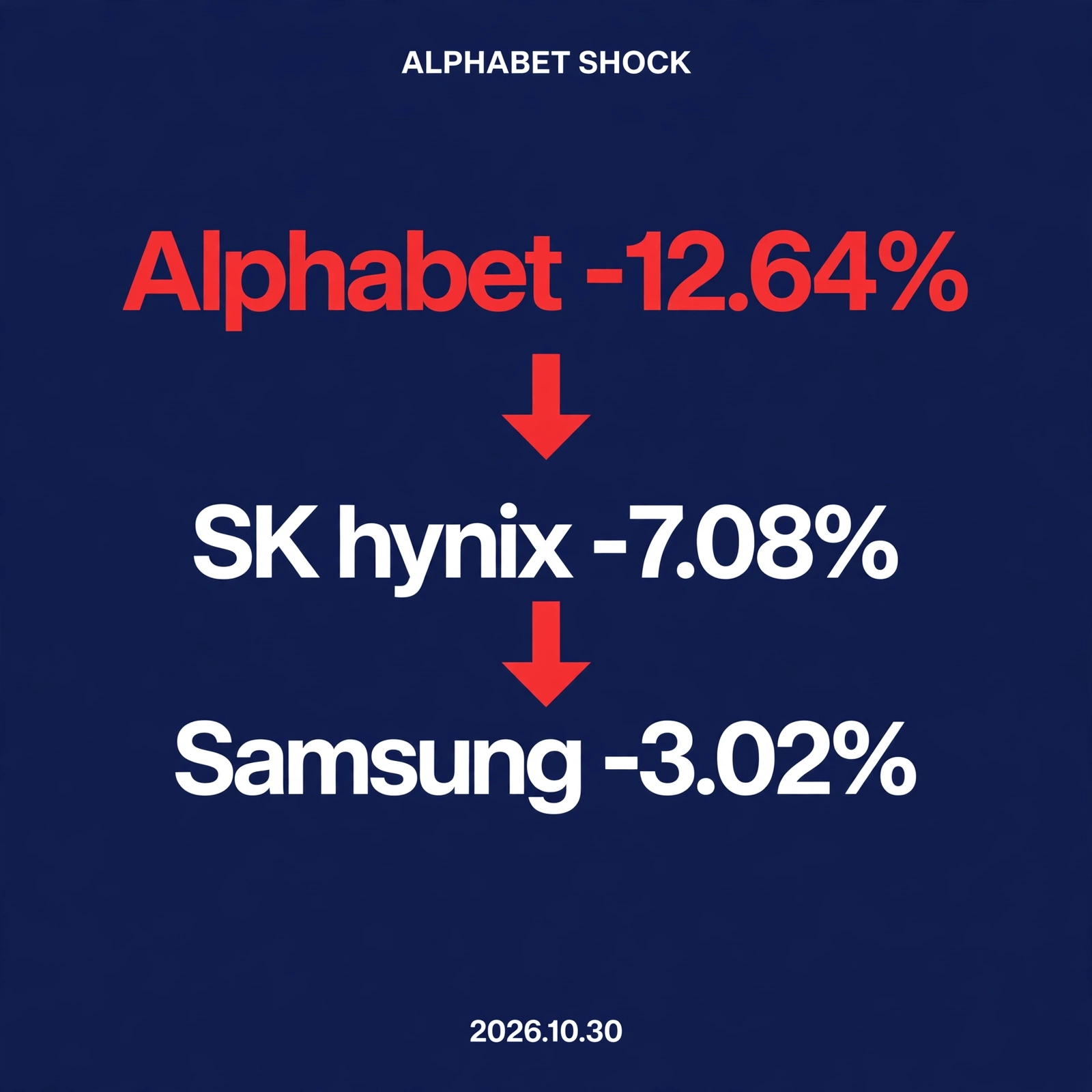
The first driver was Alphabet’s earnings shock. Third-quarter revenue rose 25% from a year earlier to $127.58 billion, but missed market expectations, and free cash flow was a deficit of $9.07 billion — the second straight quarterly deficit — after capital expenditure surged 114% from a year earlier to $51.36 billion. Alphabet shares fell 12.64% overnight, the Nasdaq fell 1.38% and the Philadelphia Semiconductor Index 1.42%. Amazon and Intel then reported weaker-than-expected results after the US close, adding to the pressure before Seoul opened. Daishin Securities’ Lee Kyung-min summed it up: weak earnings outlooks and heavy capital spending hit AI and semiconductor sentiment at the same time.
The second driver was concentrated foreign selling in semiconductors. SK hynix fell 7.08% to KRW 1,418,000 ($1,063) and Samsung fell 3.02% to KRW 225,000 ($169). Samsung’s preferred shares fell 5.33%, SK Square 5.88% and Samsung Electro-Mechanics 7.50%. On the KOSDAQ, chip materials, components and equipment names fell further: Simmtech 8.02%, Wonik IPS 7.72%, Jusung Engineering 6.78% and EO Technics 6.39%. For EWY holders, the message is uncomfortable but specific: Korea’s index is a leveraged play on the AI capex debate, because its two largest weights sell the memory that AI data centers consume. When US buyers question whether AI spending pays, Korean suppliers are repriced first, not last.
The third driver was domestic earnings shocks landing on the same day. Kia plunged 11.73% to KRW 95,600 after telling its earnings call that it will keep its annual sales target but that profitability will fall short of its earlier guidance, citing prolonged Middle East war costs in raw materials and logistics lasting into year-end. Third-quarter revenue rose 10.1% to KRW 31.60 trillion ($23.7 billion) and operating profit rose 24.3% to KRW 1.82 trillion ($1.36 billion) — yet the stock fell on the guidance, a reminder that in Korea, as in the US this week, the outlook can matter more than the quarter. Hyundai Motor fell 3.59% to KRW 282,000 after cutting its annual sales target from 4,158,300 to 4,000,000 units and its operating-margin target from 6.3–7.3% to 5.5–6.5%. Hanwha Aerospace fell 8.42% to KRW 696,000 after third-quarter operating profit of KRW 452.0 billion missed the market consensus of KRW 1,105.7 billion by 59.1%, on delayed K9 deliveries to Poland.
Winners and laggards — pharmaceuticals rose while precision and construction fell 6–7%
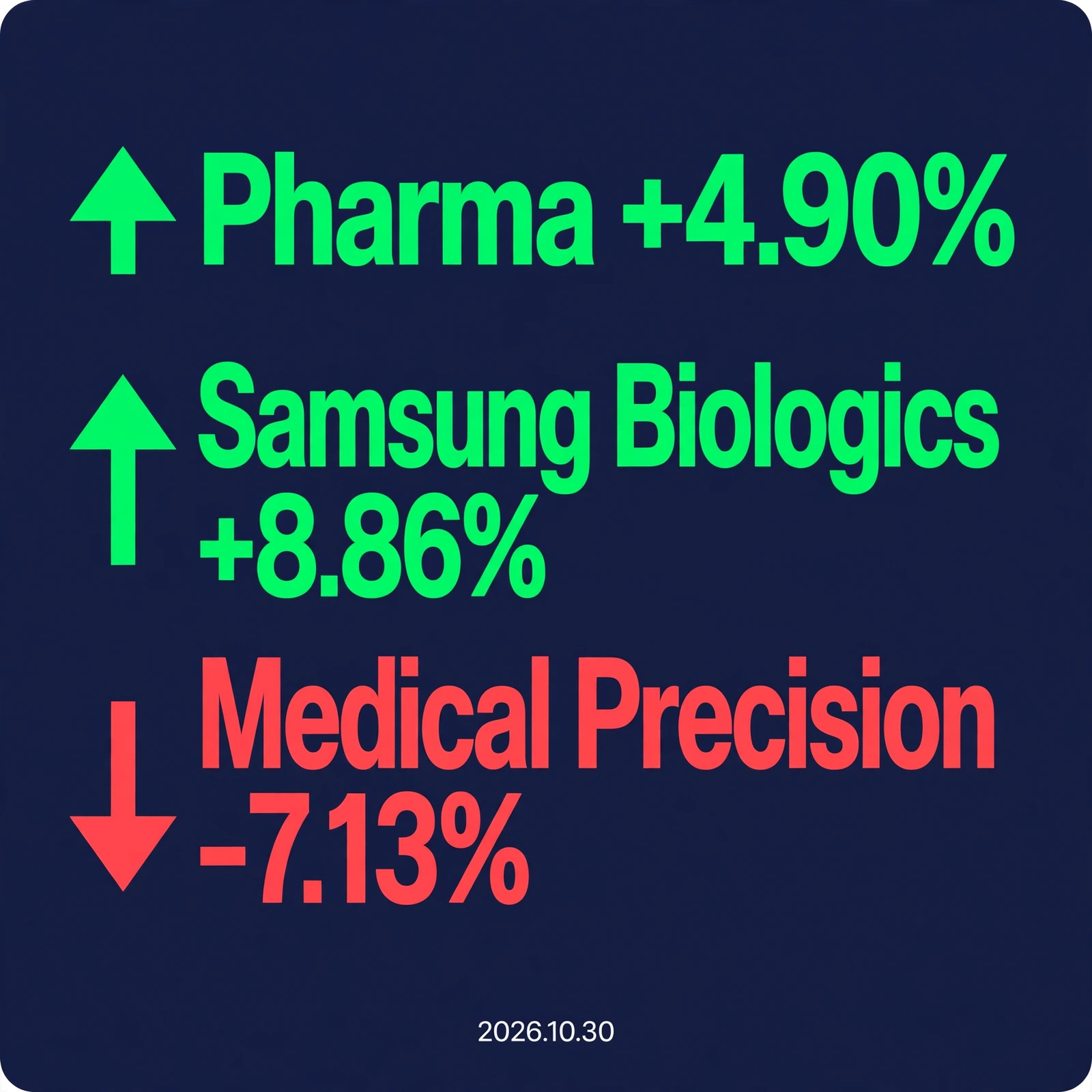
By sector, pharmaceuticals rose 4.90%, with transportation and warehousing up 1.33% and food and tobacco up 1.08%. On the downside, medical and precision instruments fell 7.13%, construction 6.22%, transportation equipment 4.88% and electrical and electronics 4.67%. Among large caps, Samsung Biologics surged 8.86% to KRW 1,487,000, LG Energy Solution rose 0.98% to KRW 359,500 — rebounding a day after its 8% plunge — and Celltrion rose 1.22% and Samsung SDI 0.93%. The pattern looks like defensive rotation inside a falling market: money did not leave Korea entirely, it moved from AI hardware exposure toward pharmaceuticals and batteries.
On the KOSDAQ, only HLB edged higher, up 0.76%, among large caps, while Alteogen fell 3.86%, Ecopro 1.50%, Ecopro BM 1.20% and Rainbow Robotics 3.97%. The KOSDAQ’s steeper fall than the KOSPI’s reflects the same mechanism at smaller scale: when the two chip giants fall, the equipment and materials suppliers that feed them fall further.
The won firmed — 1,334.3, even as stocks plunged
The won strengthened even as equities fell. The dollar-won rate closed at 1,334.3 at 3:30 p.m., down 2.5 won from 1,336.8, after rising as high as 1,340.5 intraday and falling to 1,333.6. The dollar index eased from 102.04 to 101.81 as the Federal Reserve’s rate hold reduced dollar upside and demand for US Treasuries as a safe haven pulled yields lower. Month-end exporter dollar selling and passive inflows linked to Korea’s World Government Bond Index (WGBI) inclusion also supported the won. Foreign investors should not read this as a return of foreign equity money: KRW 1.62 trillion ($1.21 billion) of stock selling and a firmer won can coexist when bond flows, futures hedging and the timing of equity-sale conversion move separately. For unhedged EWY holders, the day’s translation effect was slightly positive — a small offset to a 3.48% index fall, not a hedge.
What to watch — the next test is US earnings, not Korean guidance
Three things decide whether today is a pullback or the start of an AI-capex repricing. First, does foreign selling on the KOSPI continue? Today’s KRW 1.62 trillion ($1.21 billion) of selling ended three days of foreign buying; a second day of heavy selling would signal a positioning shift rather than a one-day rebalance, especially with the pension fund buying against it. Second, do Samsung around KRW 225,000 ($169) and SK hynix around KRW 1,418,000 ($1,063) hold? The afternoon recovery from the 5,599.42 low shows dip-buying exists, but a retest of that low would turn a sharp correction into a technical breakdown. Third, do the next US big-tech reports show cash flow catching up with capex? Alphabet and Amazon have now both shown the market the bill for AI infrastructure; until a major name shows the return, Korean memory suppliers carry the repricing risk. Domestically, the governance calendar still matters on a longer clock: LG Chem receives its PRS proceeds on November 27, followed by six months of treasury-share purchases, and Samsung’s board finalizes return details at the end of January 2027.
- Sell-side sidecar: a five-minute suspension of program sell orders when KOSPI 200 futures fall 5% or more from the previous close for at least one minute. It slows program trading; it does not halt stock trading.
- Free cash flow (FCF): operating cash flow minus capital expenditure. A negative FCF means a company spent more building than its operations generated.
- Capital expenditure (capex): spending on plants, servers and equipment for future production — in the AI era, largely data centers and chips.
- Net buying / net selling: purchases minus sales for the day. Net selling means more was sold than bought.
- Earnings shock: results far below market consensus expectations.
Three questions for investors
First, does foreign selling extend to a second day? The pension fund’s KRW 892.9 billion ($669 million) of buying absorbed part of today’s selling, but it cannot absorb a multi-day foreign exit on its own. Second, does the KOSPI hold 5,700, or retest the intraday low of 5,599.42? Holding that zone frames today as a sharp correction after a run to 6,000; losing it opens a deeper retracement. Third, does pharmaceutical strength become a real defensive rotation? Pharmaceuticals rose 4.90% and Samsung Biologics 8.86% while chips fell — whether that rotation persists or proves a one-day reflex will shape next week’s sector map.
Not investment advice. Figures are from the Korea Exchange, the Seoul foreign exchange market, Yonhap, the Korea Times and Financial News, verified October 30, 2026.
Sources & references
- Yonhap — Seoul shares dip over 3 pct on tech sell-off amid AI concerns — Oct 30 KOSPI and KOSDAQ closes, flows, sidecar and stock moves
- Korea Times — KOSPI falls 3.48% as US tech earnings fuel AI investment concerns — Sidecar timing, won close and US market context cross-check
- Financial News — KOSPI tumbles 3.48% on US AI concerns; Samsung down 3%, SK hynix down 7% — English-language sidecar timing and AI-investment context; closing levels cross-checked against Yonhap
Related articles
- KOSPI 1.24% fall Samsung shareholder return delay 5937 close analysis
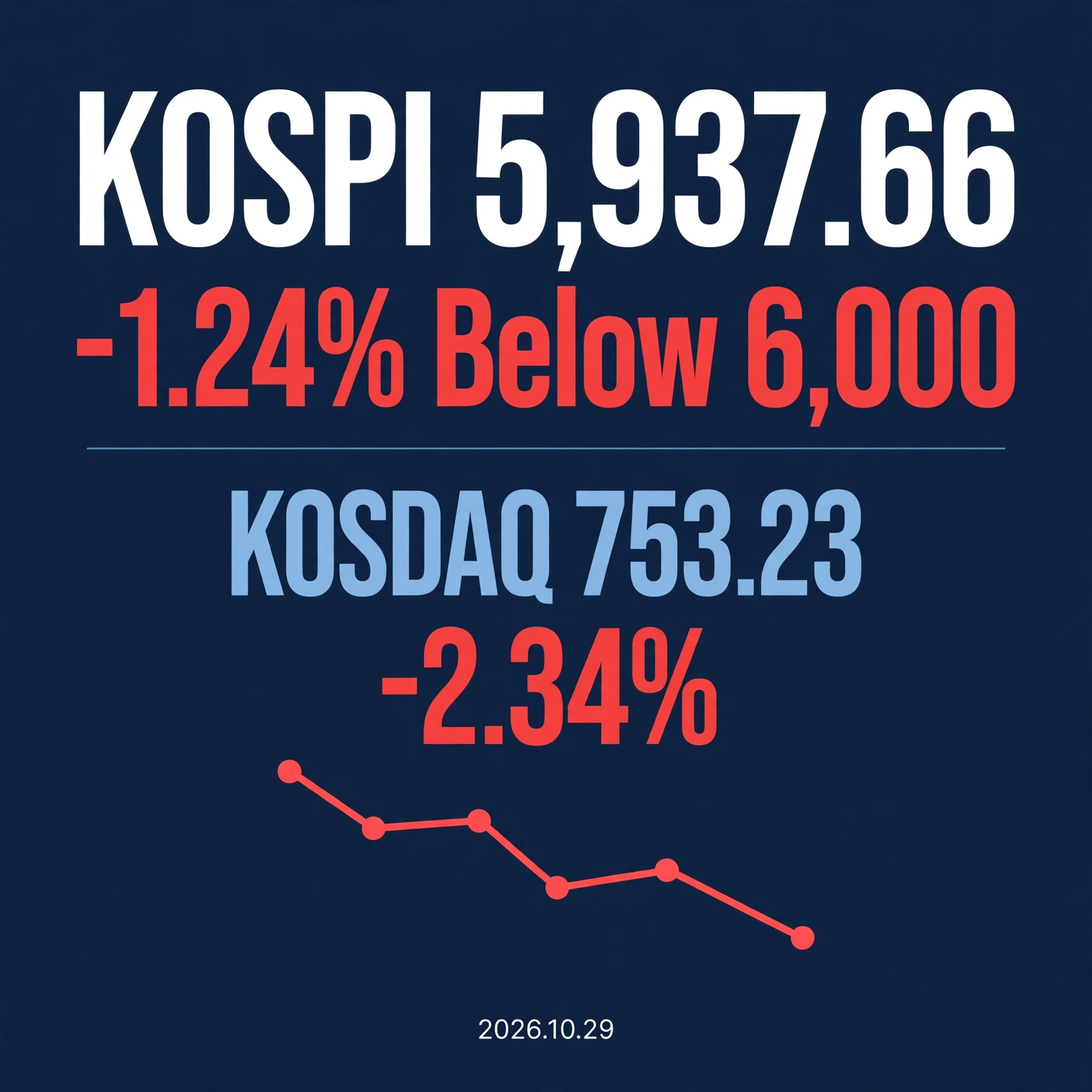
October 29 Korea market brief for foreign investors: the KOSPI fell 1.24% to 5,937.66, giving back the 6,000 line one day after retaking it, and the KOSDAQ fell 2.34% to 753.23. Samsung posted record third-quarter operating profit of KRW 107.44 trillion yet fell 4.13% after deferring shareholder-return details to January, while SK hynix, which spelled out a KRW 100 trillion ($74.8 billion) return plan, rose 2.62%. LG Energy Solution plunged more than 8%. The won firmed to 1,336.8 per dollar.
- KOSPI 6.63% surge back above 6000 SK hynix record profit foreign buying
October 28 Korea market brief for foreign investors: the KOSPI jumped 6.63% to 6,012.44, its first close above 6,000 in 10 sessions, after SK hynix posted record third-quarter profit and a KRW 100 trillion shareholder-return plan. Foreigners and institutions bought together for a second day, Samsung rose 9.01% and SK hynix 10.89%. The won weakened to 1,337.7 per dollar.
- Korea Weekend Brief China PMI Contraction US Tech Selloff Samsung Shareholder Return Analysis
October 31 Korea weekend brief for foreign investors: Seoul is closed for the weekend, with the KOSPI last at 5,730.74 (-3.48%). Overnight the Nasdaq fell 2.86% on Intel's plunge, China's October manufacturing PMI slipped to 49.3, and WTI crude rose to $104.12 on a Strait of Hormuz incident. Samsung's remaining KRW 55–75 trillion ($41–56 billion) of returns awaits a January board decision.
5minbrief on YouTube
The briefs also come as videos. Get the daily market wrap on YouTube.
Subscribe on YouTube