 5-minute briefs
KOSPI 6.63% surge back above 6000 SK hynix record profit foreign buying
#KOSPI#KOSDAQ#SK hynix earnings#SK hynix shareholder returns#Samsung Electronics#Korea discount#won dollar exchange rate#EWY
Scoreboard — KOSPI retakes 6,000, buy sidecar fires again
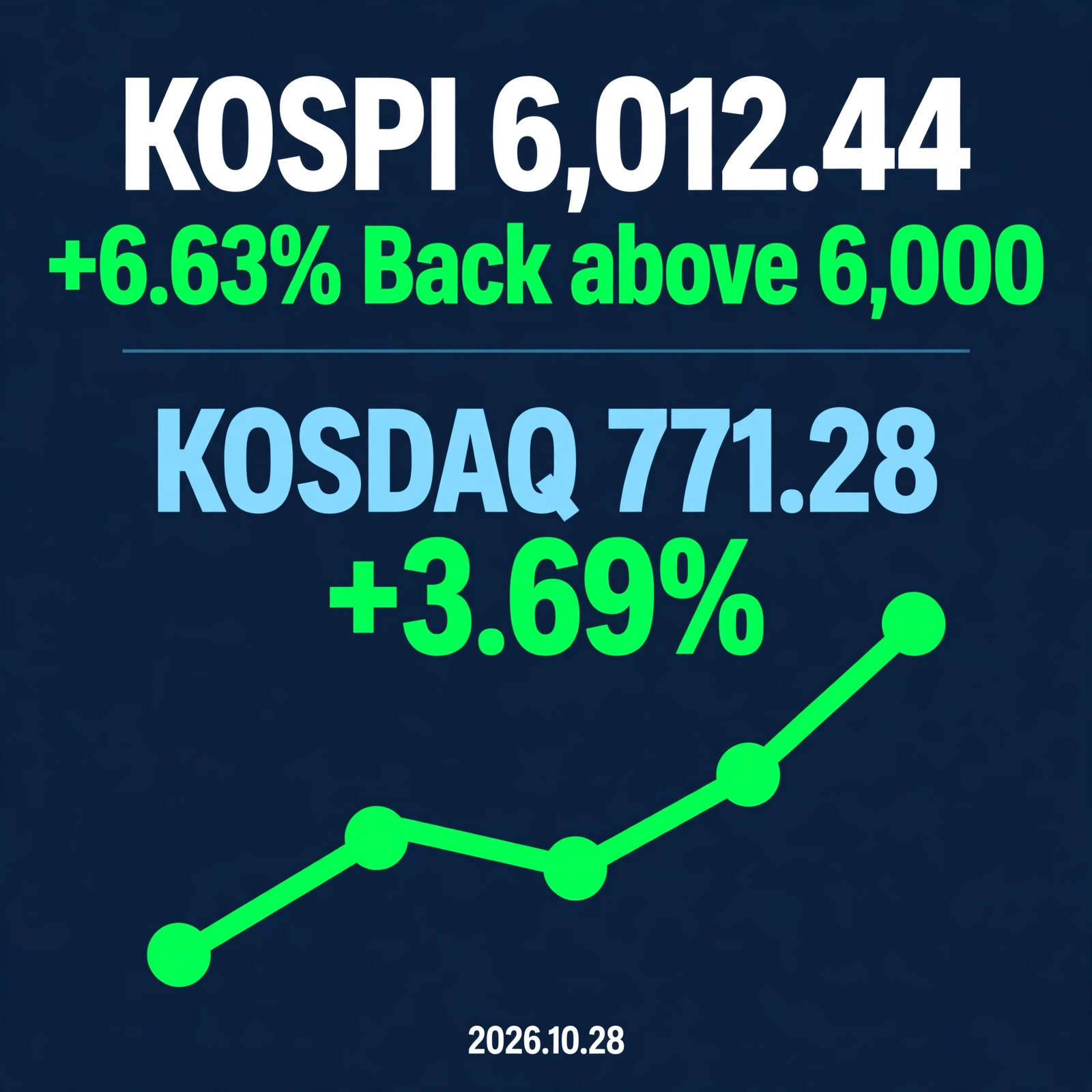
The KOSPI closed 374.10 points (6.63%) higher at 6,012.44, after opening 2.23% higher at 5,763.85 and touching an intraday high of 6,032.28. The percentage gain was the largest since July 31, and the point gain the largest since August 20. A buy sidecar fired for the second consecutive day — the first back-to-back firing since July 21–22, about three months ago. Yesterday’s rebound was not a one-day bounce: today it got much bigger.
The KOSDAQ closed 27.45 points (3.69%) higher at 771.28, after opening 1.76% higher at 756.90. Breadth was broad but not unanimous: on the KOSPI, 582 stocks rose and 289 fell (44 unchanged); on the KOSDAQ, 1,141 rose and 527 fell (68 unchanged). Trading value jumped to KRW 19.8 trillion on the KOSPI and KRW 6.7 trillion on the KOSDAQ, both well above yesterday’s levels. Real money came in — this was not a thin rally.
| Index | Close | Day change |
|---|---|---|
| KOSPI | 6,012.44 | +374.10 points (+6.63%) |
| KOSDAQ | 771.28 | +27.45 points (+3.69%) |
| Won / dollar | 1,337.7 | +14.0 won (previous session 1,323.7) |
Why it rallied — record profit, KRW 100 trillion returns, joint foreign buying
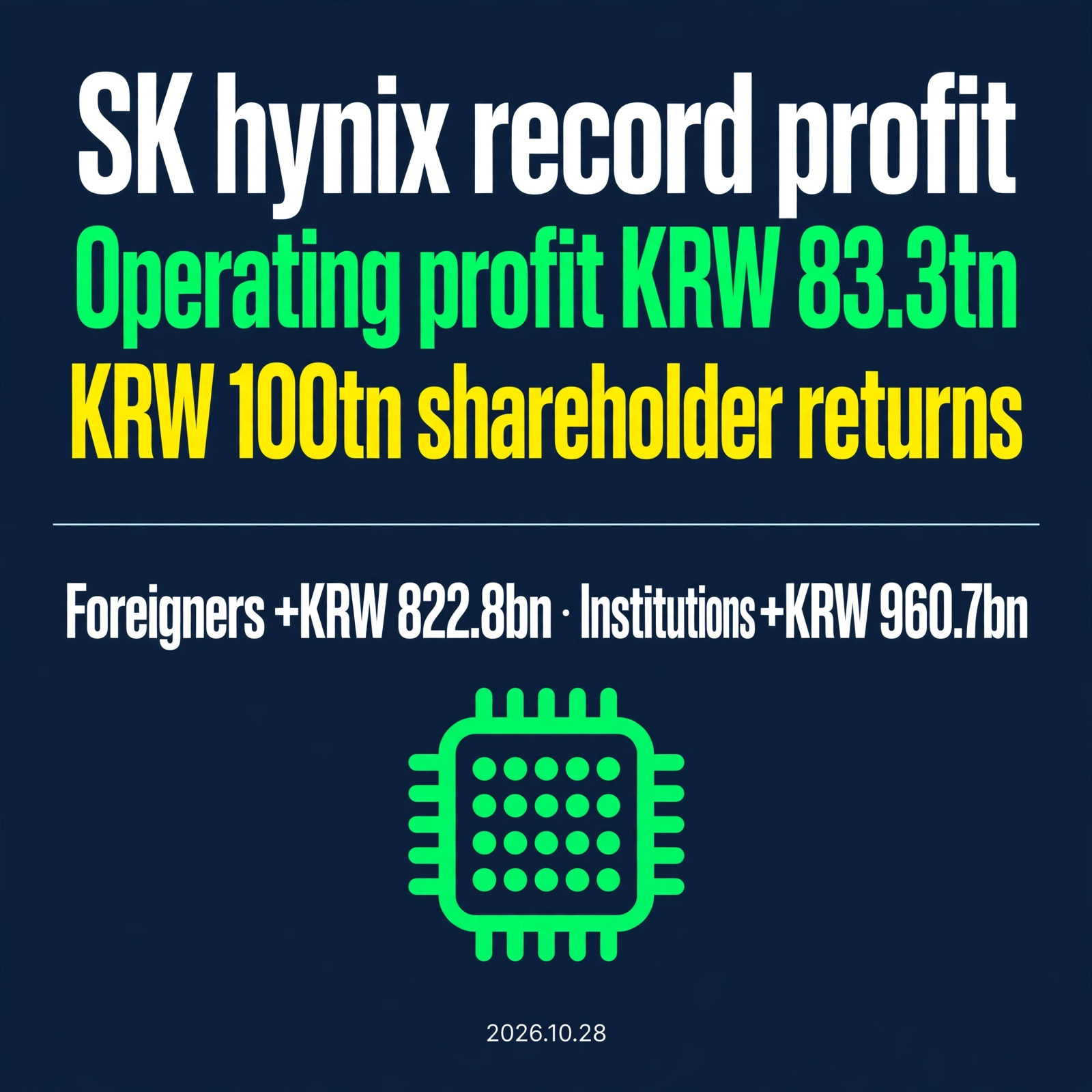
The first driver was SK hynix’s third-quarter result, released before the open. Quarterly revenue passed KRW 100 trillion for the first time at KRW 104.6 trillion, operating profit hit a record KRW 83.3 trillion — an 80% operating margin — and net profit was KRW 39.8 trillion. Revenue rose 32% from the previous quarter and 328% from a year earlier; operating profit rose 38% quarter-on-quarter and 632% year-on-year. Shipments of HBM4, the new high-bandwidth memory for AI accelerators, are ramping up, and the company said more than half of its 2027–2028 production capacity is already covered by long-term contracts. The market’s fear that memory profits had peaked — the “peak profit” thesis — was answered with numbers.
The second driver was the KRW 100 trillion shareholder-return plan, and this is where the governance lens matters. SK hynix said it will return about KRW 100 trillion to shareholders in 2026: at least KRW 30 trillion in cash dividends and at least KRW 60 trillion in buybacks and cancellations (including KRW 40 trillion approved in August). The third-quarter dividend is KRW 20,000 per share — a KRW 10,000 regular dividend plus a KRW 10,000 special dividend sharing gains from its Kioxia investment. A KRW 20 trillion buyback starts October 29 and runs for three months. For foreign investors, the point is structural: Korea’s long-standing “Korea discount” rests on the fear that chaebol-controlled companies hoard cash instead of returning it. A plan that hands back roughly KRW 100 trillion, with a special dividend explicitly linked to an investment gain, is exactly the kind of evidence that narrows that discount — and it is why the stock, not just the index, surged.
The third driver was joint foreign and institutional buying. Foreigners bought a net KRW 822.8 billion on the KOSPI and institutions KRW 960.7 billion, while individuals sold a net KRW 1.8 trillion. It was the second straight day of joint buying, and including the alternative exchange Nextrade, foreign net buying topped KRW 1 trillion for the first time since September 18. Foreigners were also net buyers of KOSPI 200 futures (KRW 144.7 billion). Overnight US strength helped: the Nasdaq rose 1.18% and the Philadelphia Semiconductor Index 3.60% on Tuesday, and expectations for Samsung’s detailed third-quarter results and return plan tomorrow (October 29) were priced in ahead of the announcement.
Winners and laggards — Samsung and SK hynix up 9–11%, biotech left out
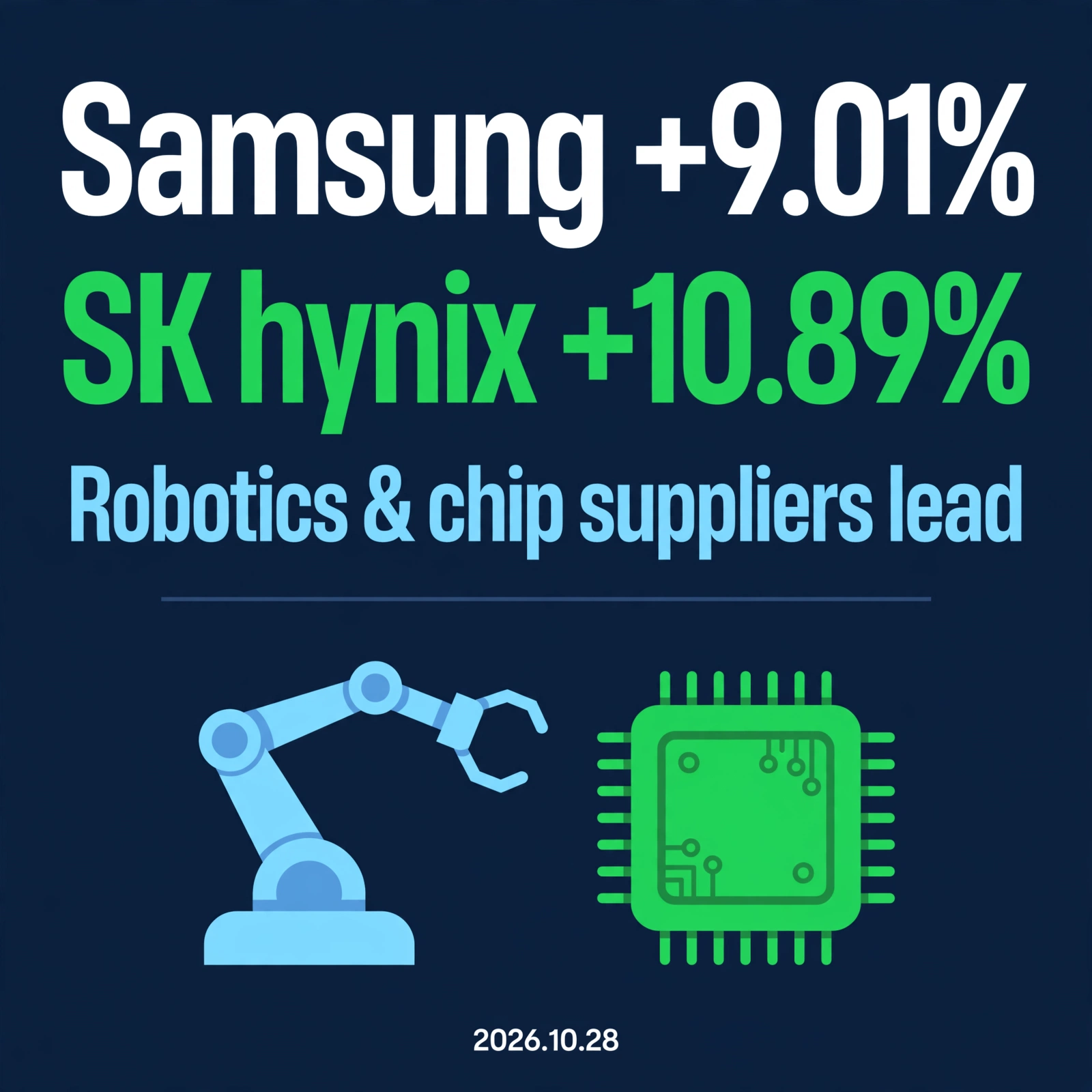
The rally was led by the two memory giants. SK hynix closed 10.89% higher at KRW 1,487,000 and Samsung Electronics 9.01% higher at KRW 242,000 — both their biggest single-day gains since August 20. SK Square rose 11.23%, Samsung preferred shares 11.10%, Samsung Electro-Mechanics 8.74%, Samsung Life 8.82%, Samsung C&T 7.81% and KB Financial 4.34%. By sector, electrical and electronics jumped 9.02%, insurance 6.43%, securities 5.46% and medical and precision instruments 5.30%. Non-metal (-0.33%), paper and wood (-0.12%) and entertainment and culture (-0.11%) fell, and Samsung Biologics slipped 0.15% — biotech sat out the semiconductor rally for a second day.
On the KOSDAQ, robotics and chip equipment names led: Rainbow Robotics surged 15.08%, Robotis 9.76%, Jusung Engineering 6.12%, Eo Technics 5.95% and PSK Holdings 14.07%. But note the flow divergence: on the KOSDAQ, institutions bought a net KRW 224.1 billion while foreigners sold a net KRW 183.4 billion and individuals sold KRW 30.9 billion. Foreign money concentrated on KOSPI large caps; the KOSDAQ rally was institution-led.
The won weakened anyway — 1,337.7, despite foreign stock buying
Foreigners bought Korean stocks, yet the won fell. The dollar-won rate closed at 1,337.7 at 3:30 p.m., up 14.0 won from the previous session, after touching 1,342.3 intraday. The lesson for foreign investors: equity flows are only one driver of the won. The dollar index hit a one-and-a-half-week high overnight, and expectations of a hawkish hold from the US Federal Reserve (FOMC) decision due tonight supported the dollar. The won’s roughly 1% daily decline trims the dollar-denominated return of today’s rally for unhedged holders — but at this magnitude it is a haircut, not a regime break.
What this means for EWY holders
If you hold Korea through the iShares MSCI South Korea ETF (EWY) or similar vehicles, today was a concentrated win: Samsung and SK hynix dominate the index, and both posted their best days since August 20. Three things to watch next. First, tomorrow’s Samsung print: detailed third-quarter results plus its own return plan are due October 29 — SK hynix set the bar, and Samsung must now clear it. Second, whether foreign buying extends to a third day: two days of joint buying is a signal; three days is a trend. Third, whether the KOSPI holds above 6,000: defending the reclaimed level on closing prices would turn today’s spike into a recovery phase rather than a relief bounce.
Checkpoints ahead
The week’s real verdicts are still to come. Tonight (US time October 28): the FOMC rate decision, followed by Microsoft and Alphabet earnings after the US close. Tomorrow (October 29): Samsung’s detailed third-quarter results and shareholder-return plan, plus US third-quarter GDP, September PCE inflation and Amazon earnings. China’s fifth plenum runs through October 29. Today’s surge will be judged against those prints.
- Buy sidecar: a five-minute suspension of program buy orders when futures surge. A cooling device for one-sided buying.
- Net buying: purchases minus sales for the day. Positive means that investor group bought more than it sold.
- Buyback and cancellation: a company buys its own shares and retires them, shrinking the share count — a core shareholder-return tool.
- HBM (high-bandwidth memory): high-performance memory attached to AI accelerators. SK hynix's HBM4 becomes its mainstream product from the fourth quarter.
- Korea discount: the persistent valuation gap of Korean stocks, often blamed on governance — low payouts, complex chaebol structures and treasury-share overhang.
Three questions for investors
First, does Samsung’s return plan match SK hynix’s surprise? Much of today’s gain pre-prices tomorrow’s announcement — the size of the plan decides whether there is a pullback. Second, does foreign buying continue for a third day? That separates a trend from an event-driven trade. Third, does the KOSPI defend 6,000? Holding the reclaimed level on closing prices would confirm a recovery phase rather than a relief bounce.
Not investment advice. Figures are based on Korea Exchange, the Seoul foreign-exchange market, Yonhap News and SK hynix disclosures, checked October 28, 2026.
Sources & references
- SK hynix Newsroom — SK hynix Announces Q3 2026 Financial Results — Official release of Q3 earnings and the shareholder-return plan (primary source for the key event)
- Addnewsin — KOSPI surges 6.63%, reclaiming the 6,000 line after 10 sessions — Oct 28 closing report with final index and flow figures
- SME Daily — KOSPI tops 6,010 on SK hynix's blowout earnings and the Anthropic IPO tailwind — Cross-check of closing levels, FX and sector moves
Related articles
- KOSPI 1.24% fall Samsung shareholder return delay 5937 close analysis
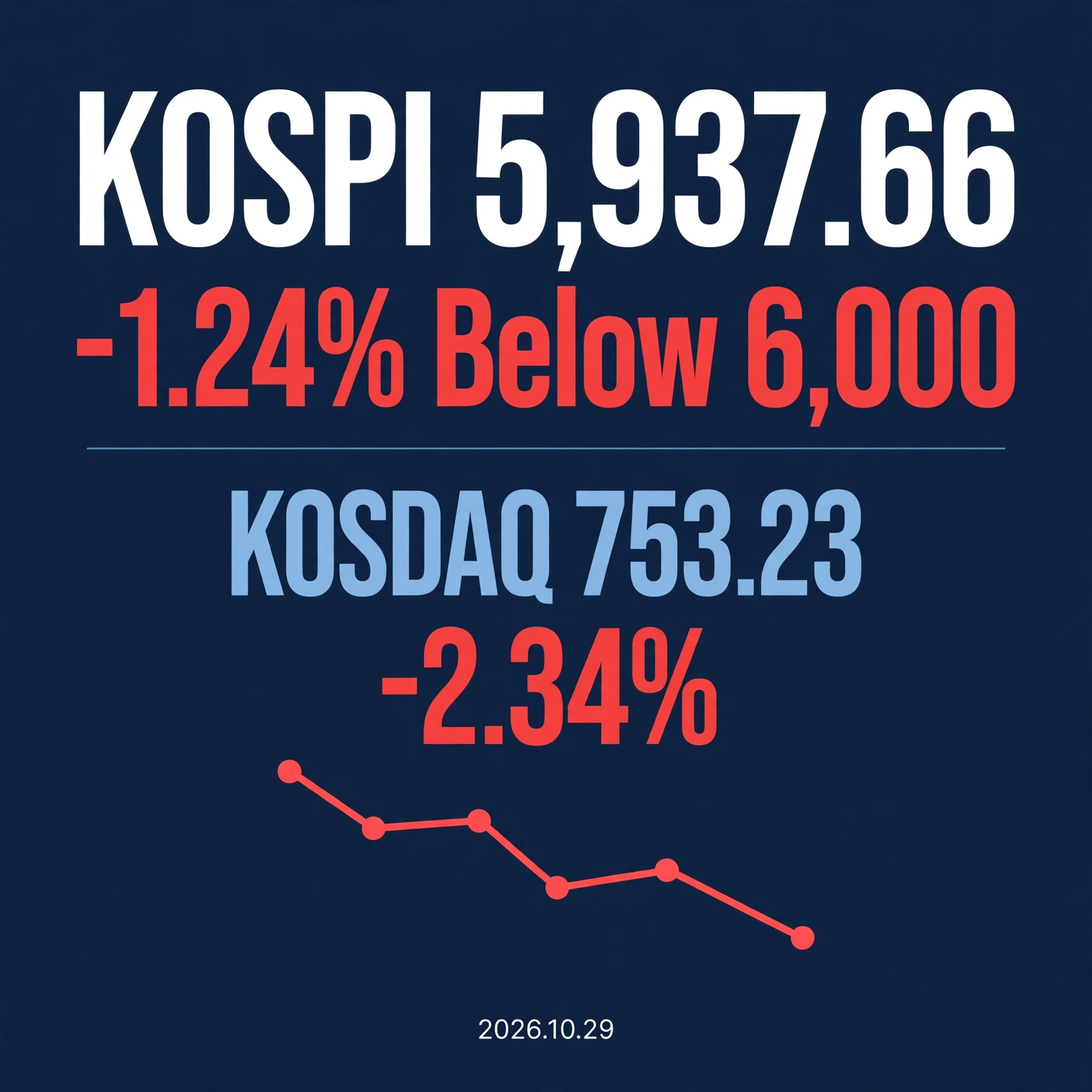
October 29 Korea market brief for foreign investors: the KOSPI fell 1.24% to 5,937.66, giving back the 6,000 line one day after retaking it, and the KOSDAQ fell 2.34% to 753.23. Samsung posted record third-quarter operating profit of KRW 107.44 trillion yet fell 4.13% after deferring shareholder-return details to January, while SK hynix, which spelled out a KRW 100 trillion ($74.8 billion) return plan, rose 2.62%. LG Energy Solution plunged more than 8%. The won firmed to 1,336.8 per dollar.
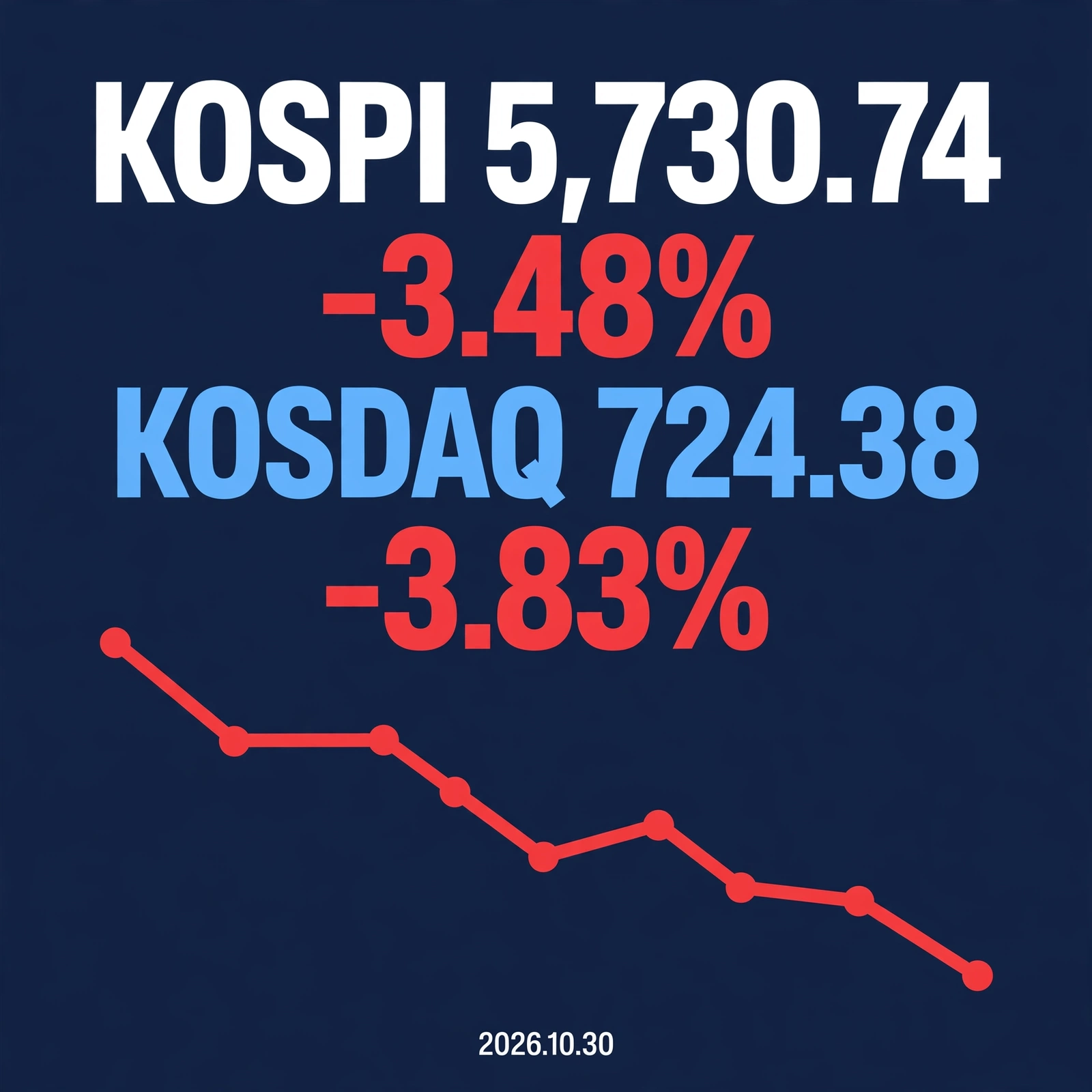
- KOSPI 3.48% plunge Alphabet shock sell sidecar semiconductor fall analysis
October 30 Korea market brief for foreign investors: the KOSPI fell 3.48% to 5,730.74 and the KOSDAQ fell 3.83% to 724.38 as Alphabet's earnings shock triggered a sell-side sidecar and foreigners sold a net KRW 1.62 trillion ($1.21 billion). Samsung fell 3.02% and SK hynix 7.08%. The won firmed to 1,334.3 per dollar.
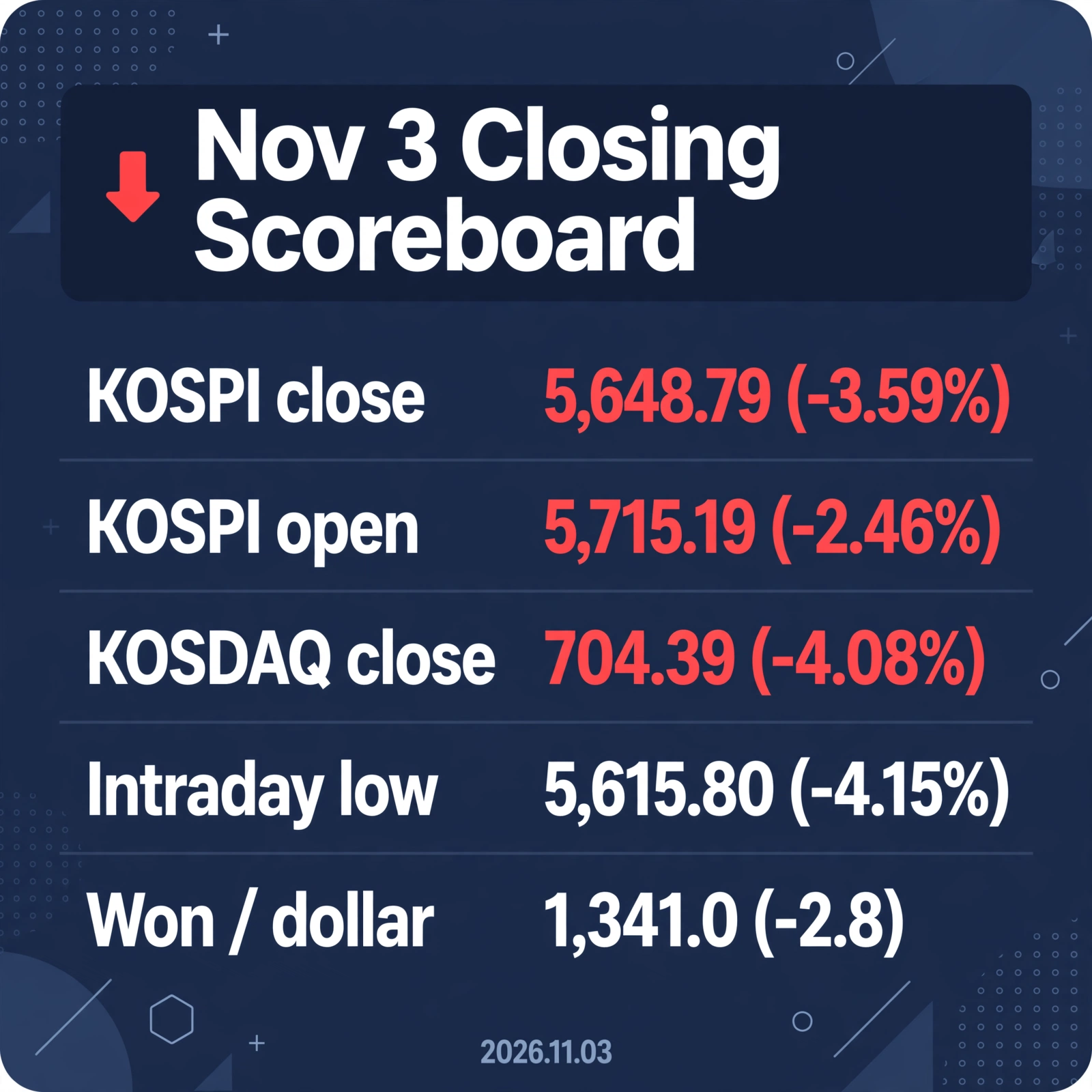
- KOSPI 3.59% Plunge Foreign Institutional 2.9 Trillion Won Selling AI Funding Fear
November 3 Korea market close: the KOSPI fell 3.59% to 5,648.79 and the KOSDAQ fell 4.08% to 704.39 as AI funding worries and US midterm caution triggered heavy foreign and institutional selling. Retail investors bought a net 2.60 trillion won alone. What it means for EWY holders.
5minbrief on YouTube
The briefs also come as videos. Get the daily market wrap on YouTube.
Subscribe on YouTube