 5-minute briefs
KOSPI Falls Below 5500 Mark Analysis Foreign Selling KOSDAQ 727 and Earnings Super Week Outlook
#SK Hynix earnings#FOMC#won dollar exchange rate#EWY
Why this day matters for foreign investors
The KOSPI opened 0.92% lower at 5,499.05, tried to recover early in the session, then slid to close at 5,469.47, down 80.83 points (1.46%). The intraday range ran from 5,455.11 to 5,565.67. The KOSDAQ fell 24.48 points (3.26%) to 727.21 from a 742.17 open, dropping below the 730 level. On the KOSPI, decliners outnumbered advancers 790 to 101, and trading value was light at 10.95 trillion won for the KOSPI market and 4.38 trillion won for the KOSDAQ. A sharp fall on light volume reads as cautious selling, not panic.
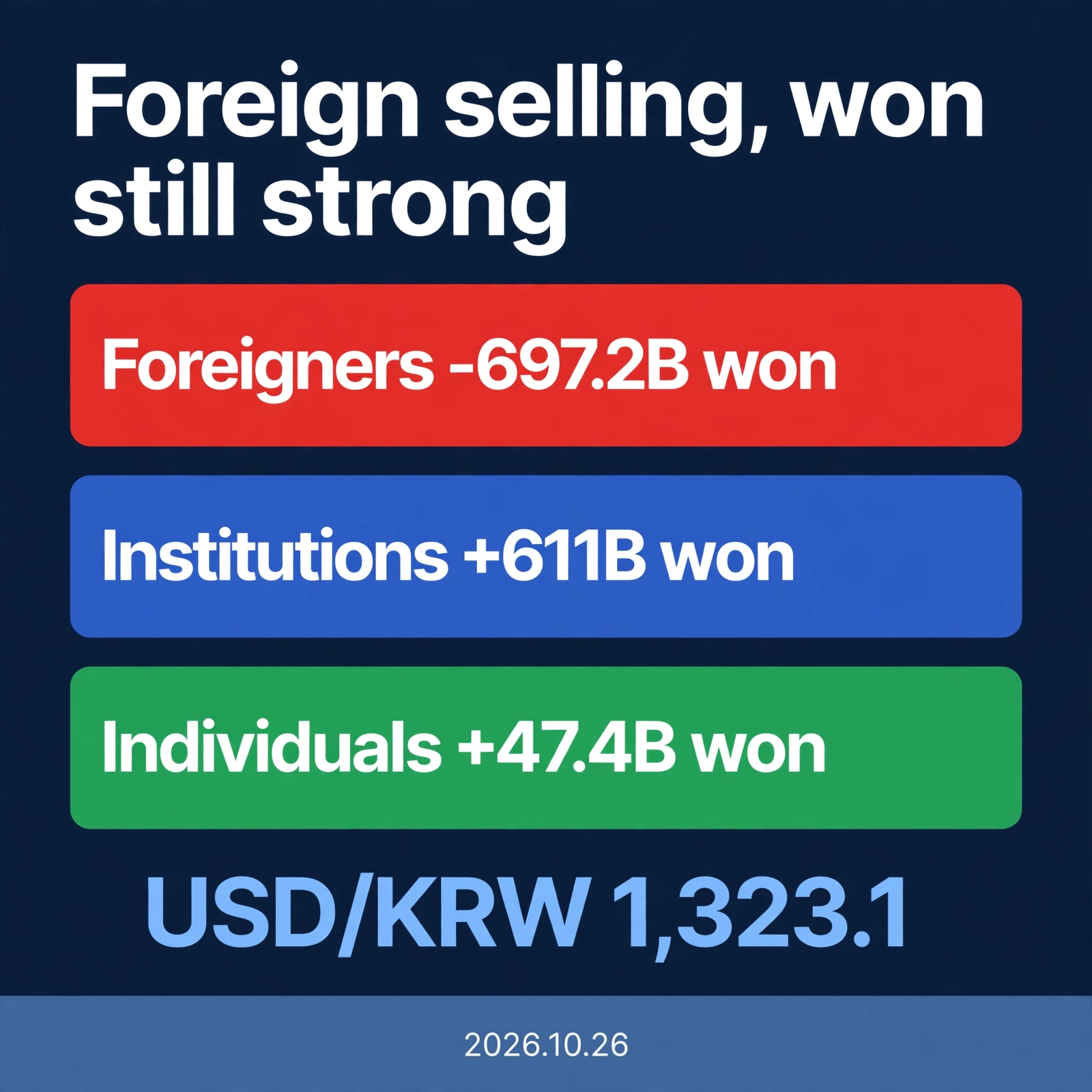
Three forces drove the decline. First, foreign selling: overseas investors sold a net 697.2 billion won on the KOSPI, and program trades showed a 672.2 billion won selling edge. In the KOSDAQ, the flow ran the other way: foreigners bought a net 39 billion won while institutions sold 127.8 billion won. Second, Wall Street’s Friday losses: the Dow fell 1.23%, the S&P 500 fell 0.52%, and the Nasdaq fell 0.21%. Third, oil and rates: Brent crude reached $116.72 and WTI reached $103.27 as Middle East tensions rose again, while the U.S. 10-year Treasury yield sat near 5.00%. When oil and U.S. yields rise together, foreign money tends to leave emerging markets first, and Korea is no exception. With big events ahead, wait-and-see sentiment kept bargain hunting limited, and the market has alternated up and down day by day since October 19.
The won paradox, explained with numbers
The won was quoted at 1,323.1 per dollar at 3:30 p.m., stronger than the previous session’s close of 1,324.6. It has now closed in the 1,320s for five straight sessions. Early in the day it traded as strong as 1,322.1. Market reports attribute the strength to dollar selling by semiconductor exporters, a flow that has run steadily since July rather than clustering at quarter-ends. A record current-account surplus, driven by the chip boom, backs the same flow.
The Bank for International Settlements (BIS) measure of the won’s overall value tells the same story. The won’s nominal effective exchange rate stood at 94.83 on October 20 (2020 = 100), its highest in about two years. That index compares the won against a basket of trading partners, so a high reading means broad won strength, not just a move against the dollar.
For EWY or FLKR holders, the practical point is this: currency is currently cushioning, not amplifying, the stock decline. A stronger won raises the dollar value of Korean holdings. The risk to watch is the overnight pattern analysts keep flagging: the won tends to weaken again in European and New York hours when exporter selling fades, so the daytime close can flatter the picture.
Stock moves: chips held up, banks, defense, and autos fell
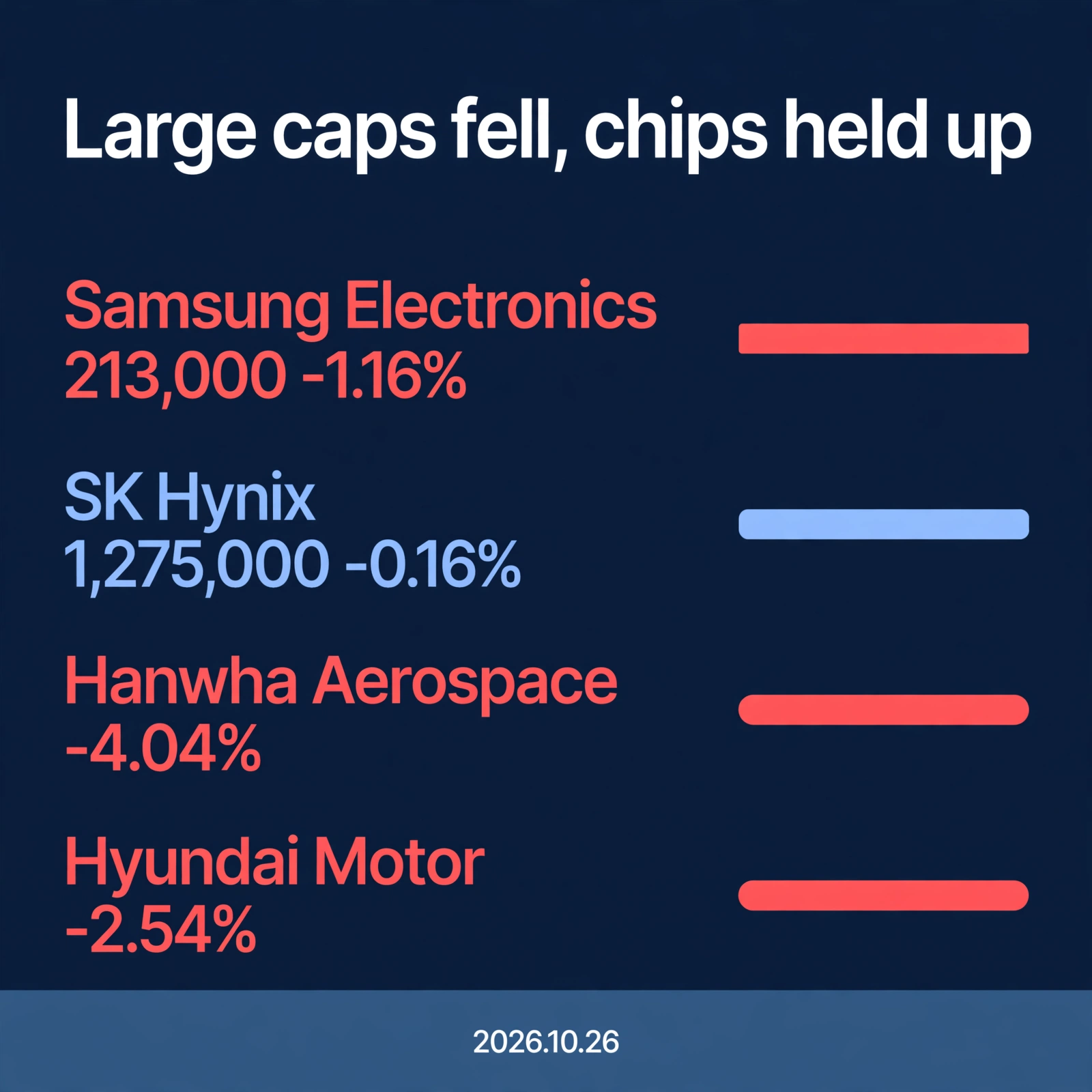
The two chip giants fell less than the market. Samsung Electronics declined 1.16% to 213,000 won and SK Hynix declined 0.16% to 1,275,000 won, with SK Hynix rising nearly 3% early in the session on speculation about a large special dividend before giving back all of the gain. Their relative resilience looks like pre-earnings waiting rather than strength: both report this week, so investors are holding judgment.
Elsewhere, the damage was broader. Hanwha Aerospace plunged 4.04% to 760,000 won, KB Financial fell 3.79%, Shinhan Financial fell 2.95%, Hyundai Motor fell 2.54% to 288,000 won, and Celltrion fell 2.26%. By the close, every KOSPI sector had fallen, led by medical and precision instruments (-5.88%), metals (-3.51%), general services (-3.48%), and machinery and equipment (-3.16%). Stock-specific losses were larger still: HD Hyundai Marine Solution plunged 13.7% after third-quarter results missed market expectations, and LIG Defense and Aerospace fell 9.8%, its fifth straight decline, on news that the defense procurement agency is reviewing additional sanctions. In the KOSDAQ, top names mostly fell, including Alteogen (-2.67%), Ecopro (-4.13%), Ecopro BM (-3.45%), and Jusung Engineering (-6.84%), while Robotis (+9.56%) stood out on the upside.
The gainers were defensive or stock-specific: Samsung C&T rose 1.39%, Samsung Life rose 0.61%, Jeju Air rose 0.96% to 5,250 won, and LG Display climbed 2.38% to 7,320 won. Korean government bond yields eased slightly, with the 3-year yield down 1.4 basis points to 3.789% and the 5-year yield down 1.6 basis points to 3.932%, a sign that safety demand moved into bonds even as stocks fell.
Governance lens: what Wednesday’s SK Hynix report really tests
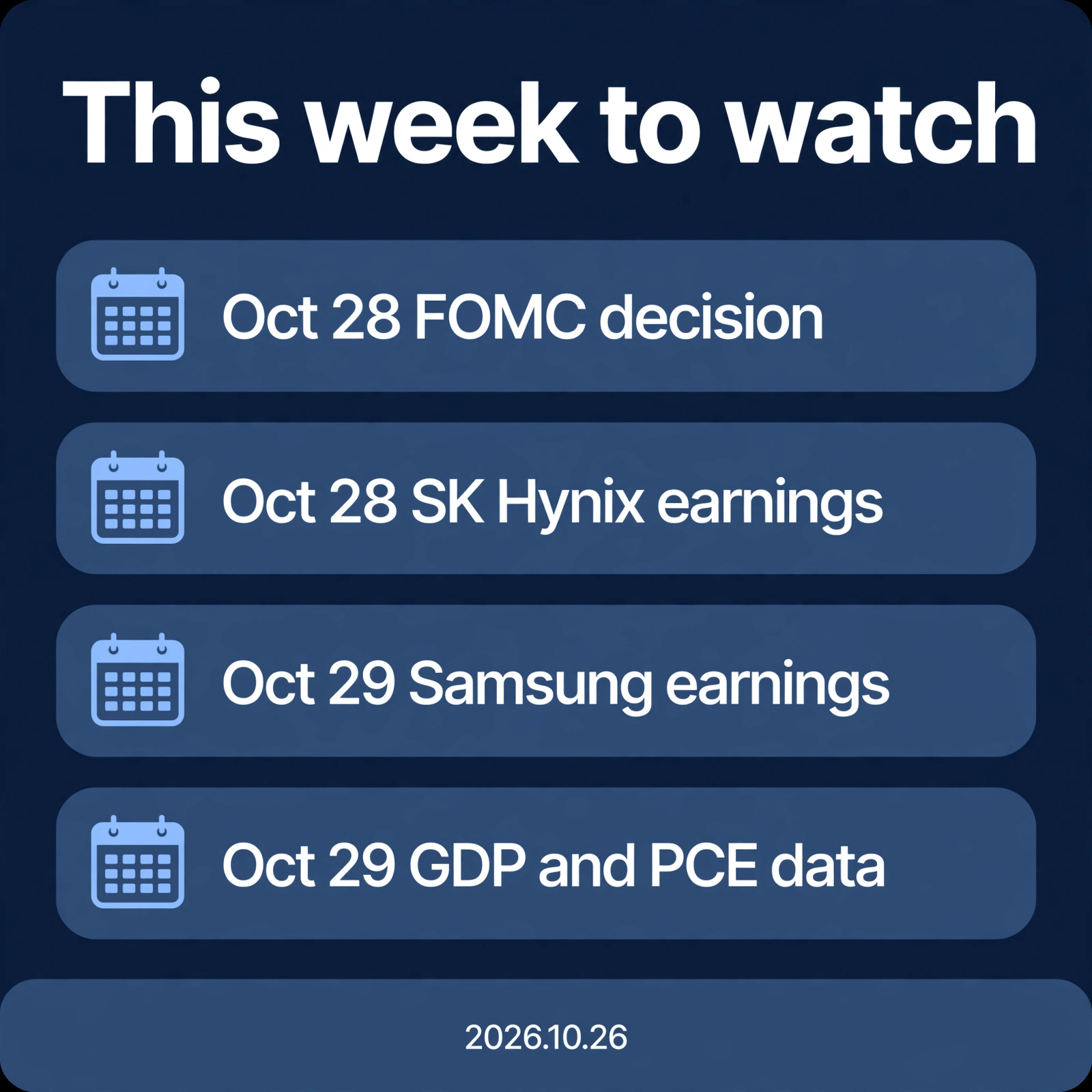
Foreign investors often apply a U.S. logic to Korean earnings: a good quarter should lift the stock. Korea keeps breaking that logic, and this week is the test case. SK Hynix reports third-quarter results on Wednesday, October 28, the same day the U.S. Federal Reserve (the Fed) announces its rate decision and Microsoft and Alphabet report after the U.S. close. Samsung Electronics follows with confirmed third-quarter results on Thursday, October 29, alongside U.S. GDP and PCE inflation data and Amazon’s results.
For SK Hynix, analysts say the market is watching whether additional shareholder-return policies are disclosed, not just the profit figure. That is a governance question, not an accounting one. After SK Hynix withdrew the planned Nasdaq listing of its Solidigm unit, investors expect stronger returns to shareholders as compensation for the changed plan. A strong quarter without a return announcement could still disappoint, while a return announcement could offset a merely good quarter. Daishin Securities researcher Lee Kyung-min summed up the week: the FOMC will likely pass without major incident, and the key is big-tech earnings, Samsung and SK Hynix results, and whether additional shareholder returns are disclosed.
There is also a policy event running in the background. China’s Fifth Plenum, the Communist Party meeting that sets the direction of China’s next five-year economic plan, runs October 26–29. Korea exports heavily to China, so the meeting’s signals on domestic demand and technology policy matter for Korean exporters even though no single-day market move can be tied to it yet.
What to watch this week
Three questions decide whether today’s break below 5,500 is a pause or a new phase. First, does the KOSPI reclaim 5,500 quickly? A fast recovery would frame today as pre-earnings positioning. A failure to reclaim it opens a search for the next support level. Second, does SK Hynix announce additional shareholder returns on Wednesday? Third, does foreign selling stay contained? Domestic institutions absorbed today’s selling, but a foreign outflow above 1 trillion won in a session would put the index under heavier pressure.
For investors who cannot follow Korean-language disclosures in real time, the practical checklist is short: watch the SK Hynix announcement for the shareholder-return language, watch Samsung’s confirmed results on Thursday for memory-price commentary, and watch the won’s daytime close versus its overnight move. Those three readings will tell you more than the daily index level alone.
- Net selling: the amount sold minus the amount bought in a session. Foreign net selling means overseas investors sold more than they bought.
- Program trading: large automated orders triggered by preset conditions. A heavy selling edge from program trades adds downward pressure on the index.
- Nominal effective exchange rate: a currency's value against a basket of trading partners. A rising reading means broad currency strength.
- Fifth Plenum: the fifth plenary session of China's Communist Party Central Committee, which sets the direction of the next five-year plan.
Not investment advice. Figures are from the Korea Exchange, the Seoul foreign exchange market, Yonhap News, and Maeil Business Newspaper, as confirmed on October 26, 2026.
Sources & references
- ET News — KOSPI gives up the 5,500 line for its lowest close since April; KOSDAQ down 3.26% — Oct 26 closing wrap (KRX figures)
- Chosun Biz — [Market View] KOSPI ends below 5,500 as investors await a packed event calendar — Closing indices and the USD/KRW rate
Related articles
- KOSPI 3.48% plunge Alphabet shock sell sidecar semiconductor fall analysis
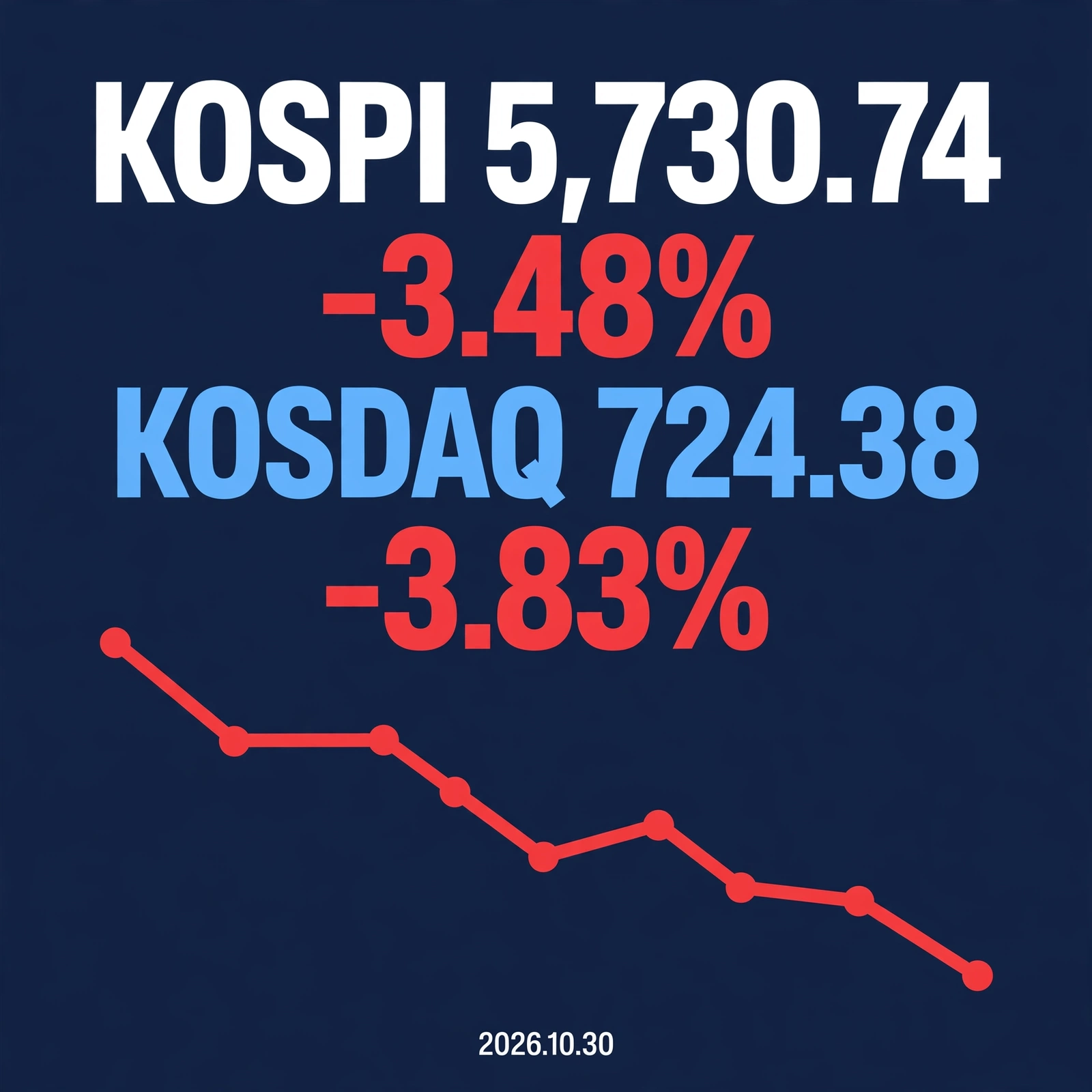
October 30 Korea market brief for foreign investors: the KOSPI fell 3.48% to 5,730.74 and the KOSDAQ fell 3.83% to 724.38 as Alphabet's earnings shock triggered a sell-side sidecar and foreigners sold a net KRW 1.62 trillion ($1.21 billion). Samsung fell 3.02% and SK hynix 7.08%. The won firmed to 1,334.3 per dollar.
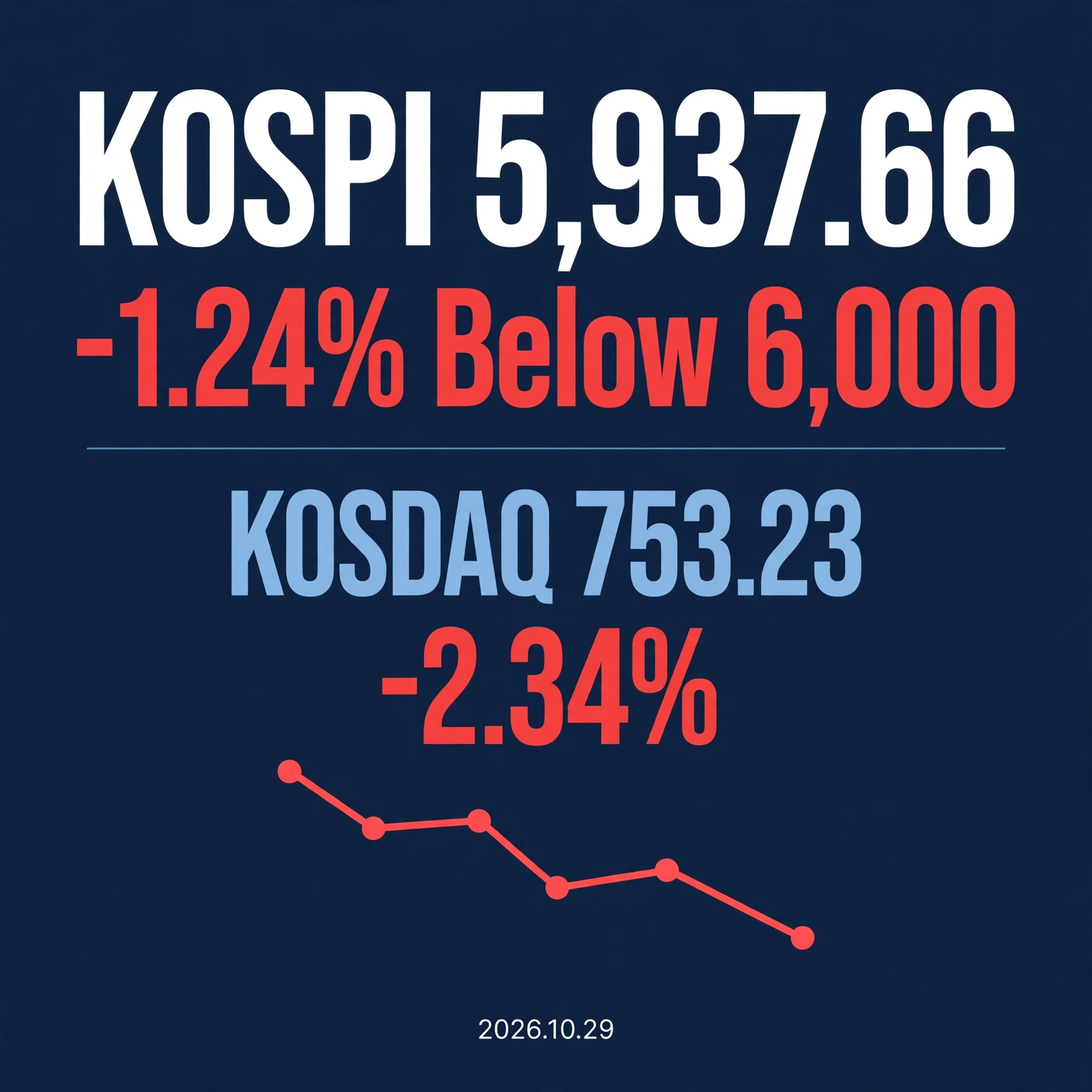
- KOSPI 1.24% fall Samsung shareholder return delay 5937 close analysis
October 29 Korea market brief for foreign investors: the KOSPI fell 1.24% to 5,937.66, giving back the 6,000 line one day after retaking it, and the KOSDAQ fell 2.34% to 753.23. Samsung posted record third-quarter operating profit of KRW 107.44 trillion yet fell 4.13% after deferring shareholder-return details to January, while SK hynix, which spelled out a KRW 100 trillion ($74.8 billion) return plan, rose 2.62%. LG Energy Solution plunged more than 8%. The won firmed to 1,336.8 per dollar.
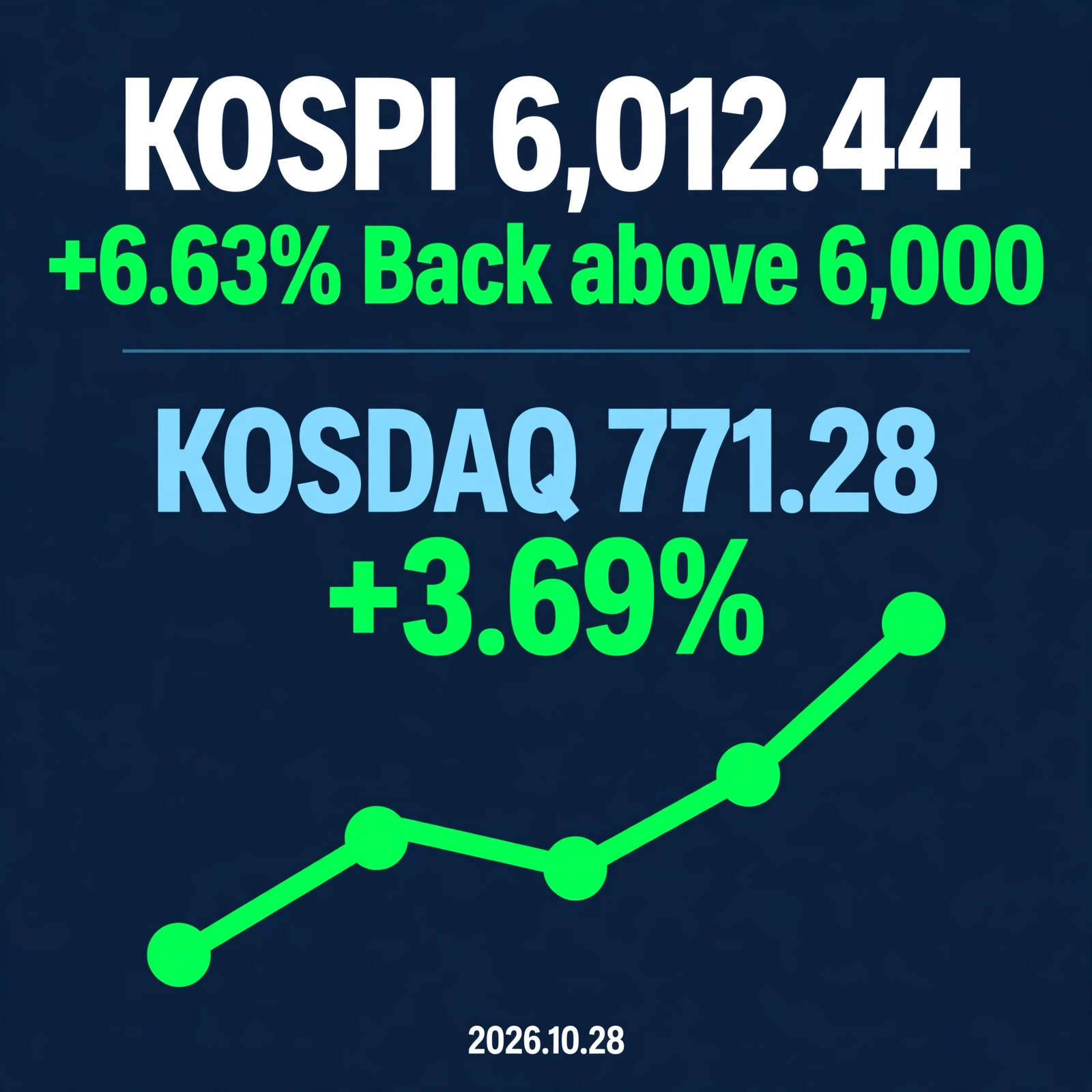
- KOSPI 6.63% surge back above 6000 SK hynix record profit foreign buying
October 28 Korea market brief for foreign investors: the KOSPI jumped 6.63% to 6,012.44, its first close above 6,000 in 10 sessions, after SK hynix posted record third-quarter profit and a KRW 100 trillion shareholder-return plan. Foreigners and institutions bought together for a second day, Samsung rose 9.01% and SK hynix 10.89%. The won weakened to 1,337.7 per dollar.
5minbrief on YouTube
The briefs also come as videos. Get the daily market wrap on YouTube.
Subscribe on YouTube