 5-minute briefs
US Stock Market Weekly Recap S&P 500 Down Dow Up AI Spending Selloff Oil Surge Analysis
#US stocks#weekly recap#S&P 500#Nasdaq#Dow#AI spending#Meta earnings#oil prices#FOMC#Microsoft#Alphabet
Weekly scoreboard: big tech fell, the Dow and small caps rose
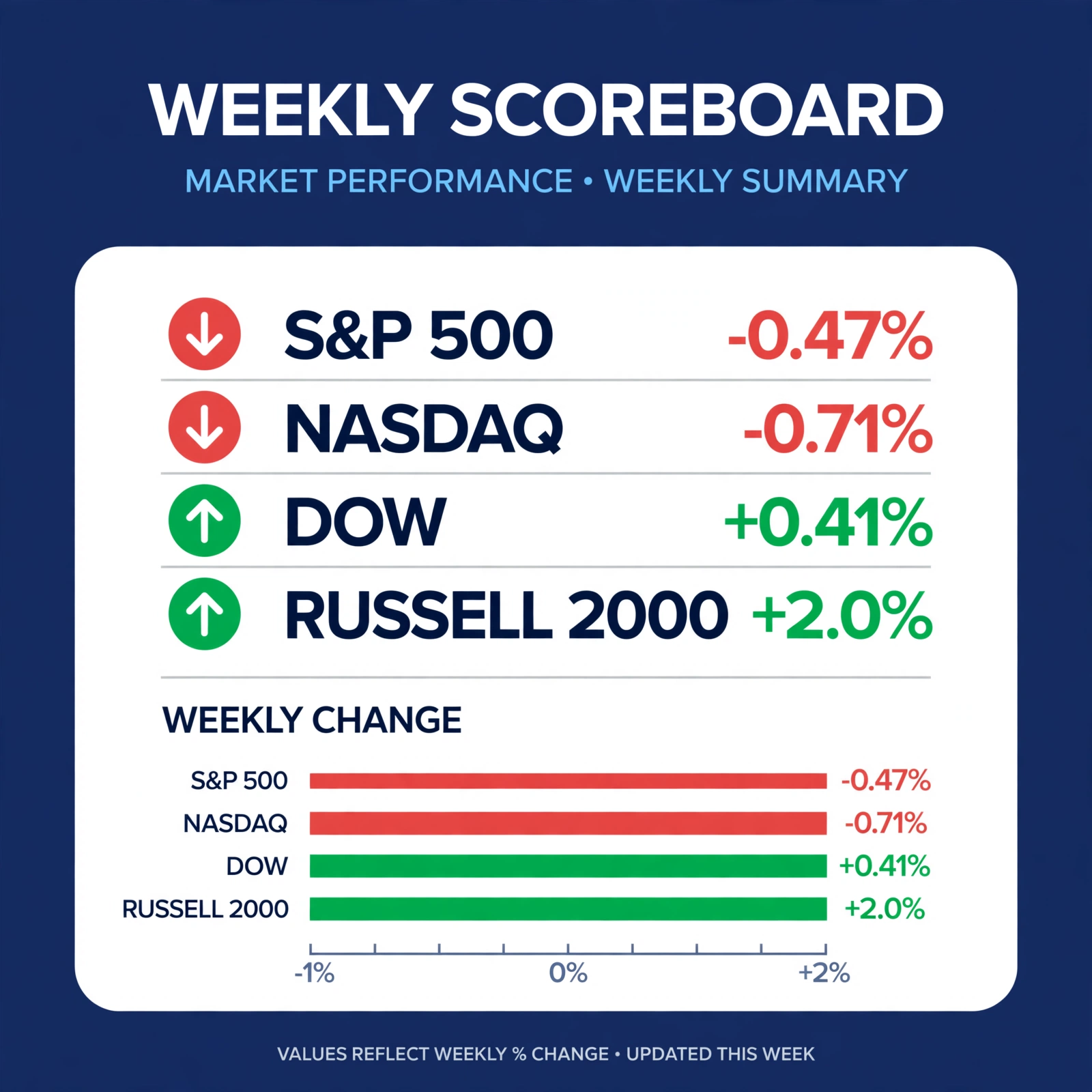
Day by day, the reversal is clear. The S&P 500 rose 0.41% on Monday, 0.28% on Tuesday and 0.58% on Wednesday, reaching a weekly high close of 7,757.17. Then Thursday and Friday gave back more than 133 points, and the week ended in the red.
| Index | Friday close | Weekly change |
|---|---|---|
| S&P 500 | 7,623.68 | -0.47% |
| Nasdaq Composite | 25,955.34 | -0.71% |
| Nasdaq 100 | — | -0.79% |
| Dow | 52,215.16 | +0.41% |
| Russell 2000 | 2,775.90 | +2.0% |
The Dow’s third straight weekly gain and the Russell 2000’s 2.0% rise mean this was rotation, not a market-wide collapse: money moved rather than left. The fear gauge, the VIX, rose to 19.45, and the 10-year Treasury yield at 5.00% added discount-rate pressure on growth stocks. There was no US market holiday this week.
Issue ① Thursday’s AI spending selloff: Meta’s earnings pulled the trigger
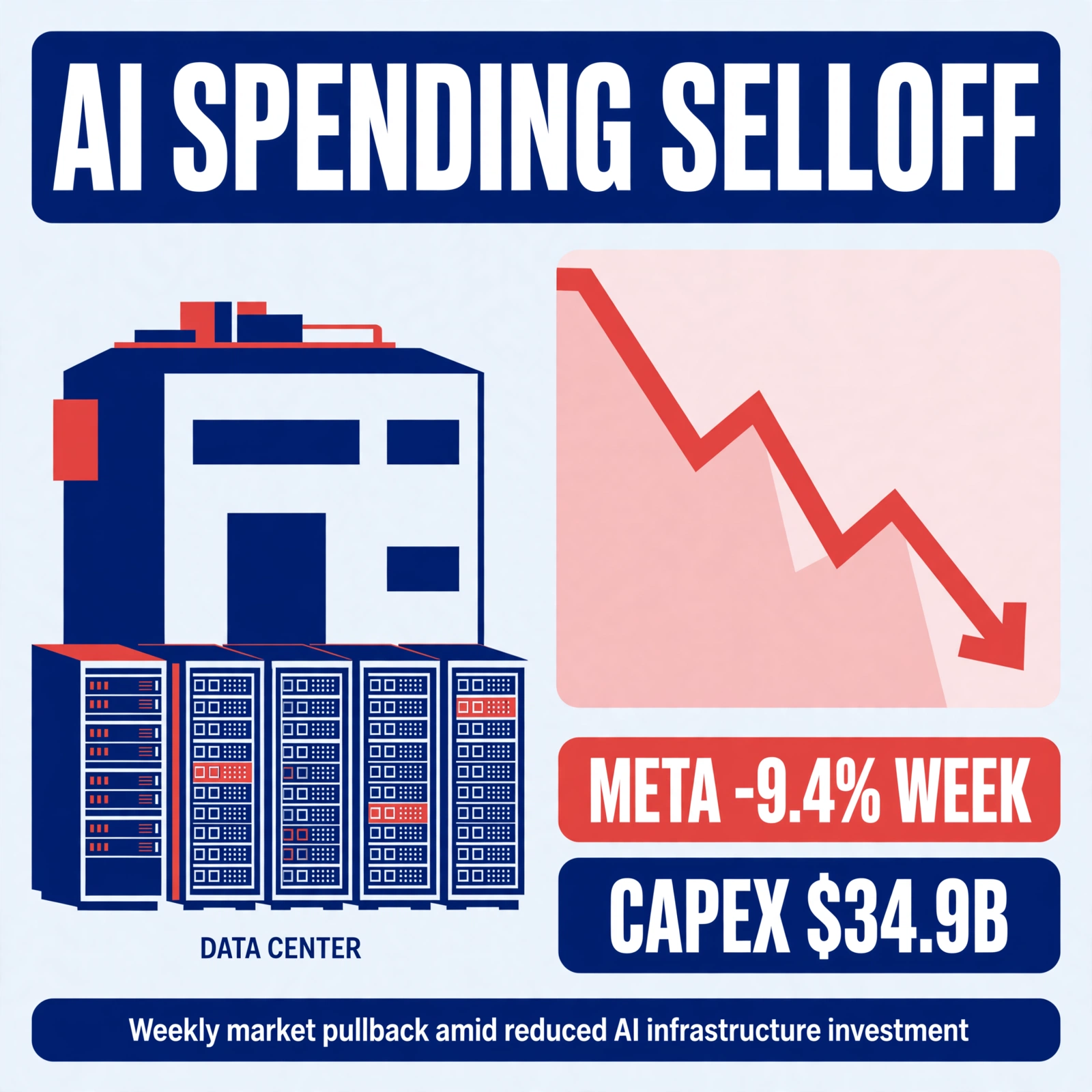
Thursday was the worst day since June. The S&P 500 fell 1.21%, the Nasdaq fell 2.60% and the Philadelphia Semiconductor Index dropped 6.7%. The trigger was Meta’s earnings, released after the close on Wednesday.
Meta’s third-quarter revenue was $64.6 billion (up 26% year over year), beating expectations of about $63.3 billion. The problem sat below that line. Quarterly capital spending reached $34.9 billion, pushing free cash flow to negative $2.12 billion, versus positive $10.63 billion a year earlier. Meta also raised the floor of its 2026 capital spending forecast from $130 billion to $135–145 billion, and unveiled a plan to issue non-voting Class C shares to fund its AI push. Meta shares fell 6.98% on Thursday to $648.85 and 9.4% for the week.
The selling spread to chips. Lam Research and other semiconductor equipment names fell by double digits, and the semiconductor index ended the week down 3.21%. Communication services lost 4.4% for the week, with Alphabet down 6.0% and Netflix down 6.6%. The market’s question shifted from “is there AI demand?” to “when does this spending turn into money?”
Issue ② Good earnings, falling stocks: the surprise paradox
The week’s second repeated pattern was stocks falling despite earnings beats. Western Digital reported revenue of $4.381 billion (+55%) and adjusted earnings per share of $4.64 (+161%), beat expectations and raised next-quarter guidance, yet closed Friday at $343.67 (-2.97%).
The pattern repeated elsewhere. Comfort Systems, a data center cooling company whose order backlog was about double a year earlier, fell 9.3% on Friday and 19.3% for the week. Bloom Energy, which also beat expectations, fell 11.9% on Friday, the worst in the S&P 500 that day.
Three reasons explain it. First, high expectations were already priced into the shares. Second, a 10-year yield at 5.00% cuts the present value of future profits. Third, doubts about the payback on AI spending are growing. Next week’s Microsoft, Alphabet and Amazon reports are the second verdict on that question.
Issue ③ Oil surge: Middle East tension lifted energy stocks
Friday’s other headline was oil. Brent crude rose 3.1% on Friday to $116.72, its highest close since April 29, and 6.2% for the week. West Texas Intermediate rose 3.8% on Friday to $103.27.
The backdrop is rising Middle East tension. Houthi attacks on Saudi energy facilities continued, and a US State Department order to evacuate non-essential diplomatic staff from Saudi Arabia heightened supply disruption fears. No confirmed production outage was reported, but the market is pricing a geopolitical risk premium into oil.
Energy was the standout sector, rising 2.60% on Friday while most other sectors fell more than 1%. NYSE decliners outnumbered advancers by about 1.7 to 1. The Dow fell 652.82 points (-1.23%) on Friday, hurt also by AT&T dropping 7.96% on a report that SpaceX is seeking about 80,000 US cell sites.
Issue ④ The early week was calm: optimism ruled until Wednesday
Judging the week by Thursday alone misses the start. On Monday, a nine-session losing run for chip funds ended, and on Tuesday health care stocks hit a record high. On Wednesday, SpaceX reported its first profit as a public company, and Super Micro Computer rose 9.55% on a raised outlook.
In other words, optimism about earnings season ruled until Wednesday. Meta’s report on Thursday flipped that optimism into an AI funding debate. The week’s lesson is simple: in this market, which groups gain money and which lose it matters more than the direction of the headline index.
- Free cash flow: cash left after operating costs and big investments, the source of dividends and buybacks. Negative means outside funding is needed.
- Capital spending (capex): money spent on assets such as data centers and equipment. In the AI era, its size is the size of a company's future bet.
- Rotation: money moving from one group of stocks to another rather than leaving the market. This week it moved from big tech to small caps and energy.
- Risk premium: extra compensation priced in for uncertainty. In oil, it is the markup for possible supply disruption.
- Discount rate: the rate used to convert future profits into present value. Higher rates shrink the present value of distant profits.
Next week’s checkpoints: Wednesday is super day, Thursday is data day
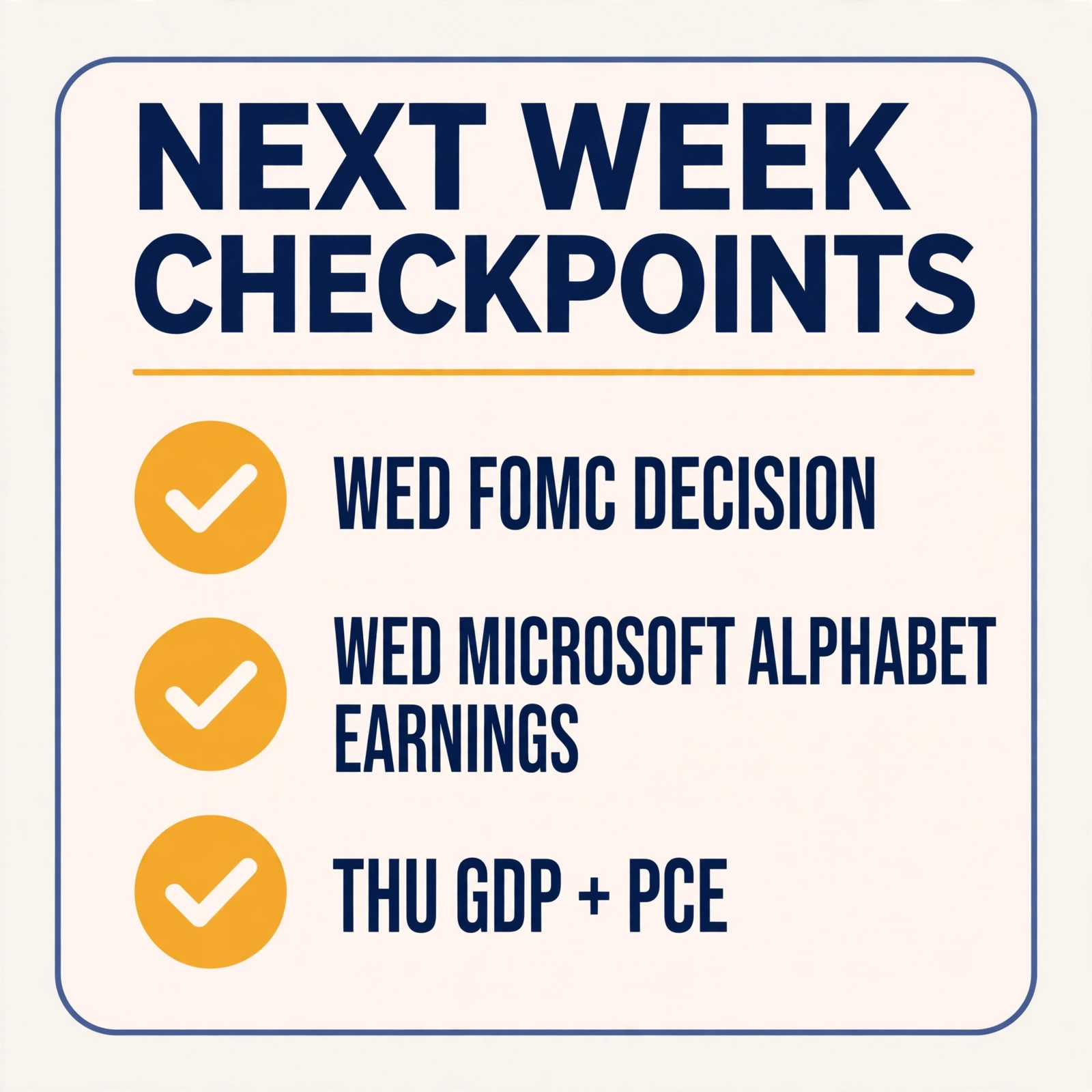
Next week (October 26–30) is different every day. Monday (26th) has no major data release, with Verizon among the reporters. Tuesday (27th) brings consumer confidence, durable goods orders and new home sales, plus Visa, Coca-Cola and Boeing earnings.
Wednesday (28th) is super day. The FOMC announces its rate decision at 2:00 p.m. Eastern Time, followed by a press conference 30 minutes later. This is the first meeting since September’s hike to 3.75–4.00%, and 94 of 100 economists in a Reuters survey expect no change. But with a December hike still possible, a single hint at the press conference could move markets. After the close, Microsoft (fiscal first quarter) and Alphabet (third quarter) report. Watch Azure growth guidance of 45% and quarterly capital spending of about $50 billion.
Thursday (29th) brings the advance estimate of third-quarter GDP (expected +3.0% annualized, versus 2.2% in the second quarter) and September PCE inflation (core expected +3.1% year over year, versus 3.0% in August) at 8:30 a.m. Amazon reports after the close, and Mastercard and Eli Lilly report before the open. Friday (30th) brings the Employment Cost Index and the Chicago PMI (expected 53.0, versus 58.8 in September), plus ExxonMobil, Chevron and AbbVie earnings. Apple reports the following Monday (November 2).
Three questions investors should check next week
First, does Microsoft’s Azure growth reach its 45% guidance? Second, does the FOMC press conference hint at a December hike? Third, does Thursday’s core PCE beat the 3.1% expectation? If two or more answers come back negative, last week’s “fall despite a beat” pattern is likely to continue. If Azure beats guidance and PCE lands as expected, the market gets evidence that AI spending can pay back. Oil remains a wild card: if Brent crude at $116.72 holds, headline inflation pressure could carry through PCE and into the November 10 CPI.
Sources & references
- Reuters (via The Circuitry) — Dow falls 653 points as Brent crude settles at its highest since April — Friday closes and weekly index moves
- Meta Platforms (SEC 8-K Exhibit 99.1) — Third Quarter 2026 Results — Meta Q3 revenue, capex, free cash flow and full-year capex outlook (primary source)
Related articles
- US Market Close Analysis FOMC Holds Rates at 3.75–4.00% in 10-2 Vote as Microsoft and Alphabet Earnings Split (October 29)
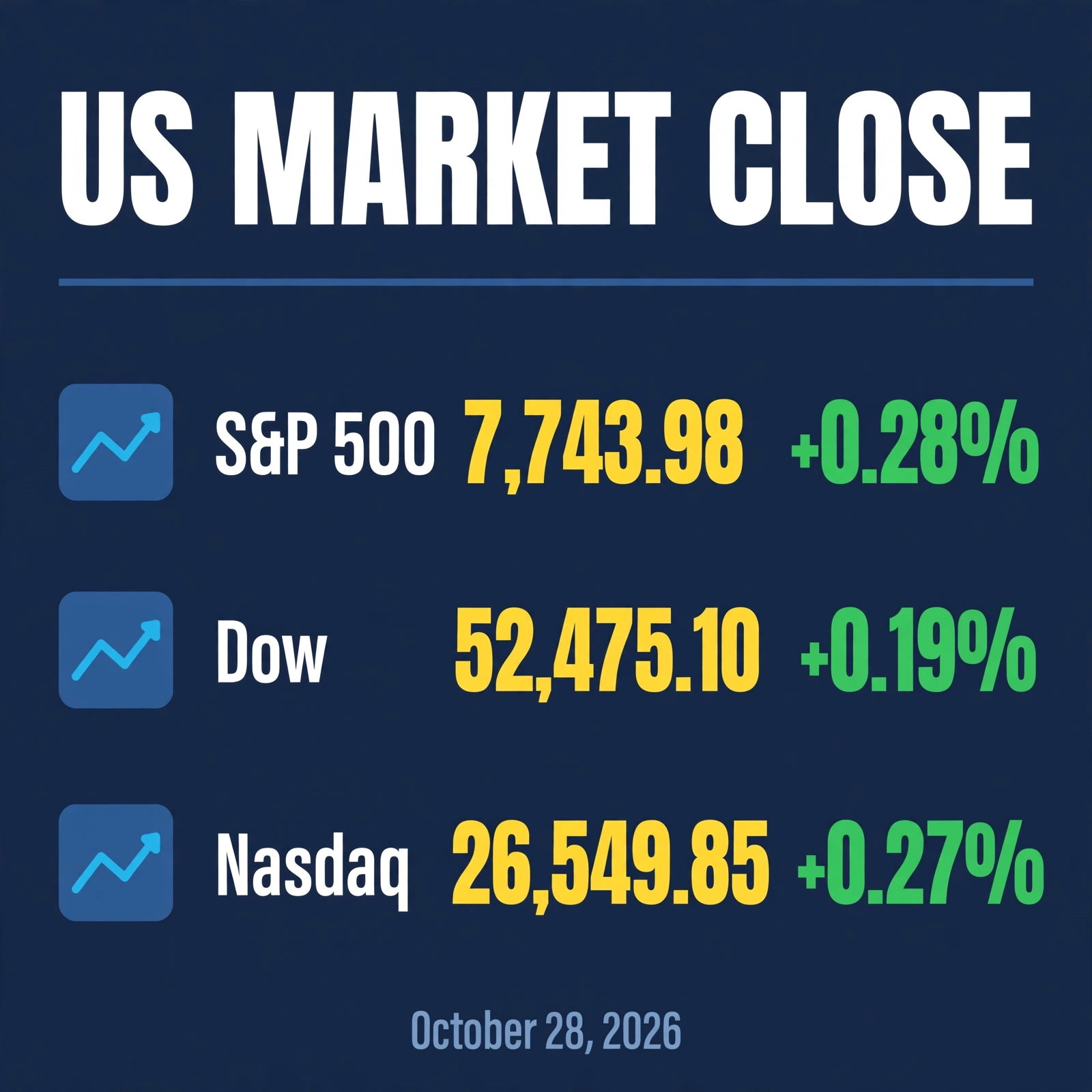
Wednesday, October 28 US close: S&P 500 7,743.98 (+0.28%), Dow 52,475.10 (+0.19%), Nasdaq 26,549.85 (+0.27%). The Fed held rates at 3.75–4.00%, and after the close Microsoft beat estimates while Alphabet's net income fell sharply.
- US Market Close Analysis Nasdaq -1.38% Alphabet -12.6% Plunge GDP 3.4% PCE 3.6% (October 30)
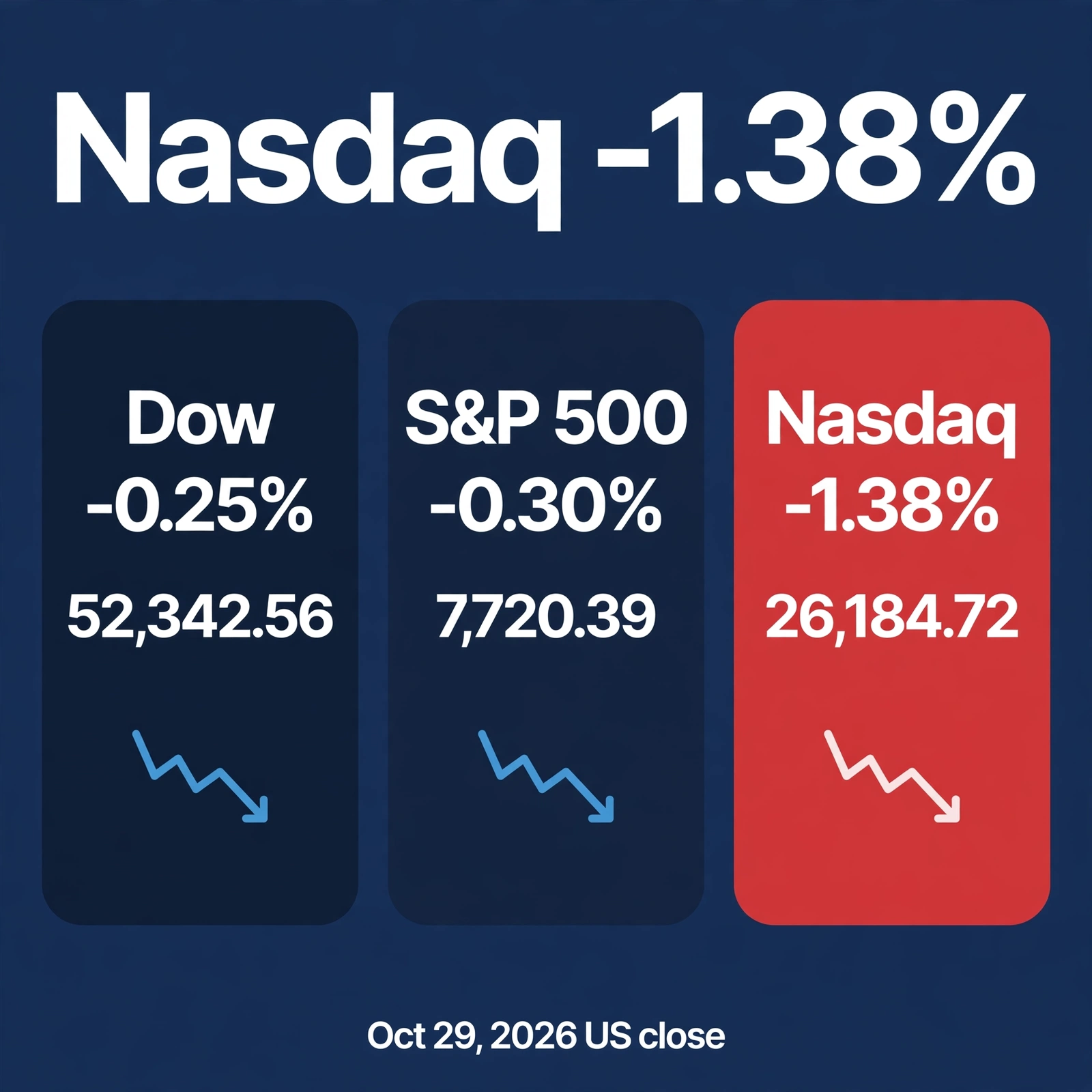
October 29 US close: Dow 52,342.56 (-0.25%), S&P 500 7,720.39 (-0.30%), Nasdaq 26,184.72 (-1.38%). Alphabet plunged 12.6%, ending a three-day winning streak, as Q3 GDP of 3.4% met September PCE of 3.6%. Amazon and Intel fell further after hours.
- US Stock Market Weekly Recap Nasdaq Falls 3.4 Percent Thursday AI Rout and Correction Analysis
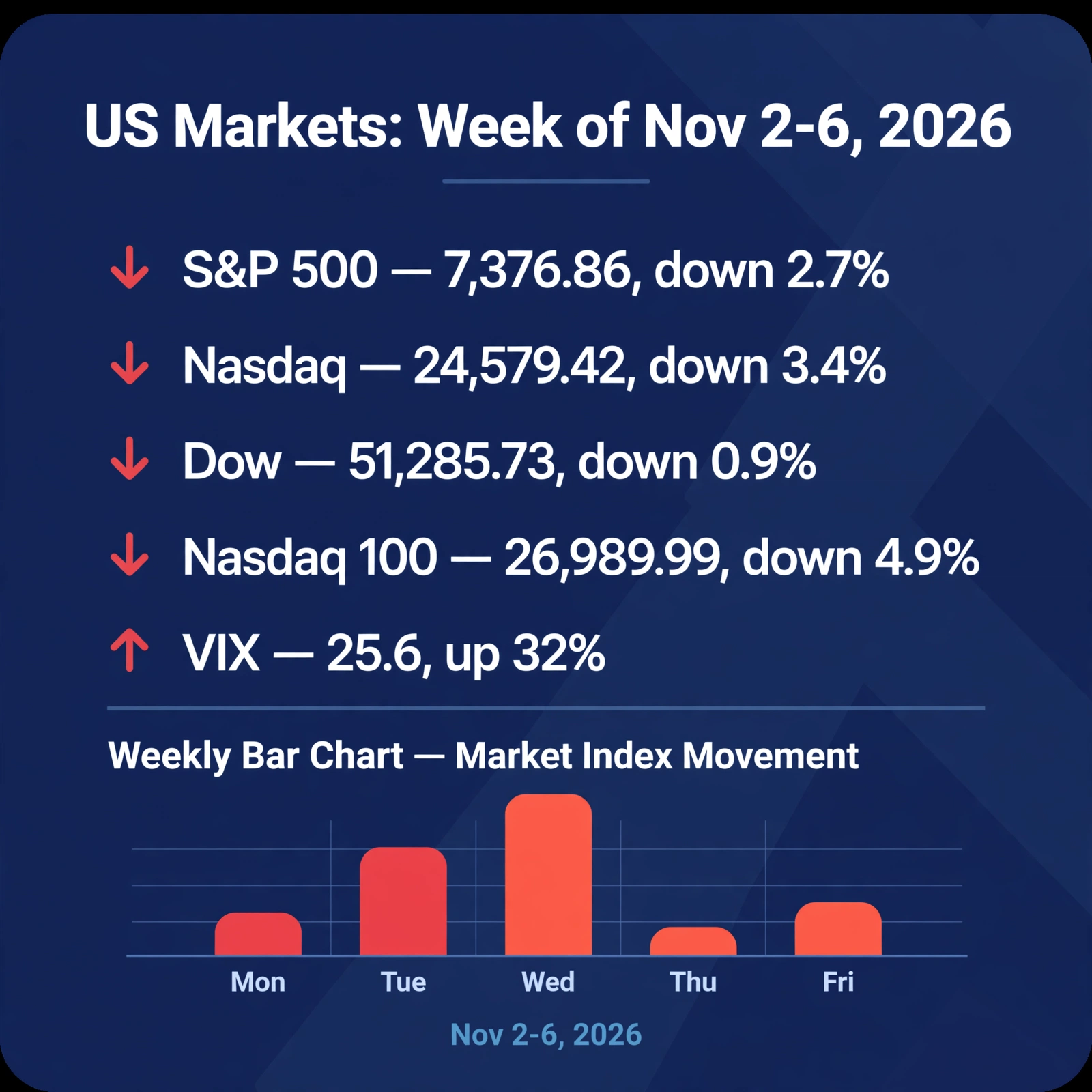
US stock market weekly recap for November 2–6. The S&P 500 fell 2.7%, the Nasdaq 3.4% and the Dow 0.9%, and Thursday's AI sell-off pushed the Nasdaq into correction territory. Midterms, the jobs report and the Hormuz oil plunge, plus next week's CPI and PPI checkpoints.
5minbrief on YouTube
The briefs also come as videos. Get the daily market wrap on YouTube.
Subscribe on YouTube