 5-minute briefs
Korea stocks selloff chaebol market cap loss won strength foreign investors analysis
#Korea stocks#KOSPI#foreign selling#EWY
Sunday holiday — Friday’s close at a glance
Korea does not trade on weekends, so Friday, October 23 is the latest session. The KOSPI rose 16.53 points (0.30%) to 5,550.30, recovering from an intraday slide toward the 5,300 level in a V-shaped session. Foreigners sold roughly ₩1 trillion while institutions bought about ₩870 billion, absorbing the flow. The KOSDAQ fell 12.41 points (1.62%) to 751.69.
The weekly picture was weaker. The KOSPI fell 117.75 points (2.08%) from October 16, and the KOSDAQ dropped 43.09 points (5.42%). For the week, retail investors bought a net ₩1.12 trillion, foreigners sold a net ₩705.9 billion, and institutions bought a net ₩421.8 billion. The won ended the week at 1,324.6 per dollar, up 0.4 won on the day.
| Index | Close | Day | Week |
|---|---|---|---|
| KOSPI | 5,550.30 | +0.30% | -2.08% |
| KOSDAQ | 751.69 | -1.62% | -5.42% |
| USD/KRW | 1,324.6 | +0.4 won | Two-year won high |
About ₩1,101 trillion wiped out in a month — SK hit hardest
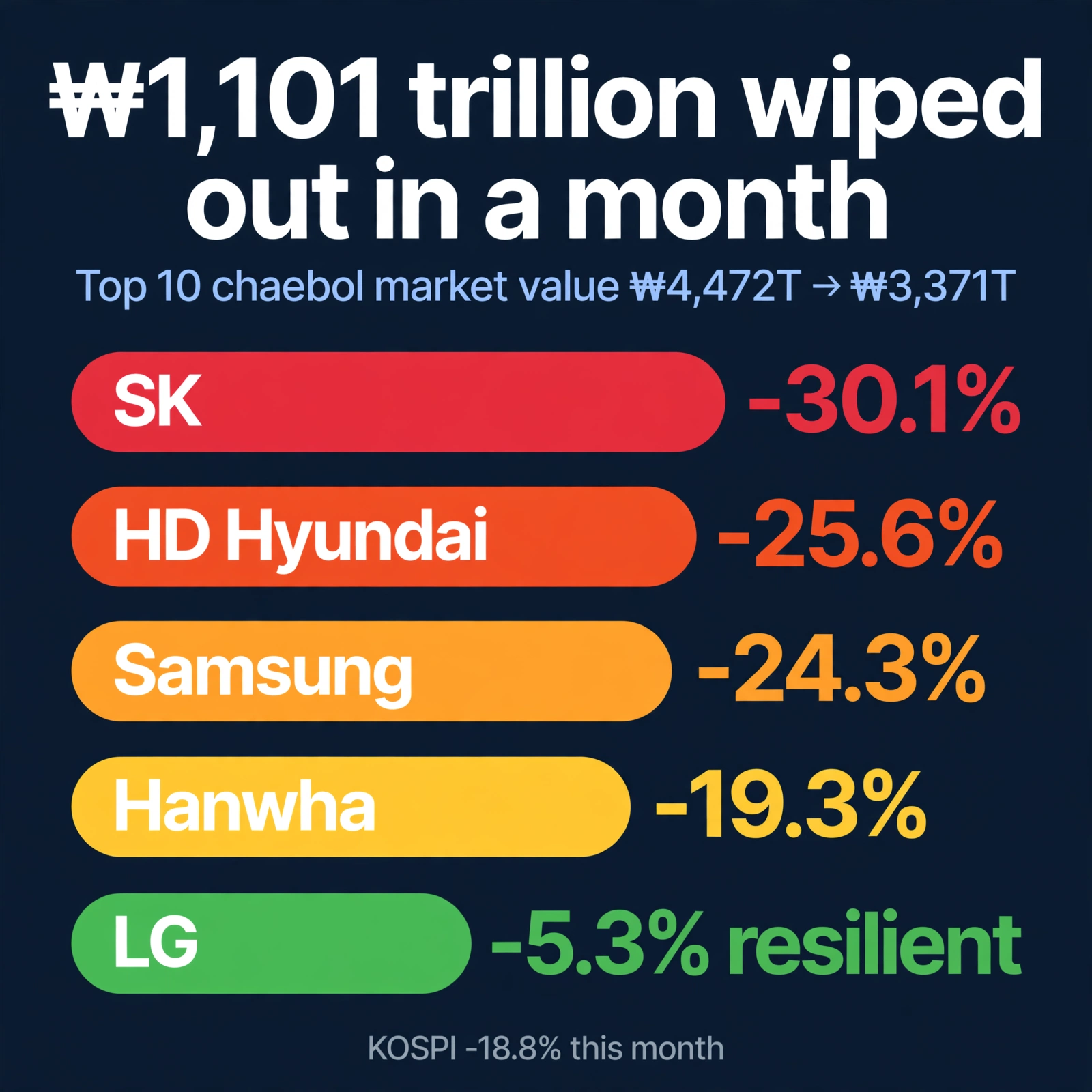
Data from the Korea Exchange and FnGuide put the top 10 groups’ combined market value at about ₩3,371.44 trillion as of October 23, down about ₩1,101 trillion from about ₩4,472.53 trillion at the end of September. The KOSPI has fallen 18.8% this month, and all ten groups lost value.
SK Group lost the most. Its market value fell 30.1%, from ₩1,563 trillion to ₩1,093 trillion, as SK Hynix and SK Square fell 28.1% and 32.0% this month on worries about AI value-chain profitability. The two companies lost ₩365 trillion and ₩48 trillion in market value respectively. HD Hyundai fell 25.6% (from ₩128 trillion to ₩95 trillion) as shipbuilding stocks slid on peak-cycle fears; HD Hyundai Heavy Industries fell 30% and HD Hyundai 32% this month.
Samsung Group fell 24.3% (from ₩2,161 trillion to ₩1,636 trillion) as Samsung Electronics’ market value dropped 19.6%, from ₩1,570 trillion to ₩1,260 trillion. Hanwha fell 19.3% (from ₩120 trillion to ₩97 trillion), hurt by won strength squeezing exporters’ won-converted earnings; Hanwha Aerospace fell 21.4% and Hanwha Ocean 30%.
The resilient names are instructive. LG Group fell only 5.3% (from ₩190 trillion to ₩180 trillion) as LG Energy Solution rose 7.3% this month on energy-storage demand tied to US AI data centers. POSCO Group fell just 6.4% (from ₩540 trillion to ₩505 trillion).
Foreigners sold roughly ₩40 trillion — yet the won strengthened
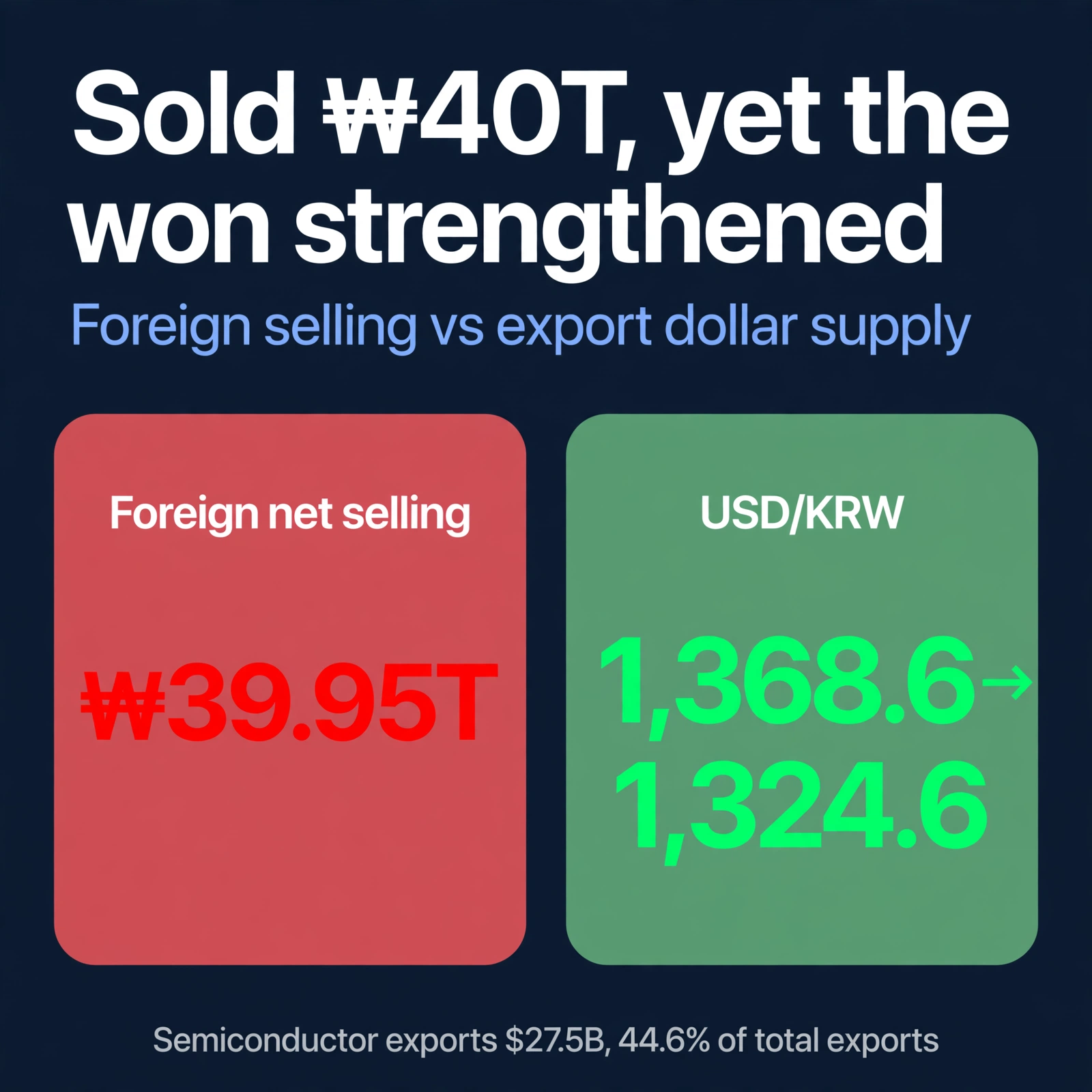
Here is the paradox global investors keep getting wrong about Korea. Foreigners sold a net about ₩39.95 trillion (roughly $30 billion) on the main board from September 1 to October 23 — ₩21.59 trillion in September and ₩18.36 trillion so far in October. Normally, foreign selling creates dollar demand as proceeds are converted out of won, pushing the exchange rate up.
Instead, the won strengthened. The rate fell from 1,368.6 at the end of August to 1,324.6, a 44-won gain, touching 1,324.2 on October 22, its strongest since October 2024. Dollar supply from exports overwhelmed the selling.
The source of those dollars is semiconductors. Customs data show exports of $61.6 billion in October 1–20, of which semiconductors were $27.5 billion, or 44.6% of the total. Daily average exports hit a record $4.74 billion. Exporters convert those dollars into won at home, flooding the foreign-exchange market. The current account tells the same story: an $46.11 billion surplus in August, the second-largest on record, with three straight months above $40 billion and a full-year surplus expected above $450 billion.
The Bank of Korea (BOK), South Korea’s central bank, is signaling tolerance. Governor Shin Hyun-song told parliament on October 23 that there is “sufficient room for the won to strengthen further” and that additional won strength would be “appropriate” for economic balance and domestic activity. Markets read that as a green light for a stronger won.
Forecasts lean the same way. Eugene Investment’s Cha Young-hoo sees the won’s floor forming below 1,300, with a 2026 range of 1,250–1,420. Caveats remain: dollar strength could return around the US Federal Open Market Committee (FOMC) meeting, and month-end dollar supply could push the rate lower still. The tug-of-war between foreign selling and export dollars decides next week’s won direction.
The tightening bill — delinquencies at a near-decade high, BOK dilemma
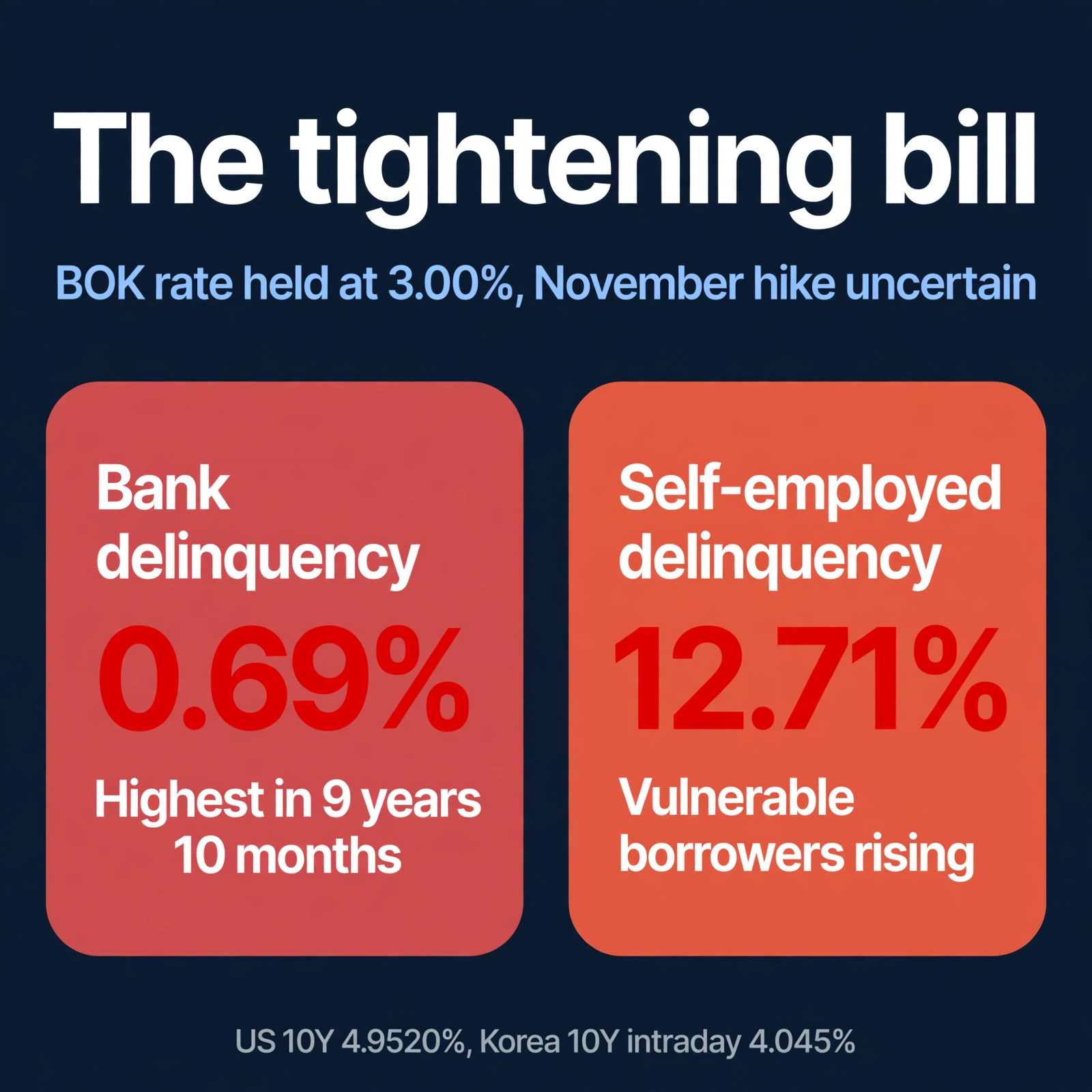
Rate hikes are now showing up as credit stress. The Financial Supervisory Service reports bank loan delinquency at 0.69%, the highest in 9 years and 10 months. Delinquency among vulnerable self-employed borrowers reached 12.71%, and delinquency is rising for small businesses and household credit loans too. The regulator warned that delinquency could keep rising in vulnerable segments and urged banks to build loss-absorbing capacity and clean up bad loans.
The backdrop is the BOK’s tightening stance. The bank held its policy rate at 3.00% this month after two hikes, saying it would monitor their impact while keeping a tightening bias. The pain accumulates with a lag: rates already raised keep feeding into repayment burdens even while the policy rate stands still, and the possibility of another hike keeps that burden in focus.
Globally, rates moved the other way. Doubts about AI investment returns drove safe-haven flows: the US 10-year Treasury yield fell 19.40 basis points on October 22 to 4.9520%, below 5% for the first time since September 23, and the 2-year yield fell 18.50 basis points to 4.6380%. Korean yields followed. The 10-year Korean Treasury bond yield fell intraday to 4.045% on October 23, its lowest since May 26, and the 3-year yield hit 3.755%, its lowest since August 27.
Governor Shin is threading a needle. He told parliament that AI investment could structurally lift Korea’s growth potential and promised to publish the bank’s own potential-growth estimate this year, while stressing that price stability is a medium-term goal. Markets read two signals at once: the growth-potential emphasis as room to delay, the price-stability emphasis as a reason to keep hiking on the table. Brokerages and foreign investment banks still expect a November hike, but note that with two pre-emptive hikes already done, rising global uncertainty could push the timing back. French fiscal worries are adding to safe-haven demand.
What to watch next week:
- US FOMC (October 27–28) — the rate decision and press-conference hints.
- Microsoft, Alphabet and Amazon earnings — the next test of AI capital-spending durability, which feeds directly into Korean chip sentiment.
- SK Hynix Q3 earnings (October 28) — whether stronger shareholder returns follow the Solidigm IPO withdrawal. Shares rose 4.42% Friday to ₩1,277,000.
- China’s Fifth Plenum (October 26–29) — Beijing’s medium-term economic direction, relevant for Korea’s exporters.
- US September S&P Global manufacturing and services PMI — a read on US economic health.
Not investment advice. Figures from the Korea Exchange, FnGuide, Seoul foreign-exchange market, Korea Customs Service, Bank of Korea, Financial Supervisory Service and Yonhap, verified October 25, 2026.
Sources & references
- Yonhap News — Top-10 groups shed over ₩1,100 trillion in market cap in a month on the KOSPI rout (via Supple) — Original report on KRX/FnGuide tallies
- ET News — Bank won-loan delinquency rate hits 0.69%, highest in 9 years 10 months — Report of the FSS release (Oct 23) on bank delinquency
- ET News — KOSPI reverses to close up 0.3% at 5,550.30; SK hynix jumps over 4% — Basis for the Friday closing figures cited in this post
Related articles
- KOSPI 3.48% plunge Alphabet shock sell sidecar semiconductor fall analysis
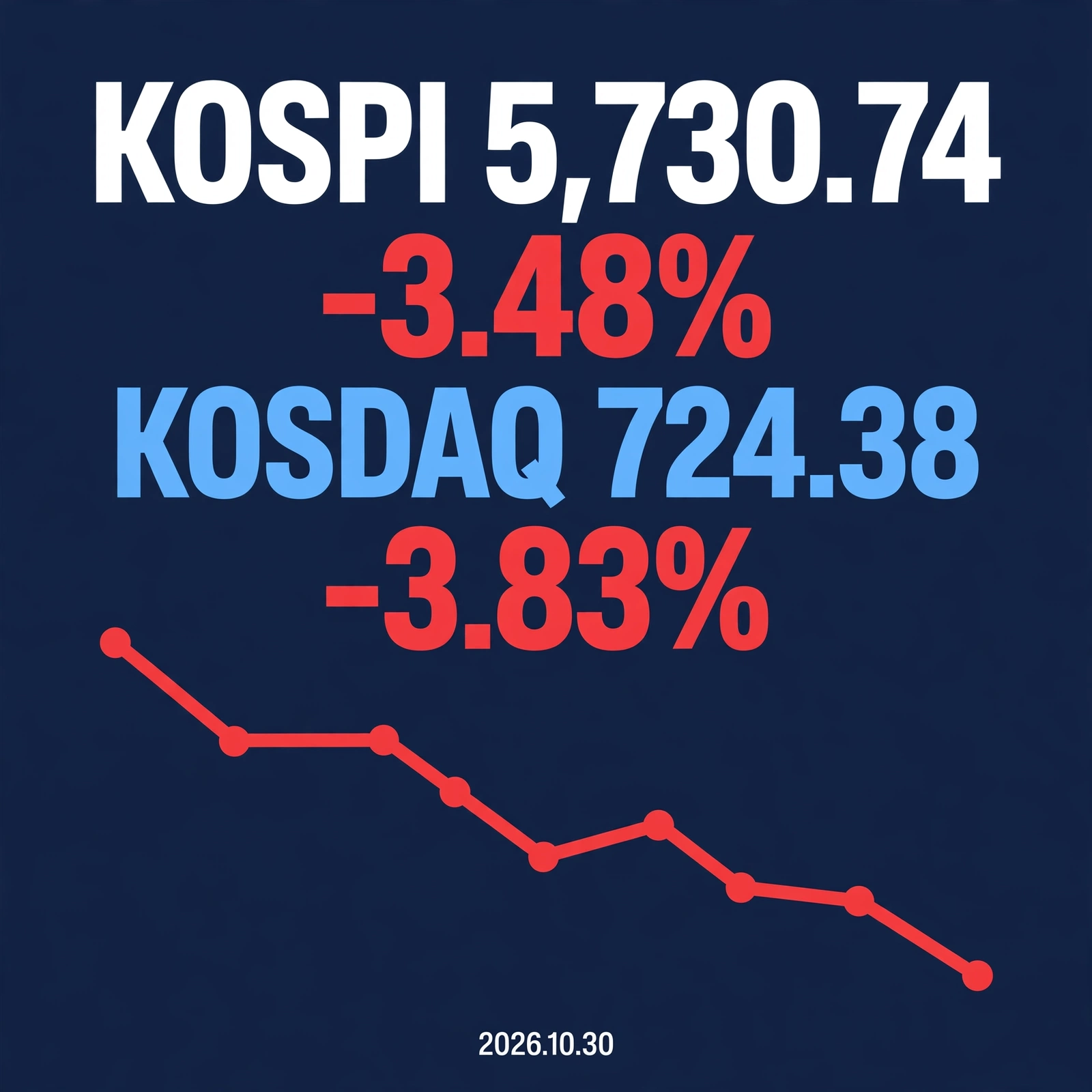
October 30 Korea market brief for foreign investors: the KOSPI fell 3.48% to 5,730.74 and the KOSDAQ fell 3.83% to 724.38 as Alphabet's earnings shock triggered a sell-side sidecar and foreigners sold a net KRW 1.62 trillion ($1.21 billion). Samsung fell 3.02% and SK hynix 7.08%. The won firmed to 1,334.3 per dollar.
- KOSPI Rebound Analysis 2.24% Rally Institutional Buying Low PBR First Day
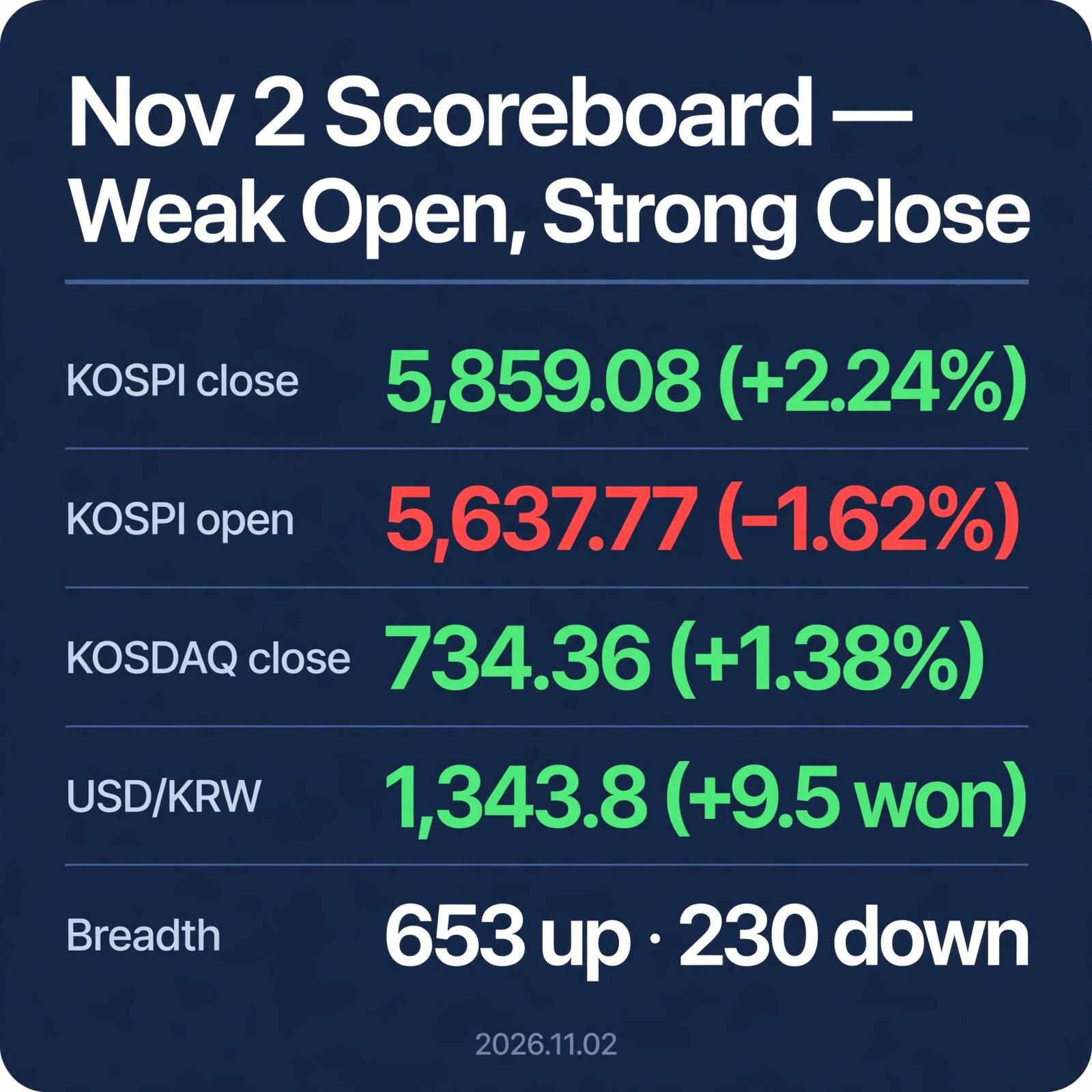
November 2 Korea market brief for foreign investors: the KOSPI opened down 1.62% on the US chip selloff, then rallied 2.24% to 5,859.08 on institutional buying and a strong first day for the low-PBR name list. Foreigners sold a net 373.1 billion won overall but bought Samsung Electronics.
- China PMI Contraction Korea Export Impact Analysis Manufacturing 49.3 Intermediate Goods Demand
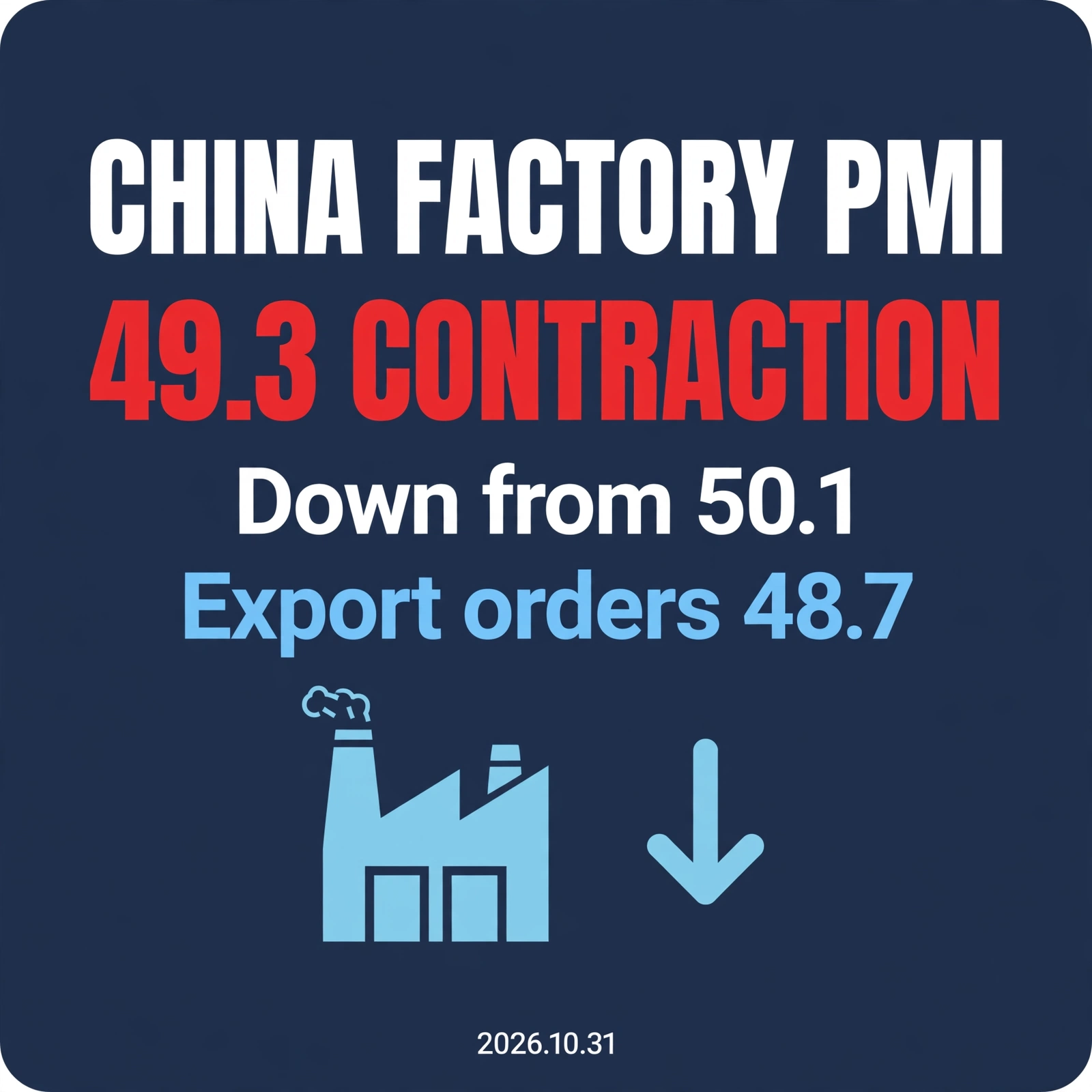
China's October manufacturing PMI fell to 49.3, back into contraction after one month of expansion. For foreign investors in Korea, the number that matters is new export orders at 48.7 — the channel through which a Chinese slowdown reaches Korean intermediate-goods exporters — set against resilient high-tech manufacturing at 51.3.
5minbrief on YouTube
The briefs also come as videos. Get the daily market wrap on YouTube.
Subscribe on YouTube