 5-minute briefs
Are Korean chaebol stocks actually cheap after the selloff valuation traps
#Korea discount#foreign selling
How cheap did they get — the one-month damage
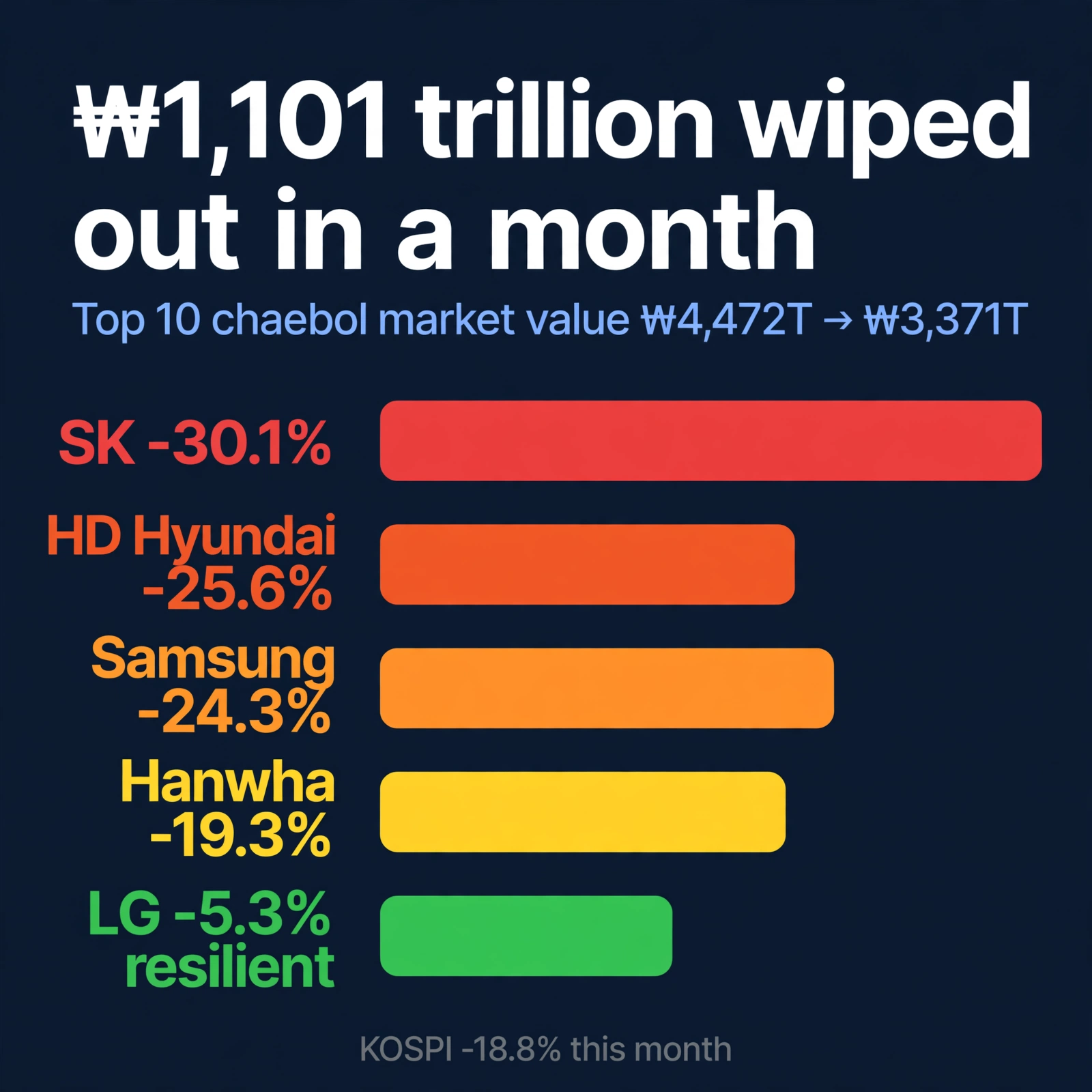
The starting point is the October 23 tally from the Korea Exchange and FnGuide. The top 10 groups’ combined market value fell from about ₩4,472.53 trillion at the end of September to about ₩3,371.44 trillion, a drop of about ₩1,101 trillion. The KOSPI fell 18.8% this month.
By group: SK fell 30.1% (from ₩1,563 trillion to ₩1,093 trillion), HD Hyundai 25.6% (from ₩128 trillion to ₩95 trillion), Samsung 24.3% (from ₩2,161 trillion to ₩1,636 trillion), and Hanwha 19.3% (from ₩120 trillion to ₩97 trillion). LG fell only 5.3% (from ₩190 trillion to ₩180 trillion) and POSCO only 6.4% (from ₩540 trillion to ₩505 trillion).
At the stock level: SK Hynix and SK Square fell 28.1% and 32.0% this month, HD Hyundai Heavy Industries 30% and HD Hyundai 32%. Samsung Electronics’ market value fell 19.6%, from ₩1,570 trillion to ₩1,260 trillion. The exception was LG Energy Solution, up 7.3% this month on energy-storage demand tied to US AI data centers.
What 1.10x PBR really means — historic low, three traps
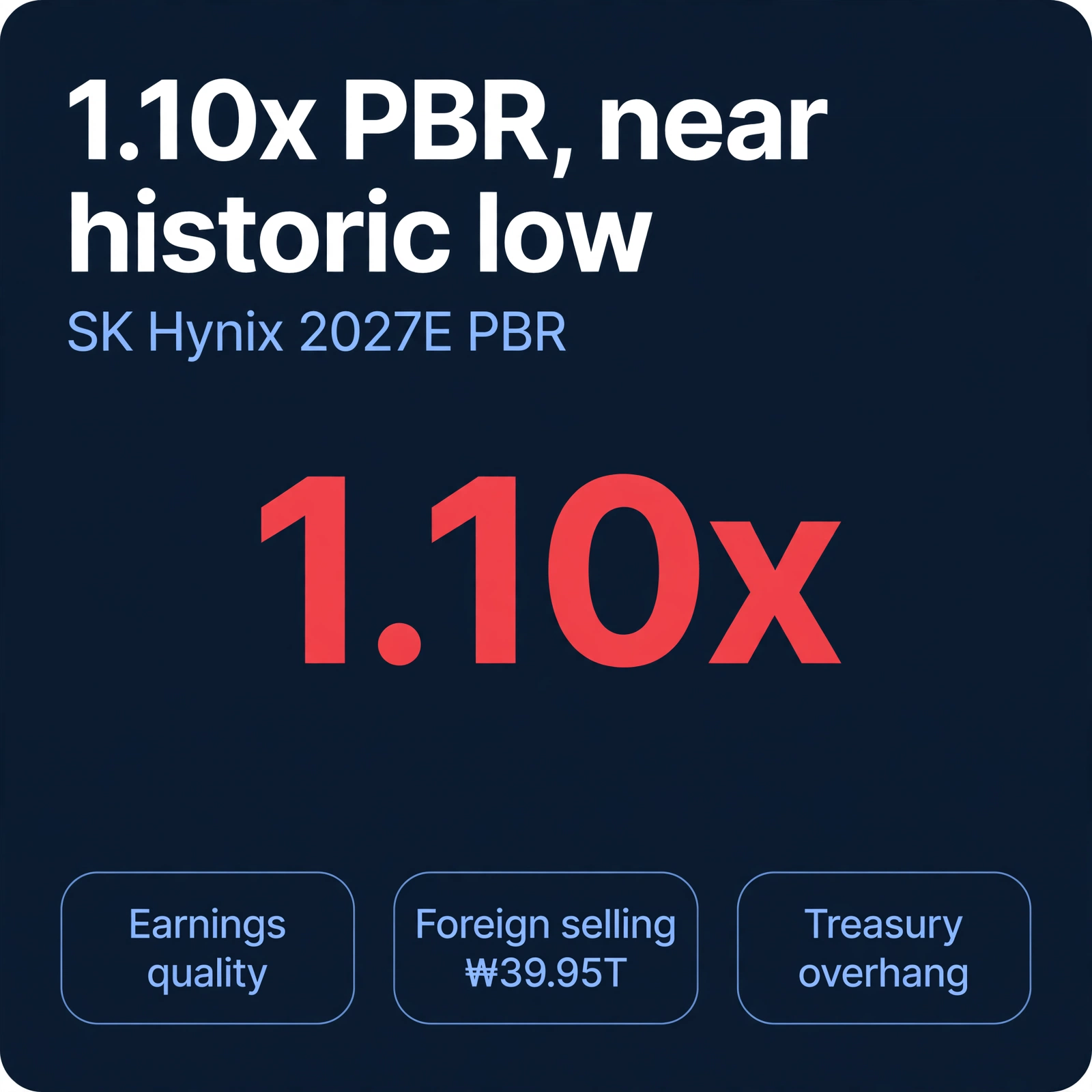
Meritz Securities puts SK Hynix’s 2027 estimated PBR at 1.10x, near a historic low. Near-trough valuation plus solid cash generation from the core business is fueling rebound hopes. Shares rose 4.42% Friday to ₩1,277,000 after the company withdrew the Solidigm IPO plan.
But three Korea-specific traps apply to cheap multiples here.
First, earnings quality. This is why a PER of 8x is not automatically cheap in Korea. Circular shareholdings inflate book values, one-off gains flatter earnings, and structurally low payout ratios (20–22%) mean book value does not reliably convert into shareholder cash. A high book value is not a promise of cash returns.
Second, the foreign-selling overhang. Foreigners sold a net about ₩39.95 trillion (roughly $30 billion) on the main board from September 1 to October 23. Cheap valuation alone does not stop selling. Until that flow stabilizes, cheap can stay cheap for a long time.
Third, treasury-share overhang. When free float is small relative to shares outstanding and treasury shares are large, potential treasury disposals cap the share price. Conversely, buybacks and cancellations are the most direct form of shareholder return. SK Hynix recently completed a ₩40 trillion buyback program. What comes next is the key to any re-rating.
What would close the discount — October 28 is the first test

Cheap stocks get expensive again only when the reasons for the discount fade one by one. The first test is SK Hynix’s Q3 earnings briefing on October 28. Meritz expects a concrete, strengthened shareholder-return plan that beats market expectations, and many analysts see the return plan — more than earnings themselves — deciding the share price.
The second condition is resolution of the AI-spending debate. If Microsoft, Alphabet and Amazon confirm capital-spending plans next week, profitability worries over Korean chip stocks could ease. The third is the won. At 1,324.6 per dollar, a two-year high, won strength pressures exporters’ won-converted earnings, and forecasts see room below 1,300 — which would force earnings estimates for exporters to be reworked.
The checklist:
- October 28 SK Hynix earnings and returns — any additional trillion-won-scale buyback and cancellation.
- Big Tech earnings and CAPEX guidance — whether the AI profitability debate cools.
- Foreign flow reversal — whether the ₩39.95 trillion selling wave slows.
- Won direction — a break below 1,300 would require rethinking exporter earnings.
Not investment advice. Figures from the Korea Exchange, FnGuide, Meritz Securities, Bank of Korea and Yonhap, verified October 25, 2026.
Watch the video

Sources & references
- Yonhap News — Top 10 Groups Lose ₩1,101 Trillion in Market Value in a Month — Korea Exchange and FnGuide tally
- EToday — SK Hynix Rebounds 4.42% as Solidigm IPO Is Shelved (Meritz Securities analysis) — Meritz Securities PBR estimate and Friday's close
- Hans Economy — Won Strengthens Despite ₩40 Trillion of Foreign Selling — Foreign net selling (KRX) and the won-dollar rate
Related articles
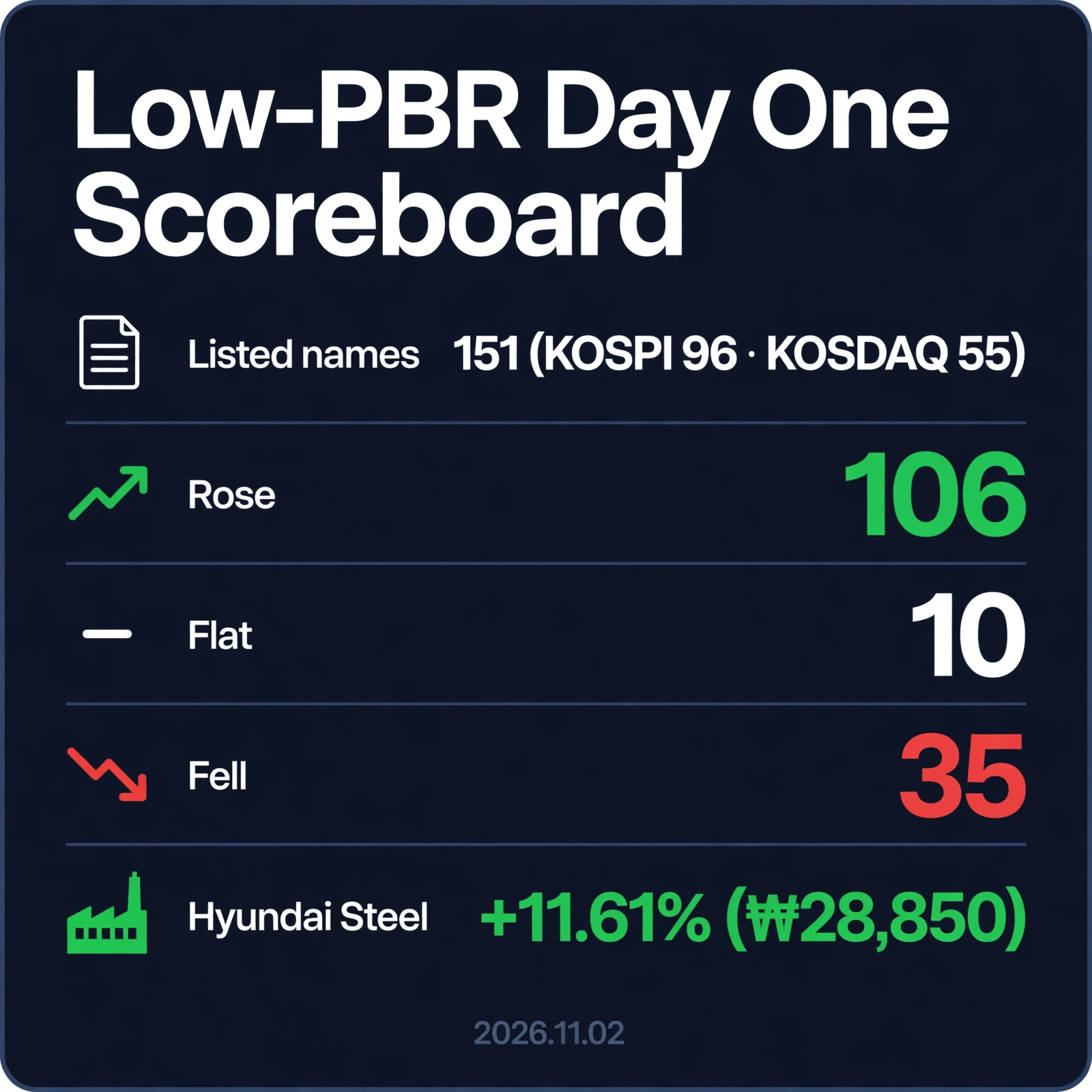
- Korea Low PBR First Day Analysis 106 of 151 Rise Hyundai Steel Surge
For foreign investors: on the first trading day of Korea's low-PBR name list, 106 of 151 stocks rose and Hyundai Steel surged 11.61%. But steel and construction rose across the board, so the list effect cannot be separated from sector strength. The real test is execution.
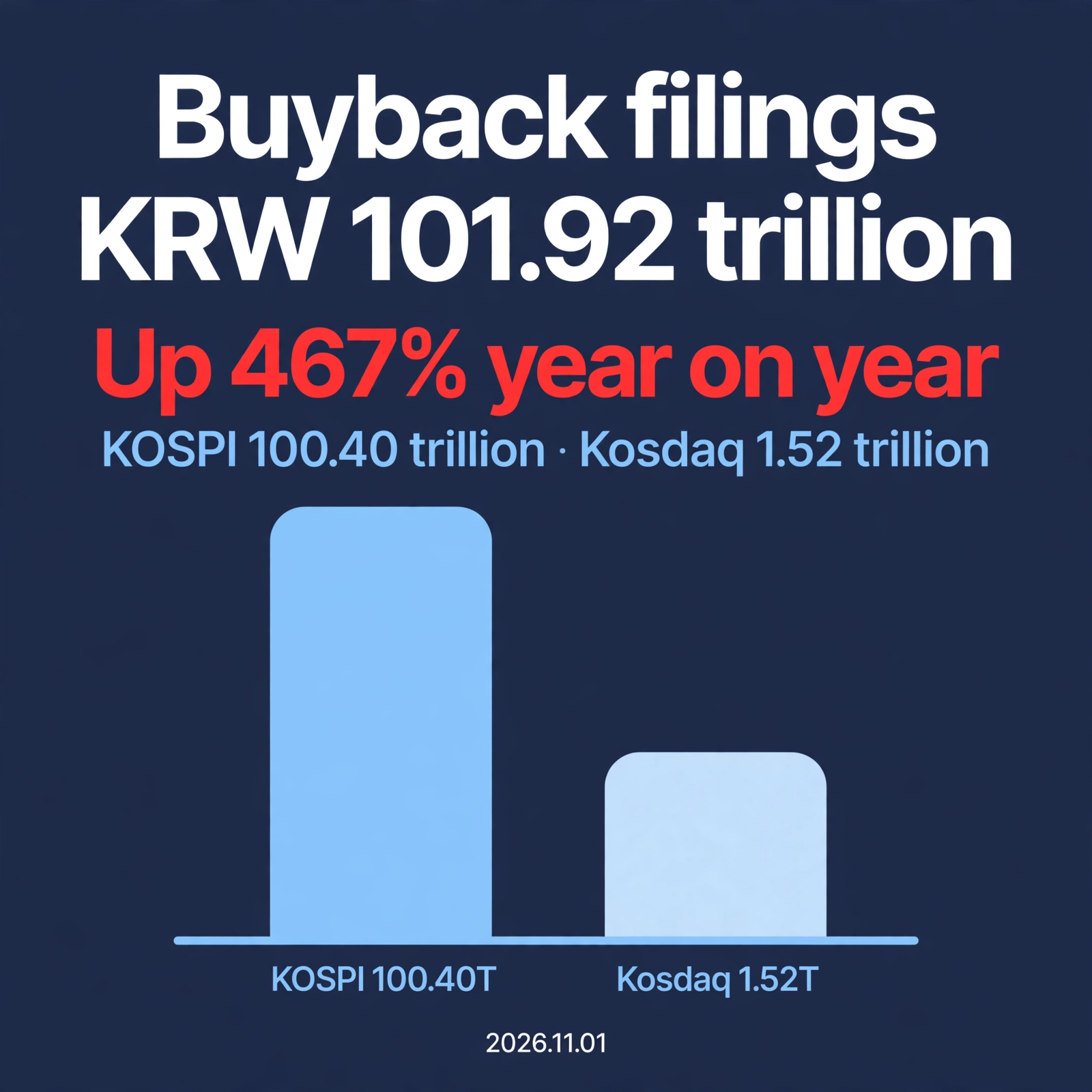
- Korea Buyback Boom 102 Trillion Won Samsung SK Hynix Concentration Analysis
Korean listed firms filed KRW 101.92 trillion in treasury-share transactions this year, up 467% — but Samsung and SK hynix account for 80.45%. Filings versus execution, cancellation versus holding, and what foreign investors should check.
- Korea Low PBR List 151 Firms Value Up Naming Governance Analysis
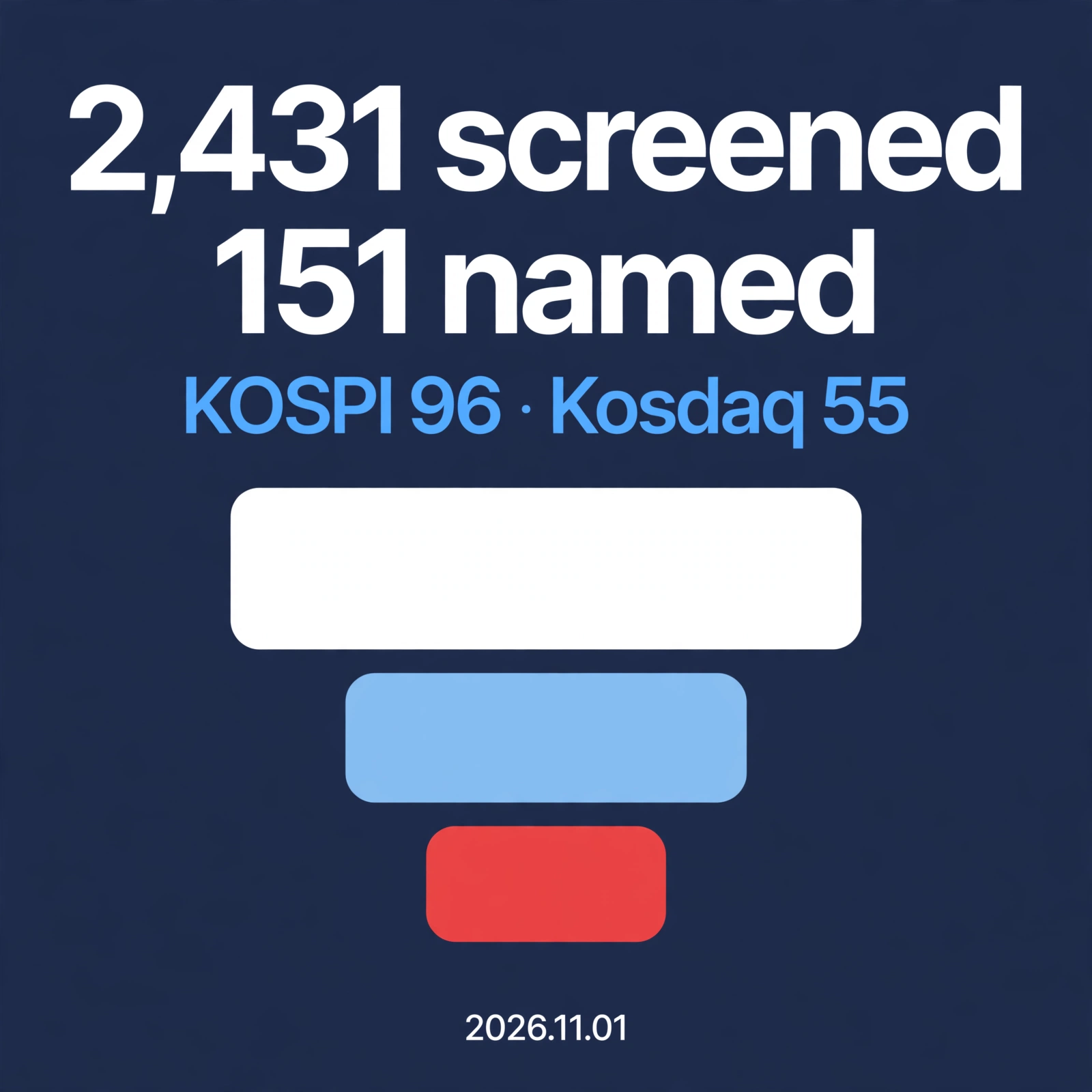
The Korea Exchange named 151 persistently low-valued firms for the first time, with a public tag on trading apps from Monday. How the list was built, what Japan's reform teaches, and the four things foreign investors should watch next.
5minbrief on YouTube
The briefs also come as videos. Get the daily market wrap on YouTube.
Subscribe on YouTube