 5-minute briefs
KOSPI Closed Saturday Oil at $116 Gold Breaks $4,000 Won Normalization 3 Things to Watch
KRX closed Saturday — Friday’s close in one table
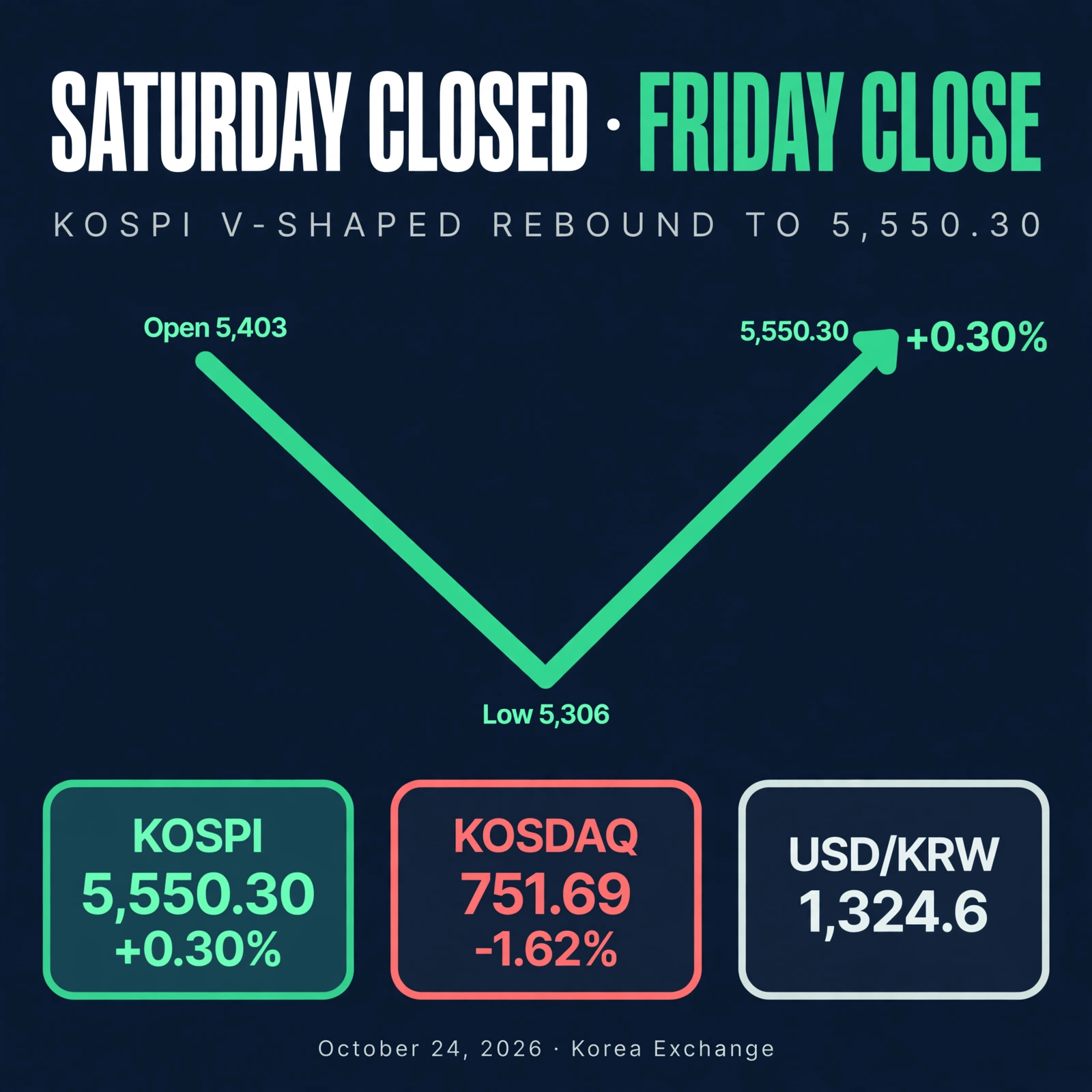
Friday (October 23) was a V-shaped day. KOSPI opened down 2.36% at 5,403.17, slid to an intraday low of 5,305.98, then flipped positive 20 minutes before the close to finish up 16.53 points (0.30%) at 5,550.30. Foreigners net sold 992 billion won; institutions net bought 872 billion won, absorbing the supply.
KOSDAQ fell 12.41 points (1.62%) to 751.69. Retail investors net bought 64 billion won, while foreigners and institutions net sold 42 billion and 25 billion won respectively.
| Index | Close | Change | Flows |
|---|---|---|---|
| KOSPI | 5,550.30 | +0.30% | Foreigners -992B won / Institutions +872B, Retail +51B won |
| KOSDAQ | 751.69 | -1.62% | Retail +64B won / Foreigners -42B, Institutions -25B won |
USD-KRW closed at 1,324.6, up 0.4 won on the day. For the week, KOSPI fell 2.08%.
Oil jumps on Middle East escalation — why it hits Korea harder
The weekend’s hottest variable is the Middle East. US President Donald Trump said at a rally in Fort Myers, Florida, on October 23 that the US “could do another small ‘Operation Roaring Fury’” — the name of the February operation in which the US struck Iran alongside Israel. The New York Times reported on October 21 that US and Israeli forces were conducting fighter-jet practice flights over Iraq.
Iran’s response has escalated in tone. Two senior officials told Reuters that Iran has plans to target undersea cables in the Gulf if the US and Israel strike again. Iran’s Revolutionary Guard Corps (IRGC) claimed two very large crude carriers hit mines south of the Strait of Hormuz. The US is also reducing embassy staff in Jordan, Lebanon, Qatar, and the UAE, after Saudi Arabia.
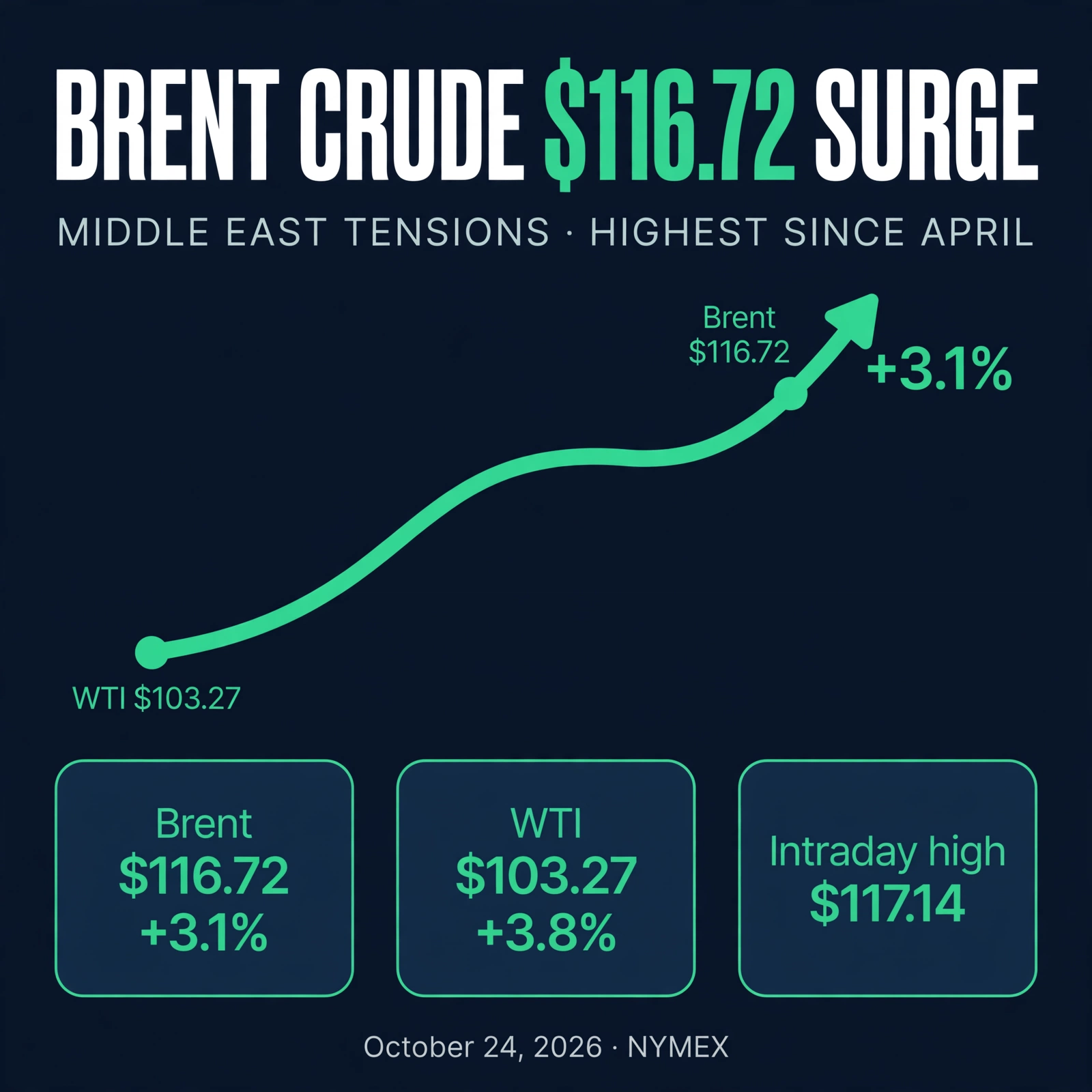
Oil has already moved. Brent crude for December delivery closed October 23 up 3.1% at $116.72 a barrel, touching $117.14 intraday — its highest since April. West Texas Intermediate (WTI) rose 3.8% to $103.27. The US Energy Information Administration (EIA) estimates global oil inventories fell by an average of 1.9 million barrels per day in the third quarter and will keep falling by 0.7 million barrels per day in the fourth quarter.
Why this matters more for Korea than for the US: Korea imports nearly all of its crude oil, so an oil spike feeds straight into import prices, corporate costs, and the won. Daishin Securities’ Lee Kyung-min noted that with the US midterm elections on November 3, negotiation progress is likely to be limited, keeping oil elevated and pressuring Korean equities.
BOK governor frames won strength as “normalization” — three things to watch
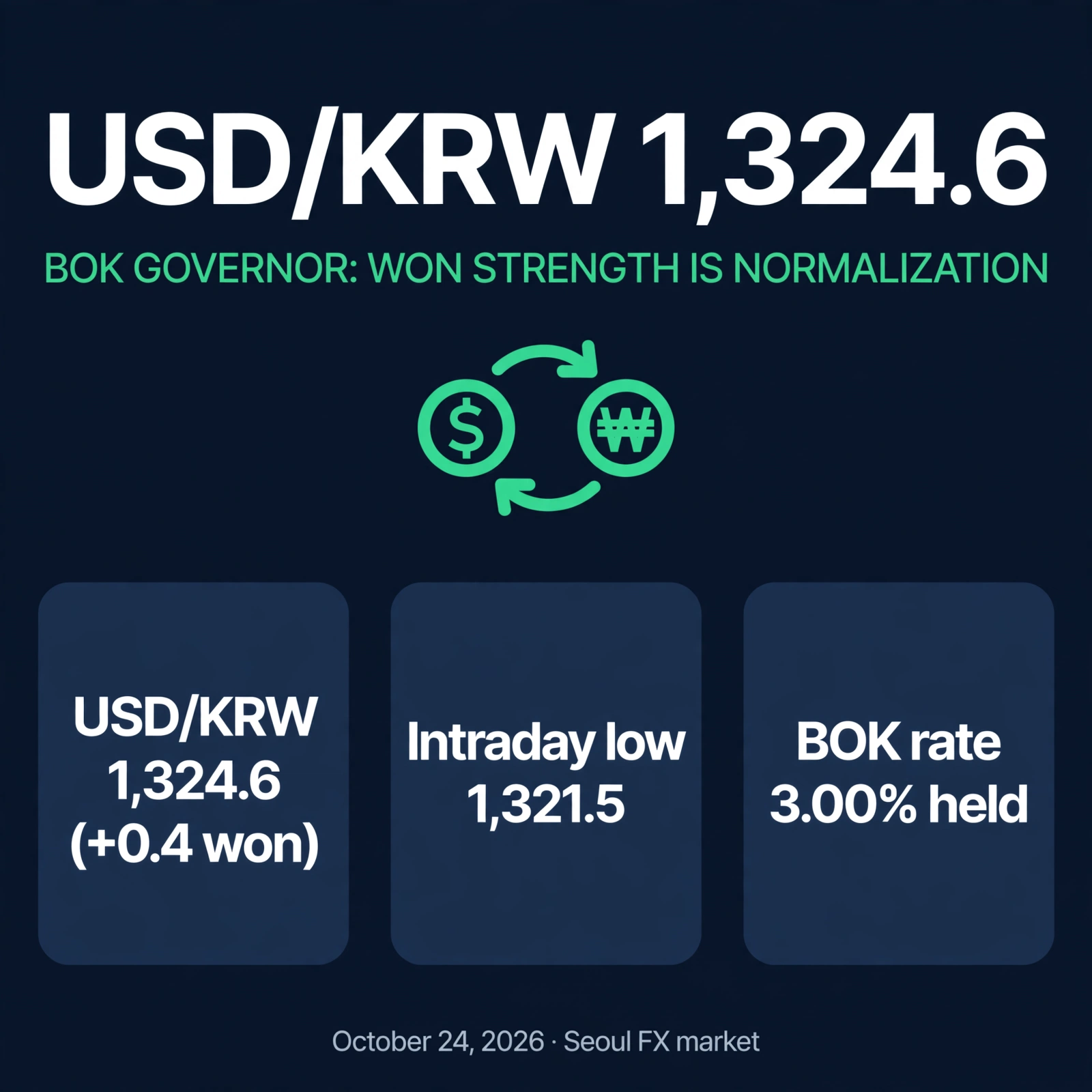
On the policy side, Bank of Korea (BOK — South Korea’s central bank) Governor Shin Hyun-song drew attention at a parliamentary audit on October 23. Asked whether USD-KRW could fall to the mid-1,200s, he avoided a direct answer but said that “looking at the effective exchange rate, the won was exceptionally undervalued early this year, and it is now in the process of normalizing.”
The read-through: the governor sees current won strength not as overshoot but as a return to fair value. Coming a day after the BOK’s unanimous decision to hold the policy rate at 3.00% on October 22, markets took it as a signal that the central bank will tolerate a stronger won. But foreigners net sold nearly 1 trillion won of KOSPI shares on Friday — whether won strength and foreign flows stay aligned is next week’s question.
Three things to watch next week:
- US FOMC (October 27–28) — 94 of 100 economists in a Reuters poll expect a hold at 3.75–4.00%. A hold is not dovish: December hike pricing and the press-conference hints matter more.
- Microsoft and Alphabet earnings (October 28, after the close) — the next verdict on AI spending. Their capex plans feed directly into sentiment on Korean chip stocks.
- US midterm elections (November 3) — with the vote approaching, Middle East negotiation progress may stay limited, keeping oil and geopolitical risk elevated into the election.
Gold’s break below $4,000 — and what it means for Korea-exposed investors — is covered in depth in today’s companion post.
Not investment advice. Figures from the Korea Exchange, Seoul FX market, Yonhap, and Reuters, verified October 24, 2026.
Sources & references
- ET News — KOSPI reverses to close up 0.3% at 5,550.30; SK hynix jumps over 4% — Basis for the Friday (Oct 23) closing figures cited in this post
- Yonhap Infomax — NY oil surges on Middle East concerns; WTI back above $100, Brent at six-month high — Original Oct 23 New York oil close report
Related articles
- Hormuz Oil Negotiation Analysis: Trump Restraint and Mining War
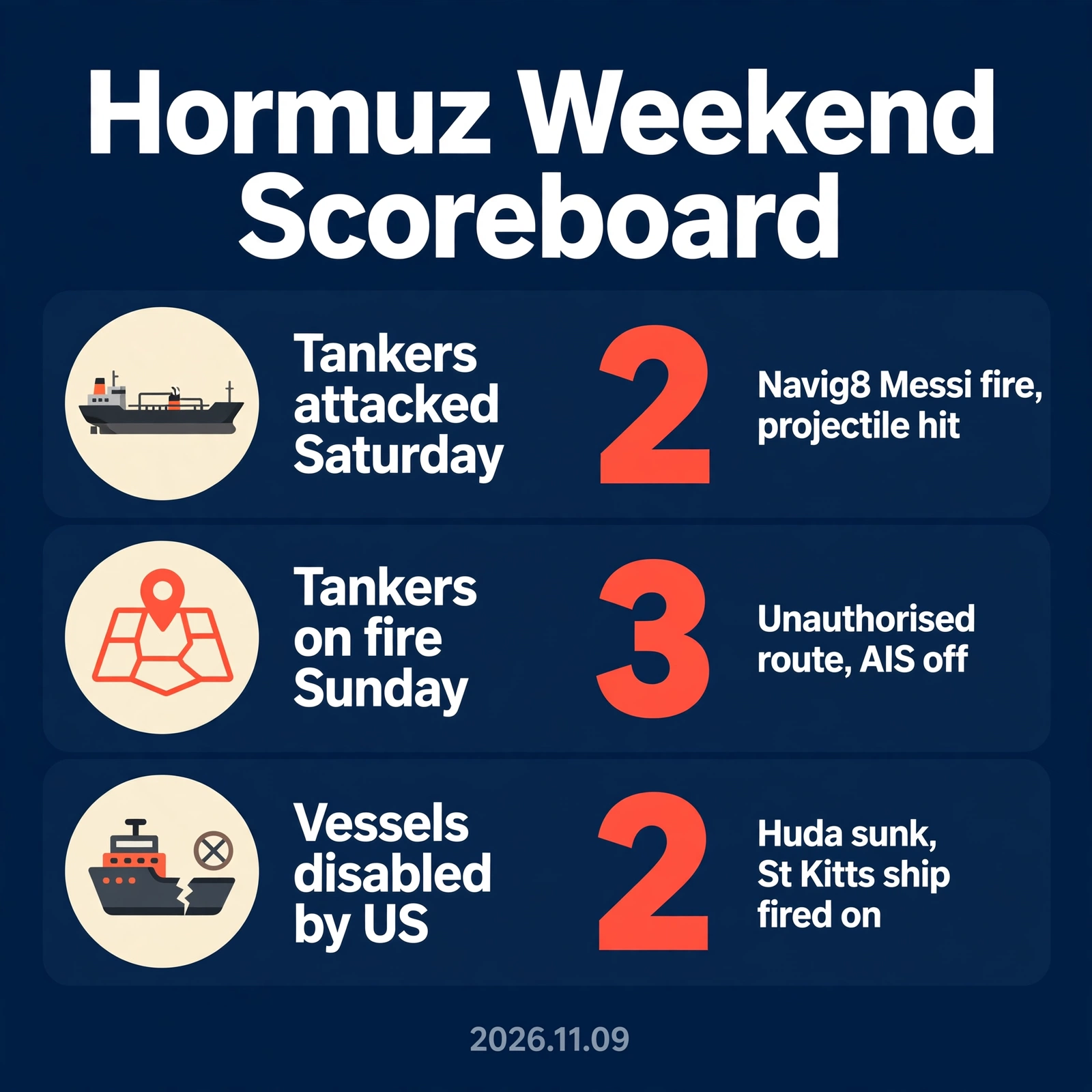
Three more tankers caught fire in the Strait of Hormuz over the weekend. Trump said fresh strikes are 'highly unlikely' if talks progress, while the IRGC keeps mining the strait. The fork Monday's open has to price.
- Strait of Hormuz Oil Price Analysis US Iran Strikes and 13% Weekly Drop
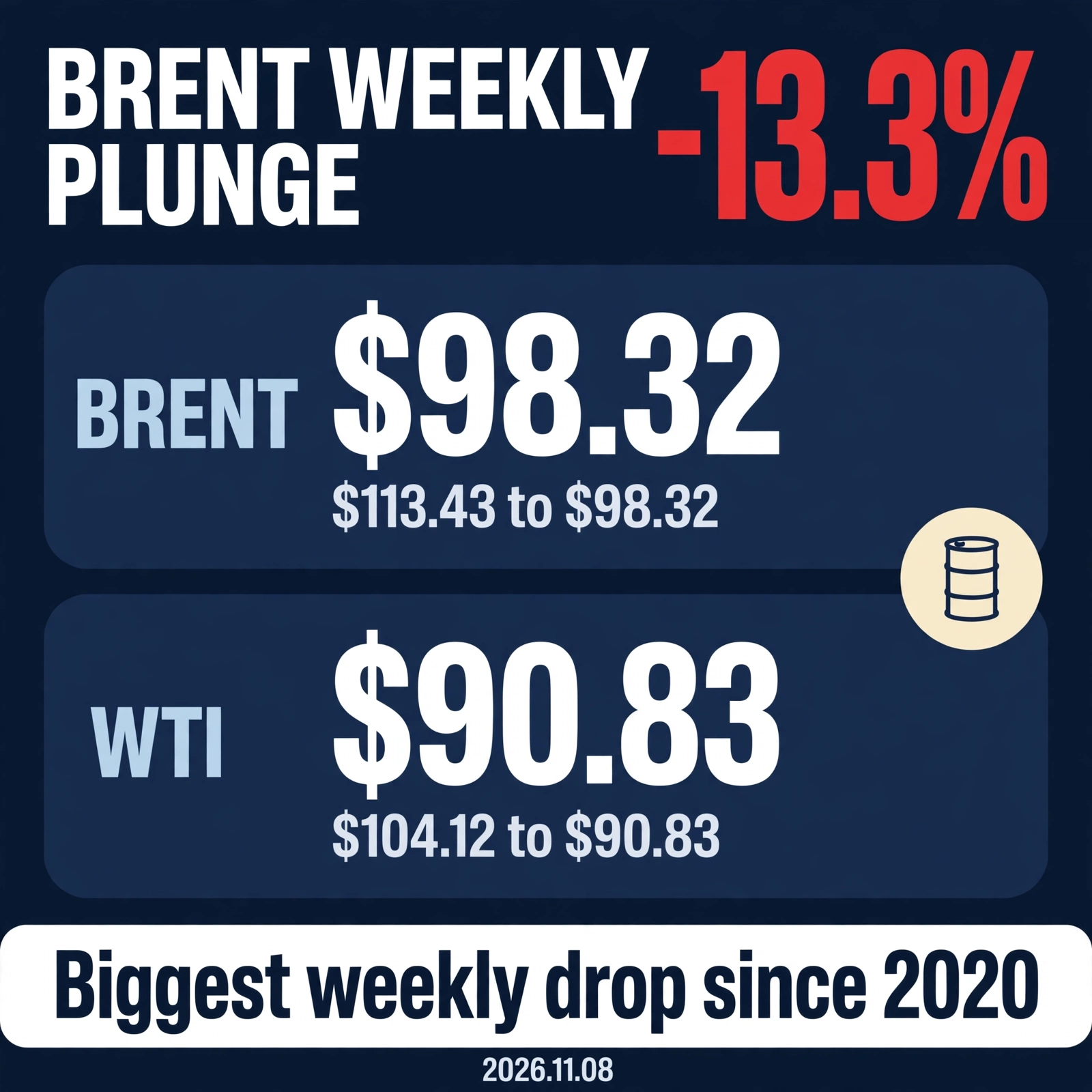
Brent crude fell 13.3% in a week to $98.32 as deal hopes drained the war premium — while attacks on Hormuz shipping ran at a near-record pace and the US struck Qeshm Island. The gap between market pricing and events on the water.
- FOMC Rate Hold Analysis 3.75–4.00% Held in 10-2 Vote and December Hike Signal
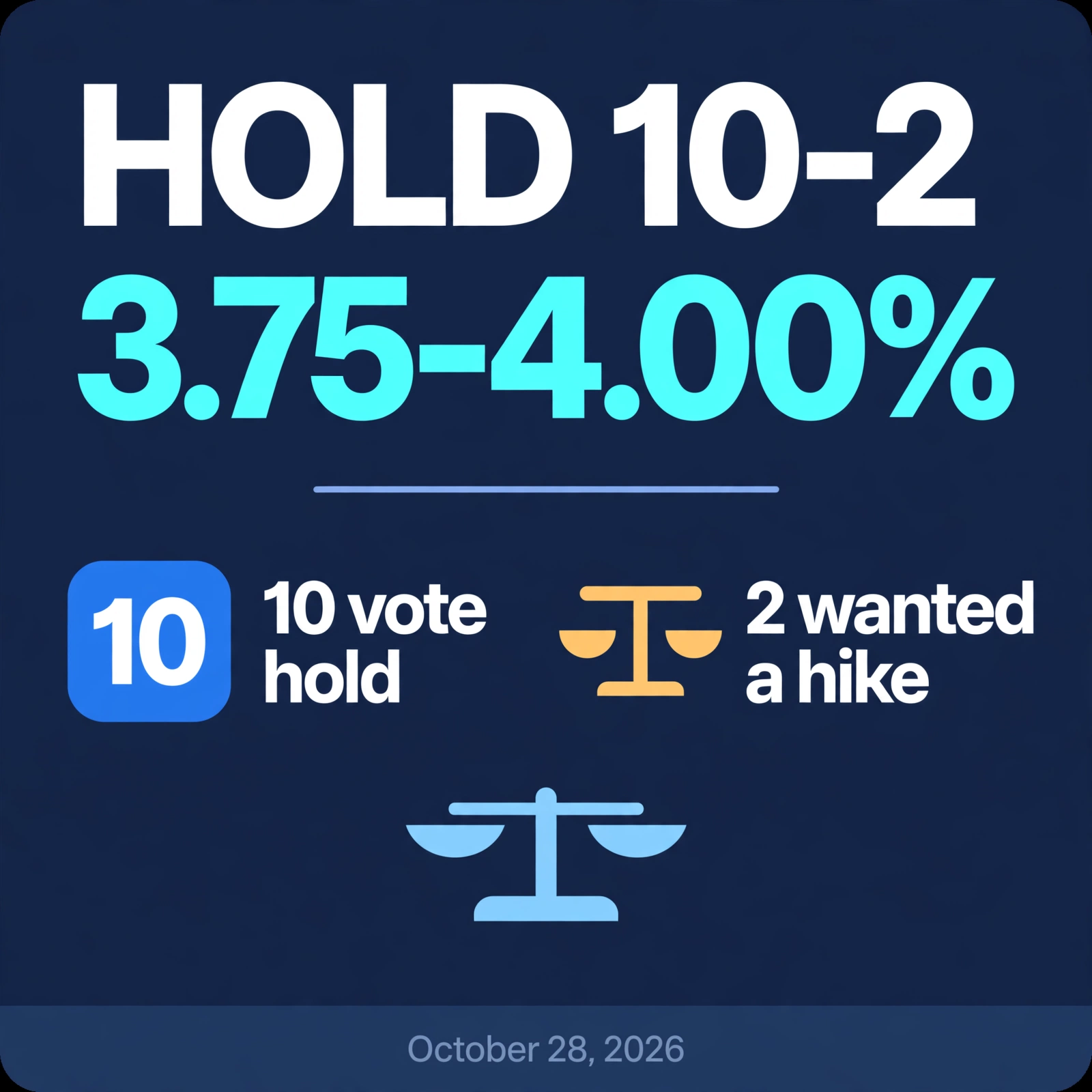
On October 28 the Fed held its benchmark rate at 3.75–4.00%. The vote was 10-2, with Governor Cook and President Hammack dissenting in favor of a 0.25 point hike. The hold matters less than the hawkish dissents, the open December path, and the smaller meeting calendar.
5minbrief on YouTube
The briefs also come as videos. Get the daily market wrap on YouTube.
Subscribe on YouTube