 5-minute briefs
Nasdaq Drops 2.6% on AI Spending Fears: Meta -7%, Tesla -3%, Oil Above $113 (Oct 22)
#Nasdaq#AI spending#Meta#Tesla#semiconductors#oil
Nasdaq sank, Dow held flat — an extreme two-track market
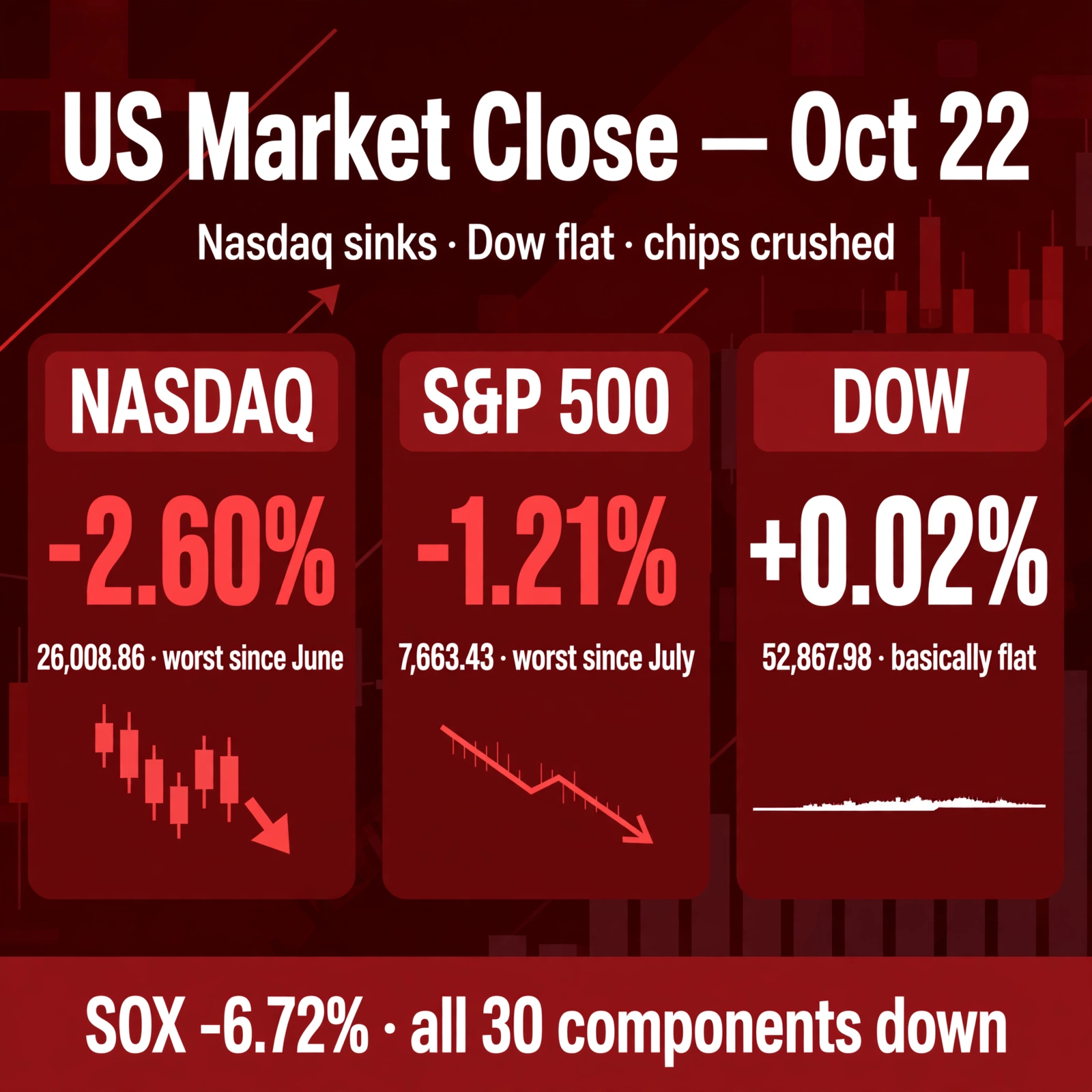
Thursday was a day of money moving out of AI and into defense. The Nasdaq dropped 2.60% to 26,008.86, its steepest fall since June, and the S&P 500 lost 1.21% to 7,663.43, its worst session since July. In contrast, the Dow edged up 0.02% to 52,867.98, essentially flat, and the small-cap Russell 2000 added 0.11% to 2,784.03.
The divergence inside the indexes was striking. While the cap-weighted S&P 500 fell 1.2%, the equal-weight S&P 500 (RSP) rose 0.73% — a 1.9-point gap. Money rotated out of mega-cap tech into insurers, consumer staples, utilities, and rate-sensitive housing names. On the NYSE, advancers (2,319) beat decliners (1,596) — the headline drop masked decent breadth underneath.
By sector, technology (-3.29%) and communication services (-1.42%) led the decline, while consumer staples (+3.31%), utilities (+2.07%), and health care (+1.32%) held the defensive line.
AI spending fears reignited: Meta -7%, Tesla -3%
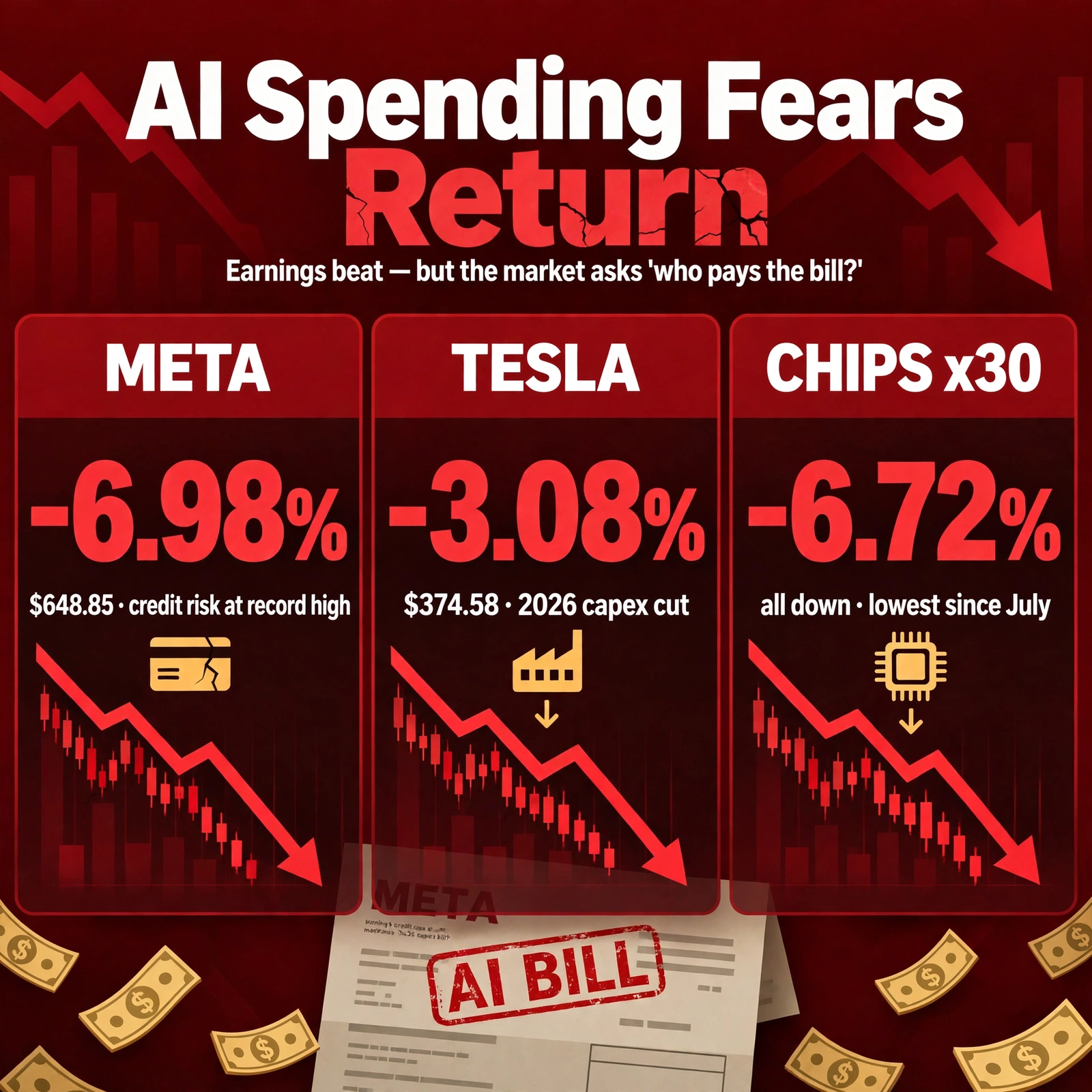
Meta and Tesla — which reported earnings the night before — became the epicenter of the selloff. The numbers were fine; the market was fixated on one question: “how much more will they spend?”
Meta plunged 6.98% to $648.85. Q3 revenue rose 26% year over year to $64.6 billion, beating estimates, but the company raised its 2026 capex outlook to $135–145 billion and posted a $2.1 billion free-cash-flow deficit for the quarter. Combined with plans for a new class of non-voting shares to fund AI, Meta’s credit risk hit a record high, and more than $100 billion in market value evaporated in a day.
Tesla fell 3.08% to $374.58. EPS of $0.48 beat the $0.44 estimate, but the company guided 2026 capex down to about $20 billion from over $25 billion. Spending less on AI and robots produced positive free cash flow — yet the market read it as a sign of slowing AI growth.
Semiconductors were devastated. The Philadelphia Semiconductor Index (SOX) tumbled 6.72% to 10,731.98, its lowest since July 29, with all 30 components falling. Lam Research -11.76%, AMD -8.10%, Intel -8.04%, Micron -6.26%, and Nvidia -4.40% all sank, alongside Amazon -4.57%. SpaceX gave back -9.14% of the prior day’s 7.8% surge. The same names that led Wednesday’s AI optimism reversed course within 24 hours.
- Equal-weight index: an index that holds every stock at the same weight regardless of market cap. It strips out mega-cap concentration to show the market's "true breadth."
- Credit risk: the chance a company fails to repay its debt, measured via instruments like credit default swaps (CDS). When it rises, bond investors see growing danger.
- Non-voting shares: new shares with no voting rights. They raise cash without diluting existing shareholders' control.
Oil at $113, bonds bid: Middle East risk drives safety flows
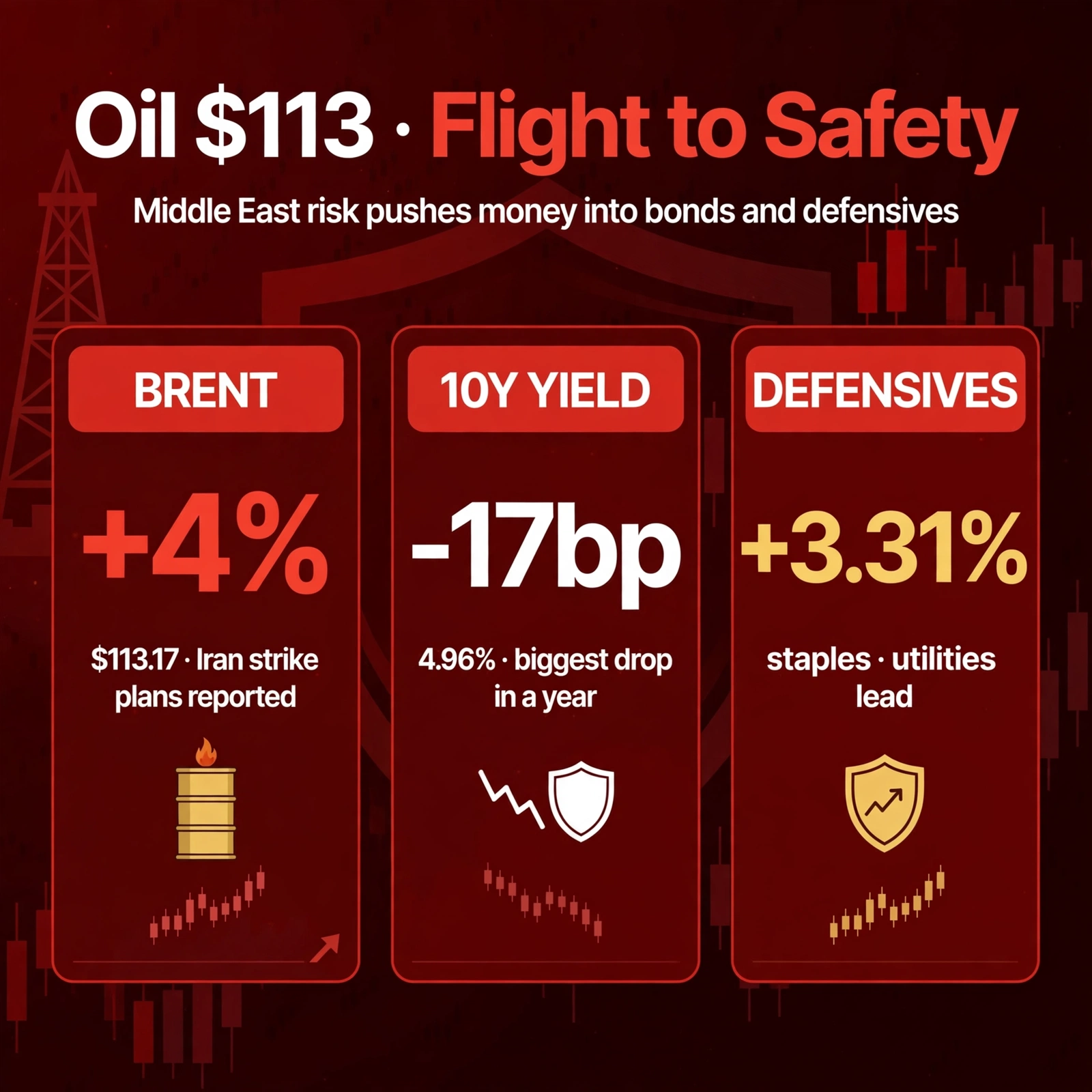
The other axis of the day was the Middle East. The New York Times reported that the US and Israel have drawn up plans for “short but intensive” strikes on Iran after the midterm elections, and President Trump said “something one way or another” would “happen fairly soon.” The State Department ordered non-emergency personnel and families to leave Saudi Arabia. Fears of renewed strikes — after a month-long pause — pushed oil higher.
Brent crude surged 4% to $113.17 and WTI jumped 2.4% to $99.47. The US national average gasoline price is hovering above $4 a gallon. The energy sector still fell -0.87% — because the rally came from supply-disruption fears, not demand, which burdens the economy instead.
Money piled into Treasuries. The 10-year yield plunged 17bp to 4.96%, the biggest one-day drop in over a year, and the lowest in about a month. Lower yields usually lift growth stocks — Thursday was the opposite, because the reason for the drop was fear: safe money came before cheap money.
Macro data was actually fine. Initial jobless claims fell to 194,000, below the 200,000 estimate and the lowest since July. Continuing claims, however, climbed to 1.728 million — the labor market’s undercurrent is slowly getting heavier.
Elsewhere: Netflix +3.09% (rebounding from Wednesday’s plunge), Spotify +8.7%, Lockheed Martin +9.4% (upbeat outlook), P&G +6% (FQ1 earnings beat). Moderna -17.57% led the losers. Gold fell about $90 to near $4,050 an ounce, and Bitcoin dropped 3.31% to $81,243.
Tonight’s checkpoints
| Date | Event |
|---|---|
| Fri | Global flash PMIs (manufacturing 55.9, services 58.8 expected), final US consumer sentiment (46.3 expected) |
| Earnings | Major energy companies continue reporting |
| Next week | FOMC (~89% odds of a hold; ~76% odds of a December hike), Alphabet and Amazon earnings, Meta’s Santa Fe trial starts Monday |
For Korea-based investors
Korea’s market took the US AI scare head-on. On Thursday the KOSPI plunged 3.52% to 5,533.77, with foreigners and institutions selling while individuals bought over 1 trillion won. The end of SK hynix’s share buyback removed a key supply-demand buffer, deepening the drop.
The currency backdrop stays favorable: the won strengthened to 1,324.2 per dollar, a fresh 2026 high for a fifth straight session (strongest since October 2024). The Bank of Korea held its base rate at 3.00% while keeping a tightening stance, and Governor Shin Hyun-song noted the won “is still undervalued” on a real effective basis — hinting at room for further strength. A stronger won lowers the FX burden when buying US stocks.
Tonight’s watch points: flash PMIs and consumer sentiment. A miss could feed slowdown fears; a beat could feed oil-driven inflation fears. Next week’s Alphabet and Amazon earnings are the next test of the “AI spending scare.”
Not investment advice. Figures verified Oct 23 from Reuters, WSJ, Investopedia, and TradingKey.
Sources & references
- Associated Press — How major US stock indexes fared Thursday 10/22/2026 — Thursday closing tally for the four major indexes
- U.S. Department of Labor — Unemployment Insurance Weekly Claims Report (October 22, 2026) — Official weekly jobless claims release
- Meta Platforms — Meta Reports Third Quarter 2026 Results (SEC Form 8-K Exhibit 99.1) — The figures behind Meta's drop: capex outlook and free cash flow
Related articles
- US Stock Market Close Analysis Nasdaq Falls 2.86% Intel Plunges 28.58% Semiconductor Selloff (October 31)
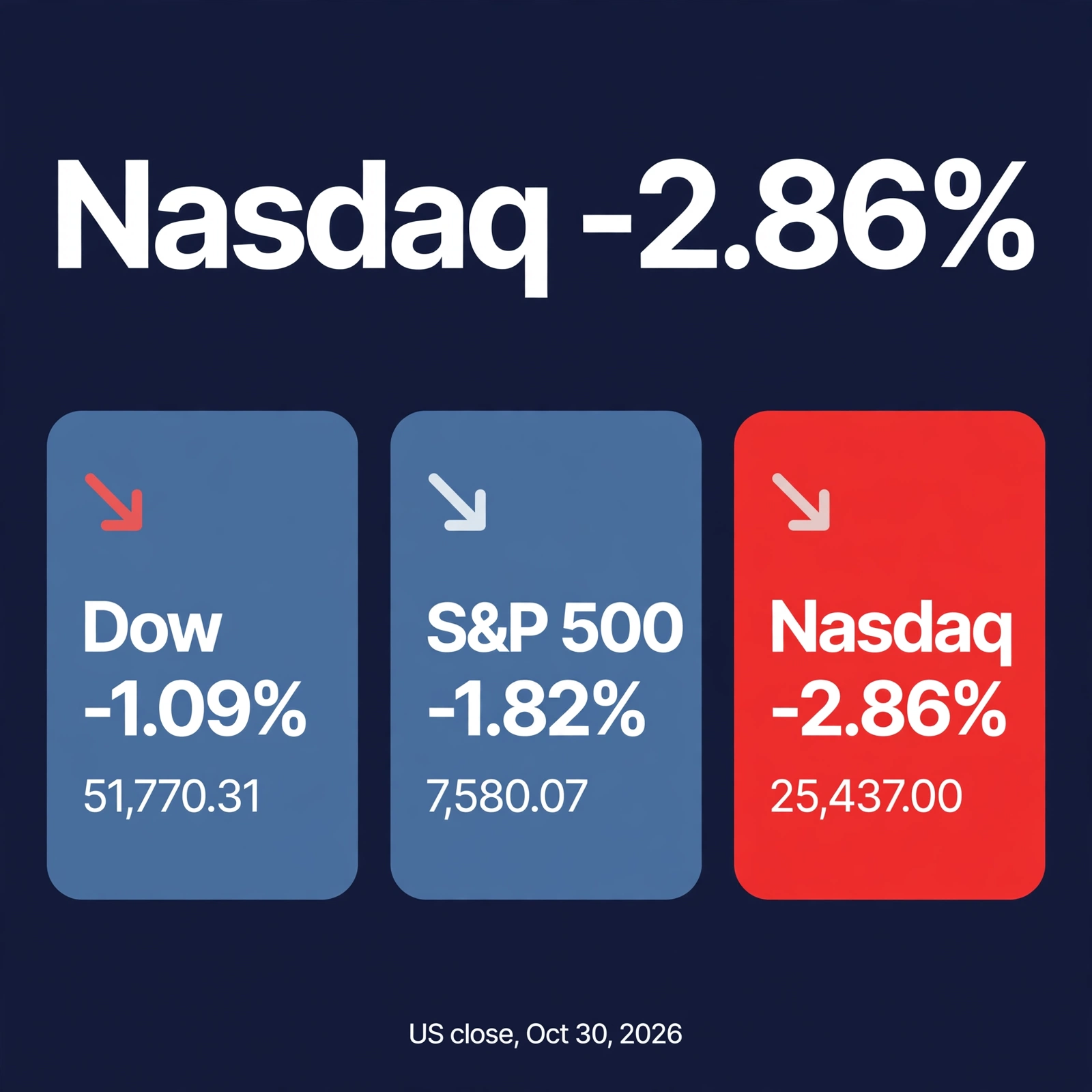
US close on Friday, October 30: Dow 51,770.31 (-1.09%), S&P 500 7,580.07 (-1.82%), Nasdaq 25,437.00 (-2.86%). Intel plunged 28.58% in its worst day since the 1970s, and the Philadelphia Semiconductor Index fell 7.20%. For October, the Nasdaq lost 5.3%, the S&P 500 fell 0.9%, and the Dow gained 1.7%.
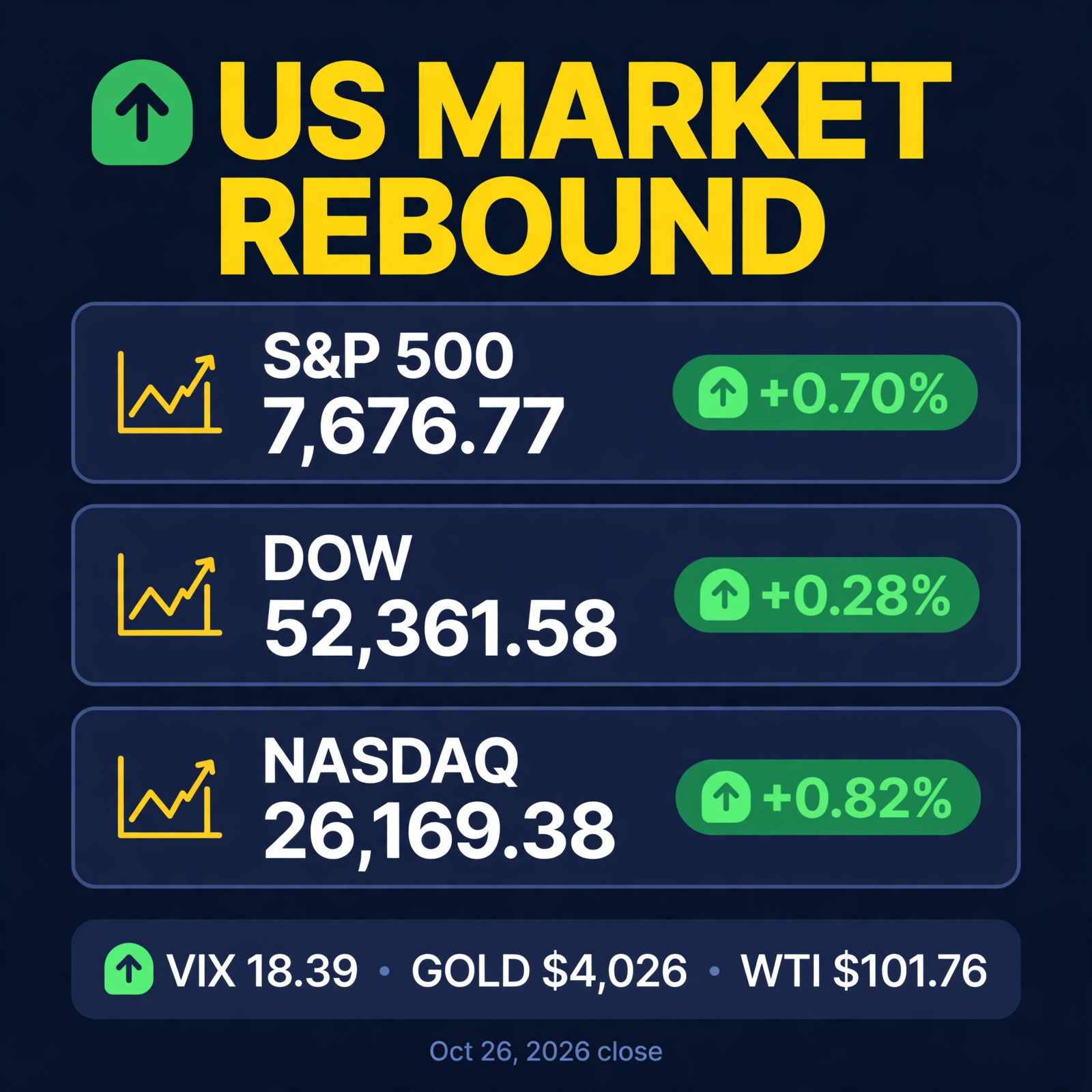
- US Market Close Analysis S&P 500 Up 0.70% Nasdaq Up 0.82% Anthropic IPO Filing AI Rebound (October 27)
Monday, October 26 US close: S&P 500 7,676.77 (+0.70%), Dow 52,361.58 (+0.28%), Nasdaq 26,169.38 (+0.82%). Anthropic's IPO filing brought AI buyers back and semiconductors led the rebound, while Meta fell 1.88% on a $95 billion equity raise plan.
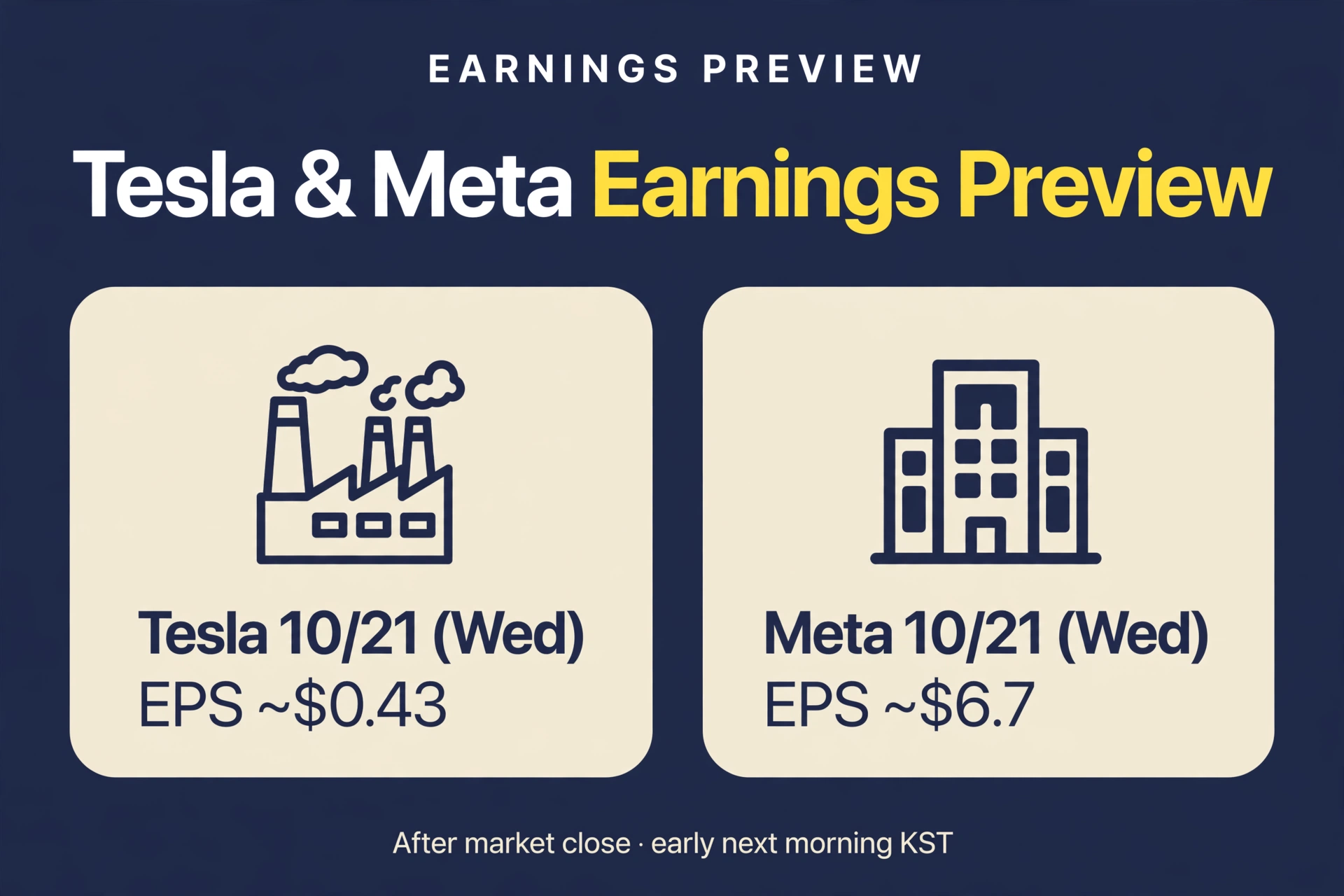
- Tesla Meta Q3 Earnings Preview: AI Capex Guidance and Key Figures (Oct 21)
Tesla and Meta report Q3 earnings on October 21. With tech rattled by AI financing worries, management commentary on AI spending will set the tone for...
5minbrief on YouTube
The briefs also come as videos. Get the daily market wrap on YouTube.
Subscribe on YouTube