 5-minute briefs
KOSPI 5239 Rebound Analysis 4.39% Surge Foreign Buying Returns and Won Strength
#foreign buying Korea#Samsung stock#SK Hynix stock#US CPI#CoreWeave earnings
A 4.39% rebound that reclaimed 5,200
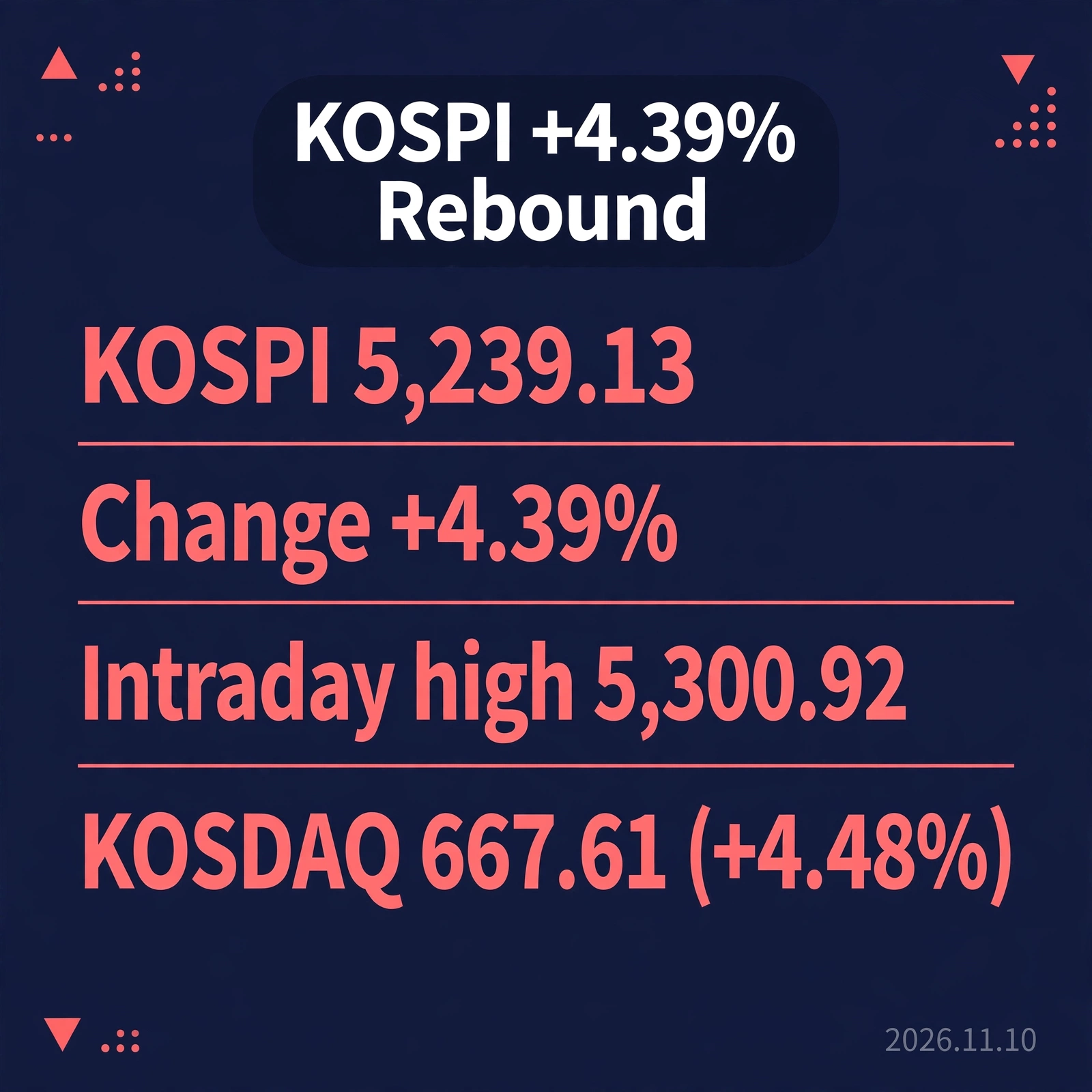
Seoul opened strong and stayed strong. The KOSPI started 4.55% higher at 5,247.22, touched 5,300.92 intraday (+5.62%), and closed at 5,239.13, up 220.28 points (+4.39%). The KOSDAQ followed the same arc, closing at 667.61 (+4.48%) after reaching 671.91 intraday (+5.16%). Both indexes snapped three-session losing streaks. Trading value was 16.2 trillion won ($12.1 billion) on the KOSPI and 4.4 trillion won on the KOSDAQ, with winners outnumbering losers 714 to 174 on the main board.
The surge was fast enough to trip a circuit-breaker-like mechanism within minutes of the open. The Korea Exchange activated a buy-side sidecar at 9:06 a.m. on the KOSPI (and at 9:10 a.m. on the KOSDAQ), suspending program buy orders for five minutes. South Korea’s fear gauge, the KOSPI 200 Volatility Index (VKOSPI), fell 8.98% to 58.19 — down from above 60 last week, but still far above its normal 10–20 range. The market is calmer than on Friday, not calm.
Foreigners bought for the first time in eight sessions
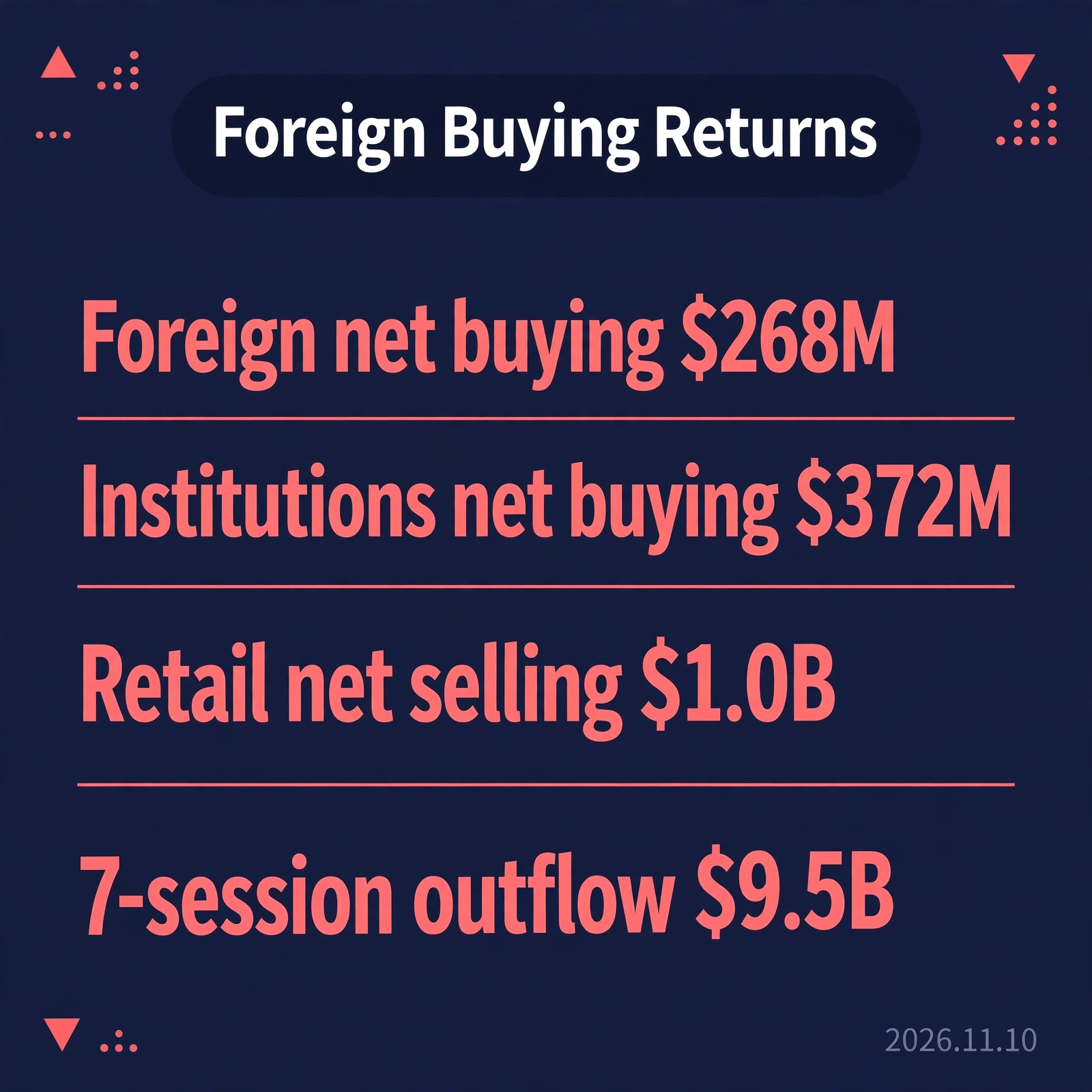
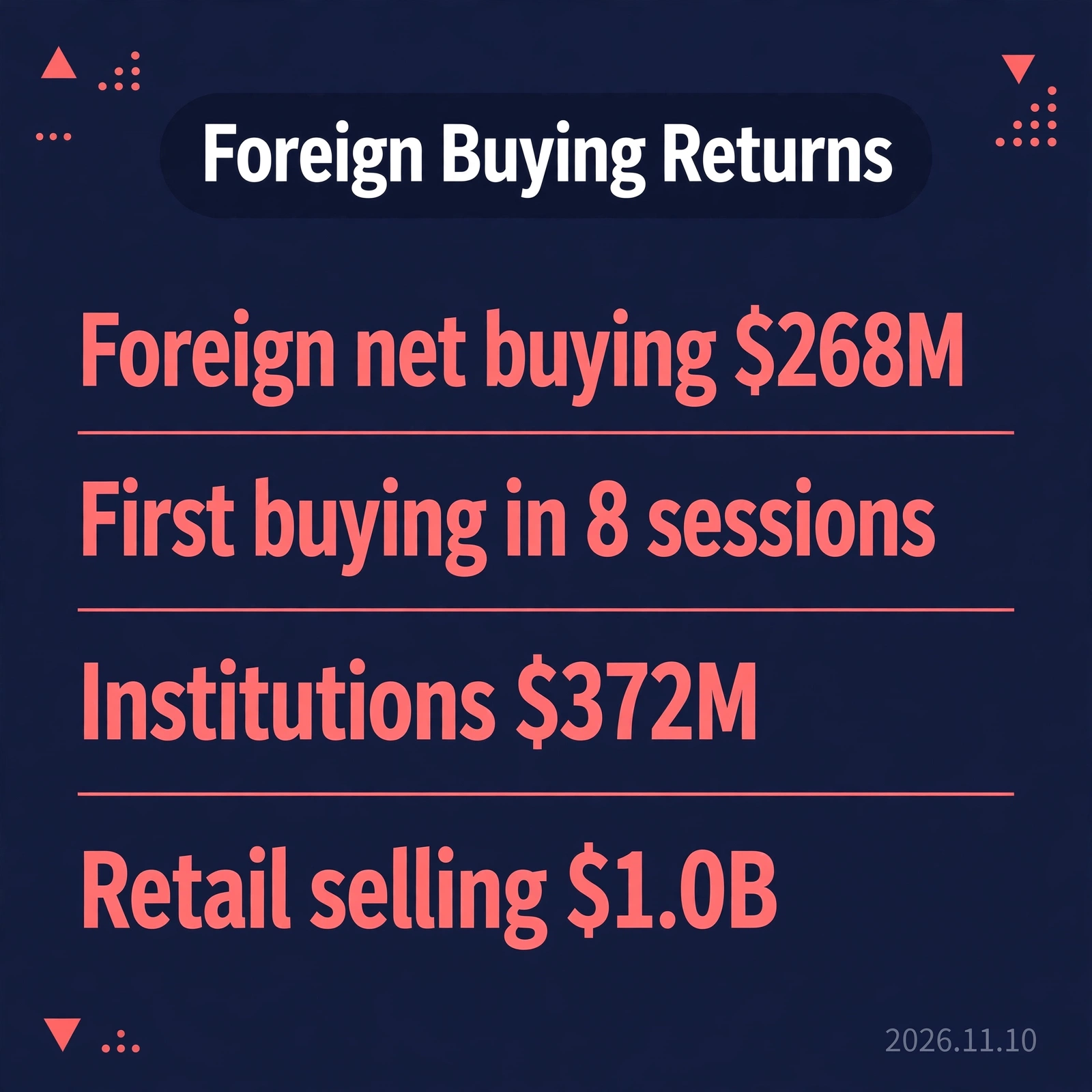
Flows flipped. Foreigners net bought 358.7 billion won (about $268 million) of KOSPI shares, their first net buying in eight sessions, and institutions bought a net 498.0 billion won (about $372 million). Retail investors went the other way, net selling 1.34 trillion won (about $1.0 billion) for a second straight session.
Scale matters here. Foreigners sold a cumulative 12.75 trillion won (about $9.5 billion) over the previous seven sessions, including 10.44 trillion won (about $7.8 billion) in the five sessions of last week alone. Today’s buying is less than 3% of that seven-session outflow. A reversal needs several more days of buying to count as one.
The turn is also, so far, a large-cap KOSPI story only. On the KOSDAQ, institutions bought 214.8 billion won (about $161 million), while foreigners still sold 147.0 billion won (about $110 million) and retail sold 56.2 billion won (about $42 million). Foreign money has come back to Samsung and SK Hynix; it has not yet come back to the broader market.
- The trigger was a US election, not a Korean event: the Democrats' midterm sweep raised fears that data-center regulation would slow the AI buildout — and Korea's two largest stocks sell memory into that same buildout. When the perceived regulatory risk eased, Seoul bounced harder than the US market itself.
- Two stocks are nearly half the index: Samsung Electronics and SK Hynix are about 45% of KOSPI market value. A foreign flow swing in those two names moves the whole index — there is no broad base to absorb it.
- The sidecar is Korea's speed bump, not a halt: when program buying surges, the exchange pauses it for five minutes. It is a cooling-off device, distinct from the full trading halt (circuit breaker) that fires on a 5% index drop. Both fired during last week's crash week.
Samsung and SK Hynix retook 200,000 and 1.2 million won
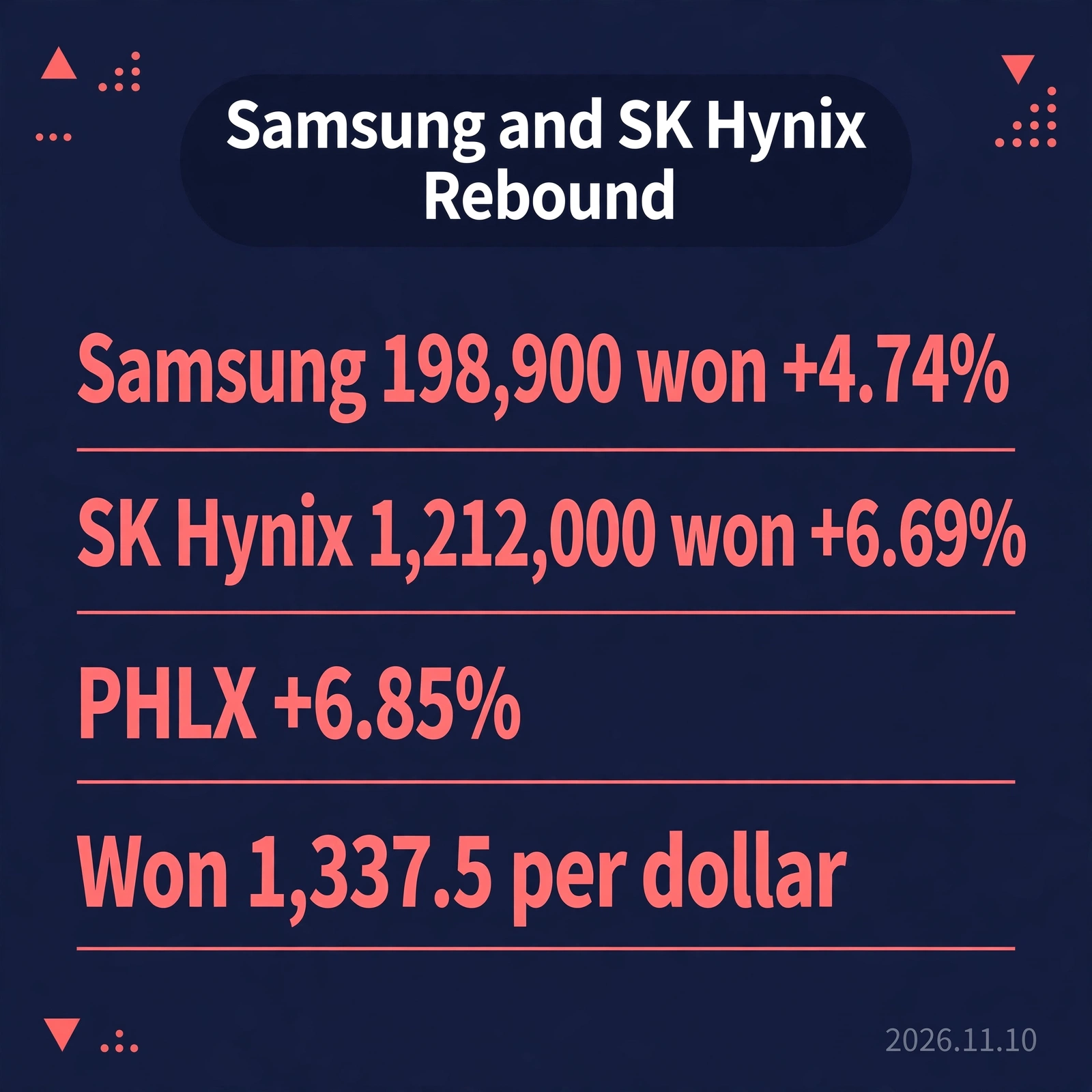
The rebound was led by the two chip giants. Samsung Electronics rose 4.74% to 198,900 won (about $149), touching 201,500 won intraday (+6.11%) to retake the 200,000-won line. SK Hynix jumped 6.69% to 1,212,000 won (about $906), retaking the 1.2-million-won level it lost on November 6 and reaching 1,242,000 won intraday (+9.33%).
The rest of the large caps mostly followed: SK Square +5.26%, LG Energy Solution +3.93%, Samsung Electro-Mechanics +4.63%. But not everything rose — Samsung Biologics fell 2.78%, Celltrion 3.33% and Shinhan Financial 0.35% even on a 4% up day. By sector, medical and precision instruments jumped 8.53%, machinery and equipment 7.65% and construction 7.15%, while pharmaceuticals fell 1.84% and food, beverage and tobacco 1.57%.
Cheaper oil lifted its own winners: Korean Air surged 11.51% and Asiana Airlines 11.68%. On the KOSDAQ, yesterday’s biggest losers bounced back — Alteogen rose 4.69% after a 16% plunge, EcoPro jumped 10.23% and EcoPro BM 8.70%.
Three headwinds eased at once
The rally had three drivers, and all three were reversals of last week’s damage. First, US semiconductors. The Dow rose 2.21% to 52,417.54, the S&P 500 gained 2.41% to 7,554.67 and the Nasdaq jumped 2.67% to 25,235.49 on Monday (US time). The PHLX Semiconductor Index surged 6.85%, with AMD up 13.26%, Broadcom 8.78%, Marvell 9.49% and Micron 6.25% — bargain hunting after a week in which the S&P 500 fell 4.36% and the Nasdaq 5.52% in a single Thursday session.
Second, oil. After meeting Qatar’s prime minister — a key mediator between Washington and Tehran — President Donald Trump said further strikes on Iran “will not be necessary for the time being”. Brent crude fell 5.85% to $92.57 a barrel and WTI dropped 4.38% to $86.85. Brent has now fallen 18.4% in six sessions, from $113.43 on October 30. The war premium is coming out of the price, and with it, out of risk sentiment.
Third, the market is re-reading the US midterms. Kiwoom Securities analyst Han Ji-young noted that investors are converging on the view that the Democrats’ data-center regulation risk is smaller than feared. The same election that crushed Korean chips last week is now being priced as a milder event.
The paradox sits inside the semiconductor rally: Nvidia fell 4.2% — the only decliner among PHLX constituents — as its board opened an independent probe into CEO Jensen Huang. Korea sells memory into the AI buildout Nvidia’s chips anchor, so whether that gap closes is one of the tests of whether today’s rebound lasts.
The won strengthened to 1,337.5 — a two-day, 19-won round trip
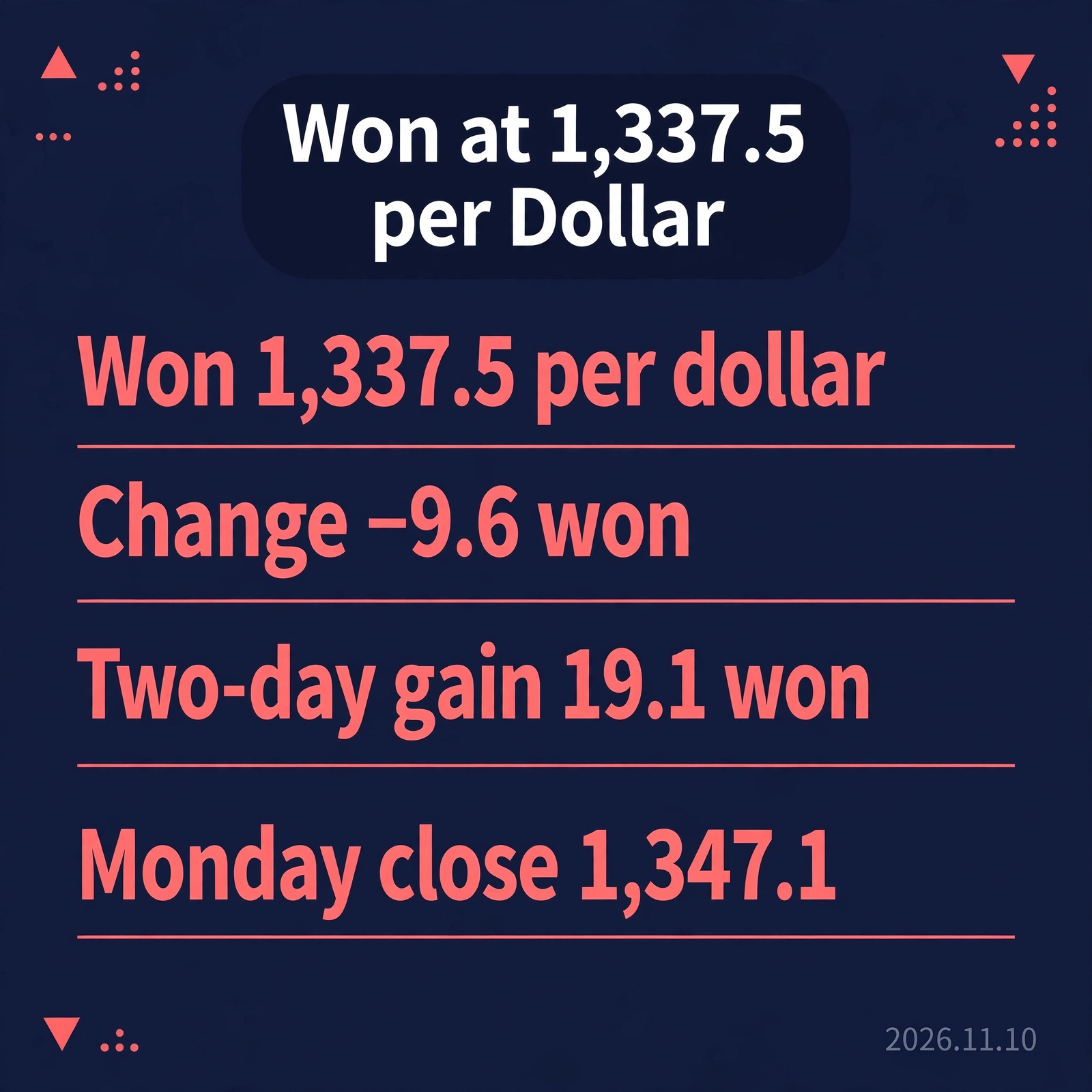
The won strengthened 9.6 won to 1,337.5 per dollar, its second straight day of gains of about 10 won and its first close in the 1,330s this month. It touched 1,335.1 intraday, the lowest since November 2, after spiking to 1,365.0 intraday on November 9. The dollar index was flat at 101.65, so this was won strength, not dollar weakness — driven by recovering risk appetite and exporters selling dollars.
That matters for foreign investors because the won and foreign flows usually move together: heavy foreign selling normally pushes the won down. The won strengthening while foreigners were still selling last week was the semiconductor-export buffer at work; today, won strength and foreign buying arrived together for the first time in eight sessions. Dealers expect a 1,320–1,380 range this week, with tonight’s US CPI as the swing factor.
What to watch — US CPI and CoreWeave earnings
Tonight decides the next move. US October CPI is released at 22:30 KST tonight, with month-on-month +0.3% and core +0.2% expected; year-on-year figures are not being published this month. After the US close, CoreWeave reports third-quarter earnings — revenue growth matters, but so do cash flow, interest costs and funding plans, the numbers that decide whether doubts about AI-investment sustainability fade.
| Date (Korea time) | Event |
|---|---|
| Tue, Nov 10, 22:30 | US October CPI |
| Wed, Nov 11, early morning | CoreWeave Q3 earnings (after US close Nov 10) |
| Wed, Nov 11 | MSCI November index review results |
| Thu, Nov 12 | Intel AI Summit Seoul (COEX) |
| Fri, Nov 13, early morning | Cisco earnings (after US close Nov 12) |
| Fri, Nov 13, 22:30 | US October PPI |
| Tue, Nov 17 | Nvidia Q3 earnings |
| Dec 8–9 | US Federal Reserve rate decision |
Three numbers to watch. First, whether foreign buying repeats tomorrow — a second day of inflows is the first evidence that today’s turn is not a one-day blip. Second, CoreWeave’s earnings and US CPI — both answer the premises behind today’s rebound: AI investment durability and inflation. Third, whether the KOSPI holds 5,200 — keeping the level it retook today adds momentum to the rebound; losing it reads as a mere retracement.
Not investment advice. Figures are as confirmed on November 10, 2026, from the Korea Exchange, Yonhap, NoCut News and the Korea Herald. Foreign and institutional flows are regular-session figures.
Sources & references
- Yonhap — Seoul shares soar over 4 pct to snap 3-day slide on tech rally, oil prices fall — KOSPI 5,239.13 (+4.39%), intraday high 5,300.92, buy sidecar 9:06 a.m., trading value 16.2T won ($12.1B), winners 714 vs losers 174, SOX +6.85%, Nvidia −4.2%, won 1,337.5
- NoCut News — KOSPI and KOSDAQ Rebound About 4% After Blue Tsunami, Rally To Continue? — Foreigners net bought 358.7B won for the first time in eight sessions, institutions 498.0B won, individuals sold 1.3396T won
- Yonhap — S. Korean won gains against U.S. dollar as oil prices slide — Won 1,337.5 per dollar (+9.6 won), Trump said further strikes on Iran will not be necessary for the time being, foreign buying boosted the won
- Korea Herald — Seoul shares soar over 4% to snap 3-day slide on tech rally, oil prices fall — KOSPI 5,239.13 (+4.39%), sidecar at 9:06 a.m., won 1,337.5 per dollar
Related articles
- KOSPI Failed Rebound Analysis 5,018 Close Foreign Selling Streak and Nvidia Probe
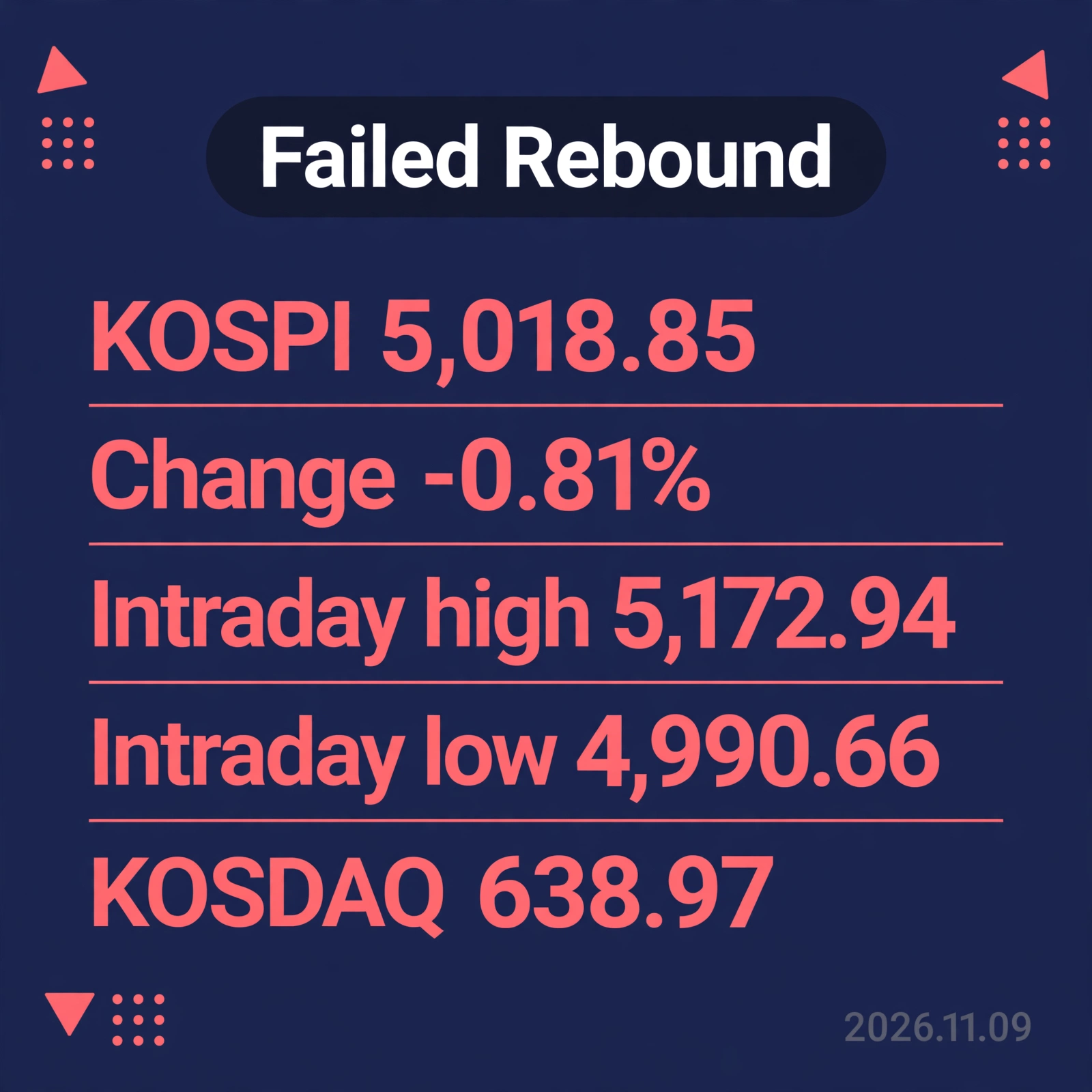
November 9 in Seoul: the KOSPI rallied 2.24% intraday to 5,172.94 but closed at 5,018.85 (−0.81%). Foreigners sold a seventh straight session, an Nvidia board probe capped the rally, and battery stocks gave back the blue-wave rally.
- Foreign Buying Korea Analysis First Net Buying in Eight Sessions After 12.7 Trillion Won Selloff
Foreign investors bought Korean shares for the first time in eight sessions, after selling 12.75 trillion won ($9.5 billion) over the previous seven. The buying is real but small — 2.8% of the outflow — and foreigners are still selling on the KOSDAQ. Four tests decide whether this is a turn or a one-day bounce.
- Won Dollar Exchange Rate Analysis 1337.5 Won Two-Day Drop and 1330s Return
The won strengthened to 1,337.5 per dollar, down 9.6 won on the day and 19.1 won over two sessions. The move is not dollar weakness — it is Korean risk appetite and exporter dollar selling reversing last week's chip-driven spike. Tonight's US CPI decides the next direction.
5minbrief on YouTube
The briefs also come as videos. Get the daily market wrap on YouTube.
Subscribe on YouTube