 5-minute briefs
US Stock Rebound Analysis: Nasdaq +2.67% as Oil Slides and Chips Surge
All three major US indexes rose more than 2% on Monday. After the worst week since April, the rebound retraced about half of Thursday’s losses in one day. Cheaper oil took pressure off inflation, and dip buyers moved into semiconductors. But the rally started with oil, not with doubts about AI spending going away. Tuesday’s CPI decides which story holds.
Scoreboard: all three indexes up more than 2%, half of Thursday’s drop retraced
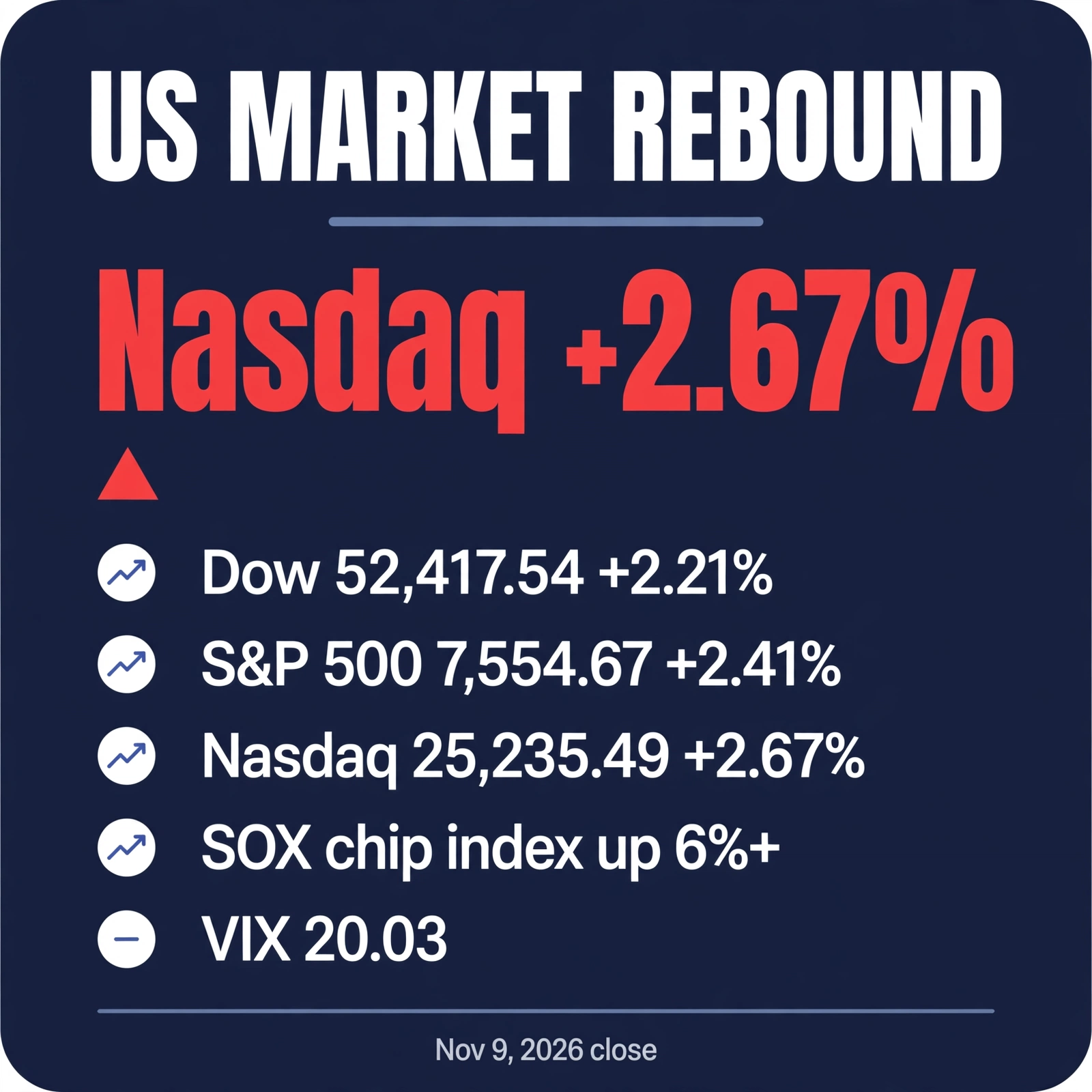
The numbers first. The Dow Jones Industrial Average rose 1,131.81 points (+2.21%) to 52,417.54, the S&P 500 gained 177.81 points (+2.41%) to 7,554.67, and the Nasdaq Composite added 656.06 points (+2.67%) to 25,235.49. It was the S&P 500’s biggest daily percentage gain since April 8, and the Nasdaq’s best day since July 30. The Nasdaq-100 tracker QQQ rose 3.54% to $679.35, and the small-cap Russell 2000 gained more than 3%.
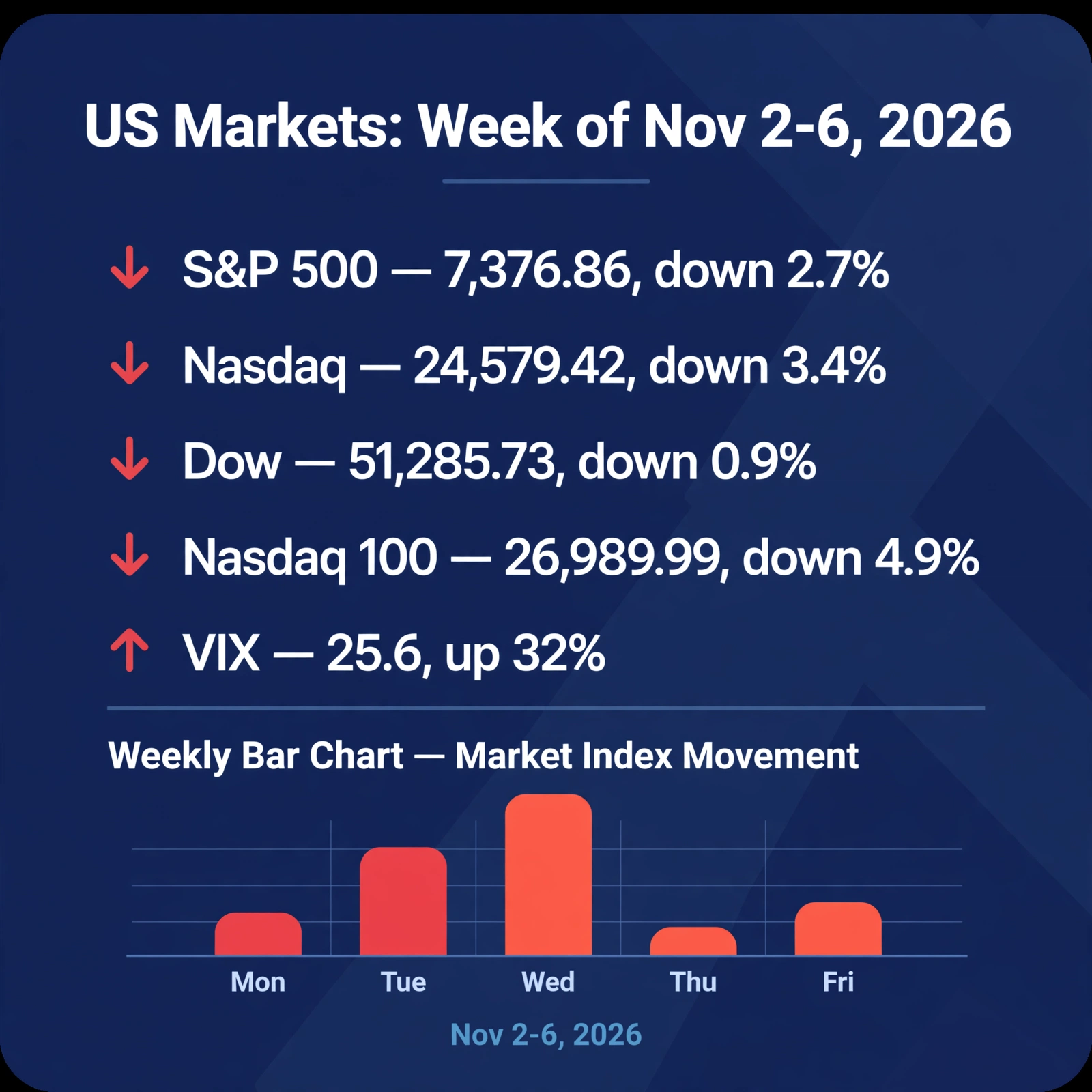
The size of the bounce is clear against last week. Last week the S&P 500 fell 2.68% — its worst week since April 2025 — the Nasdaq dropped 3.37% and the Dow lost 0.94%. On Thursday alone, the S&P 500 fell 4.36% and the Nasdaq 5.52%. Monday recovered about half of that Thursday drop — the S&P 500 reclaimed 177.81 of the 334.89 points it lost (53%), and the Nasdaq 656.06 of 1,421.51 points (46%). Friday’s small bounce (+0.31%) turned into a real retracement on Monday.
Breadth was wide. All 11 S&P 500 sectors rose, led by industrials and consumer discretionary, each up more than 3%. Advancers outnumbered decliners 4.46-to-1 on the NYSE and 3.56-to-1 on the Nasdaq. The fear gauge VIX closed at 20.03, down 21.9% from Friday’s 25.64 (intraday low 19.82). December gold futures settled at $4,114.50 (+1.0%), and the 10-year Treasury yield hovered near 4.86%.
Oil’s slide drove the rebound: Brent −5.85%, a three-month low
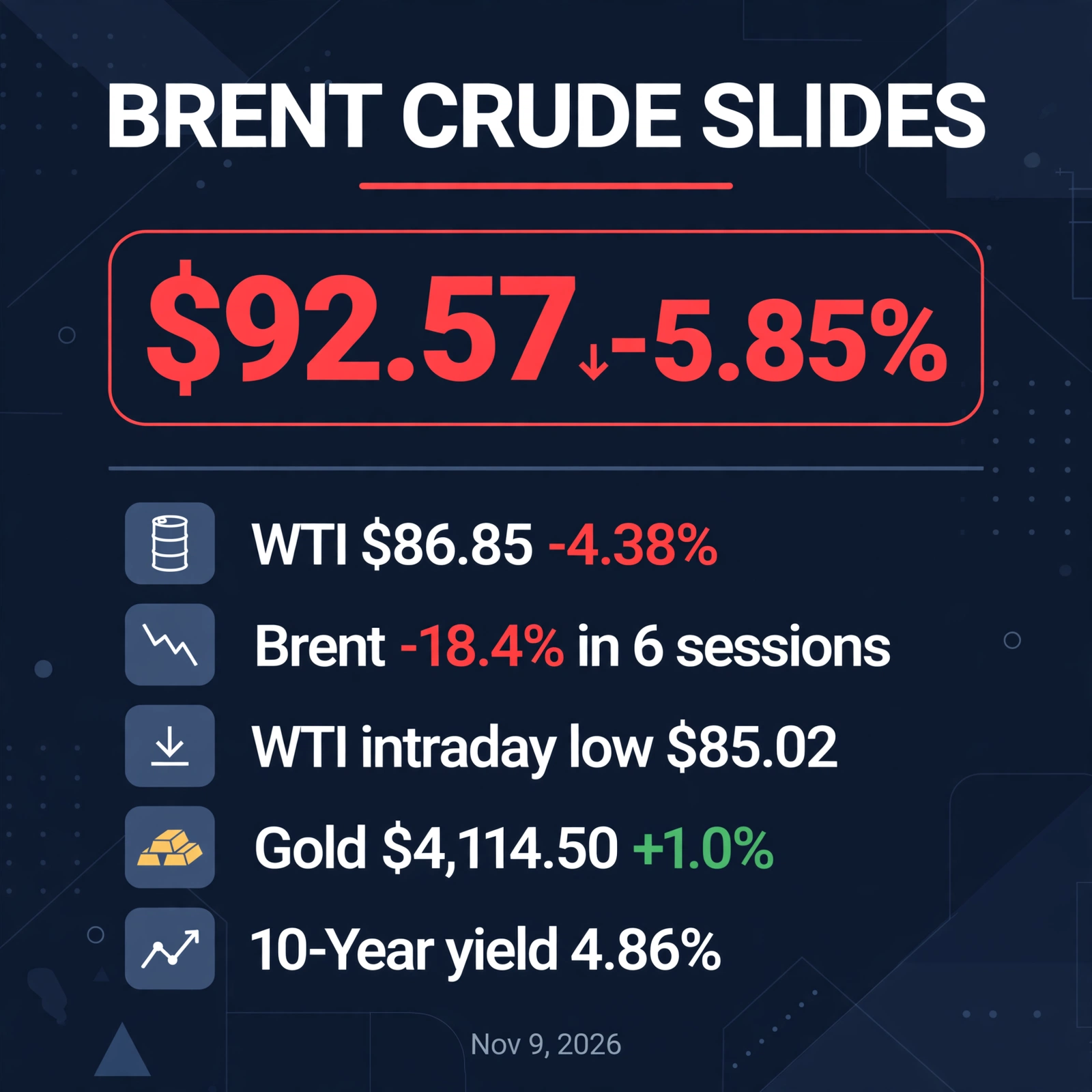
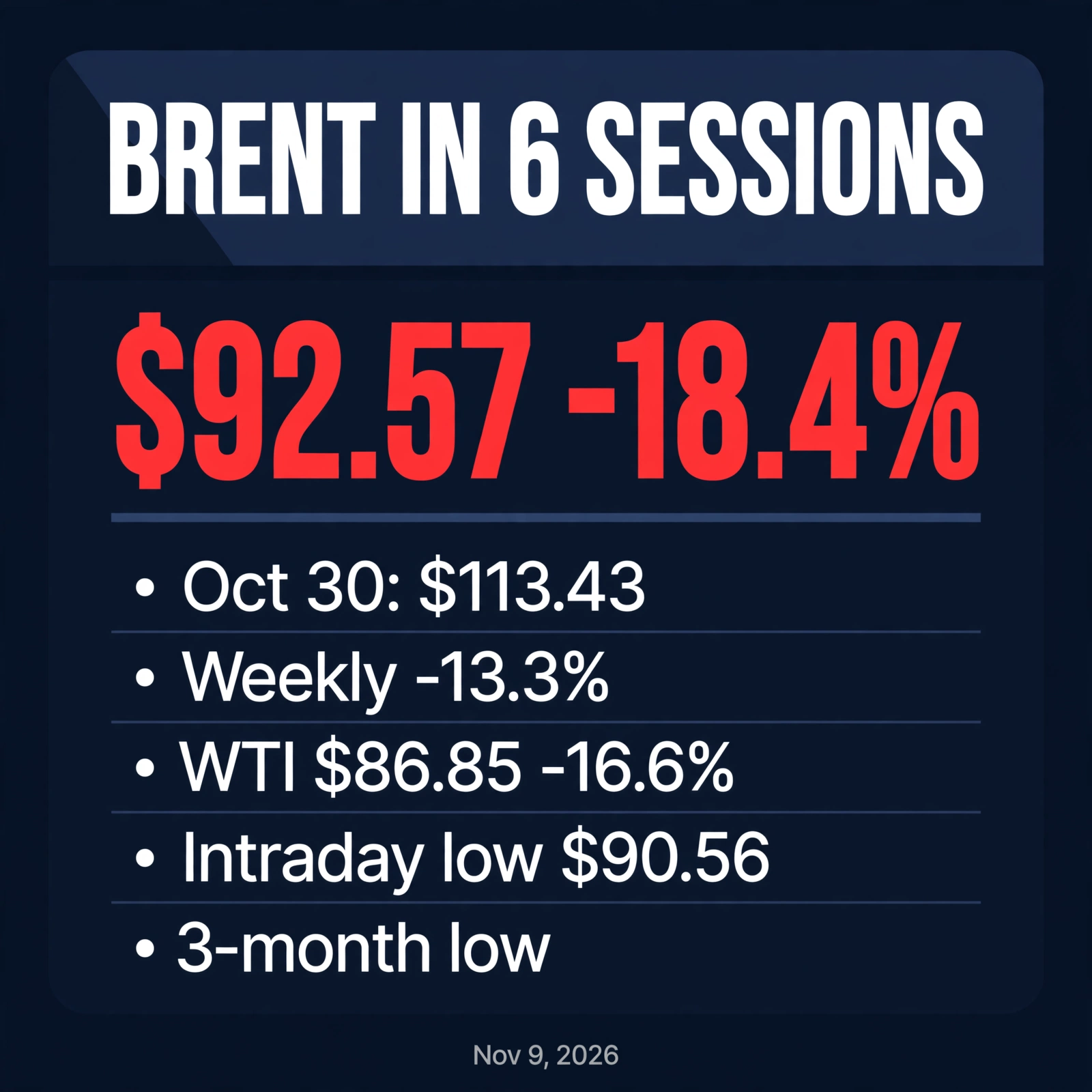
Oil was the trigger. Brent for January fell $5.75 (−5.85%) to $92.57 a barrel, and WTI for December dropped $3.98 (−4.38%) to $86.85. Both benchmarks hit three-month lows, and WTI touched $85.02 intraday — its lowest since August. Brent has fallen 18.4% in six sessions, from $113.43 on October 30 to $92.57, and WTI 16.6% over the same stretch, from $104.12 to $86.85.
Negotiation hopes did the work. Trump said on Sunday that fresh strikes on Iran were “highly unlikely” as long as talks make progress. Qatari mediators delivered Tehran’s latest proposal in person on Monday, and Qatar’s prime minister met Trump at the White House the same day. But Iran’s foreign minister said no formal agreement has been reached, and Secretary of State Marco Rubio called Tehran’s demands “unacceptable”. The talks are open; a deal is not.
The waterway is still dangerous. A tanker was reported hit by an unknown projectile near the Strait of Hormuz over the weekend, and a Houthi missile damaged a Saudi Aramco administrative building in Riyadh on Sunday. Maritime insurance for Hormuz transits still runs 6–10% of hull value, putting a single tanker voyage at $6–10 million. On supply, analysts see a global surplus of about 1.4 million barrels a day pressing on prices. The market judged the war premium is unwinding fast — and oil moved first.
Cheaper oil helps stocks for a simple reason. Lower energy costs ease inflation pressure, which weakens the case for the Fed to raise rates further. But December hike odds still stand at 82.2% on CME FedWatch. Oil alone has not changed the rate path. Tuesday’s CPI is the first checkpoint that can move those odds.
Chips rose — except Nvidia
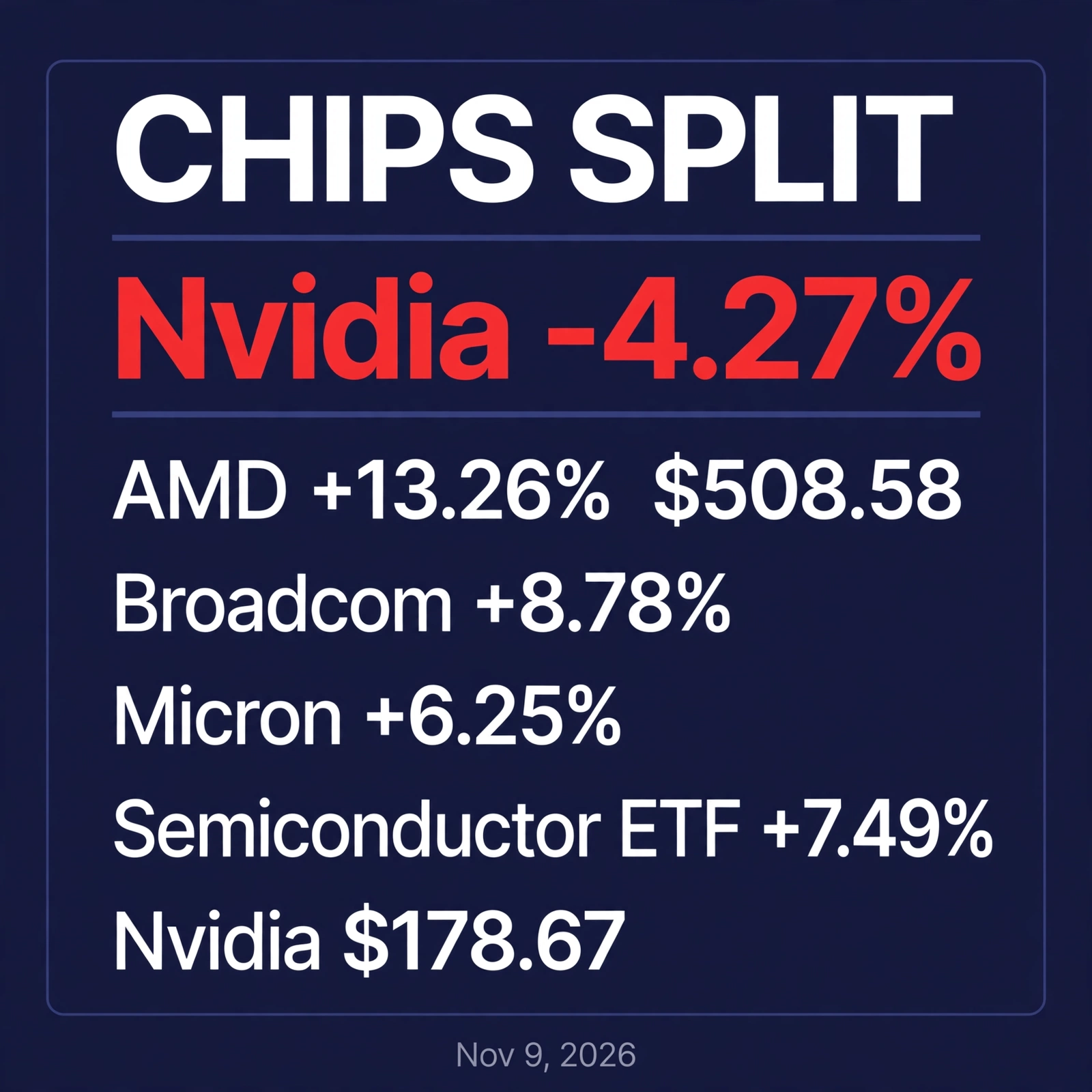
The day’s most dramatic split was in semiconductors. The Philadelphia Semiconductor Index (SOX) rose more than 6% and reclaimed 10,000, while the semiconductor ETF (SOXX) closed up 7.49% at $146.76. That is the mirror image of last week, when the SOX plunged more than 12% for its biggest weekly drop since the week ended April 4, 2025. AMD jumped 13.26% to $508.58, Broadcom rose 8.78% to $319.48, and Micron gained 6.25% to $733.15. AMD got an Oppenheimer upgrade (target $600) and a forecast of 135% data-center revenue growth in 2027 — on top of an 11.04% gain on Friday.
But Nvidia went the other way, falling 4.27% to $178.67 — the only decliner in the SOX. It fell as low as $170.24 intraday, its lowest since March 31. The stock is down 12.69% over five sessions and 22.07% over a month, and sits 26.6% below its October 6 record of $243.37. The trigger is the board’s independent investigation into CEO Jensen Huang that broke over the weekend. Nvidia reports earnings November 17, and Huang faces a closed-door briefing with three House committee chairs on November 18.
Wall Street’s verdict was “overdone.” Morgan Stanley and UBS said last week’s AI rout was overdone, and the risk of extreme data-center regulation under a Democratic Congress was unlikely to play out. The market priced AI demand and leadership risk separately on Monday. Chips up while the AI leader falls means stock-picking has started inside the AI trade.
Other names moved too. Constellation Energy rose 10.46% to $276.09 after third-quarter adjusted EPS of $5.06 beat the $3.89 estimate and full-year guidance was raised. KKR gained 1.9% on record quarterly profit, Tesla rose 5.54%, and airlines rallied on cheaper fuel. First Solar fell 4–5% on a Piper Sandler price-target cut.
- SOX (Philadelphia Semiconductor Index): An index of 30 major US chip stocks — the sector's thermometer. It holds AMD, Broadcom, Micron and Nvidia.
- VIX (fear gauge): Expected 30-day volatility implied by S&P 500 options. Below 20 reads as relatively calm. It fell from 25.64 on Friday to 19.82 intraday on Monday.
- Brent vs WTI: The two crude benchmarks — Brent from the North Sea, WTI from the US. On Monday Brent fell 5.85% and WTI 4.38%.
- CME FedWatch: Rate-hike odds implied by fed funds futures. December hike odds of 82.2% mean the market heavily prices another increase.
- CPI month-on-month vs year-on-year: Month-on-month compares prices with the prior month; year-on-year with a year earlier. October's CPI will carry no year-on-year figure — October 2025 prices were never collected during the shutdown.
- CoreWeave: An AI cloud company reporting third-quarter results after Tuesday's close — a joint test of AI compute demand and debt burden.
The summary is short. US stocks rose more than 2% on Monday and retraced about half of last week’s rout. Brent crude fell 18.4% in six sessions, and chips surged with Nvidia the only decliner. The rebound was built on cheaper oil, not on doubts about AI spending going away. October CPI arrives Tuesday at 8:30 AM ET (10:30 PM KST). Consensus is +0.3% month-on-month for headline and +0.2% for core, and no year-on-year figure will be published. CoreWeave reports after the close the same day (revenue consensus near $3.54 billion). Wednesday is Veterans Day — the bond market closes while stocks stay open — and the OPEC monthly report lands. PPI follows on Friday. Whether Monday was a retracement or a turn, CPI answers first.
Sources & references
- Reuters via Kitco — Wall St jumps back as oil slide eases inflation worries; Nvidia slumps — Monday final closes (Dow 52,417.54, S&P 7,554.67, Nasdaq 25,235.49), all 11 sectors higher, SOX up more than 6%, Nvidia the index's sole decliner
- DTN — WTI Tests $85 as U.S.-Iran De-Escalation Seen — WTI settled $86.85 (−4.38%), Brent $92.57 (−5.85%), session lows, global surplus near 1.4 million barrels a day, Qatari mediators delivering Tehran's proposal
- Reuters via Kitco — Gold climbs more than 1% as inflation fears ease on lower crude prices — December gold futures settled $4,114.50 (+1.0%); December Fed hike odds 82.2% (CME FedWatch)
- CoreWeave IR — CoreWeave Announces Date of Third Quarter 2026 Financial Results — Q3 earnings call Tuesday, November 10, 5:00 PM Eastern
Related articles
- US Stock Market Weekly Recap Nasdaq Falls 3.4 Percent Thursday AI Rout and Correction Analysis
US stock market weekly recap for November 2–6. The S&P 500 fell 2.7%, the Nasdaq 3.4% and the Dow 0.9%, and Thursday's AI sell-off pushed the Nasdaq into correction territory. Midterms, the jobs report and the Hormuz oil plunge, plus next week's CPI and PPI checkpoints.
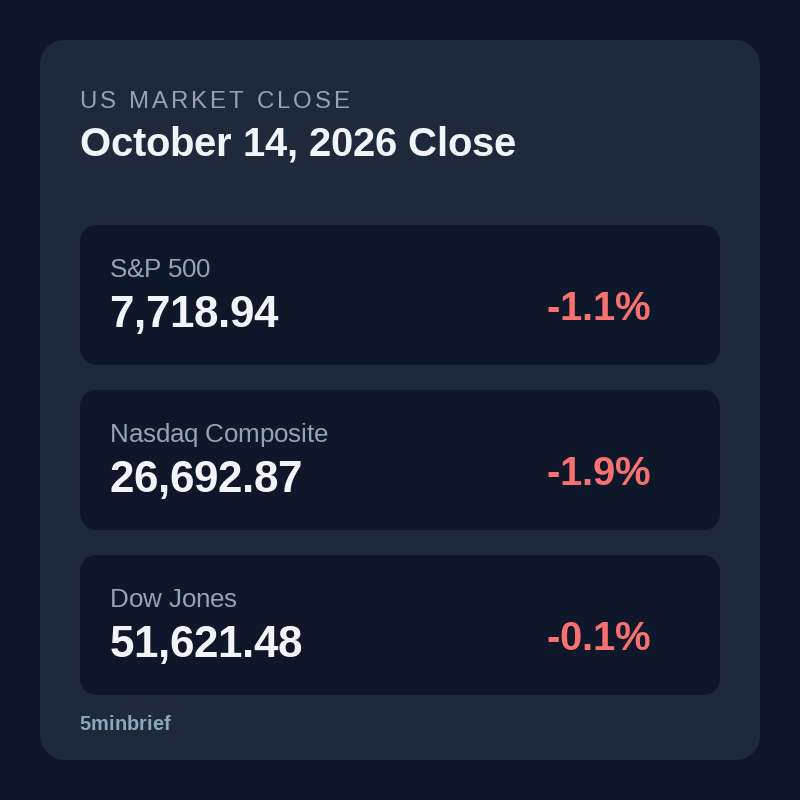
- September CPI Market Reaction S&P 500 -1.1% Nasdaq -1.9% SOX -4.3%
October 14, 2026 market close: hotter-than-expected September CPI revived Fed rate-hike fears, sending the Nasdaq down 1.9%. What happened, in plain English.
- Brent Crude Analysis: 18.4% Drop in Six Sessions on Negotiation Hopes
Brent crude has fallen 18.4% in six sessions, from $113.43 on October 30 to $92.57 on November 9. The war premium is unwinding fast — but analysts put renewed strikes at 60%, and that gap sets the terms for a reversal.
5minbrief on YouTube
The briefs also come as videos. Get the daily market wrap on YouTube.
Subscribe on YouTube