 5-minute briefs
Data Center Regulation HBM Demand Analysis Construction Delay Memory Order Chain
The numbers behind the fear — Texas 25%, Goldman Sachs 45%, ballots 33 of 45
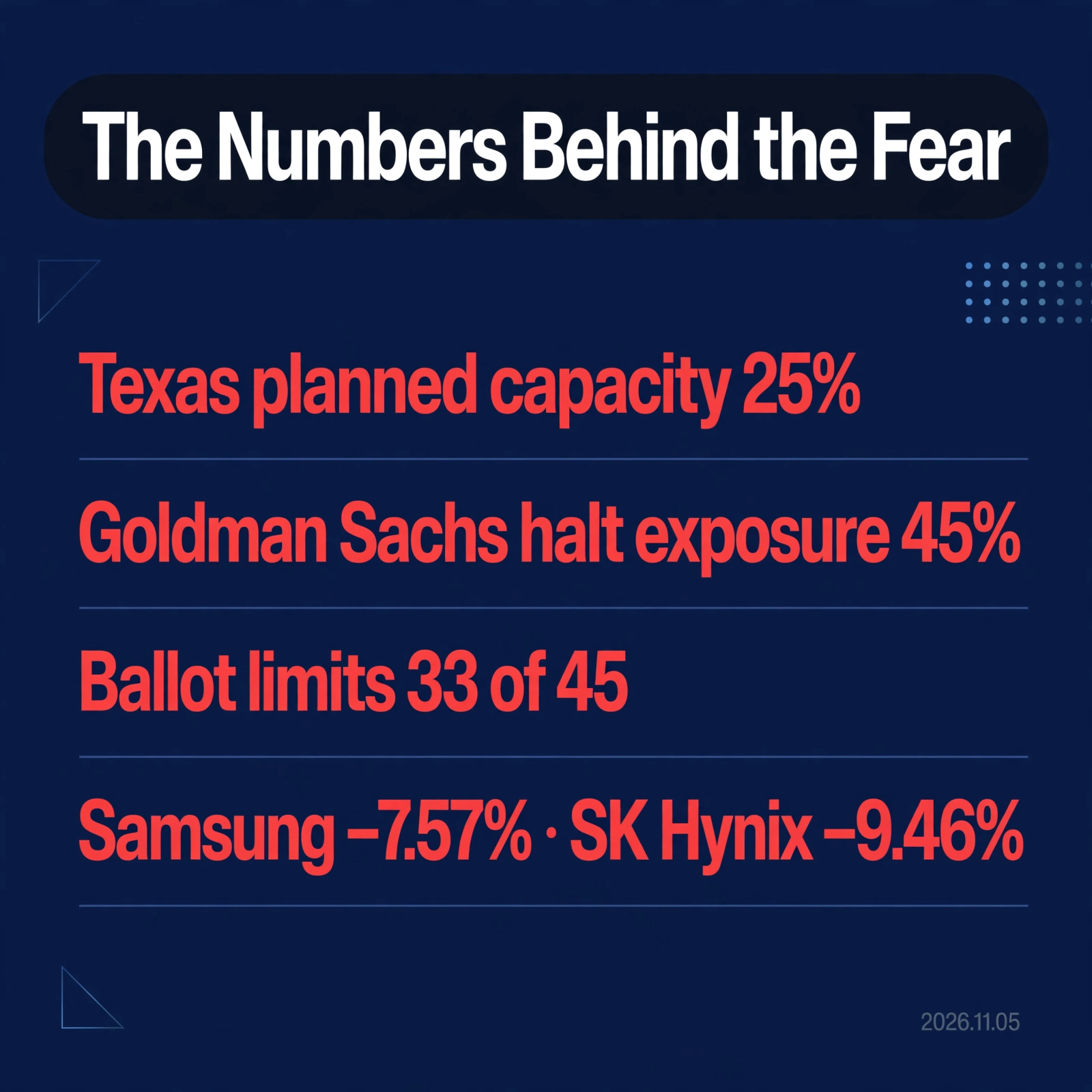
The fear now comes with specific numbers. Texas holds about 25% of planned US data-center construction capacity, and its governor-elect — the first Democrat to win the office in more than 30 years — campaigned on pausing new data-center approvals and cutting tax benefits for developers, citing residents’ electricity bills and water shortages. Candidates who campaigned on tougher data-center rules also won governor races in Georgia and Ohio. In local ballots held with the midterms, 33 of 45 data-center measures favored limits on construction. Goldman Sachs estimates that the Democratic wins at state and local level could leave about 45% of planned US data-center capacity additions exposed to temporary halts.
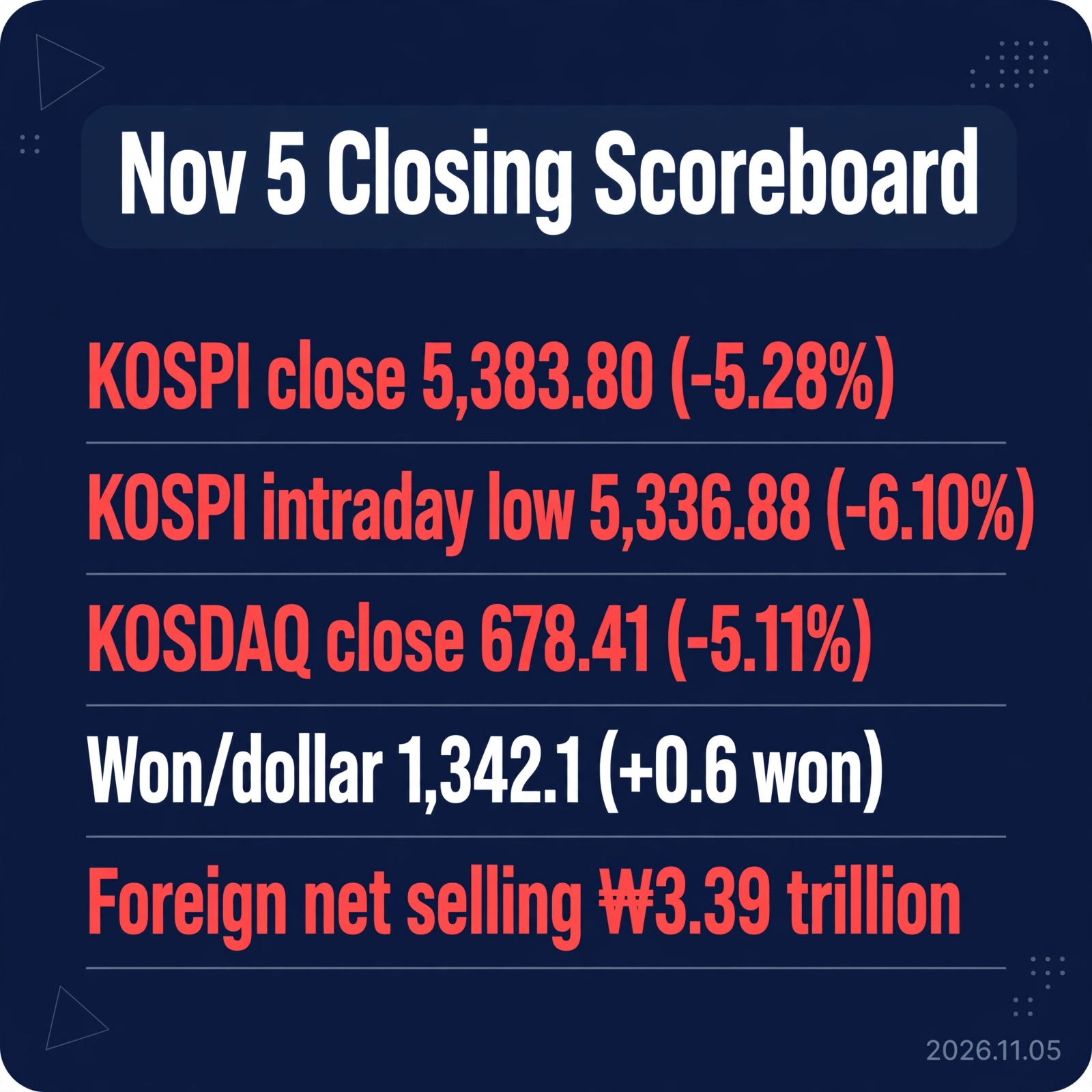
Read literally, those numbers say nearly half of America’s AI infrastructure expansion could stop. The market priced that reading today: the KOSPI fell 5.28%, with Samsung Electronics down 7.57% and SK Hynix down 9.46%. Foreign investors sold a net 3.39 trillion won on the main board, concentrated in the two chipmakers.
The transmission chain — four steps from a permit to an HBM order
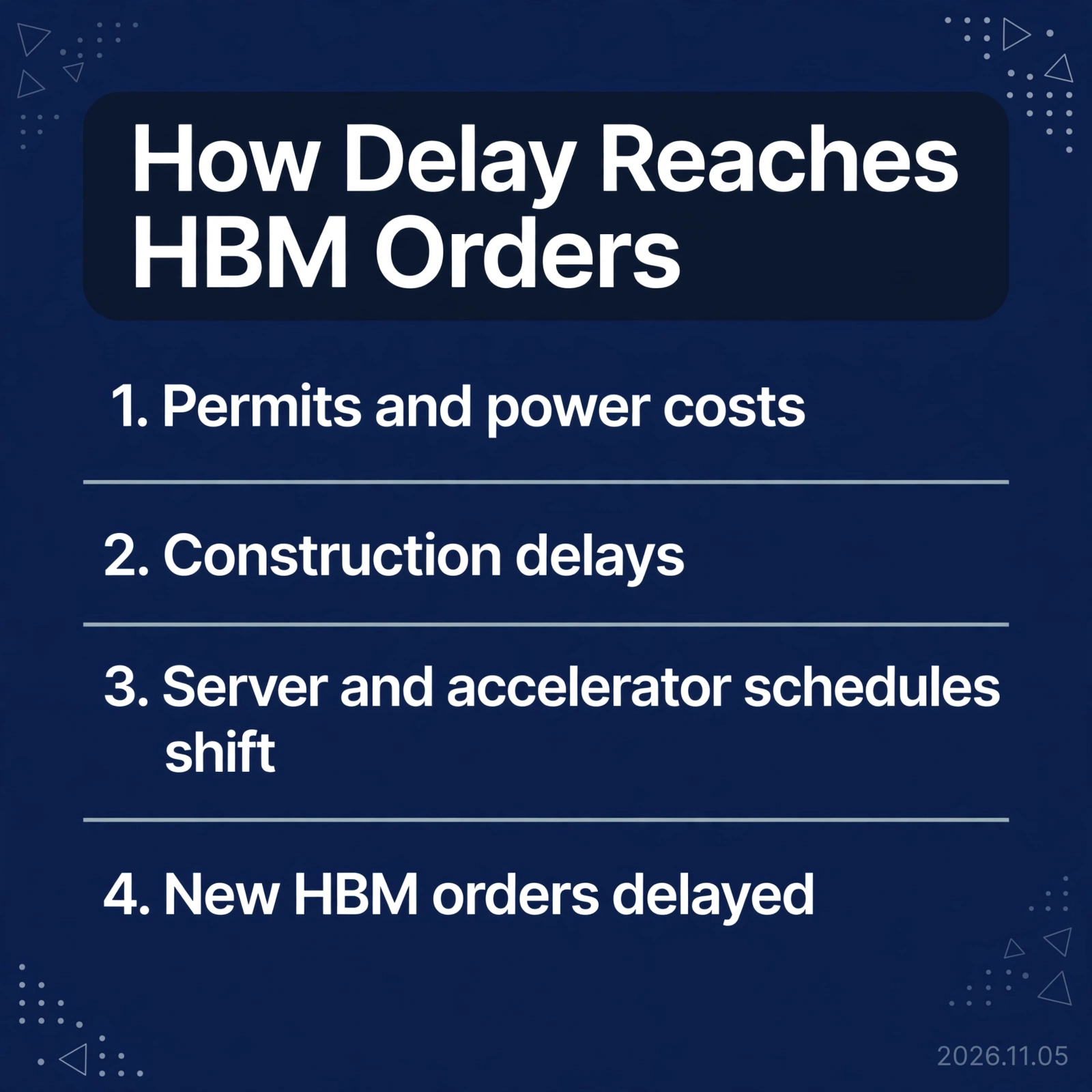
The chain from regulation to memory demand has four steps. First, permits and power costs: pauses on new approvals, higher power-cost burdens for developers, and smaller tax benefits. Second, delayed construction: late permits mean late groundbreakings. Third, adjusted accelerator and server installation schedules: a late building delays the equipment that goes inside it. Fourth, delayed new orders for HBM and server DRAM. Samsung Electronics and SK Hynix have expanded HBM and server DRAM supply on the back of Big Tech’s AI data-center investment, so a construction delay can push their new order schedules back.
The key point is where regulation actually strikes. It aims at step one — permits and costs — not at step four, memory orders. Projects already under construction and existing facility expansions are proceeding, and the memory for those volumes is already ordered. For regulation to cut memory demand, a delay at step one must actually propagate through steps two and three to step four. Today’s prices assigned a probability to that propagation; the propagation itself has not been confirmed.
The counter-argument — three reasons demand is still intact
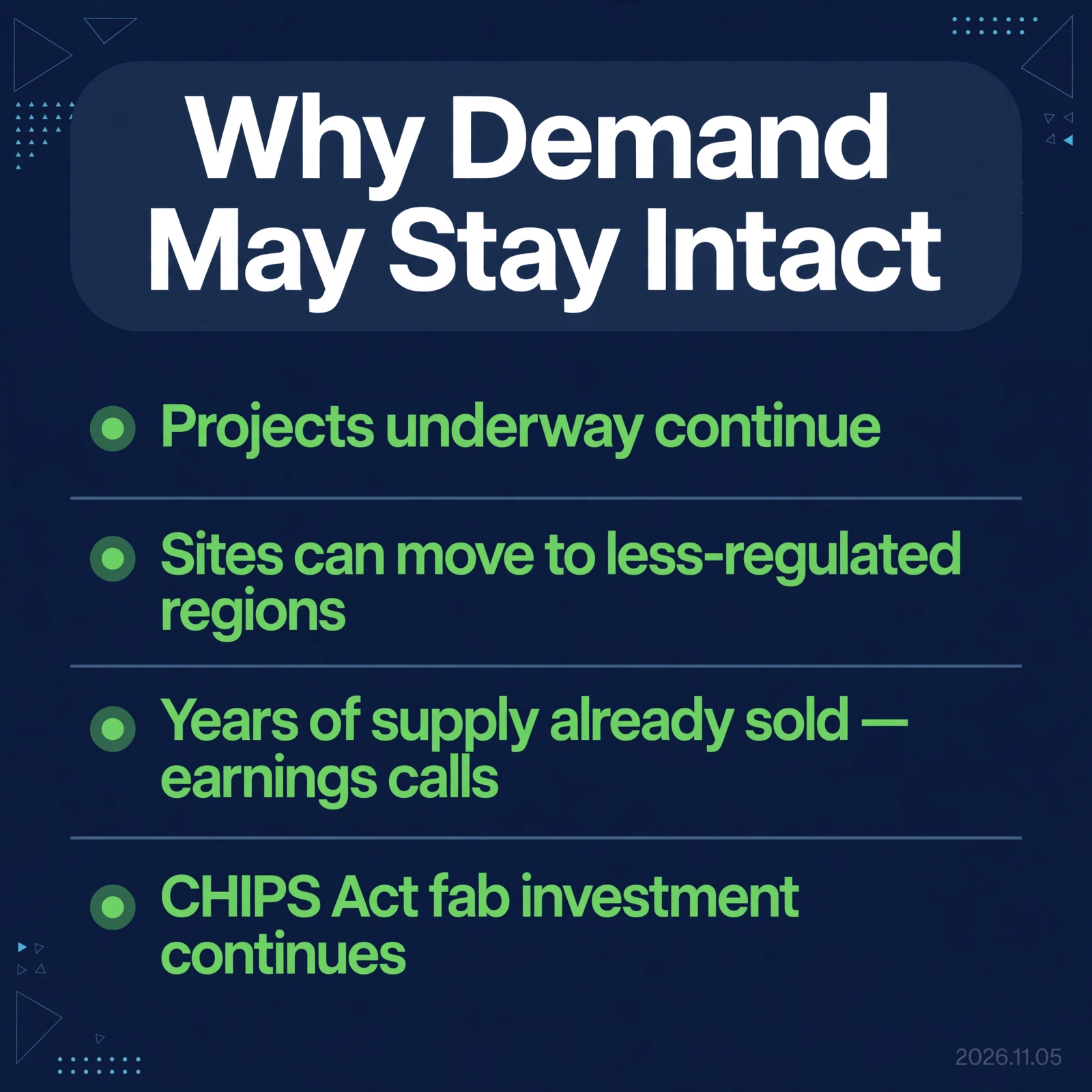
The counter-argument is substantial. First, projects already underway continue: the debate targets new approvals, not construction already in progress. Second, relocation is possible: Bloomberg’s assessment is that developers can move sites to less-regulated regions, so total demand need not fall quickly. A Bloomberg economist formerly at the Bank of Korea put it plainly — semiconductor demand should stay fairly solid for now. Third, order visibility: recent semiconductor earnings calls have described demand as strong enough that supply for years ahead is already sold.
Samsung Securities expects the likelier path to be smaller tax benefits and higher cost burdens rather than long construction delays. Samsung and SK Hynix’s US fab investments also rest on subsidies under the 2022 CHIPS Act, which has continued largely without disruption, so the election’s effect on local investment looks limited. A trade professor at Myongji University noted that even with Congress and statehouses in hand, Democrats will find it hard to actively block investment in data centers — the core infrastructure of the AI industry.
What it means for Samsung and SK Hynix — fear today, confirmation tomorrow
Today’s foreign selling concentrated on the two names. By one broker tally, foreigners sold 1.5203 trillion won of SK Hynix and 1.1626 trillion won of Samsung Electronics — 2.6829 trillion won in two stocks, most of the day’s 3.3928 trillion won of foreign selling. Overnight in the US, Micron fell 7.00% and SanDisk 7.91% on the same demand-delay worry.
The short term and the long term need separating. In the short term, volatility is likely to persist while the scope of regulation stays uncertain. In the longer term, as the Hyundai Research Institute’s research head noted, semiconductor demand turns negative only if data-center regulation actually changes investment schedules. If Big Tech confirms its AI spending plans and the governors’ measures stop at smaller tax benefits, today’s plunge reads as an overreaction. The fork in the road is bills, permitting schedules, and Big Tech’s spending confirmations.
What to watch, in order — permits, Big Tech plans, HBM visibility
Three checks, in order. First, the first permitting decisions and tax-benefit adjustments after the new governors take office in Texas, Georgia, and Ohio — whether new-approval pauses are actually imposed or the measures stay at tax-benefit cuts. Second, Big Tech’s AI spending confirmations in earnings and guidance. Third, changes in HBM order visibility — whether Samsung and SK Hynix keep saying years of supply are already sold on their earnings calls, and whether new order schedules shift. Until those three checks resolve, today’s 5% drop is the price of fear, not a measurement of demand.
Not investment advice. Figures are Korea Exchange, Yonhap, The Korea Herald, The Korea Times, MoneyToday, and NoCut News reports confirmed November 5, 2026.
Watch the video

Sources & references
- Yonhap News Agency — (LEAD) Seoul shares plunge over 5 pct on AI regulation concerns after U.S. midterms — KOSPI 5,383.80 (-5.28%), Samsung Electronics -7.57%, SK Hynix -9.46%, foreign selling 3.39 trillion won
- The Korea Herald — Kospi tumbles over 5% as foreigners dump W3.39tr in shares amid AI investment fears — Data-center moratorium fears, foreign net selling 3.39 trillion won ($2.53 billion)
- NoCut News (English) — Korean Market Takes Direct Hit From 'Blue Tsunami' — 33 of 45 local data-center ballot measures favored limits on construction
- The Korea Times — KOSPI tumbles as Democrat sweep fuels AI infrastructure concerns — Democratic sweep in Texas, Georgia, Ohio; Micron -7.00% overnight; Samsung and SK Hynix about half of KOSPI market cap
- MoneyToday (English) — 'Blue wave' sparks AI regulation fears, sending KOSPI and Kosdaq down 5% — Close 42.64% below the June 19 record high, Samsung intraday low 199,800 won
Related articles
- Nvidia Jensen Huang Probe Analysis AI Leadership Risk and Korea Chip Exposure
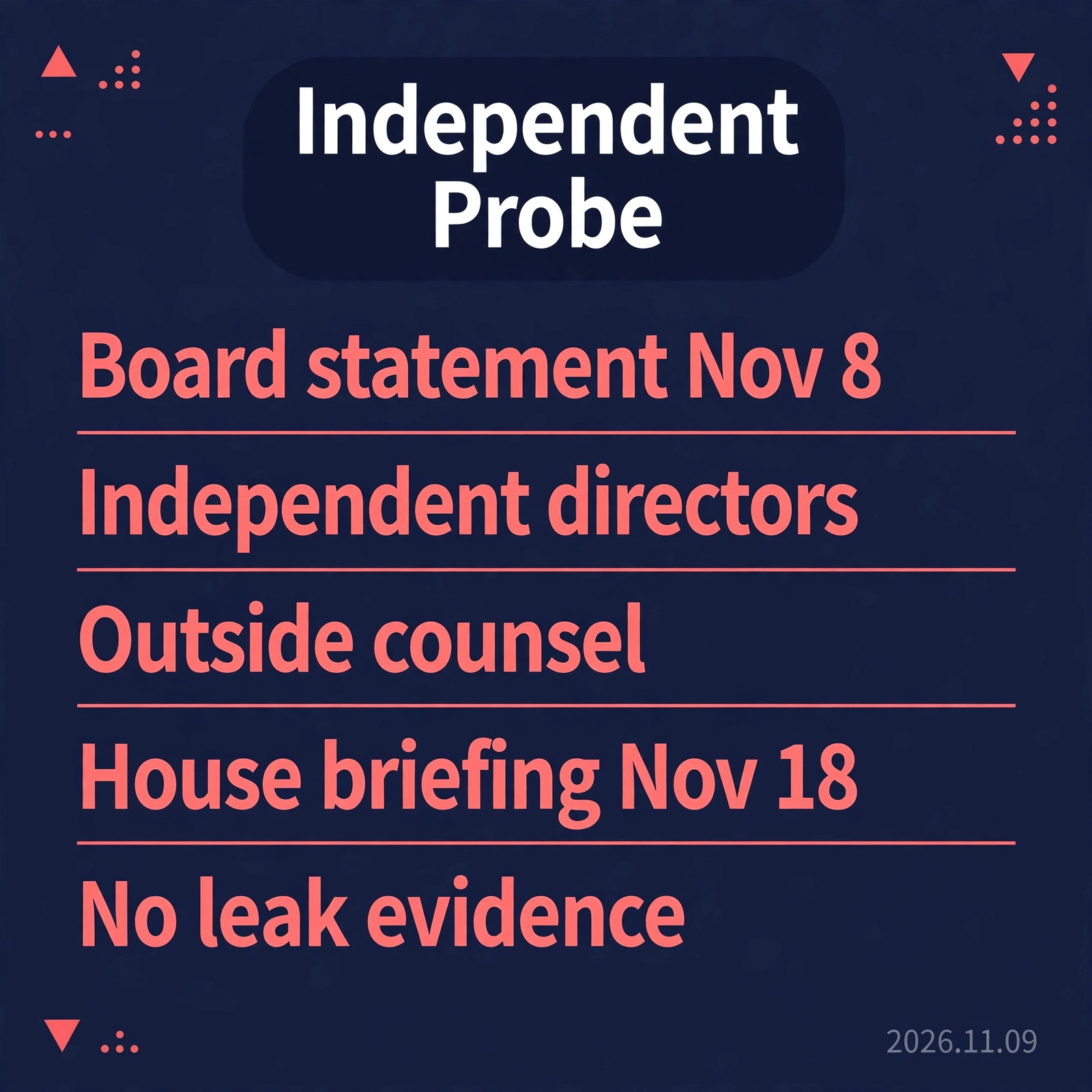
Nvidia's board opened an independent probe into CEO Jensen Huang. Huang admitted to an affair but the board says there is no evidence secrets leaked. Shares fell 9.26% Thursday, bounced 2.78% Friday, then slipped toward $180 overnight — and Korea's market feels it first.
- KOSPI 5.28% Plunge Analysis Blue Wave Data Center Regulation Foreign Selling
November 5 Korea market brief for foreign investors: the KOSPI plunged 5.28% to 5,383.80 and the KOSDAQ fell 5.11% to 678.41 as blue-wave AI data-center regulation fears drove 3.39 trillion won of foreign selling and triggered sell-side sidecars in both markets.
- KOSPI US Midterm Volatility Analysis 406-Point Swing Foreign Selling Rebound
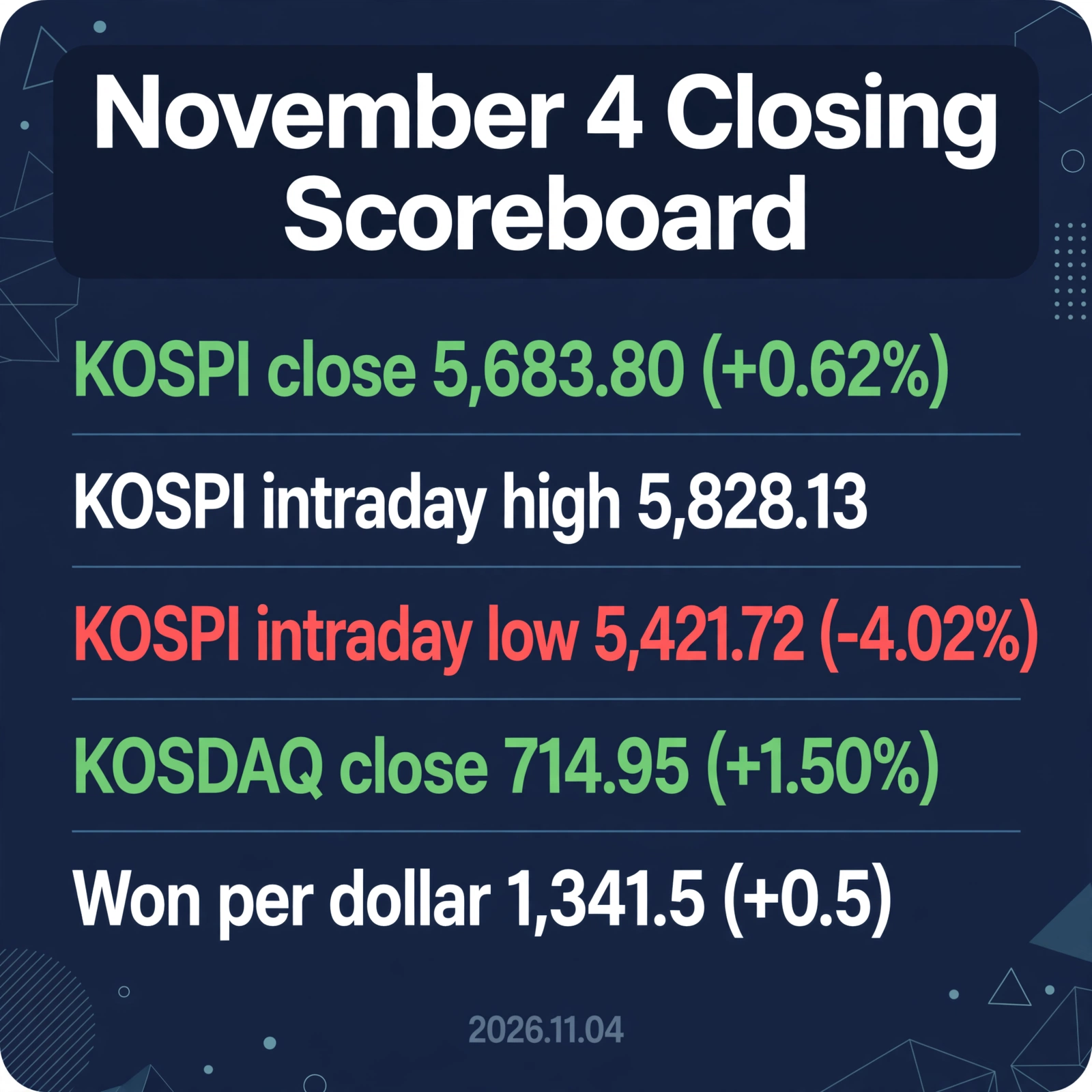
November 4 Korea market brief for foreign investors: the KOSPI swung 406.41 points intraday on US midterm vote counting, then closed up 0.62% at 5,683.80. Foreigners sold a net 2.5045 trillion won while retail and institutions bought 2.1602 trillion won, and battery and solar stocks surged on Democratic policy expectations.
5minbrief on YouTube
The briefs also come as videos. Get the daily market wrap on YouTube.
Subscribe on YouTube