 5-minute briefs
KOSPI 5.28% Plunge Analysis Blue Wave Data Center Regulation Foreign Selling
#KOSPI plunge#blue wave#data center regulation#foreign selling Korea#Samsung Electronics stock#SK Hynix stock#won dollar
The closing scoreboard — both indexes down more than 5%, intraday low 5,336.88
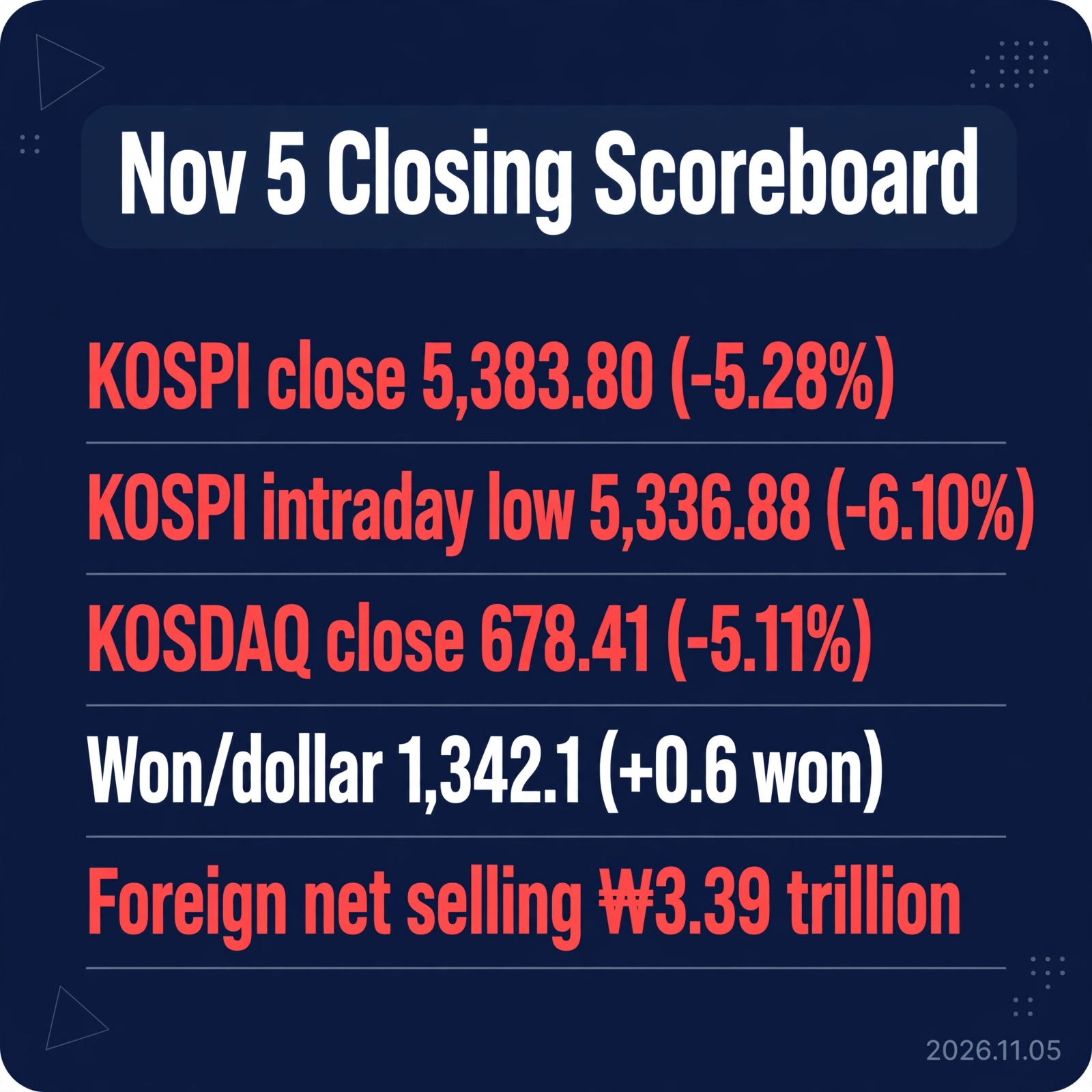
The Korea Exchange reports the KOSPI closed at 5,383.80, down 300.00 points (5.28%). The index opened at 5,580.09, down 1.82%, and never traded higher. It fell as far as 5,336.88, down 6.10% intraday. The KOSDAQ closed at 678.41, down 36.54 points (5.11%), after touching 673.38, down 5.81% intraday. By close, the KOSPI stood at its lowest level since early April and 42.64% below its June 19 intraday record high of 9,385.59 — far past the 20% drawdown that conventionally defines a bear market.
| Index | Open | Intraday high / low | Close | Change |
|---|---|---|---|---|
| KOSPI | 5,580.09 | — / 5,336.88 | 5,383.80 | –5.28% |
| KOSDAQ | — | — / 673.38 | 678.41 | –5.11% |
| Won / dollar | 1,338.5 won | 1,337.9 / 1,344.7 won | 1,342.1 won | +0.6 won |
Why it fell — the blue wave, data-center rules, and a split US session
The trigger came overnight in the US, where the market itself was split. The Dow jumped 2.93% on the removal of election uncertainty, but the Philadelphia Semiconductor Index fell 3.13%, with Micron down 7.00%, Nvidia down 3.17%, and Broadcom down 2.00%. Korean chip stocks inherited that half of the US session.
The fear has specific content. Democrats took both chambers of Congress, and candidates who campaigned on tougher data-center rules also won governor races in Texas, Georgia, and Ohio — the states where US AI data-center investment is concentrated. Texas alone holds about 25% of planned US data-center construction capacity, and its governor-elect campaigned on pausing new approvals and cutting tax benefits for developers. In local ballots held with the midterms, 33 of 45 data-center measures favored limits on construction. Goldman Sachs estimates that about 45% of planned US data-center capacity additions could face temporary halts after the Democratic wins at state and local level.
The counter-argument is that a permit delay is not a demand collapse. Projects already under construction continue, Big Tech’s long-term AI spending plans remain intact, and Bloomberg’s assessment is that the impact on Korean memory makers is limited because demand itself is not falling. Samsung Securities expects the likelier path to be smaller tax benefits and higher cost burdens for developers rather than long construction delays. So November 5 was not the day regulation changed — it was the day fear about the scope of regulation was priced at 5% before any bill exists. Bills and state permitting schedules will decide whether that fear was right.
Flows — foreigners sold 3.39 trillion won, locals bought but could not hold the line
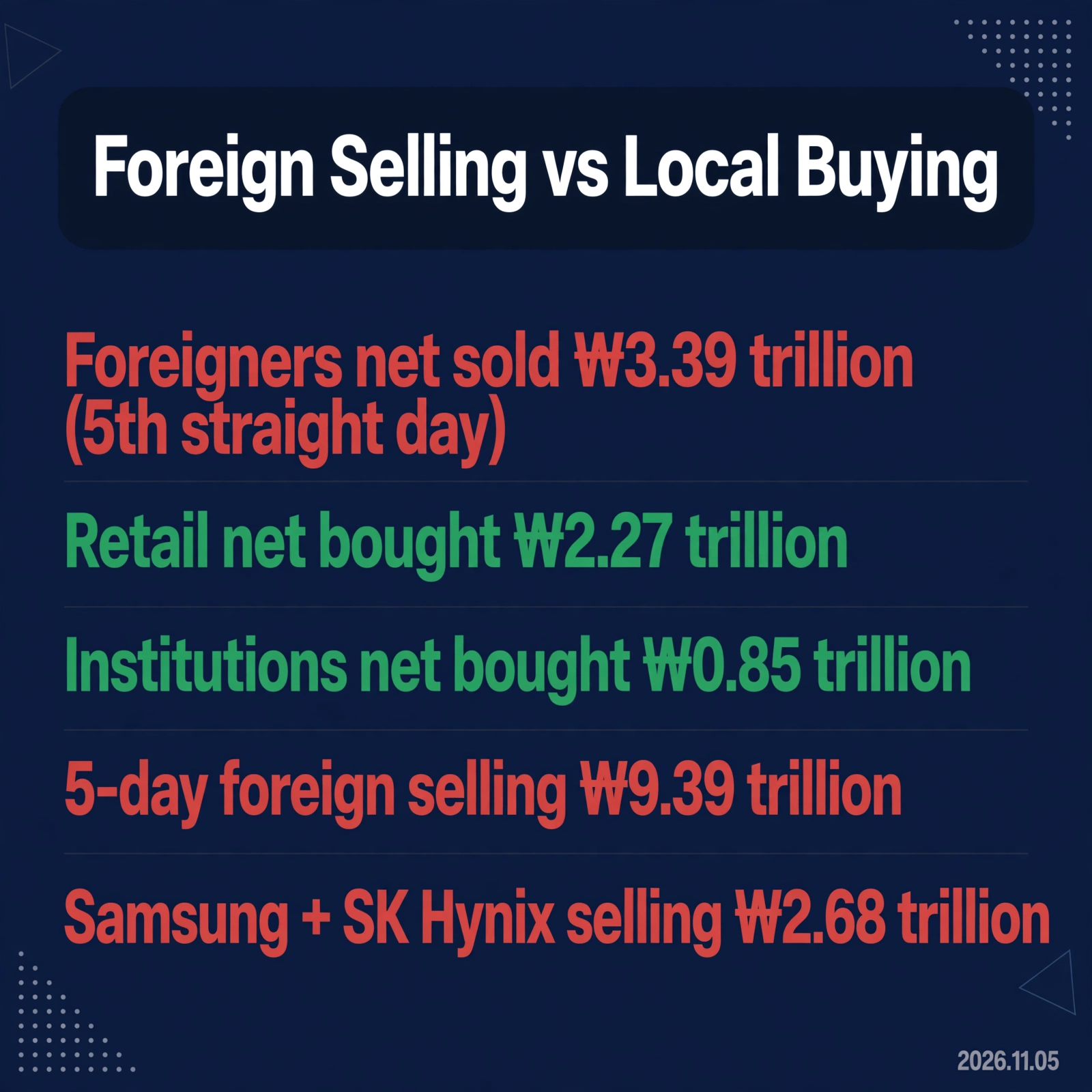
On the main board, foreign investors sold a net 3.3928 trillion won, the largest daily foreign outflow since October 15 and the fifth consecutive day of foreign selling, totaling 9.389 trillion won (about $7.0 billion) over the five sessions. Retail investors bought a net 2.2722 trillion won and institutions bought a net 845.7 billion won. Locals also bought heavily yesterday, absorbing 2.1602 trillion won, but today’s foreign selling was larger, so the index could not hold. The selling was concentrated: by one broker tally, foreigners sold 1.5203 trillion won of SK Hynix and 1.1626 trillion won of Samsung Electronics — 2.6829 trillion won in just two stocks. On the KOSDAQ, retail investors bought a net 172.0 billion won while foreigners sold 73.4 billion won and institutions sold 102.6 billion won.
- A sidecar halts program sell orders for five minutes when futures fall fast — 5% for KOSPI 200 futures, and 6% for KOSDAQ 150 futures plus a 3% index drop sustained for one minute. It triggered at 10:16 a.m. on the KOSPI and 2:27 p.m. on the KOSDAQ, the first time both fired on the same day since October 15.
- It is not a circuit breaker. Korea's market-wide circuit breakers halt all trading at 8%, 15%, and 20% index declines; a sidecar only pauses automated program selling. The US equivalent is different again — market-wide halts at 7%, 13%, and 20% of the S&P 500, with no futures-based program-trading pause.
- Foreign flows are the swing factor. Overseas investors set the marginal price in Korean large caps, so a 3.39 trillion won foreign sale day drags the index even when locals buy more than 3 trillion won back.
Do not read the retail buying as a rescue. A five-day foreign selling streak does not reverse because locals bought one day’s dip. The practical read is narrow: watch whether foreign selling continues tomorrow and whether institutional buying holds — those two lines, not today’s close, decide whether this was a washout or the start of another leg down.
Stocks and sectors — chip leaders crashed, autos, pharma, and banks rose
Samsung Electronics closed down 7.57% at 201,500 won and SK Hynix down 9.46% at 1,264,000 won. Samsung briefly fell below 200,000 won intraday, to 199,800 won. The selloff spread across the AI supply chain: Samsung Electro-Mechanics (–15.34%), SK Square (–10.01%), Hanmi Semiconductor (–9.13%), LS ELECTRIC (–13.87%), and Hyosung Heavy Industries (–12.59%) all fell sharply. On the KOSDAQ, Simtec (–17.97%), Eo Technics (–16.21%), Jusung Engineering (–12.21%), EcoPro BM (–7.72%), and EcoPro (–7.54%) led the decline.
The other side was equally clear. Celltrion (+7.50%), KB Financial (+3.63%), Hyundai Motor (+3.53%), and Samsung Biologics (+1.67%) rose, and on the KOSDAQ Alteogen (+3.68%) and Samchundang Pharm (+0.46%) gained. Hyundai Motor rose on expectations that a Democratic Congress weakens the hardline tariff stance. By sector, as of 11 a.m., pharmaceuticals (+4.48%), entertainment and culture (+4.20%), and food and tobacco (+4.07%) led, while medical precision equipment (–9.06%), electrical and electronics (–6.67%), and manufacturing (–5.12%) fell. Combined with yesterday’s battery and solar surge, the market is reading the blue wave as a policy rotation with different signs by sector, not a single negative shock. For an EWY holder, that is the governance lens in action: owning the index means owning both sides of a US political bet.
What to watch next — the won barely moved, and three checks decide the trend
The won barely moved. At 1,342.1 per dollar, up just 0.6 won, the currency did not confirm a broad exit from Korean assets even as foreigners sold nearly 3.4 trillion won of stocks — the selling looked stock-specific, driven by US political news, rather than a won panic. The same pattern appeared yesterday. One day of currency calm proves little on its own.
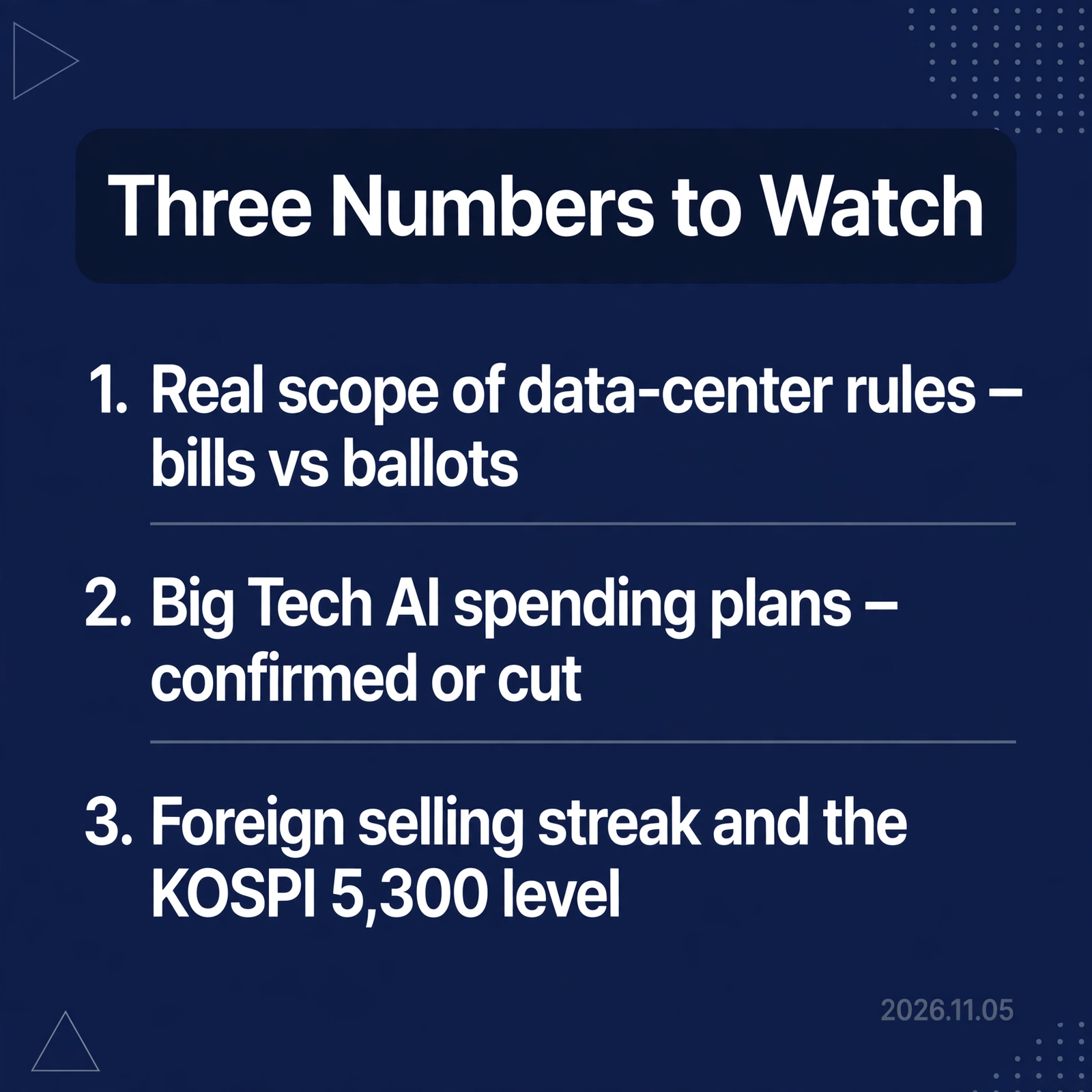
Three checks decide what November 5 meant. First, the actual scope of data-center regulation: whether permit and power-cost proposals become bills or stay at referendum level. Second, whether Big Tech confirms its AI investment plans unchanged — confirmation would frame today’s drop as an overreaction; cuts would reopen the intraday lows. Third, whether foreign selling continues and whether the 5,300 KOSPI level holds. Holding 5,300 keeps the market in a volatile range; losing it would read as a continuation of the downtrend from the June peak. Until those checks resolve, treat the 5.28% drop as a repricing of a probability, not a verdict on demand.
Not investment advice. Figures are Korea Exchange, Yonhap, The Korea Herald, The Korea Times, MoneyToday, and NewsPim reports confirmed November 5, 2026.
Sources & references
- Yonhap News Agency — (LEAD) Seoul shares plunge over 5 pct on AI regulation concerns after U.S. midterms — KOSPI 5,383.80 (-5.28%), Samsung Electronics -7.57% to 201,500 won, SK Hynix -9.46% to 1.26 million won
- The Korea Herald — Kospi tumbles over 5% as foreigners dump W3.39tr in shares amid AI investment fears — Foreign net selling 3.39 trillion won ($2.53 billion), data-center moratorium fears
- The Korea Times — KOSPI tumbles as Democrat sweep fuels AI infrastructure concerns — Samsung and SK Hynix together account for roughly half of KOSPI market capitalization, US chip losses overnight
- MoneyToday (English) — 'Blue wave' sparks AI regulation fears, sending KOSPI and Kosdaq down 5% — Close 42.64% below the June 19 intraday record high of 9,385.59, Samsung intraday low 199,800 won
- NewsPim (English) — AI Regulation Fears Spread on U.S. 'Blue Wave' as KOSPI, KOSDAQ Plunge Over 5% — Sidecar trigger times in both markets, KOSDAQ flows, power-equipment selloff
Related articles
- KOSPI 6.02% Plunge Analysis Circuit Breaker 5000 Defense Foreign Selling
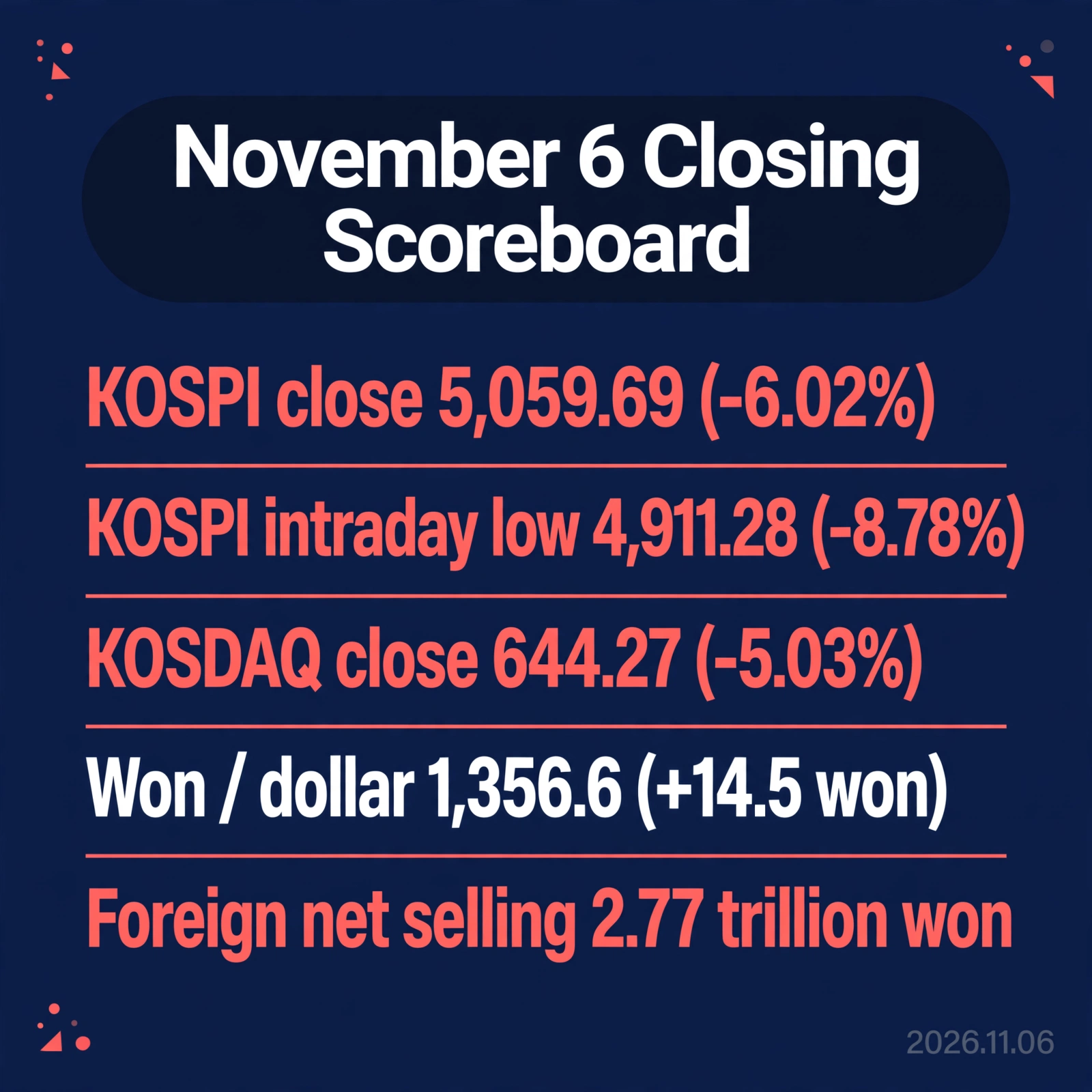
November 6 Korea market brief for foreign investors: the KOSPI plunged 6.02% to 5,059.69 as a stage-1 circuit breaker halted trading after an 8.78% intraday plunge. Foreigners sold a net 2.77 trillion won, their sixth straight day of selling, and the won fell to 1,356.6 per dollar.
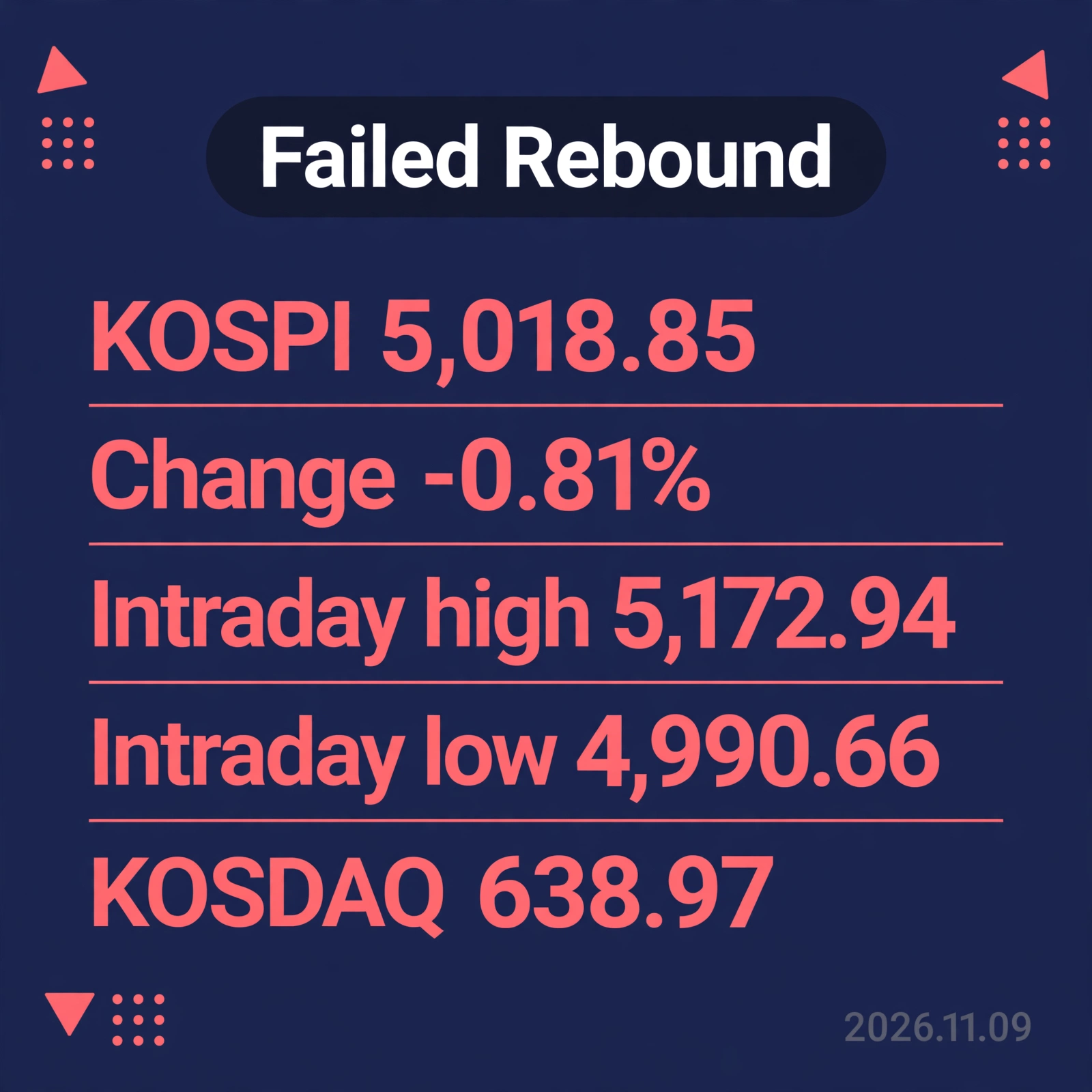
- KOSPI Failed Rebound Analysis 5,018 Close Foreign Selling Streak and Nvidia Probe
November 9 in Seoul: the KOSPI rallied 2.24% intraday to 5,172.94 but closed at 5,018.85 (−0.81%). Foreigners sold a seventh straight session, an Nvidia board probe capped the rally, and battery stocks gave back the blue-wave rally.
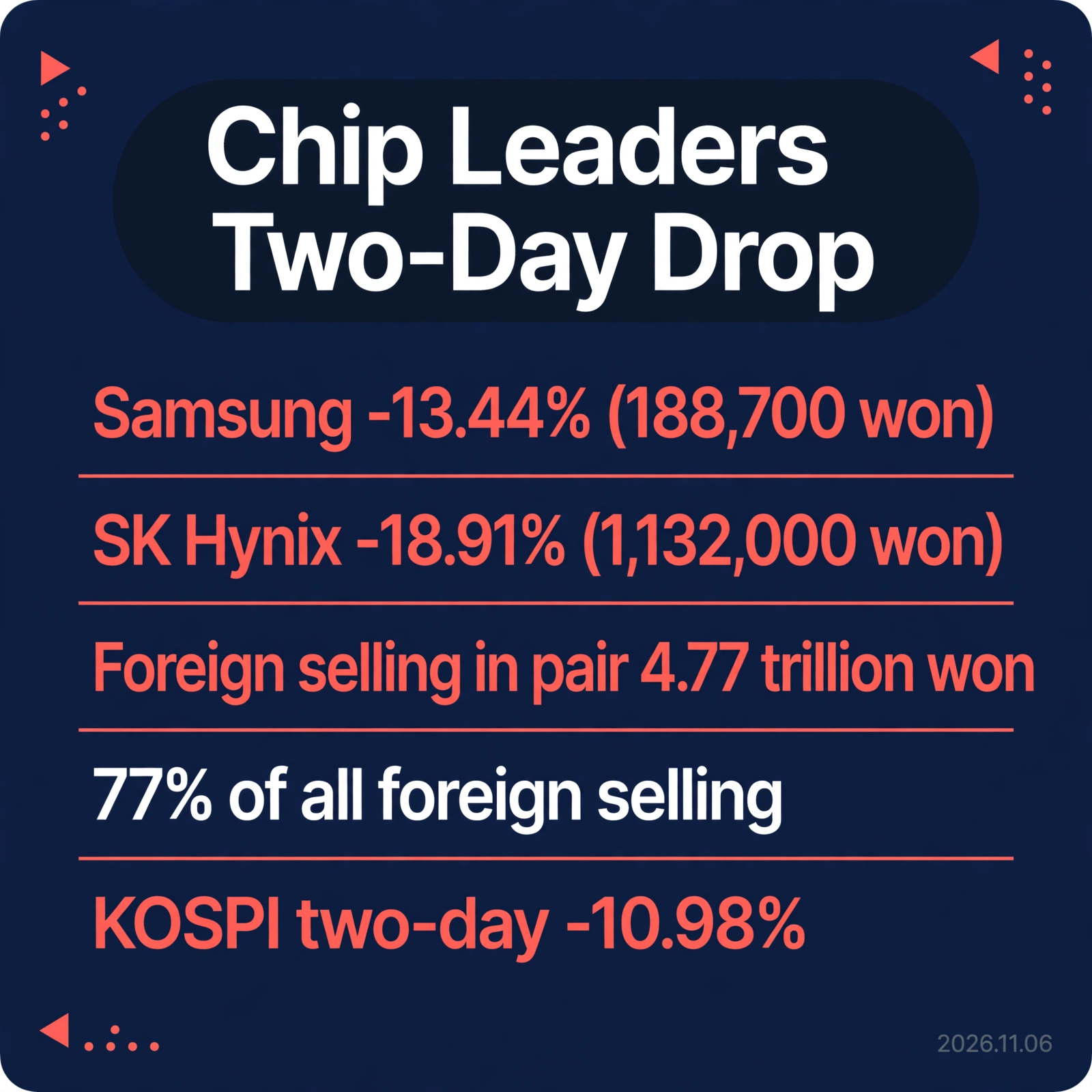
- Samsung SK Hynix Two-Day Crash Analysis 13% 19% Plunge Valuation Check
Samsung Electronics and SK Hynix fell 13.44% and 18.91% in two days as foreigners sold 4.77 trillion won of the pair. Against record third-quarter operating profits of 107.4 trillion and 83.3 trillion won, and Daishin's 5,330 line for 12-month forward PBR of 1x, this is a valuation check after the crash.
5minbrief on YouTube
The briefs also come as videos. Get the daily market wrap on YouTube.
Subscribe on YouTube