 5-minute briefs
US Midterm Gridlock Analysis Dow Rally Rotation and Limits of Policy Expectations
Why gridlock reads as good news: a narrower range of policy change
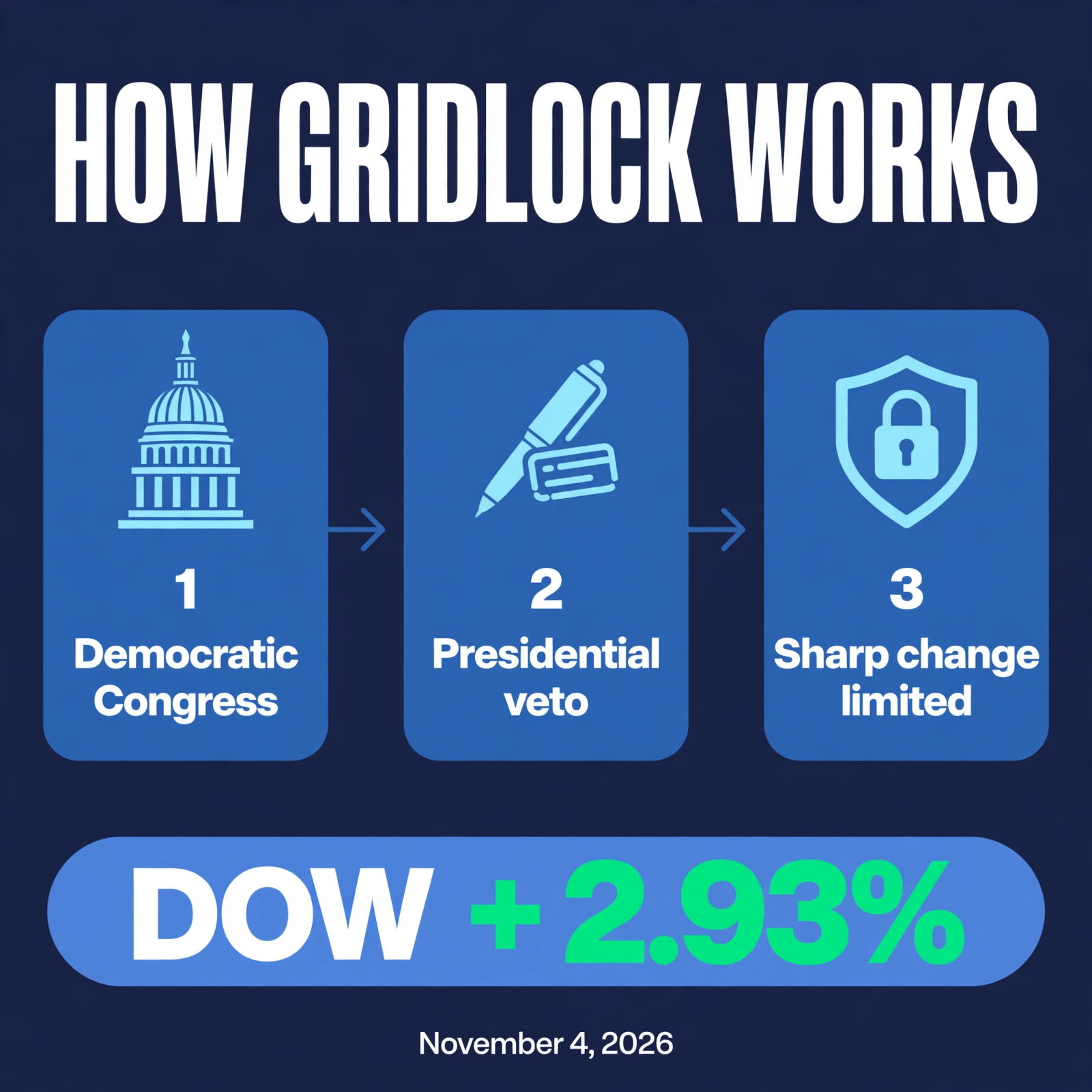
The logic of gridlock is simple. When the president and the congressional majority come from different parties, neither side can push its program through unopposed. A narrower range of policy change makes planning easier for companies, and markets read that predictability as good news. November 4 followed that logic exactly. Overnight, a Democratic sweep first read as tighter AI regulation, pushing Nasdaq 100 futures down as much as 2.4%. Then President Trump accepted the result and signaled cooperation, and the market shifted its weight to the divided-government blockade. The Dow closed up 1,515 points at 53,302.08 (2.93%), and the S&P 500 at 7,701.44 (1.75%).
A historical average adds to the story. JPMorgan Asset Management notes the S&P 500 has risen about 15% on average in the 12 months after a midterm election since 1950. Truist analysis cited by Bloomberg adds that stocks have been higher one year after every midterm since 1946. But those numbers are averages, not guarantees for this rally. An average is a distribution of the past, not the legislative calendar of this Congress. Buying on the average leaves you exposed to the one variable the average does not contain.
Anatomy of the rotation: what rose and what fell
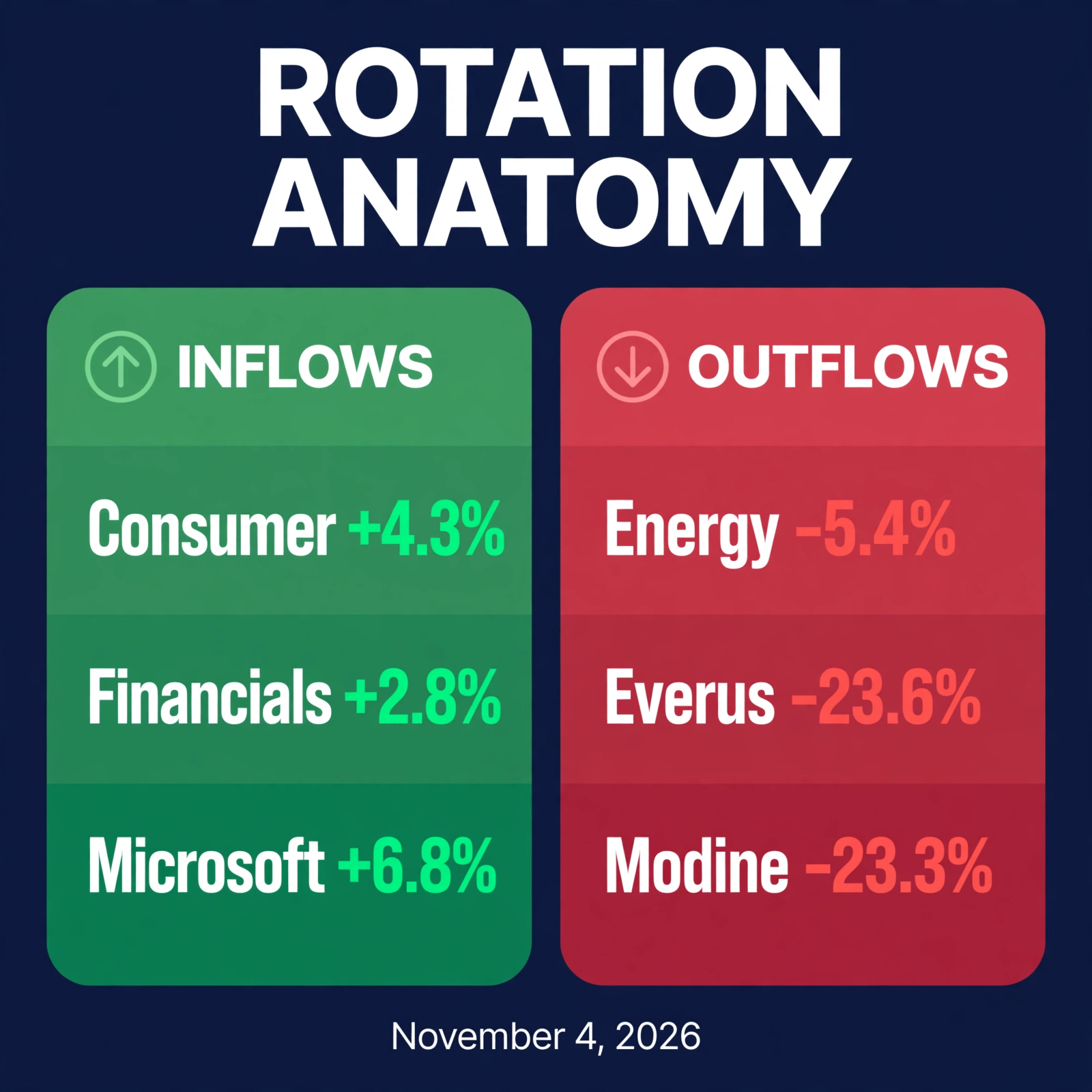
The rotation translated gridlock expectations into sectors. Consumer discretionary rose 4.3%, communication services 4.1%, consumer staples 3.8%, and financials 2.8% — money moving toward households, consumption, and finance. Microsoft rose 6.8% and Amazon 6.9%, reflecting an expectation that the AI spending race among cloud giants could cool. If hyperscalers slow the data center race, near-term earnings pressure eases. The most precise signal of the day is inside the AI theme itself: hyperscalers rose while data center builders fell.
The fallers show that policy paths are still open. Energy fell 5.4% as a direct result of the oil drop, and Everus Construction fell 23.6%, Modine Manufacturing 23.3%, and Sterling Infrastructure 20.6% as permitting, power, and environmental worries touched order-book expectations. A newly elected Texas governor who campaigned on immediately pausing new data center construction gave that worry a concrete example. Even without a federal bill passing, state-level permitting and oversight alone can shake a builder’s order assumptions. Gridlock blocking federal legislation does not block every policy path.
Limits of the expectation: veto, reversal, and the confirmation order
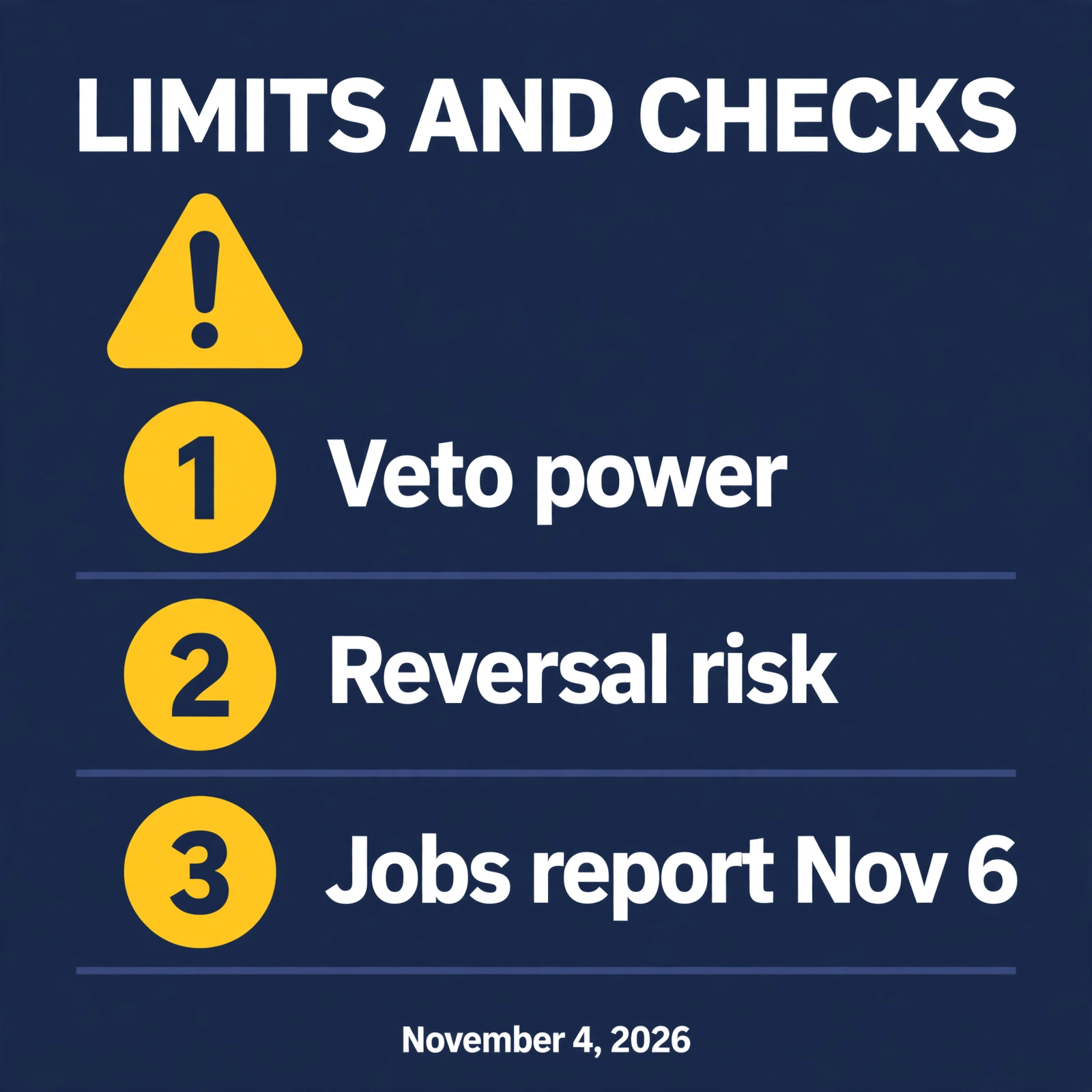
The gridlock expectation has three limits. First, the veto: even if Democrats pass a bill, the president can veto it, so sharp change is limited for both sides. That stabilizes, but it also lowers the odds that policies priced in as Democratic wins actually arrive. Solar and health care strength was a reaction to expectations, not to enacted law. Second, reversal: after a 2.93% one-day jump, profit-taking and expectation resets come easily, and stocks that rose on policy hopes alone are the first to reverse when the legislative calendar is empty. Third, non-election variables: the November 6 jobs report and company earnings can move markets longer than gridlock hopes.
The confirmation order is this. First, the Democratic Congress’s legislative priorities — which of AI data centers, tax, and spending comes first. Second, actual state-level data center permitting and power policy — a path that can reach prices before any federal bill. Third, whether oil and Treasury yields hold — WTI at $89.17 and the 10-year at 4.90% resting on expectations alone. Gridlock slows policy; it does not erase its direction. For the rally to hold, confirmed policy — not delayed policy — has to arrive.
- Divided government: a president and a congressional majority from different parties. After this midterm, that means a Democratic Congress and a Republican president.
- Veto: the president's power to refuse to sign a bill passed by Congress. An overridden veto needs a two-thirds vote in Congress, so it brakes sharp change.
- Rotation: money moving from one sector or theme to another. On this day, money moved from energy and builders toward consumer and financial stocks.
- Hyperscaler: a cloud company operating massive data centers, such as Microsoft, Amazon, or Google.
Investor checklist
First, separate stocks that rose on policy hopes alone — hopes without a legislative calendar are the most vulnerable to reversal. Second, do not misread builder and energy declines as earnings failures — Everus fell on a repricing of order assumptions, not on weak results. Third, do not lean on average statistics — a post-midterm 12-month average of about 15% is a reference distribution, not a promise from this Congress. A gridlock rally signals that uncertainty has narrowed, not that it has disappeared.
Watch the video
Sources & references
- TradingView / Benzinga — Dow Rallies 2.9%, Oil Sinks 7% After Midterms — November 4 Dow 53,302.08 (+2.93%), S&P 500 7,701.44 (+1.75%), sectors discretionary +4.3%, communication +4.1%, energy –5.4%, industrials –1.1%, Microsoft +6.8%, Amazon +6.9%
- Reuters via Free Malaysia Today — Global stocks rally, dollar dips after Democrats' midterm sweep — Futures fell up to 2% overnight then recovered, divided government as a blockade on new legislation, Treasuries rallied on expectations gridlock cuts spending
- Bloomberg via SWI swissinfo — Stocks, Bonds Climb After US Election as Oil Sinks — 'Gridlock is good' (Glenmede), stocks higher one year after every midterm since 1946 (Truist), data center development complications in some states
Related articles
- December FOMC 50bp Hike Scenario Analysis Core CPI 0.3% and Waller Comments
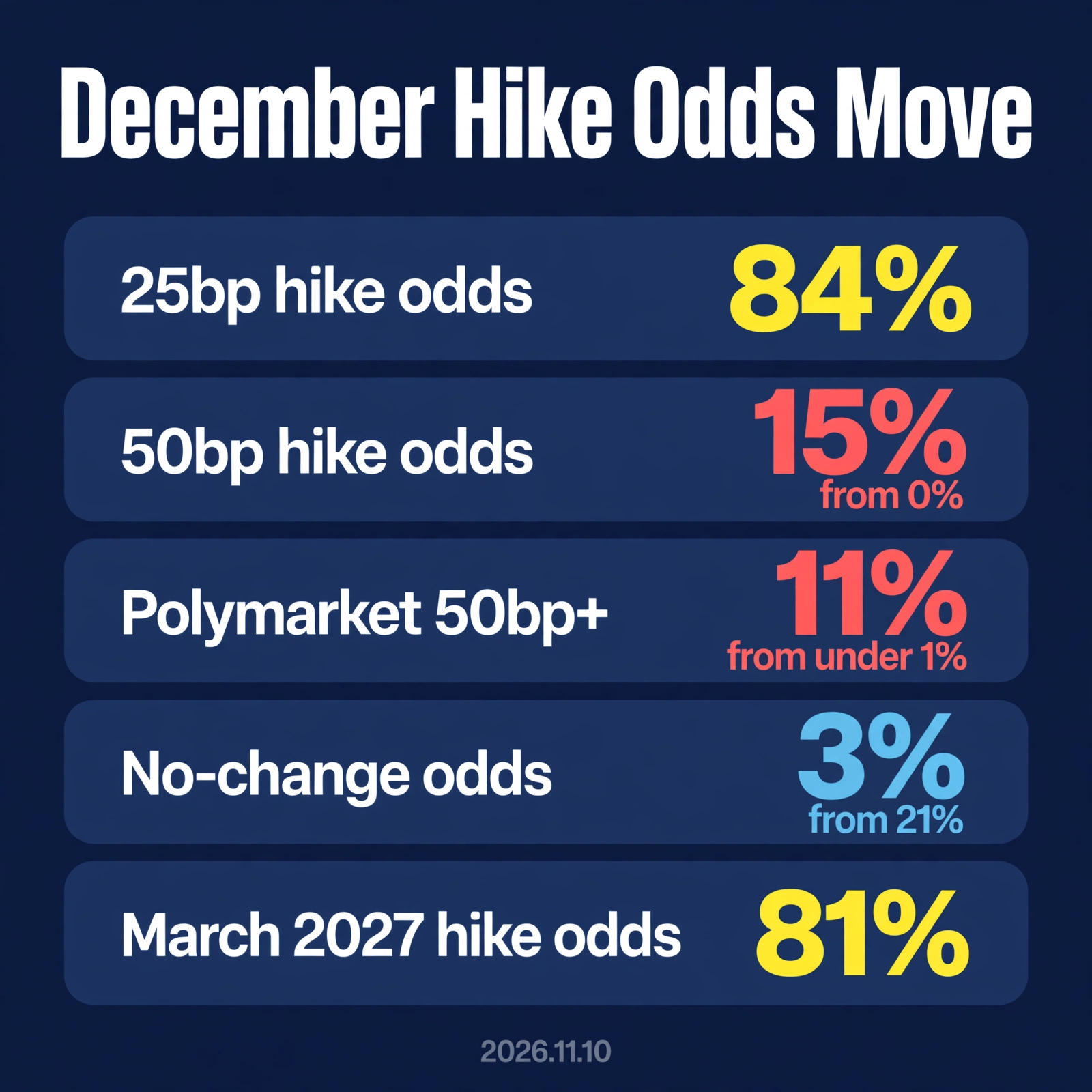
October core CPI ran at 0.3% for a third straight month, and December 50bp hike odds jumped from 0% to 15%. Governor Waller had named 0.3% core as the condition for considering a 50bp move, and November CPI comes out the day after the FOMC. What separates a 25bp hike from a 50bp one.
- Brent Crude Analysis: 18.4% Drop in Six Sessions on Negotiation Hopes
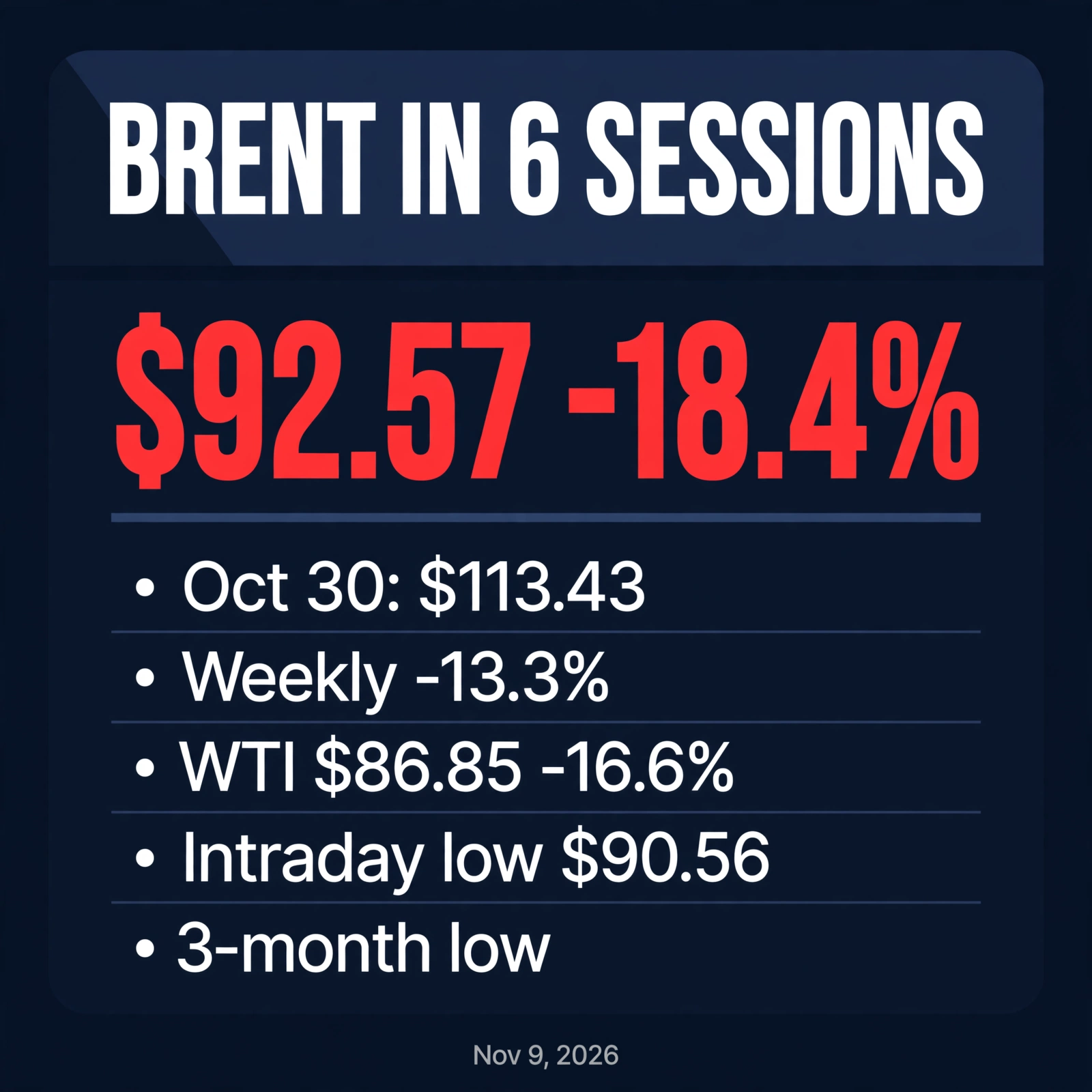
Brent crude has fallen 18.4% in six sessions, from $113.43 on October 30 to $92.57 on November 9. The war premium is unwinding fast — but analysts put renewed strikes at 60%, and that gap sets the terms for a reversal.
- Won Dollar Exchange Rate Analysis 1337.5 Won Two-Day Drop and 1330s Return
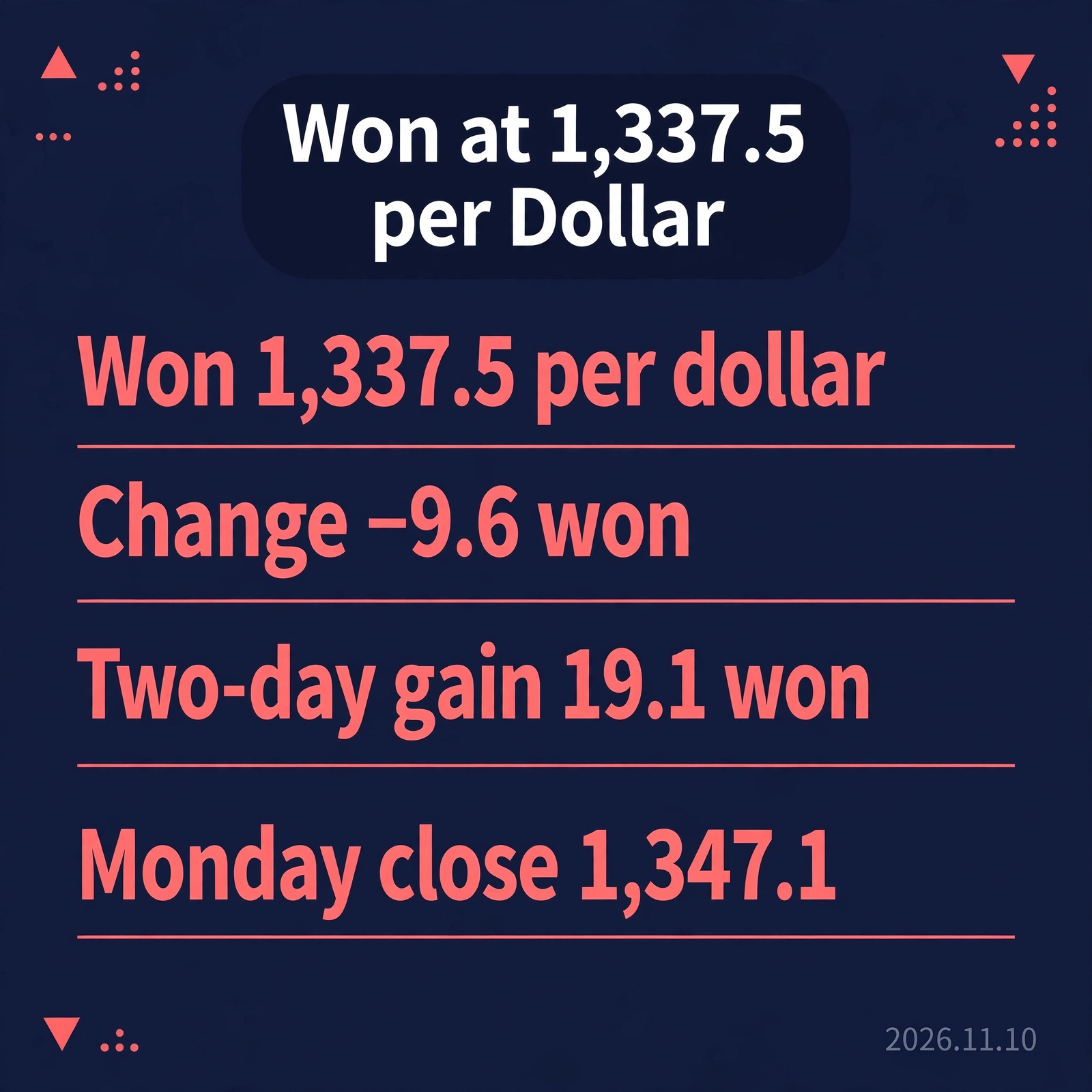
The won strengthened to 1,337.5 per dollar, down 9.6 won on the day and 19.1 won over two sessions. The move is not dollar weakness — it is Korean risk appetite and exporter dollar selling reversing last week's chip-driven spike. Tonight's US CPI decides the next direction.
5minbrief on YouTube
The briefs also come as videos. Get the daily market wrap on YouTube.
Subscribe on YouTube