 5-minute briefs
US Stocks November 3 Dow Falls 0.37% Nasdaq Rebounds 0.82% AMD Earnings Analysis
#US stocks#Dow#S&P 500#Nasdaq#midterm elections#semiconductor rebound#Apple earnings
Index closes: the previous day’s pattern, reversed on Election Day
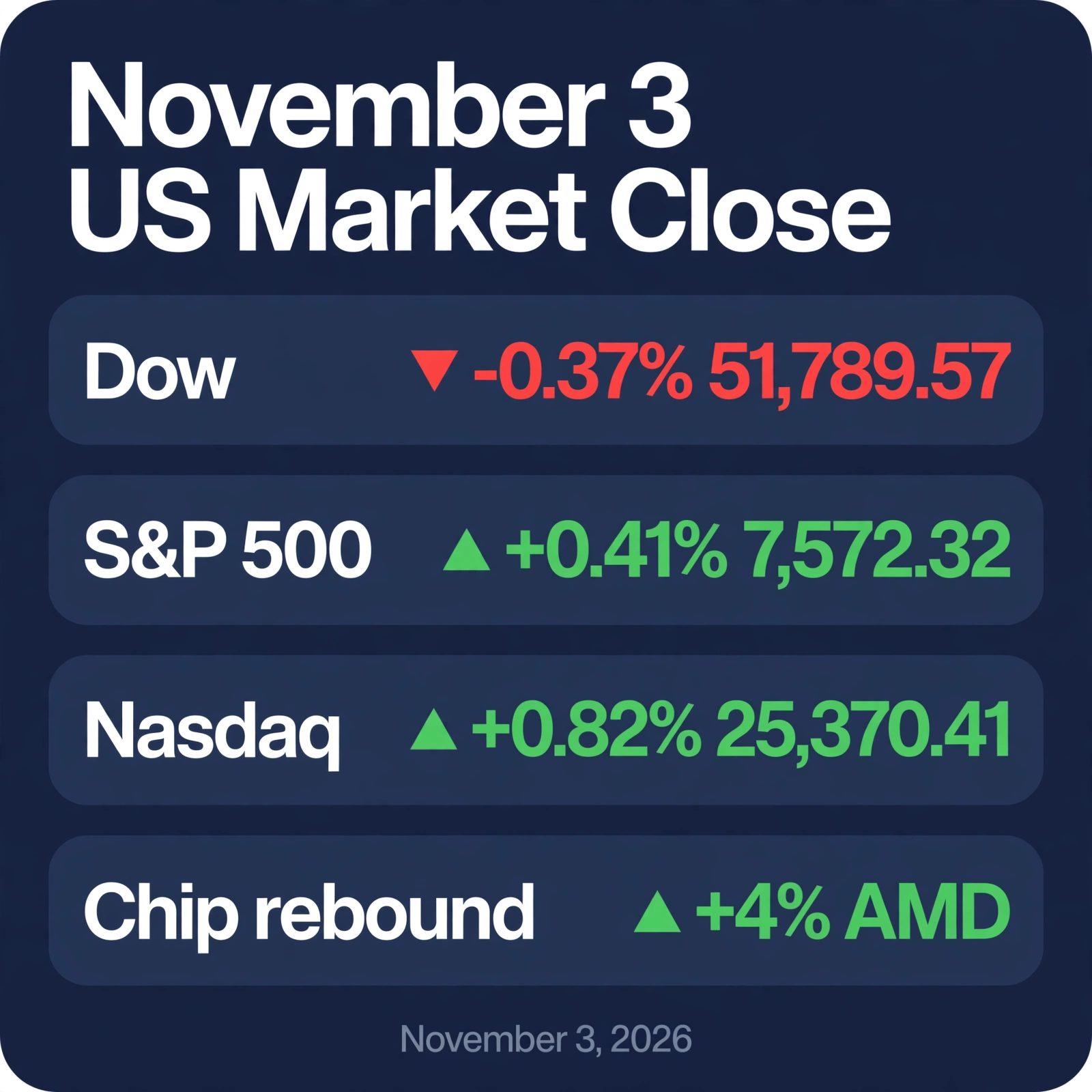
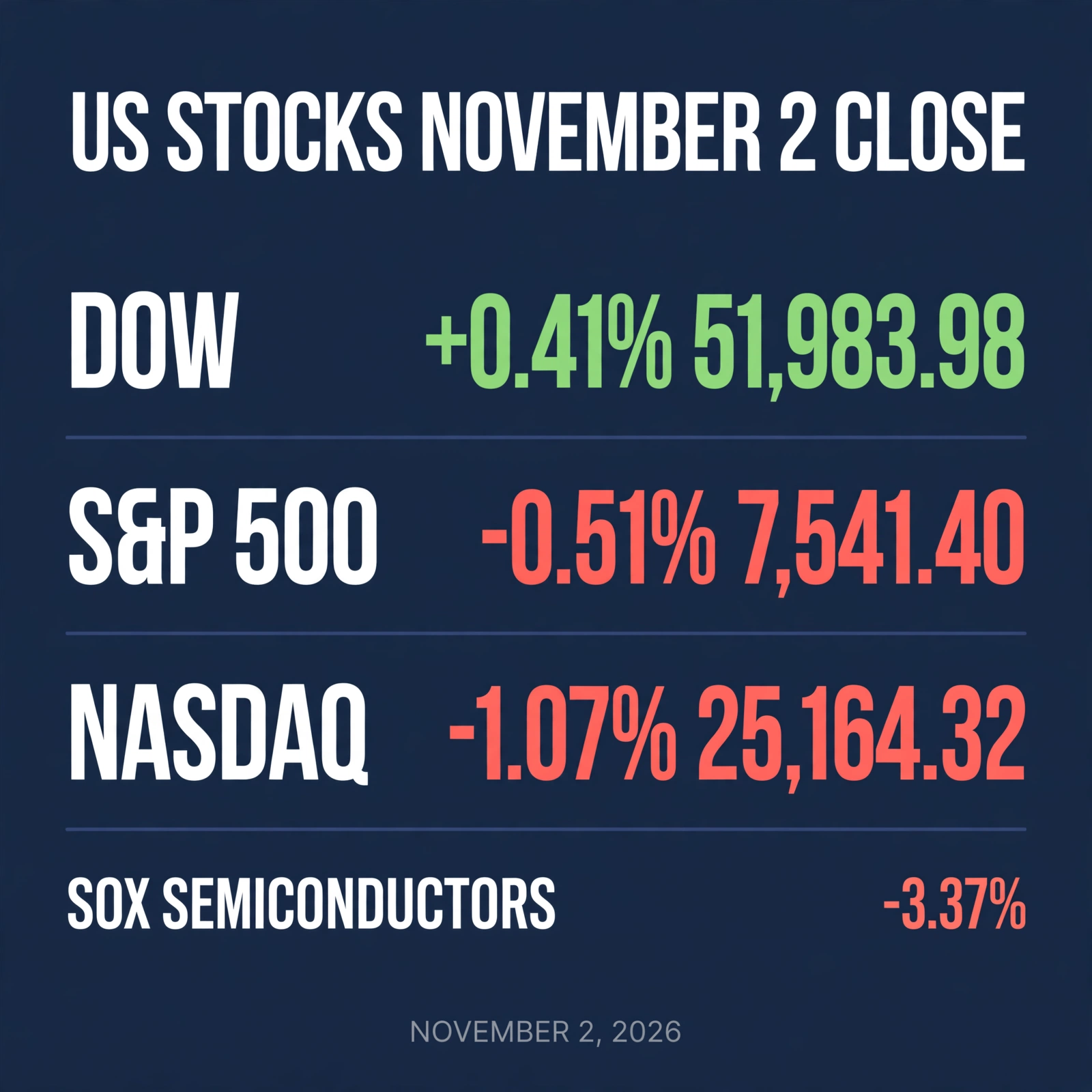
Start with the closes. The Dow Jones Industrial Average fell 194.41 points to 51,789.57 (0.37%), the S&P 500 gained 30.92 points to 7,572.32 (0.41%), and the Nasdaq Composite jumped 206.04 points to 25,370.41 (0.82%). The prior session, November 2, closed at Dow 51,983.98, S&P 500 7,541.40 and Nasdaq 25,164.32. On Monday only the Dow rose; on Election Day only the Dow fell. What matters more than the flip itself is that it rode on a single driver: a rebound in semiconductors.
Chips led the rebound. AMD rose about 4% in the regular session, Broadcom gained more than 3%, and Micron, Nvidia and Intel each rose nearly 3%. That is bargain hunting in names that had sold off sharply over the previous three sessions, including AMD, which had fallen more than 7% on November 2. In the opposite direction, Apple fell 2%. Its results had beaten expectations, but guidance pointing to a December-quarter gross margin of 45–46%, down from 47.9% in the September quarter as memory prices surge, weighed on sentiment. Two rules showed up in one session: a good result can still fall on a weaker margin outlook, and a heavily sold stock can bounce before its own earnings.
The elections were not yet a result. The first polls closed at 6 p.m. Eastern, two hours after the 4 p.m. market close, so no results were available during trading. Prediction markets had priced a high chance of Democrats retaking the House, with Senate odds around 75%, but those were pre-close expectations, not outcomes. Tuesday’s gains should not be read as a reaction to election results. The results are a variable to be confirmed on the morning of November 4, Korean time.
AMD results: data centers now 64% of revenue
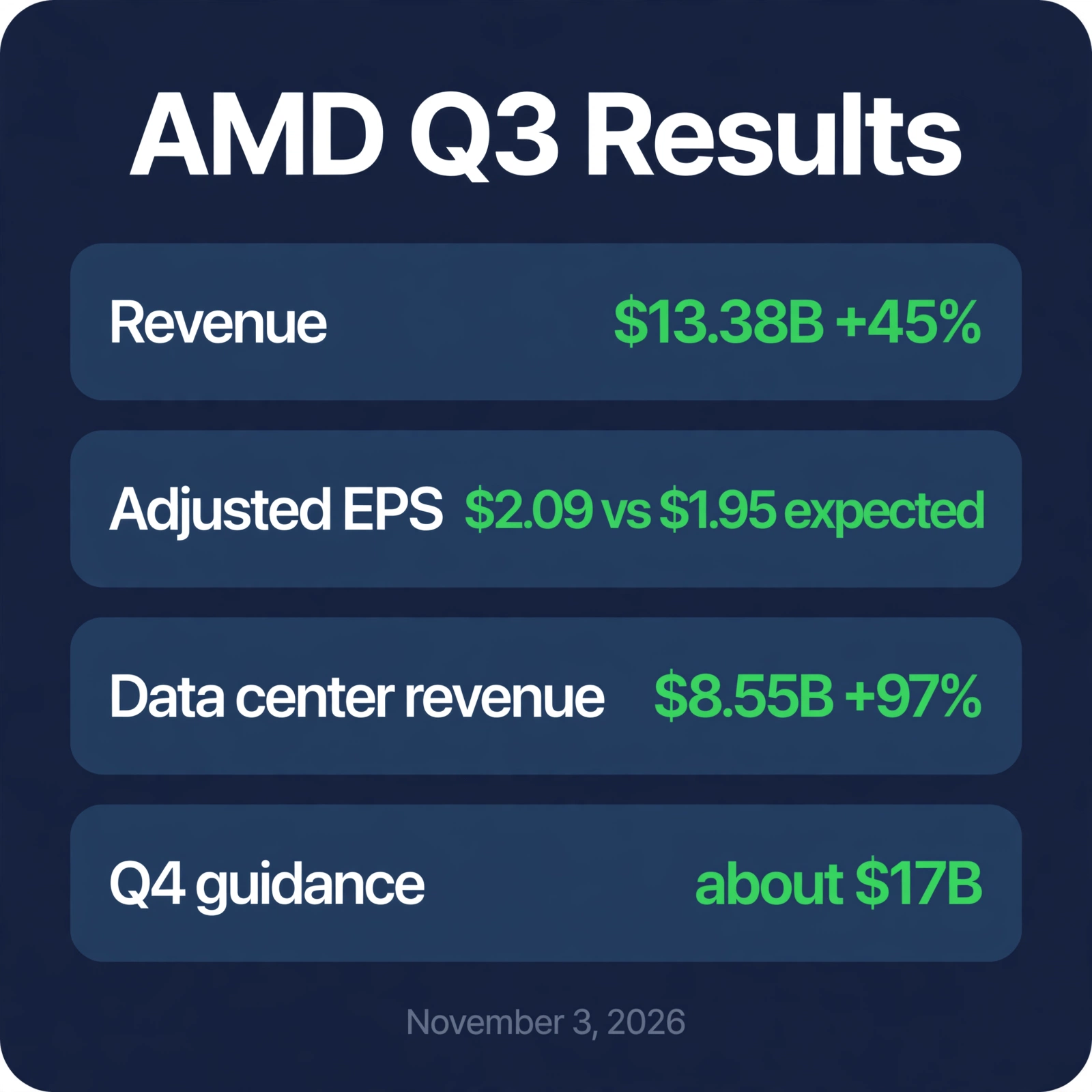
AMD’s third quarter (ended September 26), reported after the close, beat expectations. Revenue rose 45% year on year to $13.377 billion, above the consensus of about $13.08–13.1 billion and above the top of the company’s own $12.7–13.3 billion guide. Adjusted earnings per share were $2.09, ahead of the $1.95 expected and up 74% from a year earlier. GAAP net income was $2.4 billion and adjusted net income was $3.5 billion. Adjusted gross margin was 56%, in line with guidance.
The mix is the story. Data center revenue nearly doubled, up 97% to $8.55 billion, above an expected roughly $8.2 billion, and its share of total revenue jumped from 47% a year ago to 64%. Demand for EPYC server CPUs and Instinct AI accelerators drove the increase. CEO Lisa Su said growth should accelerate further in the fourth quarter as Helios rack systems and Venice production scale up. One caution on reading the numbers: net income includes a $1.1 billion accounting charge tied to last year’s OpenAI deal, so the adjusted and GAAP figures should not be mixed.
The most important number is the outlook. AMD guided fourth-quarter revenue to about $17 billion (±3%), up about 66% year on year and about 27% sequentially, above the consensus of about $16.3 billion. Adjusted gross margin is expected at about 55%. That is the mirror image of Intel’s guide-down sell-off: a beat plus a raise in the same release. For this report to anchor a semiconductor rebound, the $17 billion guide must turn into delivered revenue, and Helios shipments must support that pace — those are the next checks.
Apple, Anthropic and jobs: three variables after earnings
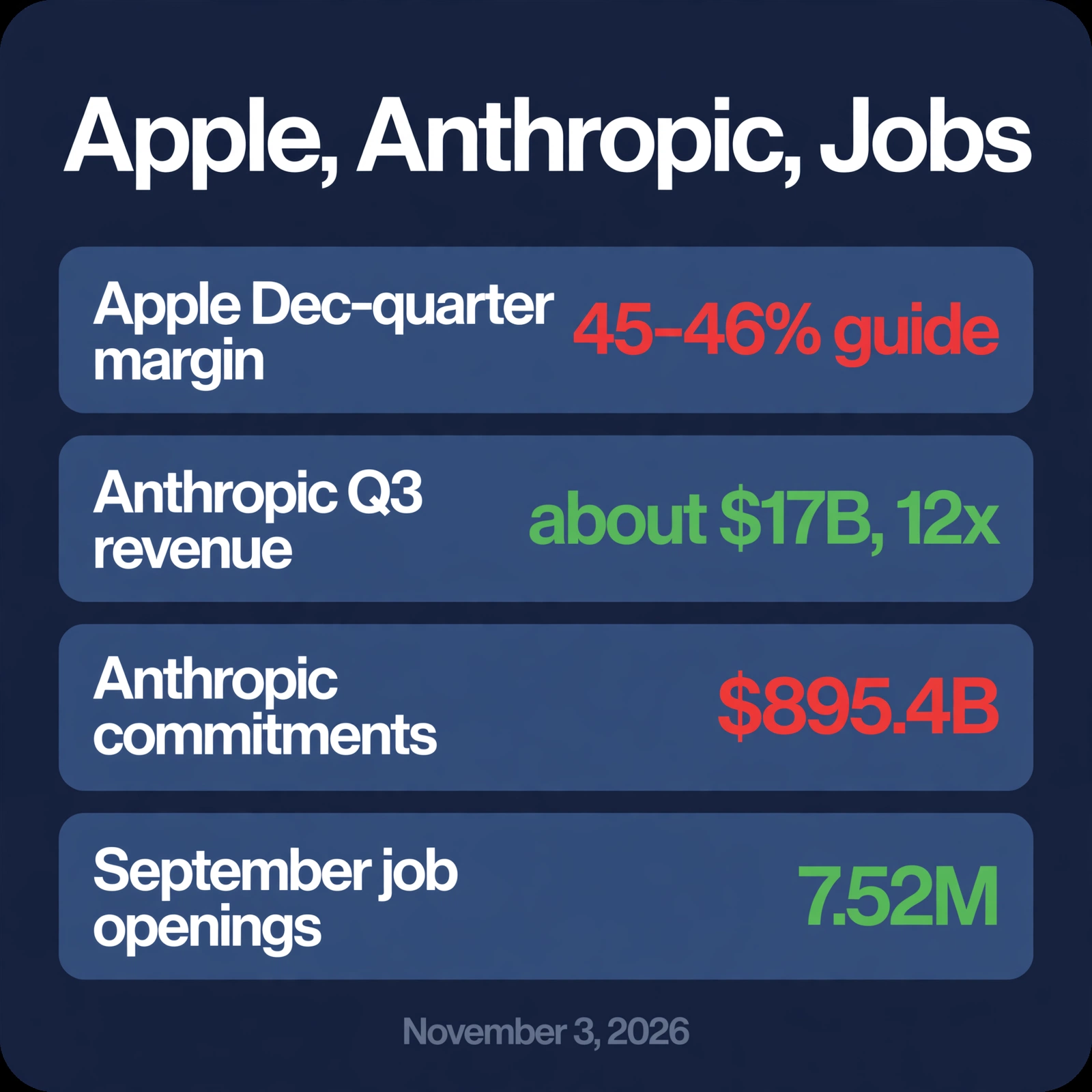
Apple’s margin outlook remains a drag on tech sentiment. A December-quarter gross margin of 45–46%, down from 47.9%, means surging memory prices, not iPhone unit sales, are now the key swing factor for Apple’s earnings. Apple had already beaten expectations with $114.48 billion in revenue on November 2, but a China revenue miss and slower services growth left the stock lower for a second session.
Anthropic’s amended S-1 added another data point to the AI profitability debate. Third-quarter revenue was about $17 billion, roughly 12 times the $1.4 billion of a year earlier, but operating profit swung from a $974 million profit in the second quarter to a $567 million loss, and the net loss was $23.3 billion. The net loss includes a $21.9 billion fair-value adjustment on convertible notes and other securities tied to the company’s rising valuation, so it is not a direct cash-flow reading. The larger number is the commitment: purchase commitments and leases for computing and infrastructure total $895.4 billion, with about $70 billion due within the year to September 2027. Twelve-fold revenue growth and $895.4 billion in commitments in the same filing is a fair summary of where the AI profitability debate stands.
Jobs data came in firmer than expected. September job openings (JOLTS) were 7.52 million, above the 7.10 million expected, a sign that labor demand has not cooled sharply. That sets up the October employment report on November 6 as the next read on the Federal Reserve’s December path. Election results, AMD’s follow-through, and the jobs report — this week’s direction is likely to be set in that order, as each variable is confirmed.
- Guidance: a company's advance forecast for the next quarter. AMD guided fourth-quarter revenue to about $17 billion.
- Data center share of revenue: the data center segment's share of total sales. AMD's rose from 47% to 64% in one year.
- Adjusted EPS: earnings per share excluding one-off items. AMD's was $2.09, versus $1.46 on a GAAP basis.
- S-1/A (amended registration statement): an updated IPO filing with the SEC. Anthropic's includes its third-quarter results.
- JOLTS job openings: the US Labor Department's job openings report. September's 7.52 million gauges labor demand.
Three things to check
First, the midterm election results. The House and Senate makeup will shape expectations on taxes, regulation and AI policy, with results emerging from the morning of November 4, Korean time. Second, how AMD’s results are digested. Whether the stock holds its pre-earnings rebound or sees profit-taking will test how durable the semiconductor bounce is. Arm and Qualcomm report after the close on November 5. Third, the October employment report on November 6. With job openings above expectations, the report will show whether labor market cooling and the Fed’s path point the same way. Not the election result itself but the policy expectations after it, and not the earnings themselves but how they are digested afterward — that is where this week’s market story sits.
Sources & references
- Baystreet — NASDAQ Rebounds as Chip Stocks Come Back — November 3 closes: Dow 51,789.57, S&P 500 7,572.32, Nasdaq 25,370.41; AMD, Broadcom, Micron, Nvidia and Intel higher, Apple down 2%
- AMD press release via GlobeNewswire — AMD Reports Third Quarter 2026 Financial Results — Q3 revenue $13.4 billion, non-GAAP EPS $2.09, Q4 revenue guide about $17 billion (±3%), non-GAAP gross margin about 55%
- MarketWatch — AMD's data-center segment drives a revenue beat — Q3 revenue $13.4 billion, up 45%, ahead of the $13.1 billion FactSet consensus; adjusted EPS $2.09 vs $1.95 expected
- New York Post — Anthropic sees $23B third-quarter loss in amended IPO filing — Q3 revenue near $17 billion, 12-fold year-on-year rise, net loss $23.3 billion, $895 billion in spending commitments
- XTB — US Open: Lower oil prices boost indices, markets await Midterms results — September JOLTS job openings 7.52 million vs 7.10 million expected; October ISM manufacturing 55.5, services 54.9
Related articles
- US Stocks November 2 Dow Up 0.41% Nasdaq Down 1.07% Apple Earnings Analysis
On November 2, only the Dow rose while the S&P 500 and Nasdaq fell. Apple beat expectations with $114.48 billion in revenue, and Palantir's US commercial revenue passed government revenue for the first time.
- US Stock Market Weekly Recap Nasdaq Falls 3.4 Percent Thursday AI Rout and Correction Analysis
US stock market weekly recap for November 2–6. The S&P 500 fell 2.7%, the Nasdaq 3.4% and the Dow 0.9%, and Thursday's AI sell-off pushed the Nasdaq into correction territory. Midterms, the jobs report and the Hormuz oil plunge, plus next week's CPI and PPI checkpoints.
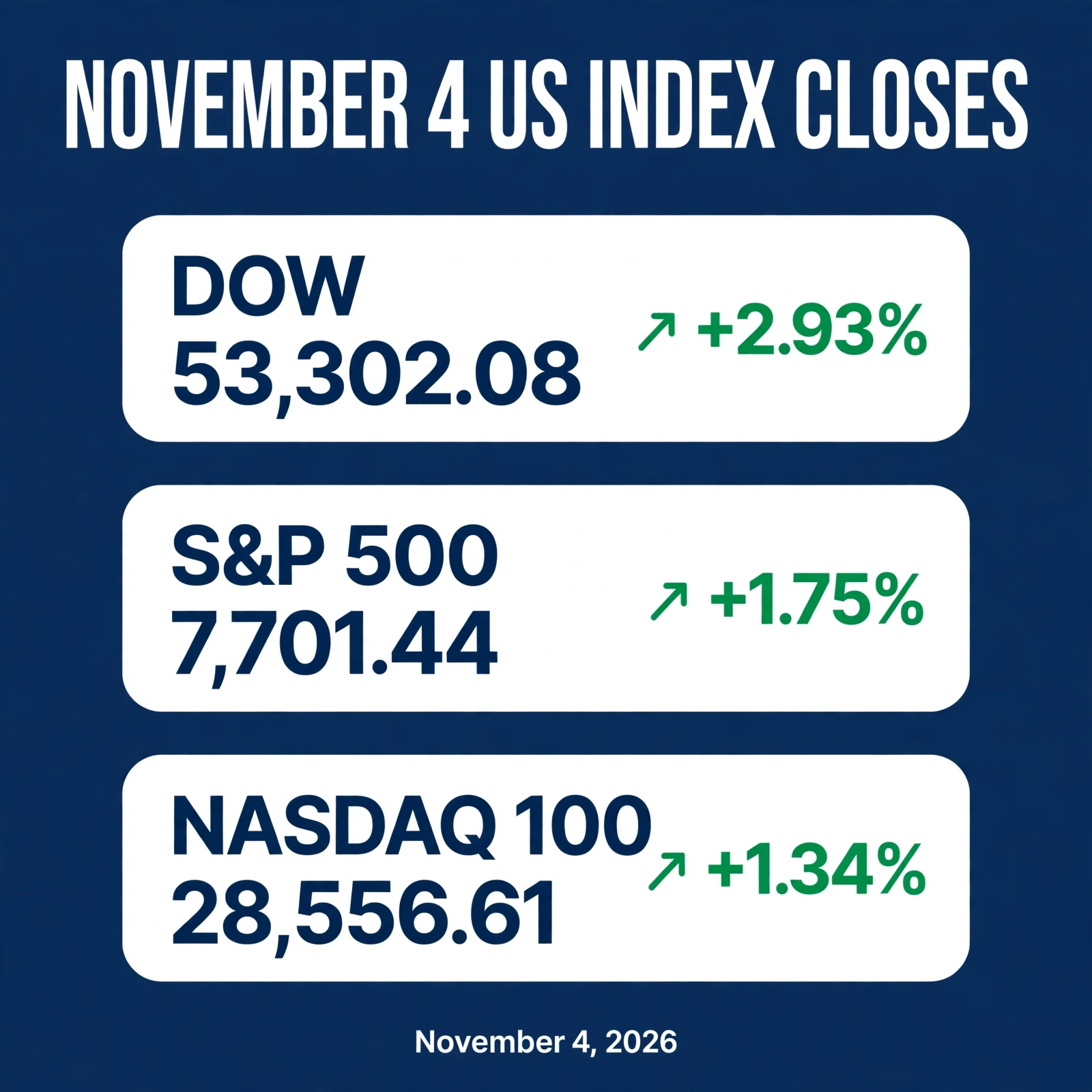
- US Stocks November 4 Dow 3.03% Surge S&P 500 1.58% Gain Midterm Blue Wave Analysis
On November 4, US stocks rallied after Democrats took both chambers of Congress in the midterms. The Dow jumped 1,569 points to 53,356.12 and the S&P 500 closed at 7,688.62, while oil fell more than 8% and energy stocks lagged.

5minbrief on YouTube
The briefs also come as videos. Get the daily market wrap on YouTube.
Subscribe on YouTube