 5-minute briefs
AI capex returns analysis Alphabet Amazon cash flow deficit semiconductor repricing
#AI capex#Alphabet earnings#free cash flow#SK hynix#Samsung Electronics#EWY
The bill first — spending more cash than operations generate
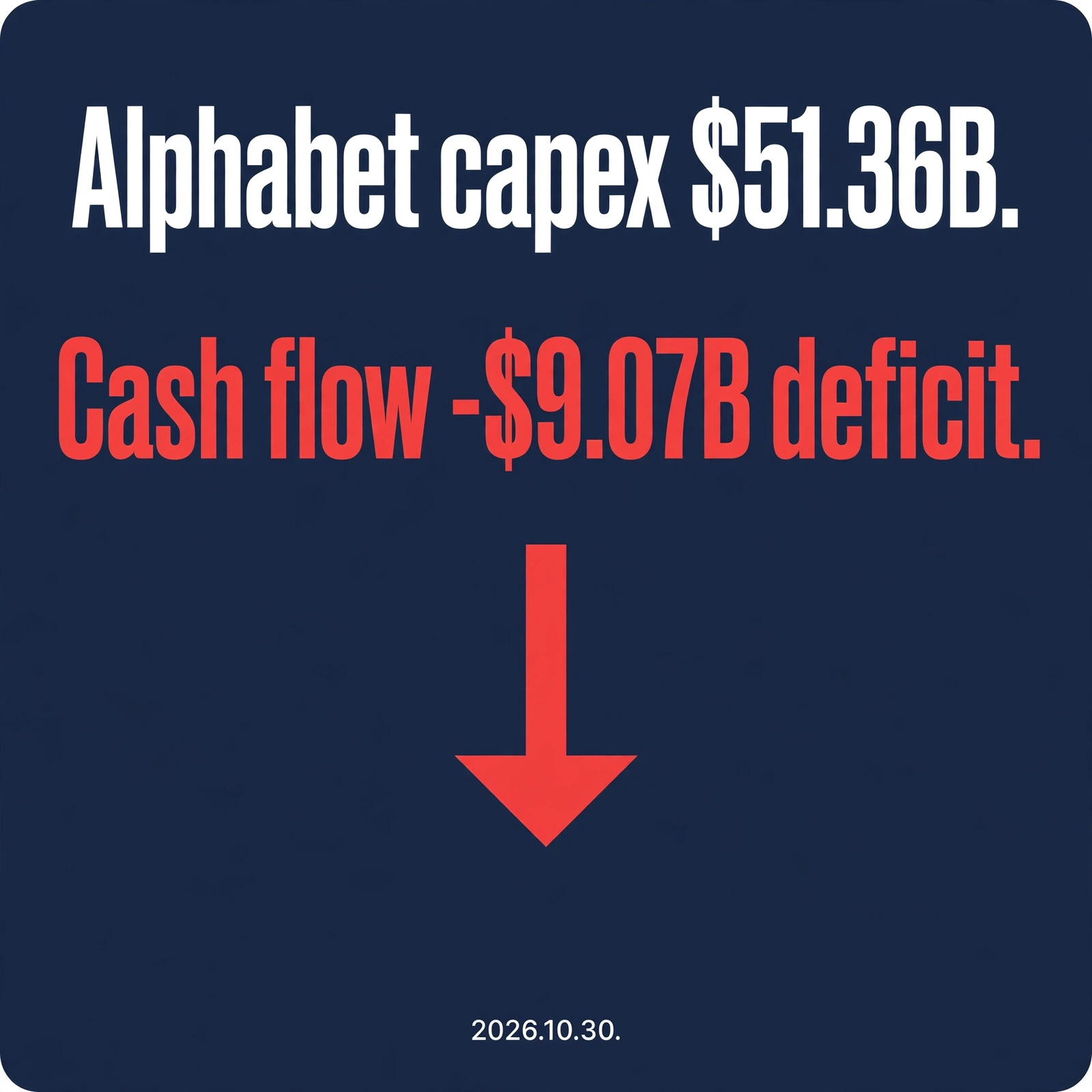
Alphabet’s quarter splits in two. Revenue rose 25% from a year earlier to $127.58 billion, a quarterly record, and Google Cloud revenue grew 103% to $30.71 billion, beating the $28.7 billion consensus, with cloud operating profit more than tripling to $11.12 billion. The spending side moved faster. Q3 capex reached $51.36 billion, up 114% from a year earlier, above operating cash flow of $42.29 billion. The capex-to-operating-cash-flow ratio was about 121% — the company cannot fund its investment from operating cash alone. Free cash flow was a deficit of $9.07 billion, more than triple the expected $2.7 billion deficit and the second straight quarterly deficit after $5.86 billion in the second quarter. Long-term debt stood at $125.1 billion at quarter-end, about 5.8 times the $21.6 billion a year earlier. Alphabet shares fell 12.64%, wiping out roughly $500 billion in market value in a day.
Amazon’s picture is larger. AWS revenue grew 39% to $45.98 billion, its fastest in five years, and total operating profit of $28.1 billion at a record 13.9% margin. But Q3 free cash flow was a deficit of $33.46 billion, the second straight quarterly deficit, and the twelve-month figure was a $42.4 billion outflow, reversed from a $14.8 billion inflow a year earlier. Amazon kept its $220 billion 2026 capex plan and said 2027 spending will be “much more”. Alphabet kept its $195–205 billion annual capex outlook and said 2027 spending will rise “significantly.” Both companies, in other words, told the market next year’s bill will be bigger than this year’s.
Why Korea gets hit first — the supplier’s position in the chain
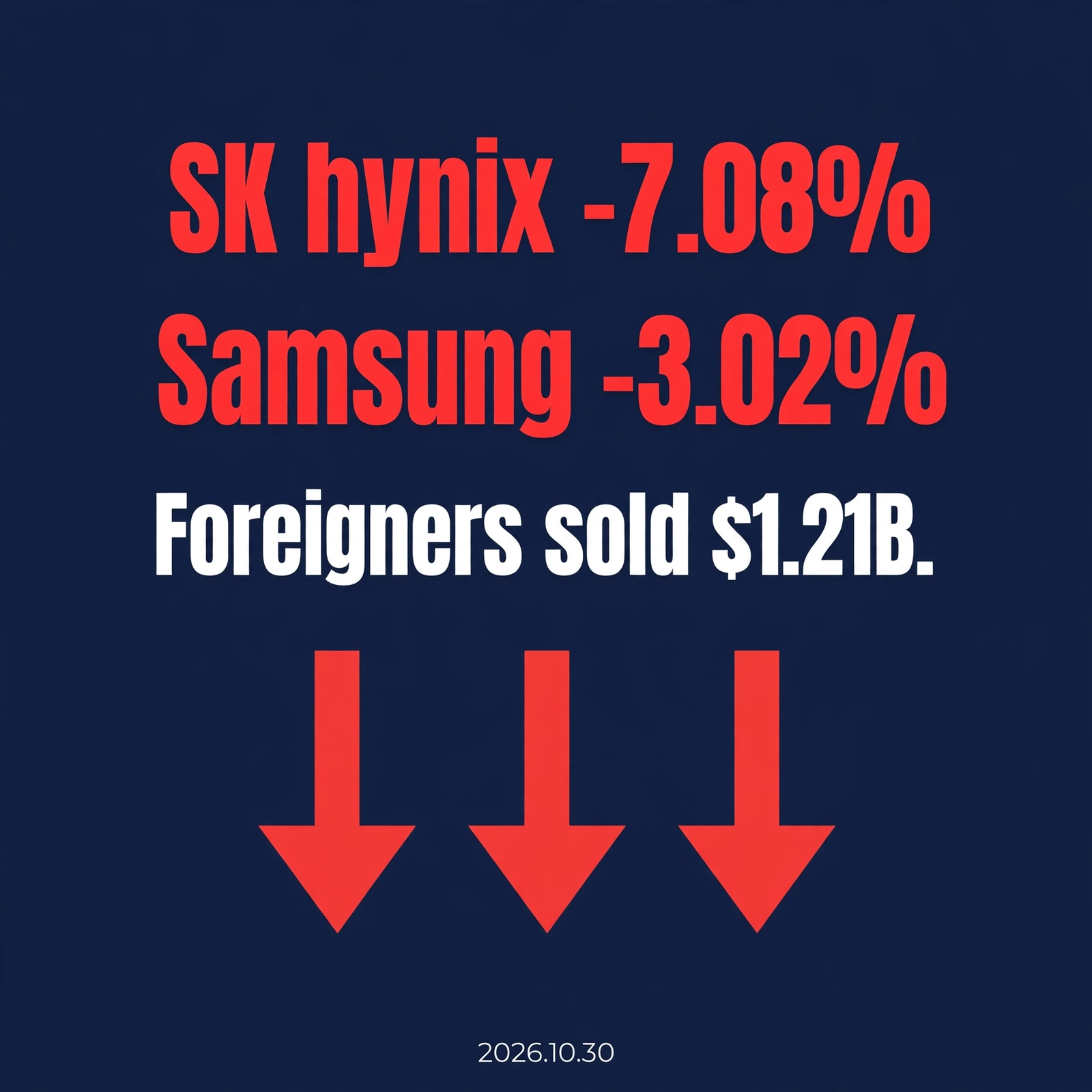
Korea’s chip stocks fall hardest for a structural reason. As the seller of high-bandwidth memory (HBM) that AI data centers consume, Korea’s suppliers treat US capex plans as an order outlook. When doubts grow about whether that capex generates cash — not whether capex itself shrinks — the market prices in slower future orders first. On October 30, SK hynix fell 7.08% and Samsung 3.02%, and foreigners sold a net KRW 1.62 trillion ($1.21 billion) on the KOSPI. KOSDAQ equipment names fell further — Simmtech 8.02%, Wonik IPS 7.72% — the usual pattern when a large-cap order outlook shakes: the supply chain below it shakes more.
Domestic earnings shocks amplified the fall, even though they were unrelated to AI. Kia fell 11.73% and Hanwha Aerospace 8.42% on guidance and earnings misses, repeating the same message on the same day: miss the outlook, and the stock pays immediately. A Samsung Securities analyst told Financial News that investors have begun to focus less on the scale of AI investment and more on whether it improves returns on investment and cash flow — and that the sharp correction has considerably eased valuation concerns in Korea’s market. For foreign investors, that is the constructive read: the repricing may be creating entry points, but only in names whose cash generation, not just whose order book, survives the new rubric.
The counterargument — growth takes time to become cash
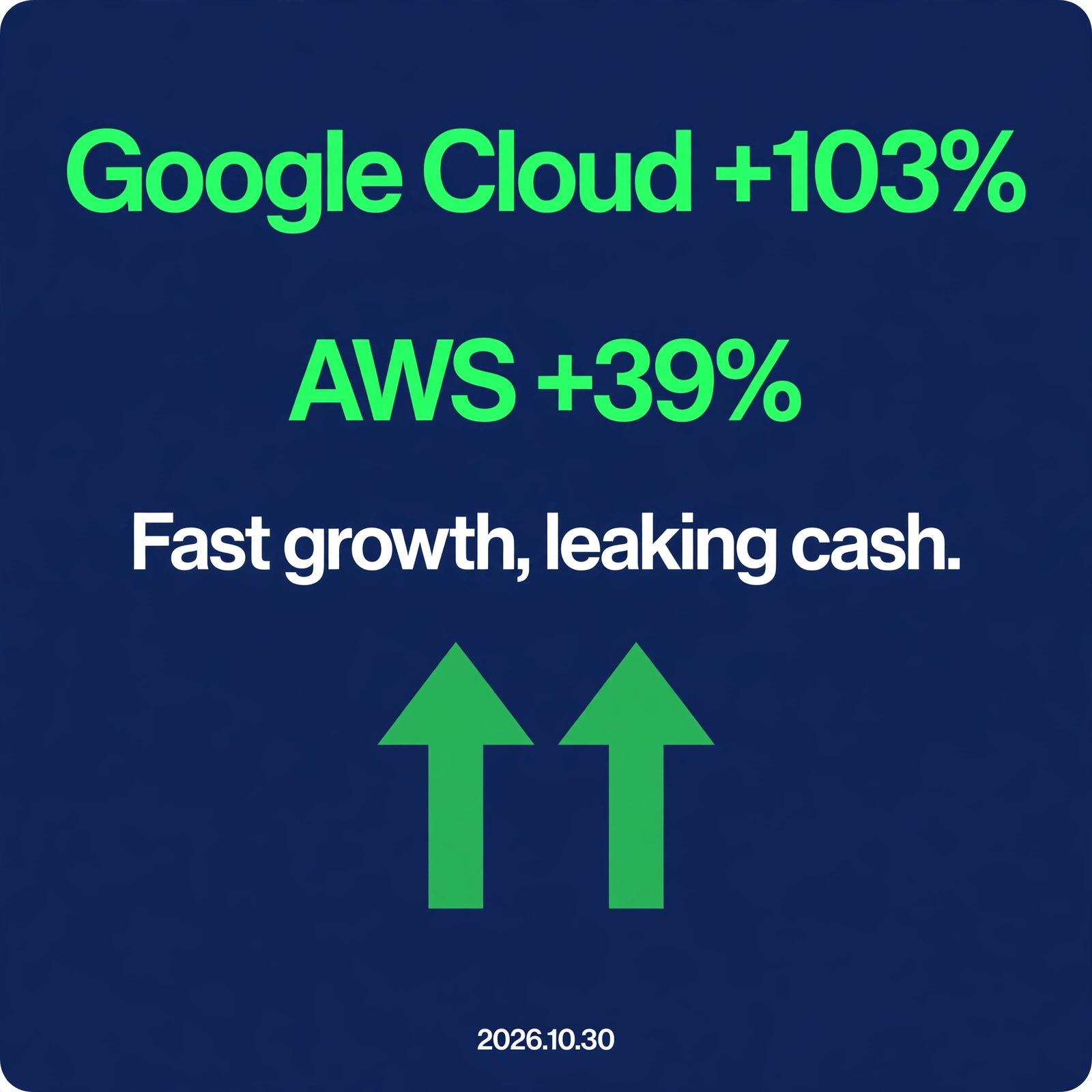
The counterargument is not weak. First, demand signals are still strong: Google Cloud 103%, Azure 48%, AWS 39%, and an AWS order backlog of $578 billion do not describe an industry nobody uses. Second, capex is front-loaded by nature. The cash leaves in the year the data center is built and returns in the years it is utilized; one quarter of negative FCF does not prove the whole cycle fails. Third, Alphabet’s core business still earns money: total operating profit rose 30% from a year earlier to $40.58 billion. The problem is not profitability, it is the speed of investment outrunning the speed of cash generation.
So the decisive variable is the pace. If investment growth keeps outrunning cash generation, borrowing rises, interest costs rise, and the pressure compounds — Alphabet’s 5.8-fold rise in long-term debt in a year is what the market is watching. If cloud growth holds and capex growth decelerates, FCF can flip positive quickly. What this earnings season proved is not the collapse of the AI boom, but a shift in the grading standard: from “how fast is it growing” to “how much cash does it leave behind.”
- Free cash flow (FCF): operating cash flow minus capex. A negative FCF means investment is funded from cash reserves or borrowing.
- Capex: spending on plants, servers and equipment for future production — in the AI era, largely data centers and chips.
- Order backlog: contracted revenue not yet recognized. A leading indicator of future sales.
- Operating cash flow: cash actually generated by the core business. It can differ from accounting profit.
Checkpoints for investors
First, does next quarter’s big-tech capex guidance decelerate or grow further? Alphabet will give its 2027 capex figure with fourth-quarter results, and Amazon has already said 2027 will be “much more” than $220 billion. The market’s reaction to those concrete numbers will split the bull and bear cases. Second, does cloud growth hold at 39–103%? If AWS, Google Cloud and Azure sustain this quarter’s pace, the “demand exists” case strengthens. Third, does foreign money return to Korean chips? October 30’s KRW 1.62 trillion ($1.21 billion) of foreign selling will prove either a one-day rebalance or the start of a capex-repricing position cut — and that distinction sets the near-term direction for Samsung and SK hynix, and for EWY holders along with them.
Not investment advice. Figures are from Alphabet and Amazon earnings releases, Yonhap and the Korea Times, verified October 30, 2026.
Watch the video

Sources & references
- Yonhap — Seoul shares dip over 3 pct on tech sell-off amid AI concerns — Oct 30 Korean market fall, foreign selling and chip stock moves
- Korea Times — KOSPI falls 3.48% as US tech earnings fuel AI investment concerns — AI capex context and Korean market cross-check
- Amazon — Q3 2026 earnings report — Amazon Q3 results, AWS growth, capex and guidance, primary source
Related articles
- KOSPI 3.48% plunge Alphabet shock sell sidecar semiconductor fall analysis
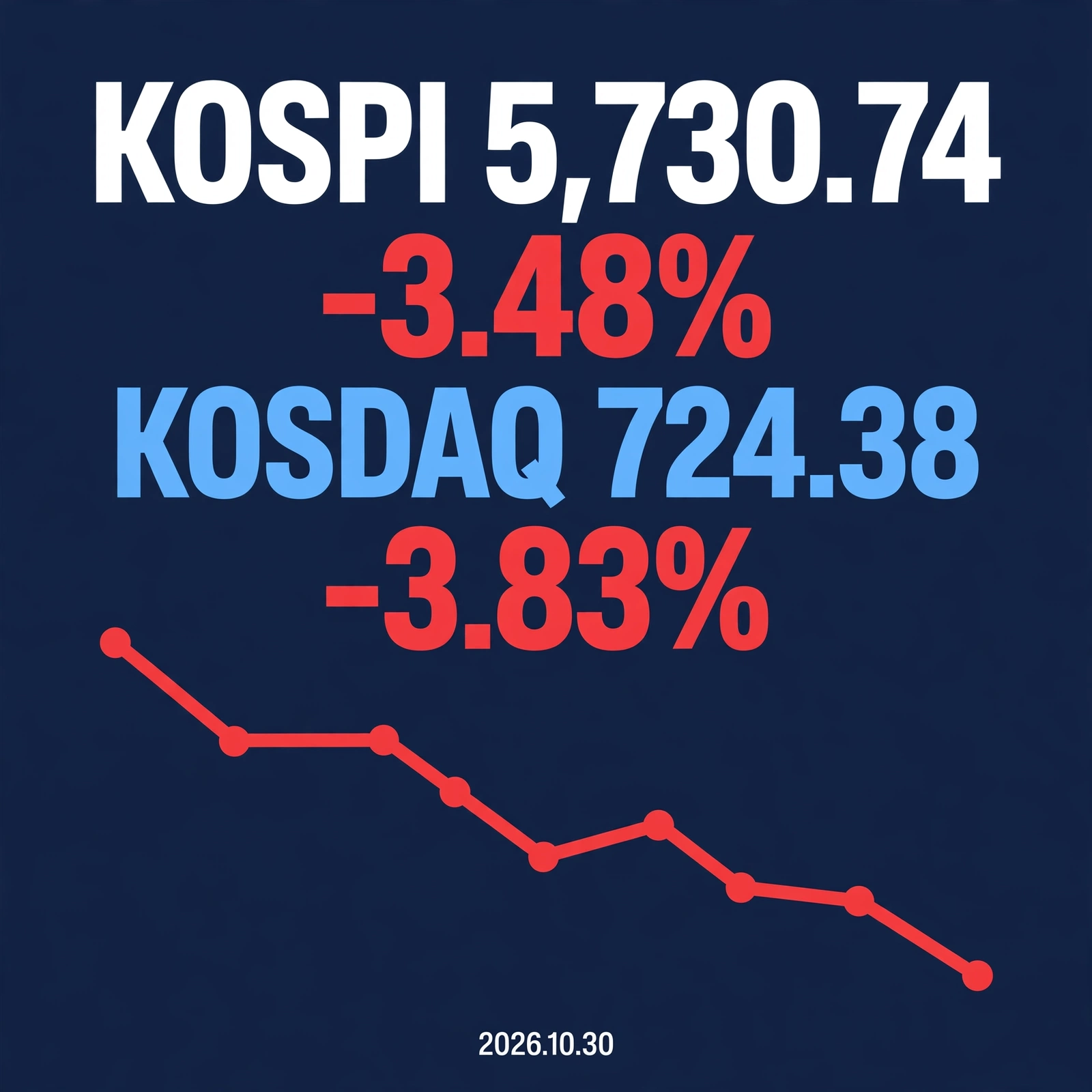
October 30 Korea market brief for foreign investors: the KOSPI fell 3.48% to 5,730.74 and the KOSDAQ fell 3.83% to 724.38 as Alphabet's earnings shock triggered a sell-side sidecar and foreigners sold a net KRW 1.62 trillion ($1.21 billion). Samsung fell 3.02% and SK hynix 7.08%. The won firmed to 1,334.3 per dollar.
- KOSPI 1.24% fall Samsung shareholder return delay 5937 close analysis
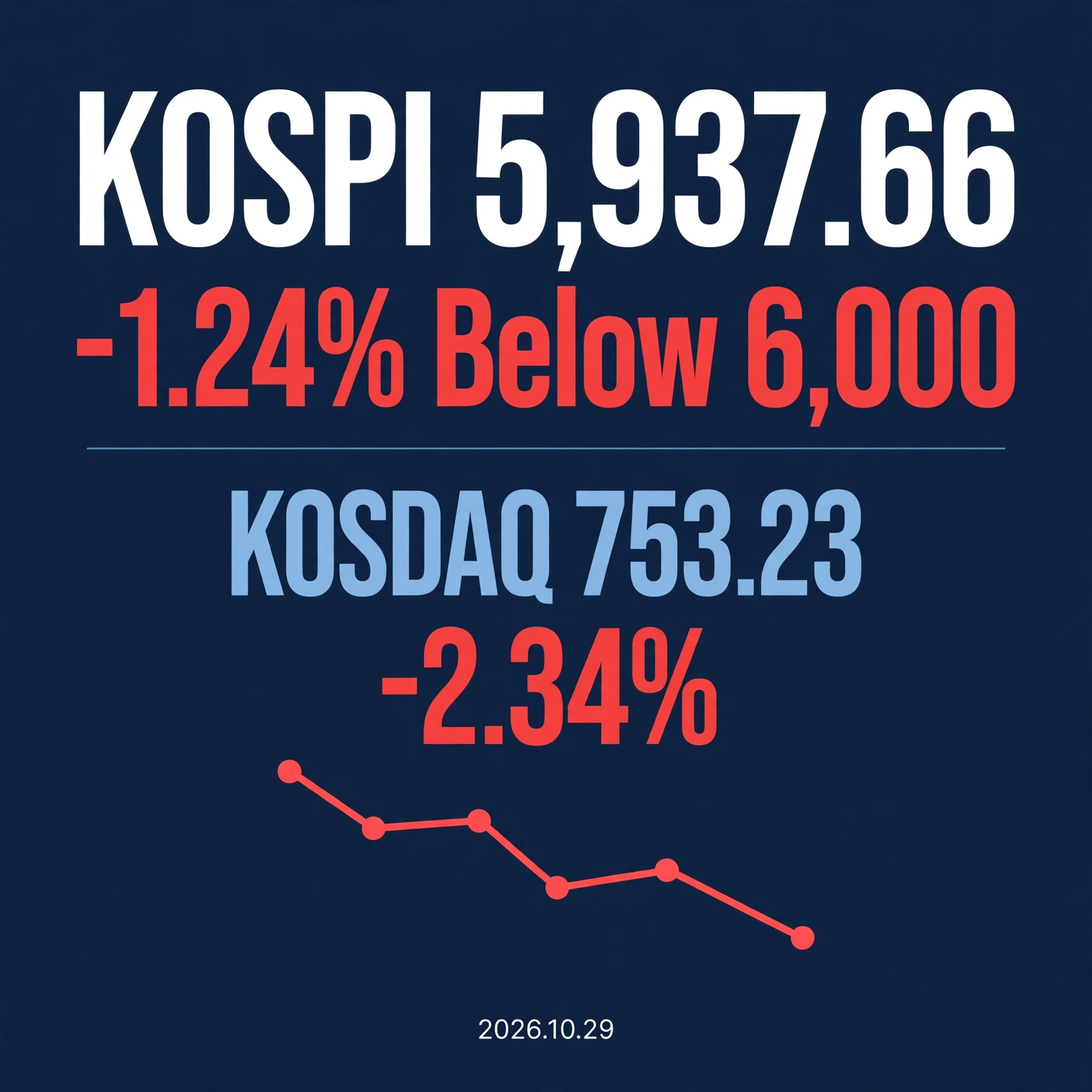
October 29 Korea market brief for foreign investors: the KOSPI fell 1.24% to 5,937.66, giving back the 6,000 line one day after retaking it, and the KOSDAQ fell 2.34% to 753.23. Samsung posted record third-quarter operating profit of KRW 107.44 trillion yet fell 4.13% after deferring shareholder-return details to January, while SK hynix, which spelled out a KRW 100 trillion ($74.8 billion) return plan, rose 2.62%. LG Energy Solution plunged more than 8%. The won firmed to 1,336.8 per dollar.
- KOSPI Market Breadth Analysis: 372 Advancers vs 490 Decliners and the 47% Two-Stock Weight
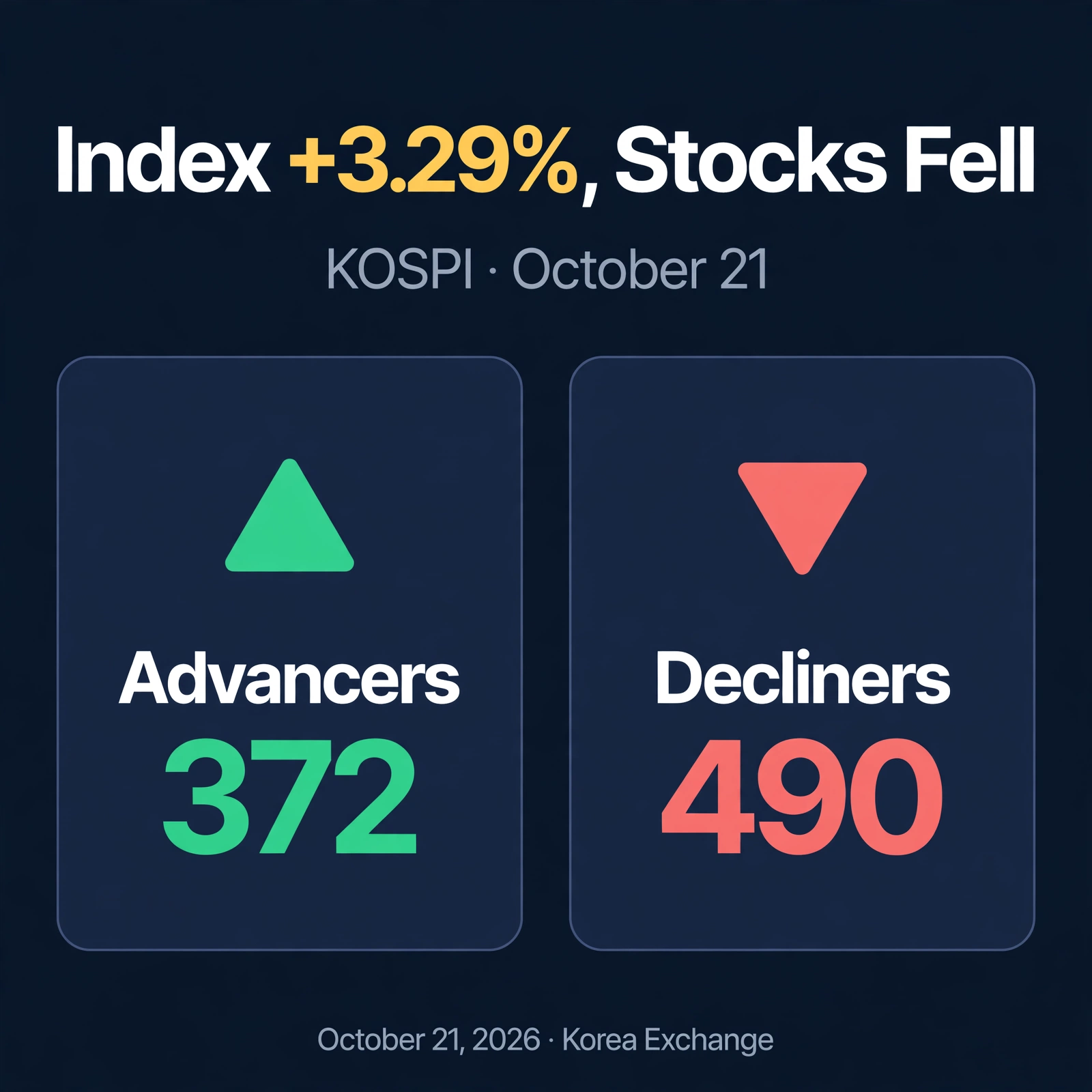
KOSPI +3.29% with 490 decliners vs 372 advancers: Samsung and SK hynix now account for ~47% of the market. What the concentration means for foreign investors.
5minbrief on YouTube
The briefs also come as videos. Get the daily market wrap on YouTube.
Subscribe on YouTube