 5-minute briefs
KOSPI Circuit Breaker Aftermath +2.05% BOK Rate Decision SK Hynix Earnings Checkpoints (Oct 17)
#KOSPI#Samsung Electronics#SK Hynix
Thursday crash, Friday bounce: a roller-coaster week
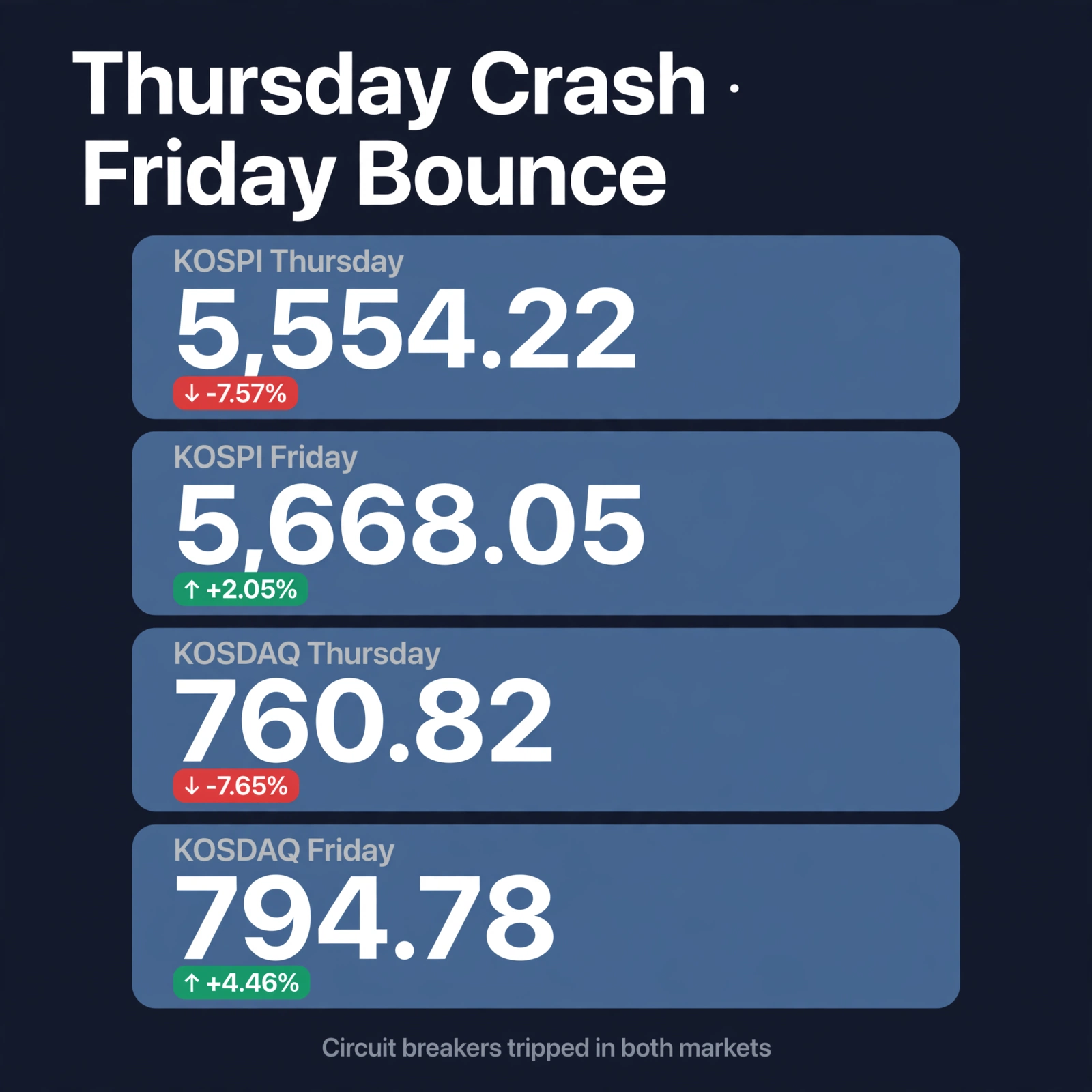
Thursday (Oct 15) was one of the most dramatic days for Korean stocks in years. The KOSPI plunged 7.57% (down 454.59 points) to 5,554.22, and the KOSDAQ fell 7.65% (down 63.06 points) to 760.82. The KOSPI fell as much as 9.29% intraday and tripped its circuit breaker, halting trading for 20 minutes (the first since July 29). Sell-side sidecars were triggered in the morning as well.
Two forces drove the crash. US September CPI came in at 3.7% year over year, above the 3.6% forecast and up from 3.4% in August, reviving fears of another Fed rate hike. And the unsecured corporate bond yield of AI data-center company CoreWeave climbed to around 15%, fueling doubts about whether AI infrastructure spending can ever pay for itself.
Friday brought a mood swing. The KOSPI rose 2.05% (up 113.83 points) to 5,668.05, while the KOSDAQ jumped 4.46% (up 33.96 points) to 794.78, with a buy-side sidecar tripping on strong rebound buying. Nvidia CEO Jensen Huang’s remark that CoreWeave’s financial position is improving helped calm AI fears. Still, Friday recovered only about 25% of Thursday’s drop, so the rebound’s staying power is an open question.
| Index | Oct 15 (Thu) | Oct 16 (Fri) |
|---|---|---|
| KOSPI | 5,554.22 -7.57% | 5,668.05 +2.05% |
| KOSDAQ | 760.82 -7.65% | 794.78 +4.46% |
| USD/KRW | 1,344.6 +6.3 | 1,331.4 -13.2 |
Foreigners vs. retail: the selling hand and the buying hand

This week’s defining flow story was the tug of war between foreign investors and retail. Thursday’s crash was driven by foreigners: they sold about 3.6 trillion won of KOSPI stocks, their eighth straight day of net selling, with 3.2 trillion won dumped from electronics alone. Retail investors and institutions bought a combined 3 trillion won, but it wasn’t enough.
On Friday the tide turned. Foreigners bought about 341 billion won of KOSPI stocks. Samsung Electronics saw 181.9 billion won of foreign net buying, the first net buying in 13 trading days. SK Hynix, by contrast, posted its 16th straight day of foreign net selling (73 billion won on Friday), with the selling merely slowing down.
Retail buying at the dip also stood out: through Oct 14, retail investors had poured 7 trillion won into just two stocks — Samsung Electronics and SK Hynix. Whether that becomes a successful dip-buy or a bag of underwater positions depends on next week’s earnings and foreign flows.
Why the swings: rate pressure and AI profit doubts
The root cause is simple: money is getting more expensive (rates) while AI investments haven’t yet shown they pay. September’s 3.7% US CPI reading makes it harder to argue the Fed’s hiking cycle is over. Higher rates cut the present value of future profits, so growth tech stocks get sold first.
On top of that, the 15% borrowing cost on CoreWeave’s unsecured bonds raised the uncomfortable question of whether AI capex can be recouped. The Philadelphia Semiconductor Index lost $1.64 trillion in market cap over six trading days, and in Korea, Samsung Electronics and SK Hynix accounted for about 68% of the KOSPI’s market-cap decline since early October.
Regulators moved too. On Thursday afternoon, Korea’s Financial Services Commission held an emergency meeting, pledging strict action against illegal short selling, price manipulation, and false information. It also asked financial firms to restrain reckless margin lending and said contingency plans would be activated quickly if instability grows.
- Circuit breaker: halts trading briefly to cool overheating. On KOSPI/KOSDAQ, a drop of 8% or more sustained for one minute triggers a 20-minute halt.
- Sidecar: pauses program trading for 5 minutes when futures prices swing sharply. A milder step than a circuit breaker.
- Treasury share buybacks: when a company buys its own shares, reducing float and supporting the stock. Samsung Electronics and SK Hynix buybacks are a key supply-side variable.
Next week’s checkpoints: the BOK decision and earnings
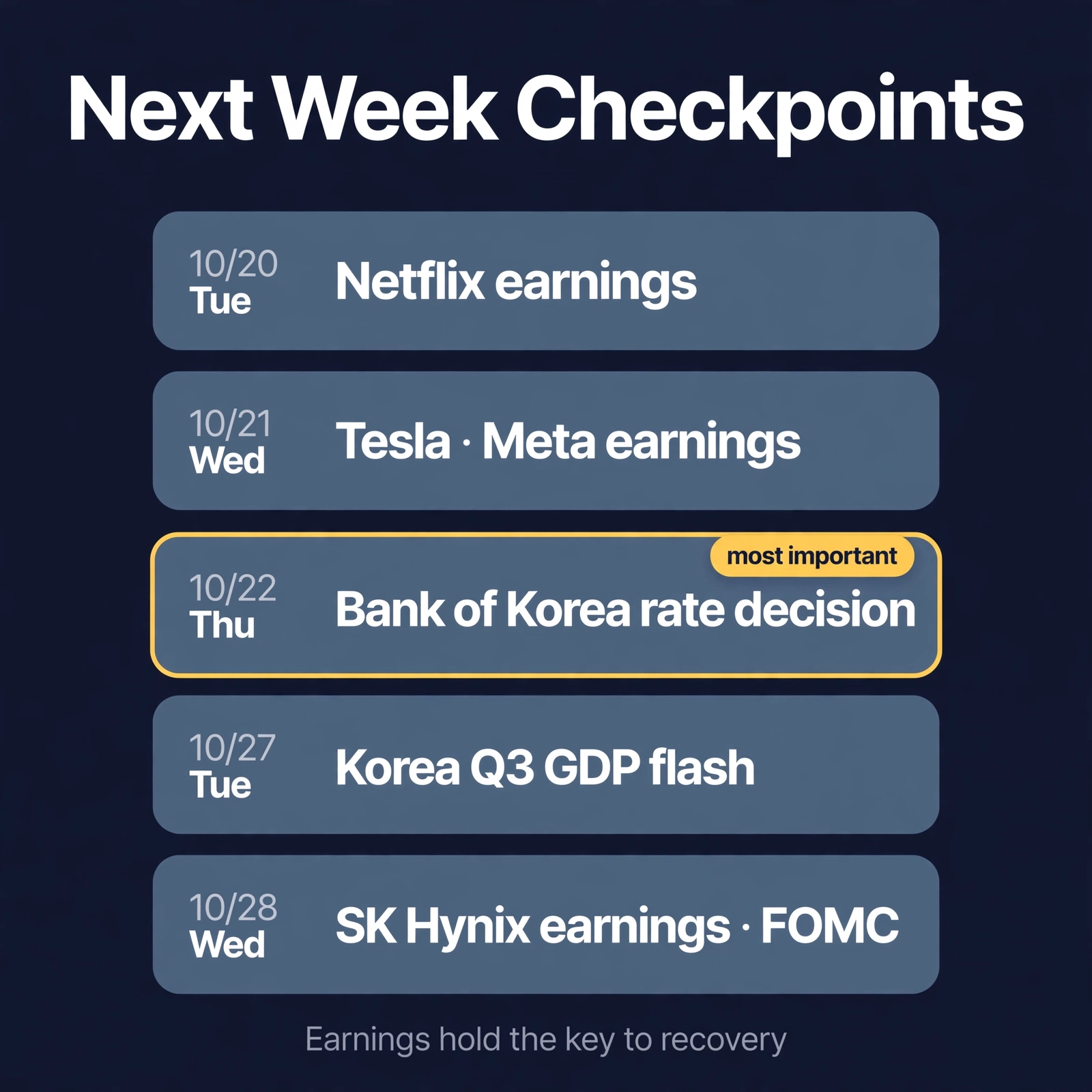
If this week was about “how far it fell,” next week is about “where the evidence lands.” The market is waiting for numbers that prove AI investment is turning into profit.
| Date | Event | What to watch |
|---|---|---|
| Oct 20 (Tue) | Netflix Q3 earnings | First results since the CCO change |
| Oct 21 (Wed) | Tesla · Meta Q3 earnings | AI and robotaxi commentary, AI infra capex |
| Oct 22 (Thu) | Bank of Korea rate decision | Market expects another hike this year |
| Oct 27 (Tue) | Korea Q3 GDP (flash) | Signs of slowdown |
| Oct 28 (Wed) | SK Hynix Q3 earnings | HBM4 competitiveness, server memory demand |
| Oct 28–29 | US FOMC | Decision due in the early hours of Oct 29 KST; about 90% priced for a hike |
The BOK decision stands out. Governor Shin Hyun-song told lawmakers he would reconsider further hikes “from scratch”, and analysts expect another hike this year. Kiwoom Securities puts the KOSPI’s near-term floor at 5,100 (based on 1x 12-month forward PBR). Restoring the uptrend will require earnings to rebuild trust in profits.
Not investment advice. Figures verified against Korea Exchange, Korea Financial Times, Newsis, Segye Ilbo, and etoday as of Oct 17.
Sources & references
- Yonhap News TV — KOSPI plunges 7.57% in circuit-breaker session; KOSDAQ down 7.65% — Oct 15 crash close and circuit breakers
- Yonhap News — KOSPI rebounds 2.1% after eight down sessions; KOSDAQ up 4.5% — Oct 16 rebound close
- Seoul Finance — FSC holds emergency market meeting, pledges zero tolerance for market disruption — FSC emergency meeting on Oct 15 (based on the FSC release)
Related articles
- KOSPI 3.59% Plunge Foreign Institutional 2.9 Trillion Won Selling AI Funding Fear
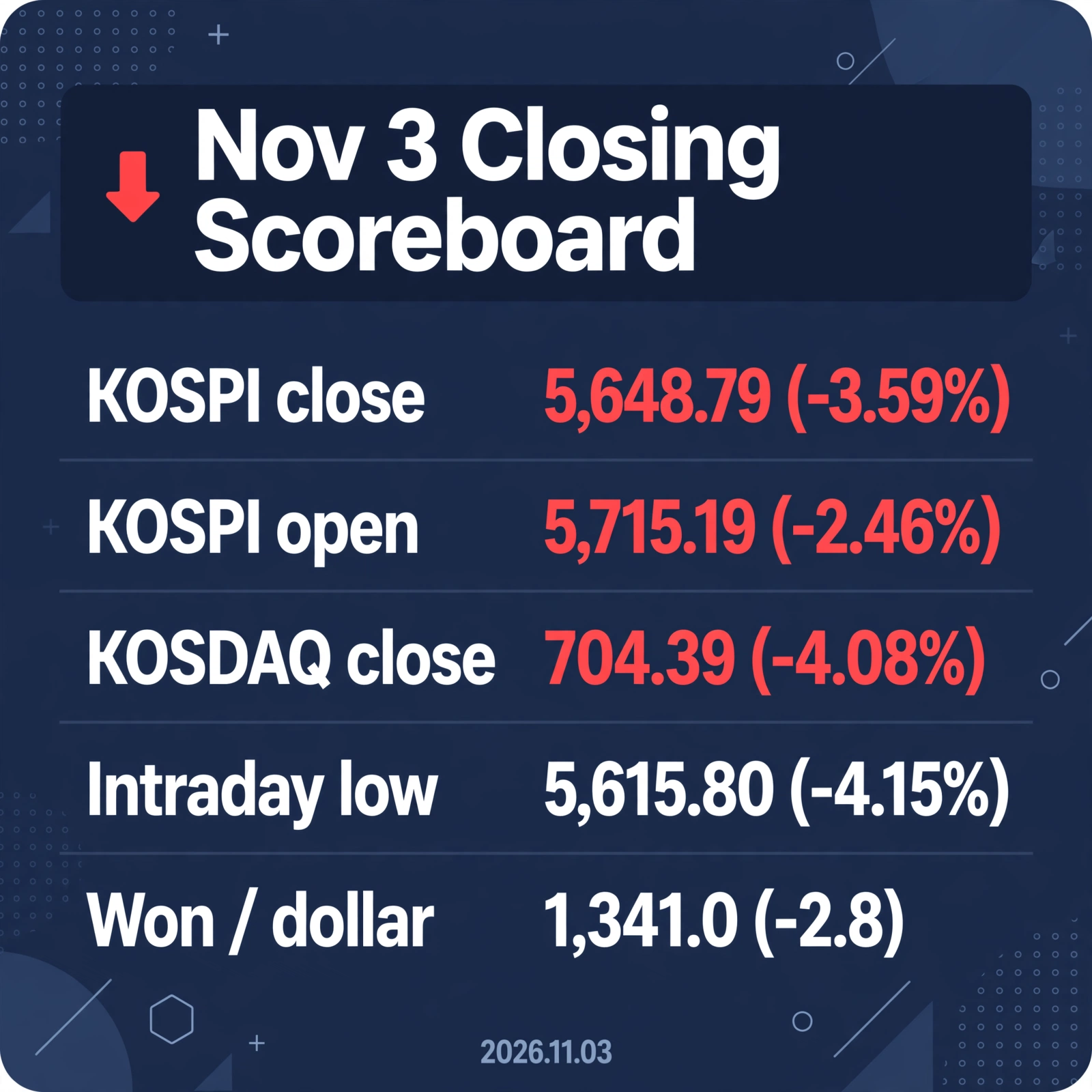
November 3 Korea market close: the KOSPI fell 3.59% to 5,648.79 and the KOSDAQ fell 4.08% to 704.39 as AI funding worries and US midterm caution triggered heavy foreign and institutional selling. Retail investors bought a net 2.60 trillion won alone. What it means for EWY holders.
- KOSPI 3.48% plunge Alphabet shock sell sidecar semiconductor fall analysis
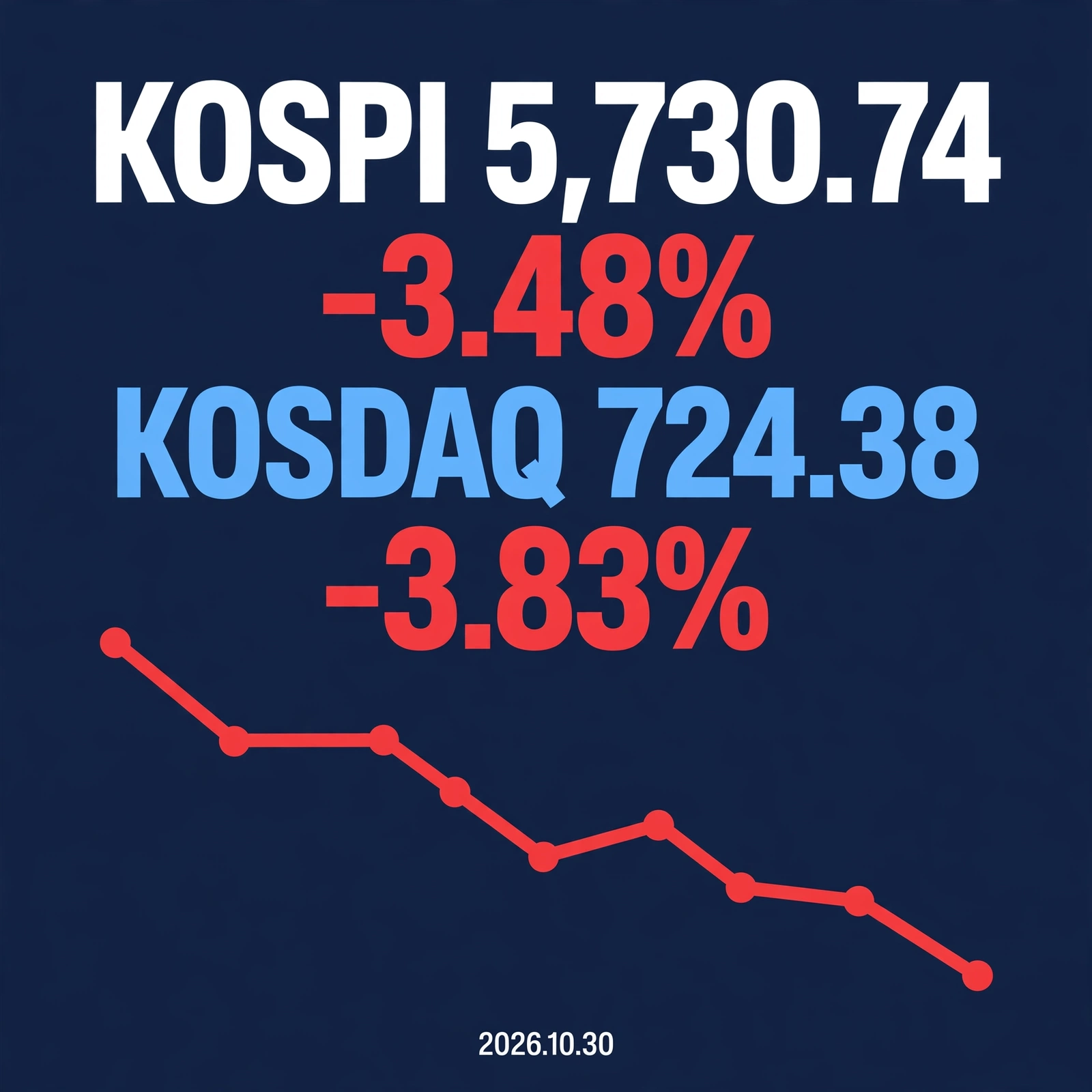
October 30 Korea market brief for foreign investors: the KOSPI fell 3.48% to 5,730.74 and the KOSDAQ fell 3.83% to 724.38 as Alphabet's earnings shock triggered a sell-side sidecar and foreigners sold a net KRW 1.62 trillion ($1.21 billion). Samsung fell 3.02% and SK hynix 7.08%. The won firmed to 1,334.3 per dollar.
- KOSPI 1.24% fall Samsung shareholder return delay 5937 close analysis
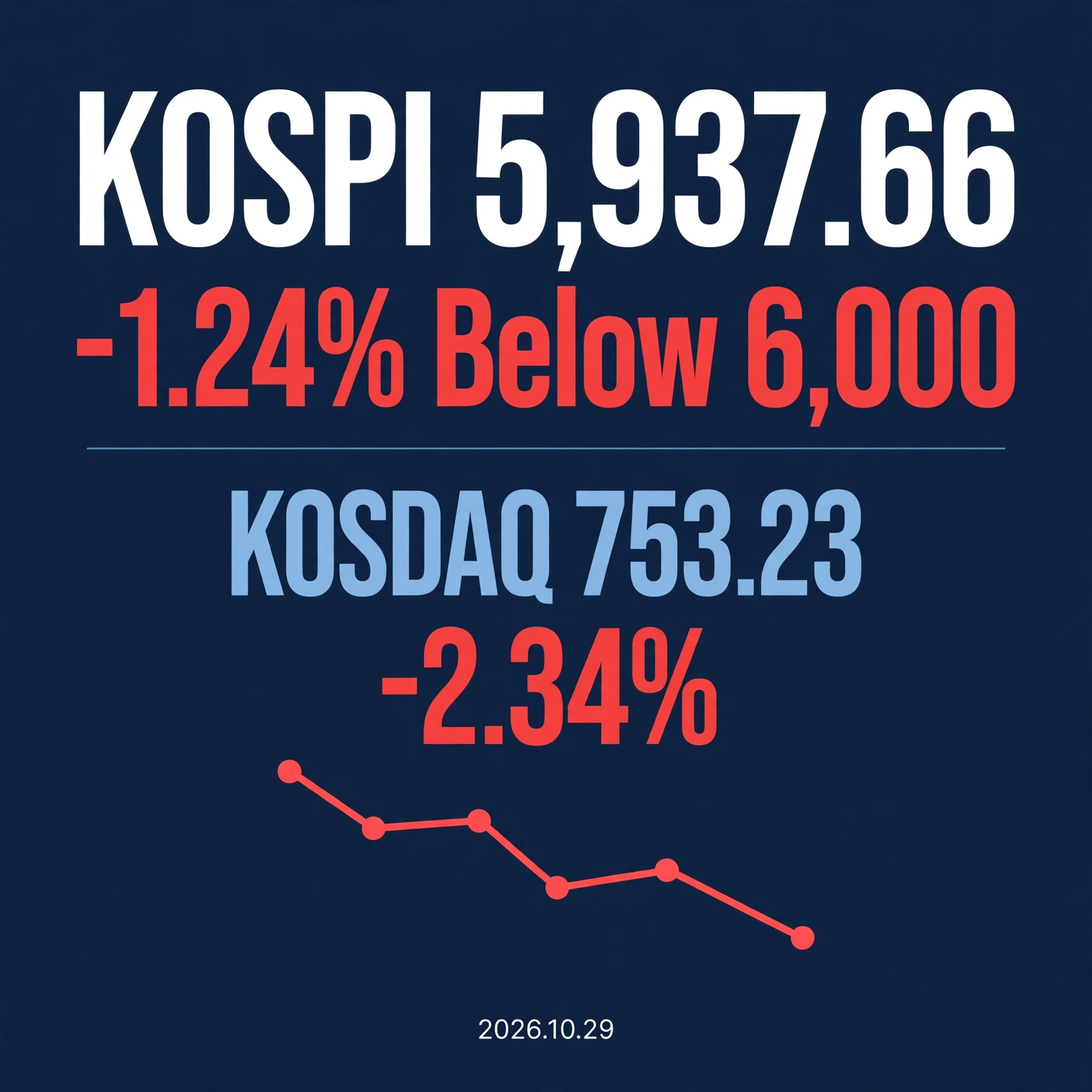
October 29 Korea market brief for foreign investors: the KOSPI fell 1.24% to 5,937.66, giving back the 6,000 line one day after retaking it, and the KOSDAQ fell 2.34% to 753.23. Samsung posted record third-quarter operating profit of KRW 107.44 trillion yet fell 4.13% after deferring shareholder-return details to January, while SK hynix, which spelled out a KRW 100 trillion ($74.8 billion) return plan, rose 2.62%. LG Energy Solution plunged more than 8%. The won firmed to 1,336.8 per dollar.
5minbrief on YouTube
The briefs also come as videos. Get the daily market wrap on YouTube.
Subscribe on YouTube