 5-minute briefs
October CPI 0.4% Above Forecast Analysis Nasdaq Falls 0.74% as Nvidia Drops 5.47%
#Fed rate hike#CoreWeave earnings#December FOMC
U.S. stocks fell across the board on Tuesday. Monday’s rebound faced its first test in the October CPI, and the print came in hotter than expected. Oil kept falling, which had powered Monday’s rally, but this time the inflation data overrode it. Markets went back to pricing the Fed’s next move.
Scoreboard: three indexes down, giving back about a sixth of Monday’s rebound
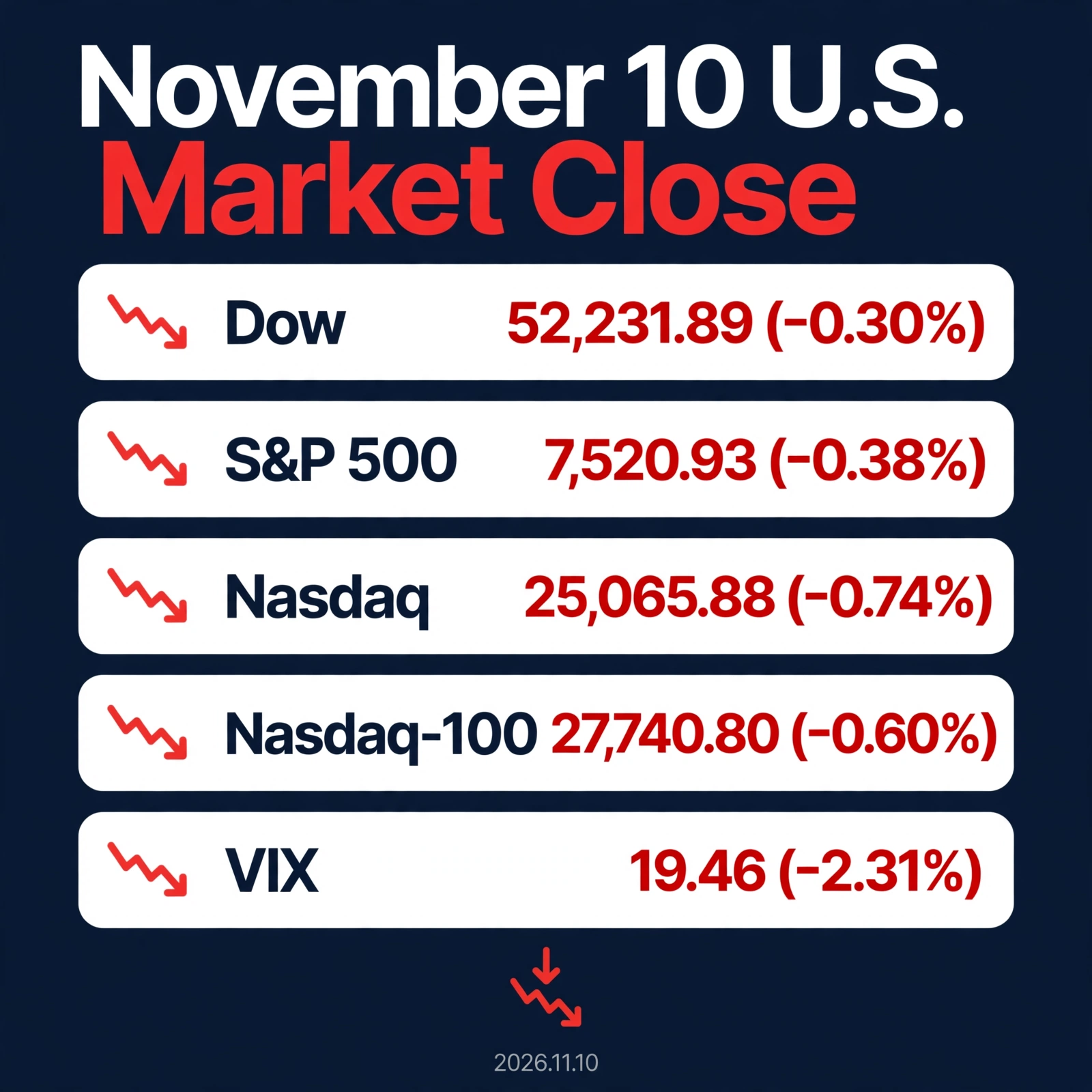
The numbers first. The Dow Jones Industrial Average fell 157.86 points (−0.30%) to 52,231.89, the S&P 500 fell 29.01 points (−0.38%) to 7,520.93, and the Nasdaq Composite fell 187.26 points (−0.74%) to 25,065.88. The Nasdaq-100 fell 166.83 points (−0.60%) to 27,740.80. Measured against Monday’s gains, the S&P 500 gave back 29.01 of the 173.08 points it gained (16.8%), the Nasdaq gave back 187.26 of 673.71 (27.8%), and the Dow gave back 157.86 of 1,104.02 (14.3%). Roughly a sixth of the rebound disappeared in one day.
The character of the selling stands out. While the cap-weighted S&P 500 fell 0.38%, the equal-weight S&P 500 fell only about 0.2%. That means the selling concentrated in mega-cap tech rather than the broad market. By sector, technology fell 1.34% and materials fell 1.97%, the two weakest groups. Energy rose 2.36%, the strongest sector, while utilities (+0.76%) and financials (+0.54%) also gained.
There is one odd number. The VIX fell 0.46 points (−2.31%) to 19.46 even as stocks declined. Down from 19.92 on Monday, it suggests the market read Tuesday’s drop as a mega-cap tech pullback rather than broad fear. That does not mean all is calm — the same gauge spiked to 25.64 on Friday.
CPI rewrites the December scenario: core at 0.3% for three months, 50bp odds at 15%
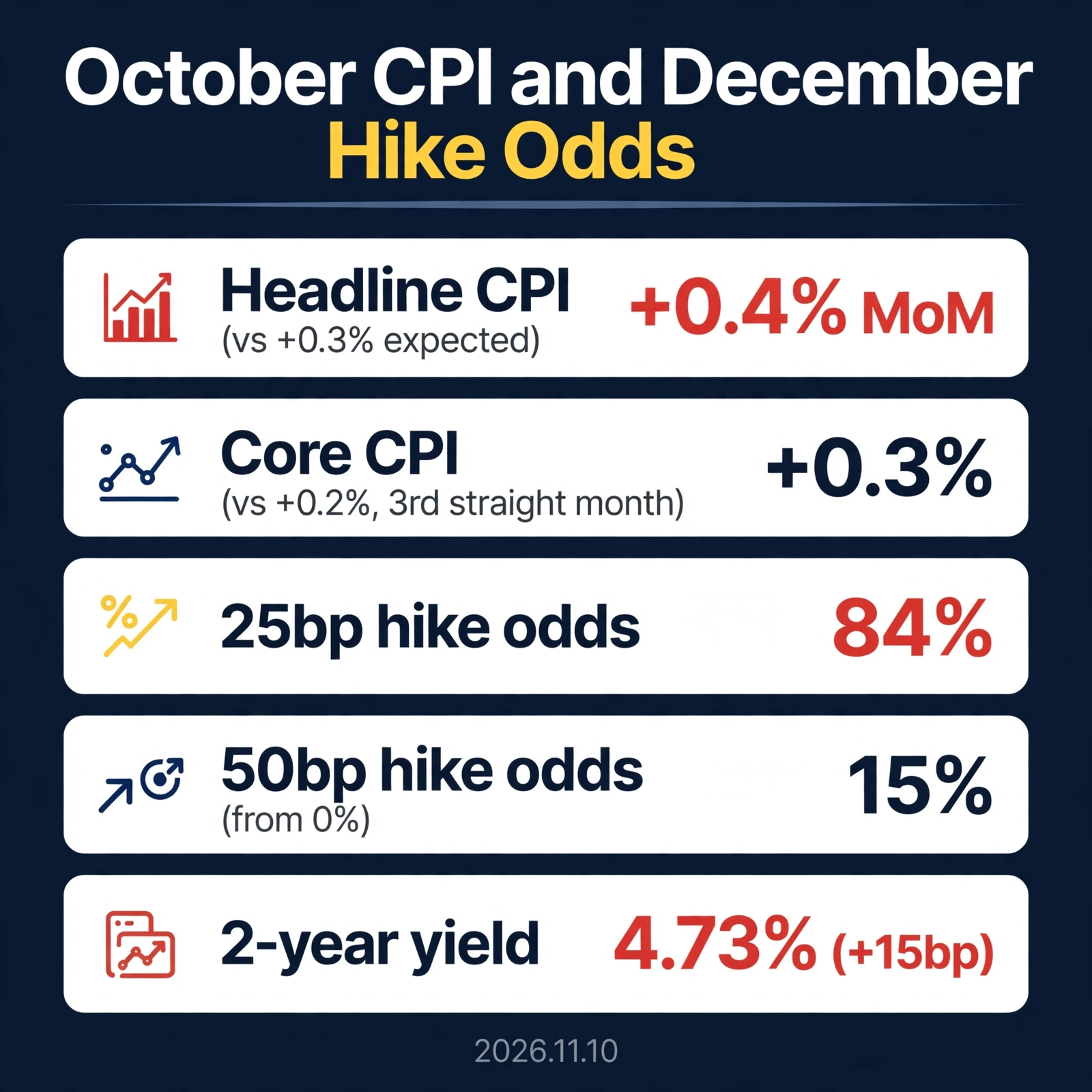
Inflation was the story of the day. October CPI rose 0.4% month over month, beating the 0.3% consensus by 0.1 percentage points. That is slower than September’s 0.6%, but not as slow as the market had hoped. Core CPI, which excludes food and energy, also rose 0.3%, above the 0.2% forecast — the third straight month at exactly 0.3%. Three months at the same pace means disinflation has stalled.
Where it rose matters too. Shelter rose 0.3% and accounted for over 30% of the monthly increase. Food rose 0.5%, energy rose 0.7% (gasoline +1.0%), and services stayed sticky across the board — recreation +0.8%, motor vehicle insurance +0.7%, hospital services +0.8%, transportation services +0.8%. Used cars (−1.2%) and communication (−0.1%) were among the few indexes that fell. No year-over-year figures were published — the October 2025 government shutdown left no price data to compare against.
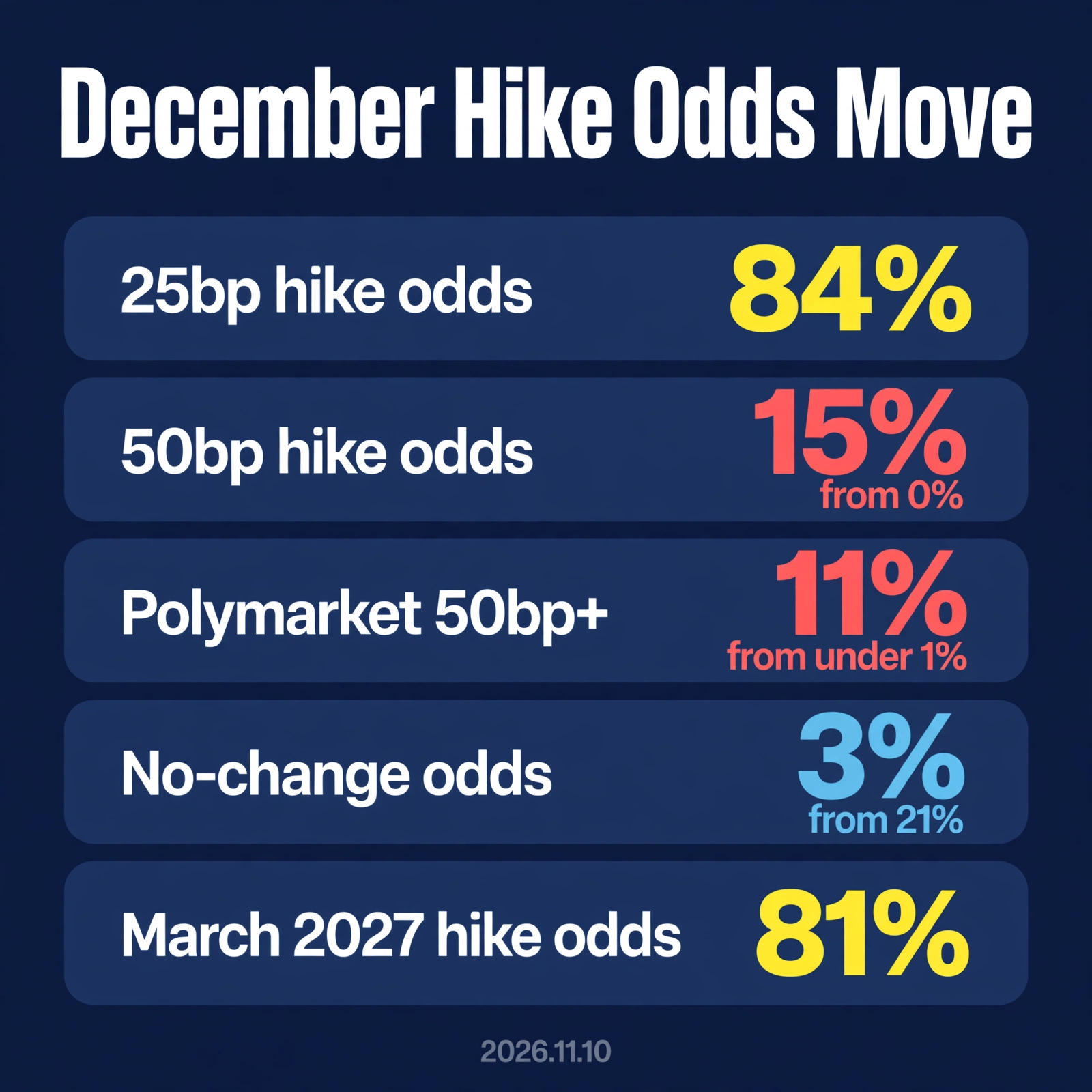
The Fed’s math changed. Governor Christopher Waller said in a London speech before the release that he leans toward a 25bp hike in December, but that core CPI around 0.3% would be a reason to consider a 50bp move. Core CPI came in at exactly 0.3%. Traders now price a December 25bp hike at 84% and a 50bp hike at 15%, up from 0% the day before. On prediction markets, odds of a 50bp-or-more hike rose from under 1% to 11%, while odds of no change collapsed from 21% to 3%.
Bonds moved the same way. The 10-year Treasury yield rose from 4.88% to 4.98% (+10bp), and the 2-year yield rose from 4.58% to 4.73% (+15bp). The 2s10s spread stands at +25bp, so the curve remains in normal territory. December gold futures fell $79.00 (−1.92%) to $4,035.50, and the dollar index rose 0.58% to 102.24.
Nvidia drops 9.5% in two sessions — but chips held up
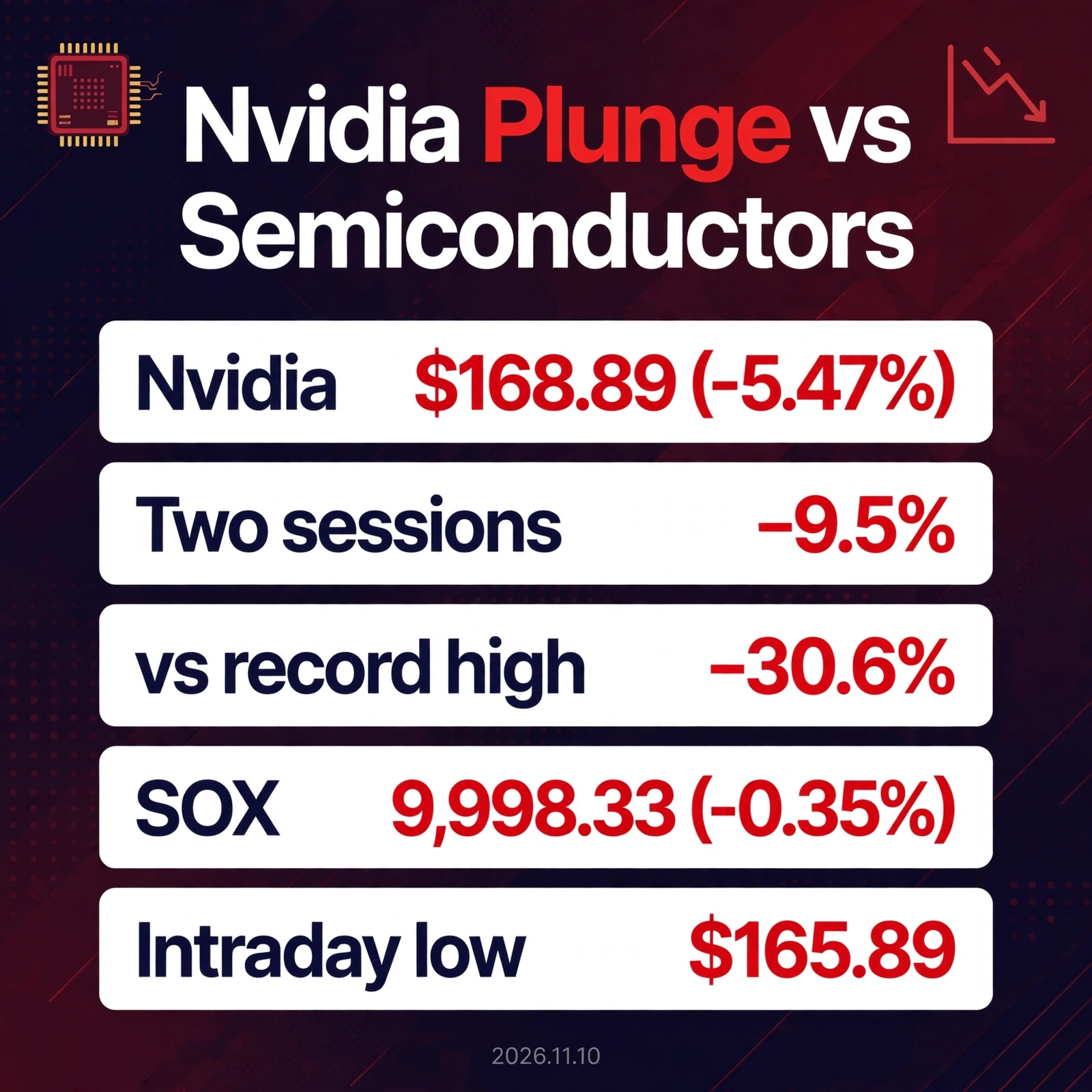
The weakest mega-cap was Nvidia. Nvidia fell $9.78 (−5.47%) to $168.89. After Monday’s −4.27%, that is a 9.5% drop in two sessions from the November 6 close of $186.63. It traded as low as $165.89 intraday on volume of 420.8 million shares, well above normal. Against the October 6 record high of $243.37, the stock is now 30.6% lower.
Two things weighed on it. The board’s independent investigation into CEO Jensen Huang, first reported over the weekend, continued to hang over the stock, and reports around a $7.5 billion hardware shipment added pressure. For a second straight day, the market priced Nvidia’s stock-specific risks separately from AI demand itself.
But the chip sector as a whole held up. The PHLX Semiconductor Index (SOX) fell only 35.60 points (−0.35%) to 9,998.33, barely giving up the 10,000 level — a decline about one-fifteenth of Nvidia’s. Compared with Monday, when the SOX jumped more than 6% to reclaim 10,000, Tuesday’s chips were comparatively calm outside Nvidia. Nvidia reports earnings on November 17, and Huang’s closed-door briefing requested by three House committee chairs is set for November 18.
- CPI month over month / core CPI: month over month compares prices with the prior month; core CPI excludes food and energy. October CPI was +0.4% MoM and core was +0.3%. Year-over-year figures were not published because of the October 2025 shutdown.
- CME FedWatch: rate-hike odds drawn from fed funds futures. A December 25bp hike at 84% and a 50bp hike at 15% means the market treats a December hike as nearly certain.
- SOX (PHLX Semiconductor Index): an index of 30 major U.S. semiconductor stocks. It closed Tuesday at 9,998.33 (−0.35%), just below 10,000.
- VIX (fear gauge): expected 30-day volatility implied by S&P 500 options. Below 20 usually reads as relatively calm. It closed Tuesday at 19.46.
- Neocloud: a cloud provider renting GPU computing power for AI training and inference. CoreWeave is the leading example. Revenue grows fast, but capex and interest costs are heavy.
- Equal-weight S&P 500: the same 500 stocks at equal weights instead of by market cap. Falling less than the cap-weighted index means the selling concentrated in the biggest names.
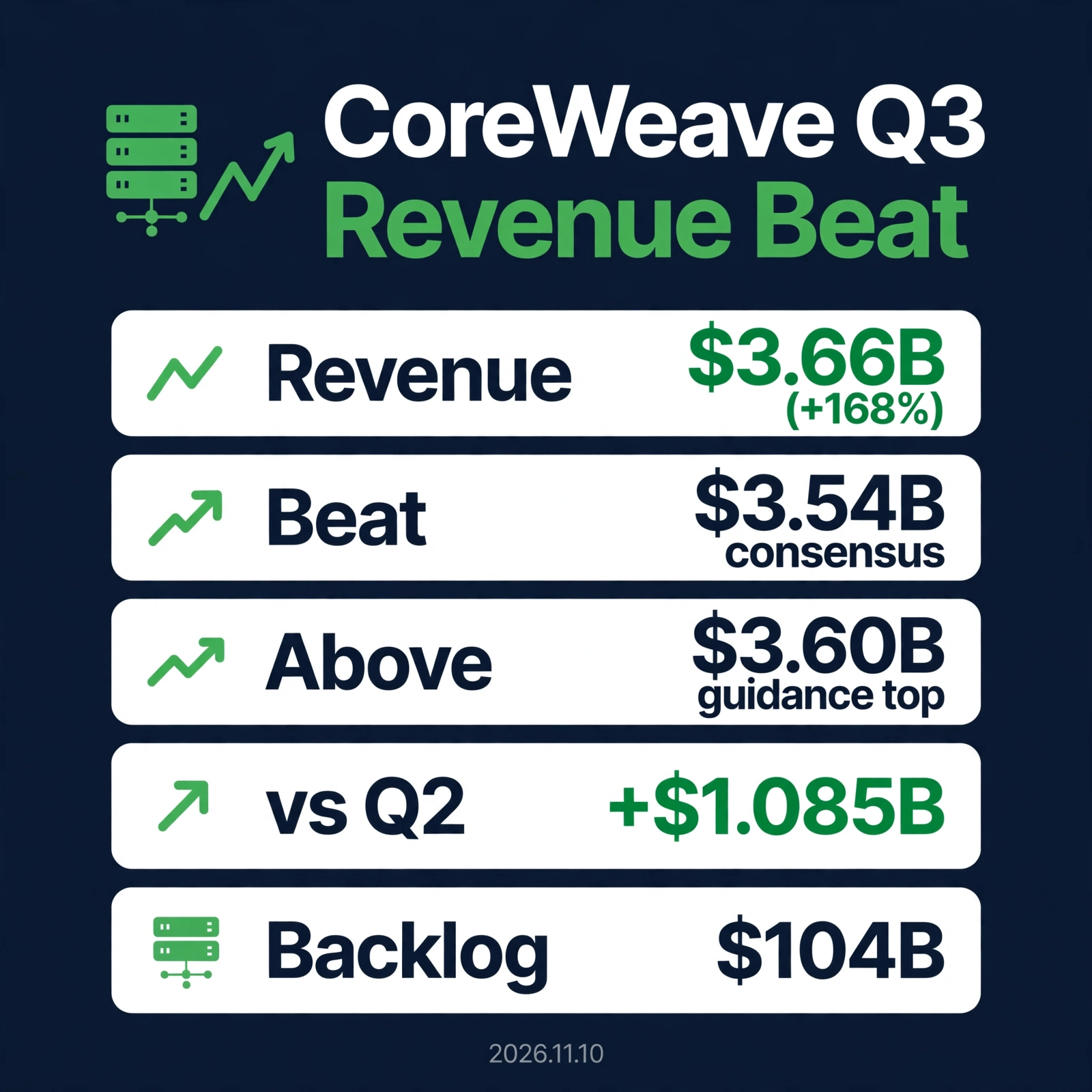
To recap. October CPI came in at +0.4% month over month and core at +0.3%, both above forecast, and December 50bp hike odds jumped from 0% to 15%. The three major indexes gave back about a sixth of Monday’s rebound, and Nvidia fell 9.5% in two sessions. But the VIX fell to 19.46 and the equal-weight index fell less, suggesting the market read the drop as a mega-cap tech pullback rather than broad fear. CoreWeave posted Q3 revenue of $3.66 billion, beating estimates, yet its $846 million interest bill was more than double its $379 million adjusted operating income. Wednesday is Veterans Day: stocks trade normally while the bond market is closed. The OPEC monthly report is due, and PPI arrives on Friday. There is no more inflation data before the December 9 FOMC — November CPI comes out on December 10, the day after the meeting. The next checkpoint is Friday’s PPI.
Sources & references
- Reuters — Wall St ends lower as hot inflation data, Fed comments heighten rate worries — November 10 final close (Dow 52,231.89, S&P 7,520.93, Nasdaq 25,065.88) after hot CPI and Waller comments
- U.S. Bureau of Labor Statistics — Consumer Price Index Summary, October 2026 — October CPI +0.4% MoM, core +0.3% for a third straight month, shelter +0.3% drove over 30% of the increase, no year-over-year release
- Yahoo Finance — Stock market today: Dow, S&P 500, Nasdaq after October CPI — December hike odds: 25bp at 84%, 50bp at 15% (from 0%); equal-weight S&P down about 0.2% vs 0.38% cap-weighted; sector moves
- Yahoo Finance — CoreWeave stock pops as Q3 revenue beats estimates, company raises full-year outlook — CoreWeave Q3 revenue $3.66B vs $3.54B consensus, full-year outlook raised, shares higher after hours
Related articles
- December FOMC 50bp Hike Scenario Analysis Core CPI 0.3% and Waller Comments
October core CPI ran at 0.3% for a third straight month, and December 50bp hike odds jumped from 0% to 15%. Governor Waller had named 0.3% core as the condition for considering a 50bp move, and November CPI comes out the day after the FOMC. What separates a 25bp hike from a 50bp one.
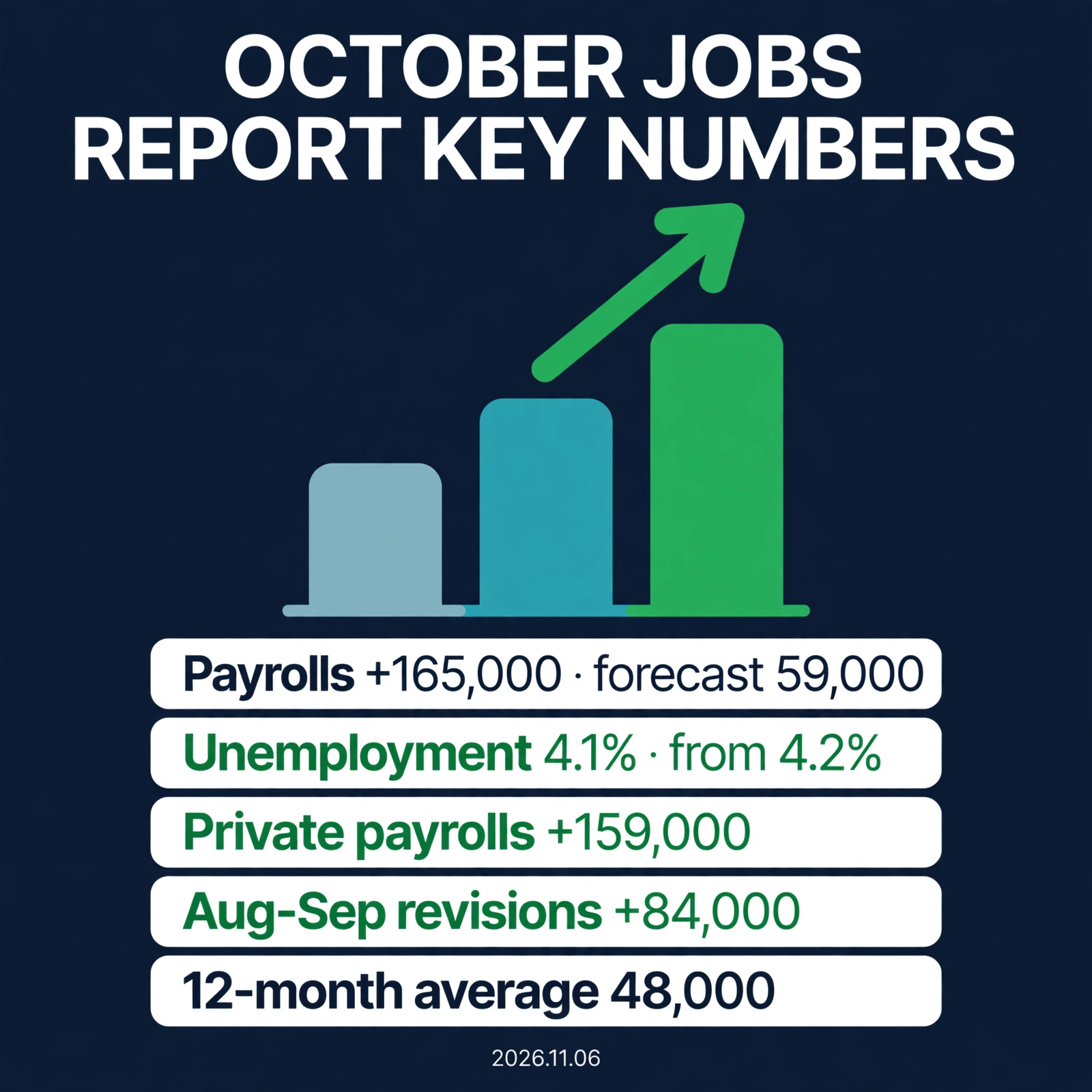
- October Jobs Report Analysis 165,000 Payrolls Surprise and December Fed Hike Odds 76.8% Flip
October nonfarm payrolls rose 165,000, nearly three times the 59,000 consensus, and unemployment fell to 4.1%. December Fed hike odds jumped from 60% intraday Thursday to 76.8% on Friday. The next test is CPI on November 10.
- CoreWeave Q3 Earnings Analysis Revenue $3.66B Beat and $846M Interest Cost Verdict
CoreWeave's Q3 revenue of $3.66 billion beat estimates and the company raised its full-year outlook. But interest expense of $846 million was more than double adjusted operating income of $379 million, and the operating margin fell from 16% to 10%. Demand is proven; the money-making structure is not.
5minbrief on YouTube
The briefs also come as videos. Get the daily market wrap on YouTube.
Subscribe on YouTube