 5-minute briefs
Hormuz Naval Mining Campaign: Southern Route Blockade and AIS-Dark Targeting
Tankers keep burning in the Strait of Hormuz. Most reports compress each fire into a single line — “tanker attacked” — but there is a clear tactic inside. Iran has declared the strait’s southern routes unauthorised and mined them, and treats vessels crossing them with their Automatic Identification System (AIS) switched off as targets. How the mines are laid, who gets targeted, and why the tactic works is the story.
The mining chronology: four tankers claimed November 4 to five more over the weekend
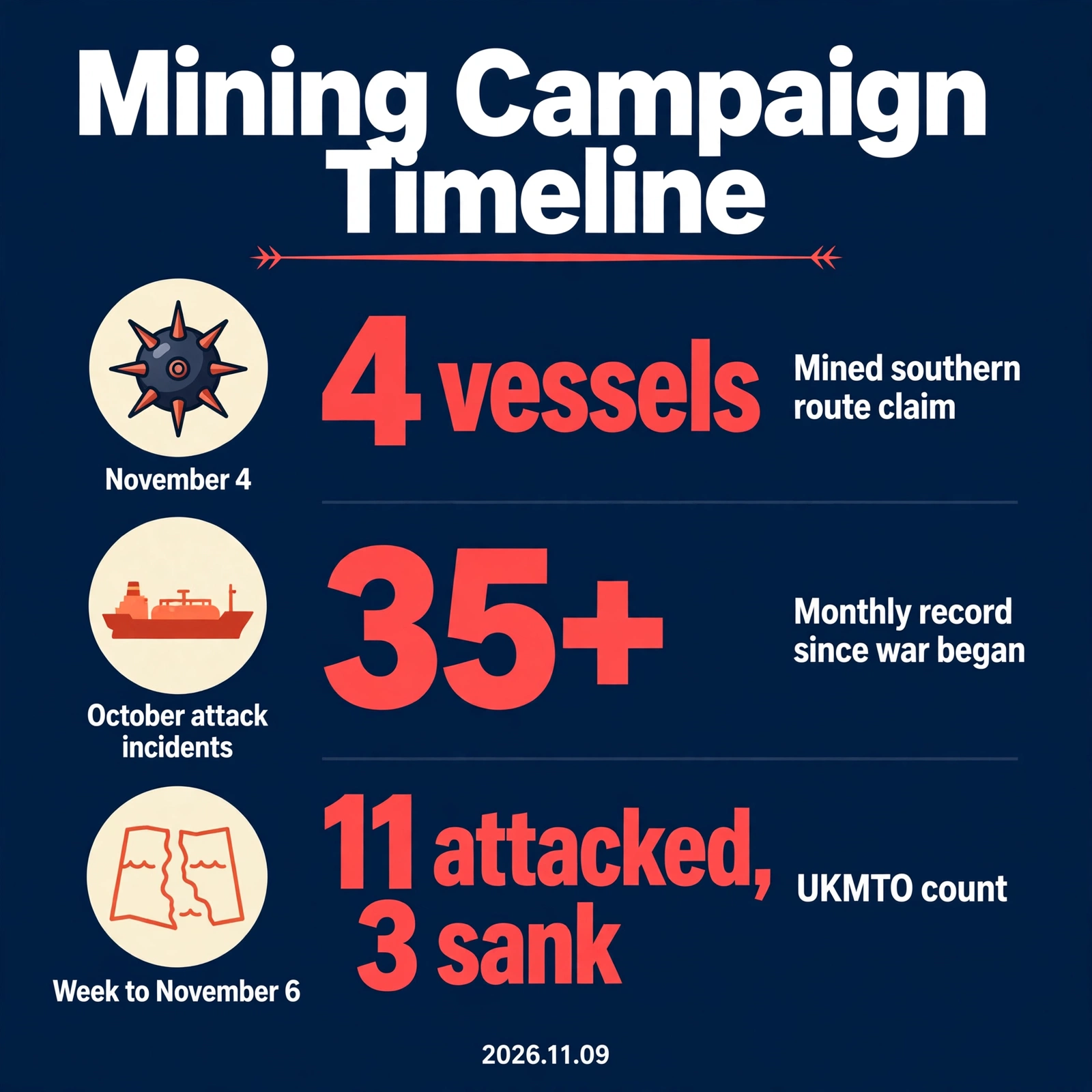
First, the chronology. Most of the numbers come from the Islamic Revolutionary Guard Corps (IRGC), and Reuters and other outlets note they could not independently confirm them. What matters is the pattern of the claims, read alongside the UK Maritime Trade Operations (UKMTO) independent count.
On November 4, the IRGC claimed four tankers were destroyed after hitting mines on the “forbidden” southern route of the strait. On November 5, it said two tankers and a tug caught fire after using unauthorised routes — one tanker hit a mine on the southern route, another large tanker caught fire while exiting the eastern route, and the tug caught fire while coming to help. On the morning of November 6, it said two tankers hit mines and caught fire, one east of the strait and one inside it.
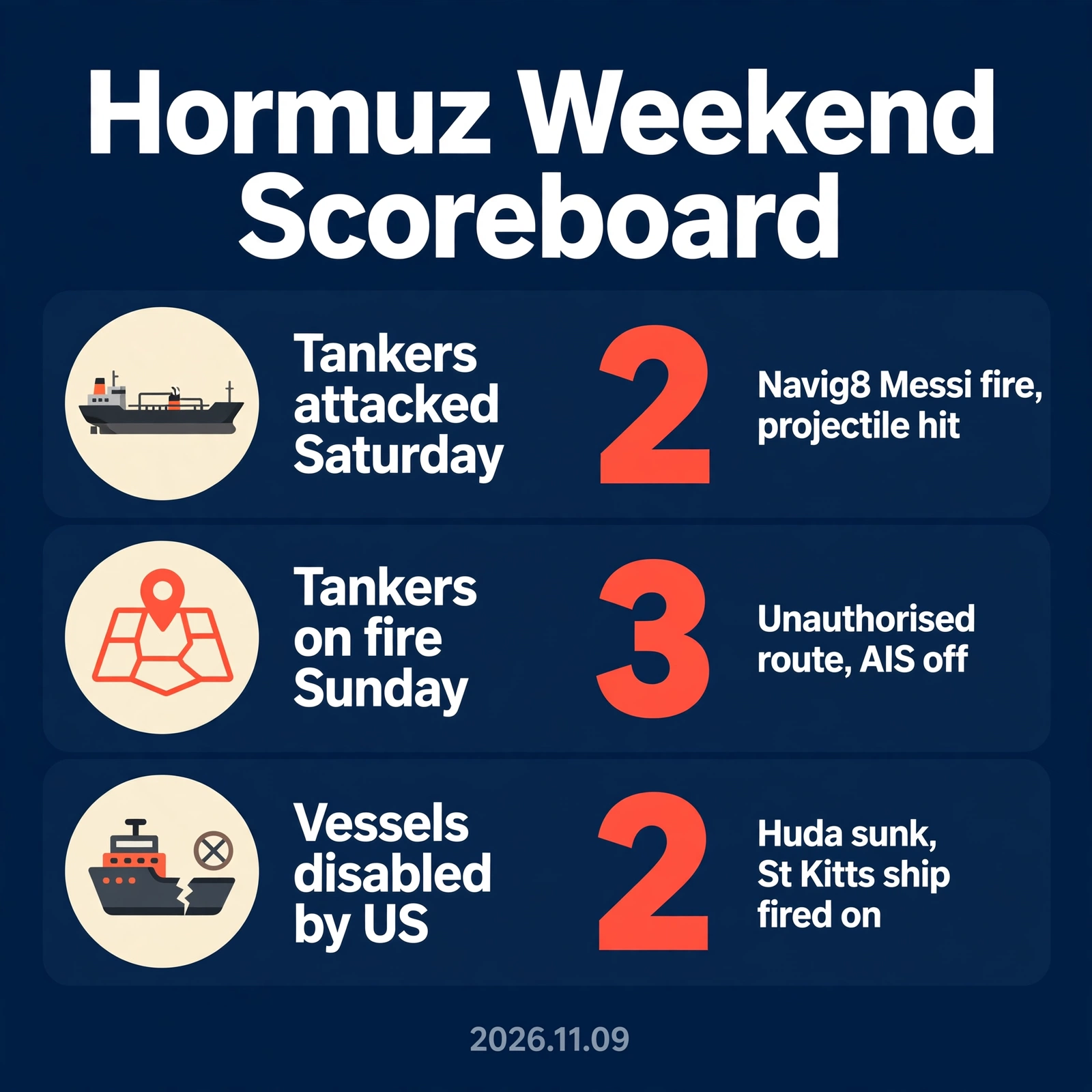
Over the weekend the form of attack changed. On Saturday, at least two tankers were attacked, the Navig8 Messi catching fire off Khasab and another hit by a projectile. From the early hours of Sunday, three tankers exploded and caught fire on unauthorised routes, the IRGC said. Adding the IRGC’s claims day by day, at least 14 vessels were hit by mines, fire or projectiles between November 4 and 8. The same incident may have been reported on more than one day, so that total should be read as the scale of the claims, not a verified count.
The independent count confirms the pace is not slowing. UKMTO recorded at least 11 ships attacked in and around the strait in the week to November 6, three of which sank. Attack-related incidents in October passed 35, the most in a month since the war began. Projectile attacks since hostilities resumed in early July total 88. Whatever the truth of each claim, ships are being attacked in the strait at the fastest rate of the war.
Anatomy of the tactic: mined south, AIS-dark targets, underwater drones
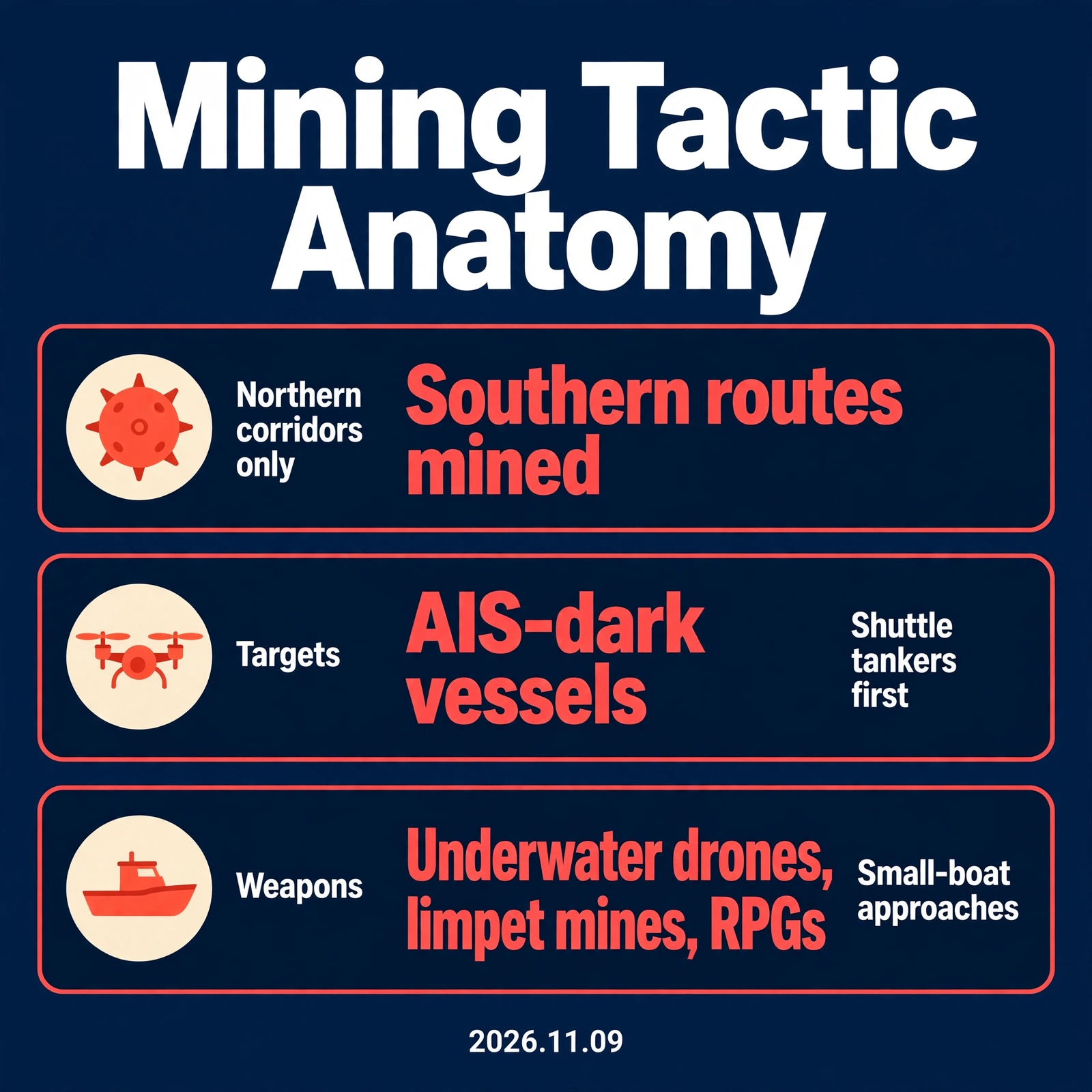
The tactic is simple at its core. Iran allows only designated northern corridors and has declared southern routes unauthorised and mined them. The IRGC Navy has said repeatedly that safe passage exists only through the designated northern corridors. Two rules define the tactic: southern routes are mined, and a vessel with its AIS switched off is treated as an unauthorised-route vessel.
Mines are not the only weapon. According to the Wall Street Journal, Iran is using explosive underwater drones, limpet mines and rocket-propelled grenades to attack ships transiting the strait. Limpet mines — explosives attached directly to a hull — are a method Iran also used in 2019, and they are back. On October 30, a small boat approached a tanker just north of Oman and attached two explosives to the hull above the waterline. Small boats loiter among fishing vessels gathering targeting information, then strike — guerrilla tactics at sea.
The target set is widening. The main targets are the shuttle tankers carrying Gulf crude out of the strait, but attacks have widened from tankers to container ships, bulk carriers and gas carriers, and even to vessels anchored outside the strait. UKMTO reports that “IRGC attacks, attempted attacks, and/or harassment activity persisted including UAV overflight, targeted surveillance of merchant shipping, and occasional VHF hailing”, and describes the Iranian presence in the strait as constant and active.
The tactic targets the ship’s choice, not just the ship. Shuttle tankers switch off their AIS to pass the strait unseen by Iran, and switching AIS off is itself what makes them targets in the IRGC’s account. AIS on means exposure to surveillance; AIS off means becoming a mine target. The US has run near-daily operations since a June ceasefire memorandum collapsed, keeping the blockade while letting other ships and oil exit — but experts say detecting or stopping this surveillance activity is not easy. The Journal reads the tactical shift as Iran compensating for a weakened navy while securing leverage in a stalled negotiation with the US.
Why mines: cheap to lay, expensive to block, and they stay
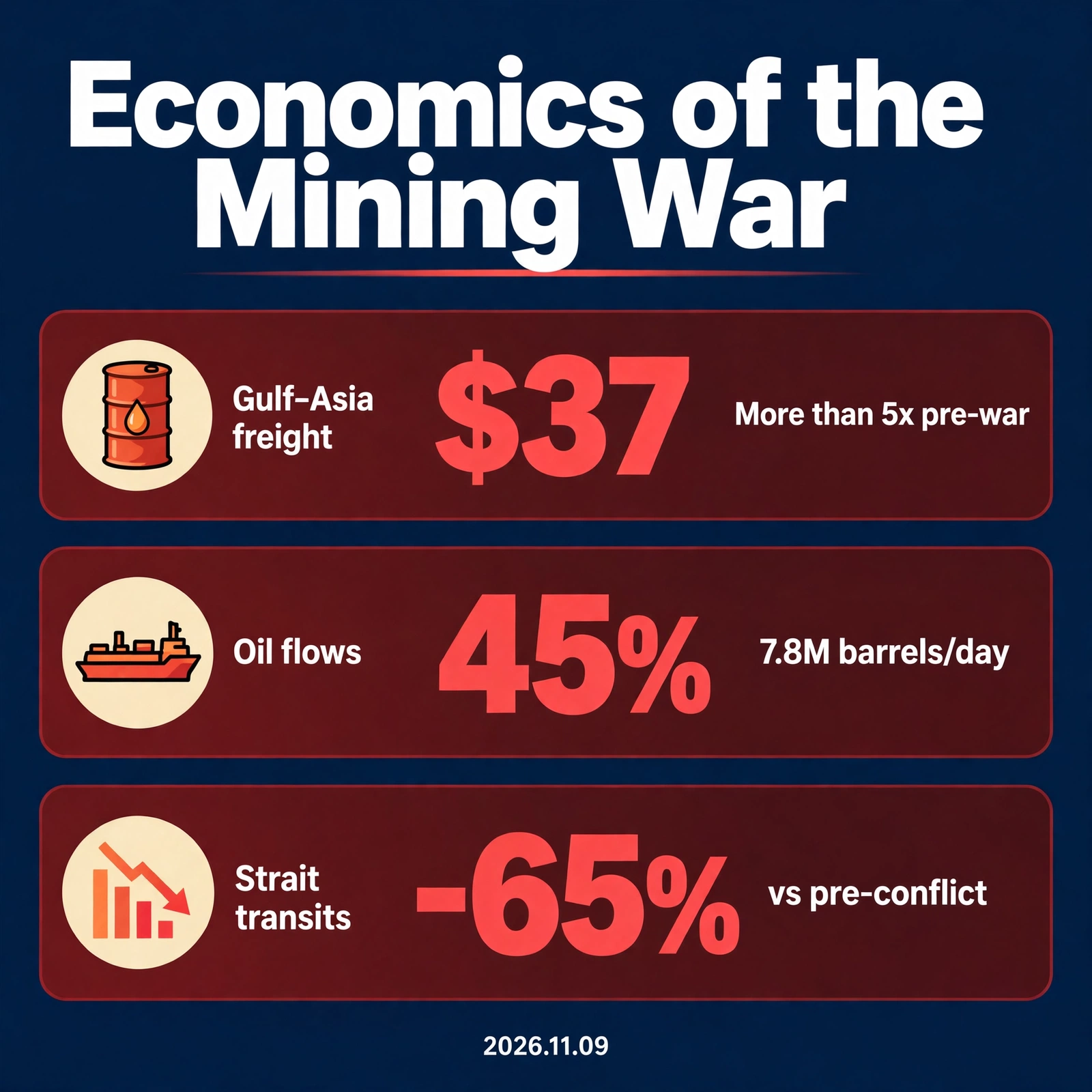
Mines were chosen for their economics. A mine is cheap to lay, and once laid it raises insurance and freight for the entire waterway, changing what ships choose to do. According to the International Energy Agency, the cost of moving crude from the Gulf to Asia was about $37 a barrel in mid-October, more than five times the pre-war level. Transits through the strait are down about 65% from before the conflict, and Kpler data put oil passing through the strait at about 7.8 million barrels a day in the week to November 1 — about 45% of the pre-war level. That is a large effect for a few mines.
The second feature of mines is that they stay. A missile ends when it is fired; a mine stays where it was laid and keeps the strait dangerous. Even if a deal is signed, the strait does not return to normal until mine maps are shared and clearance is complete. Clearance needs its own schedule after any deal, and that schedule is the pace of normalisation. That makes the mining campaign an asset on the negotiating table as well as an attack: the more mines laid, the more clearance can be traded.
The third feature is deniability. A mine strike can look like an accident, which carries less diplomatic cost than a missile attack. The IRGC presents mine strikes as the consequence of using unauthorised routes, citing the switched-off AIS as evidence. It does not name the vessels’ nationalities. Where the mines are, when they were laid and how many remain is opaque — and that opacity itself makes shipping hesitate. For a shipowner, not knowing where the mines are deters sailing as much as knowing they are there.
- Naval mine: an explosive placed in the sea that detonates when a ship touches it. Cheap to lay and able to control a wide area, it is the classic asymmetric weapon of a weaker navy.
- AIS (Automatic Identification System): the system that broadcasts a ship's position, course and speed. Switching it off avoids surveillance, but Iran treats AIS-dark vessels as unauthorised-route traffic and targets them.
- Limpet mine: an explosive attached directly to a hull. Small boats approach and attach it — a method Iran also used in 2019.
- Hormuz shuttle: tankers that load crude in the Gulf, cross the strait to the Gulf of Oman and transfer the oil ship-to-ship to long-haul tankers. At least 63 tankers take part.
- UKMTO: the United Kingdom Maritime Trade Operations, the Royal Navy body that tracks and publishes ship attacks and maritime safety in Middle East waters. Source of the 11-attacked, 3-sunk count for the week to November 6.
- Underwater drone: an unmanned submersible carrying explosives. The Wall Street Journal reports Iran is using them in strait attacks.
The summary: the Hormuz mining campaign is not an accident but a designed blockade tactic. Mined southern routes, AIS-dark targeting, and the combination of underwater drones and limpet mines produced a monthly record for attacks in October. Mines are cheap to lay, raise costs across the whole strait, and remain after any deal. So Monday’s open should watch more than the count of burning tankers. If talks make progress, whether mine maps are shared and a clearance schedule is set becomes the real test of normalisation in the strait.
Watch the video

Sources & references
- The Maritime Executive — Tanker Burns After Strike in Strait of Hormuz — Navig8 Messi identified, hit off Khasab; second tanker hit by projectile; UKMTO on persistent IRGC harassment
- Free Malaysia Today — Iran says 3 tankers caught fire in Hormuz — IRGC: three tankers exploded and caught fire on Sunday on an unauthorised route; strait carries about one-fifth of global oil consumption
- Press TV — IRGC Navy: Three oil tankers engulfed in flames in Strait of Hormuz after maritime violations — IRGC Navy statement: three tankers on an unauthorised route, navigation systems off; southern routes declared unauthorised and mined
- The Hindu Business Line — Iran suggests blasts are not US attacks as both sides report ships hit — Iranian media on Saturday evening blasts; both sides reported shipping hit in or near the strait; 11 ships attacked in the week to November 6, 3 sank
Related articles
- Hormuz Oil Negotiation Analysis: Trump Restraint and Mining War
Three more tankers caught fire in the Strait of Hormuz over the weekend. Trump said fresh strikes are 'highly unlikely' if talks progress, while the IRGC keeps mining the strait. The fork Monday's open has to price.
- Brent Crude Analysis: 18.4% Drop in Six Sessions on Negotiation Hopes
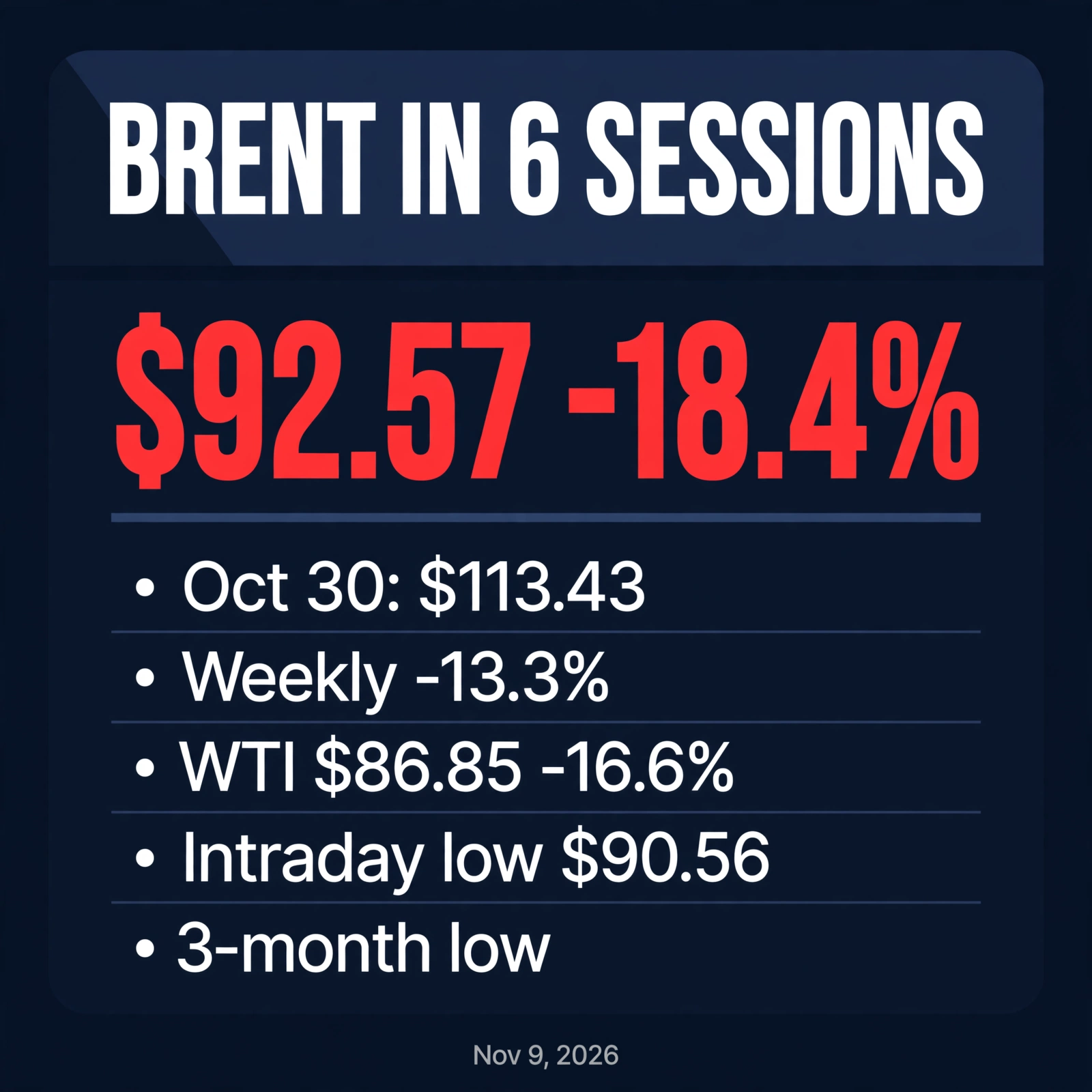
Brent crude has fallen 18.4% in six sessions, from $113.43 on October 30 to $92.57 on November 9. The war premium is unwinding fast — but analysts put renewed strikes at 60%, and that gap sets the terms for a reversal.
- Iran Oil Export Blockade: $25 Billion Stopped and the Ghost Fleet
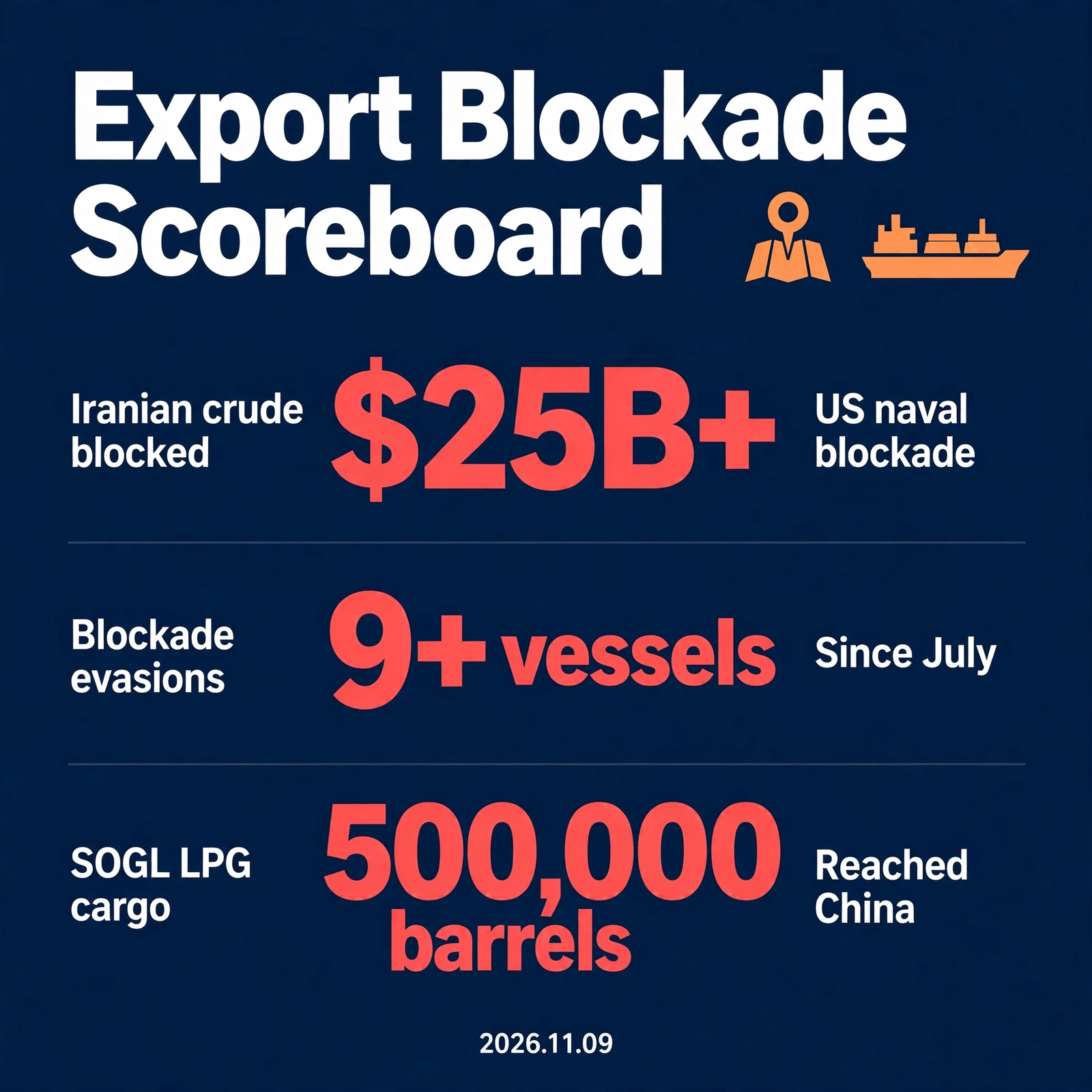
The US naval blockade has effectively stopped Iranian crude exports. Between reports of over $25 billion blocked, nine vessels slipping through, and 63 Hormuz shuttle tankers adapting, this is the real measure of the blockade.
5minbrief on YouTube
The briefs also come as videos. Get the daily market wrap on YouTube.
Subscribe on YouTube