 5-minute briefs
October Jobs Report Analysis 165,000 Payrolls Surprise and December Fed Hike Odds 76.8% Flip
Inside the jobs report: three times the forecast, past months revised up
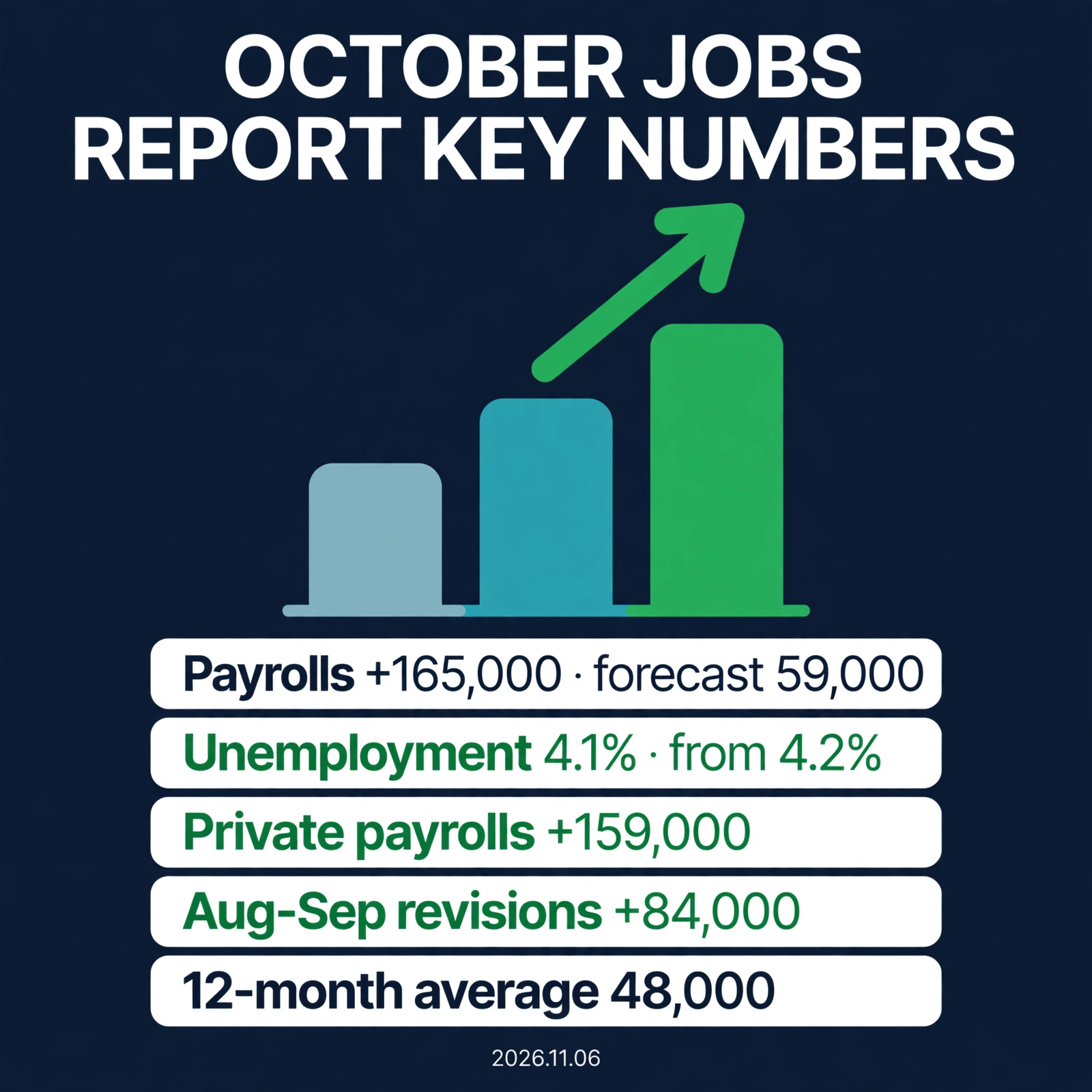
The numbers first. Nonfarm payrolls rose 165,000 in October. The Dow Jones consensus was 59,000 and the Reuters poll was 65,000. That is nearly three times what economists expected. Private payrolls rose 159,000, more than double the 64,000 forecast, and the unemployment rate fell to 4.1% from 4.2%.
Past months improved, too. August payrolls were revised up by 53,000, from 133,000 to 186,000, and September by 31,000, from 29,000 to 60,000 — a combined 84,000. The average monthly gain over the past 12 months is 48,000, so October ran at more than three times that pace. With a shrinking labor force, the monthly gain needed to keep unemployment steady has fallen from about 150,000 in 2024 to roughly 40,000 now. October’s 165,000 is more than four times that bar.
There is a cooler side to the report. The average stretch of unemployment rose to 27 weeks, the longest since the end of 2021. Jobs are being added, but once someone loses a job, finding the next one takes longer. Quantity is strong; quality is mixed.
The December flip: from 60% to 76.8%, hike instead of cut
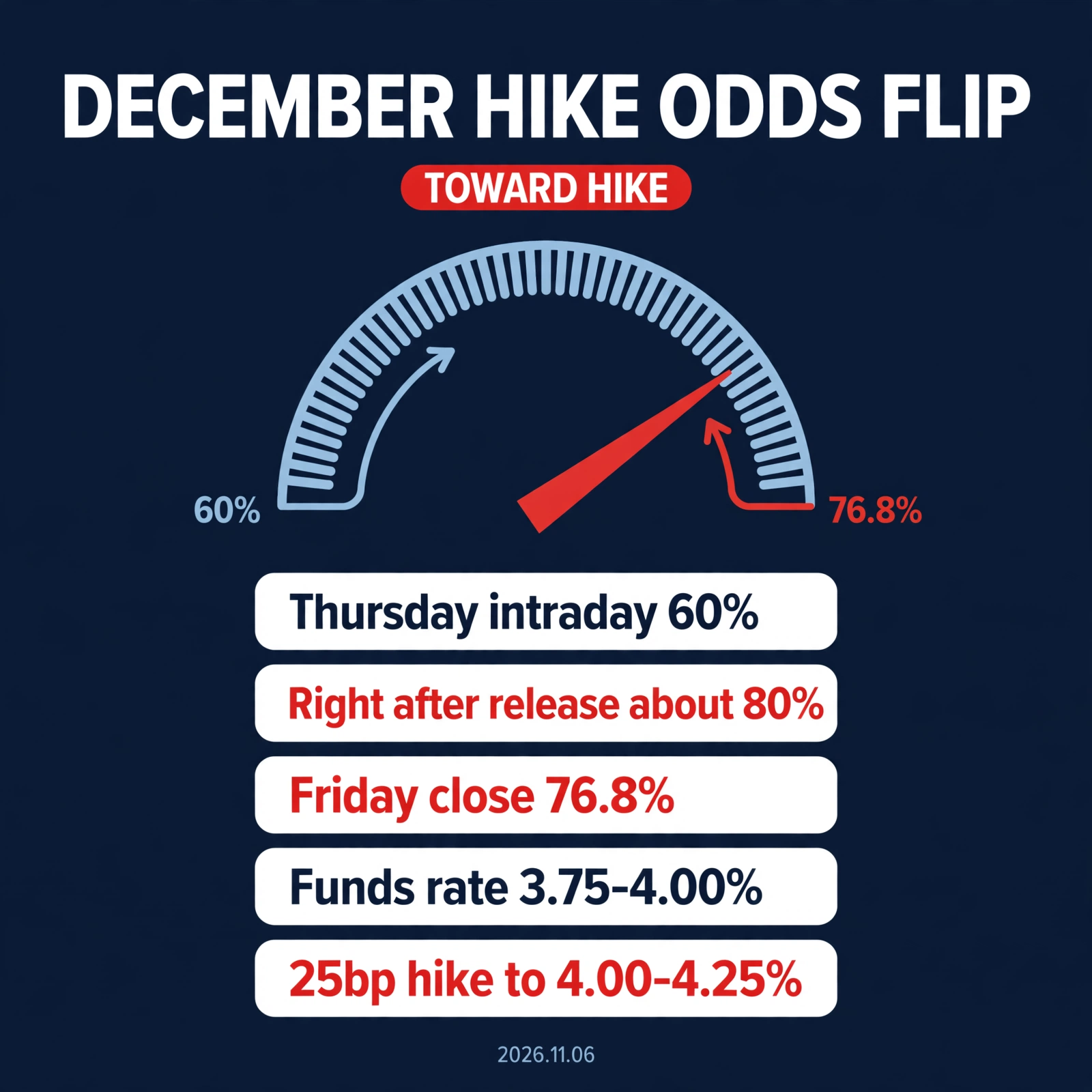
What the report changed is the December outlook. CME FedWatch odds of a 25-basis-point hike in December rose to about 80% immediately after the release, settling at 76.8%. Intraday Thursday, the same odds had fallen to 60%. That is a swing of nearly 17 percentage points in a day. Reuters put the odds at 78%.
It fits the Fed’s recent posture. The Fed held its benchmark at 3.75–4.00% on October 28, in a 10–2 vote. Governor Lisa Cook and Cleveland Fed President Beth Hammack dissented in favor of a hike. Even a hold decision carried a hawkish minority. A 25-basis-point hike would take the range to 4.00–4.25%. Some analysts are now debating 25 versus 50 basis points. Others note that recent stock-market volatility could make the central bank hesitate.
Bond markets moved first. The 10-year Treasury yield spiked to about 4.90% after the release before closing around 4.86%, and the 2-year yield stood at 4.52%. The Fed raised rates in September for the first time since 2023, to counter inflation linked to the Middle East conflict. Strong hiring gives the Fed more room to focus on inflation. The next meeting is December 8–9.
What comes next: CPI on November 10, FOMC on December 8–9, payrolls on December 4
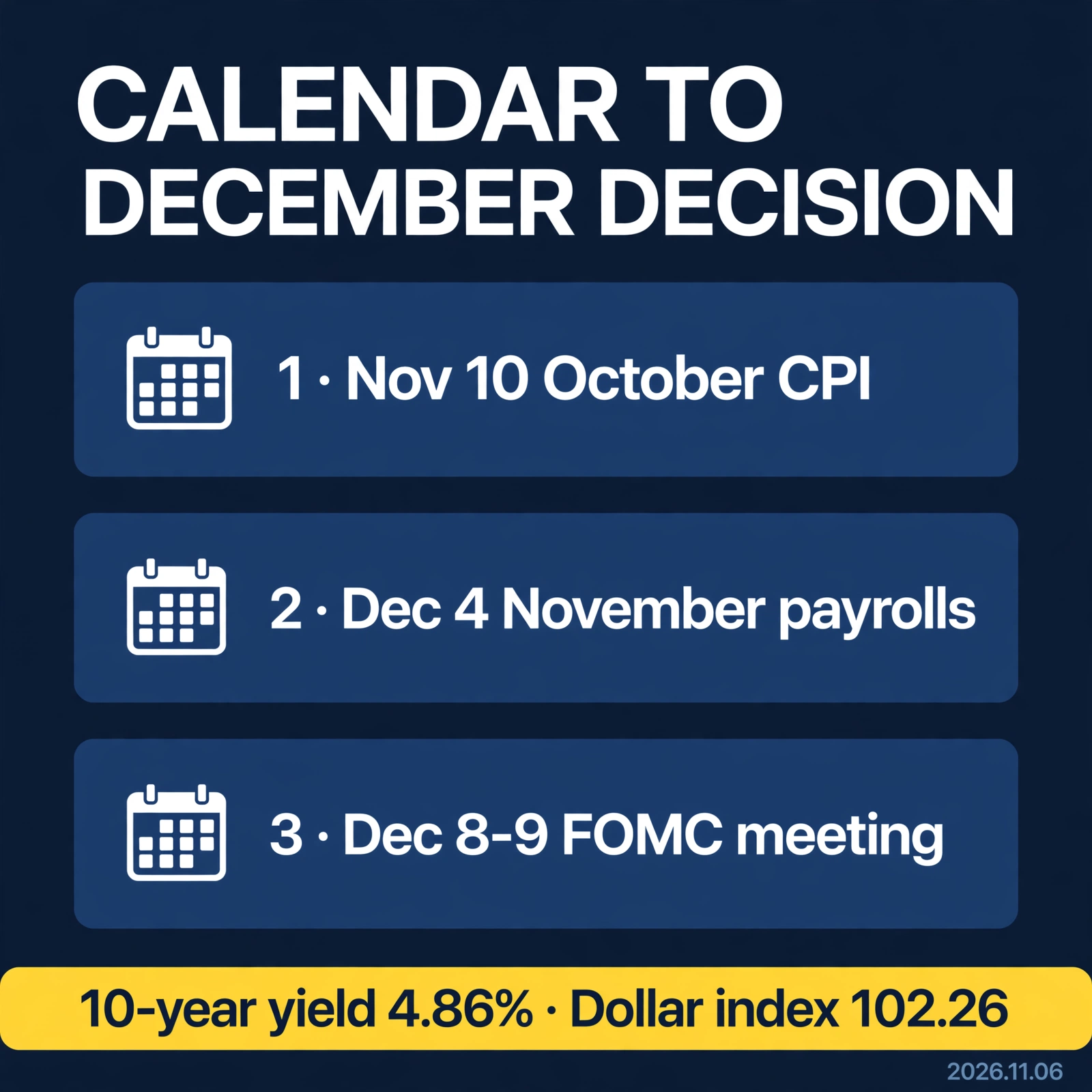
Three dates frame the December decision. First, October CPI on Tuesday, November 10. After a hiring beat, a hot inflation print would push hike odds higher still and lift Treasury yields, pressuring tech stocks. Second, the FOMC meeting itself on December 8–9. Watch whether Fed officials lean toward a hike or sound cautious in the weeks before. Third, November payrolls on December 4, which will show whether October’s surprise was a trend or a one-off.
The dollar belongs in the picture, too. The dollar index rose 0.77% to 102.26 on Friday, its biggest one-day gain since June 17. A December hike would widen the policy gap with the Bank of Japan, which holds its short-term rate at 1.25%. That gap matters for currency markets well beyond the Fed.
The conclusion is simple. The jobs report broke the assumption that the labor market was cooling, and the Fed’s next move now leans toward a hike rather than a cut. The size and pace are still open. CPI on November 10 gives the next clue. On a day when strong jobs fail to lift stocks, the market is watching rates, not growth.
- Nonfarm payrolls: the number of new jobs outside farming, published monthly by the Bureau of Labor Statistics.
- CME FedWatch: probabilities for Fed decisions derived from federal funds futures prices. A 76.8% December hike probability means the market sees a hike as roughly a 3-in-4 outcome.
- 25 basis points (bp): 0.25 percentage points, the usual size of a single Fed rate move.
- Upward revision: past payroll figures raised as new data arrives. August and September were revised up by a combined 84,000.
- Federal funds rate: the Fed's benchmark rate, now 3.75–4.00%. A 25-basis-point hike would take it to 4.00–4.25%.
Three things to watch
First, October CPI on Tuesday, November 10. After the hiring surprise, a hot inflation print could push December hike odds above 80%. Second, Fed officials’ remarks. Beyond Cook and Hammack, who dissented for a hike in October, watch whether other officials tilt toward tightening. Third, November payrolls on December 4, which will show whether October’s strength was a trend or a one-off. What matters more than the December hike itself is whether the Fed signals further hikes into 2027.
Watch the video

Sources & references
- World Money Roadmap — October Jobs: 165,000 Added vs 59,000 Expected, Jobless 4.1% — October payrolls 165,000 vs 59,000 Dow Jones consensus, unemployment 4.1%, prior two months revised up 84,000, CME FedWatch December hike odds 76.8%
- StockVolt — Payrolls Jump 165,000 in October as Unemployment Falls to 4.1% — Reuters December hike odds 78%, debate over 25 vs 50 basis points, 10-year yield 4.87%, 2-year yield 4.52%
- MarketSpeaker — Treasury Yields Rise After Strong October Jobs Report — Schwab hike odds 73%, up from 60% during Thursday's selloff; Fed's October 10–2 hold vote; next meeting December 8–9
- Yonhap News — US stocks open mixed as tech rebounds, jobs data digested — October payrolls 165,000, unemployment 4.1%, September payrolls revised up to 60,000
Related articles
- December FOMC 50bp Hike Scenario Analysis Core CPI 0.3% and Waller Comments
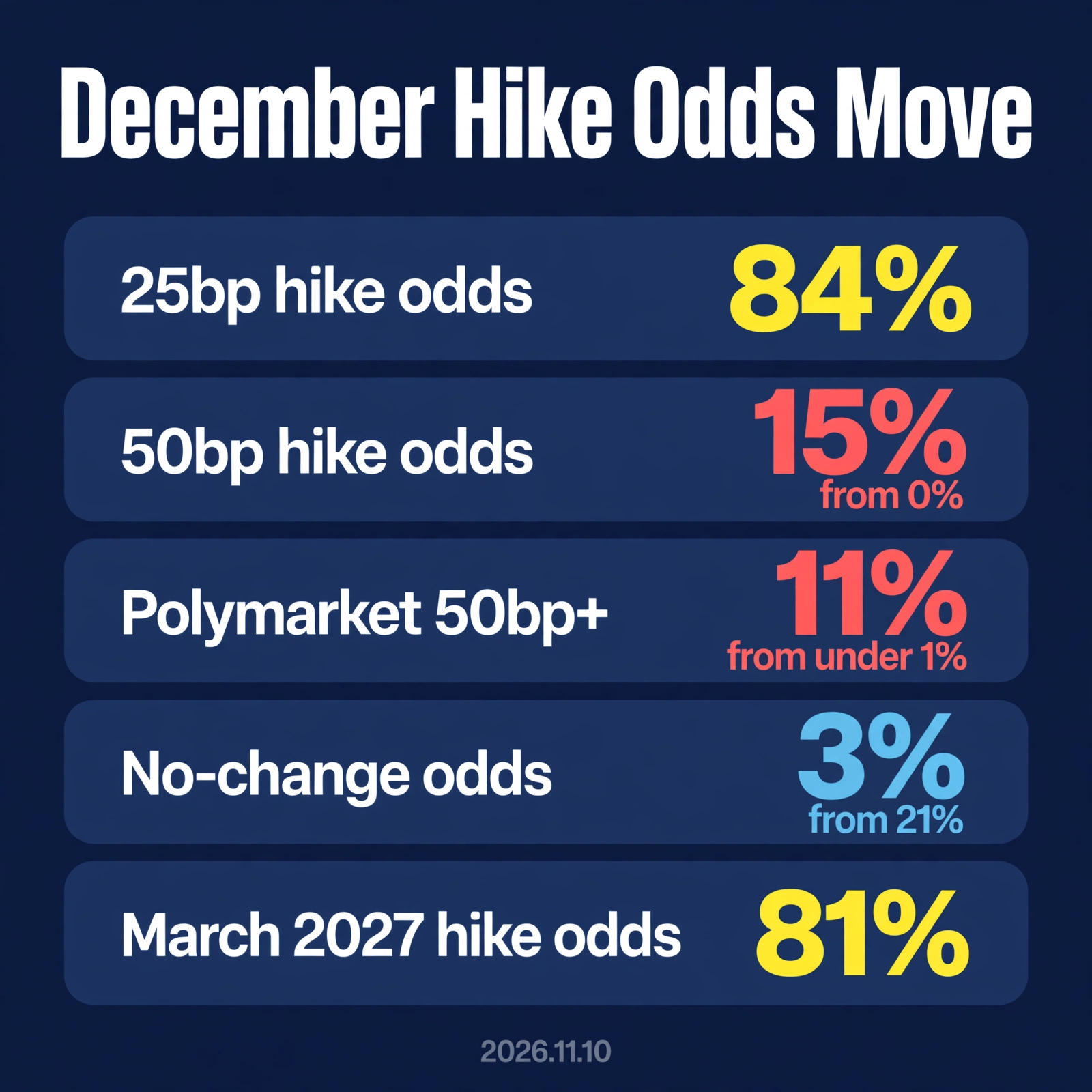
October core CPI ran at 0.3% for a third straight month, and December 50bp hike odds jumped from 0% to 15%. Governor Waller had named 0.3% core as the condition for considering a 50bp move, and November CPI comes out the day after the FOMC. What separates a 25bp hike from a 50bp one.
- October CPI 0.4% Above Forecast Analysis Nasdaq Falls 0.74% as Nvidia Drops 5.47%
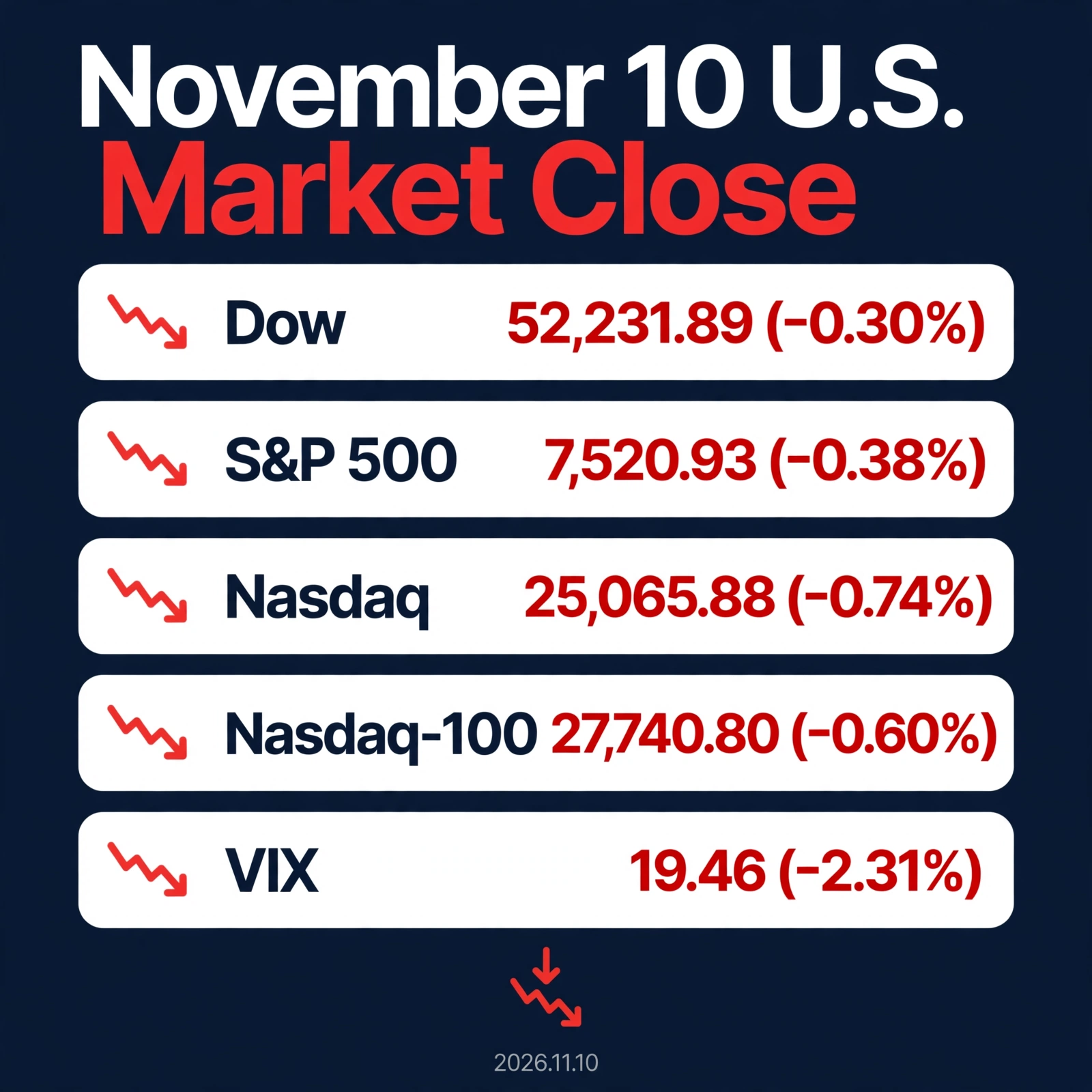
October CPI rose 0.4% month over month, above the 0.3% forecast, and U.S. stocks fell across the board on Tuesday. Core CPI ran at 0.3% for a third straight month, December 50bp hike odds jumped from 0% to 15%, and Nvidia fell 9.5% in two sessions. CoreWeave beat on revenue but interest costs still dwarf operating profit.
- Nasdaq Rebound Semiconductor Index 4.21% Recovery Jobs Surprise Rate Hike Fears Analysis
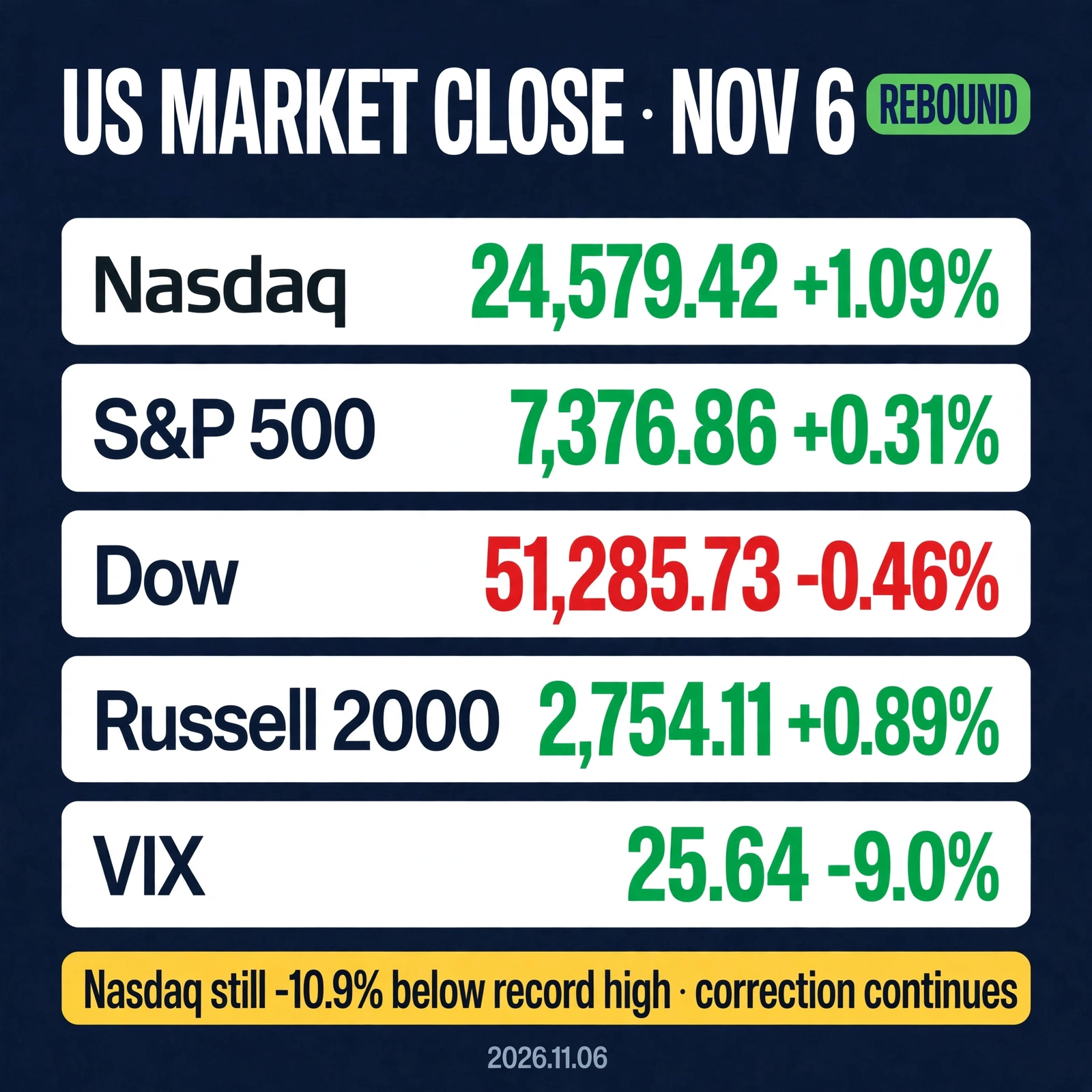
On November 6, US stocks bounced as chip stocks recovered: the Nasdaq rose 1.09%, the S&P 500 gained 0.31%, and the Dow slipped 0.46%. October payrolls jumped 165,000, far above forecasts, lifting December Fed hike odds to 76.8%.
5minbrief on YouTube
The briefs also come as videos. Get the daily market wrap on YouTube.
Subscribe on YouTube