 5-minute briefs
KOSPI Sidecar vs Circuit Breaker Analysis Dual Trigger Five Minute Pause
Today’s trigger log — 10:16 a.m. on the KOSPI, 2:27 p.m. on the KOSDAQ
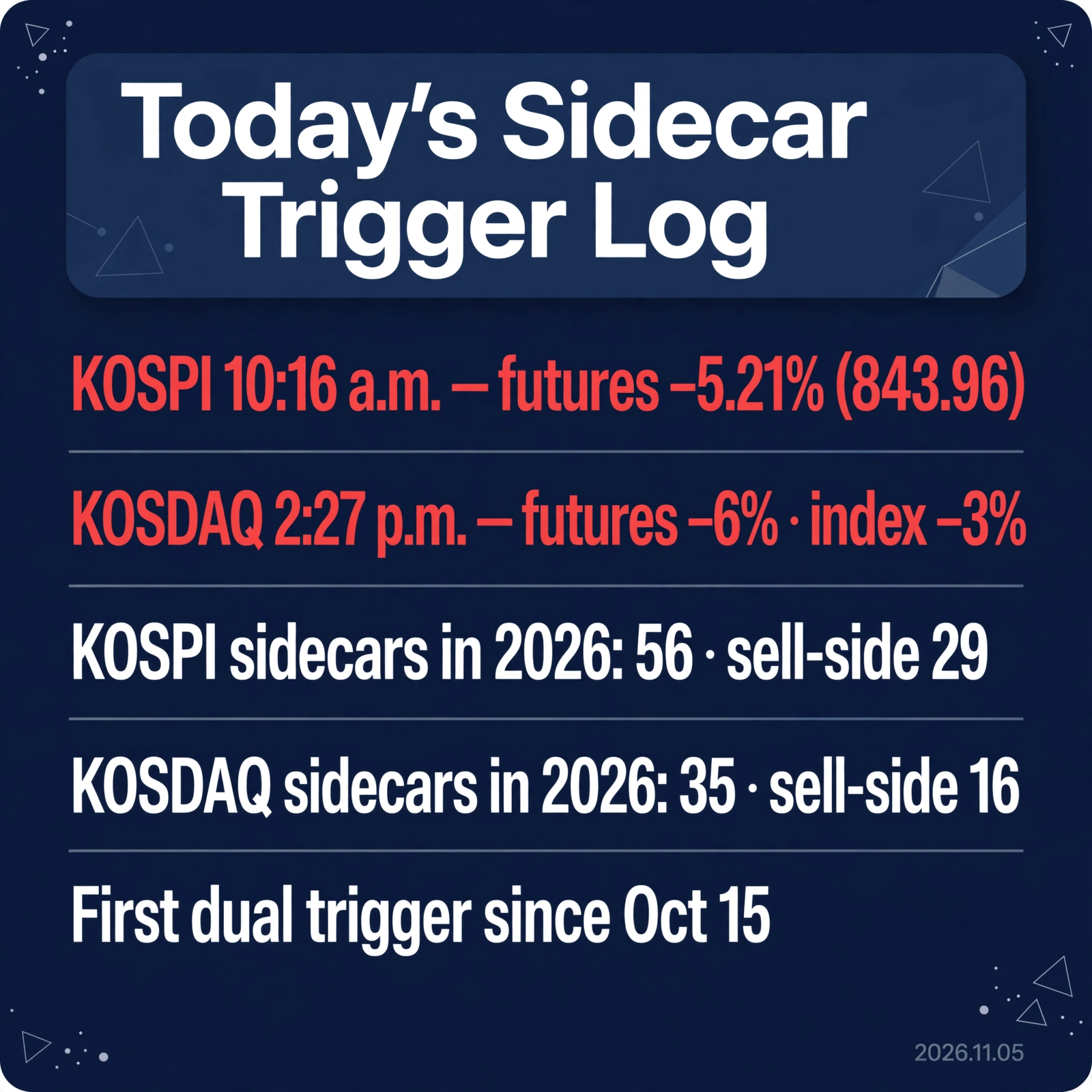
The Korea Exchange triggered a sell-side sidecar on the main board at 10:16:19 a.m., when KOSPI 200 futures stood at 843.96, down 5.21% from the previous session. Program sell orders were suspended for five minutes. The KOSPI itself was at 5,418.15 at the time, down 4.67%. In the afternoon, the KOSDAQ followed: a sell-side sidecar fired at 2:27:31 p.m., with the KOSDAQ at 675.46, down 5.52%.
Both markets triggering on the same day happened for the first time since October 15. The counts show how routine the mechanism has become. This was the 56th KOSPI sidecar this year, and the 29th in the sell direction; on the KOSDAQ it was the 35th sidecar this year, and the 16th in the sell direction. A sidecar is not a rare emergency — in a volatile year, it is a safety device that fires repeatedly.
| Market | Trigger time | Futures / index at trigger | What paused |
|---|---|---|---|
| KOSPI | 10:16:19 a.m. | KOSPI 200 futures –5.21% (843.96) | Program sell orders, 5 minutes |
| KOSDAQ | 2:27:31 p.m. | KOSDAQ 150 futures –6%+, index –3%+ | Program sell orders, 5 minutes |
What a sidecar actually stops — futures trigger, program orders only, five minutes
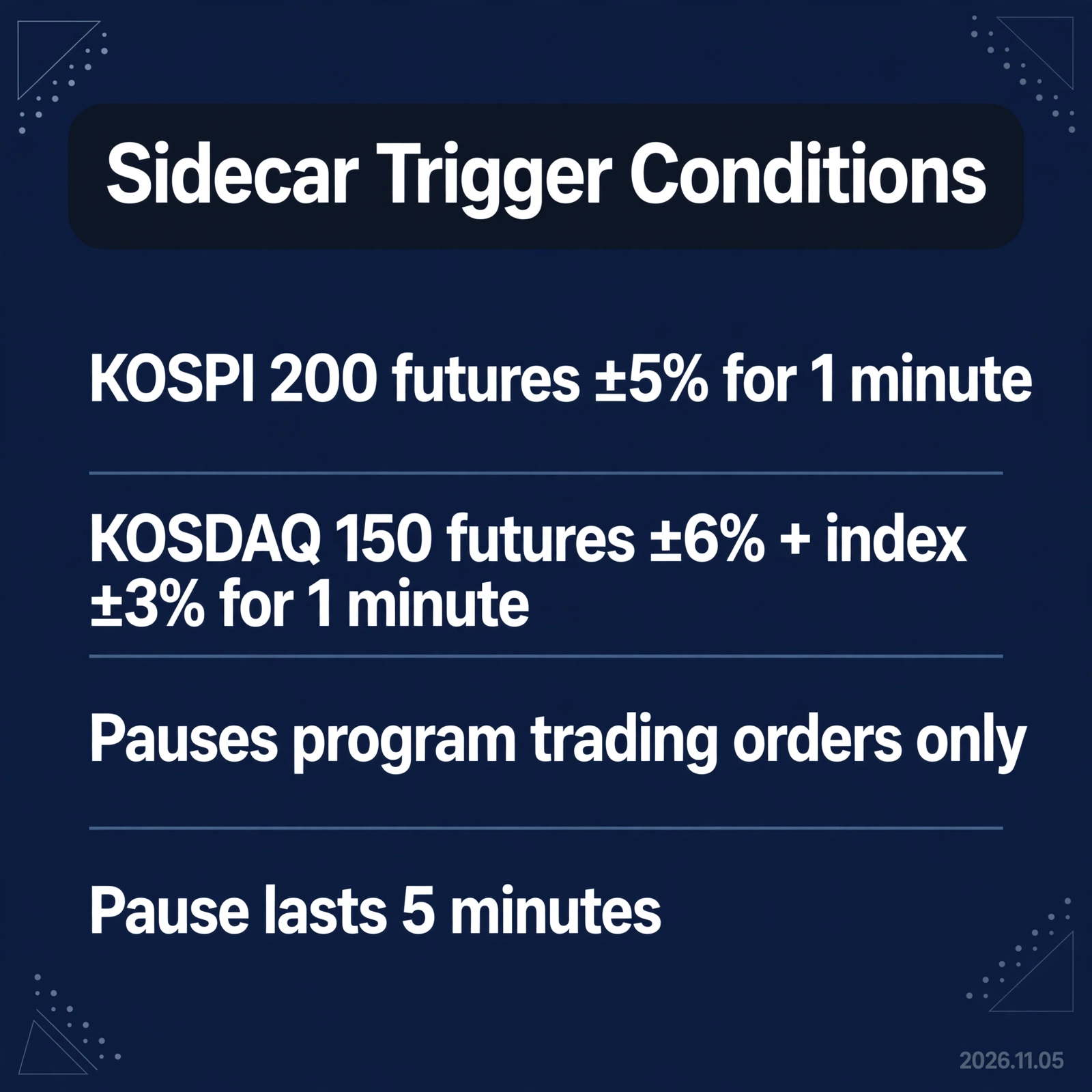
A sidecar watches futures prices, not the index. On the KOSPI, it fires when KOSPI 200 futures stay 5% or more above or below their reference price for one minute. On the KOSDAQ, it requires KOSDAQ 150 futures to move 6% or more and the KOSDAQ 150 index to move 3% or more in the same direction, both sustained for one minute. Once triggered, only program orders in that direction lose their effectiveness for five minutes. A buy-side sidecar works the same way when futures surge.
Program trading means orders a computer sends automatically once preset conditions are met — used mainly by institutions and foreign investors. When prices fall, these orders go out; if that selling pushes prices lower still, the next batch follows. The sidecar cuts that loop for five minutes. Orders that individuals place themselves, for example through a phone app, go through as usual even during a sidecar. That is why a sidecar slows a fall rather than stopping one.
There are operating limits. A sidecar fires at most once a day per direction, and it does not fire in the first five minutes after the open or in the last 40 minutes before the close (after 2:50 p.m.). Today’s KOSDAQ trigger at 2:27 p.m. came just inside that cutoff.
- Sidecar: futures move fast, program orders in that direction pause for five minutes. Triggered by futures, not the index.
- Circuit breaker: the index itself falls 8%, 15%, or 20%, and the whole market halts — 20 minutes, 20 minutes, then close for the day.
- VI (volatility interruption): a single stock moves sharply — 3% or 6% against its last trade, or 10% against its reference price — and that stock switches to a two-minute single-price auction.
- Program trading: computer-generated orders, mainly from institutions and foreign investors. The sidecar exists because these orders can cascade.
Circuit breakers and VI — full-market halts and single-stock brakes
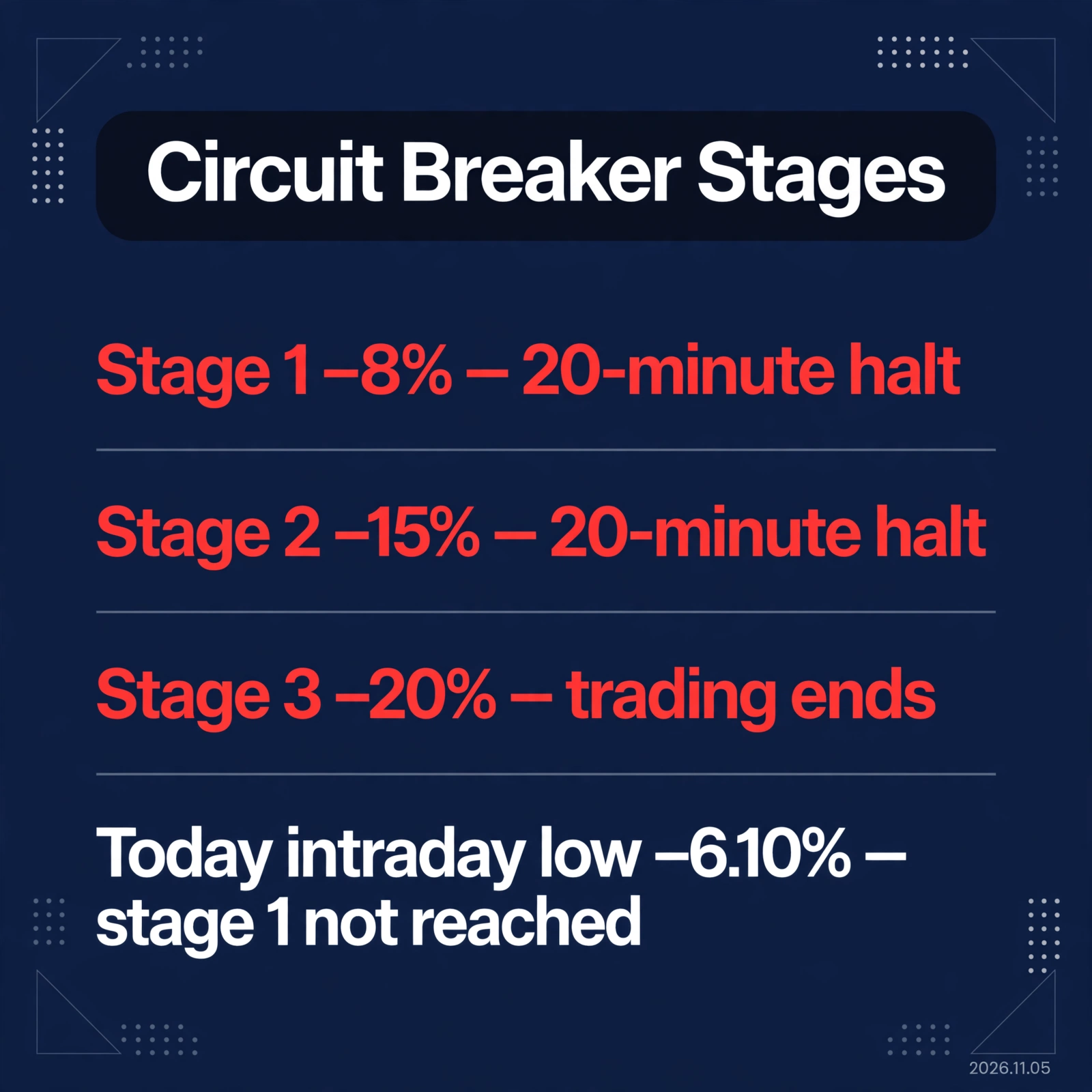
The stronger device is the circuit breaker, which watches the index itself, not futures. Stage one fires when the index stays 8% or more below the previous close for one minute: all stock and derivatives trading stops for 20 minutes, followed by a 10-minute single-price auction to reopen. Stage two, at 15% down and at least 1% below the stage-one trigger level, halts trading for another 20 minutes. Stage three, at 20% down, ends trading for the day. Each stage fires at most once a day, and stages one and two do not fire after 2:50 p.m.
| Device | Watches | Trigger | What stops | Duration |
|---|---|---|---|---|
| Sidecar | Futures price | KOSPI 200 ±5%; KOSDAQ 150 ±6% plus index ±3%, 1 minute | Program orders | 5 minutes |
| Circuit breaker | Index | –8% / –15% / –20%, 1 minute | Whole market | 20 min / 20 min / day ends |
| VI | Single stock | ±3% or 6% vs last trade; 10% vs reference | That stock’s continuous trading | 2-minute auction |
October 15 shows the difference. That day a sidecar fired first, and the selloff deepened until the circuit breaker’s first stage halted the whole market for 20 minutes. Today the KOSPI’s intraday low was –6.10%, about 1.9 percentage points short of the –8% stage-one line. Only the first of the three safety nets operated.
What foreign investors should take from this — a US comparison, and what to watch after a trigger
First, the sidecar has no US equivalent. The US halts the whole market at 7%, 13%, and 20% declines in the S&P 500; there is no mechanism that pauses only program trading on a futures trigger. A foreign investor who reads a Korean “sidecar” headline as an American-style halt will overstate what happened. The market stayed open all day while falling more than 5% — that is the difference.
Second, do not treat the trigger as a sell signal. Fifty-six KOSPI sidecars in one year says this is an alarm that rings often in volatile markets. What matters is whether selling continues after the five-minute pause, and how far the index sits from the –8% circuit-breaker line.
Third, a sidecar is no reason to relax either. October 15 proved a sidecar can be the first step toward a circuit breaker. The device buys time; it does not remove the reason for the fall.
Checkpoints — the five minutes after, and the distance to –8%
Three numbers to watch. First, tomorrow’s stage-one circuit-breaker level: against today’s close of 5,383.80, –8% sits near 4,953. If the KOSPI touches it, the whole market halts for 20 minutes. Second, whether foreign program selling resumes: foreigners sold a net 3.3928 trillion won on the main board today, and if much of that flowed through program trades, the five minutes after a sidecar are a preview of the next session. Third, whether the KOSDAQ sidecar repeats: at 35 triggers this year, the junior market fires its alarm more often than the main board, and a same-day double trigger is itself a sign that volatility is spreading across markets.
Not investment advice. Figures are Korea Exchange, MoneyToday, The Korea Times, NewsPim, and Yonhap reports confirmed November 5, 2026; the mechanism summary follows Korea Exchange rules as summarized by Bitpress.
Watch the video

Sources & references
- MoneyToday (English) — Blue Wave 'AI Regulation' Fears Jolt Korean Stock Market — 56th KOSPI sidecar this year, 29th in the sell direction, trigger at 10:16 a.m.
- The Korea Times — KRX activates sell-side sidecar for KOSPI on sharp fall — Program trading suspended five minutes at 10:16 a.m., KOSPI 200 futures down 5% for one minute
- NewsPim (English) — Sell-Side Circuit Breaker Triggered as KOSDAQ Plunges Over 5% — KOSDAQ sidecar at 2:27:31 p.m., KOSDAQ 150 futures down over 6% and index down over 3% for one minute
- Bitpress (English) — KOSPI's 5% drop paused auto-selling for 5 minutes. What changed? — Sidecar vs circuit breaker mechanics, once-a-day rule, not in first five minutes or last 40 minutes
- Yonhap News Agency — (LEAD) Seoul shares plunge over 5 pct on AI regulation concerns after U.S. midterms — KOSPI 5,383.80 (-5.28%), first dual-market sidecar since October 15
Related articles
- KOSPI 6.02% Plunge Analysis Circuit Breaker 5000 Defense Foreign Selling
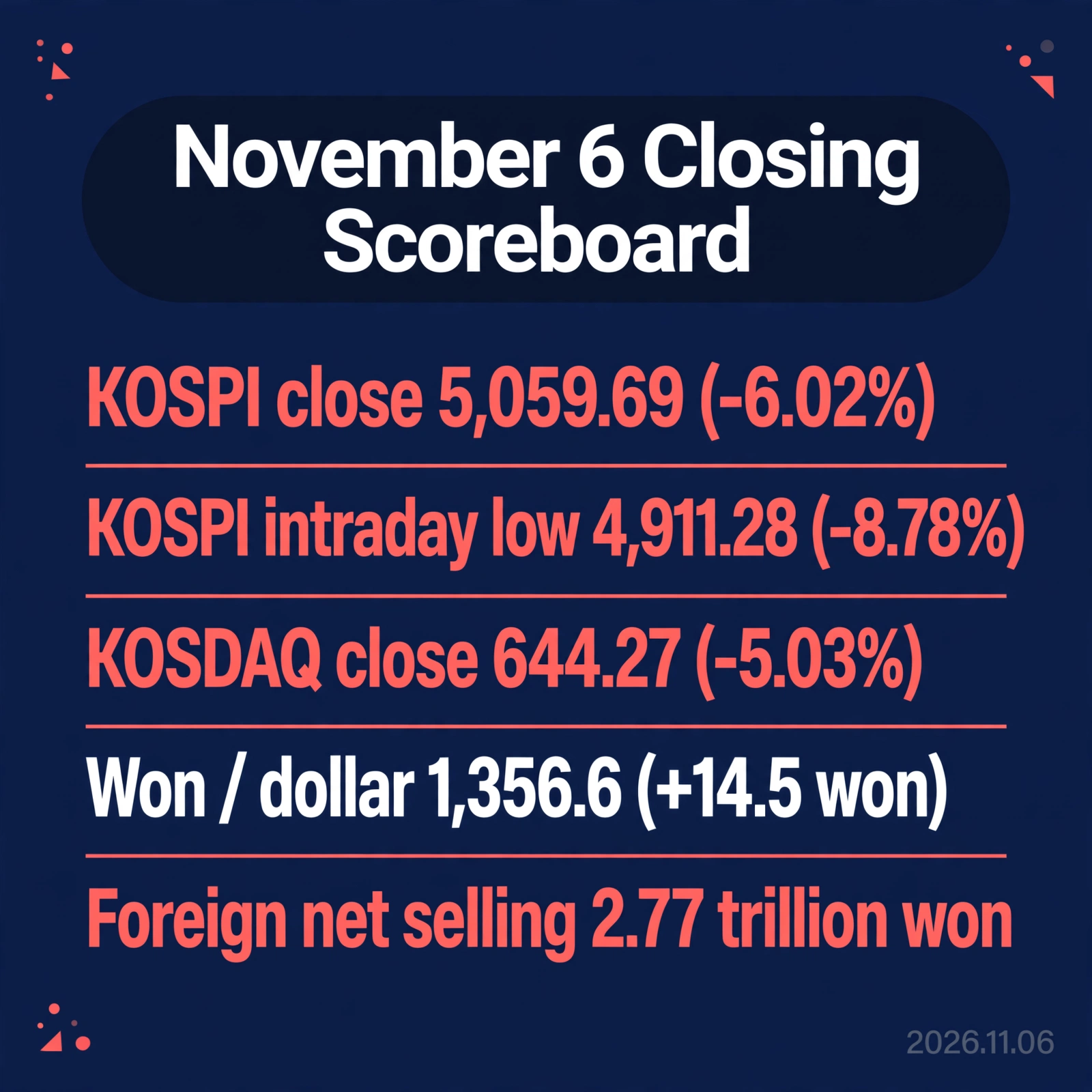
November 6 Korea market brief for foreign investors: the KOSPI plunged 6.02% to 5,059.69 as a stage-1 circuit breaker halted trading after an 8.78% intraday plunge. Foreigners sold a net 2.77 trillion won, their sixth straight day of selling, and the won fell to 1,356.6 per dollar.
- December FOMC 50bp Hike Scenario Analysis Core CPI 0.3% and Waller Comments
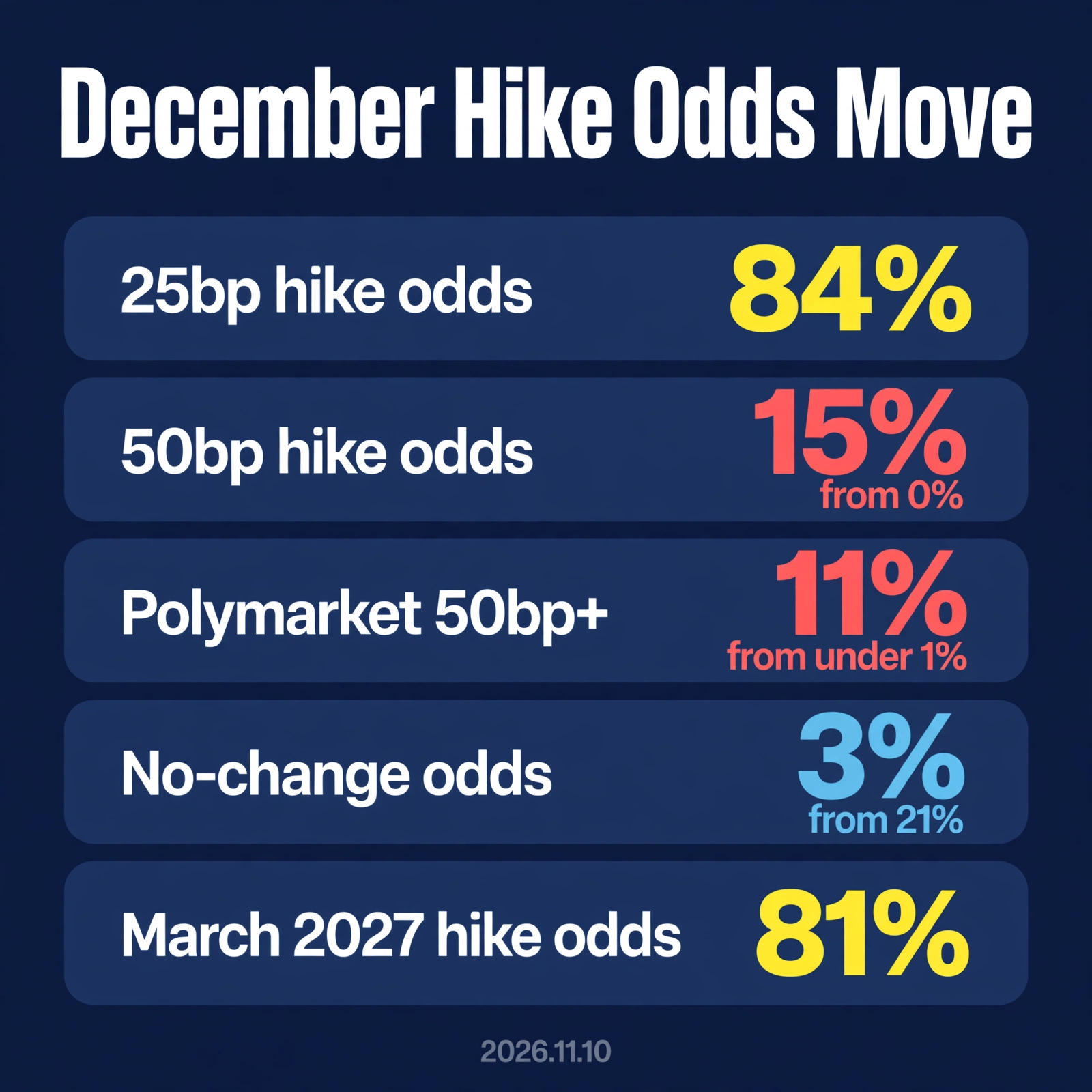
October core CPI ran at 0.3% for a third straight month, and December 50bp hike odds jumped from 0% to 15%. Governor Waller had named 0.3% core as the condition for considering a 50bp move, and November CPI comes out the day after the FOMC. What separates a 25bp hike from a 50bp one.
- Brent Crude Analysis: 18.4% Drop in Six Sessions on Negotiation Hopes
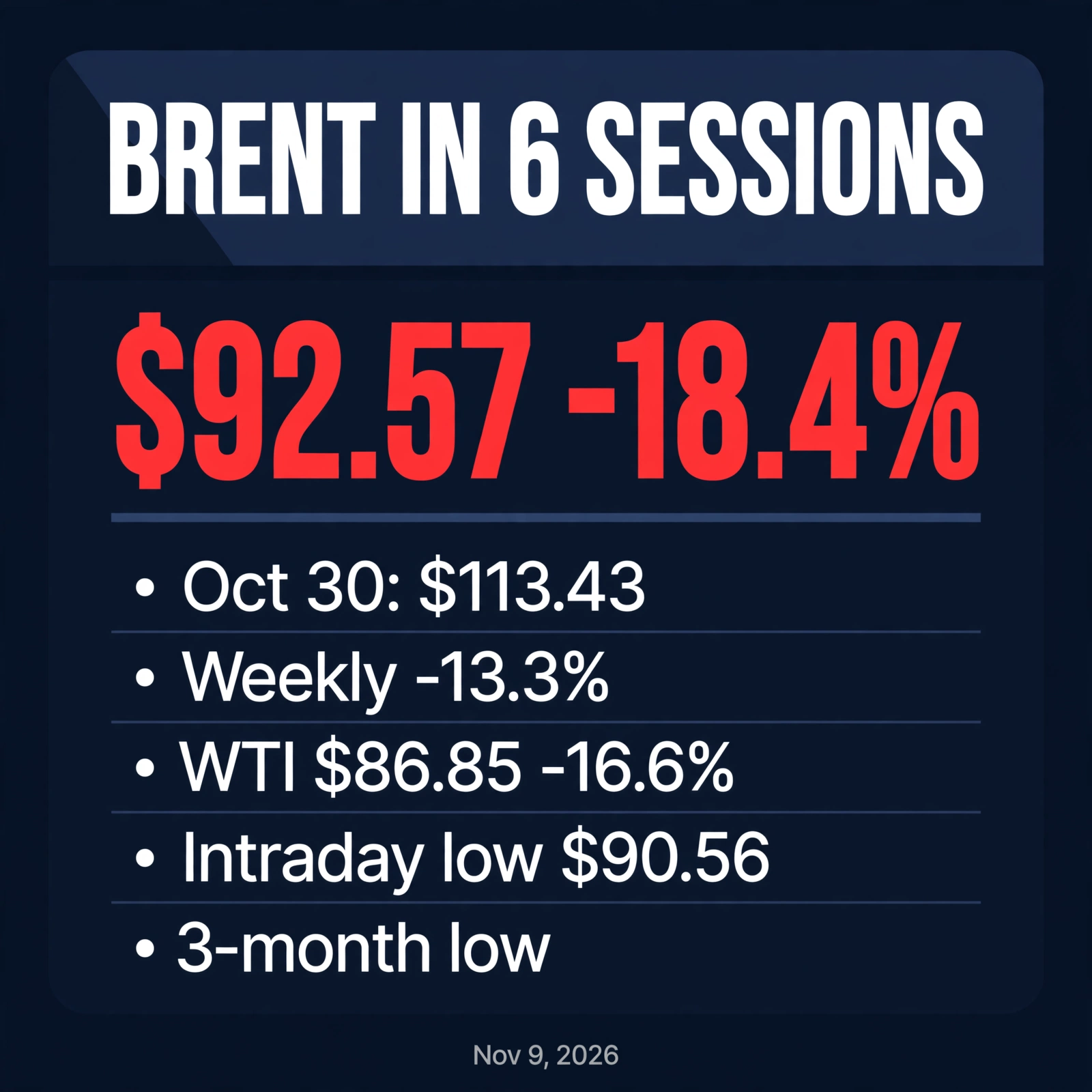
Brent crude has fallen 18.4% in six sessions, from $113.43 on October 30 to $92.57 on November 9. The war premium is unwinding fast — but analysts put renewed strikes at 60%, and that gap sets the terms for a reversal.
5minbrief on YouTube
The briefs also come as videos. Get the daily market wrap on YouTube.
Subscribe on YouTube