 5-minute briefs
Broadcom Anthropic AI Investment Analysis $63 Billion Compute Financing SPV Lease Structure and Residual Value Support
#Broadcom#Anthropic#AI investment#semiconductors
The skeleton: an SPV buys, Anthropic rents
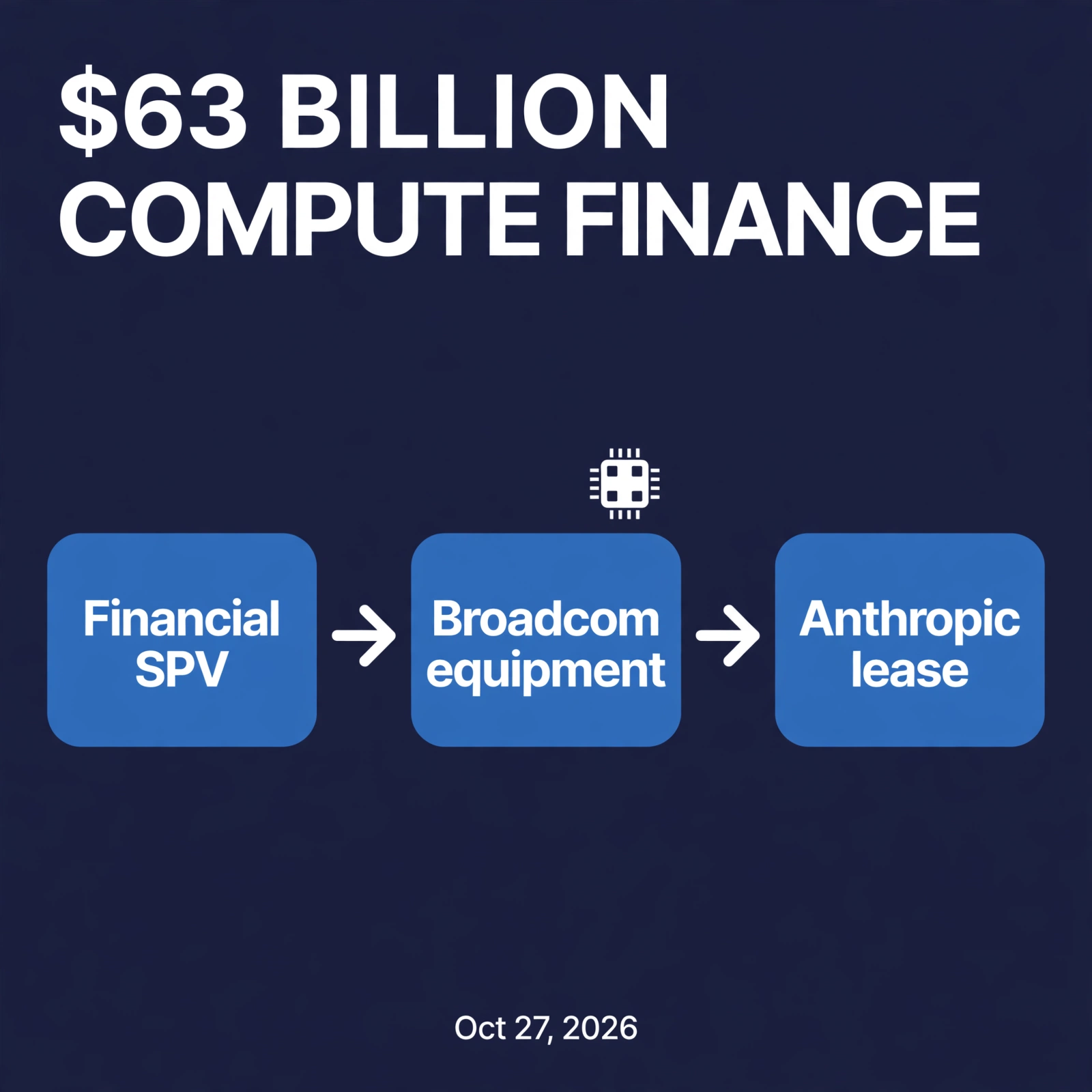
The cast is four financial firms, one chip company and one AI company. Bank of America, Citi and Morgan Stanley arrange the first-lien financing, and Blackstone alone provides the committed portion of the second-lien financing. The four firms, called the Lead Financial Partners, fund a newly formed special purpose vehicle (SPV) that buys Broadcom XPU accelerators and networking equipment and leases them to Anthropic. Deliveries are expected to start in 2027, and the deal is part of a strategic compute capacity agreement Broadcom announced earlier.
Why use this roundabout structure? If Anthropic bought directly, the equipment cost would land on its balance sheet as assets and debt, with a large upfront cash burden. Under a lease, Anthropic is on the “using” side and the financial firms are on the “owning” side. Anthropic secures large-scale compute capacity while sharing the purchase funding burden; the financial firms invest in AI demand growth with physical equipment as collateral. Broadcom CEO Hock Tan said AI compute demand “continues to grow at an extraordinary pace” and that capital is available to finance that growth.
The context matters too. Anthropic disclosed in its October 26 IPO filing first-half 2026 revenue of $16.286 billion, while compute and infrastructure costs reached $8.945 billion in the same half. Revenue is growing fast, but compute costs are growing with it. The $63 billion lease deal can be read as an attempt to turn that cost curve from “buying outright” into “paying rent.”
The money split: about $43.5 billion first lien (estimate), Blackstone alone on second lien
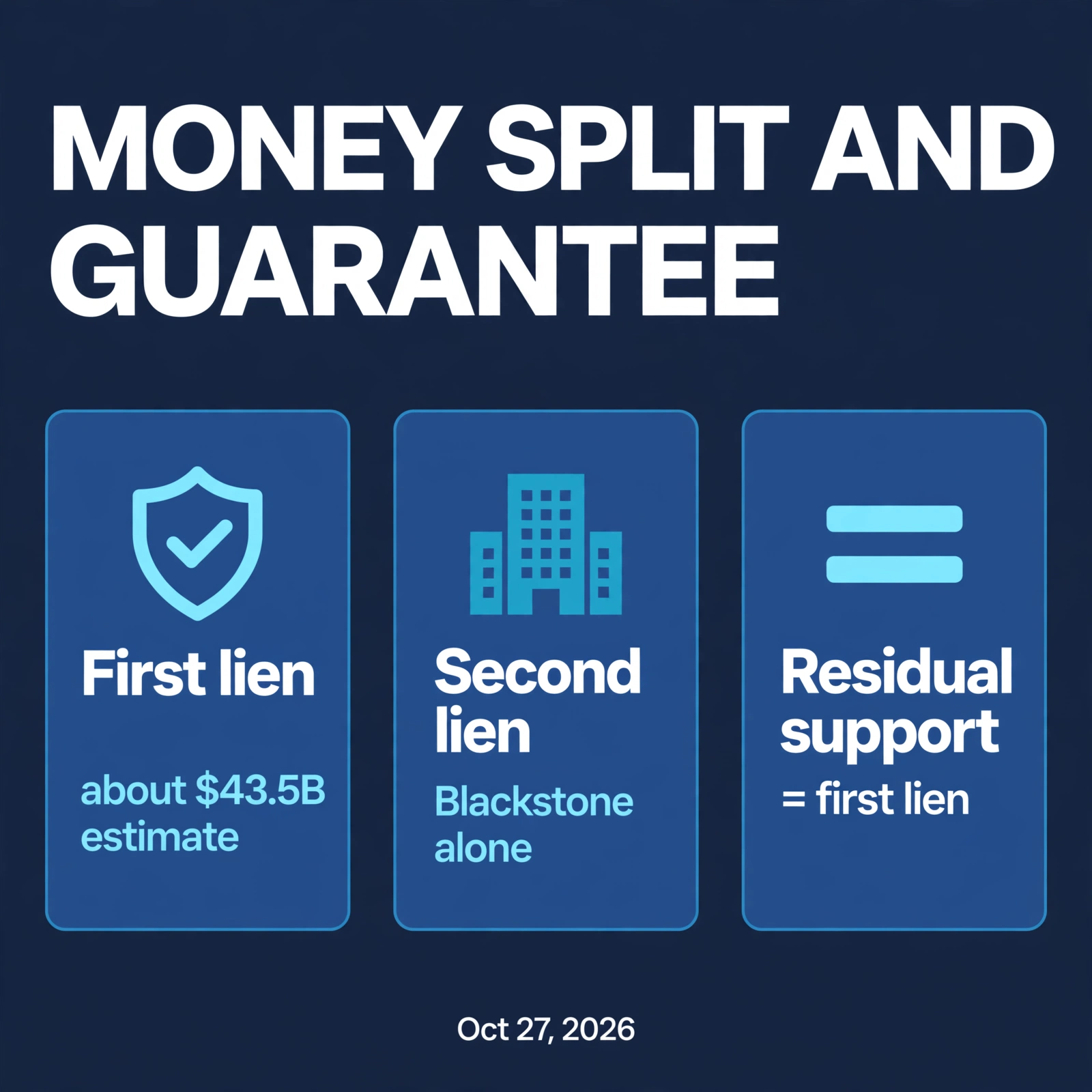
How the money splits is the second checkpoint. The official announcement gives the $63 billion total and the role split only. The first-lien figure of about $43.5 billion (about 69% of the total) is a Reuters estimate from sources, not an officially announced number. That distinction matters: do not treat $43.5 billion as confirmed. What is officially confirmed is that Bank of America, Citi and Morgan Stanley arrange the first lien, and Blackstone alone provides the committed second-lien portion.
First lien and second lien differ in repayment order. First lien is repaid first (“senior”); second lien is repaid after (“junior”). If trouble comes, second lien takes losses first. Blackstone taking the second lien alone means it sits in the riskier, higher-expected-return seat. Blackstone president John Gray said growing AI demand is “creating a massive opportunity to finance computing capacity at scale.”
Broadcom’s role adds another layer. Broadcom provides the SPV with residual value support equal to the first-lien amount. In plain terms, if the equipment’s later value falls below a level, Broadcom covers the gap. A chip seller is sharing some of the residual-value risk of the chips it sold. That is the center of the market debate: whether a seller sharing financing risk is healthy demand, or a device that pulls demand forward.
How it differs from Meta’s equity raise — and how it does not
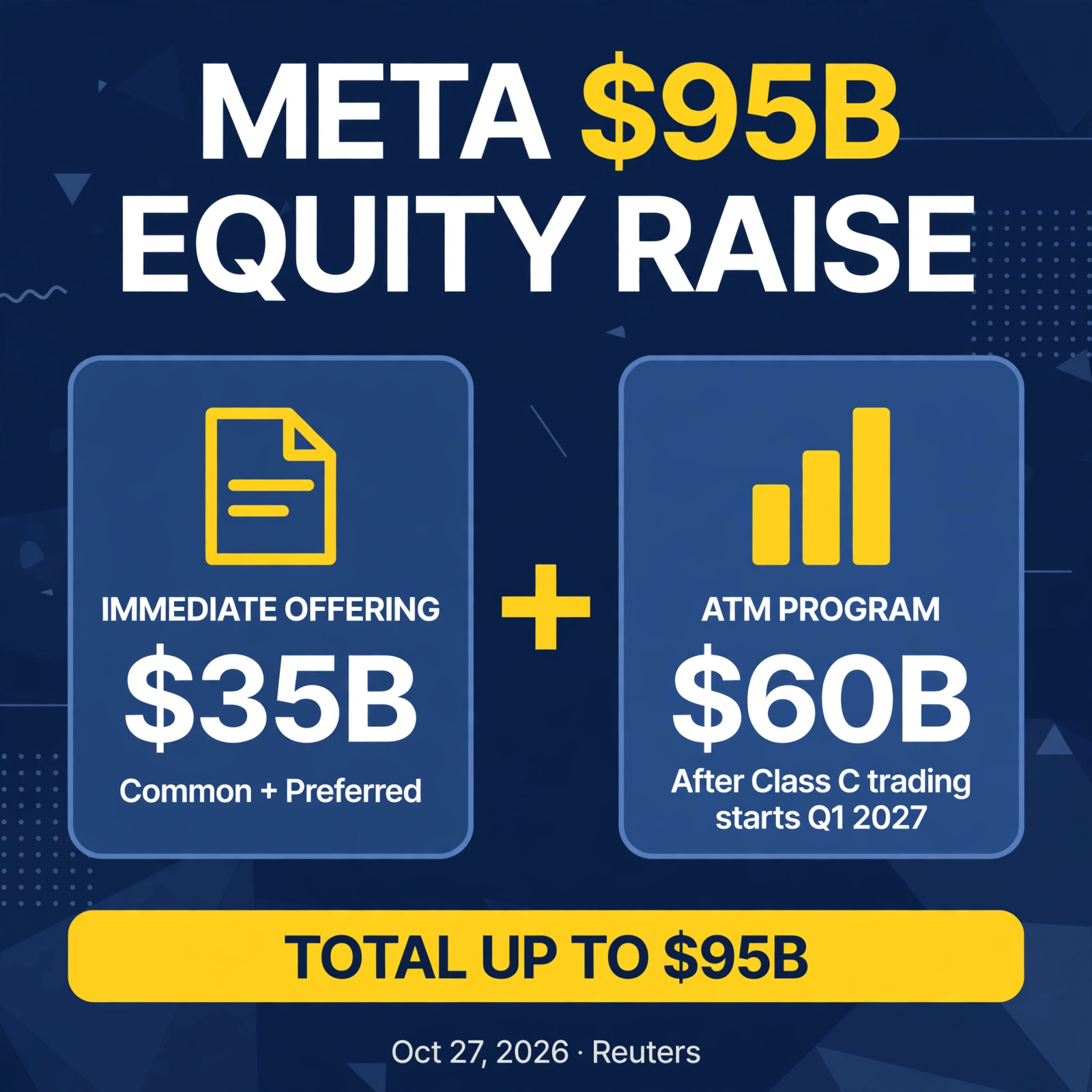
Compare this with last week’s Meta equity-raise debate and the similarities and differences sharpen. In the Meta case, chip suppliers (Nvidia, AMD, Broadcom) showed interest in taking up to $5 billion of the customer’s (Meta’s) equity offering. They helped the customer’s funding by buying shares, not by lending. In this case, the chip supplier (Broadcom) backs the customer’s equipment purchase with a residual value guarantee. The difference is equity participation versus a value guarantee.
The shared point is the “circularity” debate. In both cases, a supplier sits inside its customer’s funding structure, raising the question of whether demand would be the same size without the supplier’s help. But there is an important difference here: the money comes mainly from banks and asset managers, not from the chip company, and most of the $63 billion is financial-firm funding. This is not a simple picture of “a chip company recycling money for its own sales.” Still, Broadcom’s residual value support equal to the first-lien amount means the supplier’s skin is in the deal.
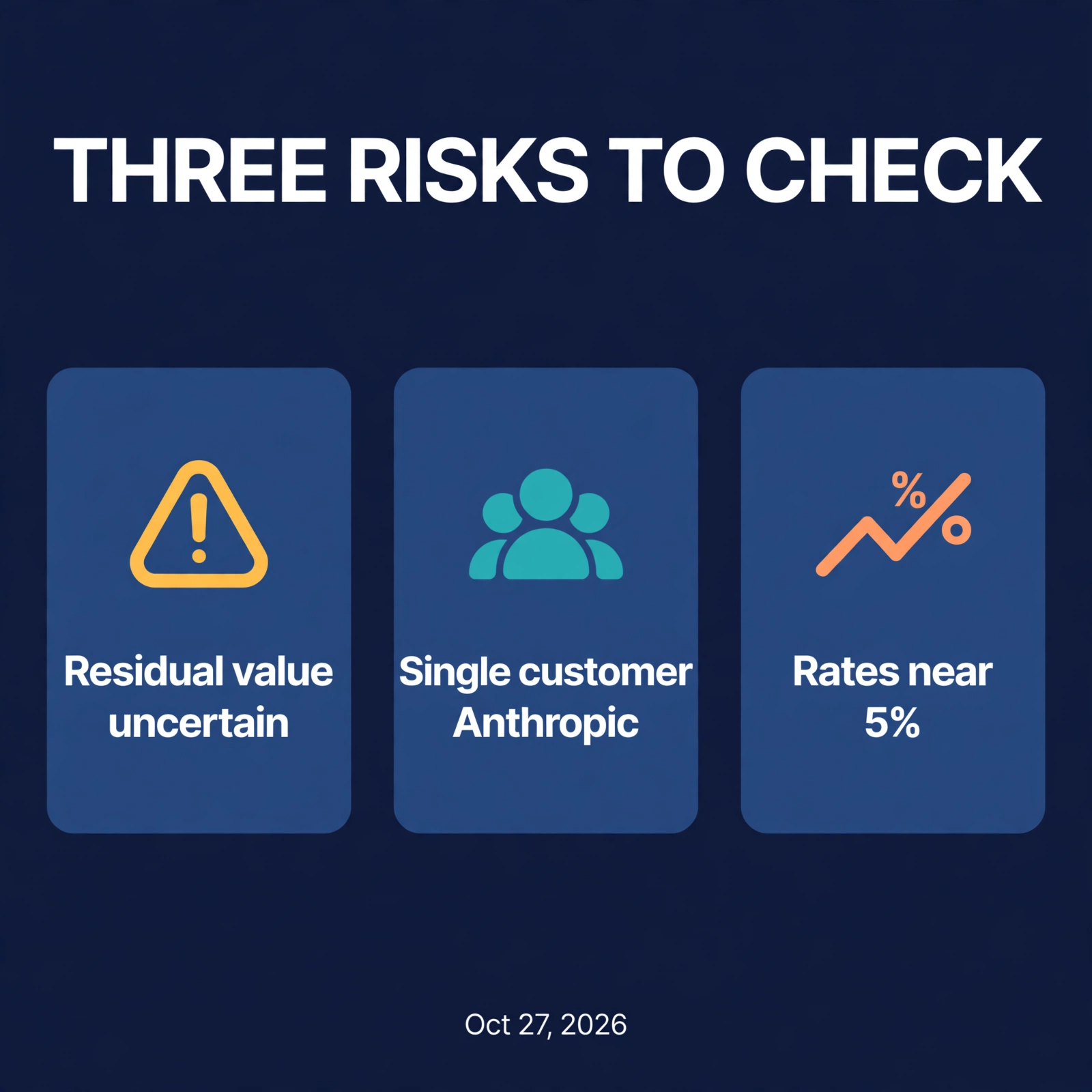
The risks break down into three. First, residual value risk: AI accelerators turn over fast, so the value of equipment delivered in 2027 is uncertain years later, and the guarantee’s scope and conditions are undisclosed. Second, customer concentration risk: dependence on a single lessee, Anthropic, is high, and Anthropic’s purchase commitments reach $265.6 billion on its S-1 basis. Third, interest-rate risk: with the 10-year yield near 5.00%, the balance between long-term rents and financing costs is sensitive to the rate path. What hint Wednesday’s FOMC gives about December matters for this deal’s funding costs too.
- First lien / second lien: repayment order. First lien (senior) is repaid first, second lien (junior) later. Later means riskier, with higher expected returns.
- Residual value support: a promise that if an asset's value at the end of a lease falls below a level, the guarantor covers the gap.
- XPU: Broadcom's name for its AI accelerators — custom AI chips doing work similar to graphics processing units (GPUs).
- Lease: using an asset without buying it. It lowers upfront funding needs but requires ongoing rent payments.
Three checkpoints for investors
First, whether deliveries start in 2027 as planned. The announcement gives only the start year; delivery volumes and lease terms will be the first confirmation of the deal’s substance. Second, Anthropic’s IPO progress: the listing’s success and size connect to the funding conditions around this lease structure. Third, how Broadcom accounts for the deal: how the residual value support shows up in results and debt items, and how management explains the structure at the next earnings call.
One sentence sums the deal up: AI demand has grown so large that the way chips are sold is itself becoming a financial product. Whether demand is real or finance-made will be judged by numbers still to come: delivery volumes, rents, and Anthropic’s lease costs as a share of revenue.
Watch the video

Sources & references
- Bank of America, Blackstone, Citi and Morgan Stanley — Announce Landmark $63 Billion Financing Structure to Enable AI Compute Capacity in Partnership with Broadcom (PR Newswire joint release) — The official announcement: structure, roles and residual value support
- Reuters — Wall Street banks, Blackstone line up $63 billion to finance Broadcom AI chips for Anthropic — Source of the first-lien size estimate (full Reuters text)
- U.S. Securities and Exchange Commission (SEC) EDGAR — Anthropic, PBC Form S-1 Registration Statement — Anthropic's revenue, compute costs and purchase commitments, from the filing
Related articles
- US Market Close Analysis Nasdaq Up 1.18% Semiconductors Up 3.60% Consumer Confidence Rebound Before FOMC (October 28)
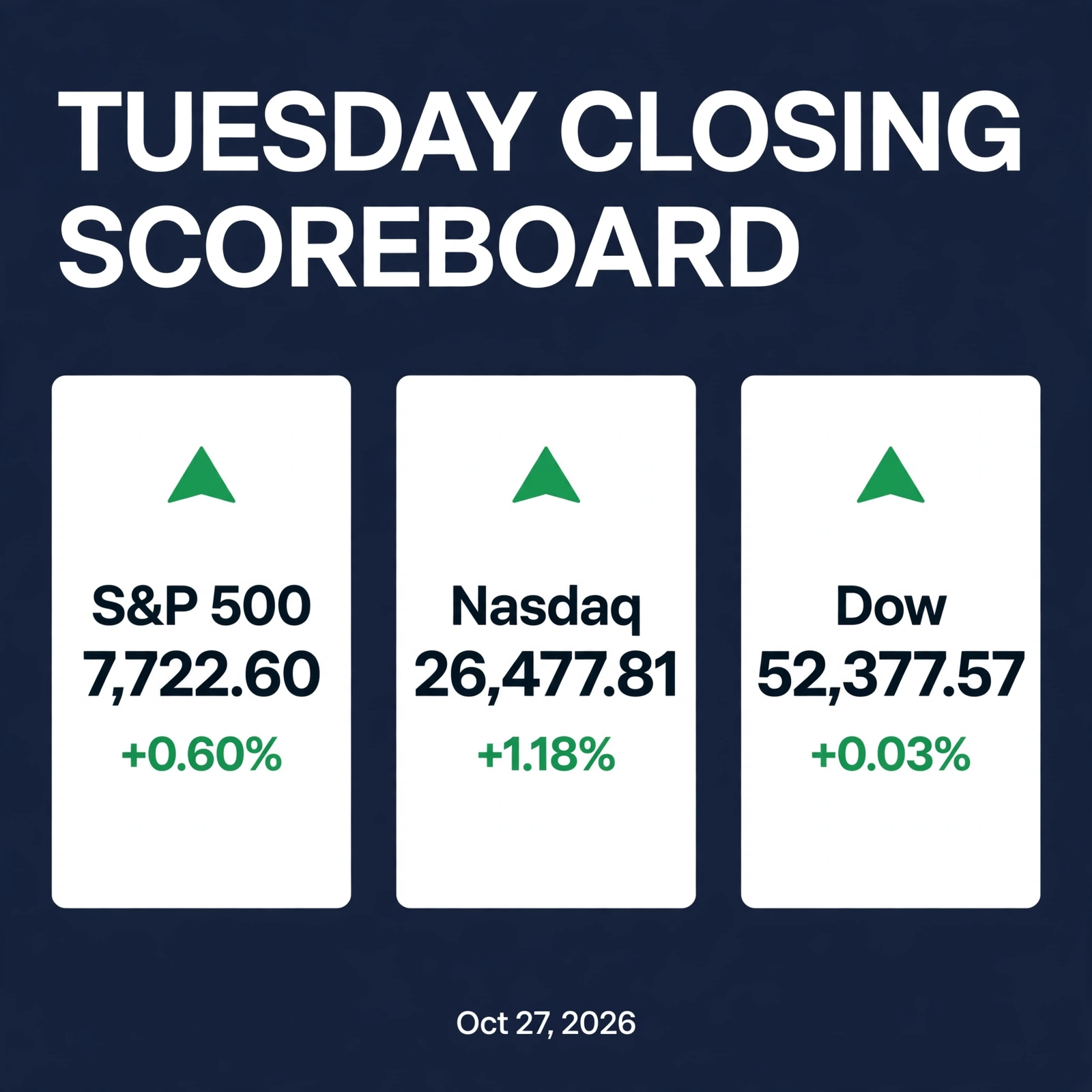
Tuesday, October 27 US close: S&P 500 7,722.60 (+0.60%), Dow 52,377.57 (+0.03%), Nasdaq 26,477.81 (+1.18%). Semiconductors rose 3.60% to lead the rally and consumer confidence rebounded to 91.7, while Boeing plunged 10.69% on a Q3 earnings miss.
- US Market Close Analysis S&P 500 Up 0.70% Nasdaq Up 0.82% Anthropic IPO Filing AI Rebound (October 27)
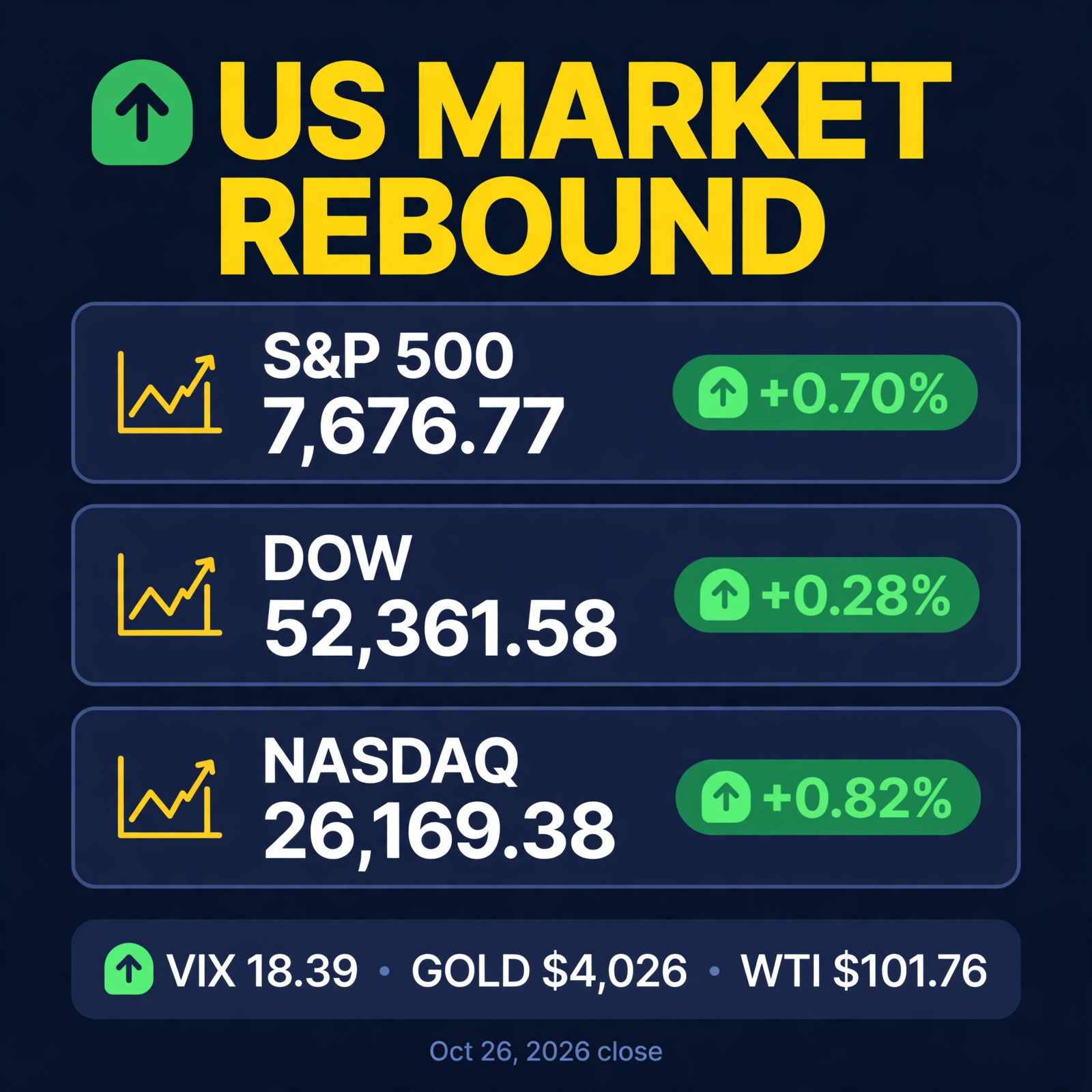
Monday, October 26 US close: S&P 500 7,676.77 (+0.70%), Dow 52,361.58 (+0.28%), Nasdaq 26,169.38 (+0.82%). Anthropic's IPO filing brought AI buyers back and semiconductors led the rebound, while Meta fell 1.88% on a $95 billion equity raise plan.
- Meta AI Investment Analysis $95 Billion Equity Raise Nvidia AMD Broadcom Circular Capital Dilution
Meta announced plans to raise up to $95 billion in equity to fund AI infrastructure: an immediate offering of about $35 billion plus an at-the-market program of up to $60 billion after new non-voting Class C shares start trading. Nvidia, AMD and Broadcom expressed interest in up to $5 billion, raising circular-capital questions.
5minbrief on YouTube
The briefs also come as videos. Get the daily market wrap on YouTube.
Subscribe on YouTube