 5-minute briefs
Nasdaq Weekly -4.5% AI Fear Software Sector Causes and Outlook (Oct 18)
#Nasdaq#Meta earnings#Tesla earnings
Friday’s new face: software broke down
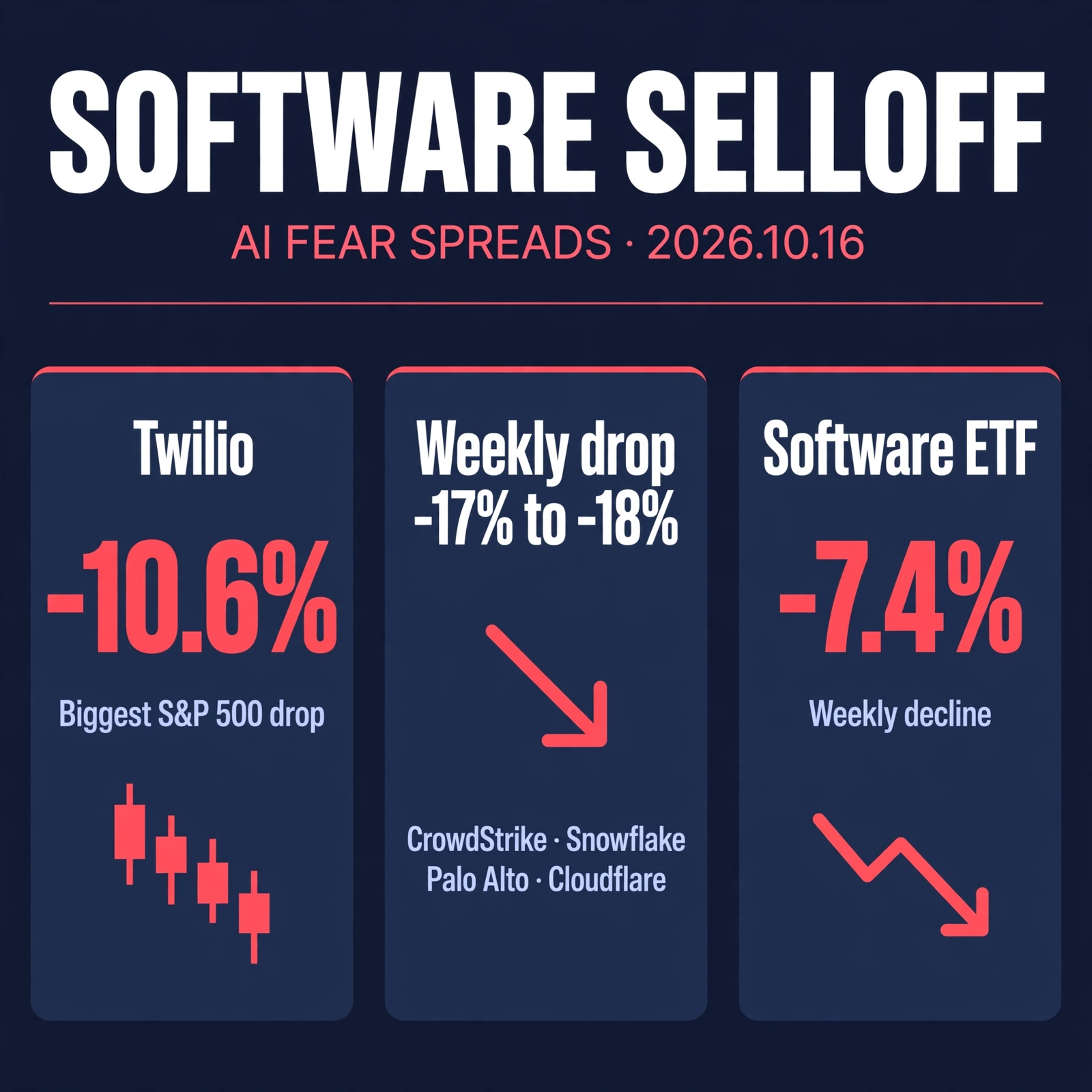
All week, the enemy was chips. But Friday’s (October 16) session had a different star: software.
| Stock | Friday move | Note |
|---|---|---|
| Twilio | -10.6% | Biggest drop in the S&P 500 |
| Oracle | -5% | Cloud growth bellwether |
| ServiceNow | -4% | Enterprise software |
| Salesforce | -2% | SaaS leader |
The weekly picture is uglier. CrowdStrike and Snowflake each lost about 17% on the week; Palo Alto Networks and Cloudflare each lost about 18%. The software ETF (IGV) fell 4.8% on Friday alone and 7.4% for the week. A broad cybersecurity fund dropped 4% on Friday.
The irony: earlier in the week, investors treated software as the safer place than chips — steady demand, less direct exposure to AI infrastructure spending. That haven broke on Friday.
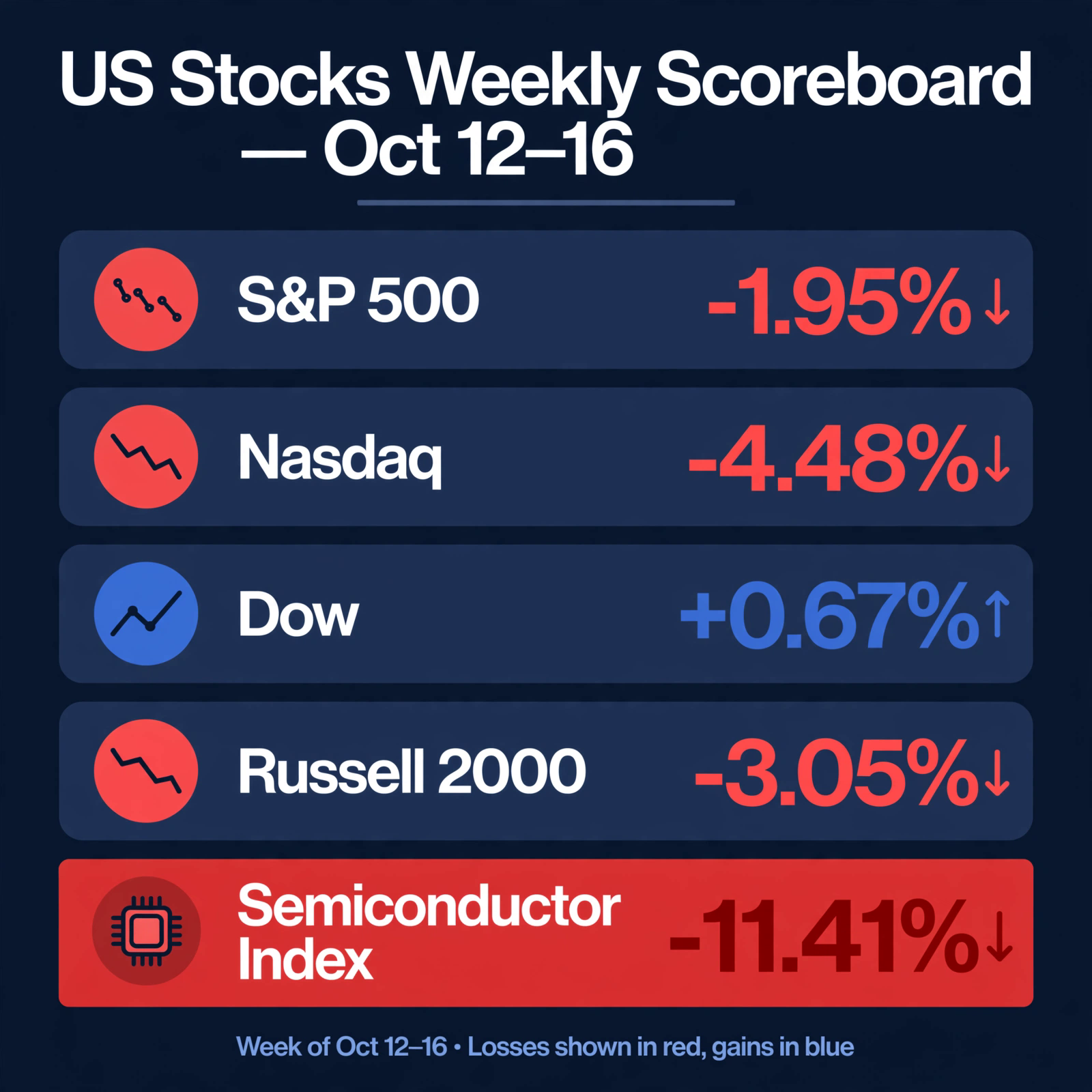
Chips kept hurting too. The PHLX Semiconductor Index (SOX) fell another 3.83% on Friday, its eighth straight loss. CoreWeave plunged 11.9% and Nebius 12.2%. SOX is down more than 8% in October (still up over 60% this year).
Why software sold off: the debate moved
The selloff boils down to one sentence. The market’s question changed from “how big will AI demand be?” to “can companies earn back what they spend on AI infrastructure?”
Software caught the second wave of that debate. First, doubts are growing that AI could eat software’s own lunch — if AI replaces coding, support, and security work, software license demand itself could shrink. Second, in a high-rate world, stocks priced for distant growth fall hardest. Names that were fine on earnings but expensive on valuation sold off first.
The fear gauges are honest. The Fear & Greed Index fell to 30 (Fear), and the AAII survey showed bears at 41.6% ahead of bulls at 38.7%.
- ETF (exchange-traded fund): a fund that tracks an index or theme. IGV is the flagship US software ETF.
- SaaS: software sold by subscription — Salesforce and ServiceNow are the poster children. If AI does customers' work directly, demand can shrink.
- Fear & Greed Index: 0 (extreme fear) to 100 (extreme greed). At 30, investors are scared — also read as a contrarian signal.
Where the money hid: bonds and dividends
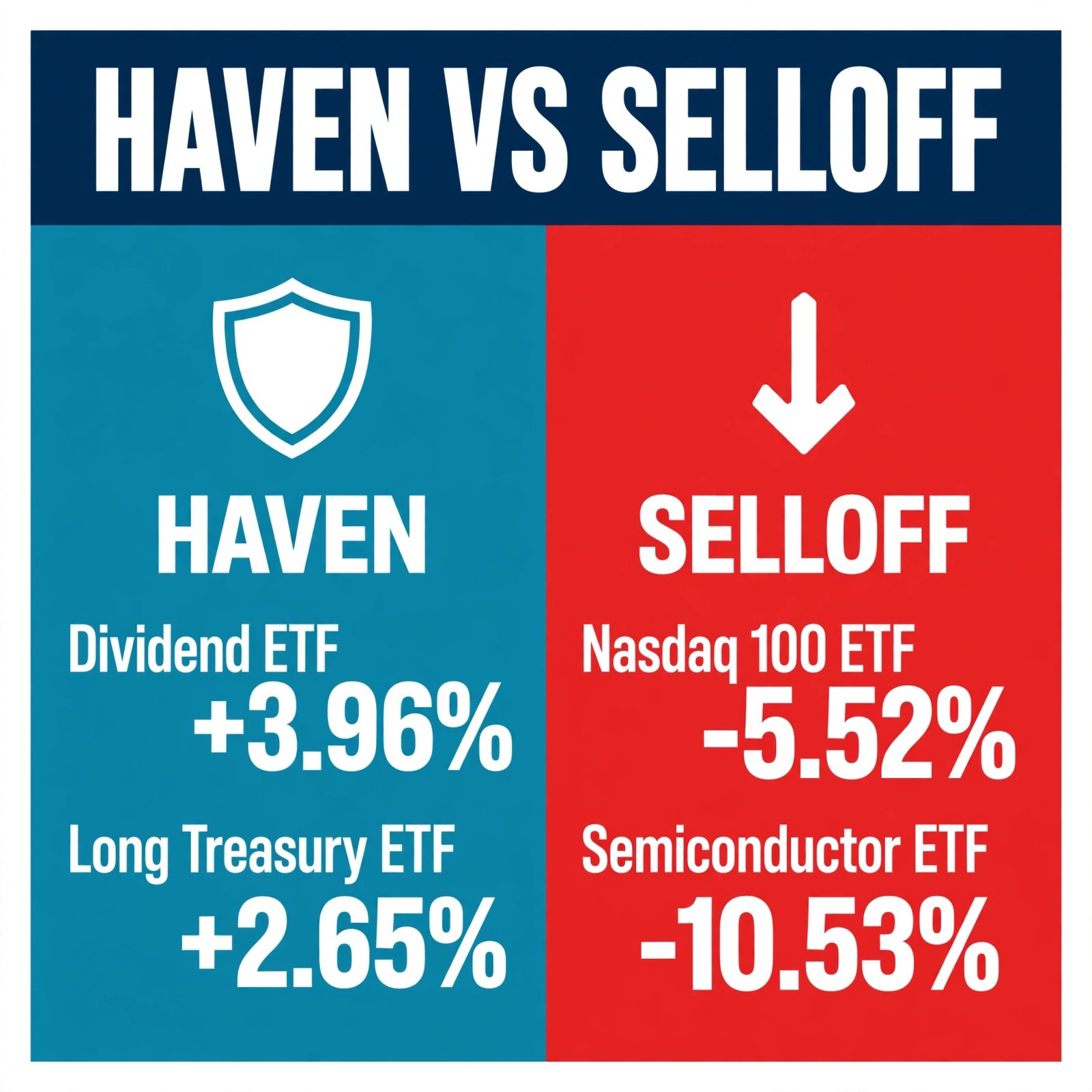
Where there is blood, there is also a haven. Over the same week, the dividend ETF (SCHD) gained 3.96% and long-term Treasury ETF (TLT) rose 2.65%. The total bond market (BND) added 0.85%. A mirror image of the Nasdaq 100 (QQQ, -5.52%) and semiconductors (SMH, -10.53%).
This is a move from “growth stories” to “cash flows.” The higher rates go, the less distant future profits are worth — and the more companies paying dividends today stand out. On Friday, the US 10-year Treasury yield closed at 5.098% and the VIX at 19.99.
This week is the verdict: hyperscaler earnings and the Fed
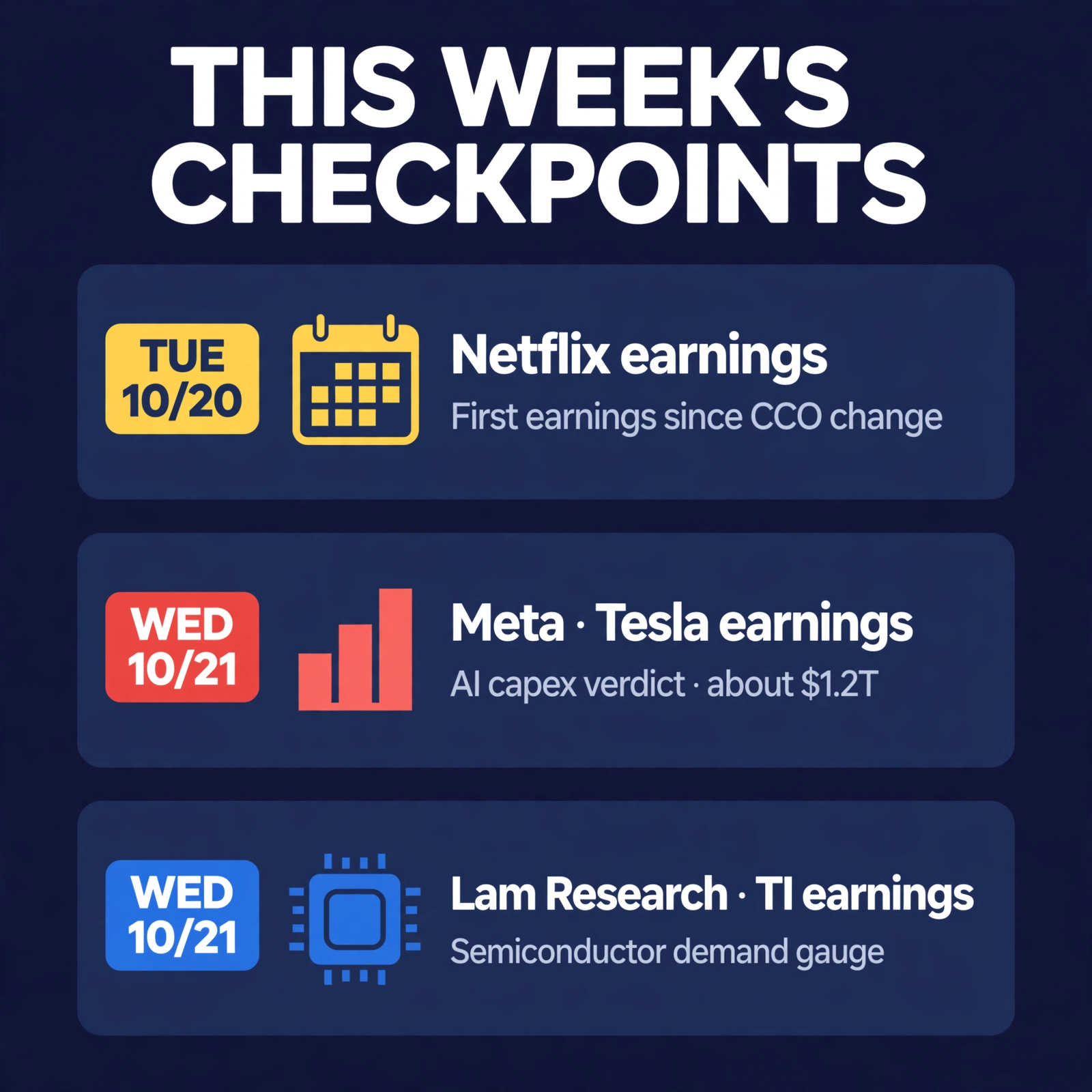
Attention now turns to this week’s earnings — the highlight stretch of Q3 season. One question matters: can Big Tech, pouring money into AI, actually earn it back?
- Wednesday (Oct 21): Meta and Tesla. Meta goes first among the hyperscalers, fresh off launching its Muse AI assistant, with a market cap of about $1.9 trillion. Goldman Sachs estimates the five AI hyperscalers will spend about $1.2 trillion on capital expenditure next year. BNY’s Kevin Shea says hyperscaler profitability must “grow faster than the pace of their capex,” and Horizon’s Chuck Carlson warns that rising capital costs raise the bar for returns.
- Wednesday: Lam Research and Texas Instruments — a read on semiconductor demand. Both stocks are up about 60% this year.
- Tuesday (Oct 20): Netflix — its first earnings since the chief content officer change. Shares fell 2.9% on Friday.
- Per LSEG, S&P 500 Q3 earnings are expected to grow more than 30% year over year — almost all of it driven by AI megacaps, so a miss would sting.
The Fed is a wild card too. Chair Kevin Warsh sounded optimistic about US economic strength on October 16, and markets lean toward no rate change in October. But Barclays expects 25bp hikes in December and January. Rate-hike fear is not gone.
The data calendar is packed: China Q3 GDP on Monday (expected 4.4%), UK CPI on Wednesday (expected 3.4%), Japan CPI on Thursday, and global flash PMIs on Friday. Whether inflation pressure keeps building is the thing to watch.
Not investment advice. Figures verified October 18 from barchart, AP, Investrade, portfolio-terminal, Straits Times (Reuters), and capitalstreetfx.
Sources & references
- Portfolio Terminal — Stock Market Close October 16, 2026: Week in Review — Weekly scorecard for Oct 12–16: indexes, sectors and funds
- Swingfolio — US Close 16 Oct 2026: Nasdaq −2.14% on AI Debt Worry — Friday's software movers
- Tormere Research — After-Market Digest: October 16, 2026 — Weekly Nasdaq move and hike odds (via Yahoo Finance)
Related articles
- Nasdaq +1.05% on SpaceX's First Profit and Tesla Merger Talks; Meta–Tesla Q3 Earnings Analysis (Oct 21)
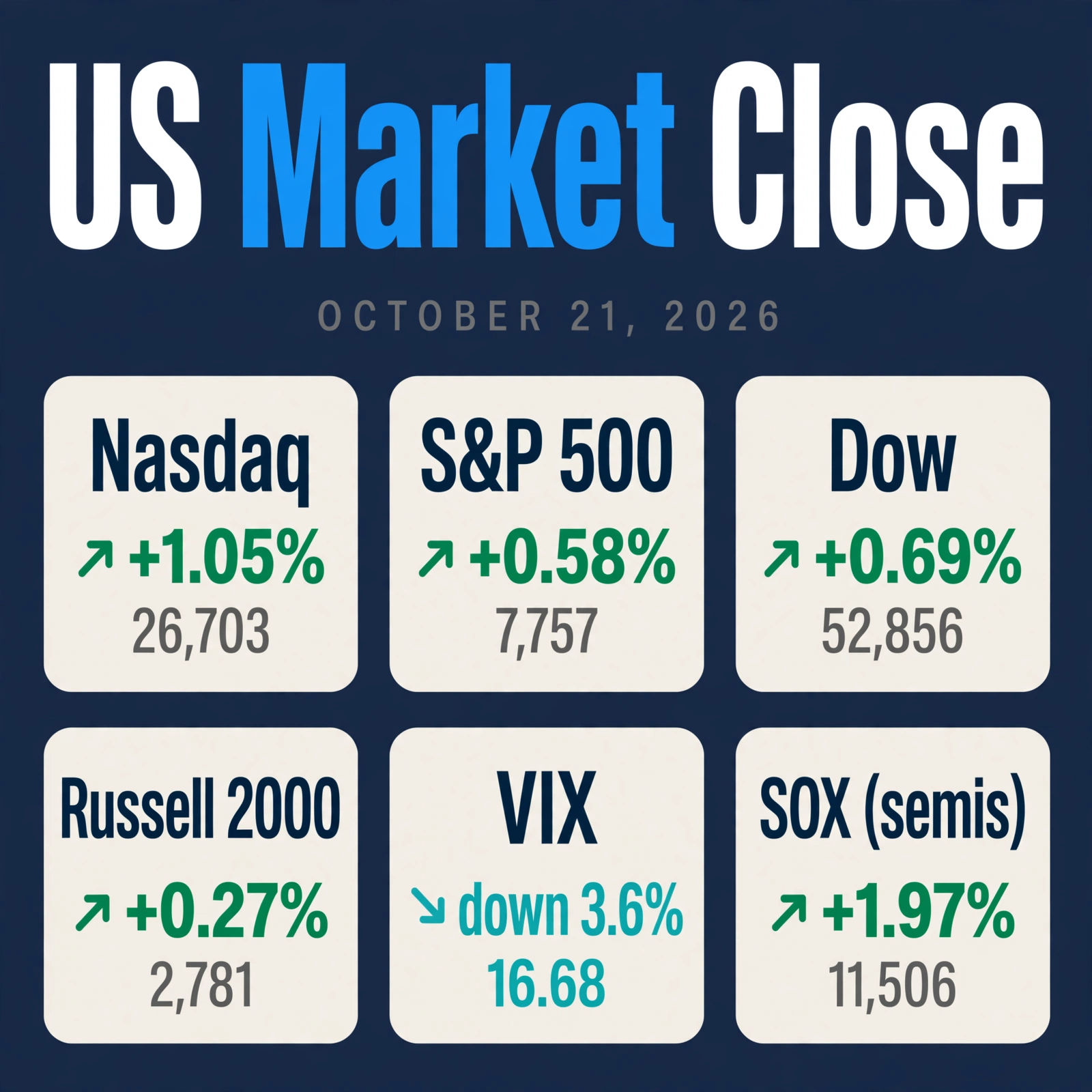
US market close Tuesday Oct 21: Nasdaq +1.05% (26,702.86), S&P 500 +0.58% (7,757.17), Dow +0.69% (52,856.09). SpaceX's first quarterly profit and Tesla merger talks led tech higher; Meta and Tesla reported Q3 results after the close.
- Nasdaq +1.1% Memory Semiconductor Rally Meta Tesla Earnings Week (Oct 19)
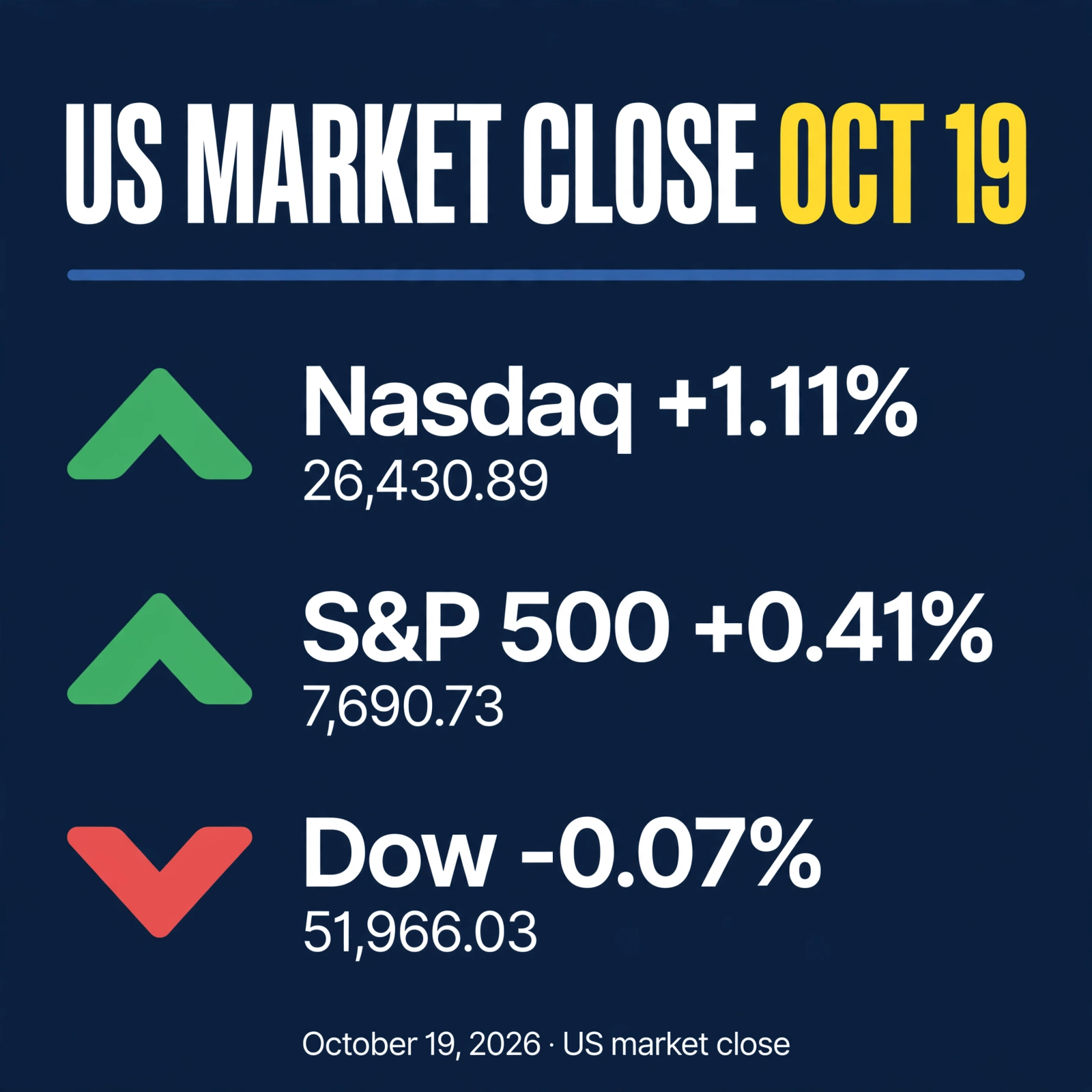
US market close, Monday October 19: Nasdaq +1.11% (26,430.89), S&P 500 +0.41% (7,690.73), Dow -0.07% (51,966.03).
- Nasdaq -4.5%, Semiconductors -11.4% Weekly: AI Fear Spread Recap and Meta, Tesla Earnings Outlook (Oct 18)
US market weekly recap for October 12-16. The Nasdaq fell 4.5% for its worst week since June while the semiconductor index lost 11.4%, its worst since...
5minbrief on YouTube
The briefs also come as videos. Get the daily market wrap on YouTube.
Subscribe on YouTube