 5-minute briefs
KOSPI 5,668 Recovery BOK October Rate Freeze Outlook Weekly Checkpoints (Oct 18)
KOSPI ends an 8-session slide: analysts see 5,100–6,100 this week
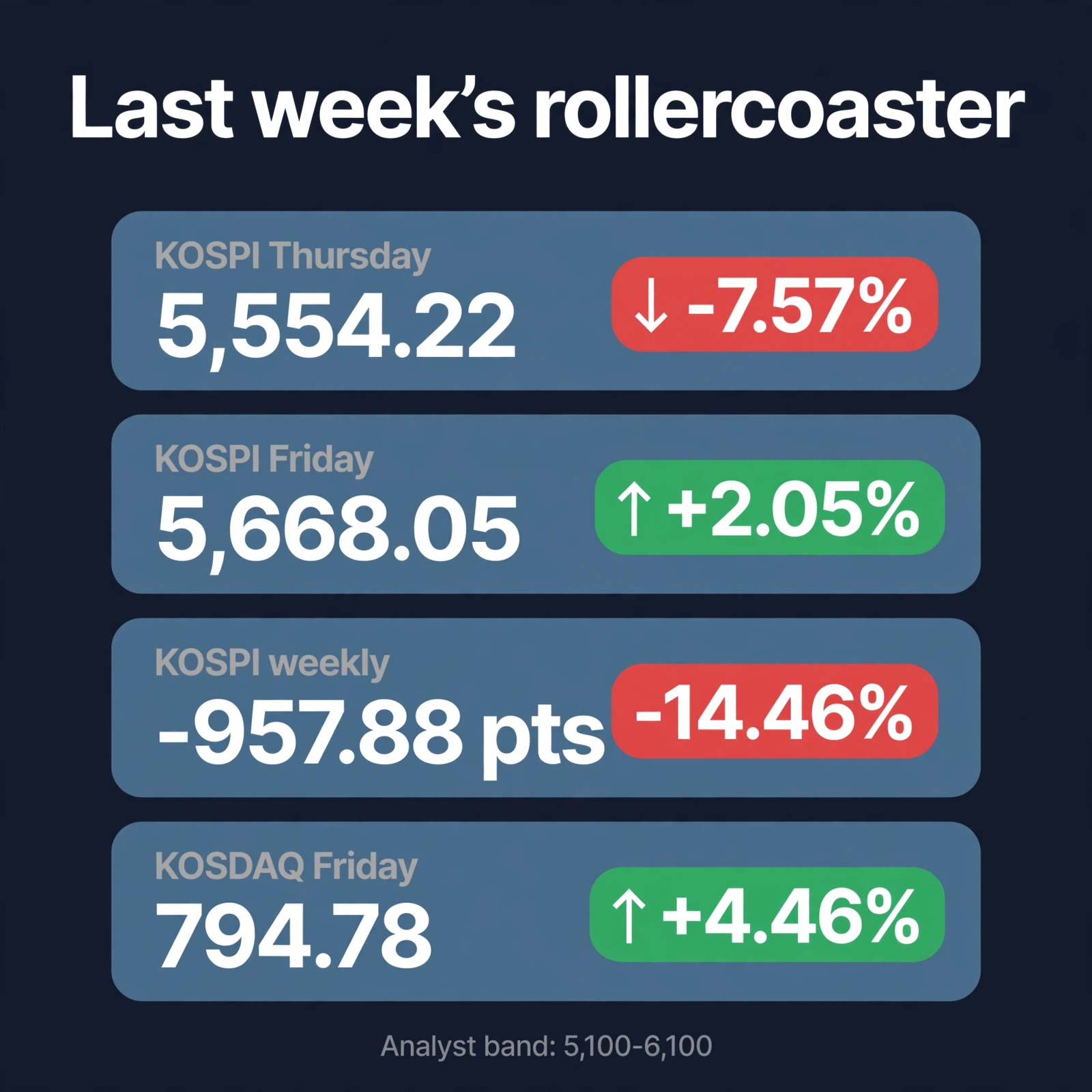
Last week was one of the most violent stretches Korean stocks have seen in years. After Thursday’s 7.57% crash that triggered a circuit breaker, KOSPI rebounded 2.05% (113.83 points) to 5,668.05 on Friday. For the week, the index still lost 957.88 points (-14.46%).
The encouraging sign came from order flow. Foreign investors turned net buyers of KRW 343 billion in KOSPI on Friday — their first net buying day in nine sessions. Individuals and institutions sold KRW 485.7 billion and KRW 682.4 billion respectively. That foreigners returned after dumping KRW 11.5 trillion between Oct 8 and Oct 15 is a meaningful shift.
Analysts expect KOSPI to trade in a 5,100–6,100 range this week. Hanyoung Kim of Kiwoom Securities set 5,100 — the 12-month forward PBR 1.0x level — as a solid floor and advised “holding and staged buying rather than panic selling.” Yuanta Securities found that in 12 past episodes when KOSPI plunged more than 10% over seven sessions, the index rose the following week 83% of the time. A short-term technical bounce is the likely path — but a real trend reversal needs more time.
| Index | Oct 15 (Thu) | Oct 16 (Fri) | Week total |
|---|---|---|---|
| KOSPI | 5,554.22 -7.57% | 5,668.05 +2.05% | -14.46% |
| KOSDAQ | 760.82 -7.65% | 794.78 +4.46% | -14.7% |
| KRW/USD | 1,344.6 | 1,331.4 -13.2 | steady around 1,33X |
Oct 22 BoK meeting: why a “hawkish hold” is the consensus
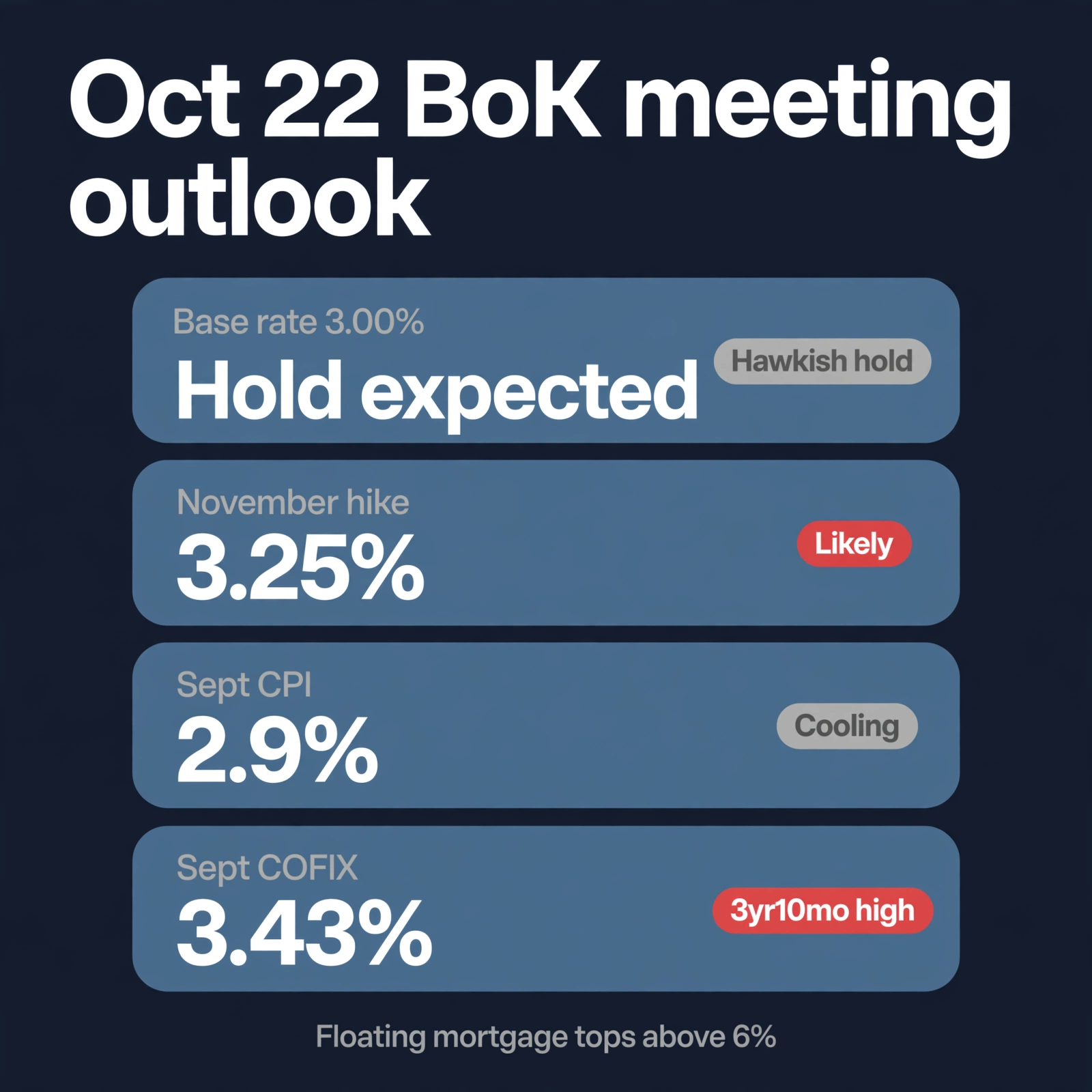
The biggest domestic macro event this week is Thursday’s Bank of Korea monetary policy meeting. Market expectations are remarkably aligned: hold the base rate at 3.00%, but keep further hikes on the table — a “hawkish hold.” Morgan Stanley, Citi, and domestic brokerages all see it that way.
Three reasons a hold is likely. First, the BoK already hiked twice in a row (July and August), from 2.5% to 3.0% — a third straight hike would be an unusually aggressive choice. Second, September CPI cooled to 2.9% from 3.1% in August. Third, Governor Shin Hyeon-song told parliament on Oct 12 that the preemptive hikes had “bought time,” hinting at a pause to assess the effects.
But “hold” does not mean the tightening cycle is over. Hana Securities called the October hold “a speed adjustment within a hiking cycle.” Attention has already moved to a November hike to 3.25%, and some see 3.50% by next year’s first quarter. Core inflation still runs above the 2% target, the BoK expects October inflation near 3%, and the IMF and OECD have raised Korea’s growth forecasts to 3.3% and 3.7% respectively. Hotter growth keeps rate pressure alive.
This is not abstract for Korean households. The 9-month COFIX — the reference rate for floating mortgages — rose 0.25 percentage points in September to 3.43%, its largest jump in 3 years and 10 months. As of Oct 16, floating mortgage rates at the major banks all breached 6% at the top end: KB 4.64–6.04%, Woori 5.00–6.20%, NH Nonghyup 4.68–6.48%. According to national statistics, average monthly interest costs for jeonse (deposit-rental) households reached KRW 211,965 in Q2 — up 144.2% from 2019, more than double the rise for homeowner households (66.1%). Every word from the BoK hits household budgets directly.
- Hawkish hold: keeping rates unchanged while signaling more hikes ahead. The market stays on edge despite the pause.
- Dot plot: a chart showing each BoK member's expected rate path. The November dot plot will be the bond market's main event.
- COFIX: the weighted average funding cost of eight major Korean banks — the benchmark for floating-rate mortgages.
Friday in the US: Nasdaq -2.15%, AI fears spread to software
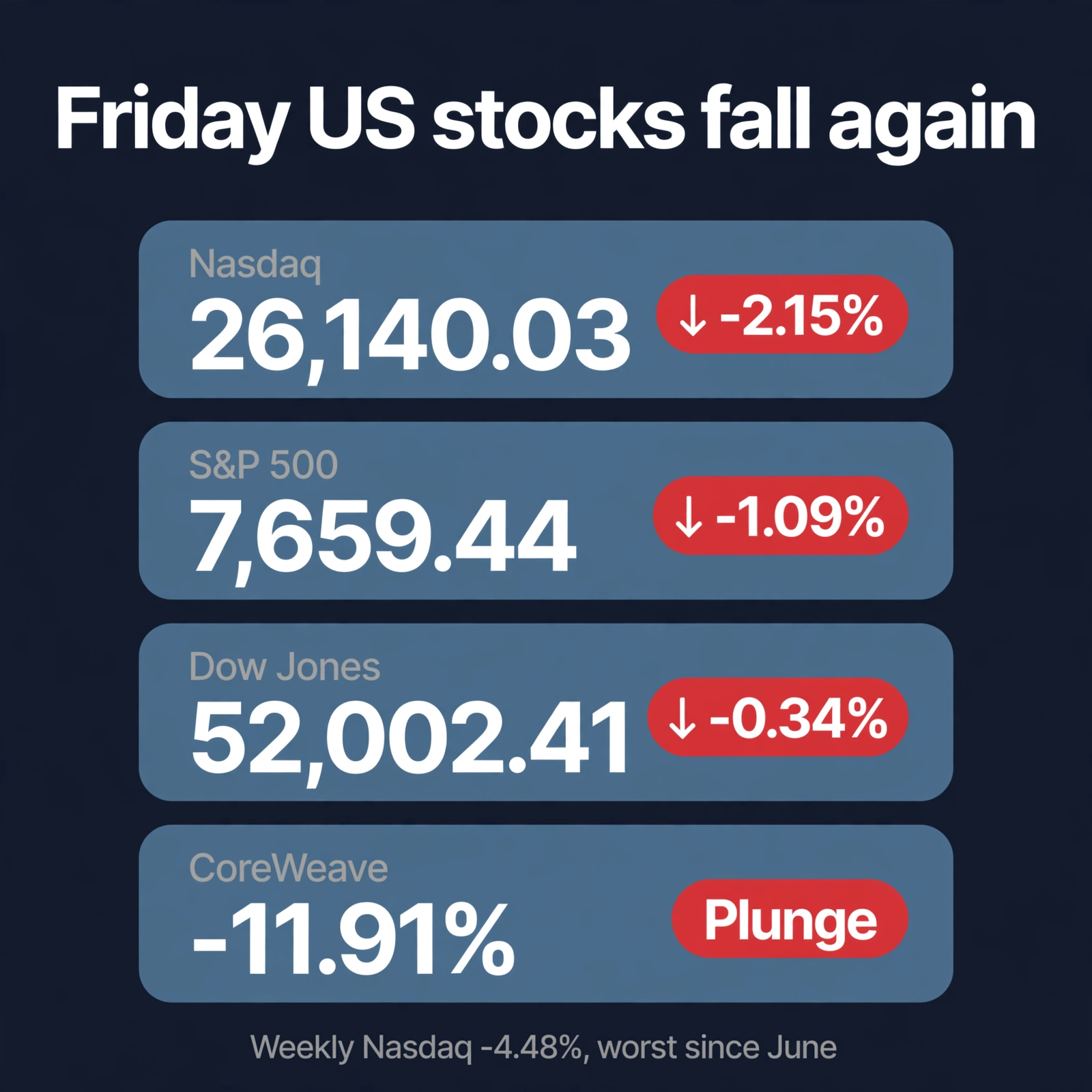
While Korea bounced, US markets flashed red again heading into the weekend. On Friday, the Nasdaq fell 572.99 points (-2.15%) to 26,140.03, the S&P 500 lost 1.09% (7,659.44) and the Dow slipped 0.34% (52,002.41). For the week, the Nasdaq fell 4.48% — its worst week since June.
What stood out was how far the AI anxiety is spreading. After the “neo-cloud” names, the selloff hit chipmakers — Micron -5.63%, AMD -5.95%, SK Hynix ADR -6.58% — and then software stocks. The Philadelphia Semiconductor Index (SOX) fell 3.83%, its eighth straight decline, the longest since the 2008 financial crisis.
Geopolitical risk added fuel via oil prices. Brent crude jumped 3.72% to $109.86 per barrel (the highest since May) after Iran escalated attacks in the Strait of Hormuz, while WTI surged 3.51% to $101.41. The US 10-year Treasury yield closed at 5.09% and the VIX at 19.99. Higher oil feeds inflation pressure — which in turn raises the odds of further Fed tightening.
- Housing market cooling: the government said on Oct 18 that Seoul apartment prices are decelerating (Gangnam -1.65%, Seocho -1.25% in September) and housing permits improved (36,000 units in Seoul over Mar–Aug, up 74% year over year). "Gap investment" purchases fell from 37.9% to 6.1% of transactions.
- New towns: the government expects housing supply to improve from 2028 as move-ins in the third-phase new towns expand from 1,300 to over 10,000 units a year.
This week’s checkpoints
| Date | Event | Watch for |
|---|---|---|
| Oct 19 (Mon) | China Q3 GDP (consensus 4.4%), Sept retail sales, industrial output | Whether China’s slowdown continues |
| Oct 20 (Tue) | US Sept housing starts, Netflix Q3 earnings | US housing, streaming results |
| Oct 21 (Wed) | Meta·Tesla Q3 earnings (US time) | AI capex guidance, AI investment commentary |
| Oct 22 (Thu) | Bank of Korea policy meeting | Rate decision. Hold expected; hawkish tone in focus |
| Oct 23 (Fri) | US Oct S&P Global PMI | Manufacturing recovery momentum |
| Oct 27 (Tue) | Korea Q3 GDP flash estimate | Whether growth is cooling |
| Oct 28 (Wed) | SK Hynix Q3 earnings | HBM4 competitiveness, server memory demand |
| Oct 28–29 | US FOMC | Decision due early Oct 29 KST. October hold favored (~87%); December hike odds near 90% |
The bottom line: this week is not about “how far it fell” but about “does the evidence show up.” The BoK’s rate signal, AI capex numbers in Meta and Tesla earnings, and SK Hynix results will deliver the hard data on the two big questions — AI profitability and interest rates — that markets are asking.
Not investment advice. Figures verified Oct 18 via KRX, Korea Exchange, Sejong-era Korean financial press, and national statistics.
Sources & references
- Yonhap News — KOSPI rebounds 2.1% after eight down sessions; KOSDAQ up 4.5% — Friday Oct 16 close recapped in this post
Related articles
- US Stock Market Weekly Recap S&P 500 Down Dow Up AI Spending Selloff Oil Surge Analysis
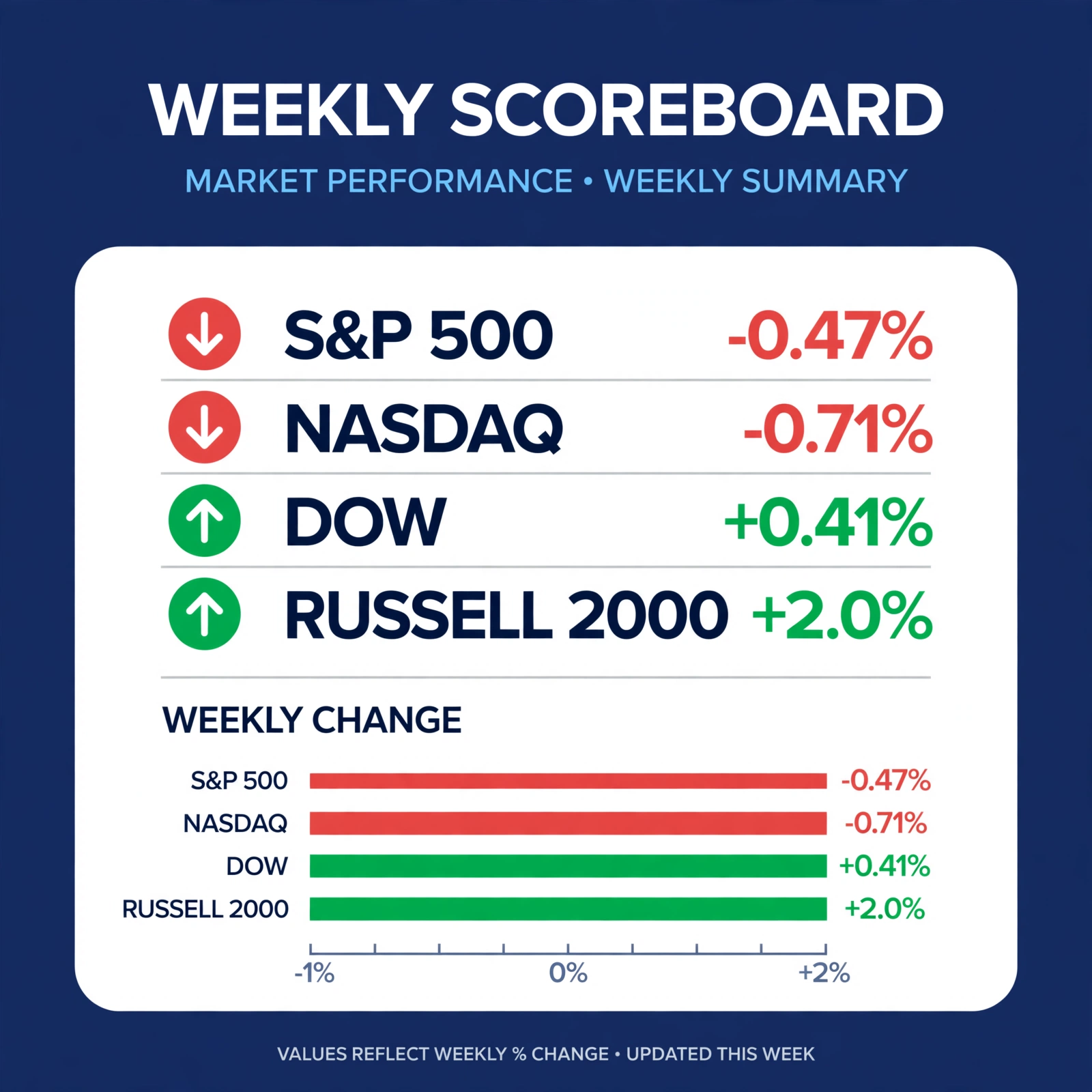
US stock market weekly recap for October 19–23: S&P 500 -0.47%, Nasdaq -0.71%, Dow +0.41%, Russell 2000 +2.0%. A Thursday AI spending selloff and an oil surge split the week. Next: FOMC, Microsoft, Alphabet, GDP, PCE.
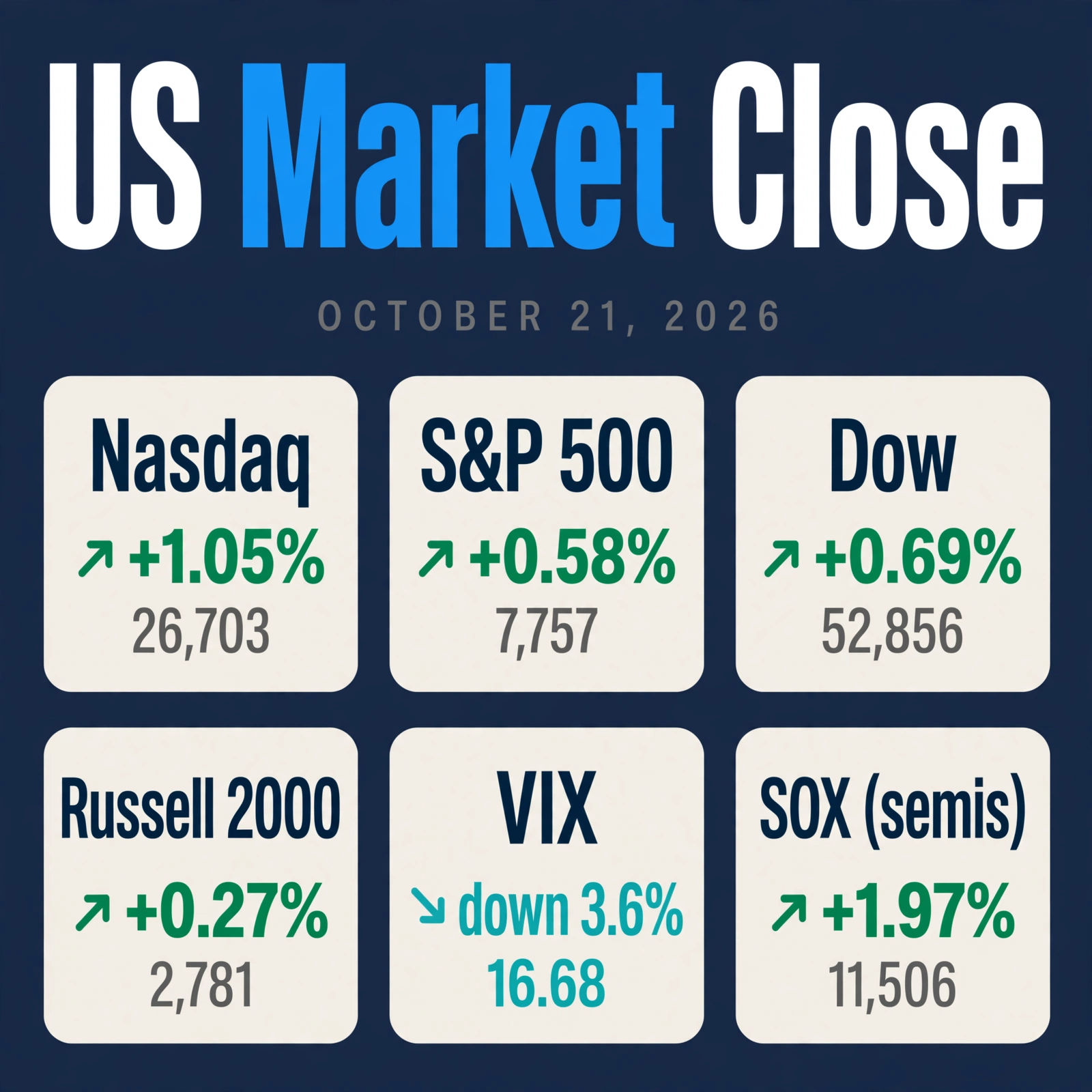
- Nasdaq +1.05% on SpaceX's First Profit and Tesla Merger Talks; Meta–Tesla Q3 Earnings Analysis (Oct 21)
US market close Tuesday Oct 21: Nasdaq +1.05% (26,702.86), S&P 500 +0.58% (7,757.17), Dow +0.69% (52,856.09). SpaceX's first quarterly profit and Tesla merger talks led tech higher; Meta and Tesla reported Q3 results after the close.
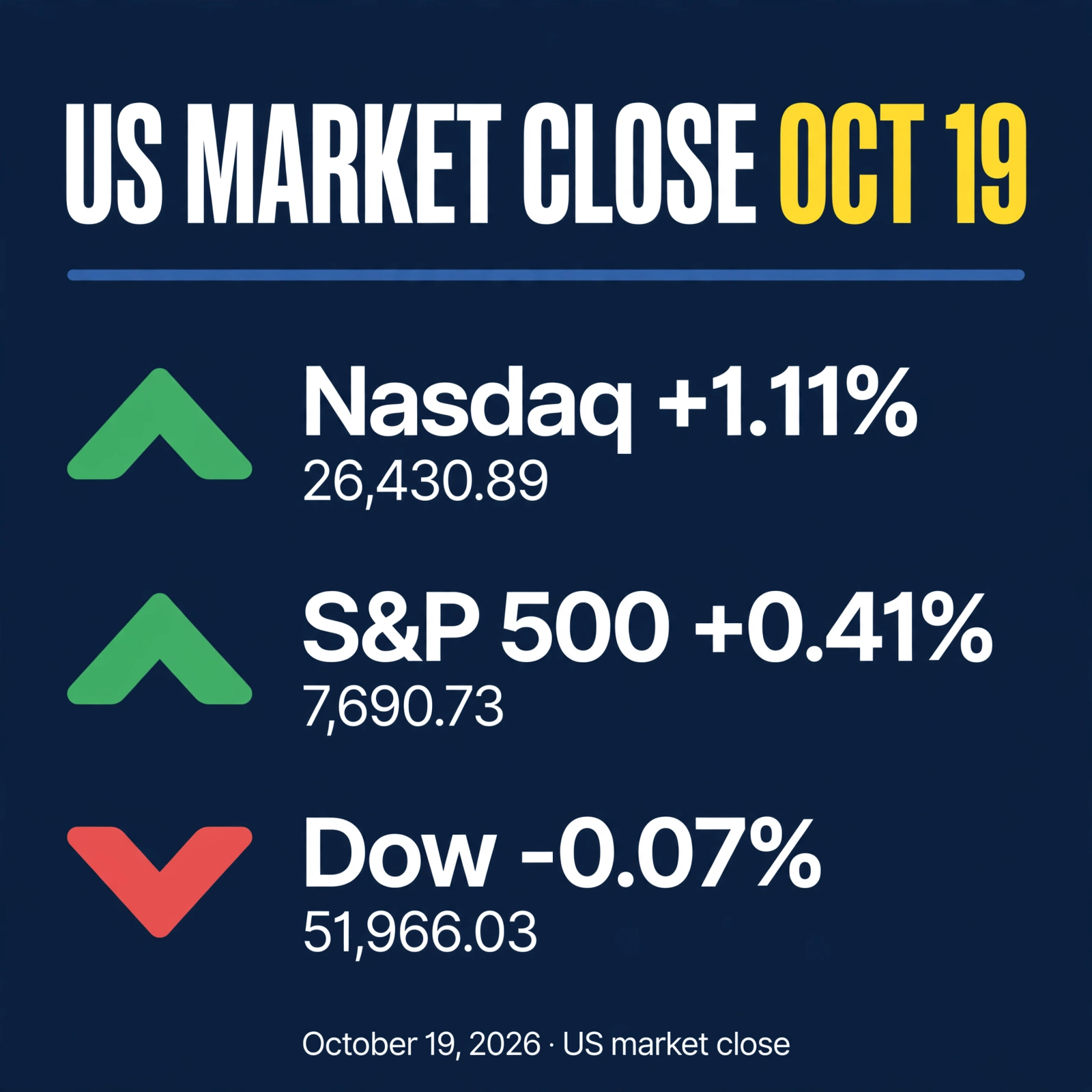
- Nasdaq +1.1% Memory Semiconductor Rally Meta Tesla Earnings Week (Oct 19)
US market close, Monday October 19: Nasdaq +1.11% (26,430.89), S&P 500 +0.41% (7,690.73), Dow -0.07% (51,966.03).
5minbrief on YouTube
The briefs also come as videos. Get the daily market wrap on YouTube.
Subscribe on YouTube