 5-minute briefs
Korea Margin Loan Waiver Analysis Forced Selling Loop and 28 Trillion Won Leverage
What was decided — the F4 meeting and a three-month waiver from November 9
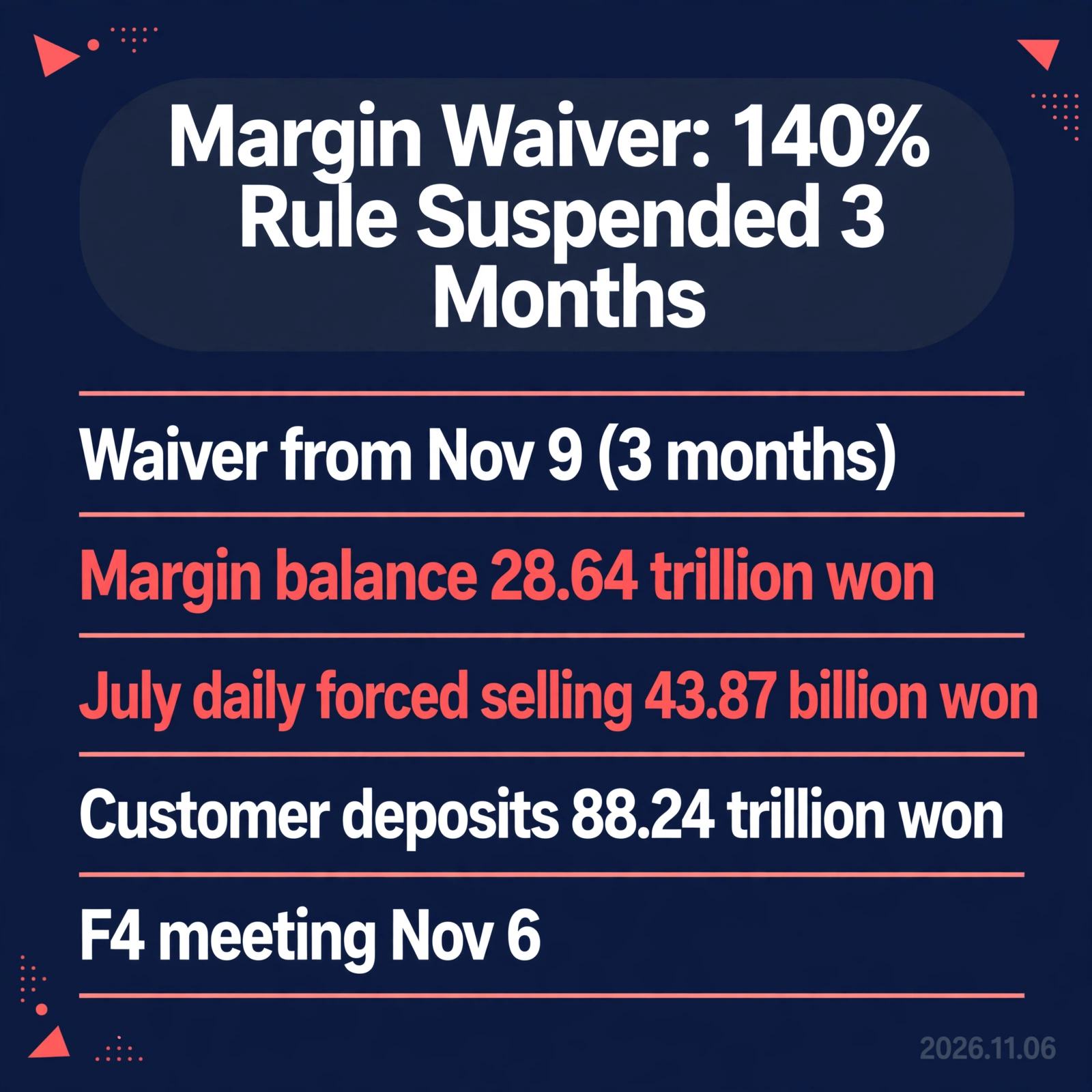
Deputy Prime Minister and Finance Minister Lee Hyung-il chaired an emergency market situation review meeting — the F4 meeting — at Government Complex Seoul at 10:30 a.m. on November 6, with Financial Services Commission Chairman Lee Eog-weon, Financial Supervisory Service Governor Lee Chan-jin, and Bank of Korea Senior Deputy Governor Kwon Min-soo attending. It was the second straight day of meetings. The group decided to exempt brokerages from the obligation to maintain a 140% collateral ratio on margin loans for three months starting November 9, with the Financial Supervisory Service expected to issue a no-action letter that day. Authorities said they would prepare additional stabilization measures if volatility worsens.
The mechanics matter, because Korea’s margin system works differently from the US version. A margin loan lets an investor borrow from a brokerage to buy shares, with the purchased shares as collateral. Brokers must hold collateral worth at least 140% of the loan, and maintain that ratio afterward. If prices fall and collateral drops below the line, the investor must post more collateral — and if they cannot in time, the broker forcibly sells the shares to recover the loan. That is forced selling, or margin-call liquidation. With the maintenance obligation waived, brokers can set collateral ratios flexibly according to the borrower and market conditions. The aim is to stop a cascade in which one round of forced sales triggers the next.
Where leverage stands — margin balances down 25.9% from the peak
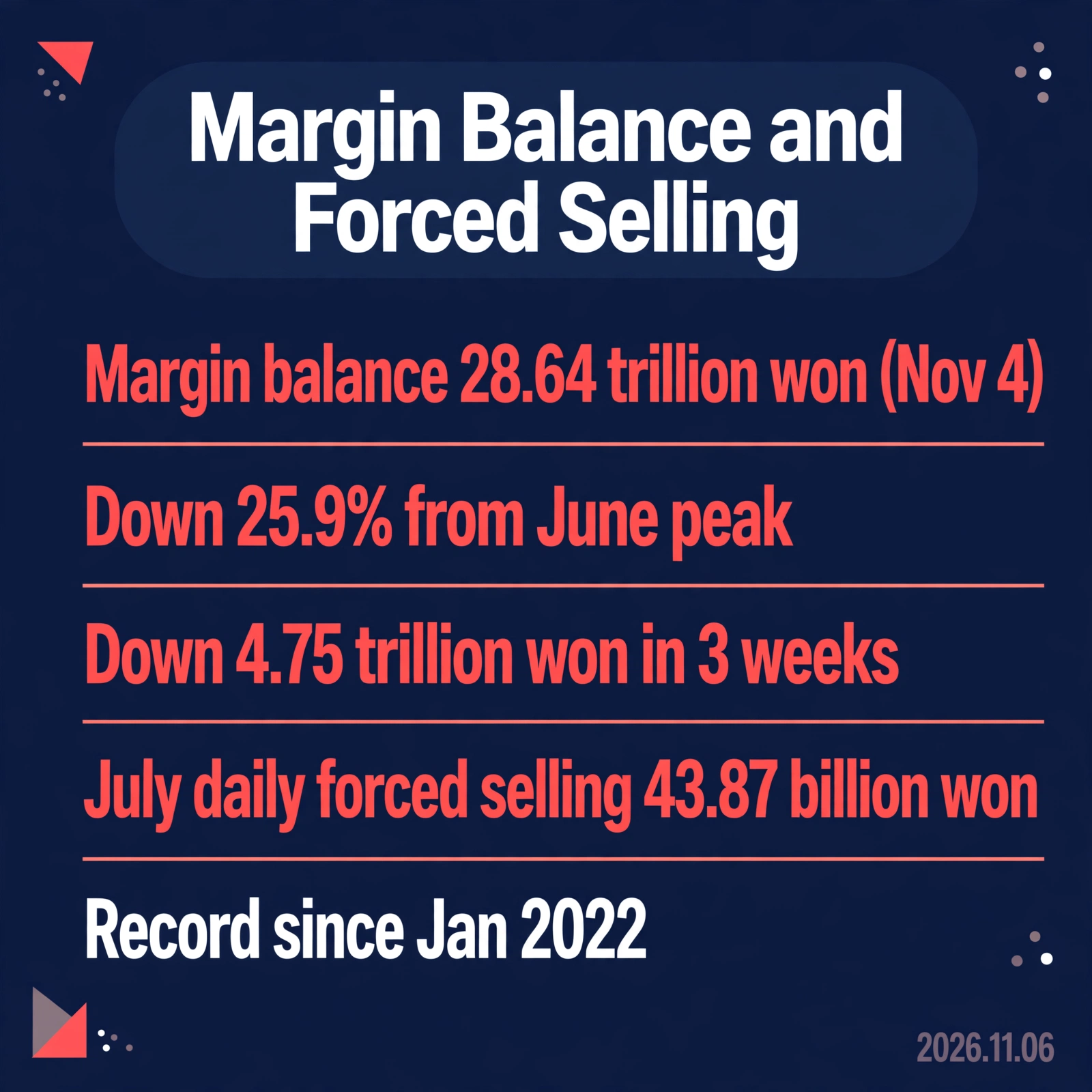
Outstanding margin loans stood at 28.64 trillion won (about $21.1 billion) on November 4. On November 3 the balance was 28.95 trillion won, the first time below 29 trillion won in about three months. The balance had been above 33.7 trillion won on October 14 and fell by more than 4.75 trillion won in just three weeks. Against the June 24 peak of 38.63 trillion won, it is down 25.9%.
That decline mixes two things: investors voluntarily cutting debt, and debt being forcibly cut by falling prices and liquidations. In mid-October, forced sales linked to unsettled purchases ran above 80 billion won a day, and forced sales on November 4 alone totaled 3.9 billion won. A smaller balance means the absolute size of future forced selling is smaller too — one reason the shrinking balance is read as a relatively positive sign inside a crash.
The forced-selling trend is more dramatic. Data from ten brokerages obtained by a National Assembly member shows daily average forced selling in July reached 43.87 billion won, the highest since the statistics began in January 2022. In December last year the daily average was 3.78 billion won. It rose to 8.27 billion won in May and 20.41 billion won in June, then more than tenfold in seven months. Forced selling only balloons in a falling market — it is selling that arrives late.
Retail firepower — deposits at 88.24 trillion won, the year’s low
Retail investors’ capacity to buy more is also near the floor. Customer deposits — the standby cash in brokerage accounts — fell to 88.24 trillion won on November 3, the lowest level of the year, down from above 100 trillion won in mid-October. Retail investors bought a net 4.88 trillion won over the three sessions from November 3 to 5, including 2.27 trillion won on November 5 alone. Much of that buying was money already sitting in accounts, not fresh inflows. Deposits falling while margin balances fall means retail firepower is shrinking from both sides at once.
- The 140% rule is a collateral rule, not a leverage cap. US Regulation T requires 50% initial margin and a 25% maintenance margin on the account's equity. Korea instead requires brokers to hold collateral worth 140% of the loan — a different structure that makes forced selling trigger on the collateral ratio, not on account equity.
- The F4 is Korea's crisis huddle. The Ministry of Economy and Finance, the Financial Services Commission, the Financial Supervisory Service, and the Bank of Korea meet as the F4 when markets turn disorderly. It is where targeted levers like this waiver are decided — fast, administrative, and reversible.
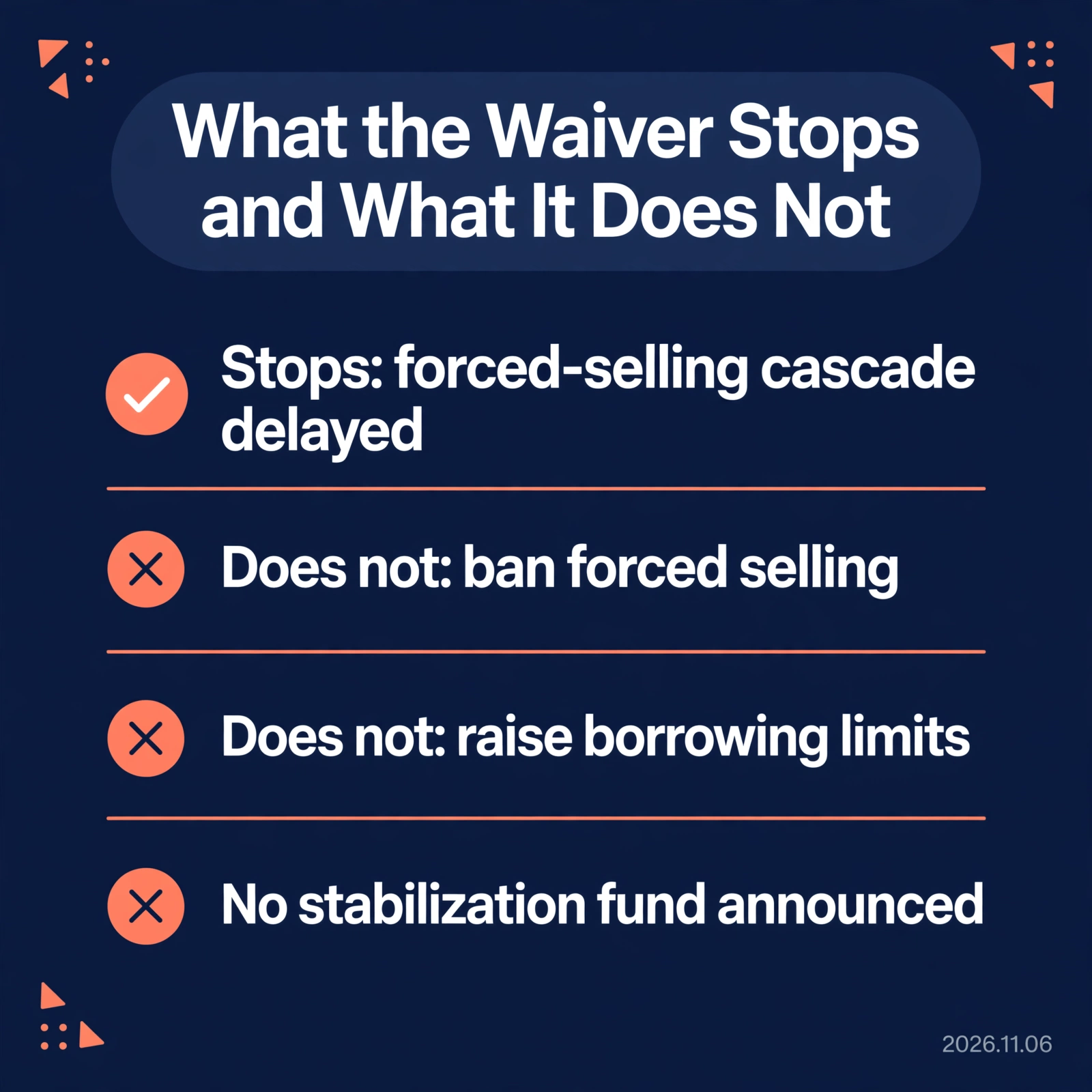
- This is not a stabilization fund. No market stabilization fund and no short-selling restriction were announced. The waiver is a speed bump for selling, not a buyer of last resort.
What the waiver stops, and what it does not — three distinctions
First, the waiver slows the forced-selling chain but does not remove it. Brokers gain discretion, but if prices keep falling, collateral values will eventually fall below loan values anyway. The waiver lasts three months; if prices have not recovered by then, the problem is postponed, not solved.
Second, the waiver does not raise borrowing limits. It does not let investors borrow more to buy. Retail buying capacity is already at the floor, and that fact is unchanged.
Third, the measure could leave leveraged investors and brokerages exposed to bigger losses if prices keep falling, as one local report noted — delaying a forced sale that should have happened can deepen the eventual loss. It is not a blanket ban on forced selling.
Three numbers decide whether the waiver mattered. First, whether margin balances keep shrinking — and whether the shrinkage is voluntary repayment or forced liquidation. Second, whether daily forced selling approaches July’s 43.87 billion won level again. Reaching it would mean the leverage-driven second leg is real. Third, whether deposits rebound from 88 trillion won. Standby cash has to return before retail buying power recovers. The waiver buys time. Prices have to stabilize inside that time for it to mean anything.
Not investment advice. Figures are Korea JoongAng Daily, The Korea Herald, Aju Press, and MoneyToday reports confirmed November 6, 2026.
Watch the video

Sources & references
- Korea JoongAng Daily — Korea moves to avert forced stock sales as Wall Street rout rattles markets — F4 emergency meeting, three-month waiver of margin-loan collateral requirements from November 9, 140% rule explained
- The Korea Herald — Gov't exempts brokerages from margin financing collateral rules for 3 months amid market plunge — Waiver to prevent excessive forced selling from amplifying volatility, F4 meeting chaired by Finance Minister Lee Hyung-il
- Aju Press — Seoul tweaks margin loan rule to contain stock selloff — Outstanding margin loans 28.64 trillion won on Nov 4, down 25.9% from June 24 peak of 38.63 trillion won; forced sales of 3.9 billion won on Nov 4; waiver is not a blanket ban
- Aju Press — Government Takes Emergency Measures as Stock Market Plummets — Exemption effective November 9, F4 attendees, aim to prevent forced selling from worsening declines
- MoneyToday (English) — Securities firms waive 140% margin rule for 3 months to curb forced selling — FSS no-action letter expected November 9, mechanics of the 140% rule and forced liquidation
Related articles
- December FOMC 50bp Hike Scenario Analysis Core CPI 0.3% and Waller Comments
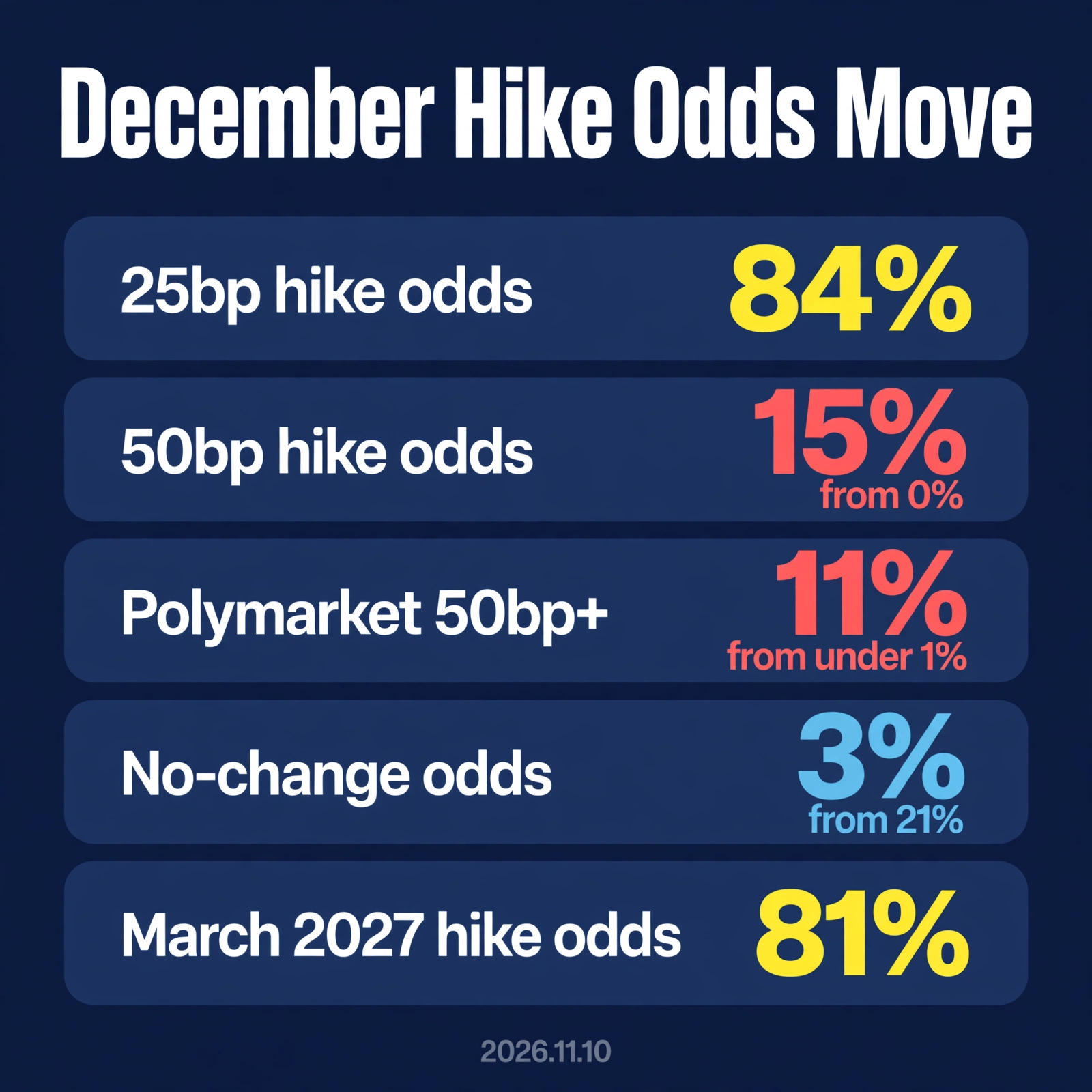
October core CPI ran at 0.3% for a third straight month, and December 50bp hike odds jumped from 0% to 15%. Governor Waller had named 0.3% core as the condition for considering a 50bp move, and November CPI comes out the day after the FOMC. What separates a 25bp hike from a 50bp one.
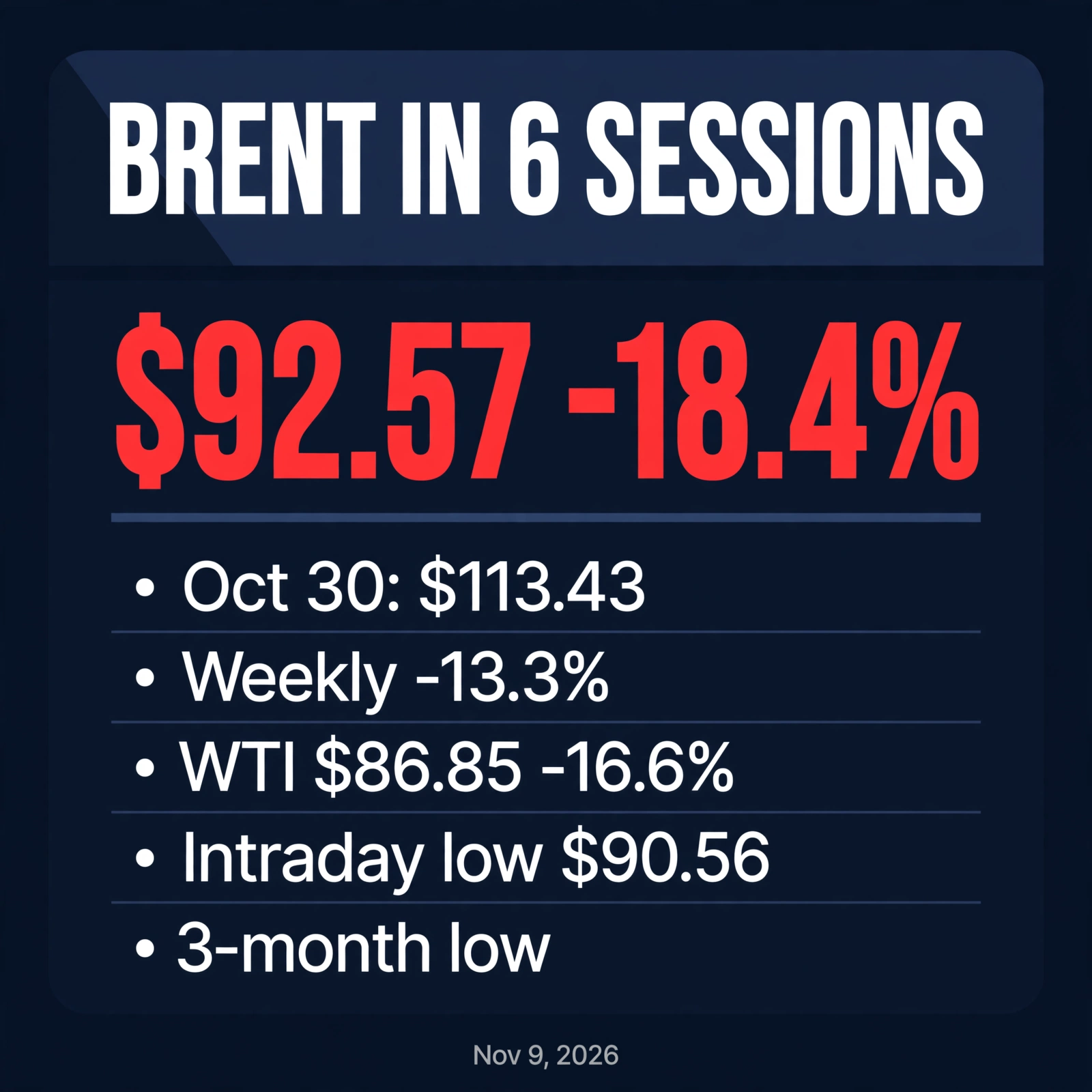
- Brent Crude Analysis: 18.4% Drop in Six Sessions on Negotiation Hopes
Brent crude has fallen 18.4% in six sessions, from $113.43 on October 30 to $92.57 on November 9. The war premium is unwinding fast — but analysts put renewed strikes at 60%, and that gap sets the terms for a reversal.
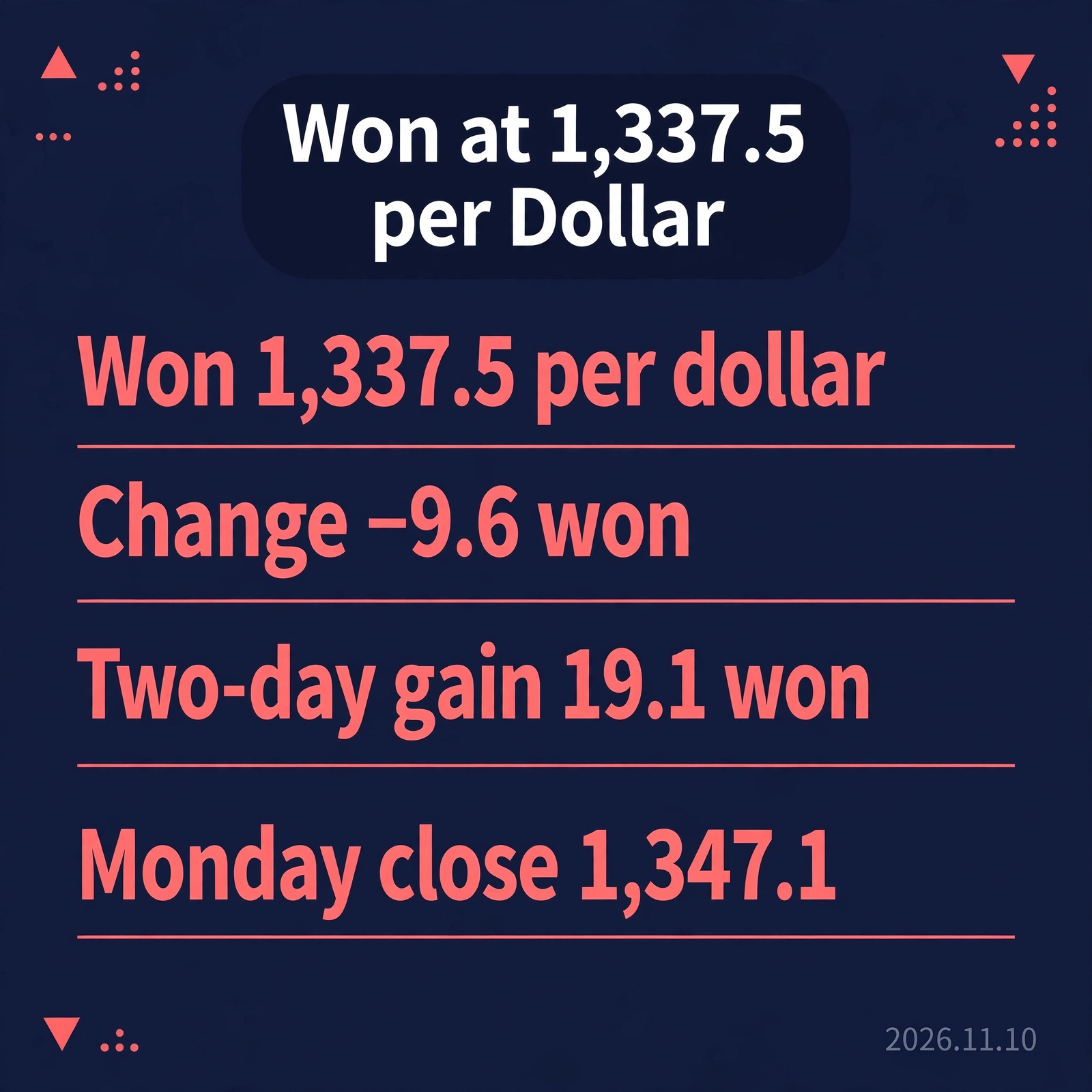
- Won Dollar Exchange Rate Analysis 1337.5 Won Two-Day Drop and 1330s Return
The won strengthened to 1,337.5 per dollar, down 9.6 won on the day and 19.1 won over two sessions. The move is not dollar weakness — it is Korean risk appetite and exporter dollar selling reversing last week's chip-driven spike. Tonight's US CPI decides the next direction.
5minbrief on YouTube
The briefs also come as videos. Get the daily market wrap on YouTube.
Subscribe on YouTube